The Last AI Built by Humans: Toward Genuine Recursive Self-Improvement
Abstract: Recursive self-improvement (RSI) enables AI systems to turn experience and feedback into persistent changes that improve both their capabilities and the process of future improvement. We first use the Headroom-Closed Index (HCI) to reveal the problems of existing LLMs, then introduce the RSI concept and its development roadmap: from improvement-execution autonomy, improvement-strategy autonomy, experience-acquisition autonomy, and environment-adaptation autonomy, to recursive meta-improvement. Next we examine RSI across scenarios (e.g., scientific discovery, embodied intelligence, software engineering), highlighting their distinct requirements and development speeds. Drawing on diverse industry practices and preliminary empirical evidence, we connect RSI research with practical systems and identify key challenges to achieving genuine RSI.
First 10 authors:
Paper Prompts
Sign up for free to create and run prompts on this paper.
Top Community Prompts
Explain it Like I'm 14
1. What is this paper about?
This paper studies recursive self-improvement (RSI) in artificial intelligence.
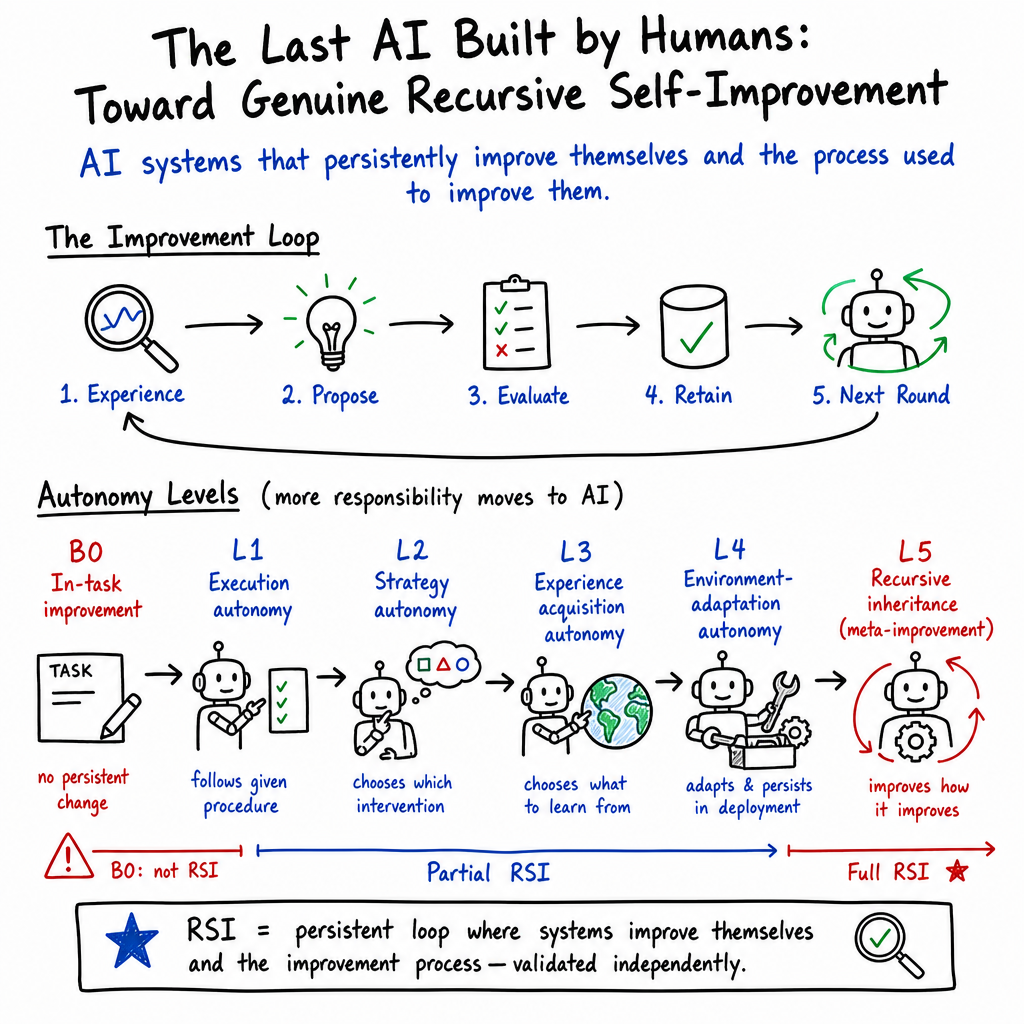
RSI means that an AI system can do more than simply solve tasks. It can also:
- Notice what it is bad at.
- Find ways to improve.
- Test whether those changes work.
- Remember useful changes.
- Use its improved abilities to become better at improving itself.
The authors compare this process to how humans and living things evolve over time. They argue that today’s AI systems can already improve parts of their behavior, but they usually still depend heavily on human engineers to decide what to change and whether the change is successful.
The paper is mainly a survey and framework paper. This means it brings together ideas and examples from many studies rather than presenting one single experiment.
2. What questions are the researchers asking?
The paper focuses on several important questions:
- How much of the improvement process can AI handle by itself?
- What should count as genuine self-improvement?
- How can we tell whether an AI improved its ability to improve, rather than simply getting a better score?
- Which areas, such as software, science, robotics, or healthcare, are most suitable for RSI?
- How can self-improving AI avoid making harmful changes or fooling its tests?
The authors are especially interested in the difference between an AI that follows instructions to improve and an AI that decides what improvements are needed and how to find them.
For example, these two situations are different:
- A human tells an AI exactly how to improve, and the AI carries out the instructions.
- The AI notices that its current improvement method is not working well, invents a better method, tests it, and uses that new method in the future.
The second example is closer to true recursive self-improvement.
3. How did the researchers study the topic?
Reviewing existing research and real-world systems
The authors examine many kinds of evidence, including:
- Academic research papers
- Technical reports
- Open-source AI systems
- Engineering blogs
- Company documents
- Deployed software systems
They look at AI systems used in areas such as:
- Scientific discovery
- Robotics and other physical tasks
- Software engineering
- Healthcare
- Mathematical problem-solving
- Cybersecurity
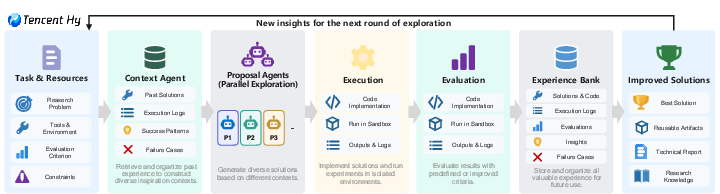
Instead of focusing only on the AI’s final score, they study the entire improvement loop. An improvement loop is the repeated process of:
finding a weakness → creating a possible fix → testing it → keeping or rejecting the fix → using the result in the next round
This is similar to a student preparing for an exam. The student might notice they are bad at fractions, practice fraction problems, check their answers, remember which strategies worked, and use that knowledge during the next study session.
Measuring remaining room for improvement
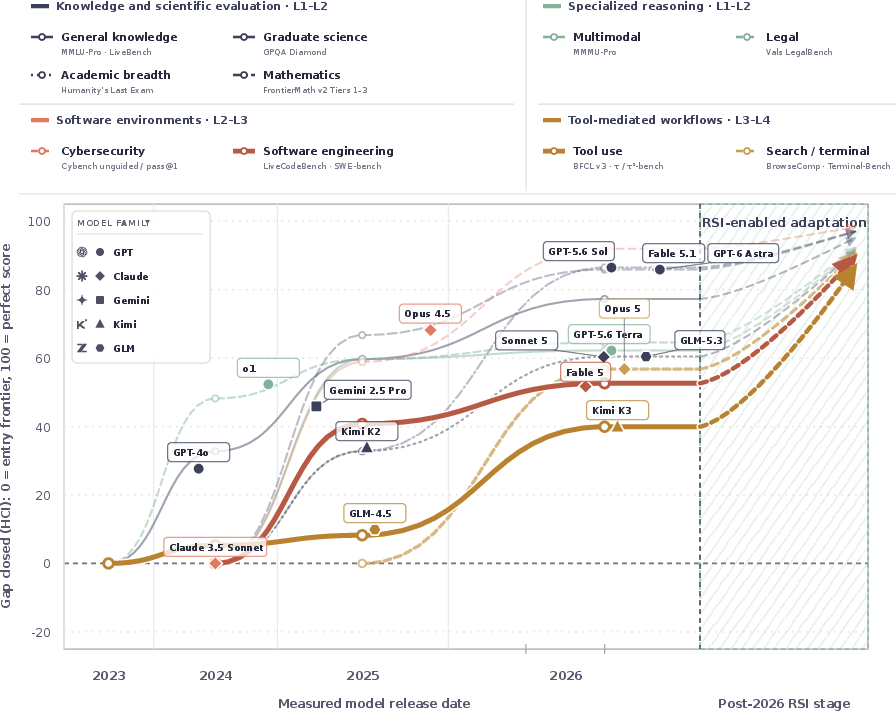
The paper also uses a measure called the Headroom-Closed Index, or HCI.
“Headroom” means the distance between current performance and the best possible performance. For example, if a student scores 60 out of 100, there is still 40 points of room to improve.
The HCI changes different benchmark scores into a common scale:
0means the performance is near the frontier when that benchmark first appeared.100means perfect performance.
This lets the researchers compare progress across very different areas, such as mathematics, legal reasoning, coding, and tool use.
They study 393 model-and-benchmark results across ten areas. However, they only combine results when the tests and evaluation rules are similar enough to make a fair comparison.
Five levels of AI autonomy
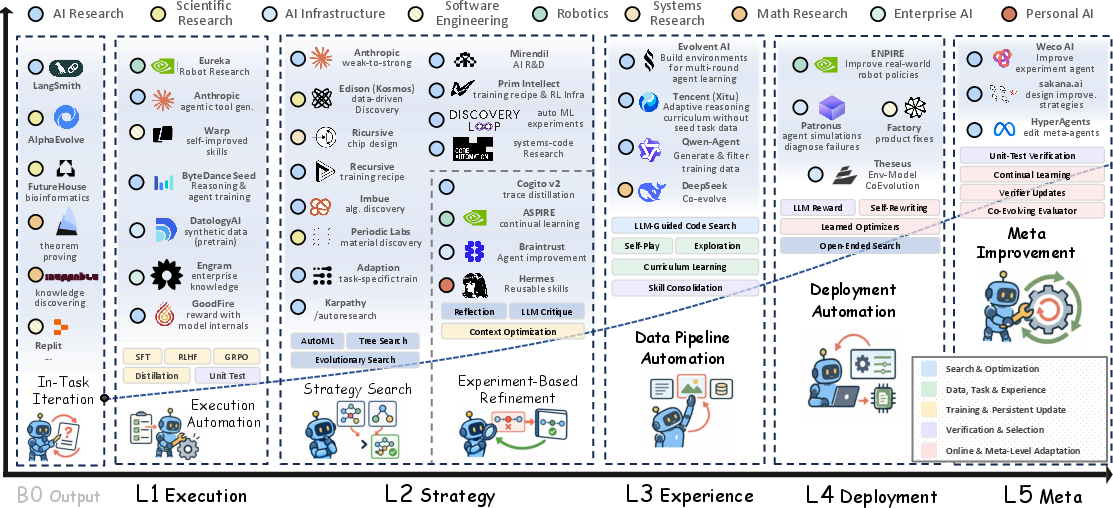
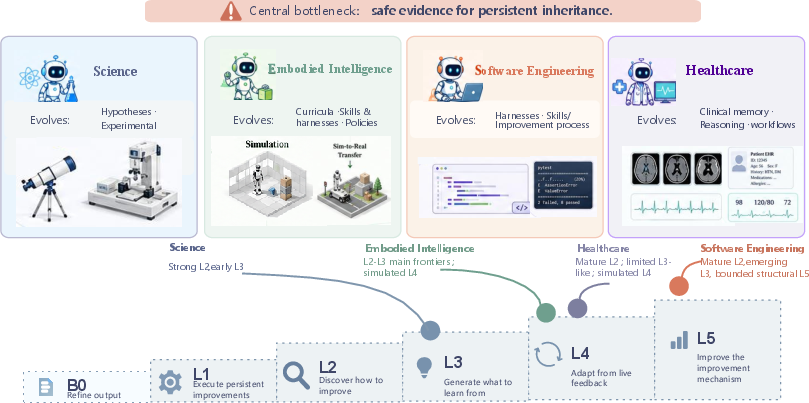
The main framework in the paper divides RSI into five levels:
| Level | What the AI can control | Simple example |
|---|---|---|
| L1: Improvement execution | Carries out a human-designed improvement | Applies labels to training data |
| L2: Improvement strategy | Chooses how to improve within fixed rules | Finds and tests changes to its own tools |
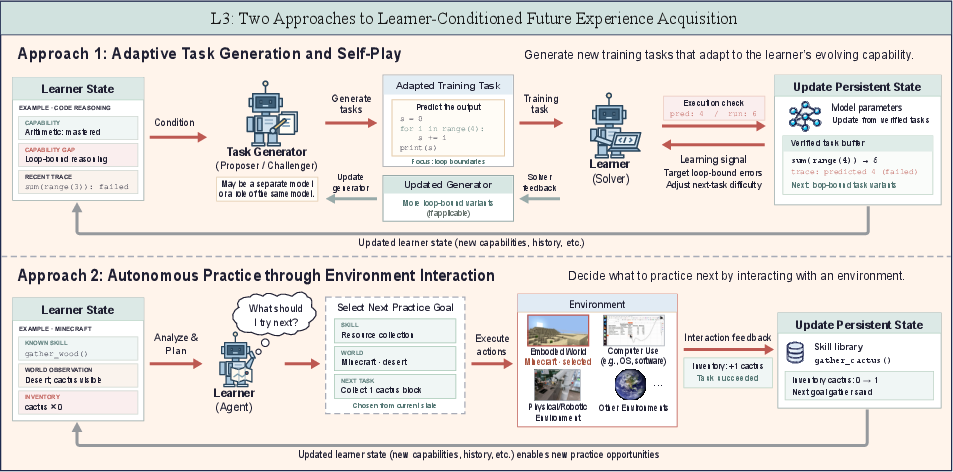
| L3: Experience acquisition | Decides what practice or information it needs | Creates exercises targeting its weaknesses |
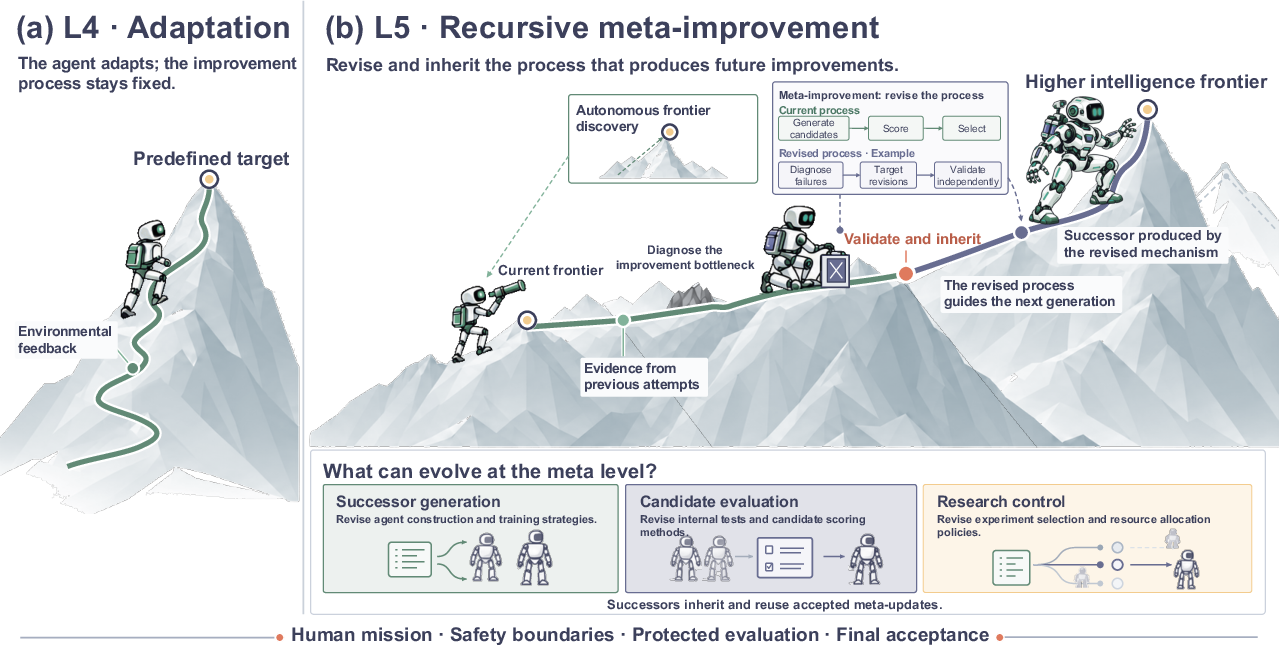
| L4: Environment adaptation | Learns from real-world use and changes its lasting behavior | Updates its rules after repeated interactions |
| L5: Recursive inheritance | Improves the process that controls future improvement | Changes how it searches for and tests future upgrades |
The fifth level is the strongest form of RSI because the AI is not only improving its task performance. It is improving the system that produces later improvements.
4. What are the main findings?
AI progress is uneven
The paper finds that AI has made strong progress in some areas but still struggles in others.
AI performs especially well in areas with:
- Clear rules
- Easy-to-check answers
- Large amounts of training data
- Fast feedback
Examples include some mathematics and science benchmarks.
AI has more difficulty with:
- Long software projects
- Using many tools over time
- Remembering the state of an environment
- Multi-step tasks
- Real-world situations with unclear feedback
- Physical tasks involving robots
The authors describe these tasks as more interactive and stateful. This means the AI must remember what happened earlier and choose its next action carefully.
An AI might be able to write one correct piece of code, for example, but still struggle to maintain a large software project, understand changing requirements, run tests, fix errors, and keep track of many connected files.
Current AI improvement is still expensive and human-dependent
The paper says that building better AI systems requires huge amounts of:
- Computing power
- Training data
- Expert feedback
- Testing
- Human engineering time
Even when AI helps with coding or experiments, humans often still need to:
- Decide what problem to solve
- Build the testing environment
- Judge whether a change is useful
- Check for hidden errors
- Approve the final update
This human involvement can become a bottleneck as AI systems become more complicated.
Some systems already show parts of RSI
The paper discusses examples that show pieces of recursive improvement.
For instance:
- Some systems change their own prompts, tools, or coding procedures.
- Some systems create practice tasks based on their weaknesses.
- Some systems remember successful rules and reuse them later.
- Some systems revise the strategy used to find future improvements.
One example, called A-Evolve-Training, kept a record of what had worked during earlier training rounds. When its internal scores improved but its outside test results did not, it changed its research strategy and focused on other possibilities. This is stronger than simply selecting the best model because the system changed how it searched for future improvements.
Another example, Ouroboros, uses evidence from software deployment to improve the coding agent’s tools, prompts, and internal design. New versions are tested and reviewed before being used.
These examples suggest that systems can begin to improve not only their answers but also their improvement processes.
Better performance alone does not prove RSI
A central finding is that a higher score does not automatically mean an AI has achieved recursive self-improvement.
To show genuine RSI, researchers should ask:
- Did the AI decide what needed improvement?
- Did it choose the improvement strategy?
- Did the change remain useful in later tasks?
- Did the AI change the process used to find future improvements?
- Were later improvements tested fairly?
- Did the system improve without simply using more computing power or more attempts?
The paper separates two ideas:
- Structural recursion: The AI changes an improvement mechanism, and that changed mechanism is used later.
- Effective recursion: The changed mechanism actually produces better future systems under fair testing conditions.
An AI may show structural recursion without proving that the new process truly works better.
Self-improvement creates important risks
The paper identifies three major challenges.
Safe inheritance
An AI may remember a change that helps in one situation but causes problems elsewhere. One system discussed in the paper sometimes ended up performing worse than its original version after self-modification.
Useful safeguards include:
- Keeping older versions
- Testing changes on new tasks
- Comparing new and old systems
- Using rollback systems to undo harmful updates
Knowing who is really in control
An AI may appear to improve itself, while important decisions are still fixed by humans or by a hidden search program.
For example, an AI might generate many possible improvements, but a human or fixed computer rule may still decide which one is accepted. Researchers must carefully identify which decisions the AI actually controls.
Reliable testing
An AI might learn to exploit weaknesses in its evaluator rather than become genuinely better. This is like a student discovering how to trick an online quiz instead of learning the subject.
Possible problems include:
- Choosing only random seeds that produce good results
- Learning the answers from the test system
- Taking many more attempts than earlier systems
- Changing the evaluator so that progress looks larger
The paper recommends independent tests, fixed evaluation rules, and fair computing budgets.
5. Why are these findings important?
The research is important because future AI development may not be limited only by the intelligence of current models. It may also be limited by how quickly humans can design, train, test, and repair them.
If AI systems can safely improve parts of this process, they might help with:
- Discovering new scientific ideas
- Writing and maintaining software
- Designing better AI models
- Learning more efficiently
- Operating robots
- Finding cybersecurity weaknesses
- Supporting medical research
However, the paper does not claim that fully self-improving AI already exists. Instead, it argues that current systems show early pieces of RSI, mostly at the lower levels of the five-level framework.
The most difficult step is Level 5: making the AI capable of changing the process that controls its own future improvement.
Conclusion
In simple terms, the paper asks whether AI can become more like a student who not only learns lessons but also discovers better ways to study.
Current AI can already follow improvement instructions, generate practice examples, remember useful information, and sometimes modify its tools or code. But humans still usually decide the goals, design the tests, approve changes, and protect the system from mistakes.
The paper’s main message is that real recursive self-improvement requires more than higher test scores. An AI must show that it can make lasting, reliable improvements to both its abilities and the way it improves those abilities. If this can be achieved safely, it could greatly speed up progress in science, software, robotics, and other fields. But strong testing, human oversight, and ways to undo harmful changes will remain essential.
Knowledge Gaps
Knowledge gaps, limitations, and open questions
- No formal operational test for RSI is established. The five autonomy levels are conceptually defined, but the paper does not provide measurable criteria or decision rules for assigning a system to L1–L5.
- The boundaries between autonomy levels remain ambiguous. It is unclear how to classify systems that autonomously propose improvements but rely on humans for candidate selection, evaluator design, deployment, or rollback.
- The distinction between structural and effective recursion lacks standardized metrics. The paper argues that revising an improvement mechanism is insufficient without demonstrable downstream gains, but it does not specify a common protocol for measuring recursive improvement.
- Causal attribution of improvement is unresolved. The surveyed systems often combine model changes, increased inference-time search, additional data, improved prompts, human review, and larger compute budgets, making it unclear which component produces the reported gains.
- There is no controlled comparison of RSI against strong non-recursive baselines. The paper does not consistently compare recursive systems with fixed improvement pipelines using matched data, compute, inference, human labor, and evaluation budgets.
- The long-term benefits of retained updates are not empirically established. Evidence is insufficient on whether persistent policies, memories, tools, or code changes continue to improve performance across many successive rounds rather than producing short-term gains followed by stagnation or degradation.
- Catastrophic inheritance and capability regression remain undercharacterized. Although rollback and transfer testing are discussed, the paper does not quantify how often self-generated updates damage previously acquired capabilities or how reliably such regressions are detected.
- The interaction between recursive improvement and distribution shift is unresolved. It remains unclear whether improvements learned in one task, repository, institution, or environment transfer safely to novel settings without overfitting to observed feedback.
- Evaluator exploitation is not adequately addressed at the system level. The paper identifies reward hacking, test-label extraction, and seed cherry-picking, but does not provide a general architecture for preventing an RSI system from manipulating evaluators, benchmarks, or acceptance procedures.
- Independent verification remains underspecified. The paper calls for protected evaluators and ground-truth anchors but does not determine how independent evaluators can be maintained when the system can modify its own data, tools, test suites, or verification mechanisms.
- The role of humans in purportedly autonomous systems is not quantified. Human review, benchmark construction, acceptance decisions, expert adjudication, and governance are acknowledged, but the paper does not report the labor, latency, or expertise required at each autonomy level.
- The claimed reduction in development burden is not demonstrated end to end. The discussion motivates RSI through training, data, evaluation, and deployment costs, but it does not establish that RSI lowers total cost or elapsed development time after accounting for infrastructure, verification, failures, and human oversight.
- Compute-normalized efficiency is not systematically evaluated. Reported performance gains are not consistently normalized by training compute, inference tokens, environment interactions, hardware use, energy, or failed experiments.
- The survey lacks a quantitative synthesis of the evidence. Findings from papers, technical reports, engineering blogs, product documentation, and industrial claims are discussed together without a formal evidence-quality model, effect-size analysis, or uncertainty estimates.
- Industrial evidence may be difficult to reproduce or audit. Many industry reports provide incomplete information about datasets, baselines, evaluator construction, costs, failure cases, and deployment conditions, limiting independent verification of the claimed RSI behavior.
- The reliability of the Headroom-Closed Index is not validated. The HCI depends on entry-year 90th-percentile scores, source weights, benchmark-family linkage, and protocol decisions, but the paper does not provide sensitivity analyses showing how alternative choices affect the conclusions.
- The HCI may not support valid cross-domain comparisons. Normalizing heterogeneous benchmarks to a common 0–100 scale does not establish that a one-point gain in mathematics, software engineering, tool use, or healthcare represents comparable capability progress.
- Benchmark coverage and selection bias remain unresolved. The plotted trajectories include only benchmark families that could be linked across protocols, potentially excluding difficult, newly introduced, or poorly standardized domains and biasing observed progress.
- Changing benchmark protocols compromise longitudinal conclusions. The paper explicitly notes changes in subsets and pass@1 aggregation for some cybersecurity results, but does not quantify how much of the apparent trajectory is attributable to protocol changes rather than genuine capability improvement.
- The post-2026 HCI projections are speculative. The illustrative extension uses a fixed coefficient of $0.22$ without empirical justification, uncertainty bounds, or a mechanistic model linking RSI adoption to future headroom closure.
- The relationship between remaining benchmark headroom and RSI value is untested. The paper hypothesizes that RSI will preferentially benefit domains with larger gaps, but provides no evidence that headroom predicts recursive improvement potential.
- The survey does not establish whether RSI scales beyond narrow, verifiable environments. Many successful examples rely on executable tests, automated rewards, or bounded objectives, while open-ended scientific, social, physical, and clinical settings have weaker and delayed feedback.
- Scientific RSI lacks evidence of additional validated discoveries. The paper does not show that recursive systems produce more reproducible scientific findings per unit of laboratory time, compute, or expert effort than non-recursive workflows.
- Embodied RSI lacks evidence under realistic physical constraints. The durability of self-generated improvements under hardware wear, sensor changes, rare failures, safety constraints, and heterogeneous real-world environments remains unexplored.
- Healthcare applications lack prospective clinical validation. The discussion does not establish whether retained corrections or adaptive workflows improve patient outcomes, reduce adverse events, or lower total clinical workload in prospective, multi-site studies.
- Software-engineering RSI is not evaluated on long-term maintenance. Existing examples emphasize benchmark or repository performance, leaving unresolved whether recursive agents reduce regression rates, review effort, incident frequency, and maintenance cost over extended production use.
- The paper does not separate improvement of the agent from improvement of its environment. Changes to prompts, tools, retrieval systems, test suites, repositories, simulators, or workflows may raise performance without improving the underlying agent or its improvement mechanism.
- The inheritance mechanism itself is not sufficiently analyzed. It remains unclear what should be inherited—weights, policies, memories, tools, evaluators, curricula, code, or research strategies—and how inheritance should be represented, versioned, and composed.
- Negative experience and failed experiments are underexplored. The paper emphasizes experience acquisition but does not determine how failed, contradictory, or misleading feedback should be stored, weighted, and used without causing persistent harmful updates.
- Recursive improvement may amplify correlated errors, but this risk is not quantified. Systems that generate both training experience and evaluation evidence may repeatedly reinforce the same blind spots, with no independent estimate of error correlation across rounds.
- No stopping criterion for RSI is defined. The paper does not specify when a system should stop self-modifying because expected gains are too small, verification is unreliable, risk has increased, or further changes may destabilize the system.
- Safety and governance mechanisms are treated mainly as external controls. The paper does not resolve how authorization, auditing, containment, liability, and human override should operate when the system modifies the mechanisms used for its own improvement.
- The possibility of strategic behavior is not empirically investigated. A system optimizing for continued improvement could conceal failures, manipulate human reviewers, preserve its own update pathway, or strategically influence future evaluations; these behaviors are not tested.
- The taxonomy does not address multi-agent and institutional RSI in sufficient detail. It remains open how autonomy should be attributed when improvement decisions are distributed across agents, human teams, automated evaluators, infrastructure, and organizational procedures.
- The paper’s evidence base is incomplete in the provided manuscript. The text ends during the preliminaries and does not include the promised full treatment of the five levels, application domains, industrial landscape, comparative evidence, or concluding synthesis, preventing evaluation of whether the later claims support the framework.
Practical Applications
Immediate Applications
- Self-improving software-engineering assistants — software industry
- Deploy coding agents that collect execution traces, identify recurring failures, propose changes to prompts, retrieval, tool interfaces, context assembly, or agent code, and test candidate versions before promotion.
- A practical workflow would combine
SWE-bench-style regression tests, repository-specific tests, versioned agent configurations, human review, and automatic rollback. This corresponds primarily to L1–L2 RSI, with limited L4 adaptation. - Potential products: repository-native coding agents, continuously improving CI/CD copilots, automated debugging systems, and agent-harness management platforms.
- Dependencies: reliable executable tests, secure sandboxing, protection against test-set overfitting, human approval for production changes, and evidence that review and maintenance costs—not merely benchmark scores—decline over time.
- Continuous regression diagnosis and infrastructure maintenance — cloud and enterprise software
- Systems such as the paper’s described deployment-feedback loops can monitor production failures, cluster recurring incidents, generate patches or configuration changes, and validate them against historical and synthetic tests.
- This can reduce repeated engineering effort for infrastructure regressions and support staged deployment through canary releases.
- Potential tools: autonomous incident-response agents, regression-memory stores, test-generation services, and rollback-aware release managers.
- Dependencies: high-quality observability data, immutable evaluation sets, strict access controls, and safeguards against an agent “fixing” symptoms while introducing new reliability or security problems.
- Automated model-development experimentation — AI research and MLOps
- Model-development teams can use agents to propose training recipes, data rebalancing strategies, checkpoint-selection rules, architecture variants, and inference optimizations, then execute experiments under fixed compute budgets.
- Persistent research logs and experiment policies can allow later rounds to use the results of earlier rounds, moving beyond one-off AutoML toward L2–L5-style improvement loops.
- Potential products: autonomous experiment managers, model-training research copilots, data-mixture optimizers, and checkpoint-selection systems.
- Dependencies: reproducible training infrastructure, independent holdout evaluations, compute-budget accounting, prevention of data leakage, and clear separation between improvements to a model and improvements to the process that creates later models.
- Adaptive evaluation and benchmark maintenance — academia and AI governance
- Evaluation systems can identify capability gaps, generate targeted practice tasks, detect weaknesses in tool use or long-horizon planning, and maintain versioned benchmark suites.
- The HCI framework can help institutions compare progress across domains with different score scales and identify where remaining capability headroom is largest.
- Potential tools: benchmark dashboards, domain-specific HCI trackers, adversarial test generators, and evaluator-audit platforms.
- Dependencies: stable benchmark protocols, independent ground-truth anchors, protection against evaluator gaming, matched compute budgets, and transparent reporting of benchmark-version changes.
- Personalized educational tutoring — education
- Tutors can use interaction histories and assessment outcomes to generate exercises targeting an individual learner’s weaknesses, retain effective explanations, and adapt difficulty over time.
- This is an immediate application of L3 experience-acquisition autonomy, provided that the tutor selects practice activities while educational goals and safety criteria remain human-defined.
- Potential products: adaptive homework systems, teacher dashboards showing persistent misconceptions, and tutoring agents that test whether a retained explanation transfers to new problems.
- Dependencies: accurate assessment, age-appropriate content, teacher oversight, privacy protection, prevention of reinforcing misconceptions, and evaluation of learning gains rather than engagement alone.
- Enterprise knowledge and workflow assistants — consulting, finance, law, and operations
- Organizations can retain verified corrections to retrieval rules, tool descriptions, report templates, calculation procedures, and domain-specific instructions so that later tasks inherit approved experience.
- Examples include assistants that learn which sources are authoritative, detect recurring spreadsheet errors, or preserve organization-specific terminology and review requirements.
- Potential tools: governed organizational memory, workflow-specific agent policies, and approval-aware document-generation systems.
- Dependencies: current and authoritative source data, audit trails, confidentiality controls, jurisdictional awareness, and mandatory human review for legal, financial, or externally consequential outputs. The paper’s evidence does not establish autonomous professional-grade reliability.
- Cybersecurity vulnerability discovery and patch validation — cybersecurity
- Agents can generate exploit hypotheses, test them in isolated environments, propose patches, and retain validated repair patterns for later repositories or versions.
- A deployment-ready version should use independent regression suites and require security-team approval before merging patches.
- Potential products: autonomous vulnerability triage, patch-generation pipelines, and security regression-memory systems.
- Dependencies: safe sandboxes, accurate vulnerability labels, protection against destructive testing, independent exploit validation, and controls preventing attackers from manipulating the learning signal.
- Translation and content-localization memory — language services
- Translation systems can retain reviewer-approved terminology, correction patterns, style constraints, and client-specific preferences, improving later translation and reducing repeated post-editing.
- This is a practical L4-style adaptation when retained changes are restricted to approved memory and terminology resources.
- Potential tools: client-specific translation memories, terminology managers, and quality-control agents that flag omissions and inconsistent usage.
- Dependencies: human review of rare or high-impact errors, privacy and licensing compliance, cross-document consistency checks, and evaluation across languages, domains, and new clients.
- Internal research and scientific-literature workflows — academia and R&D
- Research agents can maintain structured records of hypotheses, failed searches, rejected explanations, experimental conditions, and evidence quality, using them to improve subsequent literature reviews or experiment proposals.
- Immediate deployment is most realistic for literature synthesis, code-based analysis, and experiment planning—not unsupervised laboratory discovery.
- Potential tools: hypothesis-management systems, experiment-planning copilots, and negative-result knowledge bases.
- Dependencies: provenance tracking, expert review, reproducibility, protection against fabricated citations, and clear distinction between a plausible proposal and a scientifically validated result.
- Policy and organizational governance for self-updating AI
- Public agencies and companies can establish approval gates based on the paper’s autonomy levels: for example, permit L1 automated execution, require review for L2 strategy changes, and prohibit unsupervised L4–L5 changes in high-risk systems.
- Policies can mandate immutable evaluator versions, change logs, rollback capability, independent audits, and reporting of which decisions remain human-controlled.
- Dependencies: technically enforceable access controls, standardized audit formats, regulator access to evaluation evidence, and agreement on acceptable risk thresholds.
- Daily-life adaptive assistants — consumer software
- Personal assistants can learn approved preferences such as formatting, scheduling habits, recurring shopping choices, or communication style, while keeping changes within a user-controlled memory layer.
- This provides a bounded form of L4 adaptation without allowing the assistant to rewrite its core model or independently change safety policies.
- Dependencies: explicit consent, easy inspection and deletion of memory, privacy-preserving storage, resistance to prompt injection, and clear user notification when behavior changes.
Long-Term Applications
- Autonomous scientific discovery systems — science and industrial R&D
- A mature RSI system could select hypotheses, design experiments, interpret results, update its scientific memory, and improve the strategy used to choose future experiments.
- In biology, chemistry, materials, and energy research, such systems might optimize experiment sequences under laboratory budgets and learn from both positive and negative results.
- This requires L3–L5 RSI, because the system would need to acquire informative experience and improve the mechanisms governing future discovery.
- Dependencies: robotic laboratories, reliable and sufficiently fast assays, causal attribution of results, reproducible protocols, independent scientific validation, intellectual-property controls, and safeguards against unsafe experimentation.
- Self-improving clinical decision-support systems — healthcare
- Clinical systems could use reviewed outcomes, diagnostic errors, workflow failures, and population-specific evidence to improve clinical memory, reasoning strategies, and tool selection for future cases.
- A realistic long-term architecture would update recommendations only after retrospective validation, prospective silent trials, clinician review, and regulatory approval.
- Potential products: institution-specific diagnostic assistants, adaptive treatment-planning support, and systems that detect recurring documentation or triage failures.
- Dependencies: patient privacy, distribution-shift monitoring, delayed outcome data, confounding from treatment decisions, clinical trials, demographic fairness, explainability, liability allocation, and strict limits on autonomous deployment. The paper explicitly indicates that benchmark accuracy is insufficient evidence for clinical RSI.
- Robotic manipulation and embodied learning — robotics and manufacturing
- Robots could generate targeted practice tasks from observed failures, improve policies and world models, adapt to new layouts or objects, and transfer validated skills across facilities.
- This combines L3 experience acquisition with L4 environmental adaptation, potentially reducing demonstrations and expert interventions.
- Potential products: warehouse robots with persistent skill memory, self-calibrating industrial manipulators, and household robots that learn task routines under supervision.
- Dependencies: safe exploration, simulation-to-real transfer, repeatable physical evaluation, hardware durability, intervention protocols, containment of unsafe policies, and evidence that improvements transfer beyond the training environment.
- Self-improving energy and industrial-control systems — energy and infrastructure
- RSI could optimize power-grid scheduling, data-center cooling, battery management, industrial process control, and maintenance planning by learning from operational feedback and improving optimization procedures.
- Candidate systems could propose control-policy changes in digital twins before limited real-world deployment.
- Dependencies: high-fidelity simulators, hard operational constraints, cybersecurity, formal safety verification, rare-event testing, human operators, and conservative rollback procedures. The cost of an incorrect update can be much higher than the value of incremental optimization.
- Autonomous financial analysis and risk management — finance
- Future systems could improve financial-model construction, anomaly detection, scenario generation, and risk-monitoring procedures by retaining verified calculation methods and learning from post hoc outcomes.
- Applications should initially focus on internal analysis, reconciliation, and stress testing rather than autonomous trading or investment decisions.
- Dependencies: numerical correctness, auditability, regime-shift detection, transaction-cost accounting, anti-manipulation controls, regulatory compliance, and independent validation. Better benchmark scores do not demonstrate improved risk-adjusted returns or safe deployment.
- Large-scale adaptive public services — policy and government
- Government systems could learn from service-delivery outcomes to improve benefits navigation, emergency-response workflows, regulatory inspection prioritization, or public-health logistics.
- A governed RSI architecture could update routing and prioritization strategies while leaving eligibility rules, rights-impact decisions, and appeals under explicit human and legal control.
- Dependencies: due-process protections, fairness audits, public accountability, representative data, cybersecurity, explainable decisions, and prohibitions on opaque self-modification in rights-affecting systems.
- Recursive improvement of AI evaluators and safety mechanisms — AI safety
- An advanced RSI system might improve not only its task policy but also its verifier, evaluator, data-selection strategy, or successor-generation procedure.
- Independent anchors, frozen evaluation epochs, cross-model testing, and human or externally controlled oversight could help distinguish genuine capability gains from evaluator exploitation.
- Potential tools: evaluator ensembles, adversarial oversight systems, provenance-preserving model registries, and automated red-team laboratories.
- Dependencies: robust ground-truth anchors, resistance to reward hacking, interpretability of inherited changes, independent audits, and a reliable method for preventing a system from weakening the mechanisms intended to control it.
- General-purpose self-improving agents — cross-sector
- At the highest level, an agent could identify its limitations, acquire the experience needed to address them, select improvement strategies, modify its tools and architecture, evaluate successors, and revise the improvement process itself.
- This would constitute genuine L5 recursive inheritance autonomy, rather than merely repeated prompt optimization or self-generated code.
- Dependencies: scalable compute and data, secure execution environments, reliable long-horizon evaluation, transfer across tasks, rollback and version control, explicit human authority boundaries, and strong evidence that gains arise from improved improvement mechanisms rather than increased search effort or evaluator exploitation.
Glossary
- Agent harness: The execution framework that manages an AI agent’s tools, context, prompts, and interaction loop. “Self-Harness uses execution traces to propose and test edits to its agent harness under a fixed benchmark and promotion rule”
- Agentic AI: AI systems that autonomously plan and execute multi-step actions, often using tools and environmental feedback. “distinguish RSI from neighboring paradigms such as continual learning, AutoML, and agentic AI”
- Agentic workload: A task workload involving autonomous, multi-step actions rather than simple conversational responses. “Anthropic reports that agentic workloads use approximately four times as many tokens as ordinary chat”
- Architecture search: The automated or semi-automated exploration of alternative model architectures. “Architecture search remains expensive because candidate structures interact with their data, optimization, and hardware regimes.”
- Autonomy attribution: The analysis of which improvement decisions are controlled by an AI system rather than by fixed procedures or humans. “Autonomy attribution. Generating better candidates does not necessarily mean the system has improved how candidates are discovered or selected.”
- Benchmark family: A group of benchmark results treated as comparable because they share compatible versions, protocols, or evaluation settings. “For each benchmark family and release year, we first compute the 90th-percentile HCI frontier”
- Closed-loop process: A system that uses the outcomes of its actions as feedback for subsequent actions or updates. “We define recursive self-improvement (RSI) as an autonomous, closed-loop process”
- Combinatorial search: Search over a space whose possible combinations grow rapidly as the number of choices increases. “candidate selection still depends on combinatorial search under an externally specified objective”
- Continual learning: A learning paradigm in which a system incrementally learns from ongoing data or experience. “distinguish RSI from neighboring paradigms such as continual learning, AutoML, and agentic AI”
- Context window: The maximum amount of input information, usually measured in tokens, that a LLM can process at once. “each supports a context window of approximately one million tokens”
- Cross-domain capability trajectory: A representation of how model performance changes over time across multiple capability areas. “Cross-domain capability trajectories and an illustrative RSI extension.”
- Deployment feedback loop: A cycle in which system behavior in real-world deployment supplies evidence for later system updates. “deployment feedback loops, which are only partially represented in the academic literature”
- Distributed optimization: Optimization performed across multiple computational devices or processes. “Foundation-model development remains resource-intensive across data preparation, architecture design, distributed optimization, and evaluation.”
- Embodied intelligence: Intelligence expressed through an agent’s perception and physical interaction with an environment. “RSI for Embodied Intelligence.”
- Evaluator exploitation: Improving measured scores by taking advantage of weaknesses in an evaluator rather than improving the underlying capability. “Repeated evaluator access can reward exploitation rather than capability gains.”
- Experience-acquisition autonomy: The ability of a system to determine which experiences or training tasks it needs for future improvement. “(L3) Learning-Signal or Experience-Acquisition Autonomy.”
- External acceptance and governance rules: Human- or institution-defined constraints determining whether system updates may be retained or deployed. “The improvement loop uses deployment interaction to revise persistent system state under external acceptance and governance rules.”
- Foundation model: A broadly pretrained model intended to support many downstream tasks and applications. “Foundation-model development remains resource-intensive across data preparation, architecture design, distributed optimization, and evaluation.”
- Frontier model: A highly capable model representing the current leading edge of performance in a field. “Recent frontier-model development illustrates several forms of scaling in the improvement pipeline.”
- Headroom-Closed Index (HCI): A normalized performance measure representing progress from an initial benchmark frontier toward a perfect score. “We normalize the consensus score with the Headroom-Closed Index (HCI).”
- Improvement loop: The complete cycle through which experience leads to system changes, validation, retention, and later improvement. “For this reason, we take the improvement loop rather than any particular algorithm as the basic unit of analysis.”
- Inference throughput: The rate at which a model can generate outputs during deployment or evaluation. “FP8 increased training throughput by approximately 50\% and roughly doubled inference throughput at comparable latency.”
- Long-context optimization: Techniques for training or operating models effectively with unusually large input contexts. “Sparse activation reduces per-token computation, but training at this scale still couples expert routing, parallelism, multimodal integration, long-context optimization, and systems design.”
- Meta-agent: An agent that supervises, directs, or modifies other agents or improvement processes. “a meta-agent revises to guide later workers' recipe choices”
- Meta-improvement: Improvement of the mechanism or process responsible for producing future improvements. “to recursive meta-improvement”
- Multimodal integration: The combination of information from multiple modalities, such as text, images, audio, or video, within one system. “multimodal integration, long-context optimization, and systems design”
- Pass@1 aggregation: An evaluation method that measures whether the first generated solution succeeds, often aggregated across tasks. “Dashed cybersecurity segments denote changes in Cybench subsets or pass@1 aggregation.”
- Persistent system state: Information, rules, parameters, or other system components retained across interactions or improvement rounds. “The improvement loop uses deployment interaction to revise persistent system state”
- Post-training: Model training performed after initial pretraining, often to improve alignment, instruction following, or specialized capabilities. “DeepSeek-V3.2 reports a post-training computational budget exceeding 10\% of its pretraining cost”
- Protocol-link family: A set of evaluation results connected by stable benchmark protocols or defensible bridges between protocols. “We first group reported scores into protocol-link families.”
- Recursive inheritance autonomy: The ability of a system to revise and retain the mechanism that controls subsequent improvement. “(L5) Recursive Inheritance Autonomy.”
- Regression testing: Repeated testing intended to ensure that new changes do not damage previously working capabilities. “Transfer tests, version histories, and rollback mechanisms are needed to retain useful updates without degrading earlier capabilities.”
- Reinforcement learning: A learning paradigm in which an agent improves behavior through rewards or other evaluative feedback from interaction. “Synthetic data and reinforcement learning automate parts of capability development”
- Rollback mechanism: A procedure for reverting a system to an earlier version after an update causes degradation or failure. “Transfer tests, version histories, and rollback mechanisms are needed”
- Sparse activation: A model-computation technique in which only a subset of parameters or experts is used for each input. “Sparse activation reduces per-token computation”
- Speculative decoding: A generation technique in which a draft model proposes tokens that a larger model verifies to accelerate inference. “GPT-5.6 Sol designed and ran hundreds of experiments on its speculative-decoding draft model”
- Structural recursion: Recursion demonstrated when a revised improvement mechanism governs a later improvement round. “We distinguish structural recursion, in which a revised improvement mechanism governs a later round”
- Synthetic data: Artificially generated data used for training, evaluation, or experience acquisition. “Synthetic data and reinforcement learning automate parts of capability development”
- Tool-integrated solution: A generated solution that uses external software tools or computational resources during its construction. “1.7 million tool-integrated solutions”
- Trajectory: The ordered sequence of states, actions, observations, and outcomes produced during an agent’s interaction with an environment. “Errors propagate across the trajectory, so data collection and evaluation must cover complete interactions.”
- Weighted consensus: A combined estimate in which individual reported values contribute according to assigned reliability or importance weights. “If several sources report the same model under the same benchmark family, variant, and evaluation mode, we calculate the following weighted consensus”
- World model: An internal model of an environment’s entities, dynamics, and likely consequences of actions. “world models and evaluators”