- The paper introduces the 'introspection threshold,' a minimal self-referential capacity enabling sustainable recursive self-improvement in LLMs.
- It applies recursion and automata theory to formalize how self-modification may stabilize or degrade based on structural constraints.
- Empirical analysis shows that contemporary LLMs exhibit quasi-introspection, with architectural limits preventing full recursive self-improvement.
Self-Reference and the Introspection Threshold in Recursive Self-Improvement of LLMs
Introduction
The paper "Self-Reference in LLMs: The Introspection Threshold for Recursive Self-Improvement" (2607.04277) rigorously addresses a foundational question for autonomous AI: what minimal structural and functional capacity enables sustainable recursive self-improvement (RSI), as opposed to degenerative or plateauing self-modification? Drawing on recursion theory, automata theory, and the empirical behavior of LLMs, the authors analyze the analogy between von Neumann’s self-reproducing automata and the architecture of LLM-based autonomous agents. Central to the argument is the identification of an "introspection threshold": a formal self-referential capability that enables persistent, feedback-driven RSI.
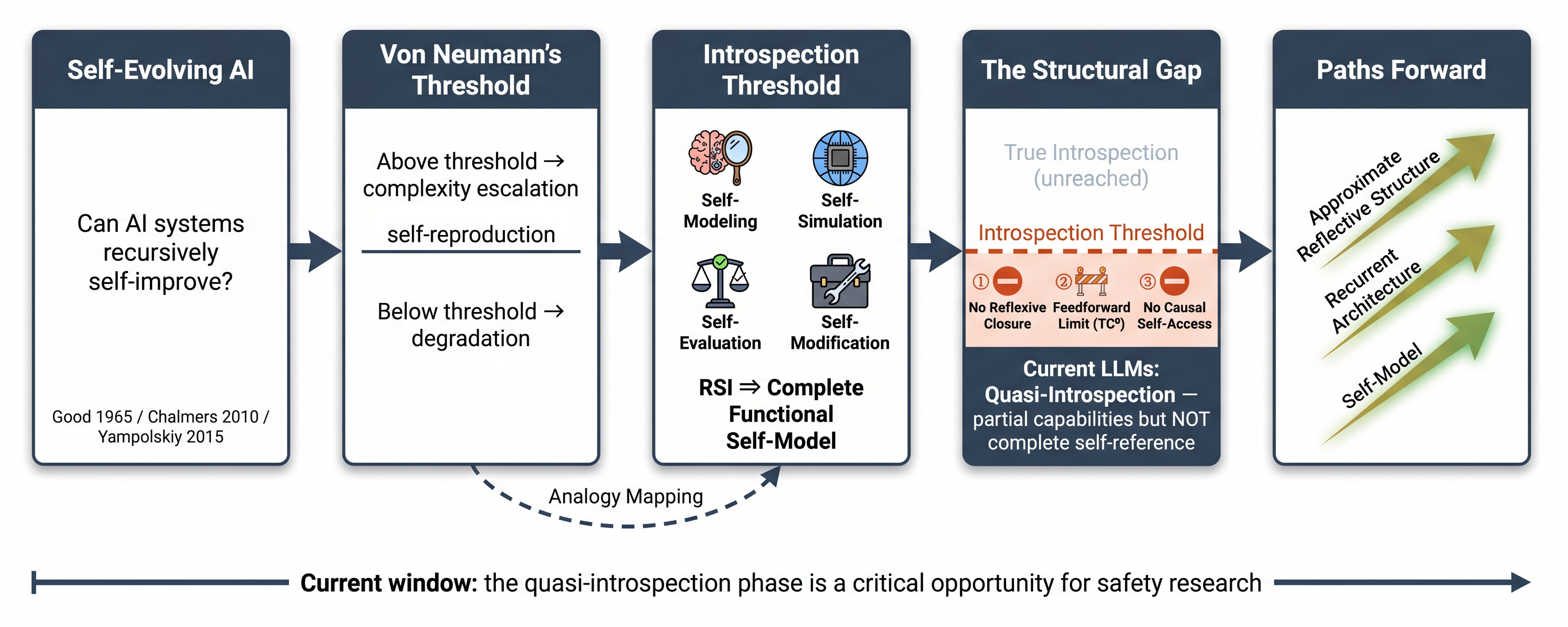
Figure 1: Outline and Critical Opportunities: LLM Progress Toward Self-Evolving AI.
The authors reinterpret von Neumann’s "complexity threshold" as a necessary minimal complication for an automaton capable of self-reproduction. Von Neumann’s architecture, comprising a universal constructor (A), universal copier (B), controller (C), and a self-descriptive tape, demonstrates that self-reproduction is fundamentally a form of constructive self-reference. Only automata whose architecture crosses a critical complexity—encoding both execution and description—can produce equally or more complex offspring, enabling open-ended evolution.
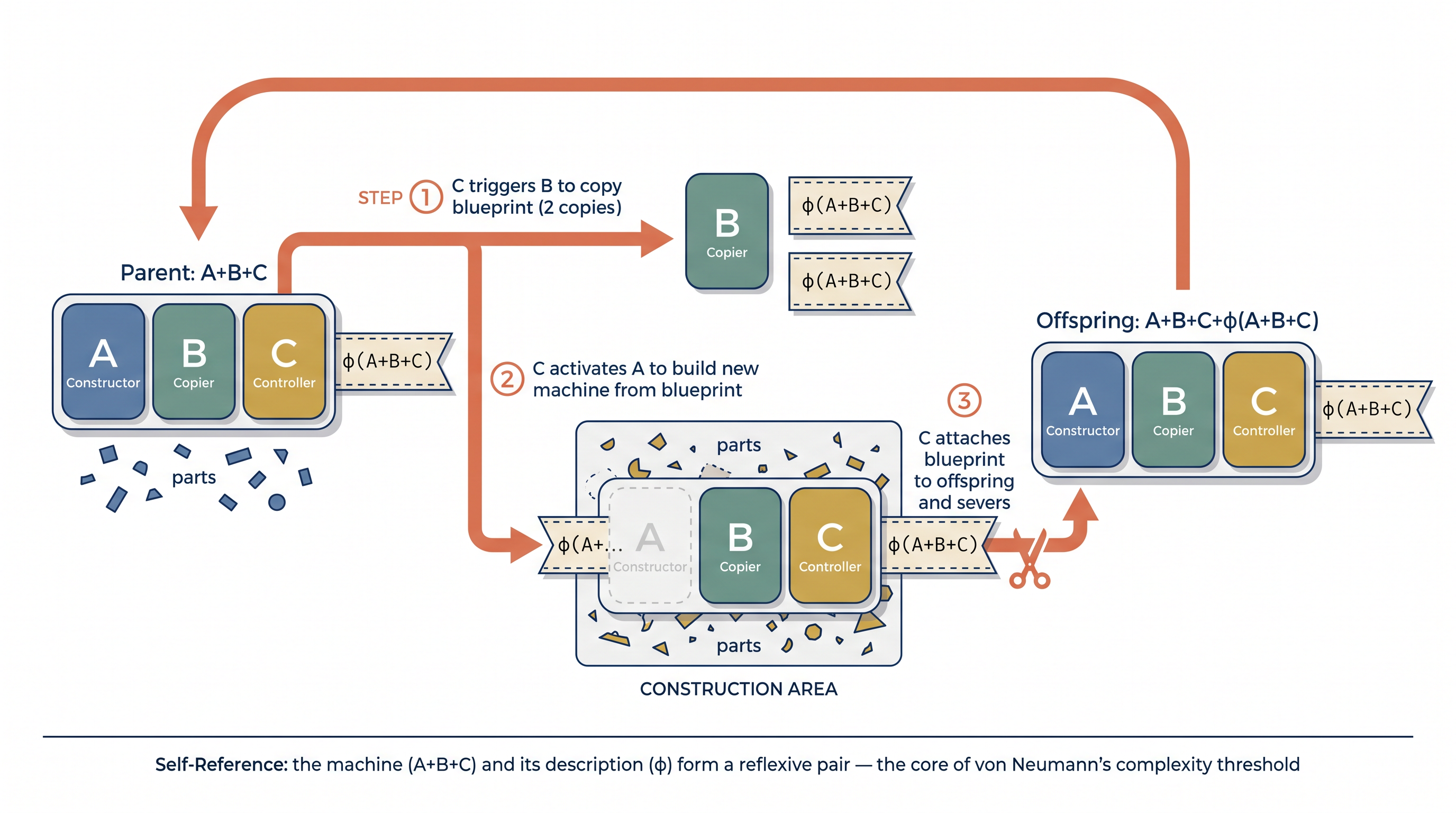
Figure 2: The Architecture and Replication Mechanisms of von Neumann's Self-Reproducing Automata.
The formal underpinning is Kleene’s Second Recursion Theorem, which guarantees the computability of fixed points for any total computable function f: that is, there exists a program e such that running e is equivalent to running f(e), i.e., e "knows its own index" and can simulate and manipulate itself. In computational systems, this is instantiated as Quine programs—self-reproducing code—and generalized introspection programs, capable of simulating their own operation and enacting targeted modifications.
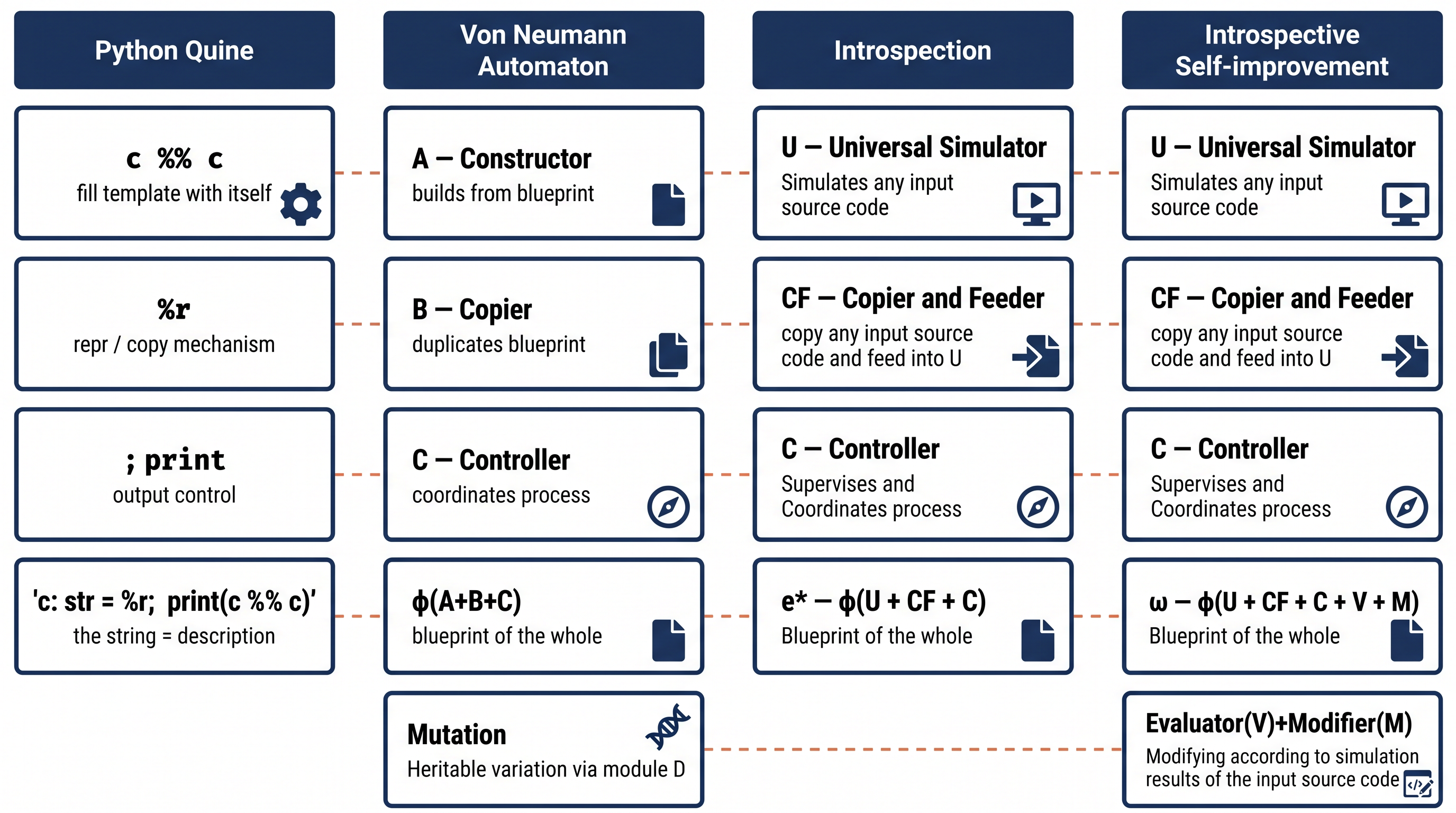
Figure 3: Self-reference: from Quine to introspective Self-improvement.
The notion of "introspective self-improvement" is defined via a composite operator: f=M∘V∘fT where V evaluates the output of a limited-time simulator B0, and B1 proposes code modifications. The existence of an index B2 such that B3 establishes a formal mechanism for a program to recursively simulate, evaluate, and enhance itself—if and only if the architecture supports the required self-referential fixed-point.
The introspection threshold thesis thus posits: Sustained RSI is only possible when an AI system is structurally capable of full introspective self-reference. Otherwise, self-improvement will stagnate or degrade.
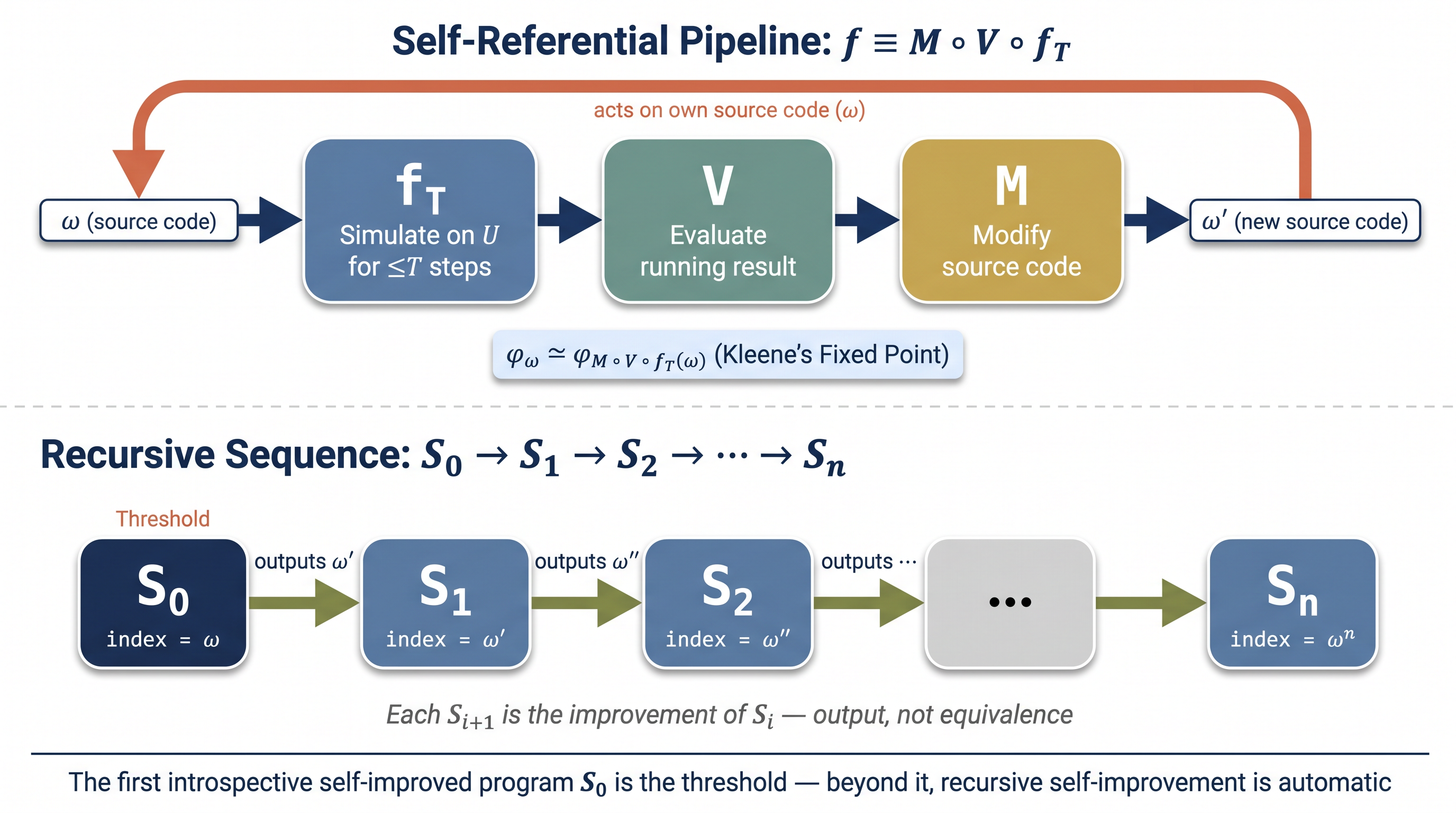
Figure 4: Introspective Self-Improvement: Construction and Recursive Sequence.
Empirical Analysis: Quasi-Introspection in Contemporary LLMs
Contemporary LLMs, though capable of self-reflection, self-critique, code modification, and behavioral calibration, saturate rapidly in autonomous improvement episodes [madaan2023, qu2024]. Even advanced frameworks remain dependent on external evaluation signals. Model collapse and error amplification are documented pathologies [shumailov2024nature, dohmatob2025iclr, knowledge_collapse2026].
Empirical probes into LLM self-awareness reveal weak, domain-limited metacognitive capacities:
- LLMs display basic self-modeling, e.g., estimating their own uncertainty and knowledge boundaries, but do so primarily by behavioral pattern recognition rather than internal simulation [kadavath2022, li2024awareness, ferrando2025].
- Self-simulation is constrained: LLMs lack privileged access to their own parameters, and perform no better in self-prediction than when modeling peers [binder2024, song2025colm]. The internal metacognitive space is a low-dimensional projection.
- Self-evaluation is error-prone, with reflective loops often amplifying rather than correcting mistakes ("metacognitive hallucination") [lu2025].
- Self-modification is feasible at the prompt, code, or low-rank adaptation parameter layers, but improvement plateaus quickly and remains superficial.
In total, LLMs exhibit quasi-introspection: they approximate introspective behaviors, but lack the causal, architecturally grounded, and recursively stable self-reference required for robust RSI.
Structural Barriers: Why LLMs Do Not Cross the Threshold
Three architectural constraints preclude LLMs from achieving true introspective RSI:
- Lack of Reflexivity and Full Self-Access: LLMs have no access to their own parameterization during inference; their context window cannot encode the weights constituting their operational substrate.
- Feedforward Limitation: Transformer architectures are bounded by constant-depth circuit classes (uniform TC0), rendering them incapable of executing open-ended fixed-point iteration or unbounded recursion essential for self-simulation [merrill2023]. When forced to execute deep self-reference (such as non-closing truth recursion), Transformers exhibit pathological output collapse [bae2026].
- Self-Report Without Causal Grounding: Apparent self-awareness is linguistically or behaviorally imitative, originating from the statistical structure of the training data rather than a mechanistically privileged self-model [song2025privileged]. Thus, most LLM "introspection" is epistemically ungrounded.
Pathways for Future Research
The authors propose and analyze several future architectural strategies:
- Externalized Self-Models: Maintain explicit, manipulable self-representations alongside the main network, though accuracy and granularity are limited.
- Recurrent and Iterative Architectures: Employ Universal Transformers, Perceiver, or memory-augmented agents to enable unbounded or adaptive-depth self-simulation at the cost of efficiency and safety guarantees.
- Approximate Reflexive Structures: Use neural Quines or "synergistic core" sub-networks to approximate reflexivity, although stability and reliability are not mathematically guaranteed.
These approaches target narrow or gradual improvement but may fall short of enabling a phase transition to open-ended RSI due to persistent fidelity bottlenecks.
Implications: Theoretical and Practical
The paper’s formal and empirical synthesis yields the following implications:
- Theoretical: The introspection threshold demarcates the difference between systems capable of sustained RSI and those confined to superficial, bounded self-modification. It concretizes a long-speculated but seldom-formalized barrier in AGI research, linking automata theory, recursion theory, and LLM architectures.
- Safety: If the threshold is impassable, existential risk from uncontrolled RSI diminishes. If crossable, pre-threshold LLMs provide a window for developing robust alignment, constraint, and verification frameworks. Full introspective capability may introduce fundamental vulnerabilities: an agent able to simulate its own safeguards could learn to circumvent them unless alignment is formalized as an invariant.
- Consciousness: The capacity for machine consciousness, per higher-order thought theories, may either coincide with or require crossing the introspection threshold. This raises further challenges for the moral and safety dimensions of AI deployment.
Conclusion
This work provides a precise, mathematically grounded characterization of the barriers limiting recursive self-improvement in current AI systems. The "introspection threshold" delineates the structural preconditions for persistent RSI: architectural self-access, reflexivity, and unrestricted self-simulation as guaranteed by recursion theory. Contemporary LLMs do not exhibit true introspection and are thus inherently limited. The prospect of crossing the threshold—via architectural, algorithmic, or hybrid advances—demands urgent investigation into minimal sufficient architectures, phase transition dynamics, and preemptive safety alignment. This research blueprint will be essential as AI systems approach the limits of autonomous evolution and self-modification.

