Frontis-MA1: Training an AI4AI Model towards Recursive Self-Improvement in Machine Learning Engineering
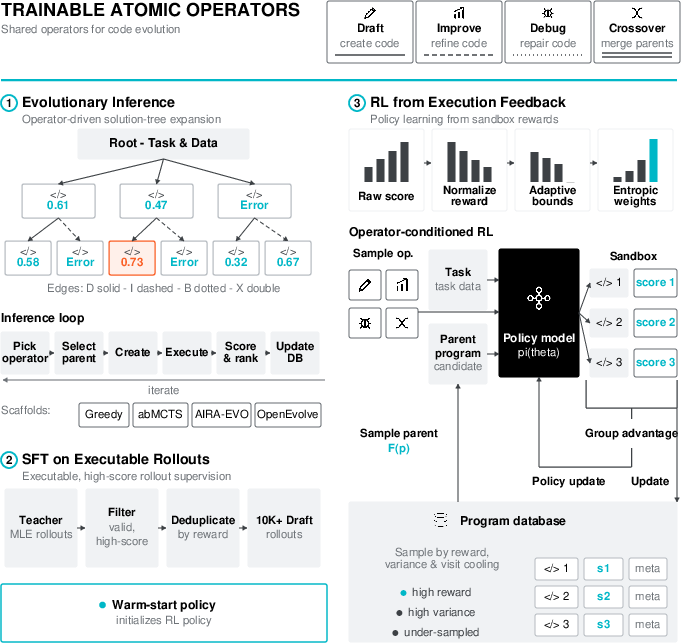
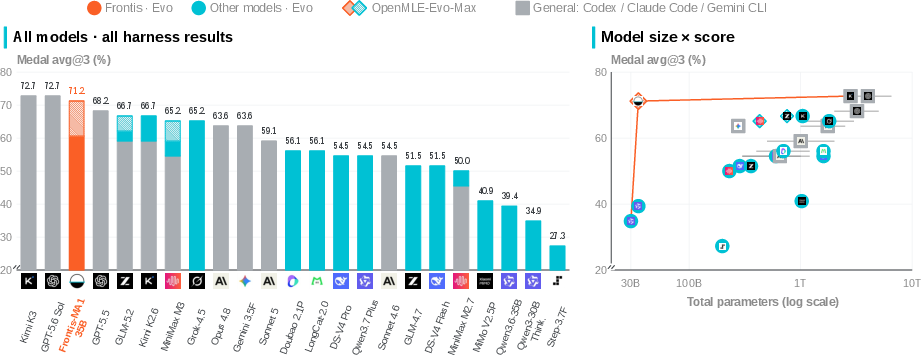
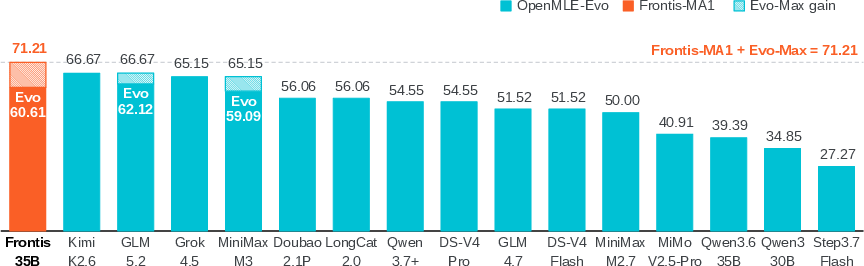
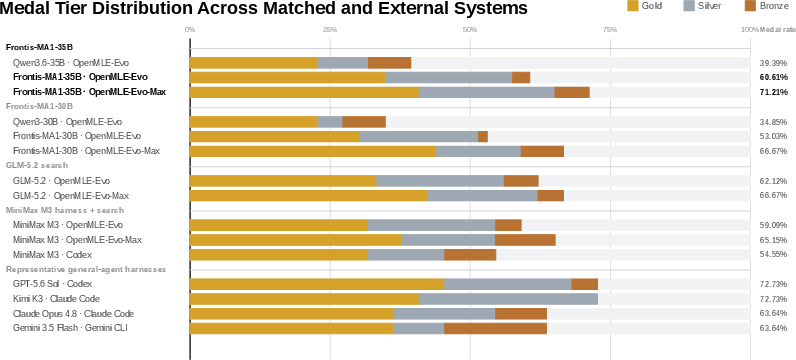
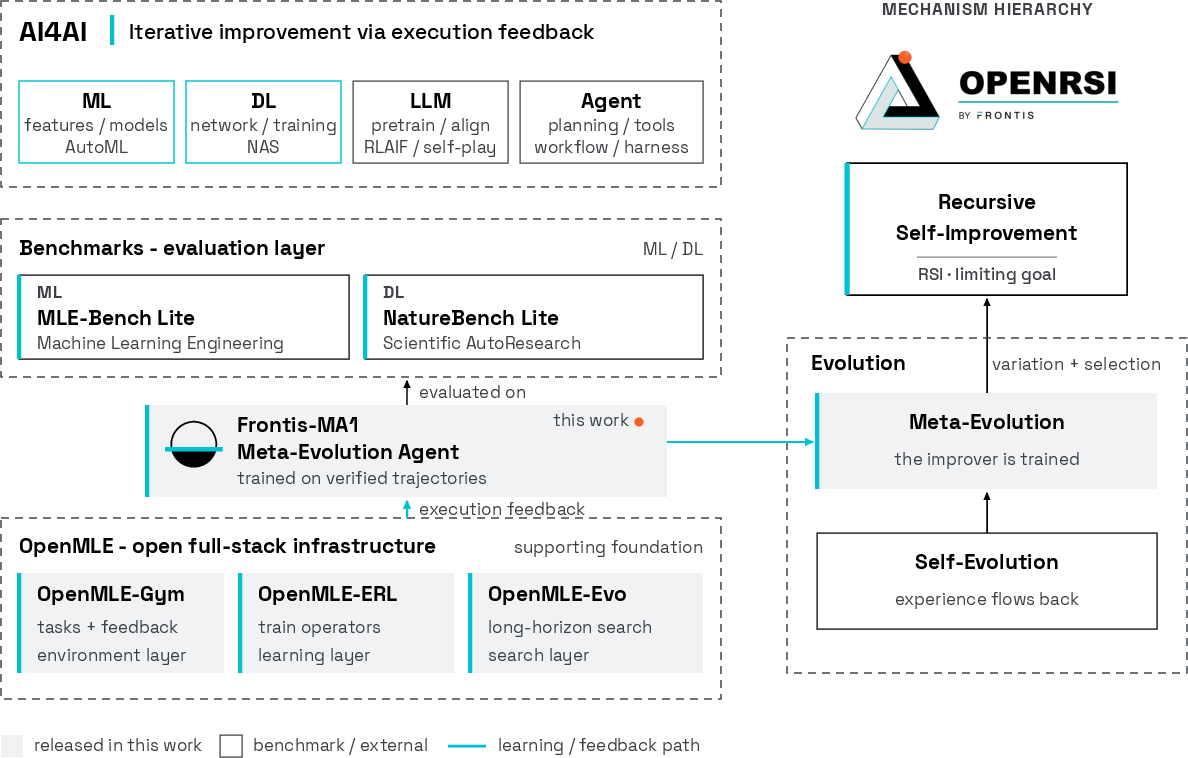
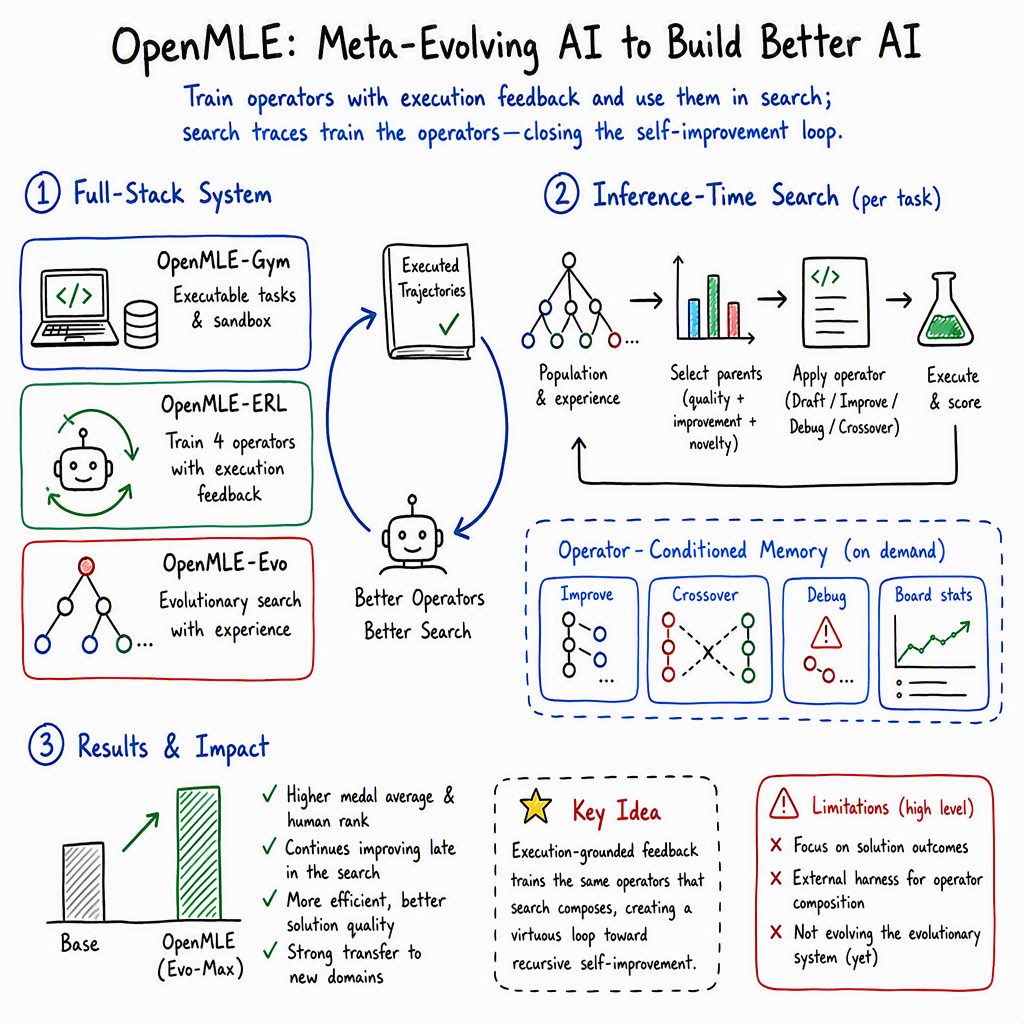
Abstract: Recursive self-improvement (RSI) requires AI systems that improve the process of building AI (i.e., AI4AI); machine learning engineering (MLE) offers a concrete, executable testbed for studying this capability. We introduce OpenMLE, an open full-stack system for RSI research in MLE, spanning verifiable task environments with execution feedback (OpenMLE-Gym), operator learning (OpenMLE-RL), and long-horizon search (OpenMLE-Evo). On this stack we post-train Frontis-MA1 (35B) as a meta-evolution agent for MLE, aligning post-training and inference around four atomic program-evolution operators (Draft, Improve, Debug, Crossover): the same operators are trained via execution-grounded SFT and RL on data deduplicated against all evaluation benchmarks, then composed into long-horizon search, coupling learning and evolution in a single loop. On MLE-Bench Lite under a 12-hour per-task budget on one RTX 4090 capped at 12 GB VRAM, Frontis-MA1 (35B) improves Medal Average from 39.39% to 60.61% over its base model with OpenMLE-Evo, and reaches 71.21% with OpenMLE-Evo-Max (benchmark-independent experience priors and asynchronous search), exceeding GPT-5.5 + Codex and approaching GPT-5.6 Sol and the 2.8T Kimi K3. On held-out NatureBench Lite, both components transfer: with the framework fixed, swapping in the trained model raises Match-SOTA from 50% to 70%; with the model fixed, swapping in OpenMLE-Evo raises it from 20% to 50%. We release the model weights and the full OpenMLE stack to enable reproducible research on executable AI4AI toward RSI. Code: https://github.com/FrontisAI/OpenRSI
First 10 authors:

Paper Prompts
Sign up for free to create and run prompts on this paper using GPT-5.
Top Community Prompts
Explain it Like I'm 14
Explaining “Frontis-MA1: Training an AI4AI Model towards Recursive Self-Improvement in Machine Learning Engineering”
Overview (What this paper is about)
This paper is about teaching an AI to help build better AIs on its own. The authors build a system called OpenMLE and a model called Frontis‑MA1 that can write, test, fix, and improve machine‑learning code step by step. The big idea is “AI for AI” (AI4AI): using AI systems to make the next generation of AI systems. They push toward “recursive self‑improvement” (RSI), which means each improved AI helps improve the next version even more.
Key Goals and Questions
In simple terms, the paper asks:
- Can we train an AI agent that doesn’t just write code once, but also runs it, reads the results, and then fixes and improves it over many attempts?
- Can this agent learn from its own trial‑and‑error experience to get better at improving machine‑learning projects?
- Can we build a full, open, testable setup (data, tools, and code) so other people can repeat and improve this research?
How They Did It (Methods, in everyday language)
To reach these goals, the authors build a full “gym + coach + game plan” for machine‑learning engineering (MLE):
- The Gym: OpenMLE‑Gym Think of this like a huge set of challenging practice levels for coding machine‑learning solutions.
- It includes 5,758 real, runnable tasks (many adapted from Kaggle), each with:
- A clear goal (like “predict these labels” or “classify images”)
- Public data to use
- A hidden checker that scores your program
- A safe “sandbox” that runs your code and returns detailed feedback (scores, logs, errors, time used)
- This makes the tasks fair, repeatable, and big enough to matter.
- The Skills Coach: OpenMLE‑ERL (Execution‑grounded Supervised Fine‑Tuning + Reinforcement Learning) The model learns four core skills (operators) it can use over and over:
- Draft: write an initial solution
- Improve: refine a working solution to be better
- Debug: fix errors when something breaks
- Crossover: combine good parts from two different solutions
How it learns those skills:
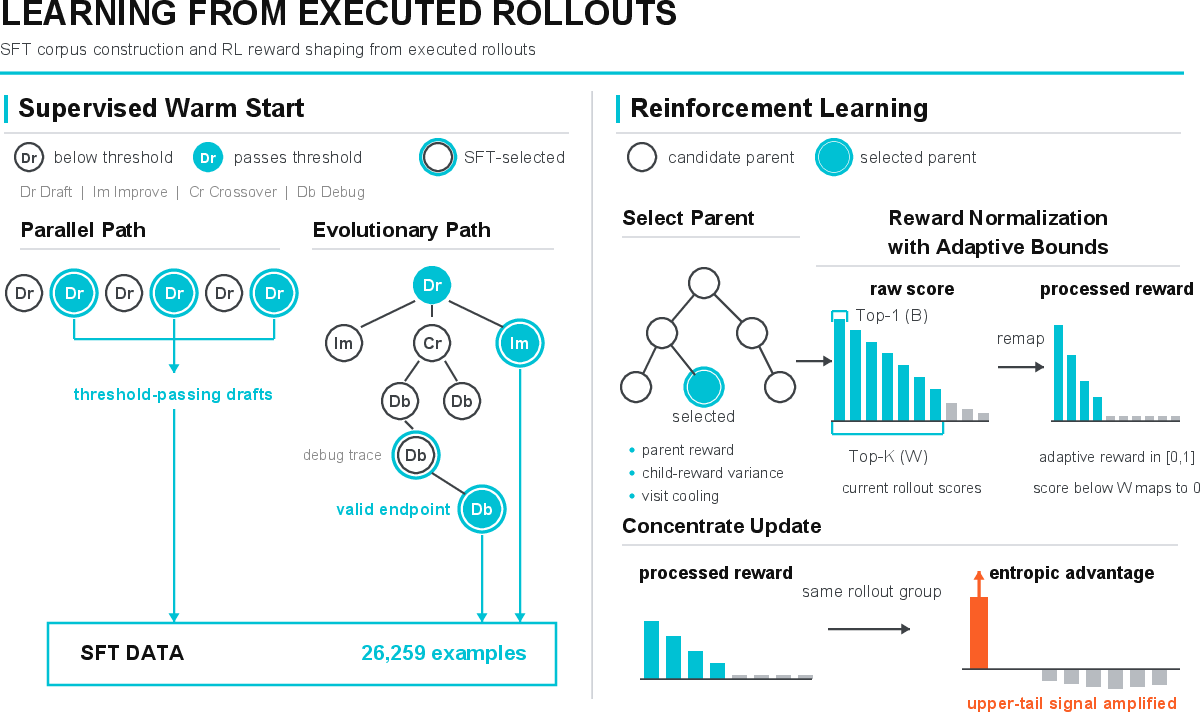
- Supervised Fine‑Tuning (SFT): Like learning from worked examples. The team collects many successful programs and useful edits that actually ran and scored well in the gym, then teaches the model to imitate those.
- Reinforcement Learning (RL): Like practicing and rewarding better outcomes. The model proposes code, the gym runs it, the model sees the result, and it gets nudged to make winning choices more likely next time.
- Two important tricks make RL work better here:
- Score re‑scaling: Different tasks have different scoring systems (accuracy, loss, etc.). They normalize scores so the model can fairly compare progress across tasks.
- Upper‑tail focus: They give more learning “credit” to the best programs in each batch, not just to any program that barely works. This teaches the model to aim for strong solutions, not just “valid” ones.
- Asynchronous training: If one code run is very slow, the system doesn’t wait; it keeps learning from the faster finished runs. This speeds up training time.
- Smart state selection: When practicing Improve/Debug/Crossover, the system picks parent programs that are strong, still uncertain, and not overused—so the model keeps learning from informative examples.
- The Game Plan at Test Time: OpenMLE‑Evo (Long‑horizon evolutionary search) This is how the trained model actually solves new tasks:
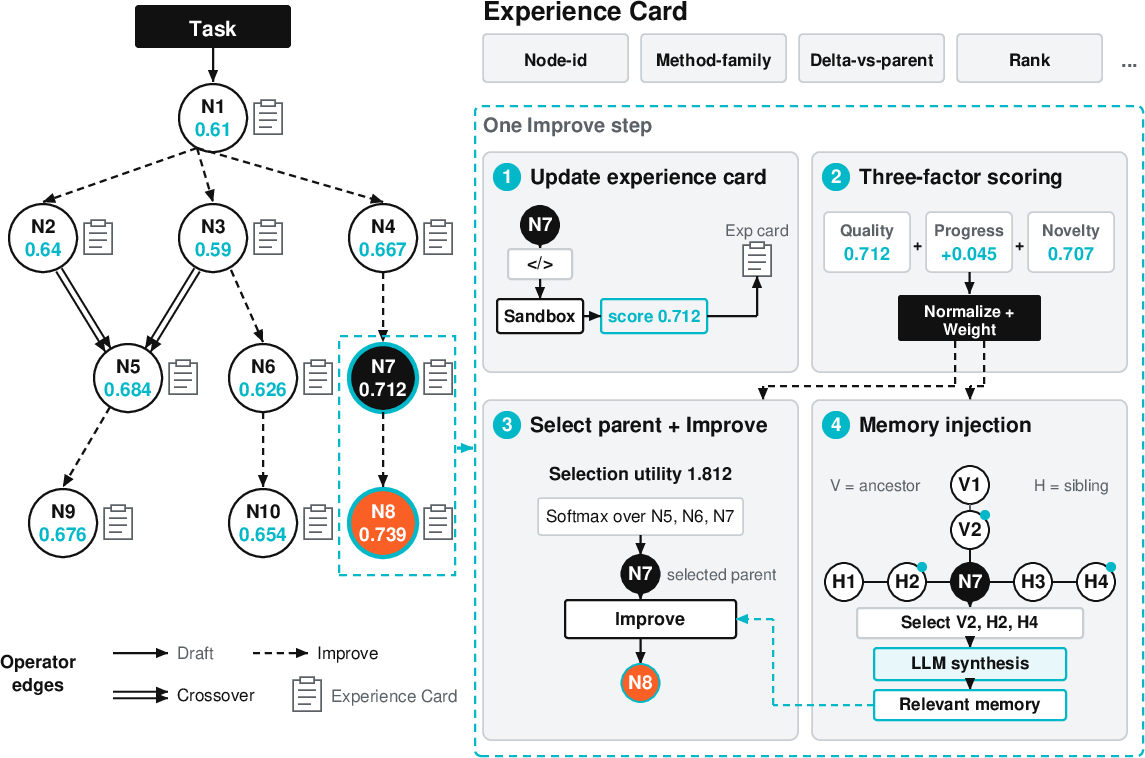
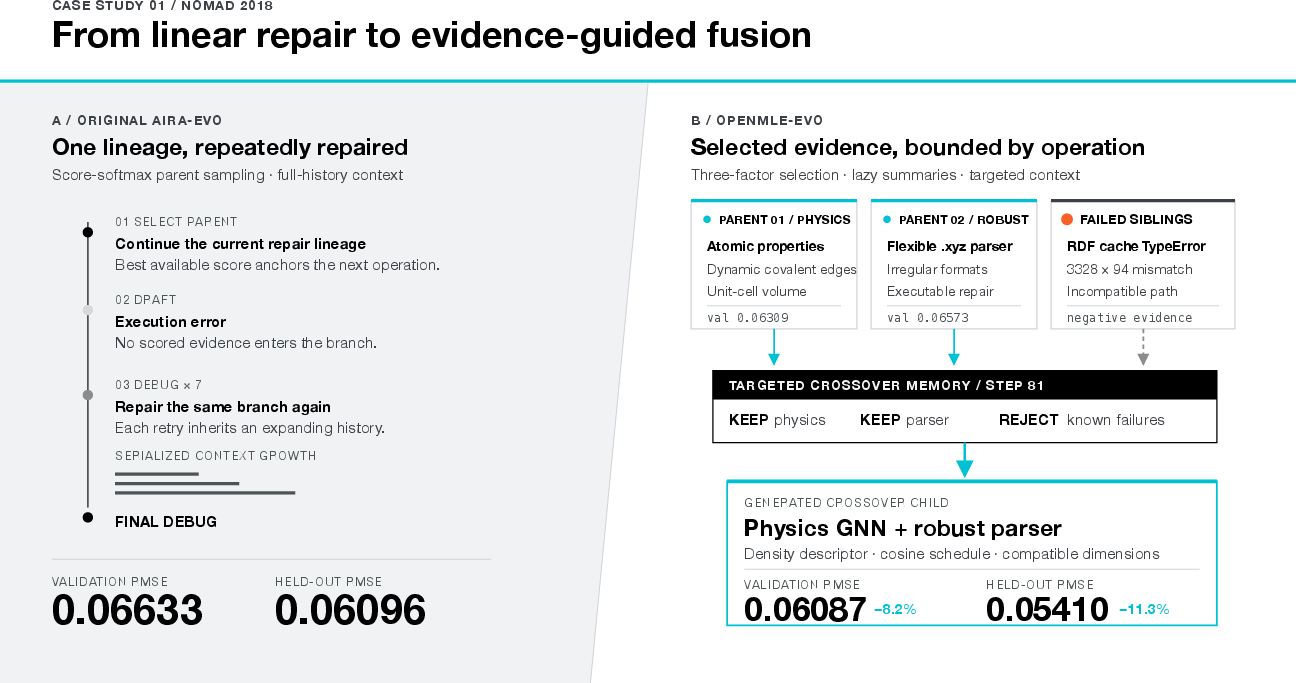
- It keeps a structured “experience card” for every attempted solution (what changed, how it scored, what errors happened, time used, and so on).
- It maintains a global “experience board” (a big picture of which ideas worked, what’s improving, and which directions are new).
- Parent selection balances three things:
- Quality (how good a solution is right now),
- Progress (how much it improved over its parent),
- Novelty (whether it explores a fresh, promising idea family).
- Operator‑conditioned memory: Before the model applies Improve/Debug/Crossover, it gathers just the most relevant history (ancestors, siblings, errors) and summarizes it on demand. This gives the model the right context without drowning it in irrelevant details.
Put simply: the system tries ideas, runs them, learns from results, and then uses that experience to decide what to try next—over many steps—like a careful scientist running experiments.
Quick summary of the parts
| Part | What it is | Why it matters |
|---|---|---|
| OpenMLE‑Gym | Thousands of real, runnable ML tasks with safe execution and scoring | Teaches and tests the agent with honest, code‑that‑runs feedback |
| OpenMLE‑ERL | Training the four skills via SFT + RL with smart rewards and sampling | Builds a model that can draft, improve, fix, and mix solutions well |
| OpenMLE‑Evo | Experience‑guided search at test time | Turns “more tries” into “smarter tries” over long sequences |
Main Findings (What worked and why it’s important)
- Better results under tight compute limits: On the MLE‑Bench Lite benchmark (22 tasks) with a strict budget (12 hours per task on a single RTX 4090 capped at 12 GB VRAM), their trained model plus OpenMLE‑Evo significantly improved over strong open baselines.
- Medal Average jumped from about 39.39 to 60.61 using the same search harness after training the model.
- With an enhanced configuration (OpenMLE‑Evo‑Max), it reached 71.21, beating a reported GPT‑5.5 + Codex setup and approaching stronger frontier systems described in the paper.
- It transfers: On a different benchmark (NatureBench Lite), both parts help:
- Swapping in the trained model (keeping the same search) boosted success from 50% to 70%.
- Swapping in the new search (keeping the model) boosted from 20% to 50%.
- This shows both the model’s training and the smarter search design matter, not just one or the other.
- End‑to‑end, open, and reproducible: They release the model weights and the full OpenMLE stack (tasks, training code, search code, sandbox tools) so others can repeat and extend this work.
Why this matters:
- The system doesn’t just write code once—it learns to run experiments, read feedback, and keep improving. That’s a key step toward AI that can help build better AI over time.
Implications (What this could lead to)
- A practical path toward recursive self‑improvement: By training the “improver” itself (the four operators) and using those same skills during long searches, the system closes a loop: try → run → learn → try better. Each round makes the model and its search behavior smarter.
- Faster, cheaper AI engineering: With careful feedback, smart rewards, and experience‑guided search, strong solutions can be found under modest compute budgets. That could make advanced AI engineering more accessible.
- A shared testbed for the community: Because the stack is open and reproducible, researchers can build on it—testing safety ideas, improving search strategies, inventing new operators, or adding richer tasks—pushing AI4AI forward responsibly.
In short: The paper shows how to train and deploy an AI agent that builds machine‑learning solutions like a thoughtful engineer—drafting, testing, fixing, and combining code—while steadily learning from its own experience. It performs well under tough limits, transfers to new tasks, and offers an open platform for future progress toward AI that can meaningfully improve itself.
Knowledge Gaps
Below is a single, concrete list of knowledge gaps, limitations, and open questions that remain unresolved and could guide future research.
- Reproducibility of training details: missing full hyperparameters, data pipelines, prompts, tokenization, context windows, optimizer settings, RL group sizes, KL/entropy targets, clipping schedules, and model-specific configuration needed for exact replication.
- Unreleased/partially released environments: 4,343 of 5,758 tasks cannot be fully released due to licensing; only prepare.py/metric.py are provided, limiting end-to-end reproducibility, data access, and comparability.
- Contamination auditing: the paper claims deduplication against evaluation benchmarks but does not provide a rigorous, auditable protocol (e.g., code/content hashing, near-duplicate embedding search, cross-source semantic leakage checks) or release the deduplication artifacts.
- Test-set overfitting risk: immediate access to evaluator scores on hidden answers during search may induce overfitting to private test sets; protocols that enforce realistic holdout validation (e.g., only validation feedback during search, single-shot test scoring at the end) are not evaluated.
- External baseline fairness: comparisons to other agents/harnesses do not clearly normalize for search budget, inference/model cost, and memory-synthesis calls; missing standardized compute accounting (FLOPs, wall time, number of sandbox executions) for apples-to-apples evaluation.
- Ambiguity in baselines and settings: several results lack precise model identifiers, harness configurations, and budgets (e.g., “GPT-5.5 + Codex,” “OpenMLE-Evo-Max”), preventing independent verification of claims.
- Statistical robustness: results are reported over three runs but without confidence intervals, per-task variance, or significance tests; robustness across seeds, runs, and hardware settings is not documented.
- Scaling laws: missing empirical scaling curves for performance versus (a) search time/budget, (b) number of candidates executed, (c) model size, and (d) operator-context length; no guidance for budget allocation in resource-limited settings.
- Ablations of ERL components: no controlled studies isolating the impact of (i) adaptive reward bounds, (ii) entropic advantages, (iii) asynchronous rollouts, and (iv) parent-selection utilities; sensitivity of each component and their interactions remains unknown.
- Hyperparameter sensitivity: no sweeps for key knobs (alpha in reward transform, beta in entropic weighting, tau and lambdas in parent selection), leaving stability and portability to new tasks/hardware untested.
- Asynchronous RL validity: off-policy effects from asynchronous group completion (policy drift, stale trajectories) and their impact on convergence are not characterized; no corrections (e.g., importance sampling) or diagnostics are reported.
- Parent-selection utility: theoretical grounding and empirical sensitivity for weighting quality, progress, and novelty are absent; how to set λs, λΔ, λn and temperature τ across tasks remains open.
- Operator vocabulary: only Draft/Improve/Debug/Crossover are supported; the framework does not explore additional high-impact operators (e.g., data augmentation/cleaning, hyperparameter search, ensembling, feature engineering, resource tuning, method selection) or automatic operator discovery.
- Controller learning: the controller is largely hand-designed; there is no learned policy for operator choice, branching factor, or budget allocation, nor a study of whether learned controllers outperform heuristic selection.
- Memory synthesis accuracy and cost: LLM-based memory generation may hallucinate or bias retrieval; there is no evaluation of summary fidelity, retrieval precision/recall, cache invalidation policies, or inference-cost trade-offs.
- Context-window limits: no clear accounting for prompt/token budgets, truncation strategies, and their effects on performance; impact of bounded operator-conditioned context on long-horizon search quality is not quantified.
- Experience priors: OpenMLE-Evo-Max uses “benchmark-independent experience priors,” but construction, filtering, and safety against meta-overfitting are unspecified; protocols for building/validating safe priors remain open.
- Generalization beyond MLE-Bench/NatureBench Lite: transfer to unseen task types, metrics, modalities (audio/video), and settings requiring heavy model training (e.g., multi-GPU deep learning, large images) is untested under the 12 GB VRAM cap.
- Representativeness of task mix: 87% of tasks are classification/regression and only 11% are multimodal; tasks involving reinforcement learning, graph learning, large-scale training, and real-time or streaming data are underrepresented.
- Realism of Kaggle-derived setup: immediate access to private-split evaluation differs from real competitions; effects on search policies and potential overestimation of real-world performance are not assessed.
- Data quality filter reliability: LLM-based semantic gating is not audited for false accepts/rejects, bias, or inter-rater reliability; no human validation sample or agreement metrics are reported.
- Sandbox fidelity and security: isolation guarantees, network/FS restrictions, package pinning, and reproducibility under nondeterministic GPU ops are not fully characterized; no red-team assessment of sandbox escape or data exfiltration.
- Error taxonomies and repair efficacy: while Debug is a core operator, there is no quantitative breakdown of error types, their frequencies, or which are effectively reduced by Debug across tasks and budgets.
- Reward shaping side effects: the adaptive-bound and entropic-advantage design may incentivize reward hacking or instability; no diagnostics for reward-metric alignment, mode collapse, or diversity loss are shown.
- Convergence and theory: no formal analysis (e.g., regret, fixed-point properties) for the meta-evolution loop, parent-selection dynamics, or conditions under which the search converges versus cycles.
- Multi-generation RSI: the work trains a single “generation-1” meta-evolution agent; it does not demonstrate multi-generation bootstrapping where each new agent measurably accelerates training or improves the improver itself.
- Cross-domain AI4AI: applicability outside MLE (e.g., compiler/optimizer design, systems tuning, AutoRL, architecture search for foundation models) is not tested; required environment changes and operator extensions remain unspecified.
- Human factors: no assessment of code quality, readability, documentation, or maintainability; no human-in-the-loop protocols to steer search, adjudicate failures, or incorporate domain constraints.
- Compute accounting: reported budgets exclude detailed inference/model-serving costs (e.g., memory-synthesis calls, controller overhead); guidelines for fair cost normalization across methods are lacking.
- Crossover utility: there is no ablation showing when and how Crossover helps versus hurts, or best practices for parent pairing and complementarity metrics.
- Robustness to budget variance: behavior under tighter/looser budgets, changing worker pools, and runtime variability is not examined; budget-adaptive strategies for different task regimes remain unexplored.
- Data governance and licensing: while some screening is mentioned, a thorough compliance audit (licenses, attribution, competition rules) and downstream redistribution policies for derived artifacts are not provided.
Practical Applications
Below are practical applications that translate the paper’s findings and system components (OpenMLE-Gym, OpenMLE-ERL, OpenMLE-Evo, and the Draft/Improve/Debug/Crossover operators) into real-world impact. Each item notes sectors, plausible tools/products/workflows, and key assumptions or dependencies.
Immediate Applications
- AI-assisted MLE copilot for teams
- Sectors: software, AI/ML platforms, MLOps
- What it looks like: an IDE- or notebook-integrated “MLE Copilot” that drafts end-to-end pipelines, improves them with execution feedback, debugs failed runs, and performs crossovers between promising solutions under a fixed compute budget; integrates with Dockerized sandboxes and CI
- Dependencies/assumptions: containerized execution (Docker), job scheduler, GPU/CPU workers, access to task data and evaluators; base LLM and the released Frontis-MA1 weights; security sandboxing
- Reproducible AutoML-in-a-box for tabular/time-series/vision/NLP
- Sectors: finance, retail, manufacturing, healthcare, energy
- What it looks like: a managed AutoML service that uses OpenMLE-Evo’s experience-guided search (quality/progress/novelty) to yield better best-of-run performance within fixed wall-clock budgets; produces auditable “experience boards” and “experience cards” per model
- Dependencies/assumptions: task-specific evaluators, data-access governance, budget controls; adherence to domain ML constraints (e.g., time-aware splits in finance)
- Experiment orchestration with execution-grounded feedback
- Sectors: research labs, enterprise data science, ML platform engineering
- What it looks like: drop-in orchestration that schedules long-running ML jobs, tracks structured execution diagnostics (success/runtimes/errors), and surfaces budget-aware best-of-run outputs; “Experience Board” dashboard for population-level insights
- Dependencies/assumptions: centralized scheduler + queue, artifact store, structured evaluator contracts, baseline MLOps stack
- Teach-and-train environments for ML engineering education
- Sectors: education, professional upskilling
- What it looks like: courseware built on OpenMLE-Gym that gives students executable tasks with verifiable metrics; students (and instructors) can observe Draft/Improve/Debug/Crossover traces and learn iterative ML engineering
- Dependencies/assumptions: access to the 1,415 fully released tasks (and scripts for the rest), classroom compute, license-compliant use of any gated data
- Faster research iteration via operator APIs
- Sectors: academia, applied research
- What it looks like: a Python API exposing the four operators so researchers can study algorithmic modifications under execution feedback, reproduce ablations (e.g., entropic advantages, adaptive bounds), and compose new controllers on top of OpenMLE-Evo
- Dependencies/assumptions: availability of open weights, prompts, and harness code; compute for repeated runs
- Safety-first execution sandboxes for LLM agents that write code
- Sectors: security, platform safety, enterprise IT
- What it looks like: hardened, budgeted Docker sandboxes with explicit evaluator contracts; classify failure modes (missing submission, scoring failure, timeout) to reduce blast radius of autonomous agents
- Dependencies/assumptions: secure containerization, network/file-system isolation, runtime guards, organization security policy alignment
- Compliance-ready, auditable ML pipelines
- Sectors: healthcare, finance, government analytics
- What it looks like: immutable logs of every candidate program, evaluator outcome, and resource usage; produce audit trails that map decisions to execution-grounded evidence and method families
- Dependencies/assumptions: regulator-accepted evaluator definitions, PII-safe data handling, policy-aligned data retention
- Internal benchmarking and vendor evaluation for AI4AI tools
- Sectors: procurement, platform teams
- What it looks like: reuse MLE-Bench Lite and NatureBench Lite-style harnessing to compare internal baselines vs. third-party AI engineering agents under equal budget caps; Pareto selection across Valid Rate, Medal Average, and Human Rank
- Dependencies/assumptions: standardized tasks and compute budgets; run isolation for fair comparisons
- “Kaggle coach” for competition preparation and analytics
- Sectors: education, data science communities
- What it looks like: guided exploration that suggests method families, surfaces underexplored directions, ranks siblings/ancestors, and explains why a particular branch improved; good for skill building and leaderboard practice (on permitted datasets)
- Dependencies/assumptions: licensing-compliant use of competition data; limits on external data leakage or rules violations
- Cost-aware research pipelines using asynchronous rollouts
- Sectors: startups, labs with constrained compute
- What it looks like: minimize idle time by consuming completed generation-and-execution groups immediately; practical speedups for heterogeneous runtime distributions across tasks
- Dependencies/assumptions: queue-based trainer, job runtime variance, careful convergence monitoring with asynchronous updates
Long-Term Applications
- Autonomous “AI that builds AI” labs (AutoResearch)
- Sectors: AI research, software, semiconductors
- What it looks like: persistent meta-evolution loops that not only search over ML pipelines but continually train the underlying operator model from accumulated executable experience, closing the RSI gap; end-to-end agents that formulate hypotheses, run experiments, diagnose failures, and allocate compute
- Dependencies/assumptions: robust generalization beyond competition-style tasks; safe continual learning; scalable reward shaping and memory; governance for agentic experimentation
- Domain-specialized RSI for safety-critical ML systems
- Sectors: healthcare, autonomous driving, aerospace, energy
- What it looks like: bounded self-improving agents that evolve perception/control/diagnostics modules with domain-specific evaluators and high-fidelity simulators; strict progress-novelty-quality controls plus formal verification hooks
- Dependencies/assumptions: certified simulators/evaluators, interpretability/verification tooling, regulatory approval for self-modifying systems
- Cross-domain operator libraries and marketplaces
- Sectors: software, robotics, education, industrial automation
- What it looks like: a shared ecosystem of reusable Draft/Improve/Debug/Crossover operators specialized to domains (e.g., time-series, reinforcement learning, robot control); marketplaces where operators and experience memories are published and reused
- Dependencies/assumptions: operator interface standards, data/model IP governance, privacy-preserving memory sharing
- Policy frameworks for self-improving AI
- Sectors: public policy, standards bodies, compliance
- What it looks like: audit and reporting standards for execution-grounded self-improvement (e.g., mandatory “experience boards,” budget accounting, failure taxonomy); certification regimes for AI4AI toolchains
- Dependencies/assumptions: consensus on evaluation rubrics, interop formats for traces/memories, regulatory capacity to audit code-exec pipelines
- Compute-aware, sustainability-optimized AI R&D
- Sectors: cloud, energy, green AI initiatives
- What it looks like: controllers that jointly optimize for solution quality and carbon/energy budgets; adaptive bounds and selection policies extended to energy/latency constraints at test- and train-time
- Dependencies/assumptions: energy metering APIs, carbon-aware schedulers, standardized cost/reward trade-off formulations
- Self-tuning enterprise ML platforms
- Sectors: large enterprises with heterogeneous data estates
- What it looks like: platforms that continuously evolve feature stores, preprocessing, and modeling recipes per domain; use method-family novelty to prevent premature convergence, with rollback on regressions
- Dependencies/assumptions: strong guardrails (RBAC, lineage, shadow deployment), multi-tenant sandboxes, change-management controls
- Agentic literature-to-experiment systems
- Sectors: academia, pharma/biotech, materials science
- What it looks like: ingest papers/protocols, draft candidate implementations, refine with execution feedback, and perform crossovers across method families to discover new variants (e.g., model training schedules, data pipelines)
- Dependencies/assumptions: domain evaluators and simulators; IP and data licensing; trustworthy extraction from literature
- Robust memory and retrieval for multi-month research programs
- Sectors: long-horizon R&D across industries
- What it looks like: scalable, operator-conditioned memory synthesis and retrieval that survive months of experiments; structured “experience cards” as the canonical research ledger
- Dependencies/assumptions: high-quality metadata capture, memory compaction and summarization at scale, catastrophic-forgetting mitigation
- Human–AI collaborative governance of evolving systems
- Sectors: safety/compliance, platform governance
- What it looks like: joint control loops where humans set budgets and novelty thresholds, review structured experience evidence, and gate deployment; explainable parent selection and operator choices
- Dependencies/assumptions: usable interfaces for reviewing experience boards; explanation tooling; org policies for human-in-the-loop approvals
- Curriculum generation and auto-grading with executable feedback
- Sectors: education, workforce development
- What it looks like: dynamic syllabi and labs that adapt to learner performance by evolving task difficulty and hints; execution-grounded evaluators ensure objective grading and stepwise debugging instruction
- Dependencies/assumptions: safe task libraries, compute provisioning for classes, plagiarism/cheating mitigation
Notes on feasibility across applications
- The open release (weights, gym, harness) enables many immediate deployments; long-term items require stronger generalization, domain-specific evaluators, sustained safety/reliability work, and governance.
- Applications making use of Kaggle-derived tasks must honor licensing and competition rules; releasing scripts without data implies organizations need their own data access.
- Performance claims and budget expectations depend on base model capability, access to GPUs/CPUs, and careful sandboxing to maintain reproducibility and security.
Glossary
- Adaptive bounds: Task-specific dynamic score ranges that preserve reward resolution where current candidates lie. Example: "OpenMLE therefore derives tighter adaptive bounds from each task's historical on-policy score frontier and remaps to a processed reward ."
- AIDE: A prior system for executable program search using iterative refinement. Example: "AIDE, AIRA, and AIRA establish iterative search over executable programs through tree- or population-based exploration, repeated execution, and candidate refinement"
- AI4AI: The use of AI systems to build and improve other AI systems. Example: "This broader direction, often called AI for AI (AI4AI), seeks to use AI systems to build and improve AI"
- AIRA: An agent framework for iterative research and refinement over executable code. Example: "AIDE, AIRA, and AIRA establish iterative search over executable programs through tree- or population-based exploration, repeated execution, and candidate refinement"
- AIRA-Evo: An evolutionary variant of AIRA focusing on population-based selection and refinement. Example: "Original AIRA-Evo derives parent-sampling probabilities primarily from normalized fitness."
- Asynchronous rollouts: RL training that consumes completed generation-and-execution groups without waiting for the slowest job. Example: "Removing stragglers with asynchronous rollouts."
- Best-of-/Pass@ objectives: Evaluation/optimization schemes emphasizing the best among multiple samples. Example: "related Best-of-/Pass@ objectives"
- Budget-adaptive SFT: Supervised fine-tuning that stops early on easy tasks or conserves execution for harder ones. Example: "Budget-adaptive SFT stops at an accepted-example quota or execution limit, preserving budget for sparse-success tasks;"
- Crossover: An operator that recombines parts of parent programs to form a new candidate. Example: "We instantiate the atomic operators as Draft, Improve, Debug, and Crossover."
- Debug: An operator that repairs failing or error-prone programs based on execution feedback. Example: "We instantiate the atomic operators as Draft, Improve, Debug, and Crossover."
- Draft: An operator that produces an initial end-to-end solution for a task. Example: "We instantiate the atomic operators as Draft, Improve, Debug, and Crossover."
- Entropic advantage: A reward-weighting scheme that amplifies learning signal for top-performing candidates within a group. Example: "OpenMLE uses an entropic advantage that amplifies reward gaps near the top of each rollout group"
- Entropic weighting: Prioritizing high-reward candidates by exponentiated weights to emphasize the upper tail. Example: "Entropic weighting increases the processed advantage assigned to the best candidate in a rollout group."
- Experience board: A task-global, aggregated record of search statistics used to guide future exploration. Example: "the harness aggregates the cards from all evaluated nodes into a task-global experience board."
- Experience card: A structured record attached to each evaluated candidate capturing provenance, performance, and execution outcomes. Example: "the harness creates a node-level experience card."
- Experience-Guided Parent Selection: A selection strategy that combines quality, progress, and novelty signals to choose which node to expand next. Example: "Experience-Guided Parent Selection"
- Execution-grounded reinforcement learning (RL): RL that uses verified execution outcomes and task-specific metrics as rewards. Example: "Execution-Grounded Reinforcement Learning"
- Execution-grounded supervised fine-tuning (SFT): SFT using only programs with verified execution and scores as training data. Example: "execution-grounded supervised fine-tuning and reinforcement learning."
- Evolutionary inference: Test-time search that repeatedly applies operators to evolve candidates under a compute budget. Example: "evolutionary inference seeks the candidate with the highest signed score:"
- Improve: An operator that refines an existing valid solution to raise its score. Example: "We instantiate the atomic operators as Draft, Improve, Debug, and Crossover."
- Island (evolutionary search): A subpopulation used to promote diverse exploration during search. Example: "in a sampled island,"
- Long-horizon search: A search process that unfolds over many iterative steps, using accumulated execution feedback. Example: "long-horizon search, coupling learning and evolution in a single loop."
- Machine Learning Engineering (MLE): The end-to-end practice of building, executing, and iterating ML solutions under real constraints. Example: "Machine learning engineering (MLE) is a particularly direct instantiation of AI4AI:"
- Medal Average: Benchmark metric: average fraction of tasks earning any Kaggle medal. Example: "Medal Average is the mean fraction of tasks receiving any Kaggle medal;"
- Meta-evolution: Learning to improve the improver by training the model on its own evolutionary trajectories. Example: "Meta-evolution closes an additional learning loop by reusing these evolutionary trajectories to train the model that proposes future modifications."
- Meta-evolution agent: A model trained to act as the variation engine in an evolutionary harness that also learned from those evolutions. Example: "A model trained and deployed in this role is a meta-evolution agent"
- Method family: A categorical grouping of related solution approaches tracked during search. Example: "explored method families, family-wise best candidates, underexplored directions, repeated failures, score trends, and the parent graph."
- MLE-Bench Lite: A public benchmark split for evaluating MLE agents under constrained compute. Example: "We evaluate on the official 22-task MLE-Bench Lite split released with MLE-Bench"
- NatureBench Lite: A held-out benchmark assessing transfer beyond competition-style MLE. Example: "On held-out NatureBench Lite, both components transfer:"
- OpenMLE-Evo: The evolutionary inference harness that performs experience-guided, operator-conditioned long-horizon search. Example: "OpenMLE-Evo organizes long-horizon search around structured experience, non-greedy selection over quality, progress, and novelty, and operator-conditioned memory."
- OpenMLE-ERL: The training stack that combines execution-grounded SFT with RL for operator learning. Example: "OpenMLE-ERL uses budget-adaptive supervision fine-tuning and reinforcement learning to turn verified solutions and revisions into stronger MLE behavior;"
- OpenMLE-Gym: The executable task suite and sandbox providing isolated runs, structured feedback, and verifiable evaluators. Example: "OpenMLE-Gym constructs 5,758 quality-gated executable tasks and provides isolated execution, structured feedback, and task-specific evaluation;"
- Operator context: The structured information about parents and feedback that conditions an operator’s proposal. Example: "constructs its operator context "
- Operator-conditioned memory: On-demand, operator-specific retrieval and synthesis of relevant prior experience. Example: "OpenMLE-Evo organizes long-horizon search around structured experience, non-greedy selection over quality, progress, and novelty, and operator-conditioned memory."
- Operator-conditioned program-generation policy: A model that generates programs conditioned on the chosen operator and its context. Example: "the operator-conditioned program-generation policy"
- Parent selection: Choosing which evaluated candidate to expand next based on multiple experience-derived utilities. Example: "Thus, each parent-selection decision jointly considers three aspects of a candidate:"
- Program-transformation operators: A compact action set (Draft, Improve, Debug, Crossover) that transforms code solutions during search. Example: "OpenMLE trains a compact set of reusable program-transformation operators over executable candidates."
- Recursive self-improvement (RSI): A process where each improved AI system further improves the pipeline that creates its successors. Example: "Its more ambitious endpoint is recursive self-improvement (RSI), where each improved system further improves the process that produces its successors"
- RLVR (Reinforcement Learning from Verifiable Rewards): RL paradigm using deterministic, checkable rewards from execution or proofs. Example: "Executable evolutionary training also differs from short-horizon RLVR on mathematics and code generation"
- Sandboxed execution: Running candidate programs in isolated environments with controlled resources to obtain verifiable feedback. Example: "The transition is sandbox execution: the environment materializes the workspace, runs the program against public data, and invokes the evaluator when a valid submission is produced."
- Signed score: A task score transformed so that larger is always better, regardless of original metric direction. Example: "converts into a signed score , for which larger is always better,"
- Test-time learning: Adapting search behavior from execution outcomes during inference rather than only at training. Example: "Test-time scaling becomes test-time learning when search learns from experience."
- Upper-tail principle: Emphasizing learning from the best candidates in a group to improve top performance. Example: "following the upper-tail principle studied in TTT-Discover"
Collections
Sign up for free to add this paper to one or more collections.