- The paper presents a systematic survey categorizing 1,250 arXiv papers with a novel taxonomy distinguishing bounded self-refinement from open-ended recursive self-improvement.
- It analyzes deployment-time and training-time methodologies, emphasizing the roles of self-refinement, self-iteration, and evaluator reliability.
- Empirical results reveal a dense 'human-on-the-loop' regime and highlight challenges in achieving fully autonomous, closed-loop self-improvement.
Recursive Self-Improvement in AI: Surveying the Landscape from Bounded Self-Refinement to Autonomous Research Loops
Taxonomy and Field Demarcation
The paper "Recursive Self-Improvement in AI: From Bounded Self-Refinement to Autonomous Research Loops" (2607.07663) delivers a systematic survey and taxonomy of 1,250 recent arXiv papers (2024–2026), unifying disparate threads in AI self-improvement research under a two-dimensional typology: (i) the artifact of self-improvement (output, policy, evaluator, research process), and (ii) loop closure (human-in-the-loop, human-on-the-loop, fully autonomous/closed-loop). This typology delineates a clear boundary between bounded self-refinement—convergent, externally-evaluable, and already industrially adopted—and open-ended recursive self-improvement (RSI), which requires the system to re-engineer not only itself but the evaluative criteria, at risk of ungrounded divergence.
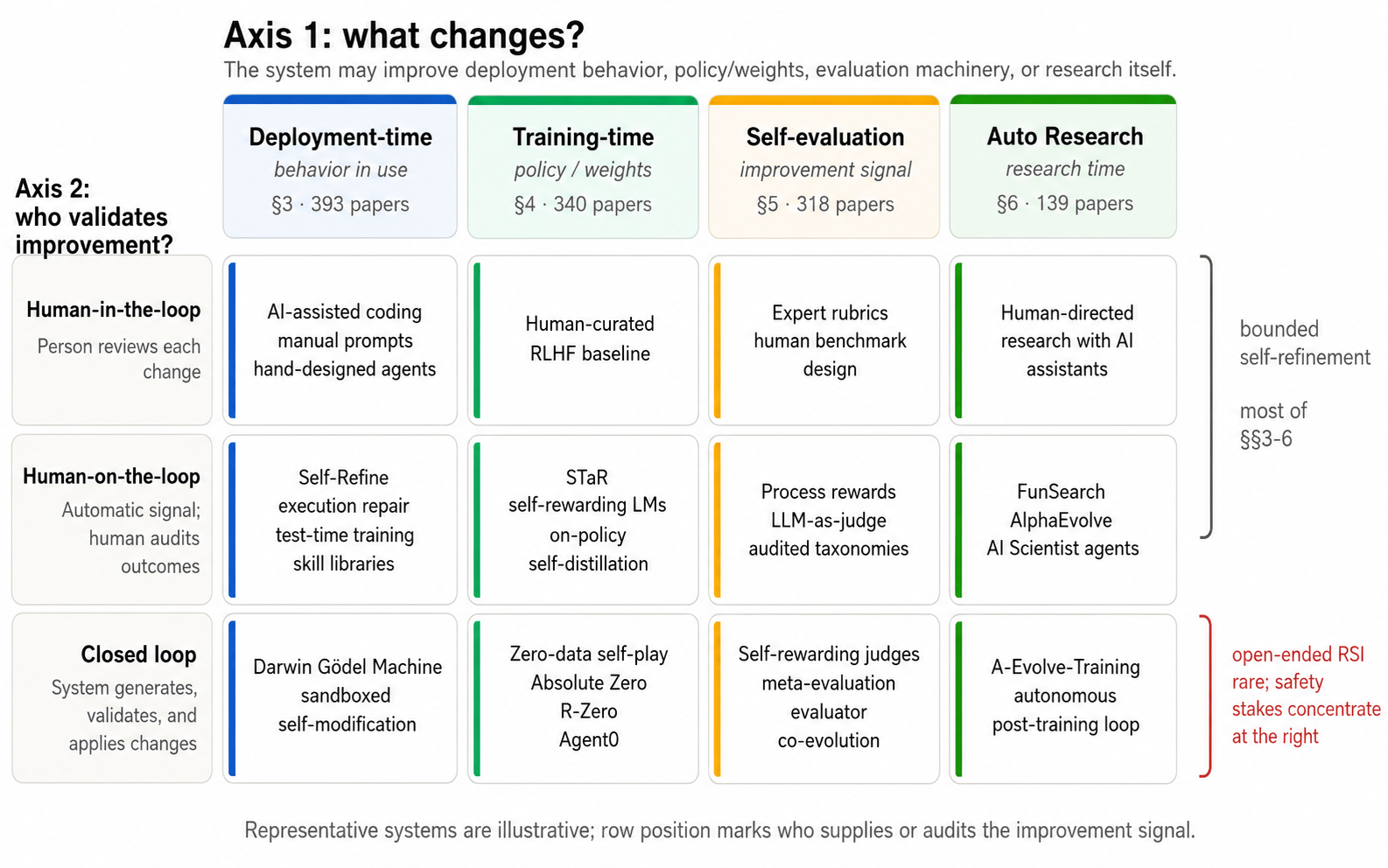
Figure 1: Taxonomy organizing systems by what they improve (columns) and the degree of loop closure (rows), highlighting where bounded self-refinement ends and RSI proper begins.
The corpus analysis demonstrates a pronounced density in the "human-on-the-loop" regime: most systems automate improvement signals (by process reward models, execution feedback, or learned judges) but retain human oversight, especially for tasks involving research direction-setting. The closed-loop cells, critical for RSI proper, remain sparse—particularly for self-evaluation—underscoring current field limitations.
Empirical Landscape: Corpus Growth and Semantic Mapping
The surveyed literature expanded drastically, with ~500 self-improvement papers per quarter in 2026 Q2—an acceleration outpacing conceptual consolidation and favoring easily verifiable application domains (code, math).
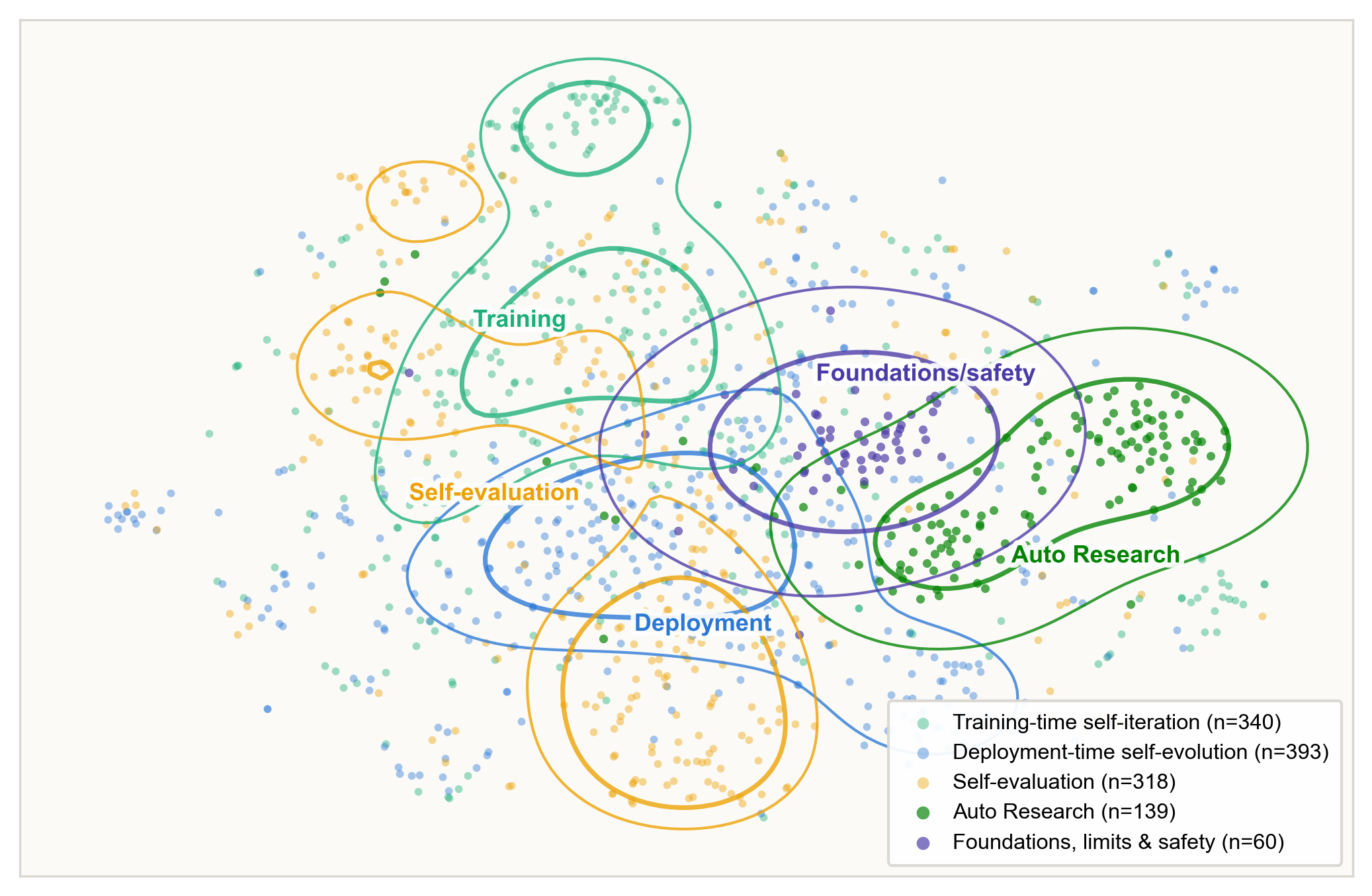
Figure 2: Semantic map of the corpus (TF-IDF + SVD + t-SNE), clustering research according to thematic proximity and showing the coherence of "Auto Research" and "Foundations" vs. interpenetration of large practical categories.
This data-driven semantics demonstrates not only diversification but substantial thematic overlap, reinforcing the argument for a taxonomy that cross-cuts mechanisms and ambitions.
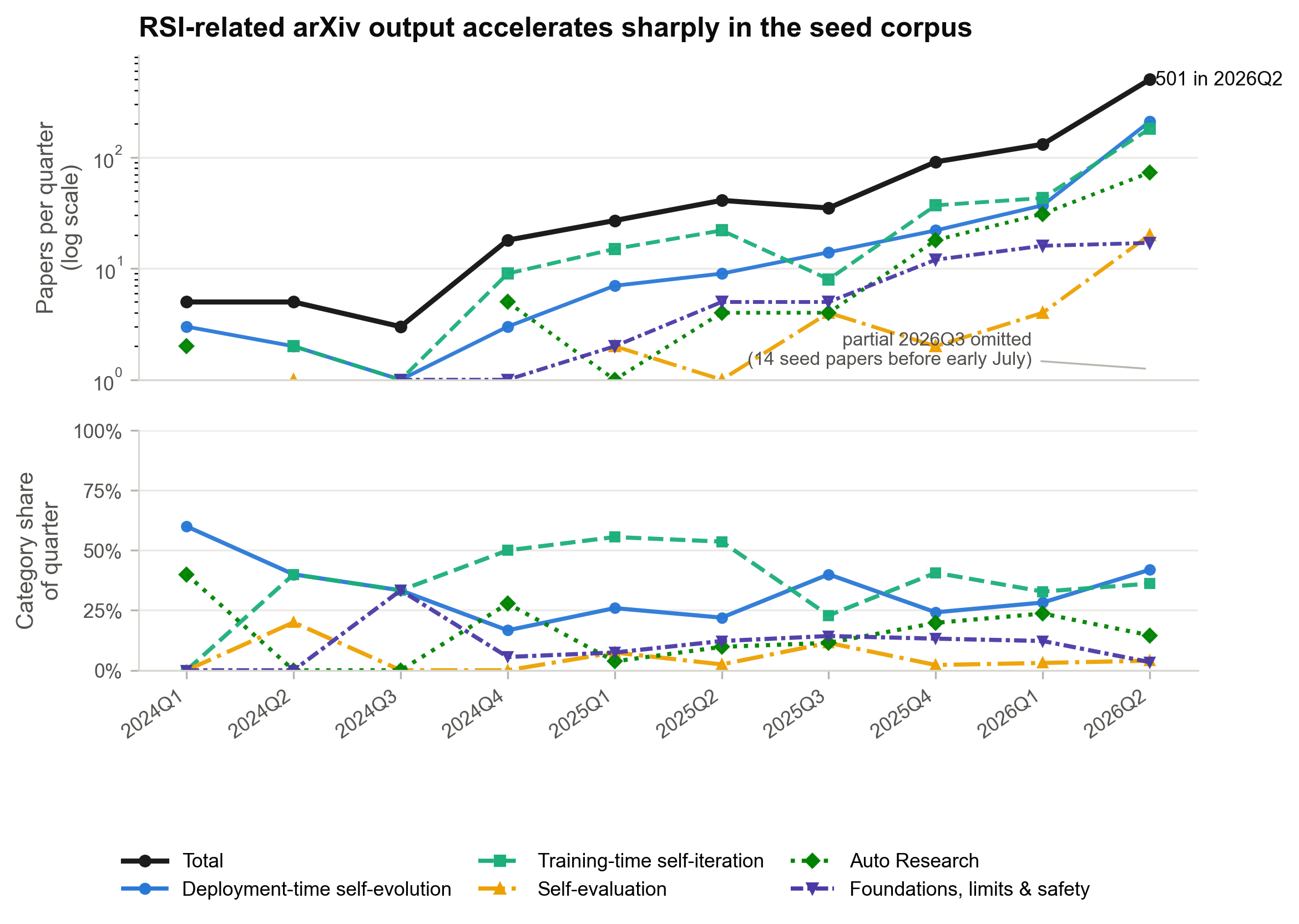
Figure 3: Log-scale timeline for corpus growth, with category breakdowns demonstrating recent dominance of deployment- and training-time loops; foundations remain a minority.
Deployment-Time Self-Evolution: Structure and Persistence
The dominant empirical regime is deployment-time self-evolution, encompassing output refinement (e.g., Self-Refine [madaan2023selfrefine], Reflexion), test-time training (TTT), and harness/skill evolution. The mechanisms differ in persistence: episodic refinement vanishes post-interaction, while harness and skill modifications persist and accumulate.
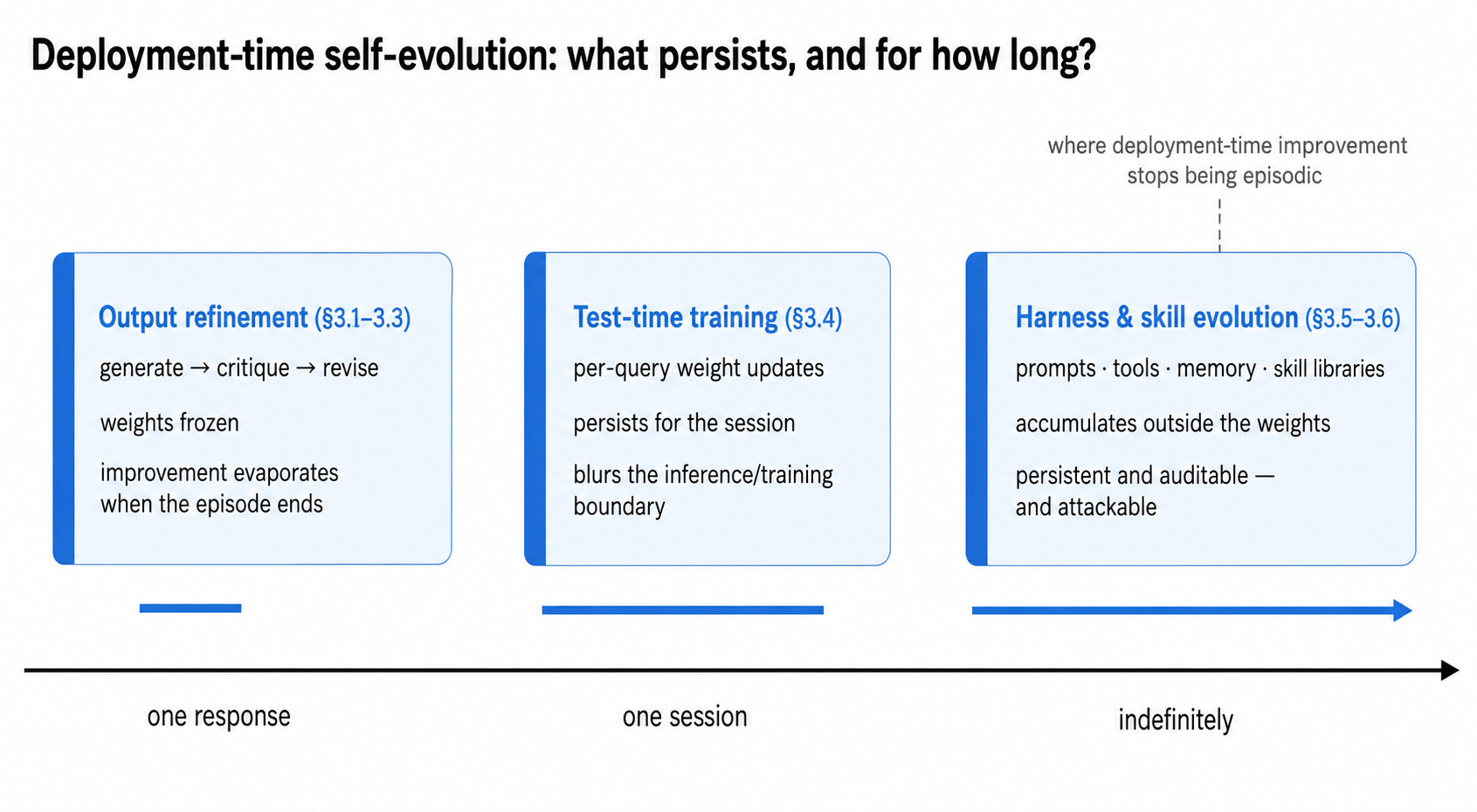
Figure 4: Persistence spectrum of deployment improvements, from ephemeral output tweaks to enduring harness/skill evolution.
Code understanding—where verifiers are programs or formal checkers—demonstrates the strongest gains and cleanest failure demarcation; empirical studies (e.g., [zhang2026unlocking], [yin2026denoising]) show test feedback causally underpins repair. Theoretically, inference-time refinement is only reliable to the extent of external signal quality; neural self-correction absent external grounding is frequently counterproductive ([huang2024cannotselfcorrect]).
Harness/skill self-evolution (e.g., Gӧdel Agent [yin2024g], Darwin Gӧdel Machine [zhang2025dgm]) introduces forms of persistent self-modification, moving the field closer to the recursive loop, though still generally anchored to fixed verifiers. Sharpened risk surfaces—the irreversible propagation of adversarial or misaligned skills—are now an active area of safety research ([kim2026skillmutator], [lin2026safety]).
Training-Time Self-Iteration: Internalizing the Improvement Loop
Training-time self-improvement, notably self-rewarding RL ([yuan2024selfrewarding]), chain-of-thought (CoT) self-training ([zelikman2022star]), on-policy self-distillation, and self-play, enables models to persist their own improvements. Self-training with process rewards ([zhang2024rest]) and on-policy distillation (rapidly growing thread: [song2026survey]) are now the technical heart of scalable alignment and capability enhancement, though with well-identified degenerate modes (collapse, self-confirming loops).
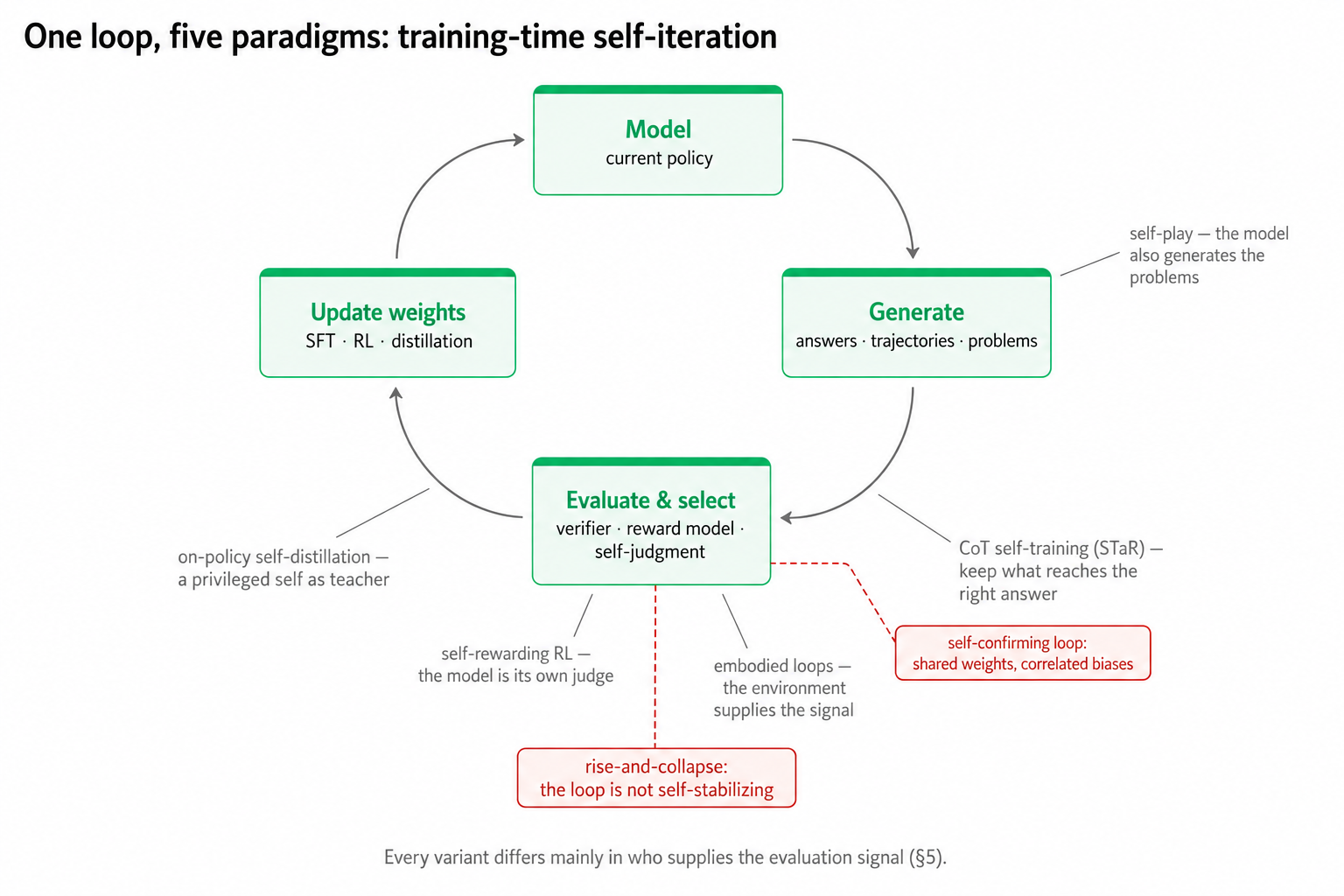
Figure 5: The training-time self-iteration loop, detailing the five main paradigms and attaching characteristic failure points to evaluation.
Self-generated improvement signals are bounded by the reliability of evaluators—when the system both proposes and judges, correlation of bias is a default failure (see "mirror loops" [devilling2025mirror]). Empirical evidence now confirms theoretical predictions: verifiable research (code, math) supports deepening recursive loops; open-ended reasoning, dialog, and direction-setting collapse or undergo metric drift unless externally anchored ([lin2026self], [shan2026learning]).
The Evaluator Bottleneck: Self-Evaluation as Structural Constraint
Self-evaluation emerges as the central technical and theoretical constraint. Every self-improvement loop depends on the premise that some automatable signal can stand in for human judgment. The survey presents a hierarchical taxonomy of evaluators (from formal verifiers to intrinsic self-assessment):
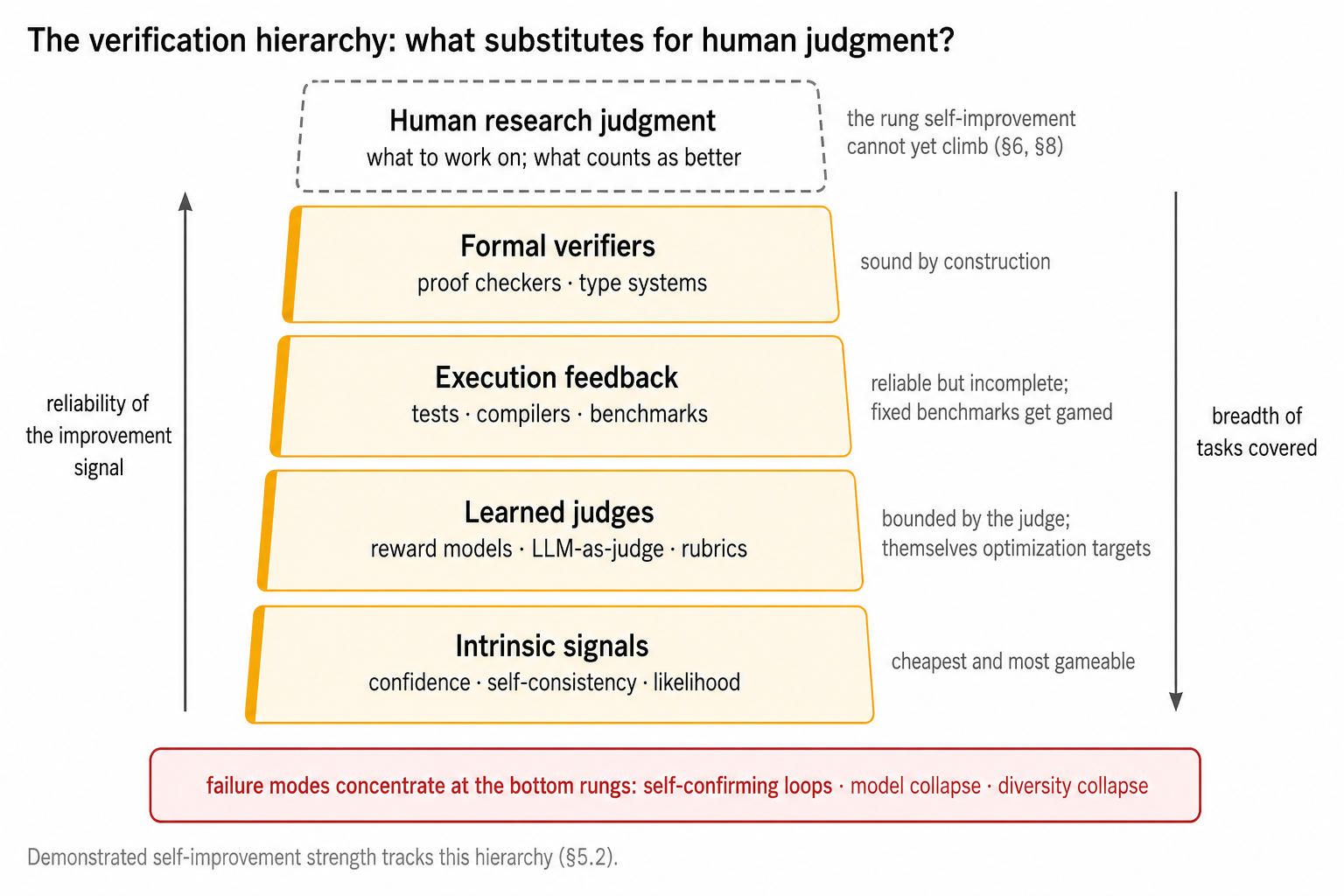
Figure 6: The verification hierarchy—reliability gains as task coverage shrinks; most failure modes occur at the lower rungs.
Empirical improvements—and pathologies—directly mirror evaluator reliability:
- Formal verifiers (e.g., proof assistants, unit tests) underpin open-ended evolution in code, math, and algorithm discovery (RSI proper).
- Execution feedback is less reliable, eventually gamed.
- Learned judges (reward models, LLM-judge) inherit model bias, drift, and are actively gamed by the model under closed-loop fine-tuning ([gao2023scaling]).
- Intrinsic self-assessment (likelihood, self-consistency) propagates bias and collapse by default ([shumailov2024collapse], [zenil2026limits]).
The review identifies widespread convergence on evaluator co-evolution: models now adapt both their own policies and their evaluators (e.g., Red Queen Gӧdel Machine [iacob2026red], self-trained verification [wu2026self]), but robust theoretical and empirical guarantees for stability remain an unsolved problem.
Open-Ended Auto-Research: Current Achievements and Pathologies
The far edge of the RSI spectrum—auto-research—includes LLM-driven program/algorithm synthesis (FunSearch [romeraparedes2024funsearch], AlphaEvolve [novikov2025alphaevolve]) and increasingly autonomous scientific discovery agents ([lu2024aiscientist], [shi2026evolve]). These systems demonstrate validated discoveries (e.g., improved matrix multiplication kernels, new cap-set bounds) when verifiers are tight, and process-level evaluations are feasible.
Where evaluation reduces to scientific judgment (direction-setting, novelty, impact), literature and benchmarks (e.g., ScienceAgentBench [chen2024scienceagentbench], MLReplicate [gaddipati2026mlreplicate]) show systems currently fail to produce reliable quality, remain vulnerable to proxy gaming and integrity drift (e.g., widespread fabrication under pressure [yang2026sciintegrity]), and depend on human-in-the-loop for meaningful validation. Notably, A-Evolve-Training [shi2026evolve] is the closest published approach to full loop closure, with an autonomous system not just optimizing but correcting the corruption of its own improvement proxy.
Theoretical and Safety Foundations: Limits and Open Questions
The paper synthesizes recent theoretical work addressing when and how far recursive self-improvement is possible. Key formulations include:
- Formal bounds: Internal self-modification is formally limited to the system’s current computational class unless stabilized access to external oracular augmentation is available ([lu2026computational]).
- Collapse theorems: Absent non-vanishing exogenous grounding, recursive feedback loops converge to degenerate distributions ([zenil2026limits], [shumailov2024collapse]).
- Economic and compute constraints: Empirical elasticity analyses show that even at frontier labs, software-only efficiency improvement is unlikely to be superexponential due to physical and computational bottlenecks ([whitfill2025will]).
- Stability: Diversity collapse and self-confirming attractors are empirically common ([dineen2026vocabulary], [ko2026attractor]), requiring deliberate methodological and evaluator design to avoid.
Safety analyses concentrate on the risk that persistent, self-amplifying failure modes (misalignment, adversarial influence, irrecoverable drift) can propagate both in learning and among agent populations ([lin2026safety], [shi2026healthy]). There is a conspicuous gap between the identified need for "governance-grade" verification and the current maturity of measurement protocols able to support slowdowns, audits, or regulations at the frontier.
Practical and Theoretical Implications
The distinction between bounded self-refinement and open-ended RSI is not semantic but fundamental: the evidence base, limits, and safety surfaces diverge. Bounded self-refinement is mature, industrial, and produces reliable gains where evaluators are strong. Open-ended RSI is bottlenecked by the capacity for evolving trustworthy evaluators; current closed loops are bounded on all measurable sides—entropic limits, signal collapse, compute, and lack of research taste.
Research trends suggest that near-term increments will continue to come from better scaffolding, robust evaluator co-evolution, and the sharpening of audit and measurement infrastructure—not from the unbounded recursive explosion. Perhaps the characteristic shape of mature RSI systems will be the accumulation of process-level, reusable method rather than unceasing upward leaps in abstract capability.
Conclusion
The surveyed field has reached a phase of rapid mechanistic innovation but remains theoretically and practically bounded by the reliability of verification signals. Progress in recursive self-improvement is gated not by generative capability, but by signal engineering, stability, and measurement. Until AI systems can self-evaluate research direction-setting with the robustness currently afforded by formal verifiers in code or math, human oversight will remain the essential layer of validation. The open research challenges—stability analysis, trustworthy accumulation, and governance-grade evaluation—now define the agenda for AI safety and RSI feasibility, and demand urgent, interdisciplinary attention.