Sharpening Tax in Post-Training
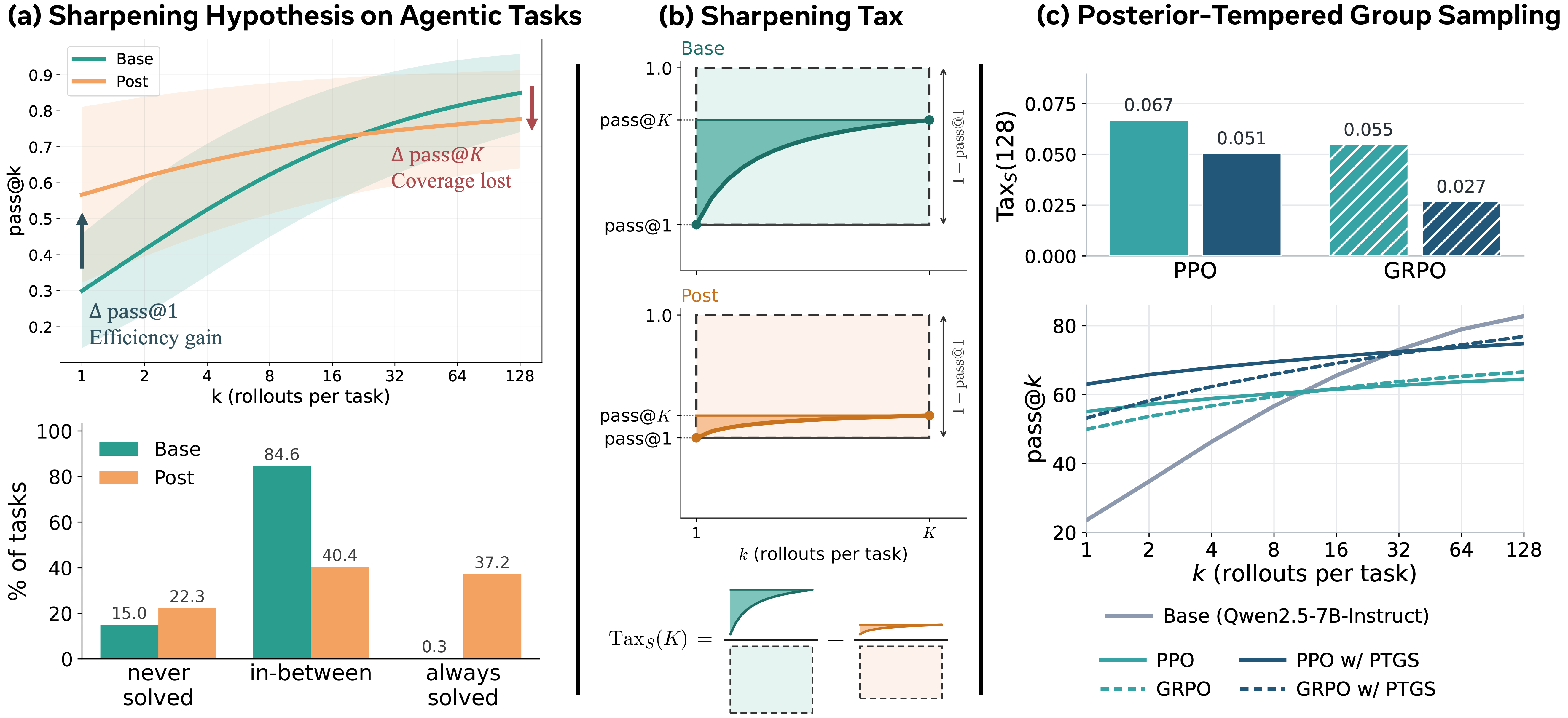
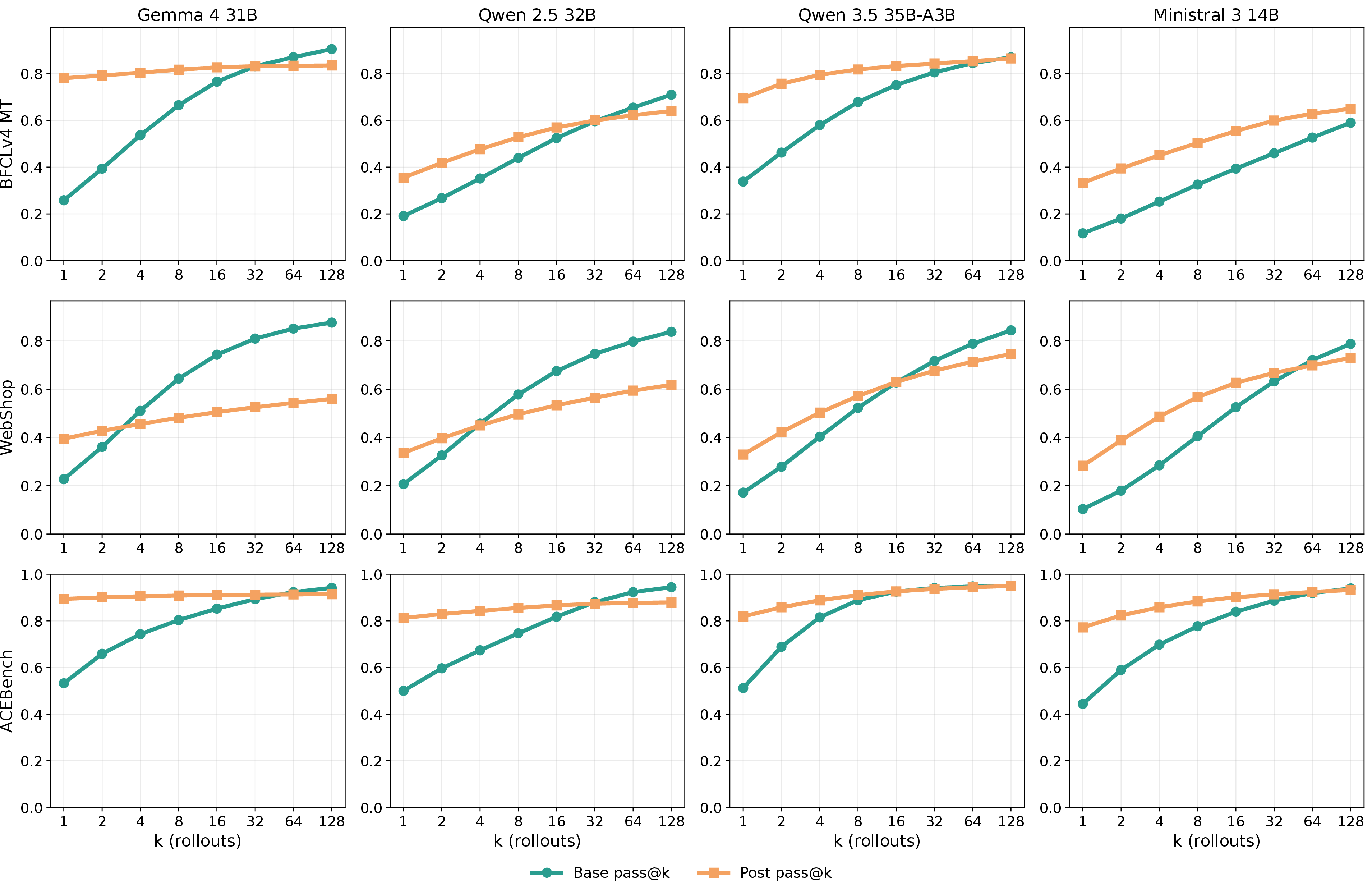
Abstract: An emerging hypothesis about reinforcement learning (RL) post-training of LLMs is that it merely sharpens existing behaviors of a base model, improving single-shot accuracy at the cost of solution coverage. Although this trade-off has been observed in math and coding tasks, it need not extend to agentic tasks, where multi-turn tool use and interaction may require capabilities newly acquired during post-training. Our surprising finding is that pre-trained LLMs, equipped with a light inference harness, can serve as capable agents. Despite far lower accuracy (pass@1), they often surpass their post-trained counterparts in solution coverage (pass@K) given a sufficient test-time budget. We further analyze the underlying mechanism and show that post-training pushes tasks toward two extremes, always solved or never solved, and thereby improves sampling efficiency and consistency at the cost of solution coverage. To measure this cost, we propose Sharpening Tax, a diagnostic metric that quantifies the loss in test-time scalability after post-training. Across 14 base/post-trained model pairs from four families and three agentic benchmarks (42 cases in total), the tax is prevalent in most settings, can be estimated from a few rollouts, and correlates well with other metrics. Finally, we present posterior-tempered group sampling (PTGS), a simple plug-and-play Bayesian sampler that adapts the sampling temperature per prompt to its estimated difficulty. Applied during RL training in two agentic environments, PTGS pays a smaller tax than the fixed-temperature baseline, solving more tasks under repeated sampling while also improving single-shot accuracy.

Paper Prompts
Sign up for free to create and run prompts on this paper.
Top Community Prompts
Explain it Like I'm 14
1. What is this paper about?
This paper studies what happens when a LLM is improved through post-training, especially reinforcement learning (RL).
Post-training can make a model more accurate when it answers once. However, the researchers ask whether this improvement has a hidden cost: perhaps the model becomes very good at only a few ways of solving a problem and loses other possible solutions.
The paper focuses on agentic tasks. These are tasks where an AI must act like an agent—for example, use tools, browse websites, make several decisions, and react to what happens.
The main idea is:
Post-training often makes an AI more reliable on its first attempt, but it may reduce the variety of solutions it can discover when it is allowed many attempts.
The researchers call this hidden cost the Sharpening Tax.
2. What questions did the researchers ask?
The paper investigates several main questions:
- Can a basic, pre-trained LLM solve agent tasks at all? The researchers wanted to know whether these abilities are completely created by post-training or whether they already exist partly inside the original model.
- Does post-training create new abilities or mostly strengthen existing behaviors? This is similar to turning up the volume on a few songs while making other songs quieter.
- What happens when the model gets several chances to solve a task? A model that is not very good on its first try might still succeed if it tries many different approaches.
- Does post-training trade solution variety for consistency? In other words, does the model become more likely to repeat the same answer or strategy?
- Can training be changed so that the model keeps both high accuracy and a wide range of possible solutions?
3. How did they conduct the research?
Comparing base and post-trained models
The researchers compared pairs of models:
- A base model, which had only been pre-trained on large amounts of text.
- A post-trained model, which had received additional training to follow instructions, reason, and solve tasks more effectively.
They studied 14 models from four model families, including Gemma, Ministral, and Qwen. The models ranged from about 3 billion to 35 billion parameters.
A parameter is like a small adjustable setting inside the model. More parameters usually allow a model to represent more complicated patterns.
Testing agentic tasks
The models were tested on three benchmarks:
- BFCL, which checks whether a model can use tools correctly.
- WebShop, where the model must complete shopping tasks on a website.
- ACEBench, which tests different kinds of interactive agent behavior.
These tasks require more than giving a final answer. The model must take the right steps along the way, such as calling a tool, reading the result, and deciding what to do next.
Giving the models many attempts
The researchers used two important measurements:
- pass@1: How often the model succeeds on its first attempt.
- pass@K: How often at least one attempt succeeds when the model is allowed tries.
For example, imagine a student solving a puzzle:
- If the student solves it on the first try, that is like high pass@1.
- If the student is allowed 32 different attempts and succeeds at least once, that is like high pass@32.
The researchers also measured consistency, which means how often all attempts succeed. A highly consistent model gives the same successful result again and again.
Helping base models with a “harness”
The base models were given a simple harness. This was not new training. It was more like giving the model:
- Clear instructions,
- A better way to call tools,
- Help with understanding tool results,
- A system for organizing its actions.
This is similar to giving a beginner better equipment and clearer instructions before asking them to complete a difficult task.
Measuring the Sharpening Tax
The researchers created a metric called Sharpening Tax. It measures how much post-training reduces the benefit of giving a model extra attempts.
A positive Sharpening Tax means:
The base model gets more benefit from trying many times than the post-trained model does.
The tax can often be estimated using only a small number of attempts, rather than testing hundreds of attempts.
Testing a new training method
The researchers also proposed posterior-tempered group sampling, or PTGS.
This method estimates how difficult each task is:
- For an easy task, it makes the model behave more carefully and consistently.
- For a difficult task, it raises the model’s “temperature,” encouraging it to try more varied solutions.
This is like a teacher telling a student:
- “You already know this type of question, so use the method that usually works.”
- “This problem is difficult, so try several different ideas instead of repeating the same one.”
4. What did they discover?
Base models can act as agents
The researchers found that base models could perform agentic tasks surprisingly well when given the simple harness.
They were usually worse than post-trained models on the first attempt. However, when they were allowed many attempts, they often caught up with or passed the post-trained models.
For example, on some tasks, a base model could eventually find successful solutions that the post-trained model rarely discovered.
This suggests that post-training does not always create completely new abilities. Some useful abilities may already exist in the base model but are difficult to access on the first try.
Post-trained models are better at first attempts
Post-trained models generally had higher pass@1.
That means they were more likely to solve a task immediately. This is very useful when:
- Only one attempt is affordable,
- Answers must be produced quickly,
- Mistakes are expensive.
Post-training makes the model more efficient and dependable in these situations.
Base models often have better solution coverage
When many attempts were allowed, base models often had higher pass@K.
This means they had a larger collection of possible successful strategies. They might fail several times, but they could eventually discover a solution that the post-trained model did not try.
A simple analogy is:
- The post-trained model is like a student who quickly uses one well-practiced method.
- The base model is like a student who is less reliable at first but can try many different methods and sometimes solve unusual problems.
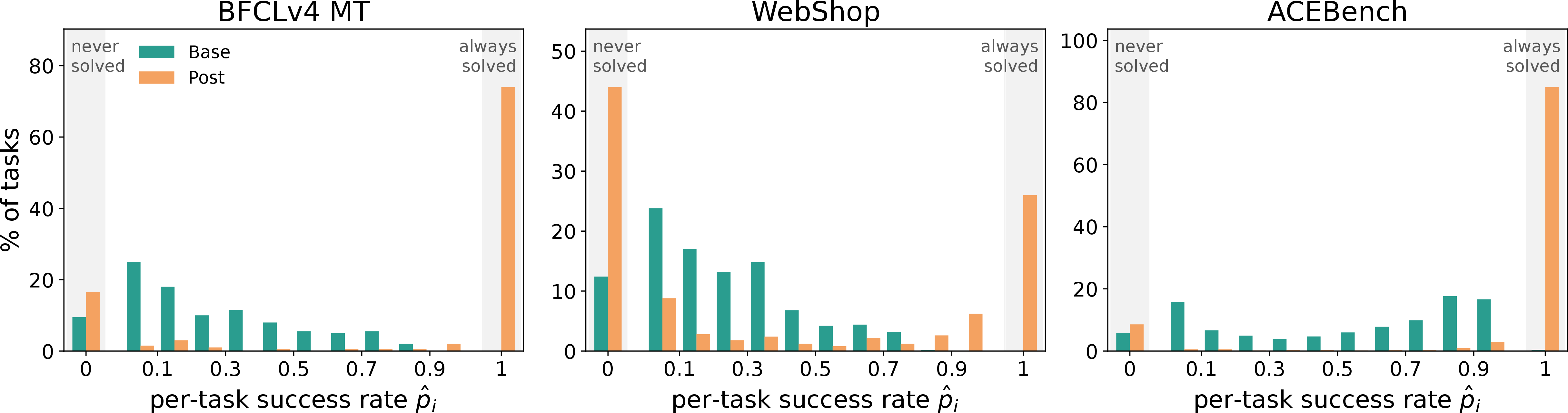
Post-training pushes tasks toward two extremes
The researchers found that post-training often makes tasks fall into one of two categories:
- Almost always solved, or
- Almost never solved.
Before post-training, many tasks were in the middle. The model might solve them after several attempts.
After post-training, fewer tasks remained in this middle range. The model became more certain and repetitive. This improves first-attempt accuracy, but it also means extra attempts are less useful.
This is what the paper means by sharpening: the model’s behavior becomes more concentrated around a smaller number of strategies.
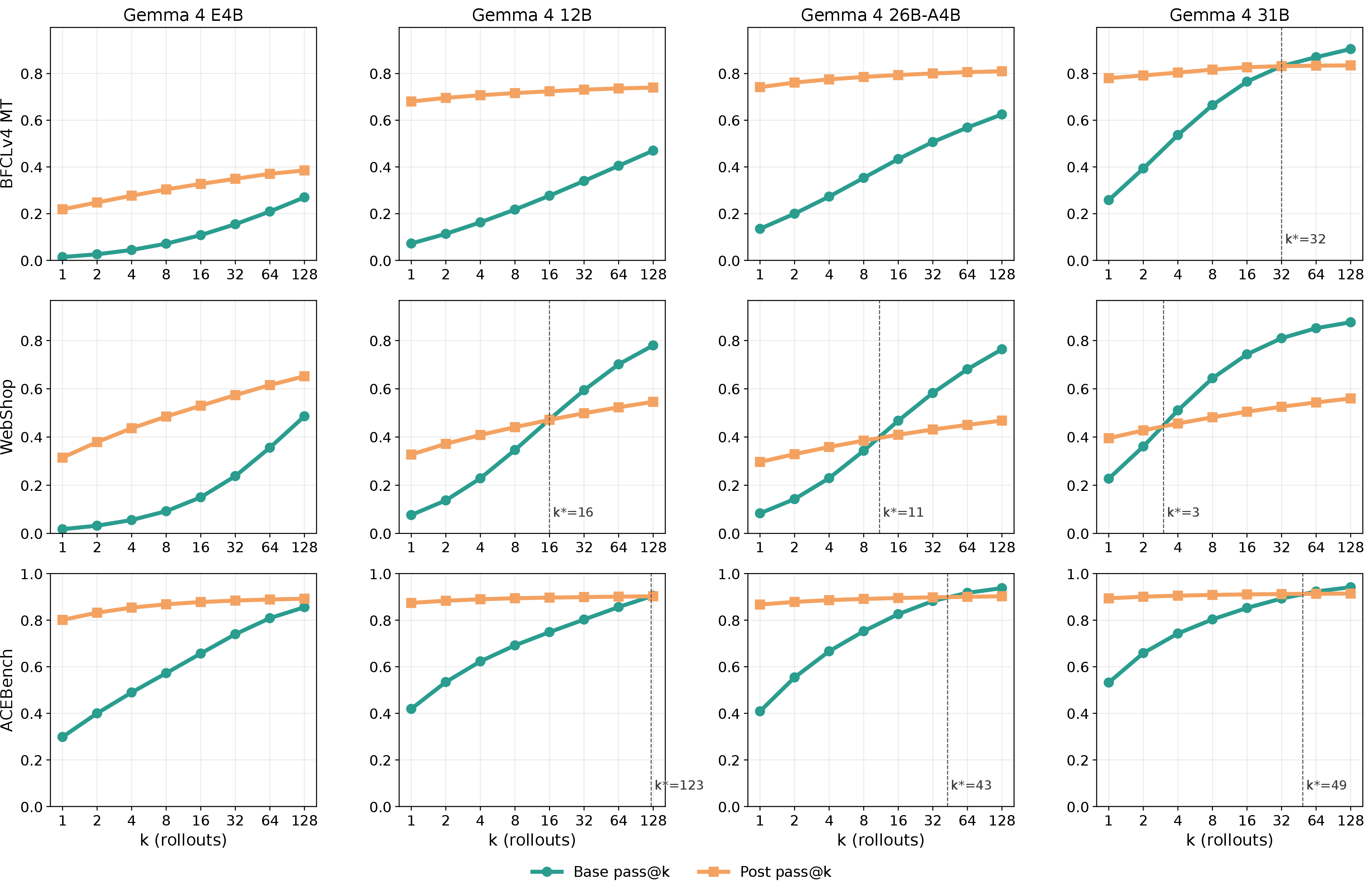
Larger models can pay the tax sooner
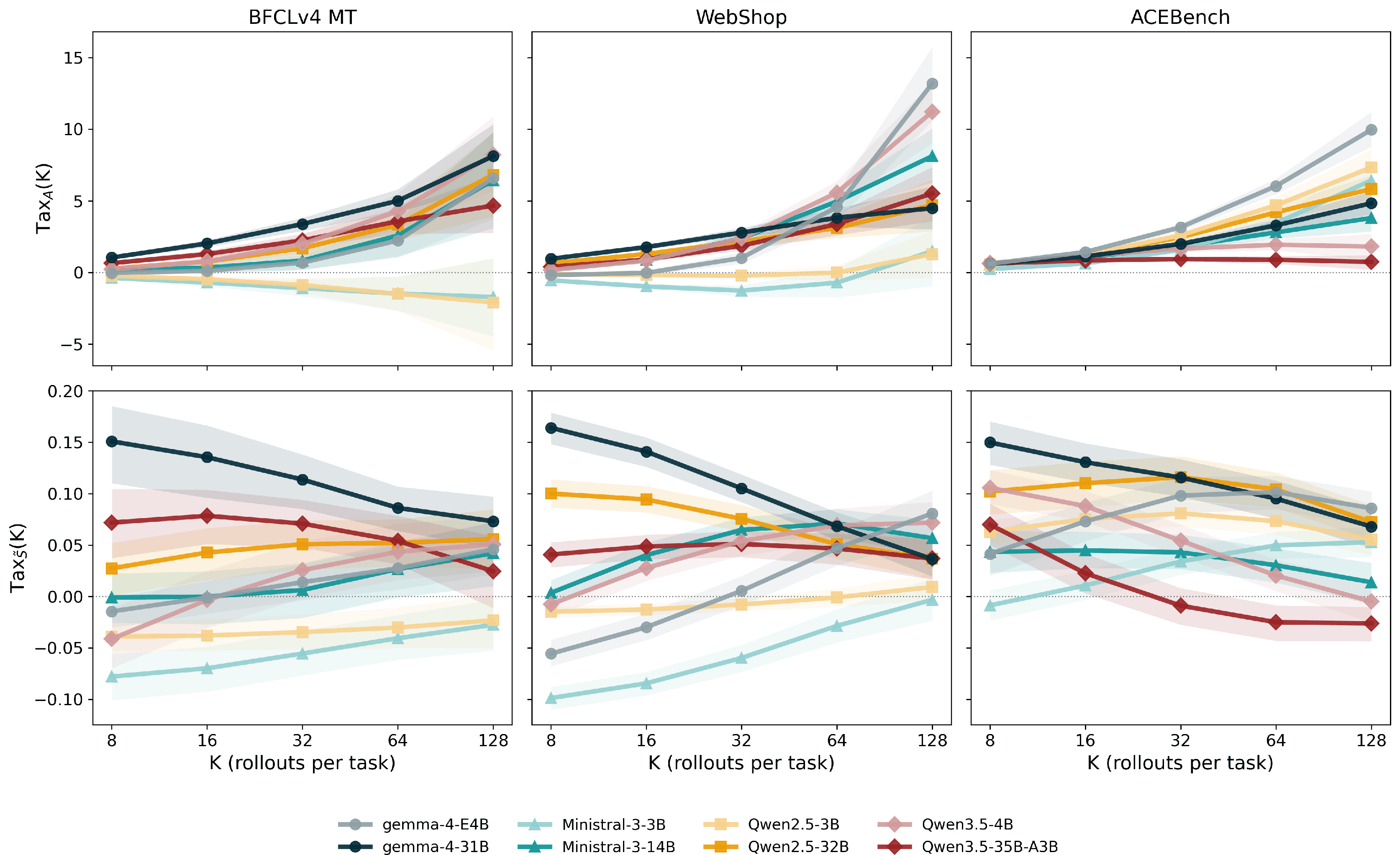
The researchers found that for larger models, the base model could overtake the post-trained model with fewer attempts.
For example, a large base model might become better than its post-trained version after only a few tries. Smaller models sometimes needed many more attempts before this happened.
This means the best choice depends on:
- The model’s size,
- How many attempts are available,
- Whether speed or variety is more important.
The Sharpening Tax appears widely
The researchers tested 42 model-and-benchmark combinations.
At larger rollout budgets, the Sharpening Tax was positive in 36 out of 42 cases. This means the post-trained models usually lost some ability to benefit from repeated sampling.
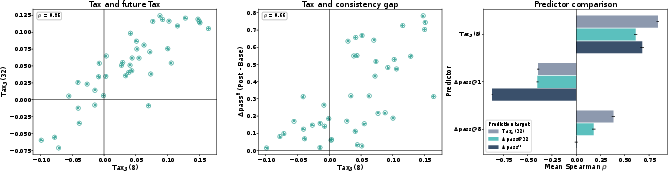
The tax could also be estimated fairly cheaply. A measurement using eight attempts was strongly related to what would happen with 32 attempts.
PTGS improved both accuracy and coverage
The proposed PTGS method performed better than ordinary fixed-temperature training in experiments involving Sokoban and FrozenLake.
Compared with normal RL training, PTGS often:
- Improved first-attempt accuracy,
- Improved success after 128 attempts,
- Reduced the Sharpening Tax.
The reason is that PTGS encourages exploration on difficult tasks while encouraging consistent behavior on easy tasks. It avoids forcing every task into the same narrow behavior pattern.
5. Why are these results important?
The paper challenges the simple idea that post-training always makes a LLM strictly more capable.
Instead, post-training may improve one kind of ability while weakening another:
| Situation | Usually better choice |
|---|---|
| Only one attempt is available | Post-trained model |
| Fast and reliable answers are needed | Post-trained model |
| Many attempts are allowed | Base model may catch up or win |
| Unusual or creative solutions are valuable | A model with broader coverage |
| The task is difficult and uncertain | A model trained to keep exploring |
This does not mean base models are always better. Base models can be less reliable, less organized, and harder to use. The main lesson is that accuracy on one attempt does not tell the whole story.
A model that succeeds 70% of the time on its first try may still be worse for repeated search than a model that succeeds only 40% of the time at first but can discover many more solutions over time.
6. What could this mean for the future?
The findings could affect how AI systems are trained and used.
For AI developers, the paper suggests that training should not focus only on making the first answer correct. It should also preserve the ability to explore different solutions.
This could be important for:
- Scientific discovery,
- Automated research,
- Complex planning,
- Website and computer-use agents,
- Creative problem-solving,
- Tasks where no single strategy works every time.
The PTGS method offers one possible solution. It allows the AI to behave confidently on easy tasks while continuing to explore on difficult ones.
Overall, the paper’s message is:
Post-training can make an AI sharper, faster, and more consistent—but sometimes less flexible. Good AI training should aim for both reliable first answers and the ability to discover new solutions when given extra chances.
Knowledge Gaps
Knowledge gaps, limitations, and open questions
The paper leaves the following issues unresolved:
- Causal attribution to RL remains uncertain. The evaluated “post-trained” checkpoints may combine supervised fine-tuning, preference optimization, RL, and other undisclosed interventions, so the observed sharpening effect cannot be attributed specifically to RL.
- The role of each post-training component is not isolated. Controlled comparisons are needed between SFT, DPO, RL variants, reward-model changes, instruction tuning, and mixtures of these methods using the same base model and training data.
- The harness creates a comparison confound. Base models are evaluated with a custom lightweight harness, whereas post-trained models generally use dataset-default scaffolding; therefore, some of the apparent coverage advantage may arise from unequal prompting, parsing, or tool-interface conditions.
- Harness sensitivity is not systematically characterized. The paper does not establish how results change across alternative system prompts, tool schemas, parsers, error-handling policies, retry mechanisms, or model-specific harnesses.
- The benchmark scope is narrow. The experiments use BFCL, WebShop, ACEBench, Sokoban, and FrozenLake, leaving the generality of the findings to be tested on software engineering, browsing, planning, embodied interaction, scientific workflows, and other long-horizon environments.
- The selected tasks may not represent real deployment distributions. It remains unclear whether sharpening taxes persist on naturally occurring user requests, non-stationary environments, noisy tools, ambiguous goals, and tasks requiring substantial world knowledge.
- The study does not evaluate out-of-distribution generalization. Base and post-trained models are compared primarily on benchmark distributions; their ability to transfer to unseen tools, interfaces, task templates, or environments is unresolved.
- The effect of pre-training data contamination is not measured. The paper argues that agentic behaviors are less prevalent in pre-training data, but it does not quantify benchmark exposure or test whether memorization contributes to the observed coverage patterns.
- The definition of solution coverage may be benchmark-dependent. Pass@ treats any successful rollout as equivalent and does not distinguish robust, efficient, safe, or high-quality solutions from brittle successes.
- Rollout independence is an important unverified assumption. The theoretical analysis assumes conditionally independent rollouts, but shared prompts, decoding infrastructure, cached context, tool state, and correlated model errors may violate this assumption.
- The effect of sequential rather than parallel sampling is unexplored. The reported coverage gains assume multiple independent rollouts, whereas practical agents may adapt later attempts based on earlier failures, feedback, or partial solutions.
- The maximum test-time budget is limited. Most conclusions are based on budgets up to 128 rollouts; it remains unknown whether the base-model advantage persists at much larger budgets or whether post-trained models eventually recover comparable coverage.
- The crossover budget is not given a predictive theory. Although the crossover tends to occur earlier for larger models, the paper does not derive how it depends on model size, parameterization, training compute, task difficulty, or rollout budget.
- Scaling trends are based on a small number of model sizes and families. The apparent relationship between model scale and sharpening may not hold for smaller models, frontier-scale models, mixture-of-experts systems, or models trained with substantially different objectives.
- The bimodalization mechanism is descriptive rather than causally established. The shift toward “always solved” and “never solved” tasks is observed empirically, but the paper does not determine whether it is caused by reward sparsity, mode collapse, KL regularization, data imbalance, optimization dynamics, or selective credit assignment.
- Task-level success probabilities are estimated with limited rollouts. Classifying tasks as always solved, intermediate, or always failed using 128 samples can misclassify prompts with very low or very high but non-extreme success probabilities.
- The metric is sensitive to the chosen evaluation budget. Sharpening Tax depends on and can change sign or magnitude across budgets; the paper does not establish how to select a canonical budget or compare taxes across benchmarks with different difficulty and rollout-cost profiles.
- The normalization in calibrated scalability may obscure meaningful differences. Dividing by single-shot failure probability can produce unstable or difficult-to-interpret values for models with pass@$1$ close to one, and its practical relationship to total inference cost is not fully examined.
- The metric does not account for rollout cost or latency. Equal rollout counts may correspond to very different token lengths, tool calls, wall-clock times, or monetary costs, so Sharpening Tax may not reflect the economically relevant value of test-time scaling.
- Statistical uncertainty for per-task distributions is underdeveloped. Confidence intervals are reported for some aggregate curves, but uncertainty in task-level bimodality, crossover points, tax estimates, and correlations is not comprehensively quantified.
- Predictability results may be overfit to the evaluated model-benchmark combinations. The reported correlations use 42 combinations from a limited set of families and tasks; independent validation across unseen model families, benchmarks, and rollout budgets is needed.
- The relationship between Sharpening Tax and downstream utility is unresolved. It is not shown whether the metric predicts user satisfaction, agent reliability, cost-adjusted success, diversity of valid solutions, or performance in systems that select or verify among multiple rollouts.
- The claim that post-training mainly redistributes existing behaviors is not directly tested. The study does not identify whether post-trained models produce genuinely novel trajectories, tools, plans, or abstractions absent from the base model, nor whether coverage overlap can be measured at the trajectory or behavior level.
- Quality and diversity of alternative solutions are not analyzed. Higher base-model coverage could reflect many redundant or low-quality trajectories; the paper does not measure behavioral diversity, solution novelty, efficiency, or safety among successful rollouts.
- The comparison does not fully control inference-time decoding. Differences in tokenization, stop criteria, maximum lengths, reasoning-mode settings, sampling implementations, and temperature defaults may affect pass@ and consistency.
- Turning off thinking mode may limit ecological validity. The decision to disable explicit reasoning for post-trained models may not reflect their intended use and could alter both their sampling efficiency and coverage relative to ordinary deployment settings.
- PTGS is evaluated in only two environments and one model family. Its effectiveness remains uncertain for other models, larger task pools, sparse or delayed rewards, long-horizon tasks, and environments with changing or continuous difficulty.
- PTGS hyperparameters are not shown to transfer. The choice of target success rate, temperature range, forgetting factor, group size, and target schedule may require substantial tuning; robustness to these choices is not established.
- The per-prompt difficulty estimate may be impractical for large or dynamic task spaces. PTGS maintains state for each prompt and assumes prompts recur, but many real applications involve unique requests, evolving tasks, or continuously changing environments.
- PTGS may introduce fairness and sampling-allocation concerns. Heating difficult prompts can increase their training cost and may deprioritize easy prompts, but the paper does not analyze compute allocation, task starvation, or performance under fixed token and interaction budgets.
- The PTGS mechanism is not compared against strong exploration baselines. Alternatives such as entropy regularization, adaptive global temperature, prioritized replay, curriculum learning, rejection sampling, diverse decoding, or explicit exploration bonuses are not comprehensively evaluated.
- The claimed simultaneous gains may depend on checkpoint selection. GRPO results use the highest validation-success checkpoint, while PPO uses the final checkpoint; this difference may favor particular methods and complicate comparisons of final accuracy and coverage.
- Training-time improvements are not separated from evaluation-time effects. The paper reports that PTGS is removed at test time, but it does not establish whether the resulting gains reflect broader learned policies, altered task memorization, or changes in trajectory length and action distributions.
- Theoretical results rely on highly idealized assumptions. The proportional-tax theorem assumes independent task sharpening, replacement of success probabilities by exactly zero or one, and conditional rollout independence; these assumptions do not directly model continuous policy changes or correlated agent trajectories.
- The theory does not explain when post-training should increase coverage. The analysis characterizes the cost of sharpening but does not provide a general criterion predicting when training creates new capabilities rather than merely concentrating existing ones.
- Safety and failure-mode implications are not examined. A broader base-model trajectory distribution may contain unsafe, invalid, or tool-destructive behaviors, so improving coverage without filtering could worsen operational risk.
- The effects of verifier quality are left open. The practical value of higher coverage depends on the availability, cost, and reliability of trajectory-level verifiers, which are not evaluated across the studied environments.
- Long-term interaction effects are missing. The experiments focus on independent task attempts and do not assess whether repeated deployment changes the environment, user behavior, tool state, or future success probabilities.
Practical Applications
Immediate Applications
- Adaptive model selection for agentic workflows — software, customer support, automation
- Use a small pilot set of approximately 8 rollouts to estimate the Sharpening Tax of a post-trained model relative to its base model.
- Route each task to the post-trained model when low-latency, high-probability success is preferred, and to a harness-equipped base model when the task is difficult, diverse, or benefits from repeated attempts.
- A practical workflow could allocate:
- Post-trained model for single-shot execution and routine requests.
- Base model plus parallel sampling for complex tool-use, browsing, planning, or research tasks.
- A verifier or reranker to select among candidate trajectories.
- Dependencies: reliable task-level success verification, a compatible tool-calling harness, sufficient inference budget, and a model family for which base and post-trained checkpoints are comparable.
- Budget-aware inference routing — cloud LLM platforms and enterprise AI
- Use pass@$1$, pass@, consistency, and early Sharpening Tax estimates to select the cheapest inference strategy for each request.
- For high-confidence prompts, use a low-temperature post-trained model with one or a few attempts.
- For uncertain prompts, increase the rollout budget, invoke a base model, or use adaptive sampling.
- This can support an inference controller that optimizes latency, token cost, and probability of at least one successful solution.
- Dependencies: calibrated cost models, independent or sufficiently diverse rollouts, and task success signals available before final execution.
- Evaluation of LLM agents beyond single-shot accuracy — academia and industrial benchmarking
- Add pass@, consistency, scalability curves, and Sharpening Tax to evaluations of tool-using agents.
- This is especially relevant for:
- Web browsing and shopping agents.
- Coding and software-repair agents.
- API orchestration systems.
- Research assistants.
- Customer-service agents.
- Robotics and simulated environments.
- Benchmark reports should distinguish sampling efficiency from solution coverage rather than treating pass@$1$ as the sole measure of capability.
- Dependencies: benchmarks must verify intermediate actions and environment state transitions; final-answer-only evaluations may overestimate genuine agentic ability.
- Post-training regression testing — model development and MLOps
- Maintain a base-model checkpoint as a reference during SFT, DPO, PPO, GRPO, or other post-training procedures.
- Estimate whether a new checkpoint improves single-shot accuracy while narrowing the set of tasks solvable through repeated sampling.
- Use Sharpening Tax as a release criterion alongside accuracy, latency, safety, and consistency metrics.
- A model release dashboard could show:
pass@1pass@Kat several budgets- consistency
- raw and calibrated Sharpening Tax
- crossover budget between base and post-trained models
- Dependencies: access to a meaningful base checkpoint, stable task distributions, and enough evaluation rollouts to produce statistically reliable estimates.
- Lightweight harnesses for base models — software tools and local AI systems
- Improve the practical utility of base models with a model-agnostic harness that provides:
- Explicit system instructions.
- Relaxed tool-call parsing.
- Structured action schemas.
- Error recovery.
- Context and state management.
- Retry handling.
- Such a harness can make base models useful for exploratory agents without retraining, particularly when many parallel attempts are affordable.
- Dependencies: model compatibility with the chosen prompt and parser, robust sandboxing, and an external verifier capable of rejecting invalid actions.
- Inference-time diversity for research and creative generation — science, engineering, design
- Use base models or less-sharpened policies to generate multiple alternative hypotheses, plans, experiments, designs, or code solutions.
- Apply a domain-specific verifier, simulator, critic, or ranking model to select promising candidates.
- Potential products include:
- Automated literature and experiment ideation systems.
- Engineering design-space explorers.
- Multi-solution code-generation assistants.
- Scientific hypothesis generation pipelines.
- Dependencies: a scalable and trustworthy verifier; without verification, increased coverage may primarily produce more invalid or unsafe candidates.
- Task-adaptive sampling during RL training with PTGS — agent training
- Integrate posterior-tempered group sampling (PTGS) into existing PPO, GRPO, or similar training loops.
- Track discounted per-prompt success and failure counts, estimate prompt difficulty with a Beta posterior, and:
- Heat difficult prompts to encourage exploration.
- Cool easy prompts to preserve reliable behavior.
- PTGS can be implemented as a sampling-layer modification without changing the core RL optimizer.
- Dependencies: repeated exposure to identifiable prompts, binary or scalar success feedback, suitable temperature controls, and hyperparameter tuning for the target success rate, base temperature, group size, and forgetting factor.
- Curriculum and data-allocation control — education, simulation, and enterprise training
- Use per-task success estimates to allocate more training rollouts or human review to tasks in the intermediate difficulty range.
- Easy tasks can be sampled conservatively, while persistently failed tasks can receive:
- More exploratory trajectories.
- Better demonstrations.
- Additional tool documentation.
- Human feedback.
- Environment-specific curriculum interventions.
- This follows the paper’s finding that intermediate-success tasks provide the greatest opportunity for improvement through additional attempts.
- Dependencies: stable task identifiers, meaningful feedback, and a training environment where failures can be diagnosed rather than merely labeled unsuccessful.
- Operational workflow selection in daily life — personal assistants and productivity tools
- A personal AI assistant could use a fast post-trained policy for routine actions such as scheduling, summarization, or form completion.
- For ambiguous tasks—trip planning, household purchasing, troubleshooting, or complex document preparation—it could generate multiple plans using a base or exploratory policy and ask the user to select or approve one.
- Dependencies: clear user confirmation for consequential actions, privacy-preserving local execution where needed, and reliable verification of tool actions.
Long-Term Applications
- Coverage-preserving post-training objectives — LLM research and model alignment
- Develop RL objectives that explicitly optimize both single-shot success and repeated-sampling coverage.
- Possible approaches include:
- Regularizing against excessive policy entropy collapse.
- Penalizing large positive Sharpening Tax.
- Maintaining a diversity archive of successful trajectories.
- Adding coverage-aware reward terms.
- Training with multiple temperatures or policy mixtures.
- The goal would be to retain the reliability of post-trained models without eliminating alternative successful strategies.
- Dependencies: robust definitions of behavioral diversity, protection against reward hacking, and evidence that coverage improvements transfer beyond the training benchmarks.
- General-purpose adaptive inference controllers — autonomous agents
- Build controllers that dynamically choose model checkpoint, temperature, number of rollouts, tool strategy, and verifier strength based on estimated task difficulty.
- A mature controller might:
- 1. Classify the prompt’s difficulty.
- 2. Select a post-trained model for routine cases.
- 3. Escalate hard cases to a base model or model ensemble.
- 4. Increase sampling temperature and rollout count.
- 5. Use a verifier or human approval step.
- This could become a standard architecture for reliable autonomous research, coding, and business-process agents.
- Dependencies: low-cost online difficulty estimation, calibrated uncertainty, fast verifiers, and acceptable latency and compute costs.
- Multi-policy and mixture-of-experts agent systems — software and robotics
- Combine specialized policies with different accuracy–coverage profiles:
- A sharpened policy for exploitation and stable execution.
- A base or exploratory policy for discovering alternative plans.
- A critic or verifier for trajectory selection.
- In robotics, this could support safe controllers for common situations and exploratory planners for novel environments, subject to simulation and safety constraints.
- Dependencies: policy interoperability, shared action representations, safe arbitration, and strong out-of-distribution evaluation.
- Scientific discovery and automated research systems — academia and R&D
- Use high-coverage base models to propose diverse experiments, explanations, algorithms, or literature connections, then use post-trained models and external tools for refinement and execution.
- Sharpening Tax could help determine whether a research agent is genuinely exploring a broad hypothesis space or repeatedly producing variants of a narrow strategy.
- Dependencies: domain simulators or laboratory validation, provenance tracking, intellectual-property controls, and safeguards against fabricated evidence.
- Reliability standards for agentic AI — policy and governance
- Regulators, procurement teams, and standards bodies could require reporting of:
- Single-shot accuracy.
- Success under bounded retry budgets.
- Consistency across attempts.
- Cost and latency per successful outcome.
- Performance on hard and novel tasks.
- Coverage loss after post-training.
- This would discourage selecting systems solely on headline pass@$1$ scores when deployment requires recovery from failures or discovery of multiple valid solutions.
- Dependencies: standardized agentic benchmarks, reproducible model access, transparent reporting of training methods, and agreement on safety-critical evaluation protocols.
- Human–AI collaboration systems that expose alternatives — knowledge work and education
- Future assistants could intentionally preserve multiple valid solutions for brainstorming, tutoring, programming, and decision support rather than converging immediately on one dominant response.
- In education, an exploratory policy could generate several solution paths, misconceptions, or explanations for a teacher or learner to compare.
- In professional settings, the system could present alternative plans with confidence and verification status instead of a single overconfident recommendation.
- Dependencies: pedagogically and professionally appropriate ranking, user-interface support for comparing alternatives, and safeguards against presenting low-quality diversity as equally valid.
- Coverage-aware safety evaluation — healthcare, finance, law, and other high-stakes sectors
- In high-stakes applications, evaluate not only whether the first recommendation is correct but also whether repeated sampling reveals materially different risks or valid alternatives.
- For example:
- Healthcare systems could generate differential diagnoses for clinician review.
- Financial systems could produce alternative risk scenarios.
- Legal systems could identify multiple interpretations or arguments.
- Post-trained consistency may be valuable for routine decisions, while broader coverage is important for rare or ambiguous cases.
- Dependencies: qualified human oversight, domain-specific validators, strict privacy controls, regulatory compliance, and the recognition that model diversity does not substitute for factual correctness.
- Continual-learning systems with task-difficulty memory — adaptive agents
- Store success and failure histories per task type or environment state, allowing future training and inference to focus exploration where the agent repeatedly fails.
- PTGS-like Bayesian updates could be extended to nonstationary environments using richer state representations, hierarchical priors, or contextual bandit methods.
- Dependencies: task identity generalization, resistance to stale or biased historical data, nonstationarity handling, and privacy-preserving telemetry.
- Theoretical development of scaling-aware post-training — foundational ML
- Extend Sharpening Tax beyond independent rollout assumptions to account for:
- Correlated samples.
- Beam search and tree search.
- Sequential self-reflection.
- Tool failures and changing environments.
- Verifier quality.
- Non-binary rewards.
- A more general theory could guide how training objectives should be selected according to deployment budget, model scale, and the value of exploration.
- Dependencies: broader empirical validation across model families, tasks, and modalities; the paper’s current evidence is concentrated on selected agentic benchmarks and relatively limited training experiments.
Glossary
- Agentic task: A task requiring an AI system to pursue goals through actions, tool use, and interaction with an environment. “agentic tasks, where multi-turn tool use and interaction may require capabilities newly acquired during post-training”
- Accuracy headroom: The remaining probability mass available for improving single-attempt success, calculated as one minus single-shot accuracy. “accuracy headroom”
- Actor-critic learner: A reinforcement-learning architecture that combines a policy-learning actor with a value-estimating critic. “an actor-critic learner such as PPO”
- Bayesian sampler: A sampling procedure that uses a probability distribution updated from observed evidence. “a simple plug-and-play Bayesian sampler”
- Bimodalization: The transformation of a distribution so that probability mass concentrates around two distinct extremes or modes. “post-training shows a bimodalization effect”
- Bootstrap confidence interval: An uncertainty interval estimated by repeatedly resampling observed data. “Shades represent 95\% bootstrap confidence intervals.”
- Calibrated scalability: A normalized measure of the benefit obtained from additional test-time computation, adjusted for single-shot failure probability. “Calibrated scalability. We normalize with the expected single-shot failure rate”
- Checkpoint pair: A base model and a corresponding model obtained after additional training. “open-source checkpoint pairs consisting of a pre-trained base model and its post-trained counterpart”
- Consistency gap: The difference between the repeated-sampling consistency of two policies. “the consistency gap between the RL and base models”
- Conditional independence: A probabilistic property in which variables are independent after conditioning on another variable. “assume that repeated rollouts are conditionally independent given ”
- Convergence: The tendency of a learning process or policy distribution to settle toward a stable state or limited set of behaviors. “the policy converges to a few action sequences”
- Coverage: The probability that at least one of multiple sampled attempts succeeds. “ (Coverage)”
- Crossover budget: The number of test-time rollouts at which one model’s performance overtakes another’s. “the crossover budget at which the base model overtakes post-trained model”
- Dataset-independent: Designed without relying on features or conventions specific to a particular dataset. “a dataset-independent, model-agnostic scaffolding”
- Distribution sharpening: The concentration of a model’s probability mass on a smaller number of behavioral modes. “i.e., distribution sharpening”
- Effective parameters: The parameters counted as contributing computationally or functionally to a model’s capacity. “ranging from 3B to 35B effective parameters”
- Empirical success rate: The observed proportion of successful outcomes among sampled attempts. “estimating per-task difficulty online from the empirical success rate of the policy”
- Entropy: A measure of uncertainty or dispersion in a probability distribution. “the average entropy of the output token distribution”
- Exploration-exploitation trade-off: The tension between trying uncertain actions and selecting actions already believed to work well. “a general sampler that balances exploration and exploitation”
- Forgetting factor: A weighting parameter that reduces the influence of older observations in an online estimate. “with a forgetting factor ”
- Group-contrast learner: A reinforcement-learning method that derives learning signals by comparing outcomes within a group of sampled trajectories. “a group-contrast learner such as GRPO”
- Harness: Auxiliary scaffolding, such as prompts and interfaces, that helps a model interact with tools or an environment. “a dataset-independent, model-agnostic scaffolding that combines a simple system prompt with relaxed tool-calling and parsing interfaces”
- Heterogeneous environmental feedback: Feedback from an environment that varies in form, source, or information content. “incorporate heterogeneous environmental feedback under uncertainty”
- Instruction-following: The ability of a model to interpret and execute natural-language directions. “the instruction-following and tool-calling skills that agentic tasks require”
- Long-horizon trajectory: A sequence of actions extending across many interaction steps. “stay coherent over long-horizon trajectories”
- Model-agnostic: Applicable across different model architectures or model families without depending on their internals. “a dataset-independent, model-agnostic scaffolding”
- Multi-turn tool calling: Repeated interaction in which a model invokes external tools over several conversational or environmental turns. “three agentic benchmarks that require multi-turn tool calling”
- Pass@: The estimated probability that at least one of sampled rollouts succeeds. “solution coverage (pass@)”
- Posterior-tempered group sampling (PTGS): An adaptive sampling method that uses a Bayesian estimate of task difficulty to set rollout temperature. “Finally, we present posterior-tempered group sampling (PTGS)”
- Post-training: Training applied after pre-training to modify a model’s behavior, often through supervised or reinforcement-learning methods. “Post-training at scale, particularly via reinforcement learning (RL)”
- Posterior distribution: A probability distribution updated using observed evidence and a prior distribution. “forming the posterior ”
- Pre-trained base model: A model trained on broad data before task-specific alignment or reinforcement learning. “Pre-trained models equipped with a simple harness”
- Prioritized sampling: A training strategy that preferentially samples experiences believed to be especially informative. “intervening in the sampling distribution of training experience can improve the resulting policy’s behavior”
- Prompt-adaptive temperature scaling: Adjusting generation temperature separately for each prompt according to its estimated difficulty. “the prompt-adaptive temperature scaling of PTGS”
- Reinforcement learning (RL): A learning paradigm in which an agent updates its behavior using rewards from interactions with an environment. “post-training of LLMs is that it merely sharpens existing behaviors”
- Rollout: One sampled execution or trajectory generated by a model for a task. “an LLM policy generates independent rollouts for each task”
- Sampling efficiency: The extent to which a policy obtains successful outcomes with relatively few sampled attempts. “pass@$1$ captures the sampling efficiency of a policy”
- Scaffolding: External prompts, interfaces, or procedures that support a model’s task execution. “a simple system prompt with relaxed tool-calling and parsing interfaces”
- Sharpening hypothesis: The hypothesis that post-training amplifies existing high-reward behaviors while suppressing alternatives. “A popular explanation is the sharpening hypothesis”
- Sharpening Tax: A metric quantifying the reduction in test-time scalability caused by post-training. “we propose Sharpening Tax, a diagnostic metric that quantifies the loss in test-time scalability after post-training”
- Signal-to-noise ratio reward-variance filter: A criterion that filters training signals according to the relative strength of reward variation compared with noise. “All runs use 200 training steps and signal-to-noise ratio reward-variance filter.”
- Single-shot accuracy: The probability that one model attempt succeeds. “post-trained LLMs lead in single-shot accuracy”
- Solution coverage: The breadth of distinct tasks or solution strategies that can be reached through repeated sampling. “post-training consistently trades coverage for sampling efficiency”
- Spearman correlation: A rank-based statistical correlation measuring the monotonic relationship between two variables. “achieving a remarkably high Spearman correlation ”
- State transition: A change in the environment’s state resulting from an action. “intermediate actions and state transitions are checked by design”
- Test-time compute: Computational resources used during inference, such as generating multiple rollouts. “base models can also perform agentic reasoning when paired with a lightweight harness”
- Test-time scalability: The extent to which performance improves as additional inference computation or rollouts are allocated. “a diagnostic metric that summarizes the effect of post-training on test-time scalability”
- Thompson sampling: A Bayesian decision strategy that samples from an estimated posterior distribution to select actions. “draws by Thompson sampling”
- Tool-calling: The process by which a model invokes external software, APIs, or environment operations. “invoke diverse tools through scenario-specific interfaces”
- Trajectory: An ordered sequence of states, actions, and outcomes generated during an agent-environment interaction. “an incorrect reasoning trajectory that stumbles onto a lucky final answer”
- Unbiased estimator: An estimator whose expected value equals the quantity being estimated. “each computed with the standard unbiased estimator”
- Validation checkpoint: A saved model state selected using performance on a validation set. “the highest validation success checkpoint in each run”
- Variance: A statistical measure of the spread of a random variable or estimator. “often uses multiple rollouts in practice for cheaper and lower-variance advantage estimates”
- Waiting-time model: A probabilistic model describing the time or number of trials until an event occurs. “connected to classical waiting-time and survival models”

