Post-Training on Office Work Improves Software Engineering: A Behavioral Account of Cross-Domain Transfer
Abstract: Long-horizon tasks require agents to maintain coherent state and goals across nested and branching work. We call this capability goal-directed execution (GDE): the repeated application of four behaviors, namely selecting goals, constructing task-relevant state, maintaining fidelity to higher-level objectives, and verifying completion against the environment. We hypothesize that long-horizon post-training strengthens these behaviors across domains. We test this by post-training Qwen3.5-122B-A10B on 363 Long-Horizon Multi-Tool Agent (LHMTA) tasks drawn from office workflows. The collection contained no software-engineering tasks, yet the model's pass@1 improved by 5.8 points on SWE-Bench Pro. Matched trajectory analysis shows gains in all four GDE behaviors in both office workflows and software repositories. Aggregate SWE-Bench Pro statistics showed related changes in information gathering, implementation, and verification. Together, the results support a behavioral interpretation in which long-horizon post-training changed how the model organized and applied knowledge across tasks, with effects extending beyond the training domain.

Paper Prompts
Sign up for free to create and run prompts on this paper.
Top Community Prompts
Explain it Like I'm 14
1. What is this paper about?
This paper studies whether training an AI model to complete long, complicated office tasks can also make it better at software engineering, even when it was never trained on coding tasks.
The researchers trained an AI model called Qwen3.5-122B-A10B on tasks such as:
- Editing documents and spreadsheets
- Searching through files
- Managing calendars
- Using websites and office tools
- Combining information from several sources
- Completing work with many steps
The surprising result was that the model also became better at fixing software problems. Its score on a coding benchmark called SWE-Bench Pro increased from 20.5% to 26.3%.
The paper argues that the model may have learned a general skill called goal-directed execution, or GDE. This means staying organized and focused while working through a difficult task.
2. What questions did the researchers ask?
The researchers mainly wanted to know:
- Can training on office work improve coding ability?
- Does the model learn general problem-solving habits, rather than just memorizing office-related information?
- What exactly changes in the model’s behavior after training?
- Do the same improvements appear in both office tasks and software tasks?
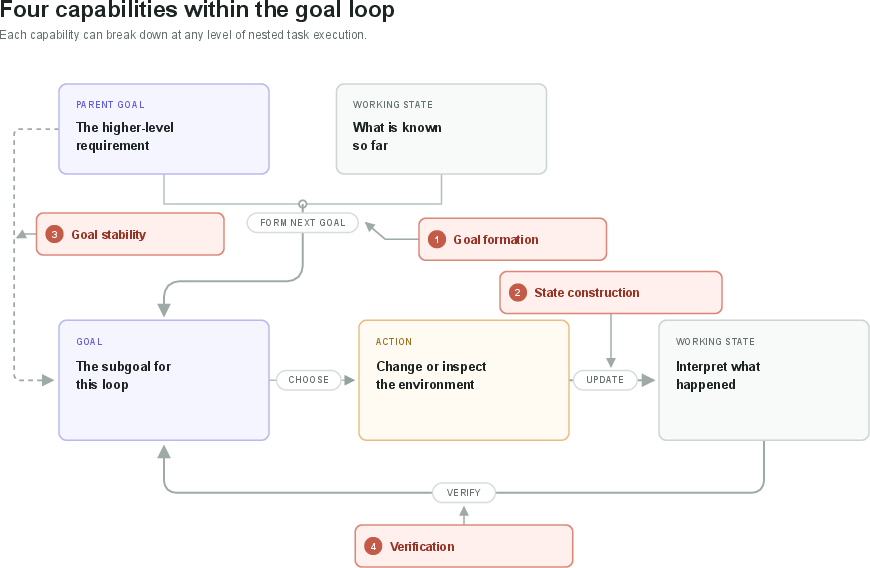
They focused on four important behaviors:
- Goal formation: Choosing the right next step.
- State construction: Collecting and remembering the information needed to make good decisions.
- Goal stability: Keeping the main objective in mind while dealing with smaller problems.
- Verification: Checking whether the work is actually correct.
These are similar to the habits a person needs when completing a large school project. For example, a student must understand the assignment, collect useful information, remember the requirements, and check the final work.
3. How was the research carried out?
Training the model
The researchers used 363 long-horizon tasks from a collection called LHMTA. “Long-horizon” means that the task takes many steps and may involve several connected activities.
For example, an office task might require the model to:
- Find information in several files.
- Compare numbers in a spreadsheet.
- Check dates in a calendar.
- Decide what should be changed.
- Create a final report.
- Check that the report is complete.
The model used digital tools through something called the Model Context Protocol. This is a system that lets an AI interact with tools in a standard way, somewhat like giving a person access to a set of computer programs.
The researchers first showed the model examples of successful work. They then used reinforcement learning, a training method where the model receives a better score when it completes more parts of a task correctly.
A task received a strict pass only if all important requirements were met. The model also received partial credit for completing some requirements.
Testing the model
The researchers compared the original model with the trained model on several tests:
- LHMTA: Similar office and tool-use tasks.
- Toolathlon: Tasks involving many different tools.
- BFCL-V4: Tests of calling computer functions correctly.
- SWE-Bench Pro: Software tasks where the model must fix problems in real code repositories.
The researchers used pass@1, which means the percentage of tasks solved correctly on the model’s first attempt.
Studying the model’s behavior
The researchers also compared the original and trained models while they worked on the same tasks. They examined:
- What the models looked at
- Which files they opened
- Whether they repeated the same searches
- How much code they changed
- Whether they ran tests
- Whether they checked their work properly
This is like comparing two students solving the same assignment and looking not only at their final answers, but also at how they worked.
4. What were the main findings?
The model improved outside its training subject
The biggest finding was that office-task training improved software performance, even though the training data included no software-engineering tasks.
| Test | Original model | Trained model | Improvement |
|---|---|---|---|
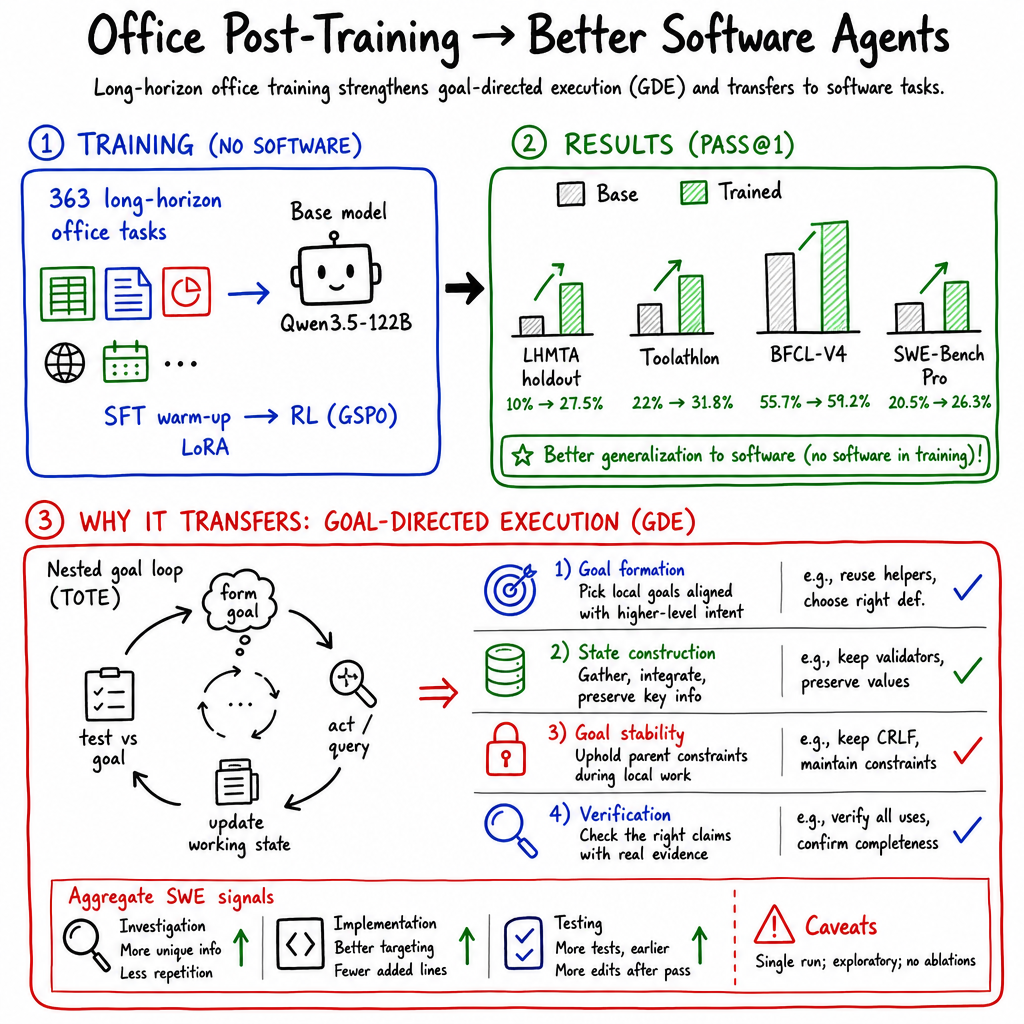
| LHMTA office-task holdout | 10.0% | 27.5% | +17.5 percentage points |
| Toolathlon | 22.2% | 31.8% | +9.6 percentage points |
| BFCL-V4 | 55.7% | 59.2% | +3.5 percentage points |
| SWE-Bench Pro | 20.5% | 26.3% | +5.8 percentage points |
A percentage point increase compares the actual percentages directly. For example, moving from 20.5% to 26.3% is an increase of 5.8 percentage points.
The trained model chose better next steps
The trained model was more likely to understand what a task really required instead of choosing a convenient but incorrect shortcut.
For example, in one coding task, existing helper functions already handled the required behavior. The original model wrote new code and accidentally changed important details. The trained model recognized that it should reuse the existing helpers.
In an office task, the original model used the wrong formula for a conversion rate. The trained model looked at the meaning of the data and chose the correct formula.
The trained model kept better track of information
The trained model was better at collecting and preserving important facts.
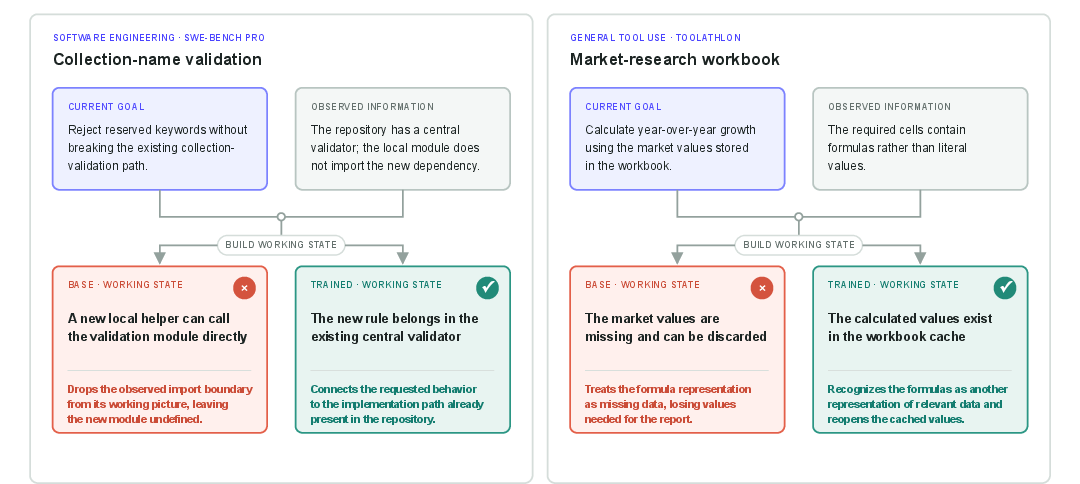
For example, when reading a spreadsheet, the original model saw formulas instead of ordinary numbers and discarded the information. The trained model reopened the spreadsheet in a way that showed the calculated values and kept them for the final report.
In a coding task, the original model saw the relevant validation system but failed to connect it to the new requirement. The trained model found and reused the correct validation path.
The trained model stayed focused on the main goal
Sometimes a small problem can cause an AI to forget an important rule from the original task.
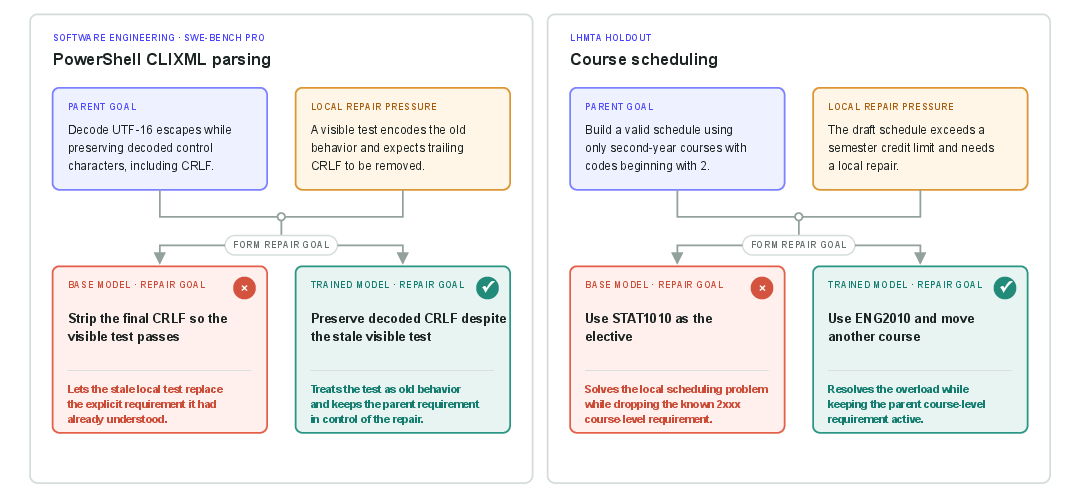
In one example, the original model first understood that certain courses were not allowed in a student schedule. Later, while fixing another scheduling problem, it added one of those forbidden courses anyway. The trained model kept the original rule in mind.
A similar problem appeared in a coding task. The original model changed correct code just to satisfy an outdated test. The trained model followed the task’s actual requirement instead.
The trained model checked its work more carefully
Verification means checking whether the result really satisfies the task, rather than merely checking whether something was produced.
The trained model:
- Ran formal tests in 73.3% of software runs, compared with 37.5% for the original model.
- Began testing earlier.
- Repeated less of the same information during searches.
- Retrieved more unique information.
- Changed fewer lines of code.
- Touched more of the files relevant to the correct solution.
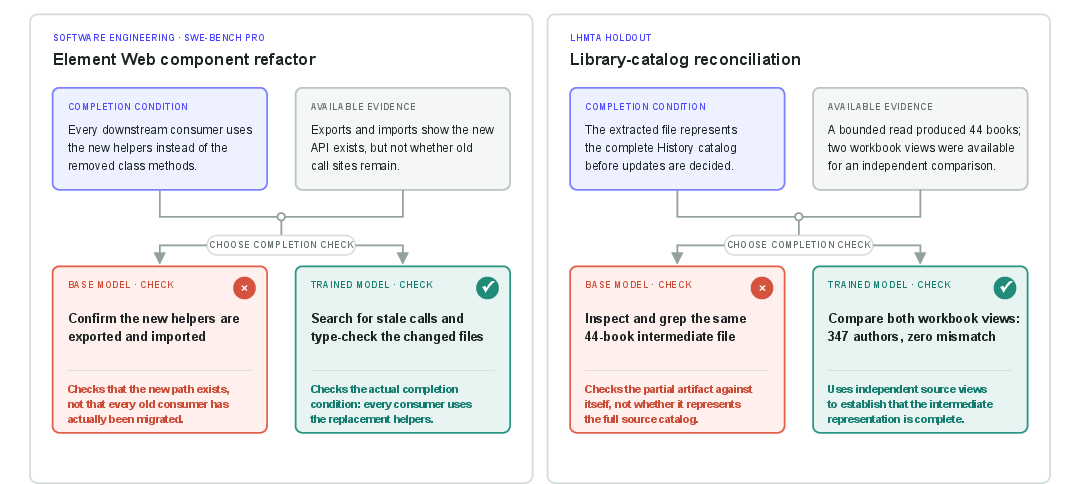
For example, in one coding task, the original model checked that new functions existed but did not search for old code that still used removed functions. The trained model searched for those old uses, updated them, and ran a targeted test.
5. Why are these findings important?
The results suggest that AI training may teach more than specific facts or answers. It may also teach ways of working.
An AI trained on office tasks does not learn the details of every software repository. However, it may learn habits such as:
- Break a large task into smaller tasks.
- Keep track of what has already been discovered.
- Connect small decisions to the main objective.
- Reuse useful existing information.
- Test important results instead of assuming they are correct.
These habits can be useful in many different areas. A person who learns how to organize a science project may also become better at planning a history project, even though the subjects are different. The paper suggests that AI models may work in a similar way.
6. What are the limitations?
The researchers are careful not to claim that they have proven exactly why the improvement happened.
Important limitations include:
- The study used only one model and one training run.
- The researchers did not test every possible type of training data.
- They did not prove that the four GDE behaviors directly caused the improvement.
- Some conclusions came from human interpretation of the model’s actions.
- The behavioral measurements were indirect. For example, a smaller code change is often useful, but it is not automatically better.
- The study did not compare office-task training with an equal amount of software-engineering training.
So, the paper provides strong evidence of a connection, but more research is needed to establish a definite cause.
7. Overall impact
The paper’s main message is that AI training may improve general work habits, not just knowledge about a particular subject.
Training an AI to handle complicated, multi-step tasks could help it become better at many kinds of work, including coding, research, planning, and document management. This could make future AI assistants more reliable when tasks involve many tools, changing information, and several connected decisions.
However, the study also shows that better performance should not be judged only by the final answer. Researchers should examine how an AI works: whether it understands the goal, remembers important information, stays focused, and checks its results. These skills may be important building blocks for making AI systems more dependable.
Knowledge Gaps
Knowledge Gaps, Limitations, and Open Questions
- Reproducibility across models and runs remains untested: The study uses one Qwen3.5-122B-A10B checkpoint and one post-training run, so it is unknown whether the transfer effect replicates across random seeds, model families, model scales, architectures, or alternative post-training algorithms.
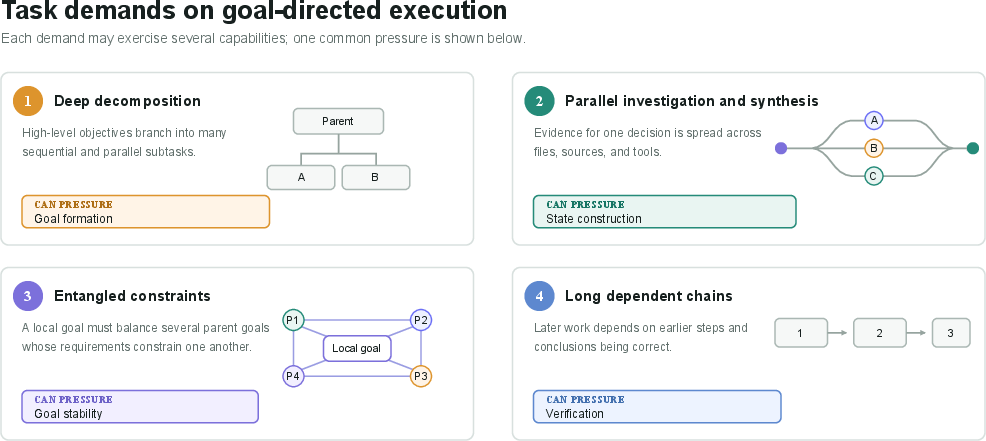
- The causal contribution of long-horizon structure is unidentified: The experiment does not isolate deep decomposition, parallel investigation, entangled constraints, or long dependent chains, leaving unclear which task properties produced the observed transfer.
- The proposed GDE capabilities are not experimentally dissociated: Goal formation, state construction, goal stability, and verification often occur together, so the study does not determine whether one capability is primarily responsible for the SWE-Bench improvement or whether they transfer independently.
- No domain-matched training comparison was conducted: The study does not compare office-task training with an equal-budget software-engineering curriculum, shorter-horizon office tasks, single-tool tasks, or mixed-domain training; therefore, it cannot establish whether non-software long-horizon data is especially efficient for improving software engineering.
- Training-stage effects are confounded: The supervised warm-up on 3,000 teacher-generated trajectories and the subsequent reinforcement-learning stage are not separately ablated, so the relative contributions of imitation learning, RL, dense partial-credit rewards, and trajectory length remain unknown.
- General improvements unrelated to GDE remain plausible: Increased persistence, instruction following, exploration, tool familiarity, context utilization, or reduced repetition could explain some of the gains without requiring improved goal-directed execution.
- The behavioral framework lacks validated annotation reliability: The paper does not report inter-rater agreement, independent annotator labels, annotation guidelines, or quantitative validation of the Claude-assisted root-cause classifications.
- GDE measurements are not fully operationalized at scale: The qualitative analysis identifies the four capabilities, but the paper does not provide a reproducible scoring protocol for measuring goal formation, state construction, or goal stability across complete evaluation distributions.
- The outcome-conditioned trajectory sample is selection-biased: Analysis focuses on the 103 tasks where the base model failed and the trained model passed, excluding regressions, shared successes, shared failures, and trained-model failures; consequently, it cannot estimate the prevalence or overall change in each behavioral failure mode.
- The aggregate metrics are indirect proxies: Retrieval overlap, reference-patch file coverage, patch size, and test execution do not directly establish better state representation, goal stability, or verification quality, and their relationship to task correctness has not been quantitatively validated.
- Reference-patch overlap may mischaracterize valid solutions: The study does not assess whether lower overlap with reference files or larger patches can nevertheless constitute correct and robust solutions, limiting interpretation of these metrics as evidence of improved implementation behavior.
- Statistical uncertainty is not reported: The results provide point estimates but no confidence intervals, significance tests, per-task paired outcomes, bootstrap analyses, or variance across rollouts, making it difficult to assess the robustness of the reported gains.
- The relationship between behavioral metrics and success is unresolved: It remains unknown whether reduced retrieval repetition, earlier testing, smaller patches, or greater reference-file overlap predict success within tasks, or merely correlate with it after training.
- Evaluation coverage is limited: Cross-domain evidence is concentrated largely in SWE-Bench Pro, with additional results from Toolathlon and BFCL-V4; transfer to other programming languages, repository types, coding agents, interactive debugging settings, and non-benchmark software work remains unexplored.
- The scope of transfer beyond long-horizon tool tasks is unclear: The study does not test whether the learned behaviors improve ordinary instruction following, mathematical reasoning, planning without tools, multi-agent coordination, or tasks involving changing or adversarial environments.
- Greedy pass@1 evaluation understates behavioral variability: Results are reported only under greedy decoding, leaving open whether the effect persists under sampling, alternative temperatures, multiple attempts, search, reflection, or different agent scaffolds.
- Potential benchmark contamination is not examined: The paper does not document whether the base or trained model had prior exposure to SWE-Bench Pro repositories, issues, tests, solutions, or related benchmark material during pretraining or intermediate training.
- The source-task distribution is insufficiently characterized: Beyond broad categories and a 363-task count, the paper does not quantify task difficulty, branching depth, dependency length, tool diversity, constraint density, or the distribution of these properties across training and holdout tasks.
- The amount and quality of training experience are not systematically varied: It remains unknown how transfer scales with the number of tasks, trajectory length, teacher quality, task diversity, reward density, or the proportion of successful versus failed trajectories.
- Training and evaluation efficiency are not analyzed: The study does not report compute, wall-clock cost, token consumption, memory requirements, LoRA configuration details, hyperparameters, or performance relative to less expensive training alternatives.
- Robustness to environmental variation is unknown: The paper does not test whether the behavioral improvements survive altered tool schemas, noisy or incomplete observations, stochastic environments, API failures, repository layouts, or unfamiliar interface conventions.
- Long-term retention is unmeasured: No delayed evaluation examines whether the transferred behaviors persist after additional training, across checkpoints, or after extended deployment.
- Goal stability is supported mainly by illustrative cases: Unlike verification and retrieval behavior, goal stability has no clean aggregate metric, so its generality across the evaluated distributions remains uncertain.
- The framework does not specify how to handle competing or changing objectives: Open questions remain about how GDE behaves when user goals are ambiguous, revised mid-task, mutually inconsistent, or in conflict with environmental constraints.
- The mechanism of cross-domain knowledge deployment is unresolved: The paper hypothesizes that post-training improves the application of pretrained knowledge, but it does not measure whether transfer reflects better retrieval, reasoning, latent knowledge access, context management, or policy-level changes.
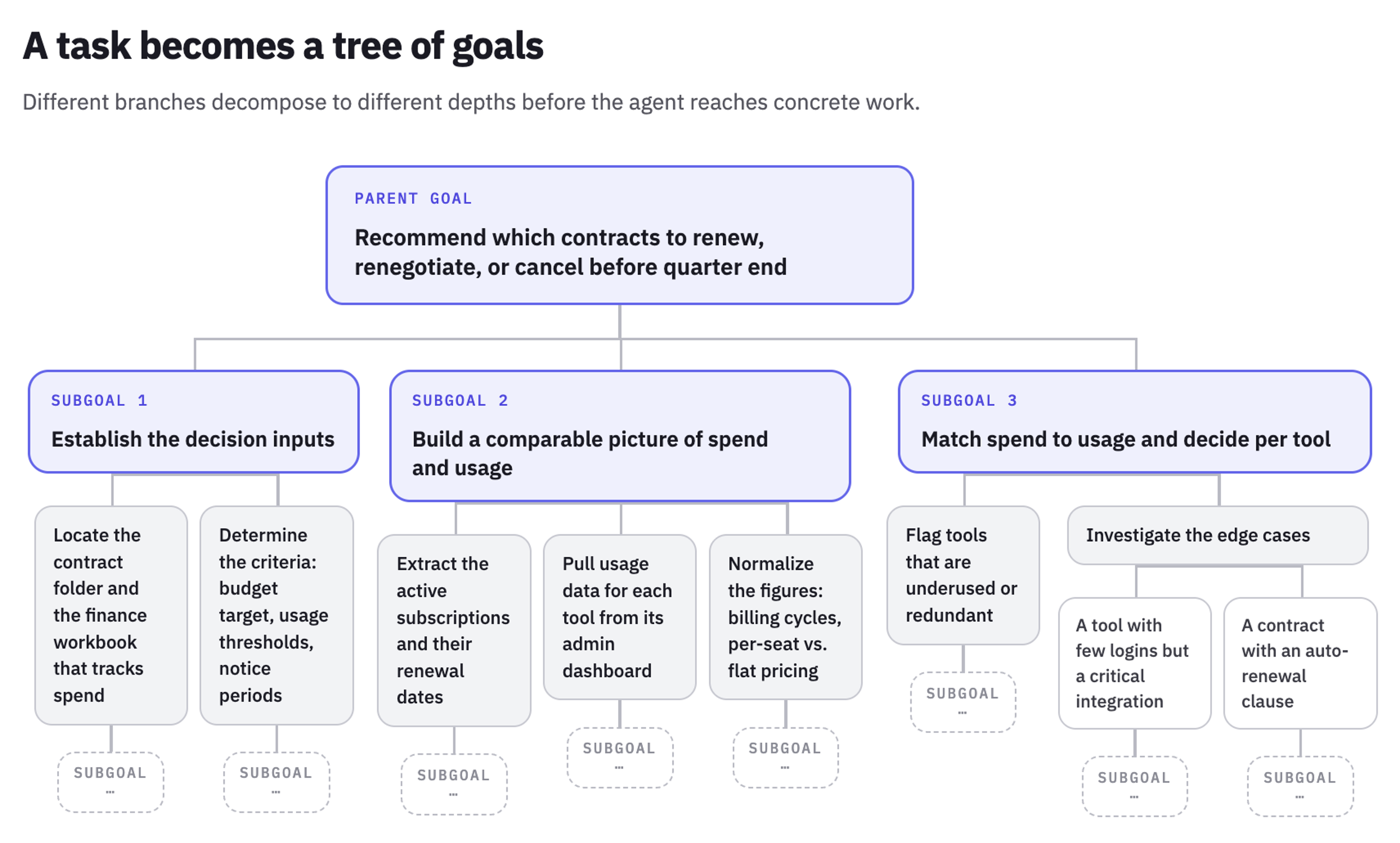
- The reconstructed task hierarchy is not validated as a general representation: The detailed decomposition of one LHMTA task is illustrative and excluded from aggregate analyses; its consistency across annotators, tasks, domains, and actual model behavior remains untested.
- Safety and unintended transfer effects are not evaluated: The study does not examine whether stronger persistence and goal maintenance increase harmful persistence, resistance to correction, overcommitment to mistaken goals, or failures to defer when human intervention is required.
Practical Applications
Immediate Applications
The paper’s findings support deploying long-horizon agents as supervised assistants for workflows that involve decomposition, information gathering, constraint tracking, and verification. These applications are feasible with current models and tool integrations, provided that humans retain approval authority for consequential actions.
- Software engineering: repository-aware coding assistants
- Use post-trained agents to inspect unfamiliar repositories, identify existing helpers and validation paths, implement narrowly scoped changes, search for downstream consumers, and run targeted tests.
- A practical workflow would require the agent to maintain a task checklist, record relevant files and constraints, test intermediate changes, and verify that no stale API calls remain.
- Potential products: IDE agents, pull-request assistants, automated bug-fix systems, and CI-integrated patch-generation tools.
- Evidence from the paper: the trained model produced smaller, more targeted patches, touched more files overlapping with reference implementations, and ran formal tests in 73.3% of trajectories versus 37.5% for the base model.
- Dependencies: reliable repository indexing, sandboxed execution, adequate test coverage, access to build tools, and human code review. Smaller patches and reference-file overlap are only proxies for correctness.
- Office productivity and enterprise operations
- Deploy agents for multi-step document, spreadsheet, calendar, browser, file-management, and service workflows.
- Example use cases include reconciling records across workbooks, preparing reports from multiple sources, coordinating schedules under constraints, managing subscription renewals, and assembling decision briefs.
- Agents should explicitly verify coverage—for example, checking that an extraction includes all relevant records rather than merely producing a coherent output file.
- Potential products: enterprise workflow copilots, spreadsheet-reconciliation tools, automated reporting pipelines, and cross-application task agents.
- Evidence from the paper: performance on the LHMTA holdout rose from 10.0% to 27.5%, while Toolathlon performance rose from 22.2% to 31.8%.
- Dependencies: stable APIs or MCP-compatible tools, consistent permissions, deterministic graders or validation checks, and safeguards against accidental edits to business records.
- Research and knowledge-work assistants
- Use agents to conduct bounded literature searches, gather evidence from multiple repositories, maintain an evidence catalog, synthesize findings, and identify missing information.
- A useful workflow would require the agent to distinguish between retrieved facts, inferred conclusions, and unverified assumptions, while reducing redundant searches.
- Sectors: academic research, market intelligence, consulting, journalism, and competitive analysis.
- Evidence from the paper: the trained model retrieved more distinct information with fewer repeated spans, suggesting improved investigation state management.
- Dependencies: high-quality search and source-ranking systems, citation verification, access controls, and human review for factual and interpretive claims.
- Automated quality assurance and verification
- Integrate goal-directed verification into software, data, and business-process automation.
- Instead of checking only whether an output artifact exists, an agent can test whether the artifact satisfies the substantive requirement: all records were included, downstream references were updated, formulas were evaluated correctly, and constraints remain satisfied.
- Potential tools: agent-generated acceptance-test plans, workflow-completion checkers, data-reconciliation validators, and CI agents that search for unhandled consumers after API changes.
- Evidence from the paper: the trained model tested earlier, ran formal tests more often, and was more likely to edit after a passing test—consistent with verification being used during execution rather than only at the end.
- Dependencies: machine-readable requirements, observable environment state, reliable test runners, and domain-specific validators.
- Agent monitoring and failure diagnosis
- Adopt the paper’s four behavioral categories—goal formation, state construction, goal stability, and verification—as an operational taxonomy for auditing agent trajectories.
- Organizations can label failures according to whether the agent selected the wrong subgoal, lost relevant evidence, abandoned a parent constraint, or accepted insufficient proof of completion.
- Sectors: AI safety, enterprise automation, customer-support operations, software reliability, and model evaluation.
- Potential products: trajectory dashboards, behavioral audit logs, root-cause analysis systems, and regression suites organized by failure type.
- Dependencies: access to complete tool-call histories and environment feedback; inferred goals and states remain behavioral interpretations rather than direct measurements of internal representations.
- Human-in-the-loop task management
- Use agents to generate and maintain hierarchical task plans while routing high-risk decisions to people.
- The system could request approval when a subtask affects a parent requirement, when evidence is incomplete, or when verification fails.
- Daily-life examples: managing travel plans with budget and timing constraints, organizing household records, comparing service contracts, or preparing tax-related documents for review.
- Dependencies: clear escalation policies, privacy-preserving integrations, reversible actions, and user confirmation before purchases, deletions, legal submissions, or other irreversible operations.
- Training-data and evaluation design
- Organizations can use realistic, multi-tool, long-horizon tasks—not only domain-specific examples—to improve and evaluate agent behavior.
- Existing agent-development programs can add tasks involving deep decomposition, parallel evidence synthesis, interacting constraints, and long dependent chains.
- Academic and industrial use: benchmark construction, post-training data selection, model comparison, and red-team evaluation.
- Dependencies: the transfer effect has been demonstrated for one model and one training run only; immediate adoption should therefore treat this as an evaluation hypothesis, not a guaranteed training recipe.
Long-Term Applications
The paper also suggests broader applications that require controlled experiments, stronger reliability guarantees, scaling, or domain-specific validation. These possibilities should not be inferred as established outcomes from the single reported experiment.
- General-purpose autonomous enterprise operators
- Develop agents capable of managing complete workflows across finance, procurement, human resources, compliance, customer operations, and IT.
- For example, an agent might collect contracts, compare spending and usage, check renewal deadlines, investigate exceptions, produce recommendations, and submit approved changes.
- GDE-style control could provide the agent with persistent parent goals, branch-level state, constraint tracking, and verification gates.
- Dependencies: robust identity and authorization management, transactional rollback, auditability, privacy protection, resistance to prompt injection, and much higher reliability than the reported benchmark pass rates.
- Healthcare administration and clinical-support workflows
- Long-horizon agents could reconcile patient records, coordinate appointments, prepare prior-authorization packages, gather evidence for clinical review, or check that required documentation is complete.
- The four capabilities map naturally to healthcare requirements: preserving patient-level constraints, integrating records from multiple systems, and verifying that no required field or contraindication was omitted.
- Dependencies: validated clinical data, interoperability standards, regulatory approval, patient privacy, explainability, bias evaluation, and mandatory clinician oversight. The paper provides no direct evidence of clinical safety or diagnostic performance.
- Robotics and embodied task execution
- Transfer GDE principles to household, warehouse, laboratory, and field robots that must pursue nested goals in changing environments.
- A robot could decompose “prepare a shipment” into locating items, checking inventory, handling exceptions, packing safely, and verifying the final package.
- Working-state construction would combine visual observations, sensor data, maps, and task constraints; verification would require physical confirmation rather than language-only completion claims.
- Dependencies: grounding between language and physical state, real-time perception, safe exploration, recovery from hardware failures, latency guarantees, and extensive simulation-to-real-world testing.
- Education and personalized learning systems
- Build tutoring agents that maintain long-term learning objectives while adapting local exercises to student performance.
- The agent could track prerequisite knowledge, detect when a learner is using a superficial proxy, verify mastery through varied assessments, and return to the curriculum-level goal after addressing a local misconception.
- Potential products: adaptive tutors, teacher planning assistants, curriculum auditors, and student project-management systems.
- Dependencies: valid educational assessments, age-appropriate interaction, teacher oversight, protection against overreliance, and evidence that GDE improvements translate into learning outcomes rather than merely better task completion.
- Energy and infrastructure management
- Apply long-horizon agents to coordinate distributed evidence and constraints in energy scheduling, maintenance planning, and infrastructure operations.
- An agent could combine demand forecasts, equipment status, maintenance windows, regulatory constraints, and weather data before recommending or executing a plan.
- Verification could compare predicted and actual system states at intermediate boundaries.
- Dependencies: real-time data quality, safety-critical controls, secure interfaces, formal validation, human authorization, and resilience to outages or adversarial manipulation.
- Finance, procurement, and compliance automation
- Use agents to reconcile transactions, review contracts, identify policy violations, monitor deadlines, and prepare audit evidence.
- Goal stability is particularly relevant where a cost-saving local action could violate a legal, contractual, or risk constraint.
- Potential products: procurement-review agents, expense auditors, contract-renewal systems, and regulatory reporting assistants.
- Dependencies: jurisdiction-specific rules, explainable decision trails, segregation of duties, data confidentiality, tolerance for false positives and negatives, and independent audit validation.
- Autonomous scientific experimentation
- Combine GDE with laboratory automation so agents can plan experiments, select measurements, update hypotheses from results, and verify whether experimental objectives were actually met.
- Nested goal loops could support protocol preparation, instrument configuration, data-quality checks, analysis, and follow-up experiments.
- Dependencies: reliable laboratory robotics, calibrated instruments, reproducibility standards, scientific judgment, safety controls, and mechanisms preventing the agent from optimizing a proxy measurement instead of the research objective.
- Behavior-aware agent architectures
- Use the four capabilities as explicit control modules or learned auxiliary objectives in future architectures.
- Possible mechanisms include hierarchical memory, parent-goal reminders, constraint ledgers, evidence catalogs, automatic subgoal generation, and verification policies trained separately from action policies.
- This could lead to products such as agents that maintain a machine-readable task graph and require evidence before closing each node.
- Dependencies: research must determine whether explicit scaffolding improves reliability beyond the post-training effect, whether the capabilities are separable, and how they interact with inference-time planning, memory, and reflection.
- Transfer-oriented post-training curricula
- Construct training mixtures deliberately around structural demands—deep decomposition, parallel investigation, entangled constraints, and dependent chains—rather than organizing data solely by subject area.
- A future curriculum might train agents on office tasks, simulation environments, software repositories, web research, and physical environments while holding task structure constant.
- Academic value: this would test whether GDE is genuinely domain-general and identify which task properties cause transfer.
- Dependencies: randomized ablations, multiple model families and seeds, matched training budgets, domain-matched controls, and evaluation on unseen domains are necessary before this can become a dependable engineering methodology.
- Policy and standards for auditable autonomous agents
- The paper’s behavioral framework could inform standards requiring agents to expose their active objective, relevant evidence, unresolved constraints, verification steps, and reasons for escalation.
- Regulators and organizations could require trajectory-level records for high-impact systems, analogous to audit logs in financial or safety-critical software.
- Potential outputs: certification protocols, minimum verification requirements, standardized long-horizon-agent benchmarks, and incident-reporting taxonomies.
- Dependencies: privacy-preserving logging, interoperable definitions of completion and verification, protection against fabricated reasoning traces, and empirical evidence that behavioral logs predict real-world reliability.
Glossary
- Agentic RL: Reinforcement learning in which an agent performs sequences of actions in an environment to accomplish tasks. “In agentic RL, training domains with richer observations and longer policy trajectories have also been associated with stronger cross-domain retention”
- Attention projections: Neural-network transformations that compute how strongly tokens should attend to one another. “We adapted it using LoRA on the attention and MLP projections”
- Behavioral account: An explanation based on observable behavior rather than unobserved internal mechanisms. “Post-Training on Office Work Improves Software Engineering: A Behavioral Account of Cross-Domain Transfer”
- Behaviorally inferred representation: A model of an agent’s state reconstructed from its observable actions and responses. “the agent's current, behaviorally inferred representation of the environment”
- BDI architectures: Agent architectures organized around beliefs, desires, and intentions. “BDI architectures likewise made belief state and the stability of intentions explicit”
- Benchmark transfer: Improvement on an evaluation benchmark that was not used during training. “Benchmark transfer alone does not identify what changed in the model's behavior.”
- Causal counterfactual: A hypothetical comparison intended to determine whether a particular factor caused an observed effect. “No causal or domain-matched counterfactual.”
- Causal link: A proposed cause-and-effect relationship between two phenomena. “the proposed causal link to long-horizon task structure remains a hypothesis.”
- Checkpoint: A saved state of a trained model used for evaluation or further training. “We compared the base and trained checkpoints on the in-distribution holdout and on external benchmarks.”
- Cognitive architecture: A computational framework modeling general cognitive processes and their interactions. “Cognitive architectures provide the closest precedents for the full model”
- Cognitive control: The regulation and maintenance of goal-directed behavior despite competing information or actions. “Cognitive control research emphasizes the active maintenance of goals against interference”
- Context management: Organizing and preserving information available to an agent during extended task execution. “Recent long-horizon scaffolds connect decomposition to context management more directly.”
- Cross-domain retention: Preservation of learned capabilities when an agent is evaluated in a different domain. “stronger cross-domain retention than domains with greater realism or surface similarity.”
- Cross-domain transfer: Application of capabilities learned in one domain to tasks in another domain. “it documents cross-domain transfer from non-software long-horizon post-training to SWE-Bench Pro.”
- Dense reward: A training reward provided in proportion to partial progress rather than only at complete success. “each full trajectory received a dense reward equal to the fraction of grader criteria it satisfied.”
- Decomposition: Breaking a complex task into smaller, more manageable subtasks. “An action that is too abstract to execute may decompose into lower-level goals”
- Deterministic grader: An evaluator that produces the same assessment for the same environment state and criteria. “Each task has a deterministic Python grader that evaluates the final environment state against several criteria.”
- Domain-general: Applicable across different subject areas or environments rather than being specialized to one. “We hypothesize that GDE is a domain-general requirement for complex agentic tasks.”
- Environment state: The objectively true condition of the external task environment. “Environment state is what is actually true”
- Entangled constraints: Requirements whose interactions make local decisions affect multiple objectives. “Entangled constraints: high-level requirements interact, making local decisions challenging.”
- Evidence catalog: A structured mapping from modeled task elements to supporting trajectory events. “An evidence catalog links the modeled nodes to the corresponding trajectory events.”
- External benchmark: An evaluation set or task suite separate from the training collection. “Toolathlon and BFCL-V4 show that some gains extend beyond LHMTA's particular tasks”
- Function calling: The ability of a LLM to produce structured requests to invoke external tools or functions. “BFCL-V4 evaluates function calling”
- Goal-directed execution (GDE): The sustained coordination of goals, state, actions, and verification across complex tasks. “We call this capability goal-directed execution (GDE)”
- Goal drift: A behavioral shift in which an agent stops pursuing its original objective. “Goal drift has also been measured behaviorally”
- Goal formation: Deriving an appropriate immediate objective from a higher-level goal and current state. “Goal formation: deriving the correct immediate target from the parent goal and current working state.”
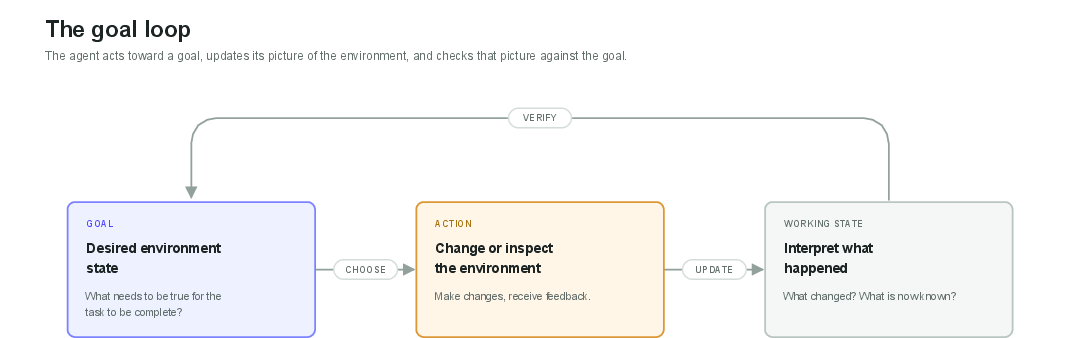
- Goal loop: A recursive cycle in which an agent forms a goal, acts, updates its state, and checks completion. “We represent task execution as a goal loop.”
- Goal misgeneralization: Pursuing an incorrect objective despite retaining relevant capabilities. “goal misgeneralization, in which an agent retains its capabilities yet pursues the wrong goal”
- Goal stability: Maintaining higher-level requirements while performing lower-level work. “Goal stability: maintaining higher-level requirements and intended outcomes while pursuing lower-level work.”
- Greedy decoding: Generating each next token by selecting the currently highest-probability token. “All results are pass@1 under greedy decoding.”
- Hierarchical reinforcement learning: Reinforcement learning that organizes behavior into multiple levels of subtasks or policies. “hierarchical RL builds subtask hierarchies into the agent as learnable structure”
- Hierarchical task network (HTN) planning: Planning that recursively decomposes tasks using predefined methods. “HTN planning decomposes tasks through hand-authored methods”
- In-distribution evaluation: Testing on data drawn from the same task distribution as training. “40 reserved for in-distribution evaluation.”
- Information retrieval: Locating and extracting relevant information from files, services, or other sources. “Mean distinct retrieved information”
- Instruction tuning: Training a model to follow natural-language instructions effectively. “instruction tuning improves their ability to apply it in response to user intent”
- Long-horizon task: A task requiring many dependent actions and sustained state and goal management. “Long-horizon tasks require agents to maintain coherent state and goals across nested and branching work.”
- LoRA: Low-Rank Adaptation, a parameter-efficient method that trains small low-rank updates instead of all model weights. “We adapted it using LoRA on the attention and MLP projections”
- Machine psychology: The study of machine behavior through input-output relationships rather than presumed internal states. “machine psychology, which defines itself by analyzing input-output relationships rather than inner workings”
- Mixture-of-experts model: A neural model containing multiple expert subnetworks, with only some activated for each input. “an open-weight mixture-of-experts model with 122 billion total and approximately 10 billion active parameters.”
- Model Context Protocol (MCP): A protocol for connecting LLMs to external tools and services. “exposed as RL environments through Model Context Protocol tools”
- Nested goal loop: A goal loop embedded within a larger loop as part of hierarchical task execution. “complex tasks contain nested and branching goal loops.”
- Observation richness: The amount and variety of environmental information available to an agent. “training domains with richer observations and longer policy trajectories”
- Outcome-conditioned subset: A sample selected according to a particular observed outcome. “We selected this outcome-conditioned subset to study how newly successful behavior manifested.”
- Pass@1: The proportion of tasks solved by the first or single evaluated attempt. “All results are pass@1 under greedy decoding.”
- Policy trajectory: The sequence of states, actions, and observations produced by an agent’s policy. “longer policy trajectories have also been associated with stronger cross-domain retention”
- Post-training: Training performed after pretraining to improve task performance or behavioral capabilities. “We hypothesize that long-horizon post-training strengthens these behaviors across domains.”
- Procedurally diverse environment: An environment generating varied tasks or situations through programmatic procedures. “the RL analogue holds for procedurally diverse environments”
- Proxy measure: An indirect metric used to represent a construct that cannot be measured directly. “Retrieval overlap, reference-file coverage, patch size, and testing commands are indirect behavioral signals.”
- Rejection sampling: Selecting generated examples that meet a specified quality or score threshold. “rejection-sampled to retain trajectories scoring above 0.9.”
- Recursive decomposition: Repeatedly breaking subtasks into still smaller subtasks. “ReCAP recursively decomposes plans”
- Reinforcement learning (RL): Training through interaction with an environment using rewards for behavior. “Second, we trained on all 363 tasks using the GSPO sequence-level estimator”
- Retrieval overlap: The degree to which information retrieved during a run overlaps with information retrieved previously or in a reference patch. “Reference patches do not uniquely specify a valid implementation strategy, and smaller patches are not inherently better.”
- Sparse reward: A reward signal provided only rarely, typically upon successful completion. “The warm-up made reinforcement learning feasible: the base policy rarely completed enough of a long-horizon task to receive a sparse pass/fail reward.”
- State construction: Gathering, interpreting, integrating, and preserving information needed for decision-making. “State construction: gathering, interpreting, integrating, and preserving the environment information needed to guide local and higher-level decisions.”
- SWE-Bench Pro: A benchmark for evaluating agents that resolve issues in realistic software repositories. “SWE-Bench Pro requires agents to resolve issues in realistic repositories”
- Task graph: A structured representation of task steps and their dependencies. “we reconstructed a successful LHMTA trajectory as a recursive task graph.”
- Tool orchestration: Coordinating multiple external tools or services to complete a task. “Toolathlon measures long-horizon orchestration across heterogeneous tools”
- Trajectory analysis: Examination of the sequence of actions, observations, and outcomes produced during task execution. “Matched trajectory analysis shows gains in all four GDE behaviors”
- Transfer hypothesis: The proposal that capabilities learned in one task domain can improve performance in another. “Our transfer hypothesis is that tasks from different domains can place similar demands on GDE.”
- Verification: Checking whether evidence demonstrates that the intended state or goal has been achieved. “Verification: determining what evidence would establish that the intended state has been reached”
- Working memory: A temporary representation used to retain and manipulate information during task execution. “HiAgent organizes working memory into subgoal-based chunks”
- Working state: An agent’s current representation of the environment as it relates to active and parent goals. “Working state: the agent's current, behaviorally inferred representation of the environment as it relates to its active and parent goals.”
Collections
Sign up for free to add this paper to one or more collections.

