- The paper establishes that at the CP-conserving point, the averaged non-Clifford magic—quantified by the stabilizer Rényi entropy M2—is locally minimized.
- It employs a spin-effective Hamiltonian model and conditional two-qubit maps to simulate elastic np scattering and quantify quantum resource generation.
- Numerical results reveal a quadratic increase in magic due to CP-violating perturbations, underscoring robust signatures for effective field theory analyses.
Local Magic Minima at the CP-Conserving Point in Low-Energy Neutron-Proton Scattering
Introduction and Motivation
This work investigates the information-theoretic properties of neutron-proton (np) scattering at low energies, embedding CP-violation diagnostics within the quantum resource framework of nonstabilizerness (Magic). The central technical innovation is to model the two-nucleon spin dynamics as a conditional two-qubit map, analyze the Clifford/non-Clifford structure of these spin operations, and systematically quantify the generated Magic via the stabilizer Rényi entropy (M2). The analysis is motivated by patterns seen in other sectors of the Standard Model, where extrema of entanglement or Magic have been found to align with physically distinguished or naturally fine-tuned parameters. Here, the focus is on the strong CP problem, specifically the physical vacuum angle θˉ, and whether the CP-conserving (CPC) point (θˉ=0) is structurally distinguished from the perspective of non-Clifford resource generation in scattering.
Spin Map Construction and Magic Quantification
The analysis begins by reducing the elastic np scattering process to a spin-effective Hamiltonian motivated by leading-order chiral EFT. The retained CP-conserving term takes the form fCPCσ1⋅σ2, while the CP-violating part is linear in θˉ via a spin-difference operator ϵ(σ1−σ2)⋅n^, where n^ parameterizes the momentum transfer direction. The resulting two-qubit conditional spin unitary,
U(n^)=e−iHeff(n^),
acts on arbitrary spin input states.
Magic is quantified operationally: each of the 60 pure two-qubit stabilizer states is evolved under M20 for a fixed M21, and the output Magic is computed using M22: M23
where M24 is the phase-free Pauli group for M25 qubits (M26 here) and M27.
Magic is then averaged over all stabilizer inputs and over M28 on the sphere, producing a basis-independent, direction-averaged diagnostic of non-Clifford resource generation for elastic M29 scattering in the spin sector.
Local Magic Minimum at the CP-Conserving Point
For the Clifford spin-exchange point θˉ0, corresponding to the SWAP gate up to global phase, the spin map is a Clifford rotation, so Magic vanishes identically regardless of input. Away from this point, nonzero Magic arises. The central question is: for small θˉ1, is there a local extremum of averaged Magic at the CPC point, and what is its character?
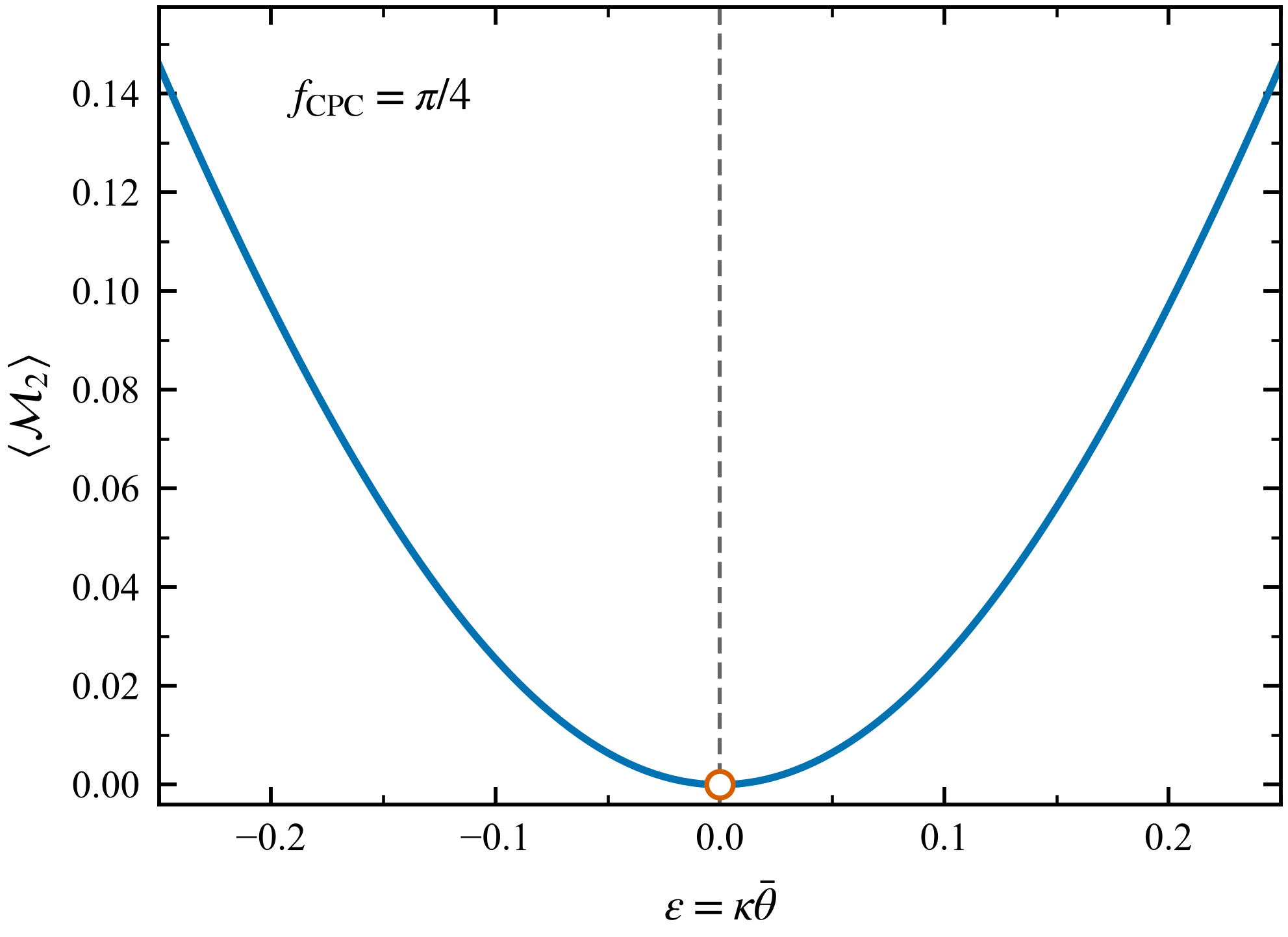
Figure 1: The complexity landscape at the CPC Clifford point in the leading spin-effective model. The solid purple line shows direction-averaged stabilizer Rényi entropy as a function of the scaled CPV coordinate. The red dot marks the local minimum at θˉ2.
Numerical computations confirm that at θˉ3, the averaged Magic is strictly minimized at θˉ4 (Figure 1). The CPV perturbation increases Magic quadratically in θˉ5 due to the symmetry θˉ6, so the CPC point is a strict stationary point and a local minimum: θˉ7
in the spin sector.
Robustness Under CPC Background Variation
One critical issue is whether this minimum depends on fine-tuning to the Clifford/SWAP point or is robust under generic CPC backgrounds (θˉ8 values). Additional simulations for various θˉ9 show the persistence of the Magic minimum at θˉ=00 over a significant range of CPC couplings.
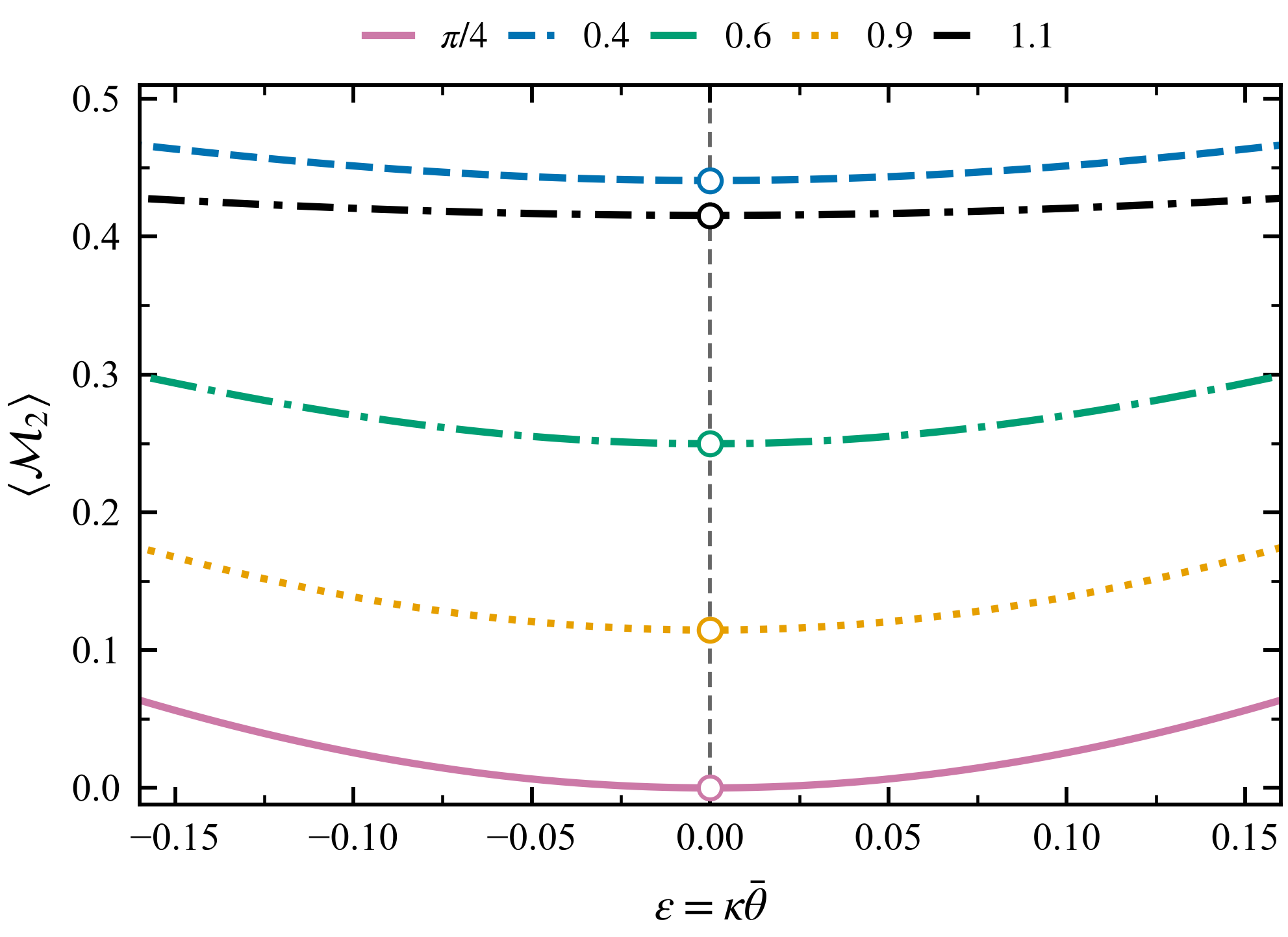
Figure 2: Robustness under variations of the effective CPC coupling. Direction-averaged Magic across several θˉ=01 illustrates that the local minimum at θˉ=02 persists for a range of CPC backgrounds, not just at the Clifford point.
Moving away from the Clifford point lifts the CPC baseline Magic, but for all sampled θˉ=03 values, the local minimum remains at the CP-conserving point. This supports the view that the extremum is not artificial, but a structural feature of the spin-effective model in a physically relevant regime.
Explicit Spin-Sector Curvature Analysis
The local minimum is characterized by evaluating the curvature of the Magic functional at θˉ=04 (i.e., θˉ=05). To this end, a dense scan over the CPC coupling parameter θˉ=06 is performed. The curvature,
θˉ=07
is computed explicitly via finite differences on the complete two-qubit functional averaged over all stabilizer states and directions.
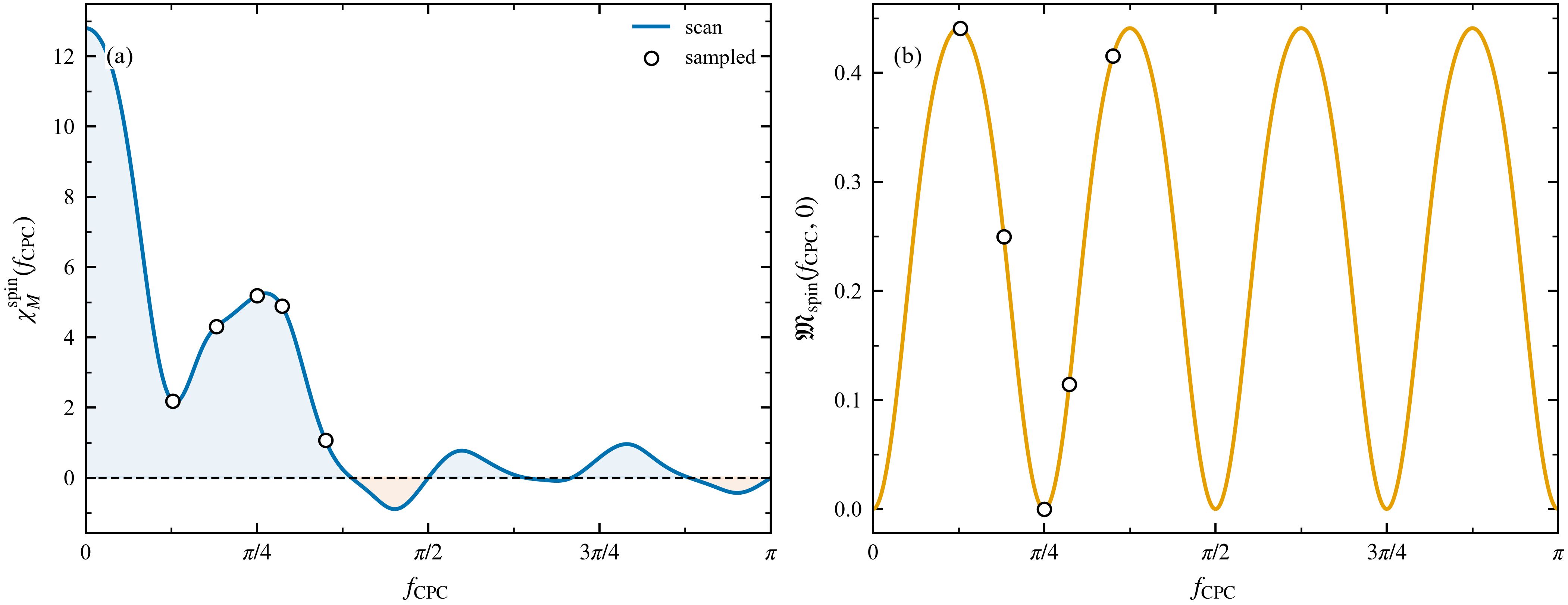
Figure 3: Finite spin-sector Magic curvature. Left: θˉ=08 (curvature at θˉ=09) as a function of np0. Rigorous sign changes demonstrate that the positivity of curvature—and thus the extremum—is windowed, not universal. Right: baseline Magic as a function of np1.
The scan in Figure 3 reveals that positive curvature—hence, a local minimum at np2—is observed in explicit windows of np3, which include the Clifford point and representative CPC backgrounds relevant to low-energy np4 scattering. Notably, sign reversals occur outside these windows, indicating that the information-theoretic extremum is not generic for all CPC spin-exchange phases but is sharply localized in the parameter space allowed by the physical np5-wave channel.
Implications and Future Directions
This study gives a concrete information-theoretic characterization of the CP-conserving point in low-energy np6 scattering: within a leading spin-effective treatment retaining OPE spin structures, the generation of Magic—i.e., the non-Clifford computational resource—is locally minimized at np7 over a physically relevant domain of CPC backgrounds. When interpreted via the mapping of np8 to the physical singlet-triplet np9-wave phase shift difference,
fCPCσ1⋅σ20
this implies that the phase-shift trajectory for low-energy fCPCσ1⋅σ21 scattering falls within the positive-curvature domain where the minimum is present.
Theoretically, this adds to the body of evidence that fundamental parameters (e.g., Standard Model couplings, now the strong CP angle) are associated with resource minima in the quantum computation sense. Practically, this work motivates further EFT studies to determine the precise physical location of the fCPCσ1⋅σ22 trajectory and to generalize from the spin-effective proxy to the full, multi-channel fCPCσ1⋅σ23-matrix in chiral EFT. In particular, the susceptibility of the Magic minimum to higher-order and non-spin-exchange interactions will be crucial for comprehensive resource-theoretic diagnostics of strong-interaction processes.
Conclusion
This paper establishes that within a spin-effective, OPE-retained description of low-energy fCPCσ1⋅σ24 scattering, the CP-conserving vacuum angle fCPCσ1⋅σ25 is locally distinguished as a minimum of non-Clifford Magic generation for a broad and physically motivated set of CPC spin-exchange backgrounds. The positive curvature at the minimum is shown both numerically and via explicit computation of the finite spin-sector functional. The result is robust within specified CPC phase windows corresponding to relevant experimental phase-shift ranges, but is not globally generic in parameter space. Extension of these findings to the complete chiral EFT scattering matrix will require further partial-wave and input-output quantum resource analyses across all spin and momentum channels.
This work provides both a new lens for the strong CP problem and concrete impetus for future investigation of quantum information-theoretic structure in nucleon-nucleon interactions.