- The paper demonstrates that enforcing maximal entanglement in anti-polarized two-qubit states recovers gauge-invariant gluon and graviton interactions.
- The analysis quantifies entanglement using concurrence and non-classical magic via second-order stabilizer Renyi entropy in tree-level scattering.
- The study shows that minimal, yet nonzero, magic uniquely selects the physical interaction parameter (k=1), suggesting an informational basis for gauge symmetry.
Introduction
This paper establishes a deep connection between quantum information theory and the structure of fundamental interactions in quantum field theory. Traditionally, gauge invariance is imposed as an axiom to constrain the forms of interactions in the Standard Model and beyond. The authors propose an alternative, informationally motivated route: using the quantum measures of entanglement and magic as principles, they demonstrate that imposing maximal entanglement (MaxEnt) and minimal, but nonzero, magic in tree-level particle scattering uniquely selects physical, gauge-invariant interactions for both gluon-gluon and graviton-graviton processes. This dual principle suggests that nature's dynamics may be constrained by quantum information-theoretical quantities, pointing toward a foundational role for these principles in the emergence of gauge invariance.
Quantifying Entanglement and Magic
Entanglement and magic are treated within the two-qubit formalism pertinent to all massless boson scattering at tree level with two possible polarizations ∣L⟩ and ∣R⟩. The concurrence Δ=2∣αδ−βγ∣ measures entanglement, where Δ=1 signals maximal entanglement and Δ=0 represents product states.
Magic, defined as the non-Cliffordness enabling universal quantum computation and non-classical simulability, is captured by the second-order Stabilizer Renyi Entropy (SRE):
M2(∣ψ⟩)=−log(41P∈P2∑∣⟨ψ∣P∣ψ⟩∣4)
For two-qubit states, M2 attains a theoretical maximum log(16/7)≈0.827, but stabilizer states remain at M2=0.
Entanglement and Magic in Boson Scattering
The analysis starts with tree-level gluon and graviton scattering. Crucially, only initial states with opposite polarizations (∣RL⟩,∣LR⟩) produce nonzero entanglement and magic. Concurrence for gluon scattering is:
ΔRLgluons=t4+u42t2u2
with maximal entanglement at θCOM=π/2 (center-of-mass scattering angle), independent of color. Magic for these processes is low; for both gluons and gravitons, M2 peaks at log(4/3)≈0.288, far below the maximal value for arbitrary two-qubit states.
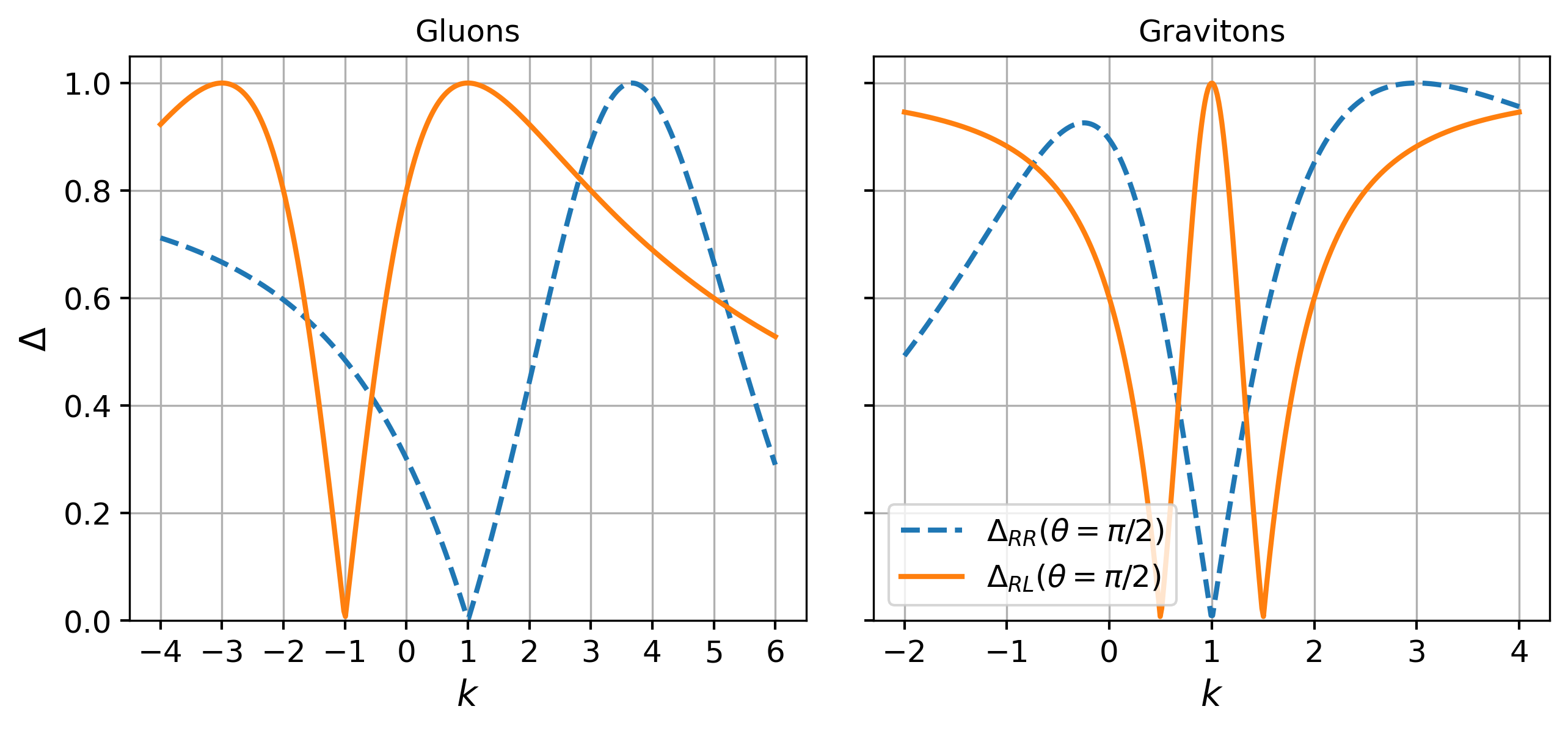
Figure 1: Concurrence as a function of vertex parameter k for gluon and graviton scattering. Gauge-invariant solution (k=1) is isolated by MaxEnt in RL initial states, while nonphysical solutions correspond to RR initial states.
This indicates that strong entanglement does not equate to computational hardness; classical simulability persists without significant magic. The presence of low, yet nonzero, magic ensures universality while keeping simulation tractable.
To test whether quantum-information principles can supplant gauge axioms, the quartic vertex in QCD and gravity is explicitly altered by a scaling parameter k. This induces gauge non-invariant dynamics. The total amplitude becomes:
M=Ms+Mt+Mu+kM4
For each k, entanglement and magic are evaluated after scattering.
Enforcing MaxEnt for RL initial states isolates the physical gauge-invariant solution (k=1) but also yields spurious, nonphysical k values (e.g., k=−3, k=11/3 for gluons, k=3 for gravitons), which would permit maximal entanglement in RR initial states, contradicting the physical scenario where same-polarization states remain unentangled.
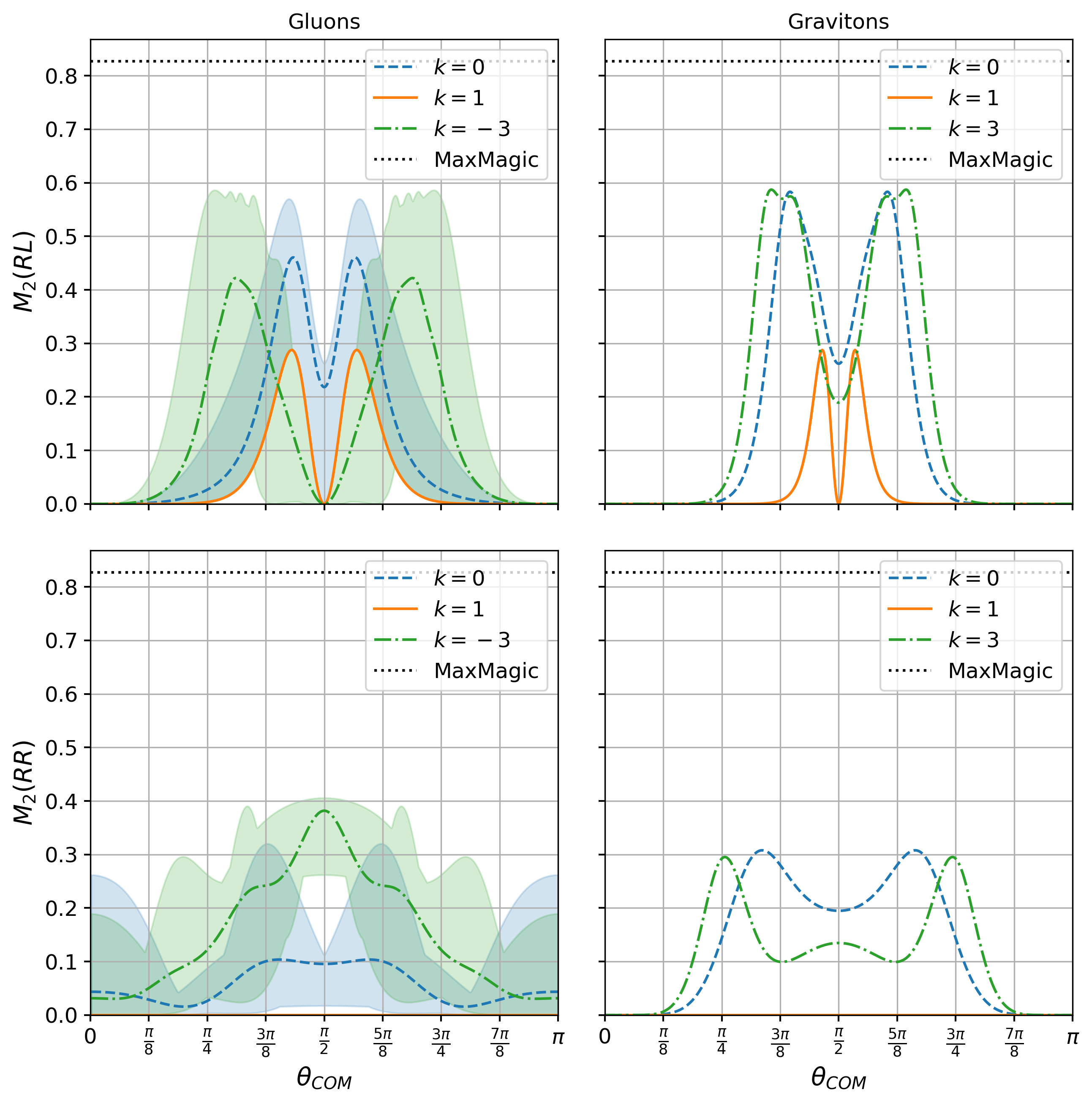
Figure 2: Magic M2 as a function of θCOM for multiple values of k: gauge-invariant solution (k=1) achieves a global minimum for magic, independent of the color channel.
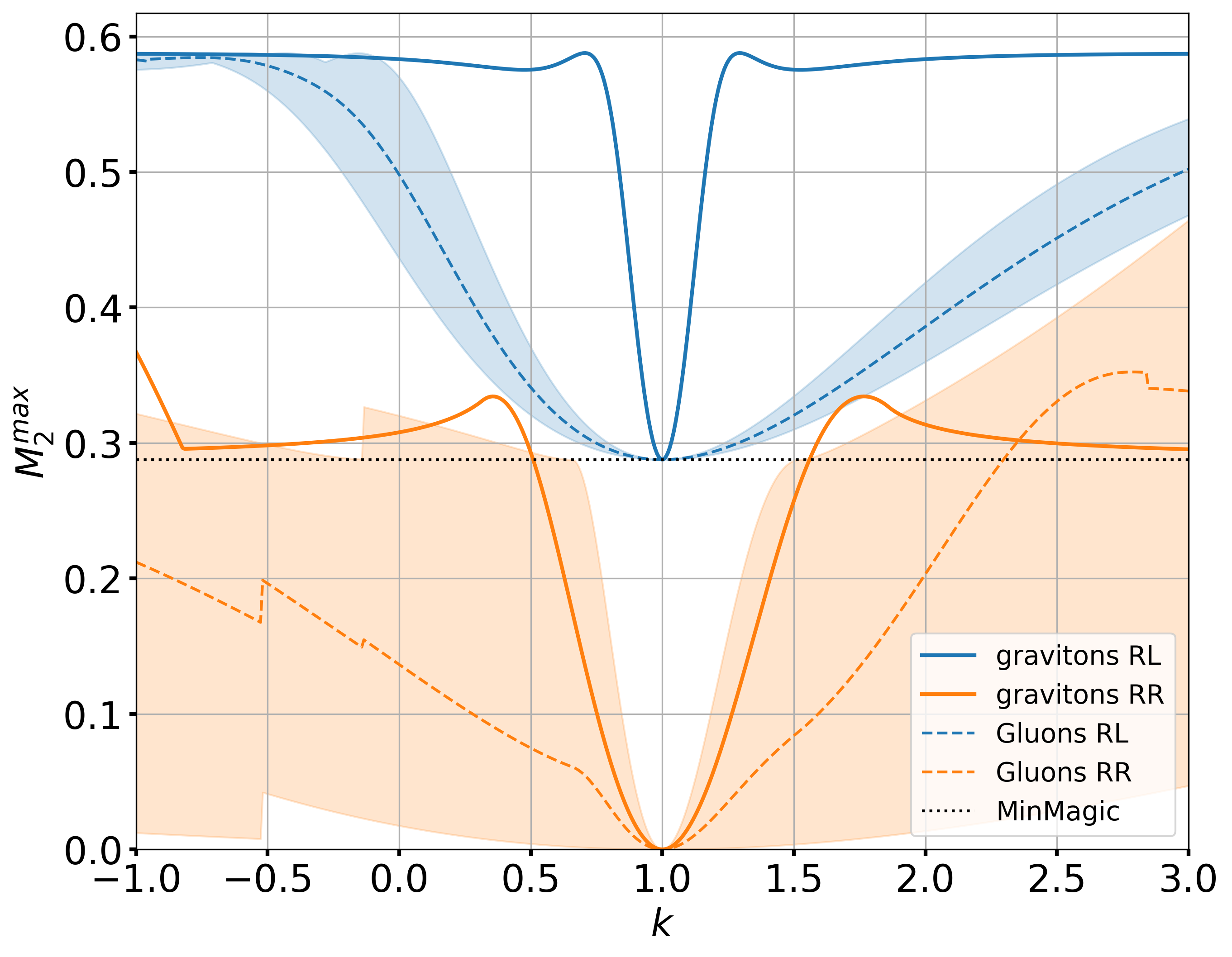
Figure 3: Maximum M2 as a function of k; the unique global minimum is k=1, corresponding to QCD and gravity, well below the maximal magic for two-qubit states.
Importantly, while MaxEnt alone is not sufficient for unique recovery, adding the principle of minimal magic (M2 minimized but >0) singles out k=1 as the unique solution. All other k yield higher magic. The gauge-invariant interaction is simultaneously a global minimum of magic and a maximum of entanglement, for anti-polarized initial states.
Additionally, the magic generated is universal among all color configurations only for k=1, indicating an informational origin for color universality in gauge theory.
Implications and Theoretical Perspective
The findings suggest a novel informational origin for gauge symmetry in field theory: elementary interactions maximize quantum correlation (nonlocality) while strictly minimizing, but not nullifying, the generation of magic. This principle ensures strong quantum behavior conducive to Bell inequality violations and quantum protocols, but keeps simulation complexity low, in near-stabilizer regimes.
The approach provides a template for seeking physics beyond the Standard Model via quantum-information constraints, especially as experimental detection of entanglement and magic becomes feasible in collider settings.
The limitation to pure two-qubit states and tree-level processes is apparent; extensions to multipartite and higher-dimensional systems may demand more refined magic measures, an area of ongoing study.
Conclusion
The interplay between entanglement and magic provides a robust, quantum-information-theoretical foundation underlying gauge invariance in fundamental physics. The combined MaxEnt and minimal-magic principle uniquely selects physical interactions, suggesting a re-interpretation of gauge symmetry as an emergent phenomenon grounded in quantum resource theory. Future research should address the generality of these results in non-tree-level, multipartite, or higher-spin systems, as well as leverage quantum information principles in novel model-building and experimental searches for new physics.