- The paper establishes that both linear and 2nd-order Rényi stabilizer entropy remain faithful metrics for mixed-state magic, being zero if and only if the state is a mixture of stabilizers.
- Analytical and numerical results confirm that the stabilizer entropy gap under free operations, such as partial trace and dephasing, is strictly positive and robust in large Hilbert spaces.
- Efficient computation via the Walsh-Hadamard Transform enables practical application of stabilizer entropy to benchmark quantum systems and detect magic in NISQ devices.
Stabilizer Entropy as a Reliable Magic Proxy for Mixed States
Quantum Resource Theory Framework and Non-Stabilizerness
This work systematically addresses the reliability of stabilizer entropy (SE)—specifically its linear and second-order Rényi (2-SE) forms—as quantifiers of non-stabilizerness, or "magic," in ensembles of generic and structured mixed quantum states. The discussion is grounded in the established resource theory framework, where free states are convex mixtures of stabilizer (Clifford) states, and free operations are those implementable via Clifford circuits, computational basis measurements, partial trace, and appending stabilizer ancillae.
The authors introduce resource proxies as functions that, while not strictly monotonic under all free operations, violate monotonicity only with exponentially vanishing probability in large Hilbert spaces. This relaxes conventional monotonicity requirements but is justified for practical and experimental contexts, especially when proxies, such as SE, are efficiently computable or experimentally accessible.
Stabilizer Entropy for Mixed States
SE, both in its linearized form Mlin(ψ)=Pur(ψ)−SP(ψ) and the 2-SE Rényi entropy, admits operational extensions to mixed states:
- Mlin(ψ)=Purity(ψ)−Stabilizer Purity(ψ),
- M~2(ψ)=M2(ψ)−S2(ψ)=logSP(ψ)Pur(ψ).
For mixed non-stabilizer states, both Mlin and M~2 remain faithful (zero if and only if the state is a mixture of stabilizers), and easy to compute for large systems due to analytical and algorithmic advances.
Notably, the paper proves strong inequalities showing that M~2(ψ)≥Mlin(ψ),log2[Mlin(ψ)] for any mixed state ψ. These relationships underscore the robustness of Mlin as a lower bound proxy for 2-SE magic and as a diagnostic for non-stabilizerness.
Free Channels and Violations: Analytical and Numerical Results
The paper rigorously investigates the monotonicity of Mlin under essential free operations: partial trace and complete dephasing in the computational basis. The central object is the SE gap, defined for a free operation E as Mlin(ψ)=Purity(ψ)−Stabilizer Purity(ψ)0, evaluated over various state ensembles.
Haar-Random States
For Haar-random (generic) states, the average SE gap is shown to remain strictly positive under both partial trace and computational basis dephasing, quickly converging to its asymptotic value for increasing system size Mlin(ψ)=Purity(ψ)−Stabilizer Purity(ψ)1 and subsystem sizes. Concentration of measure effects ensure that variance is exponentially suppressed with system size, and violations of monotonicity are exponentially rare.
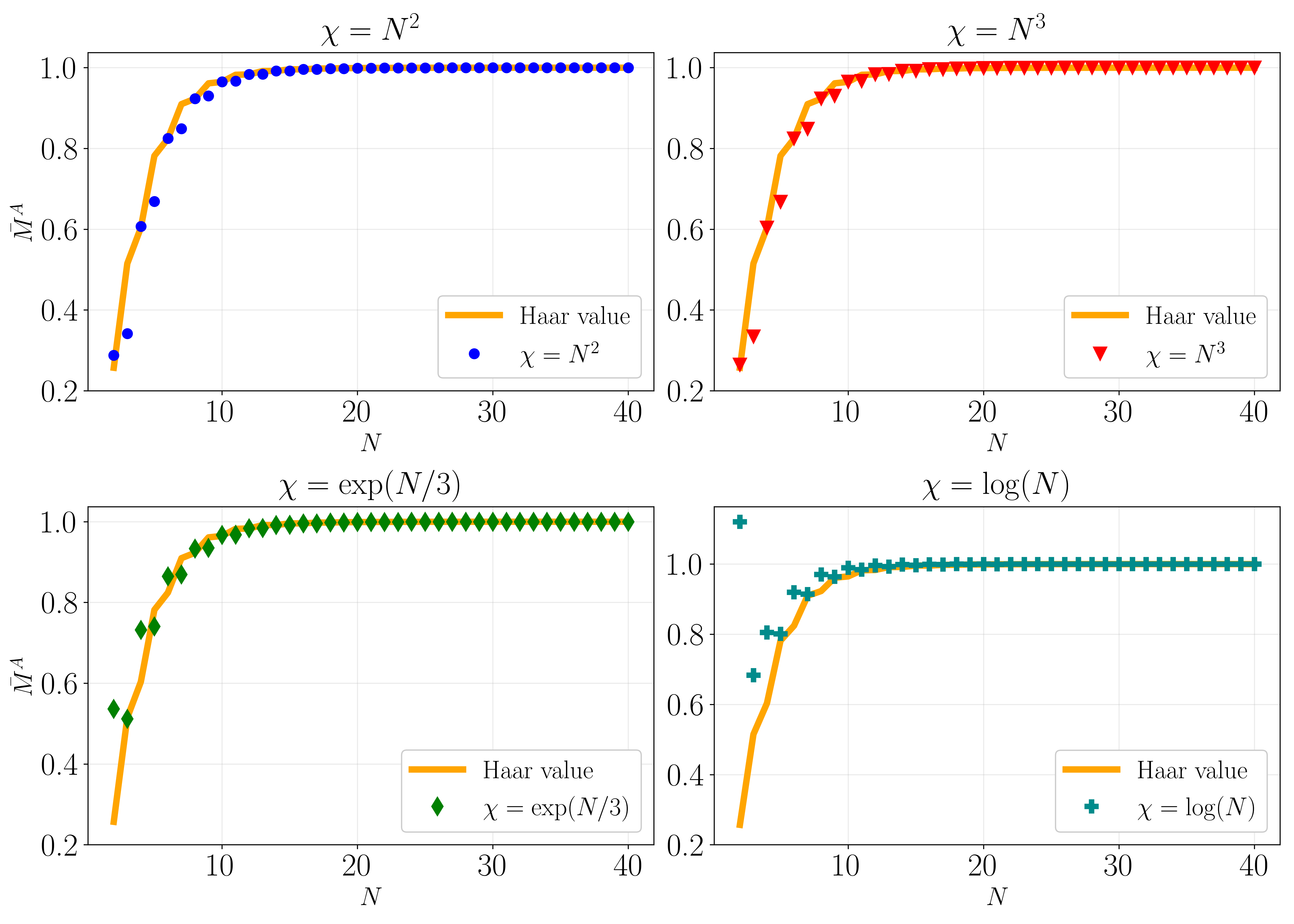
Figure 1: The SE gap under partial trace is strictly positive across all scaling regimes and qubit numbers, rapidly approaching the Haar value irrespective of Mlin(ψ)=Purity(ψ)−Stabilizer Purity(ψ)2 scaling with Mlin(ψ)=Purity(ψ)−Stabilizer Purity(ψ)3.
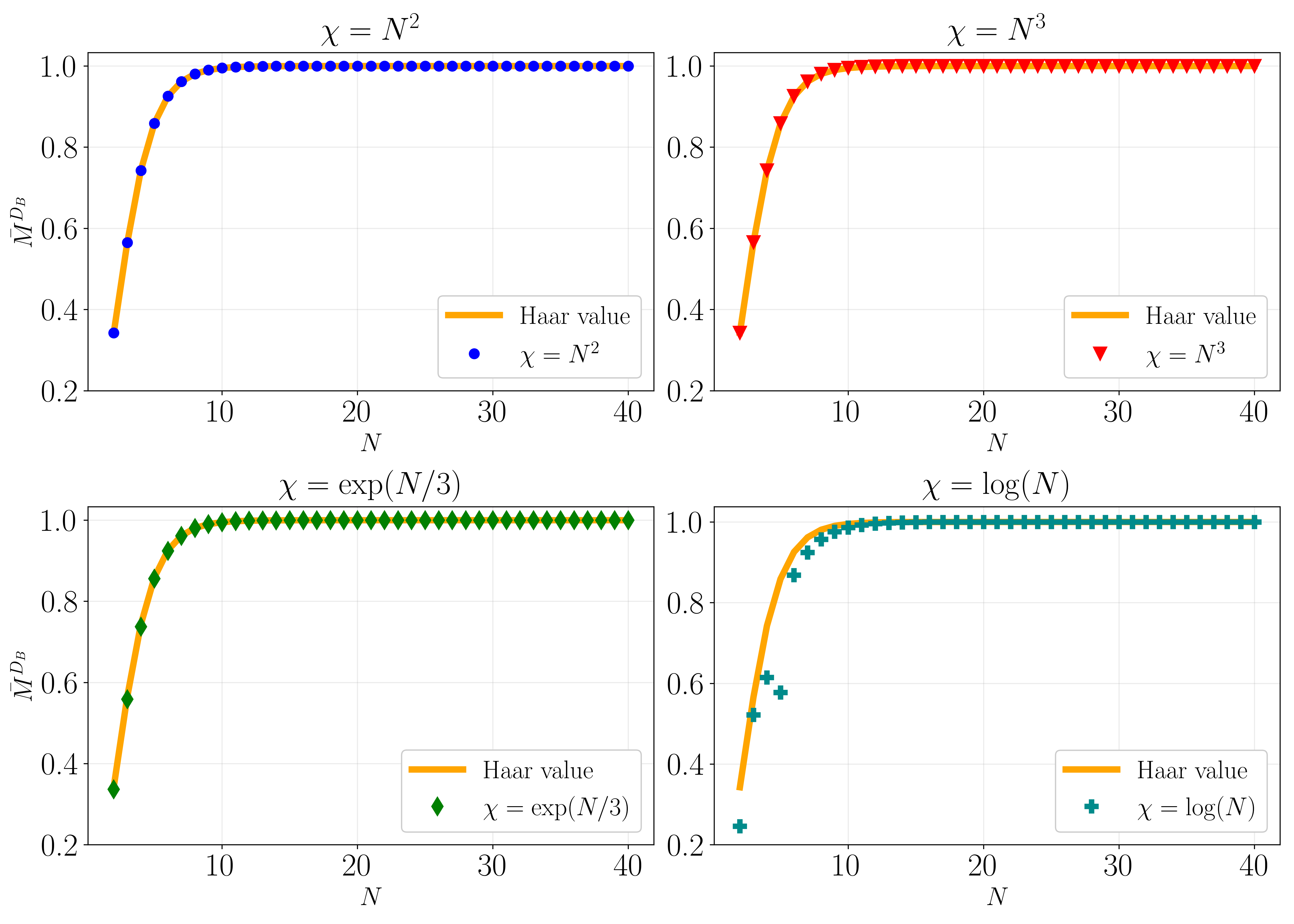
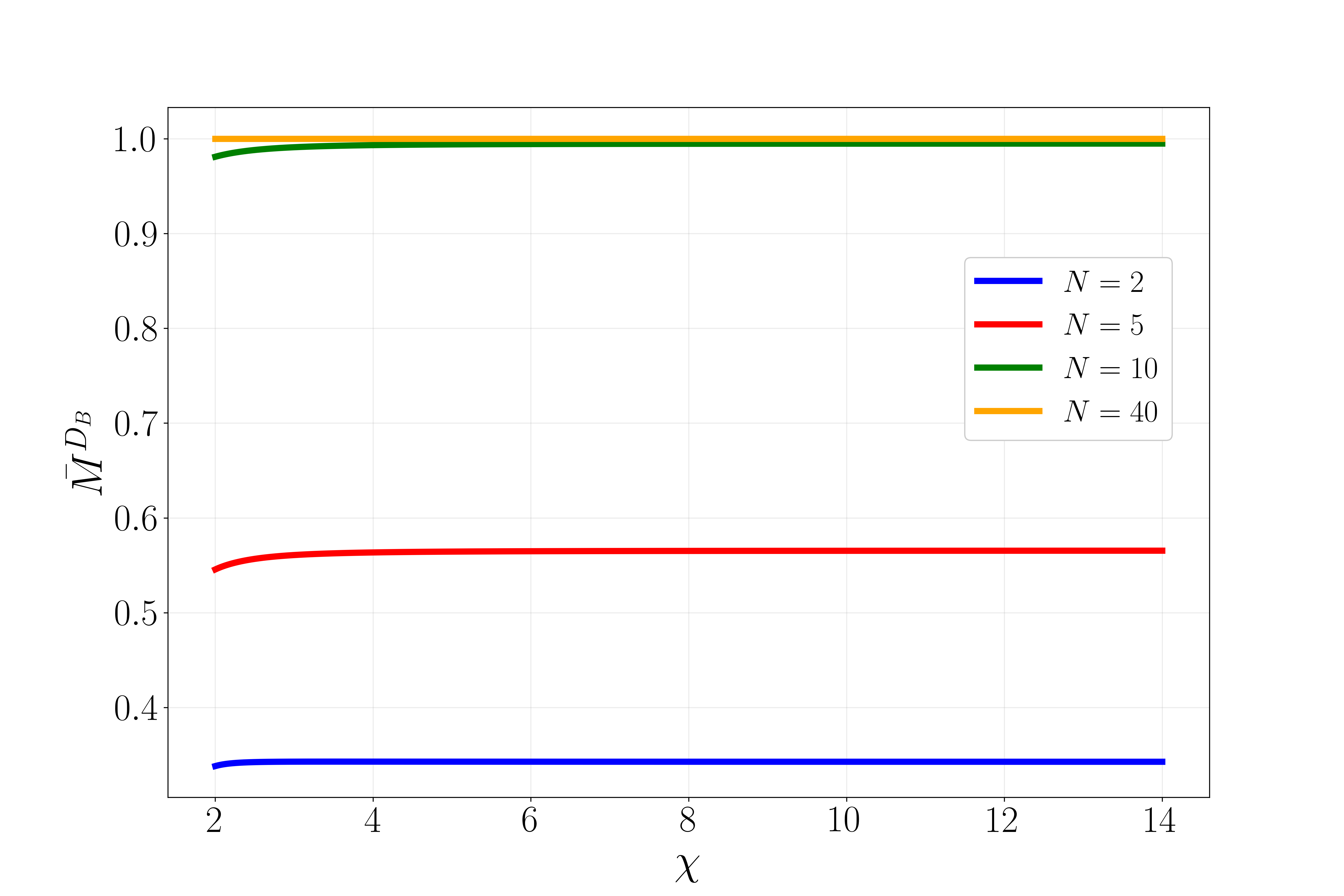
Figure 2: The SE gap for the complete dephasing channel demonstrates similar rapid convergence to the Haar value, robust for all scaling of the bond dimension Mlin(ψ)=Purity(ψ)−Stabilizer Purity(ψ)4 and system size.
Random Matrix Product States
Given the limitations of Haar randomness for physical many-body systems, the study extends to ensembles of Matrix Product States (MPS) with bounded bond dimension, both under periodic and open boundary conditions (OBC). Analytical and large-scale numerical simulations confirm:
- Partial trace and dephasing gaps remain strictly positive for all tested bond dimensions, system sizes, and bipartitions.
- The positivity and tight concentration (small variance) of the SE gap persist if the bond dimension Mlin(ψ)=Purity(ψ)−Stabilizer Purity(ψ)5 is fixed or scales polynomially/exponentially with system size.
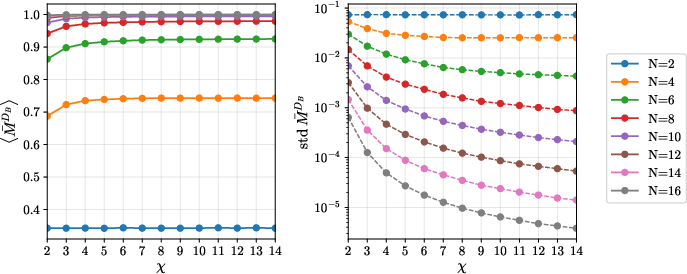
Figure 3: Average and standard deviation of the SE magic gap for complete dephasing in MPS with OBC, showing robust positivity with increasing Mlin(ψ)=Purity(ψ)−Stabilizer Purity(ψ)6 and Mlin(ψ)=Purity(ψ)−Stabilizer Purity(ψ)7.
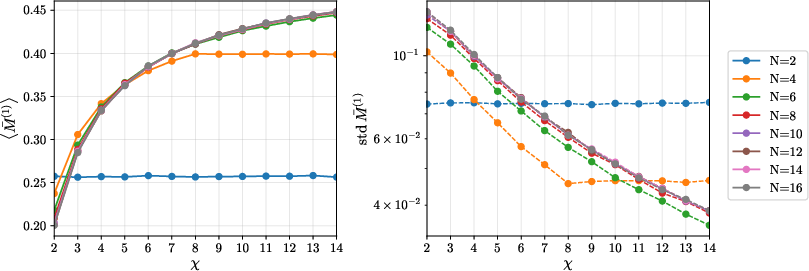
Figure 4: Magic gap and standard deviation under partial trace of the first qubit in MPS OBC, confirming positivity across the sampled ensembles.
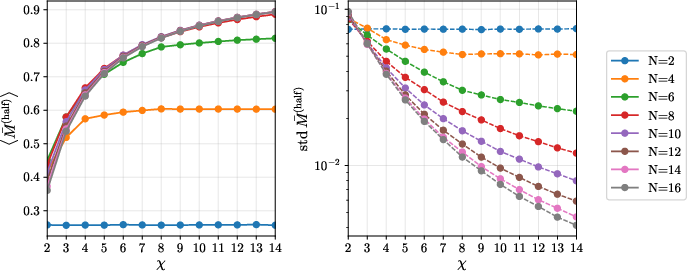
Figure 5: Magic gap and standard deviation under partial trace of half the system in MPS OBC, with increasing gap for larger traced subsystems.
The gap is consistently largest in the bipartition that discards the maximal fraction of degrees of freedom, as expected from resource theory intuition.
Scaling Regimes and Violation Probabilities
The study investigates three scaling regimes for Mlin(ψ)=Purity(ψ)−Stabilizer Purity(ψ)8: logarithmic, linear, and exponential. In all cases, the average gap increases (or plateaus at positive values), with vanishing probability for violation estimated by Chebyshev bounds and concentration inequalities. In every scenario sampled (Mlin(ψ)=Purity(ψ)−Stabilizer Purity(ψ)9 states per M~2(ψ)=M2(ψ)−S2(ψ)=logSP(ψ)Pur(ψ)0 pair in numerics), no violation was observed.
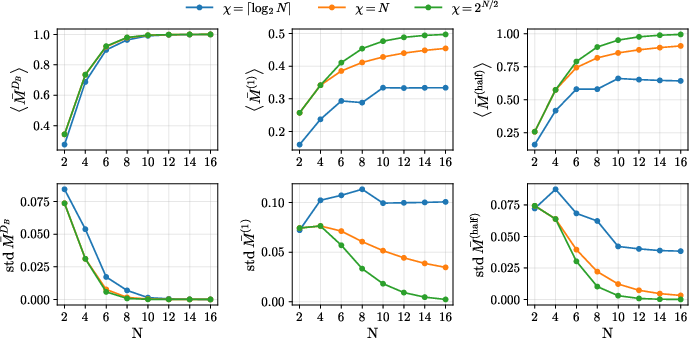
Figure 6: Average magic gaps (top) and their standard deviations (bottom) versus M~2(ψ)=M2(ψ)−S2(ψ)=logSP(ψ)Pur(ψ)1 for various M~2(ψ)=M2(ψ)−S2(ψ)=logSP(ψ)Pur(ψ)2 scalings, confirming positivity and increasing typicality.
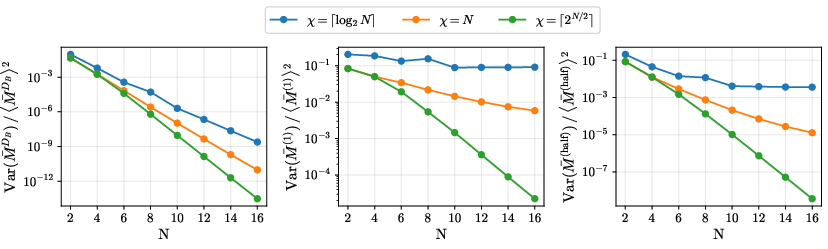
Figure 7: Chebyshev upper bound on the violation probability for M~2(ψ)=M2(ψ)−S2(ψ)=logSP(ψ)Pur(ψ)3 as a function of M~2(ψ)=M2(ψ)−S2(ψ)=logSP(ψ)Pur(ψ)4 for three M~2(ψ)=M2(ψ)−S2(ψ)=logSP(ψ)Pur(ψ)5 scalings; the bound decays rapidly, supporting proxy reliability.
Efficient Computation of Stabilizer Entropy for Large Systems
A crucial technical innovation is the exploitation of the Walsh-Hadamard Transform (WHT) for efficiently computing the stabilizer purity and purity of dephased and reduced states, enabling the practical evaluation of SE proxies on mixed states of up to M~2(ψ)=M2(ψ)−S2(ψ)=logSP(ψ)Pur(ψ)6 qubits even for generic or tensor network (MPS) states. The WHT-based algorithm substantially reduces computational complexity versus direct enumeration of the Pauli spectrum and can be adapted for both pure and mixed states (after partial trace or dephasing).
Implications and Outlook
The main formal conclusion is that linear stabilizer entropy and 2-SE entropy are trustworthy proxies for magic for mixed states, even when strict monotonicity does not hold by construction, provided one samples from physically relevant randomized ensembles. Analytically and numerically, the measure is non-increasing under all relevant free operations with overwhelming probability—this is critical for both experimental benchmarking and theoretical studies in quantum computation and simulation.
Theoretical implications include:
- Justification of SE-based resource measures for benchmarking and comparison across mixed-state protocols, without the need for explicit convex roof extensions or distillation cost calculations.
- Implications for simulatability: numerical studies of non-stabilizerness of many-body systems or intermediate-scale quantum circuits can rely on SE with high confidence.
- The approach generalizes to other resource theories where strict monotones may be inaccessible due to computational overheads but proxies can be demonstrated to behave as resource measures for physically relevant state families.
Experimentally, the computability and faithfulness of M~2(ψ)=M2(ψ)−S2(ψ)=logSP(ψ)Pur(ψ)7 (and its measurement protocols) make it suitable for direct implementation in magic state detection, benchmarking, and quantum advantage studies in noisy intermediate-scale quantum (NISQ) devices.
Conclusion
This study provides a rigorous foundation for the use of stabilizer entropy as a magic monotone proxy for mixed states, validated by analytic calculations and large-scale numerics. The findings demonstrate that SE functions as a robust, faithful measure of non-stabilizerness in practice, with violations of expected monotonicity being exceedingly rare for all relevant quantum channels and ensembles. This resolves a significant open question at the interface of quantum information theory, simulation, and experiment, and establishes stabilizer entropy as a central tool for characterizing quantum resources on both theoretical and practical grounds.
Reference: "Stabilizer entropy is trustworthy for mixed states" (2606.29443)