- The paper demonstrates that achieving higher ergotropy in quantum batteries necessitates increased nonstabilizerness, highlighting a key resource cost.
- It employs the stabilizer Rényi entropy to measure magic and analyzes its evolution alongside energy storage in diverse charging protocols including XXZ and SYK models.
- Results show that under certain conditions, optimal work extraction can occur with minimal nonstabilizerness, offering design insights for resource-efficient quantum batteries.
Interplay of Nonstabilizerness and Ergotropy in Quantum Batteries
Introduction
The study presents an explicit investigation into the relationship between nonstabilizerness—often referred to as "magic"—and ergotropy in the context of quantum batteries (QBs). Nonstabilizerness serves as a quantifier for quantum computational complexity beyond the stabilizer subtheory and is essential for quantum advantage in simulation and computation. Ergotropy encapsulates the maximum extractable work from a quantum state via unitary operations. This work systematically explores how the global generation of nonstabilizerness is linked to the capacity for work storage (ergotropy) across a suite of quantum charging models, including spin chains, random unitary circuits, and the Sachdev-Ye-Kitaev (SYK) model.
The authors adopt the stabilizer Rényi entropy (SRE) as a scalable metric of nonstabilizerness and analyze its co-evolution with energy and ergotropy during various charging protocols. Both practical and theoretical implications are examined, particularly the "resource cost" for high-performance quantum batteries and the scenarios in which "magic" is or is not required for maximal ergotropic charging.
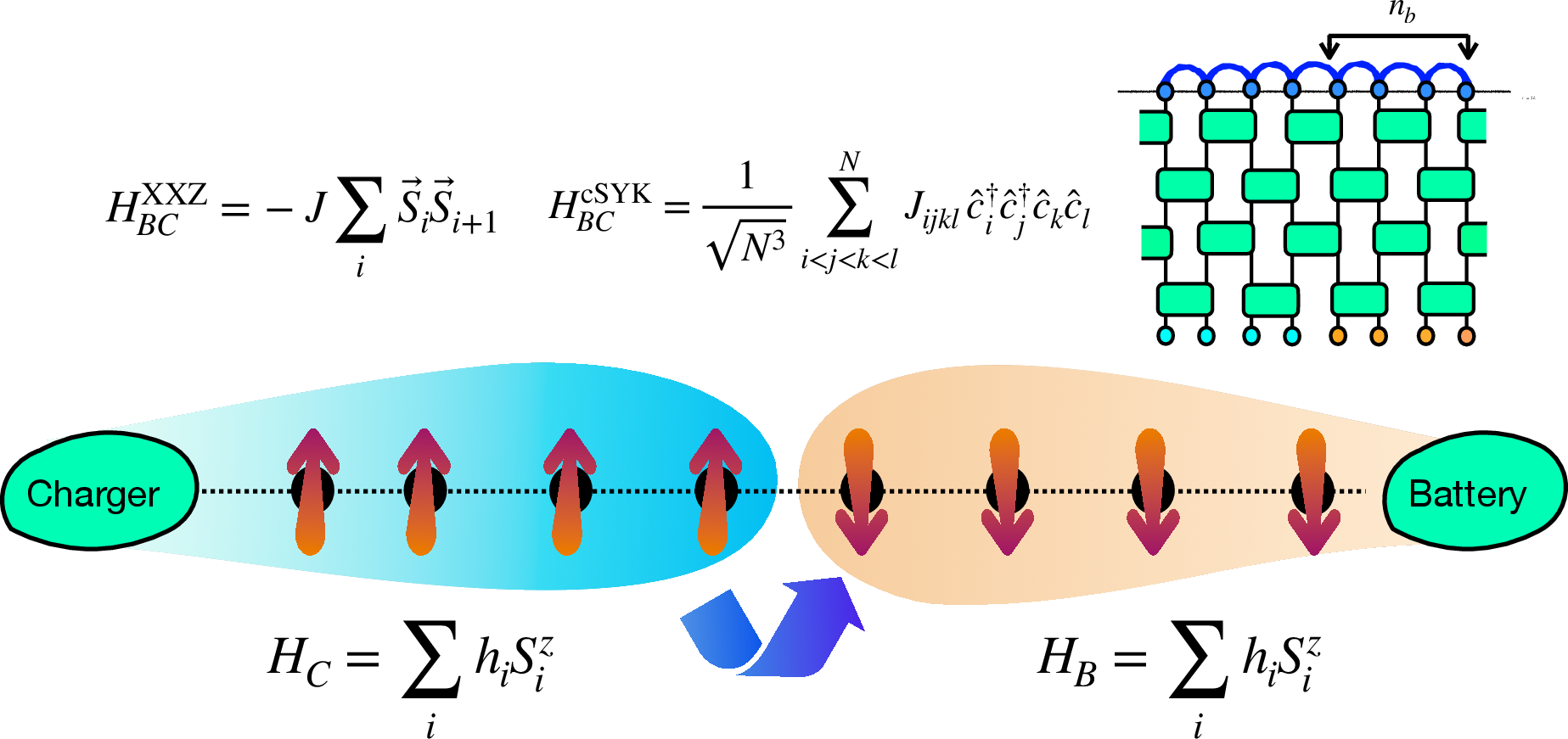
Figure 1: Schematic of the quantum battery and charger setup, illustrating the spin chain partitioning and protocols for energy transfer.
Nonstabilizerness, Quantum Batteries, and Measurement Protocol
The model considers an N-spin-½ chain, partitioned such that the left half is charger (C) and the right half battery (B). Initially, the charger subsystem is fully excited (∣↑⟩⊗N/2), and the battery subsystem is in its ground state (∣↓⟩⊗N/2). Charging proceeds under a global Hamiltonian Ht=HC+HB+HBC, with HBC engineering energy transfer across the interface.
Nonstabilizerness is quantified by the second-order stabilizer Rényi entropy: M2(∣ψ⟩)=−log2P∑∣⟨ψ∣P∣ψ⟩∣4/2N,
where the sum is over the N-qubit Pauli group.
Work stored and ergotropy are computed as: W(t)=Tr[HBρ(t)]−Tr[HBρ(0)],E(ρ)=Tr[ρHB]−UminTr[UρU†HB].
Nonstabilizerness and Ergotropy in the XXZ Spin Chain
The XXZ interaction, C0, is analyzed for quantum batteries. Both stored energy and nonstabilizerness exhibit quadratic growth at early times: C1
while ergotropy remains zero until a critical time due to the passivity of the reduced state. Beyond this regime, a linear relation between the time-averaged SRE and ergotropy emerges, signifying that storing higher ergotropy necessitates increased nonstabilizerness—a no-free-lunch principle for resource cost.
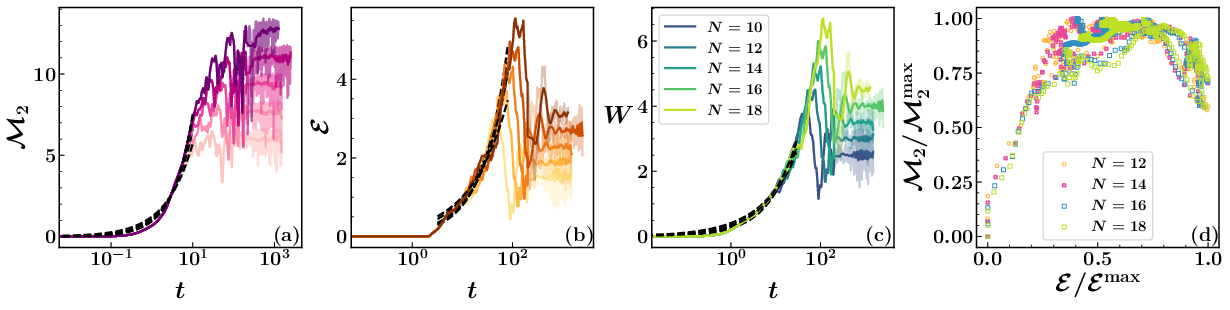
Figure 2: Dynamics of SRE, ergotropy, and stored work versus time for the XXZ-coupled system, highlighting their distinctive behaviors and saturation dynamics.
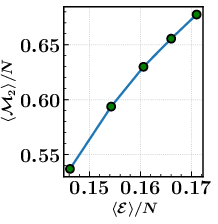
Figure 3: Parametric dependence of average SRE on average ergotropy for varying system sizes, demonstrating their positive correlation.
Complex SYK Model: Universal Scaling and Hyperbolic Correspondence
Extending to a complex SYK model, an all-to-all random system with C2 symmetry, both SRE and ergotropy grow as C3 at early times, mirroring the XXZ case, but saturate to finite values differing from Haar-random limits due to constrained Hilbert space sampling.
A crucial finding is the universal functional dependency between SRE and ergotropy in this model: C4
where constants depend on system size but, upon normalization and scaling, produce a master curve invariant to C5.
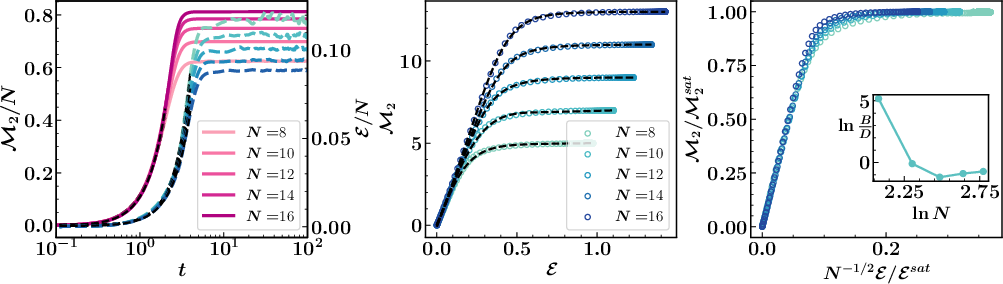
Figure 4: SRE and ergotropy time evolution under cSYK dynamics showing simultaneous growth and saturation.
Brick-Wall Circuits: Symmetry, Hamiltonian Structure, and Resource Cost
The interplay between nonstabilizerness and ergotropy is further dissected with brick-wall random unitary circuits. Here, the nature of two-qubit gates—generic Haar, C6-symmetric, Hamiltonian-generated, or Clifford—determines the necessity and cost of nonstabilizerness for work storage.
- C7-symmetric circuits: SRE and ergotropy obey a robust, nearly system-size-independent hyperbolic tangent relation. Both quantities saturate, and resource cost for ergotropy is precisely quantifiable.
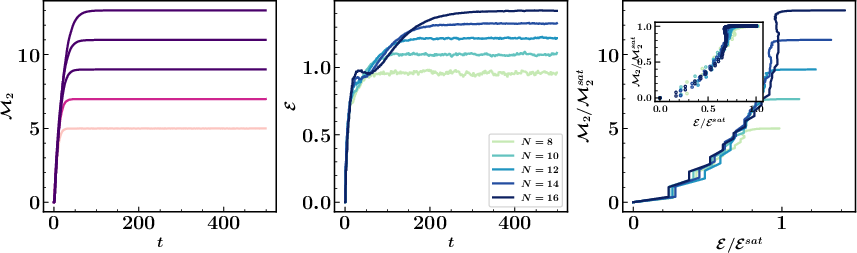
Figure 5: SRE and ergotropy for a C8-symmetric random brick-wall circuit; SRE is a universal function of ergotropy.
- Hamiltonian-generated circuits: For XXZ or Ising-type local interactions, the functional relation between SRE and ergotropy becomes non-universal. Notably, Ising-like charging can yield high ergotropy with minimal nonstabilizerness, offering a route for resource-efficient quantum battery protocols.
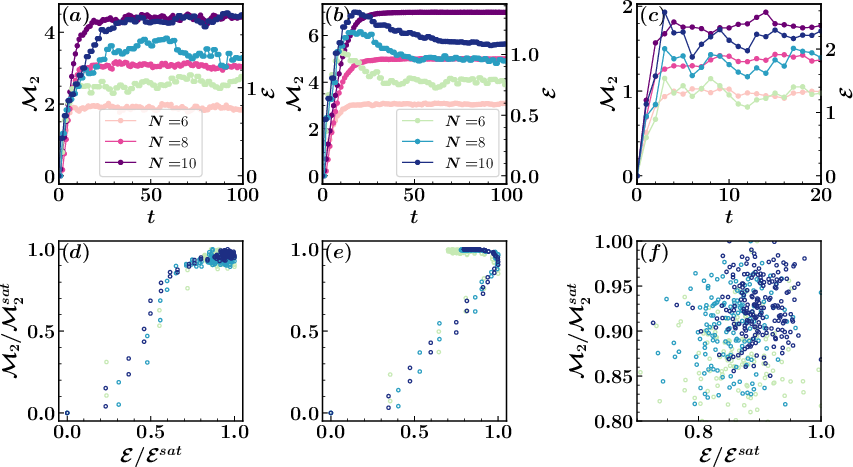
Figure 6: The evolution and correlation of SRE and ergotropy for brick-wall circuits with XX, XXZ, or Ising couplings; interplay depends sensitively on the underlying Hamiltonian.
- Clifford circuits: Clifford unitaries maintain stabilizer dynamics throughout, allowing the battery to accrue substantial ergotropy without generating any SRE. The charging performance is determined by the stabilizer rank and local magnetization structure, showing ergotropy is not necessarily a function of nonstabilizerness under Clifford evolution.
- Fully Haar random circuits: Ergotropy and SRE decouple; there is no simple correspondence, and excessive "magic" can even suppress extractable work at large times.
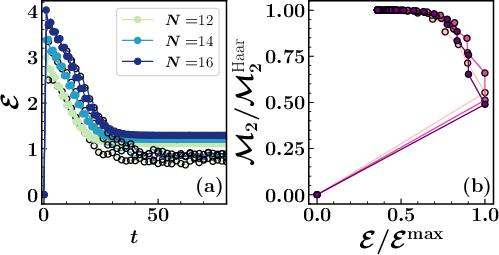
Figure 7: Ergotropy (Clifford, Haar) and SRE dynamics. Under Haar evolution, increased nonstabilizerness can coincide with lower ergotropy.
Initial-State Magic and Maximum Charging Power
In a complementary setting, battery initial states are prepared with finite nonstabilizerness, and the charging protocol is restricted to Clifford evolution. Here, the relationship between initial SRE and maximum average power is non-monotonic. Increasing initial "magic" does not translate to greater power output; instead, very high SRE can act as a bottleneck, reducing charging efficacy.
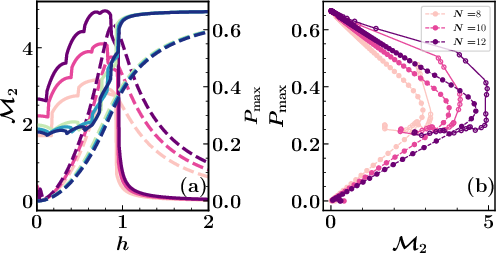
Figure 8: The non-monotonic dependence of maximum average power on initial nonstabilizerness for different magnetic fields and anisotropies in an XY-model battery.
Two-Qubit Analytic Connection
For C9, a closed-form functional relation is derived: B0
and the state with maximal stored work is shown to have zero SRE, sharp evidence that optimal charging does not require maximal nonstabilizerness.
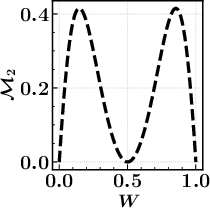
Figure 9: SRE versus work for the two-qubit case; highest stored work corresponds to zero nonstabilizerness.
Asymptotic Ergotropy in B1-Symmetric Circuits
At long times, the large-B2 ergotropy under B3-symmetric brick-wall circuits scales as B4, derived via block probabilities and Gaussian binomial approximations: B5
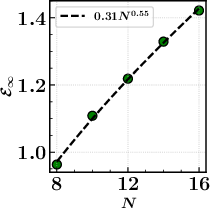
Figure 10: Asymptotic, subextensive scaling of ergotropy with system size under B6 symmetry.
Conclusion
This work rigorously delineates the conditions under which nonstabilizerness (magic) is an operational cost for work storage in quantum batteries. For typical interacting models with B7 symmetry, there exists a universal, typically monotonic relationship between global SRE and ergotropy. In certain limits (e.g., Clifford circuits, Ising interactions), high ergotropy can be achieved at minimal magic cost, providing concrete design levers for resource-efficient quantum battery architectures. Excess nonstabilizerness does not necessarily enhance battery operation and can suppress extractable work, depending on the protocol. The results offer new insights into quantum resource theories, optimization of quantum battery protocols, and the broader landscape of quantum thermodynamic devices.
Implications and Outlook
These findings inform the optimal design of quantum batteries in both near-term quantum devices and long-term fault-tolerant architectures, drawing sharp distinctions between dynamics that require "magic" and those that do not. The analytic and numerical methodologies introduced may be extended to study other resource theories (coherence, entanglement) or more complex models (higher-spin batteries, open-dissipative dynamics). Future research should explore multi-battery networks, explicit measurement protocols for SRE in experimental platforms, and connections to quantum error-correcting code energy economics.
Reference:
"Interplay of Nonstabilizerness and Ergotropy in Quantum Batteries" (2605.03600)