- The paper shows that amplitude damping causes an irreversible loss of entanglement followed by a rebirth of magic, revealing a fundamental duality in quantum resource theory.
- It presents exact threshold identities for magic death, rebirth, and entanglement sudden death, particularly in GHZ-type state trajectories under noise.
- The study demonstrates that the reborn magic is extractable via parity-syndrome measurement and Clifford decoding, enabling practical magic-state distillation for fault-tolerant architectures.
Sudden Death of Entanglement, Rebirth of Magic: An Expert Analysis
Introduction and Motivation
This work addresses the interplay between two central nonclassical resources in quantum information theory—entanglement and "magic" (nonstabilizerness)—under the archetypal Markovian noise channel, local amplitude damping. The resource-theoretic distinction between these two is pivotal for quantum computation: while entanglement underpins quantum advantage in communication, magic quantifies the non-Clifford capacity essential for universal quantum computing beyond efficient classical simulation [Veitch2014The, Howard2017Application, Liu2022Many].
The principal finding is a contradistinction between the irreversible loss ("sudden death") of entanglement and the possibility of "rebirth" of magic under local amplitude damping. Surprisingly, states initially outside the stabilizer polytope (non-Clifford) can lose their magic as they enter it at finite time, but for a broad class of initial conditions, they can subsequently regain magic (exit the stabilizer polytope) after having become fully separable, and even when all marginals are stabilizer. This provokes a deeper understanding of the dissipation dynamics in quantum resource theories and reveals a hidden channel-level symmetry.
The robustness and dynamics of "reborn" non-stabilizerness post entanglement death are not only theoretically characterized with exact threshold identities but also shown to be extractable for magic-state distillation, providing practical implications for fault-tolerant quantum architectures.
Resource Theory: Stabilizer Polytope Dynamics
Resource theories of entanglement and magic diverge dramatically under local quantum channels. While separability is preserved under local CPTP maps, stabilizer polytope membership is not. Thus, amplitude damping can push states into and out of the stabilizer polytope S.
This phenomenon is characterized by considering quantum trajectories ρ(γ) induced by n-qubit amplitude damping, where the tuning parameter γ represents the integrated noise. The prototypical example is the GHZ-type state:
∣ψn⟩=α∣0n⟩+β∣1n⟩,0<α<β
whose dissipative trajectory exhibits regions outside S (magic), entry into S (magic death), and eventual re-exit into nonstabilizer territory (rebirth of magic), before terminating at the stabilizer vertex ∣0n⟩.
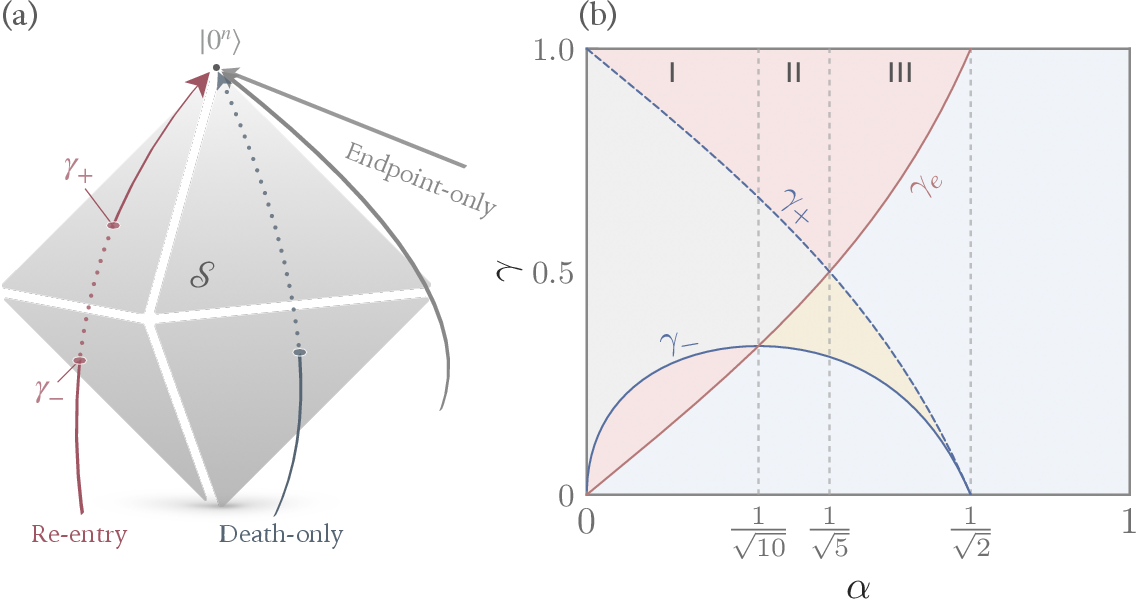
Figure 1: Resource phase diagram under amplitude damping, classifying trajectory behaviors—re-entrant (magic death and rebirth, red), death-only (blue), and endpoint-only (gray), with phase boundaries for GHZ-type inputs and regime classification.
The stabilizer polytope membership for these GHZ-X trajectories admits an explicit criterion:
ρn(γ)∈S⟺P0≥candPn≥c,
with closed-form population and coherence expressions, and robust analytical control for all n (see Supplemental Material for full characterization). The critical boundaries for transitions—magic death ρ(γ)0, rebirth ρ(γ)1, and entanglement sudden death ρ(γ)2—are solved exactly, with the notable identity:
ρ(γ)3
highlighting an exact complementarity mediated by a channel-level duality between system and environment (Stinespring dilation).
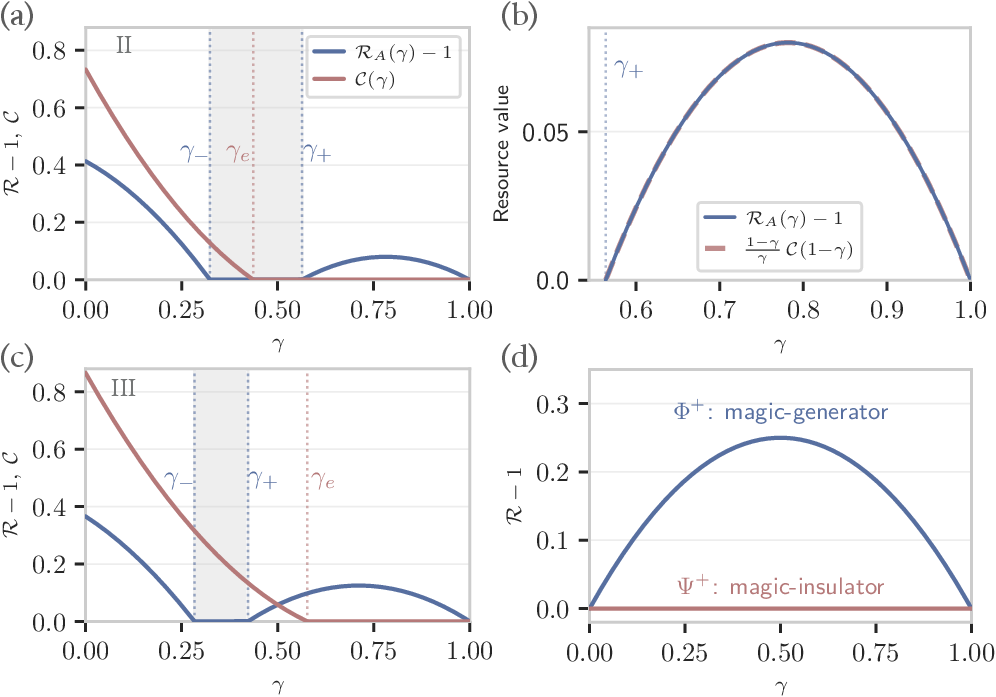
Figure 2: Magic (blue) and entanglement (red) thresholds for GHZ-type two-qubit trajectories. Magic dies at ρ(γ)4 and is reborn at ρ(γ)5, always with the sum of the entanglement-death and magic-rebirth thresholds equal to one.
Magic–Entanglement Complementarity and System–Environment Duality
A key technical result is the explicit relationship between the loss of entanglement (as measured by vanishing negativity or concurrence) and the rebirth of magic on the amplitude-damped GHZ trajectory. The mirror symmetry under ρ(γ)6 arises from the fact that the complementary channel of amplitude damping at noise ρ(γ)7 is another amplitude-damping channel with parameter ρ(γ)8. This duality ensures that the point at which entanglement dies is "reflected" onto the point at which the system exits the stabilizer polytope, i.e., magic is reborn.
This symmetry persists under a broad class of real, ground-state-preserving, phase-covariant channels, provided certain profile symmetries are obeyed, as formalized in the Supplemental Material.
Notably, in the small-ρ(γ)9 regime, magic rebirth occurs when the state is not just separable, but fully separable, and with all marginals stabilizer—a regime where “nonlocal” magic lies wholly in many-body correlations, hidden from marginals. Yet, through parity-syndrome measurement and Clifford decoding, this magic can be concentrated onto a single qubit for distillation.
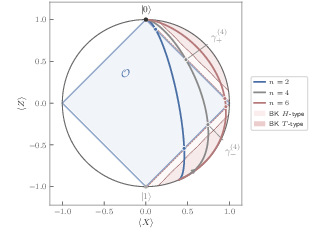
Figure 3: Decoded single-qubit trajectories (Bloch n0-plane) under parity-syndrome extraction, for varying n1, illustrating evolution through the single-qubit stabilizer octahedron and Bravyi–Kitaev sufficient distillability regions.
The work further provides super-exponential scaling behaviors with n2 for the stabilizer window's width, confirming that for fixed amplitude, the duration of the magic-free stabilizer region shrinks rapidly with increasing system size.
Extraction and Distillation of Reborn Magic
The “reborn” magic is shown to be nonlocally encoded yet operationally accessible. Parity-syndrome projection and Clifford decoding yield a single-qubit “magic” state whose coordinates and robust nonstabilizerness are in closed-form, matching the n3-qubit criterion exactly (extraction is lossless in expectation).
The extracted state, after Clifford twirling, meets or exceeds the thresholds for canonical n4- and n5-type magic-state distillation protocols [Bravyi2005Universal, Reichardt2005Quantum]. In the large-n6 limit, the extracted coordinate n7 approaches n8, strictly above necessary thresholds, guaranteeing that even from highly decohered but appropriately initialized trajectories, strongly distillable magic-state ancillas are obtainable.
This construct provides a passive, heralded alternative to active magic-state preparation in the context of fault-tolerant quantum computing—a relevant protocol for experimental implementations leveraging engineered dissipation.
Distinct phenomenology arises for pure stabilizer initial states. Under homogeneous damping, the set of pure stabilizer states splits into a small set of super-exponentially rare magic-insulators (those with constant Hamming-weight support) and generic magic-generators (those with mixed-weight support). The n9 Bell states exemplify this dichotomy: γ0 (magic-generator) immediately leaves the stabilizer polytope under damping, while γ1 (magic-insulator) remains inside for all time, despite their Clifford equivalence.
(Figure 2d)
Figure 2d: Bell-state splitting under amplitude damping—γ2 is a magic-generator (blue curve, robustness increases immediately), γ3 is a magic-insulator (robustness identically unity).
Pure stabilizer states with constant-weight support form a negligible fraction of all stabilizer states, a fact rigorously quantified in the paper by explicit upper bounds.
Other Trajectories and Broader Scope
The dynamical structure of "death and rebirth" is not universal across trajectories:
- Death-only: States like anti-γ4 edges undergo magic death at finite damping but never re-exit the stabilizer polytope.
- Endpoint-only: Generalized-γ5 states and typical Haar-random states reside outside γ6 for all γ7.
- Non-GHZ-X Re-entrant: The construction is not restricted to GHZ-X states; a non-GHZ-X vacuum–anti-γ8 slice also manifests the same phenomenon, as realized as a ground state of a two-local Hamiltonian.
(Figure 1a)
Figure 1a: Trajectory classes: schematic with explicit examples, revealing the fine structure of stabilizer polytope crossings as a function of input state structure.
Implications and Outlook
Theoretical implications include a rigorous decoupling of entanglement and magic as resources under local noise, the operationalization of nonlocal magic in fully separable states, and the exact solvability of the mixed-state stabilizer-polytope membership decision within this class—otherwise a computationally intractable problem [Leone2026Unbearable]. The explicit thresholds provide a concrete testbed for experimental verification of resource-theory transitions.
Practical implications are significant for scalable quantum computation. The demonstration that Markovian amplitude damping, when combined with suitable syndrome extraction, can act as a resource generator, suggests protocols for leveraging naturally occurring noise as a source of magic for distillation. This can be realized passively, complementing or potentially supplanting active ancilla generation in certain regimes.
Connection to other current research lines is evident: the phase structure uncovered here parallels transitions identified in monitored circuits [Niroula2024Phase, Tarabunga2025Magic, Scocco2026Rise], and deepens the understanding of the relationship between magic and entanglement [Tirrito2024Quantifying, Dowling2025Bridging].
Open questions include the treatment of generic mixed states, extension to other noise channels, detailed exploration in code spaces, and experimental verification, particularly in multi-qubit superconducting or photonic platforms.
Conclusion
This work delineates the fundamental asymmetric dynamical relationship between magic and entanglement under local amplitude damping. The irreversible loss of entanglement is contrasted with the rebirth of magic—even post full separability. The established analytical thresholds, explicit resource complementarity, and operational extraction protocols grant both theoretical insight and practical utility, yielding implications for quantum error correction, fault-tolerant computation, and dissipative resource engineering. The results underscore that, in open quantum systems, distinct quantum resources can exhibit profoundly different non-equilibrium behaviors under the same noisy dynamics, with important consequences for the architecture of future quantum technologies.
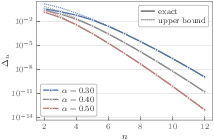
Figure 4: Super-exponential decay of the stabilizer window width with increasing γ9, for various initial amplitudes—demonstrating rapid contraction of the magic-free region as system size grows.