- The paper demonstrates that quantum complexity, measured via entanglement, magic, and non-Gaussianity, serves as a vital resource for simulating and understanding nuclear and high-energy phenomena.
- It employs detailed phase diagrams and resource-theoretic metrics, including stabilizer Rényi entropies, to clearly delineate regions where classical simulation is feasible versus those requiring quantum advantage.
- The study highlights novel simulation techniques and experimental observables that blend quantum information science with traditional nuclear and particle physics methods for advancing research.
Quantum Complexity and Novel Paradigms in Nuclear and High-Energy Physics
The paper "Quantum Complexity and New Directions in Nuclear Physics and High-Energy Physics Phenomenology" (2604.26376) constitutes a comprehensive and technically rigorous review of the mechanisms by which quantum information science (QIS)—in particular, structural tools from quantum resource theory and complexity analysis—has begun to inform and accelerate research in nuclear and high-energy physics (HEP). The authors synthesize advances in the characterization of entanglement, non-stabilizerness (magic), and non-Gaussianity, establishing these quantities as central complexity resources both in the context of simulating many-body systems and for uncovering physical phenomena in strongly interacting matter. This essay provides an analytic summary of the work, focusing on definitions, measurement strategies, emergent findings across physical systems, and the theoretical and practical implications for future developments in the domain.
Foundational Resource Theories in Quantum Complexity
The review positions quantum state complexity as a central organizing principle in the computational tractability of physical systems, explicitly connecting resource theories of entanglement, magic, and non-Gaussianity to phase structure and emergent collectivity in field theories and many-body systems. Efficient classical simulation is tied to the existence of efficient classical descriptions—manifest as, e.g., tensor networks in low-entanglement regimes (area-law states), stabilizer circuits for Clifford dynamics, or Gaussian states in free theories.
States of maximal complexity reside at the intersection of high entanglement and high non-stabilizerness, exhibiting structures inaccessible to classical approximation and demanding quantum computational resources. The review formalizes measurement protocols for these quantities, notably the stabilizer Rényi entropies (SREs) for magic and associated anti-flatness measures, alongside standard entanglement monotones such as entropy and n-tangles. The critical insight is that the mutual interplay between entanglement and magic—captured, for example, by non-local magic measures—dictates the boundary between classically tractable and intractable dynamics, organizing the many-body Hilbert space into regions of low and high computational hardness:
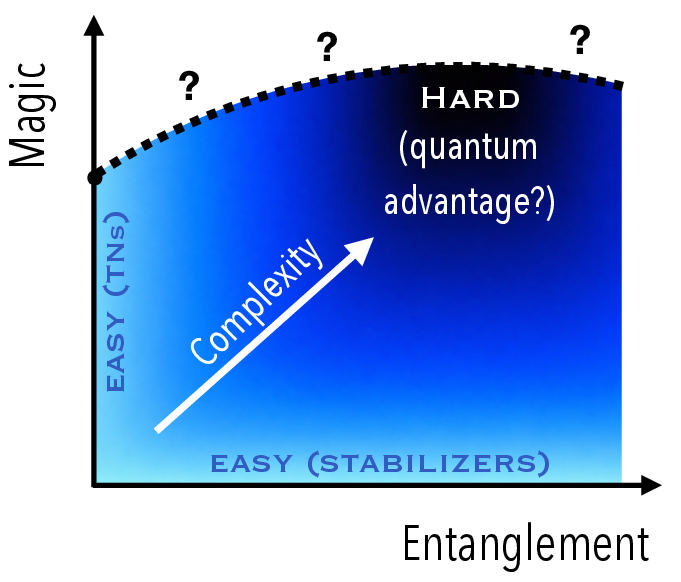
Figure 1: Schematic entanglement-magic phase diagram demarcating classically efficient states (low magic and/or low entanglement) and complex regimes requiring quantum resources.
Complexity Structures in QCD, Nuclei, and High-Energy Processes
Low-Energy Nuclear Physics
The authors present detailed analyses of complexity content in nuclear forces and structure, leveraging both experimental data (e.g., phase-shift analysis for nucleon-nucleon scattering) and ab-initio simulation techniques. Entanglement and magic generation in two-body scattering—quantified as entangling and magic power—are shown to encode information about emergent symmetries such as accidental SU(4), and to identify regions of parameter space where quantum complexity is minimized, corresponding to high-symmetry effective theories.
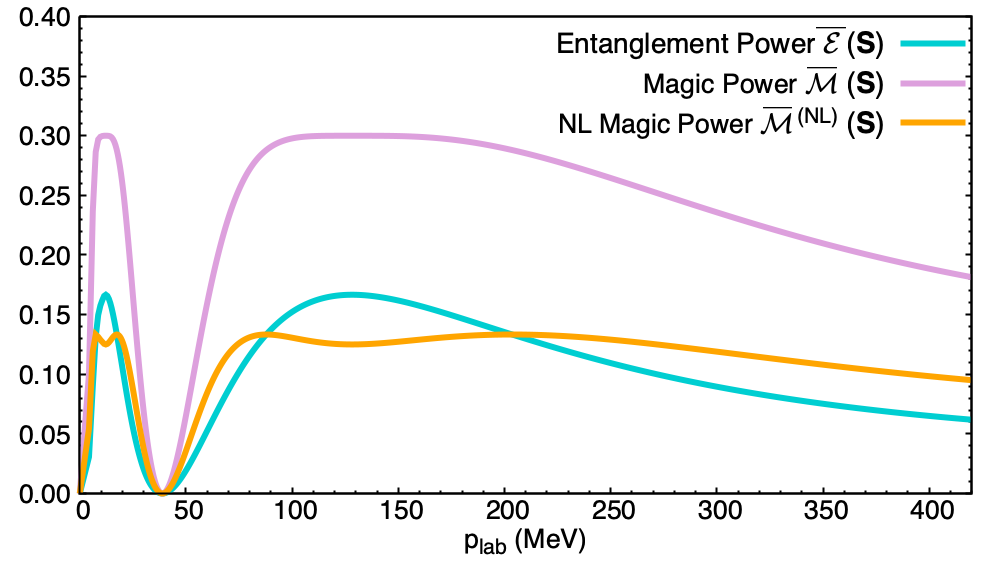
Figure 2: Entanglement power for neutron-proton and neutron-neutron systems as a function of scattering angle and momentum, revealing complexity evolution across effective field theory truncation orders.
Proton-neutron bipartite and multipartite entanglement analyses in shell-model nuclei demonstrate that physical ground states and excitations tend to occupy regions of moderate complexity, with volume-law magic and multipartite entanglement manifesting in collective, deformed nuclei. These findings clarify that nuclear collectivity is associated with large-scale but structured entanglement and moderate non-stabilizerness, suggesting that compressible representations (e.g., low-rank superpositions of stabilizer states or tensor networks) are often viable except in proximity to dynamically complex transitions such as shape coexistence or pairing criticality.
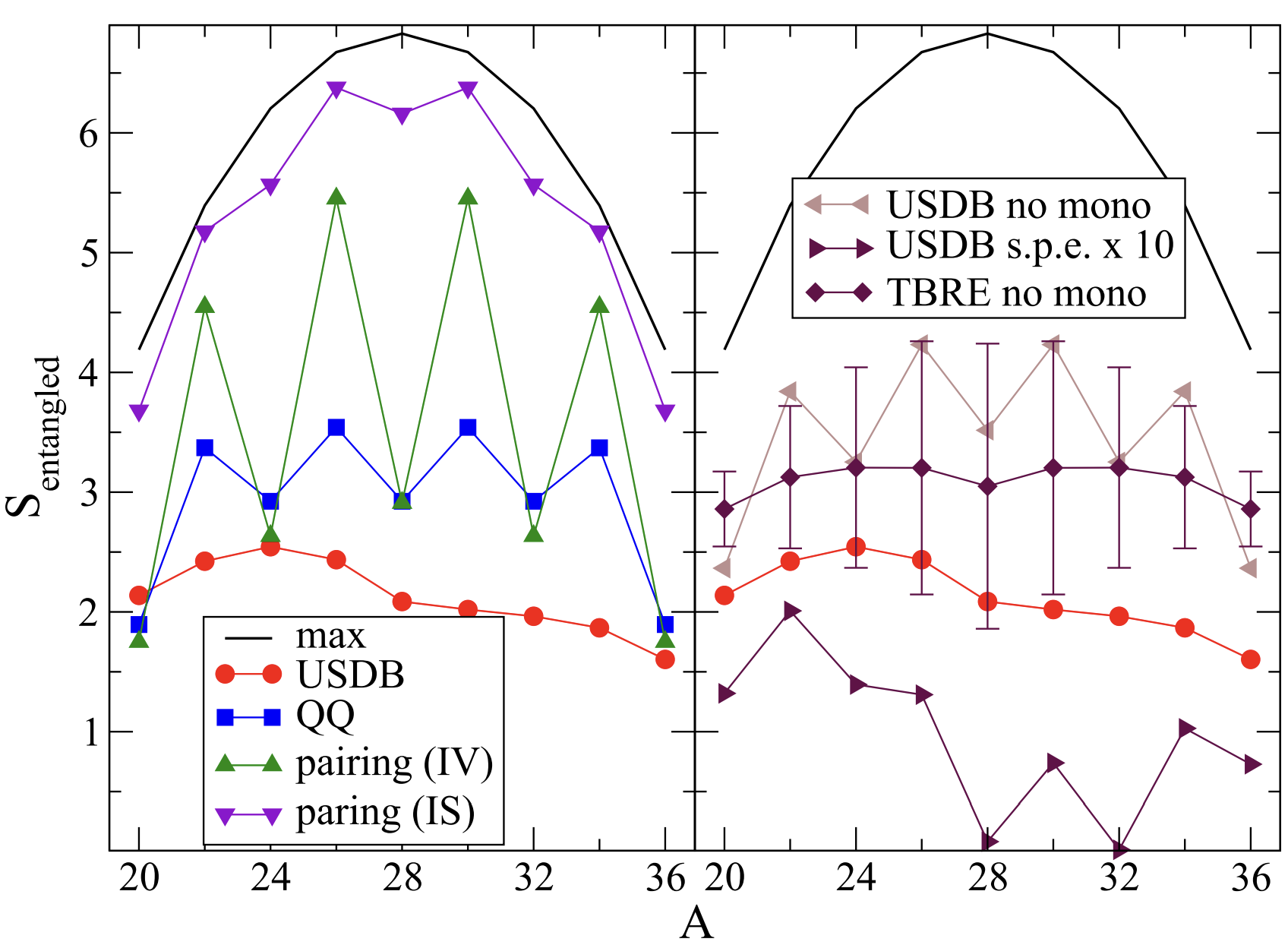
Figure 3: Proton-neutron entanglement entropy in N=Z sd-shell nuclei, illustrating the scaling with nucleon number and shell structure.
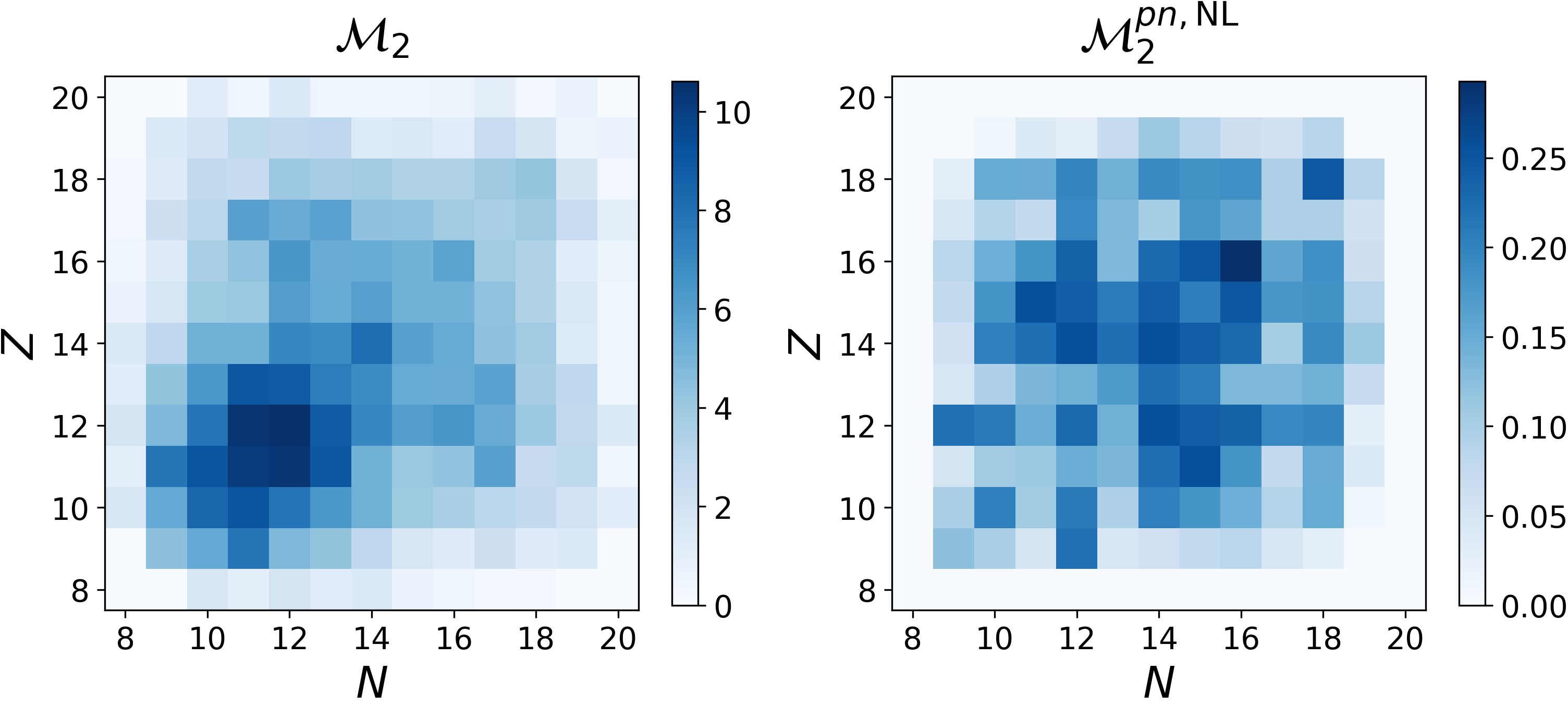
Figure 4: Magic and bipartite non-local magic in sd-shell nuclei, highlighting their respective sensitivities to nuclear structure and correlations.
Quantum Complexity in Phase Transitions and Dynamics
The paper examines schematic models (Richardson pairing, LMG, Agassi) to elucidate the behavior of quantum complexity measures across phase transitions. Notably, the LMG model exhibits a complexity barrier in the phase diagram: ground states interpolate between low-complexity tensor products, through a region of high magic and entanglement (the phase transition), to a highly entangled, but low-magic stabilizer state in the symmetry-broken phase.
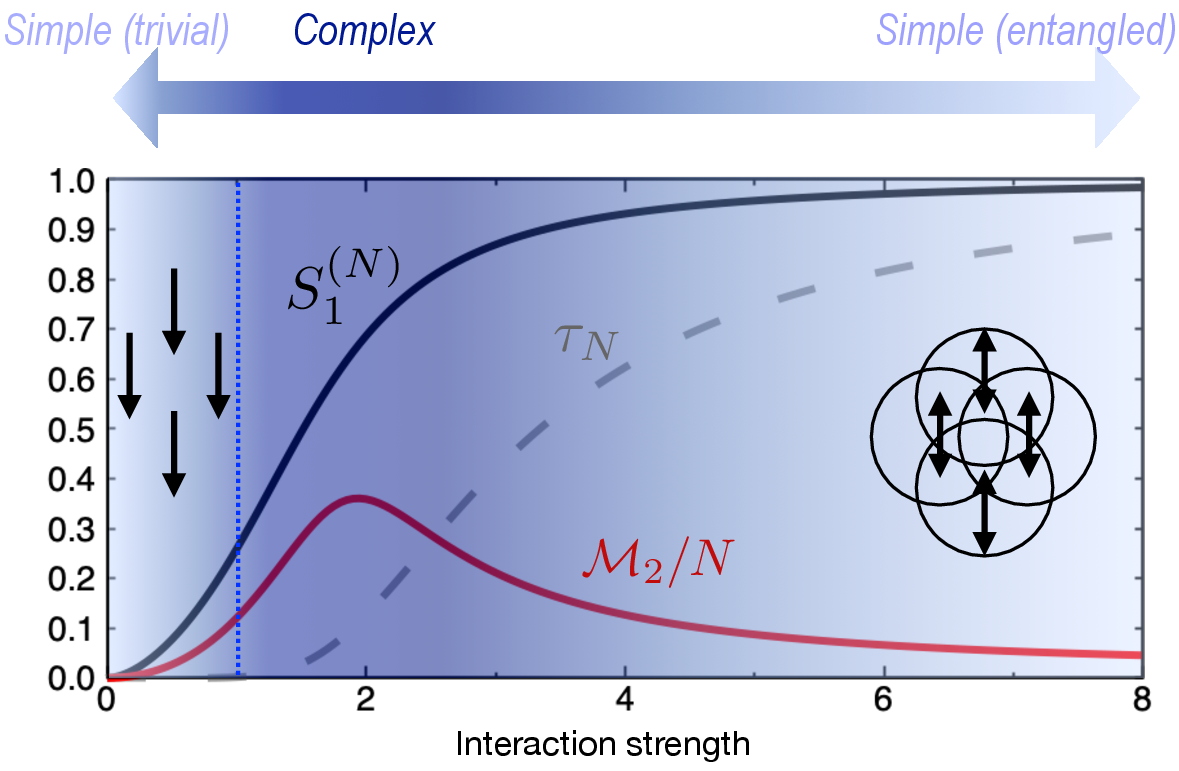
Figure 5: Complexity diagram of the LMG model: regions of maximal complexity (high-magic, high-entanglement) coincide with the quantum critical regime, whereas both trivial and highly collective phases are compressible.
Dynamic processes such as scattering, transfer, and nuclear fission are also interrogated through the lens of time-resolved entanglement and magic production, revealing transient complexity barriers during non-equilibrium evolution—a potential computational bottleneck for classical and quantum simulation workflows.
Techniques for Complexity Mitigation and Simulation
A key focus of the review is on optimization techniques—basis transformation, truncations, hybrid classical-quantum schemes, and neural quantum state architectures—that exploit insights from quantum complexity to enhance simulation efficiency.
- Single-particle and many-body basis optimization: Basis selection minimizes entanglement and magic, facilitating DMRG and SVD-based approaches that approximate nuclear wavefunctions through factorized (proton-neutron) or compressed (natural orbital) schemes.
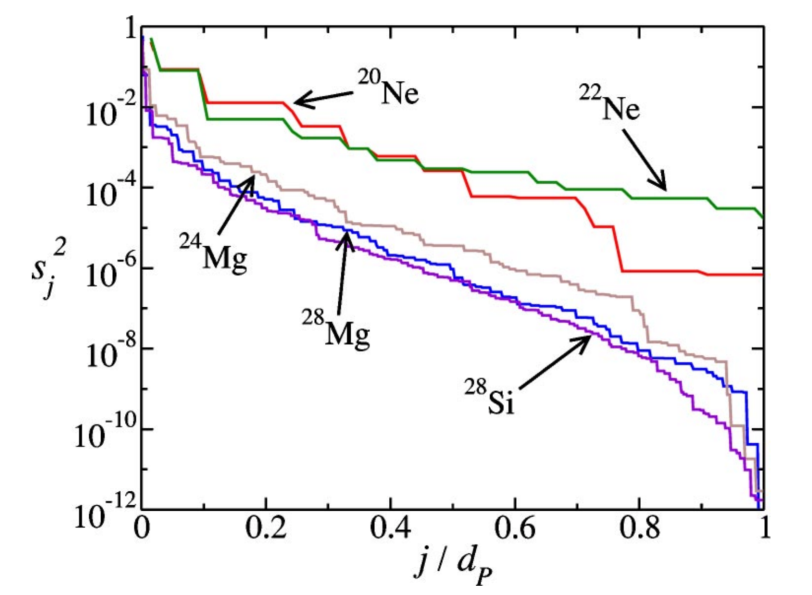
Figure 6: Singular values of neutron reduced density matrices in shell-model nuclei, motivating Schmidt decomposition-based wave function factorization.
- Stabilizer state methods: The identification of stabilizer ground states as approximants to collective phases suggests a new paradigm for symmetry-preserving and computationally efficient state preparation, with quantum magic subsequently addressed via perturbative correction circuits.
- Neural quantum states: Investigations into the representational capabilities of RBMs and related architectures show that magic content poses a bottleneck for classical learning algorithms, correlating directly with reconstruction fidelity in large Fock spaces.
Figure 4: Fidelity of neural quantum states representation as a function of the non-stabilizerness of the target state, indicating that magic is a limiting factor in classical NQS expressivity.
Quantum Complexity in High-Energy and Many-Body Gauge Theories
The review extends its complexity-theoretic framework to QCD and Standard Model processes, analyzing entanglement and magic generation in high-energy scattering, gluon-gluon processes, and hadronic structure. A notable demonstration is the correlation between minimized magic production and the physical value of the weak mixing angle in Z0-mediated processes, implying that quantum informational criteria may non-trivially constrain model parameters.
Measurement strategies for complexity observables in collider events (e.g., tt spin entanglement and magic) are outlined, and the role of multipartite complexity measures in informing jet structure, fragmentation, and baryogenesis is discussed, with an emphasis on complexity-induced barriers during string breaking and thermalization.
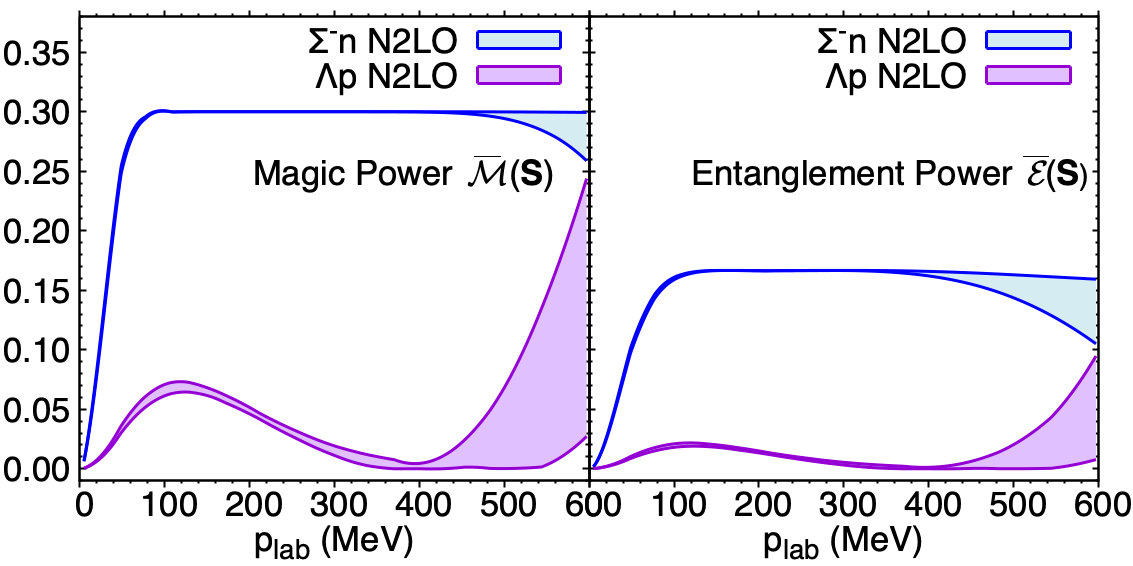
Figure 7: Magic power in scattering processes, illustrating maximal complexity production in sectors with reduced symmetry.
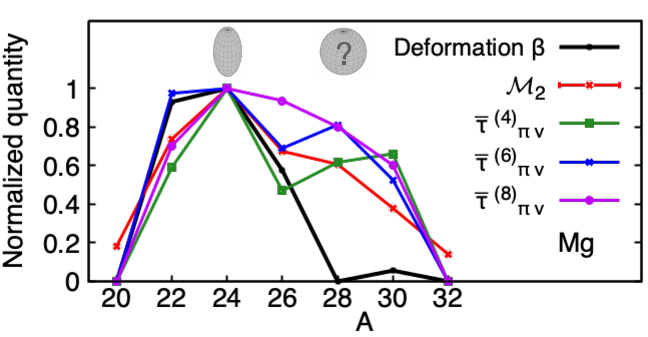
Figure 8: Total and non-local magic in Schwinger-model string breaking, showing rapid complexity decay at the string-breaking threshold.
Theoretical and Practical Implications
This survey suggests several key outcomes:
- Pathways to quantum advantage: Complexity quantification enables precise determination of regimes where quantum hardware is strictly necessary. Optimally combining classical and quantum resources hinges on mapping problem instances within the entanglement-magic-non-Gaussianity resource landscape.
- Algorithmic innovation: Understanding of non-local resource structure is catalyzing new algorithmic designs, including stabilizer-initialized quantum circuits, tensor-stabilizer hybrid ansatzes, and complexity-adaptive neural architectures. These advancements directly impact the scalable simulation of nuclei, QCD processes, and extreme astrophysical environments.
- Physics insights: Quantum complexity illuminates hidden symmetries, guides power-counting in effective field theories, and provides new interpretive tools for the emergence of collective and critical behavior—from hadronic to nuclear and astrophysical scales.
- Experimental observables: The identification of observable proxies for complexity (e.g., anti-flatness, non-local magic, entanglement spectrum) opens the door to measuring quantum information content in experimental data, as already beginning in LHC analyses and advanced neutrino phenomenology.
Conclusion
The integration of quantum information science into the analysis of nuclear and high-energy systems represents a significant theoretical and methodological advance. By organizing the Hilbert space according to resource-theoretic axes and explicitly linking computational complexity to physical observables and emergent phenomena, the field is poised for both more efficient simulations and deeper physical insights. Future research will likely focus on the development and deployment of hybrid simulation frameworks, further analytic categorization of complexity-induced phase structure, and the direct measurement of complexity-theoretic quantities in experimental settings. The confluence of quantum computing and many-body physics thus holds promise for resolving classically intractable problems and for revealing new layers of structure in fundamental interactions.