- The paper demonstrates that the relative entropy of magic is nonadditive for nearly all tensor products except for commuting cases.
- It employs analytic and geometric methods to characterize magic states on the Bloch sphere and within the stabilizer polytope.
- The findings refine resource conversion rates, impacting strategies for fault-tolerant quantum computation and magic state distillation.
The Relative Entropy of Magic and Its Nonadditivity
Introduction
The resource theory of magic rigorously formalizes the quantification and utilization of non-Clifford resources required for universal fault-tolerant quantum computation. Stabilizer operations, encompassing Clifford gates and stabilizer states, are efficiently simulable classically and thus non-universal due to the Gottesman-Knill theorem. Universal quantum computation is achieved by supplementing stabilizer circuits with "magic" states—non-stabilizer ancillae—enabling, e.g., injection of T gates [Bravyi05]. Quantifying the resourcefulness of these states is central to understanding their cost and optimal deployment.
This paper investigates the structure of single- and multi-qubit magic states under the relative entropy of magic (Rrel), providing analytical and geometric characterizations. The central technical result is a thorough analysis of the nonadditivity of Rrel, culminating in proof of nonadditivity for essentially all tensor products except for a measure-zero set of commuting cases, and construction of infinite nontrivial families exhibiting nonadditivity (2605.22392).
The Geometry of Magic and Closest Stabilizer States
For single qubits, the magic resource space is efficiently visualized on the Bloch sphere: the stabilizer states (computational and Pauli eigenbases) form an octahedron within the Bloch ball. States lying outside this polytope are magic states.
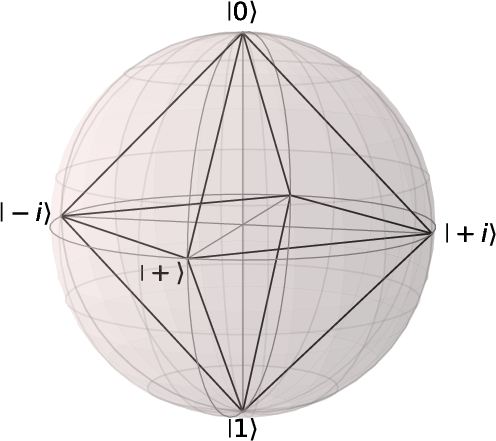
Figure 1: The Bloch ball representation where the stabilizer states occupy an octahedron; magic states are positioned outside this region.
Analytically, the authors leverage the explicit convex structure of the stabilizer polytope and techniques from the resource theory of entanglement [relEnt] to parameterize all magic states with a fixed closest stabilizer state, exploiting supporting hyperplane characterizations. For magic states with stabilizer states on the faces of the octahedron, a unique supporting hyperplane exists, while for those on edges, a continuous family does.
Two families play a central role: the T-like states, pure states at maximal distance from the stabilizer octahedron's center-of-faces, and H-like states, located above edge midpoints. The T-state achieves maximal single-qubit Rrel.
The authors derive precise analytic expressions for the Bloch vectors of magic states closest to any stabilizer state and, crucially, a mapping from a given magic state to its unique closest stabilizer, generalizing prior works.
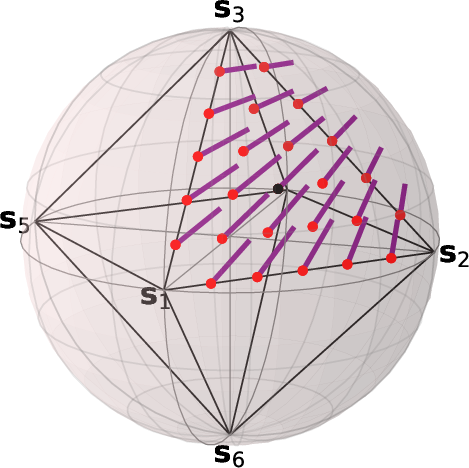
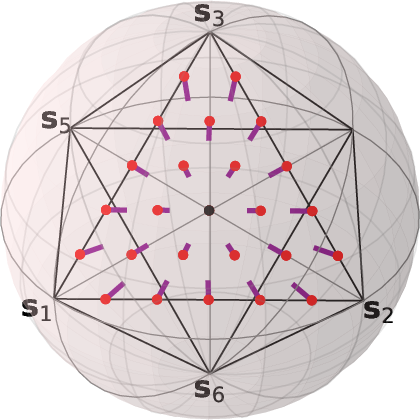
Figure 2: Side view of distributions showing the correspondence of magic states to their stabilizer projections on the octahedron’s boundary.
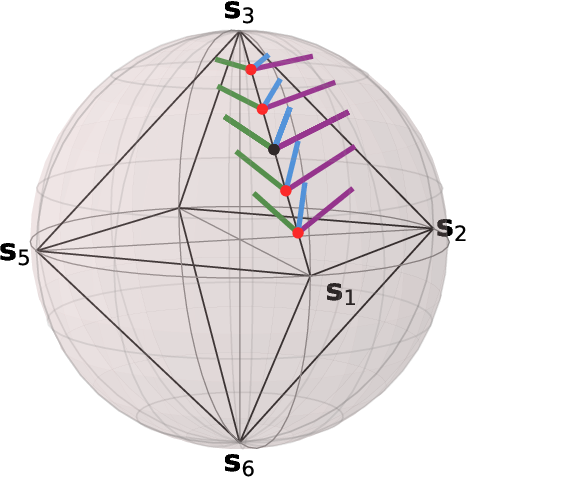
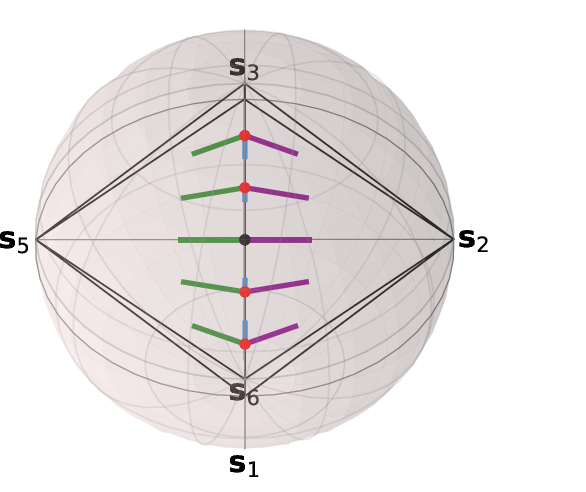
Figure 3: Top view elucidating the rotationally symmetric arrangement of magic states with respect to the stabilizer octahedron.
Quantitative Behavior of the Relative Entropy of Magic
Using these parameterizations, one can determine Rrel analytically for all pure single-qubit states. The measure is maximized at the T-state, decreases smoothly with angular distance from the T-axis, and exhibits rotational symmetry for states on facets of the stabilizer polytope.
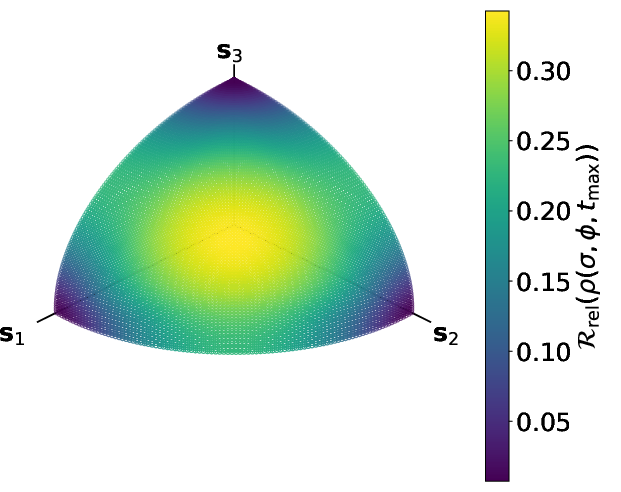
Figure 4: Relative entropy of magic Rrel0 for pure states on a triangular facet, illustrating decay as distance from the Rrel1 point increases.
For edge states, the maximal value is achieved at Rrel2-like states, corresponding to injection resources for Rrel3 and Hadamard-type magic, relevant for gate synthesis. Computing these values avoids the need for costly numerical optimizations requiring convex minimization over the stabilizer set.
Nonadditivity: Strong Results and Construction
One of the paper’s primary contributions is an explicit, analytic proof of the nonadditivity of Rrel4 for an infinite family of multi-qubit states. Previously, only sporadic counterexamples were established [Rubboli_2024]. The authors rigorously show that, unless all (or all but one) constituent single-qubit magic states and their respective closest stabilizer states commute, additivity fails. This result is established by constructing hyperplane witnesses and demonstrating that the optimal product stabilizer is not the closest for the joint state.
More formally, for
Rrel5
if at least two constituents are non-commuting with their optimal stabilizer, and at least one such stabilizer lies in the relative interior of a facet, then additivity does not hold: Rrel6
This resolves the scope of additivity for tensor-product states in the resource theory of magic, with explicit analytic bounds.
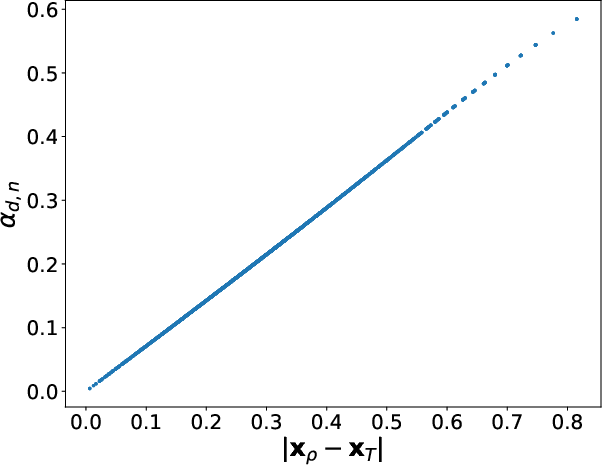
Figure 5: The angle Rrel7 between support directions, quantifying deviation from additivity; steeper slopes indicate greater nonadditivity.
The analysis also encompasses numerical results for maximally magic two-qubit states, demonstrating that Rrel8 remains subadditive, even for states maximizing the stabilizer Rényi entropies [liu2025MaxMagic].
Implications and Future Directions
The precise geometric and analytic characterization of Rrel9 deepens understanding of resource cost for non-Clifford ancillae, informing distillation, synthesis, and fault-tolerance overheads. The proof that nonadditivity is generic outside commuting cases constitutes an essential refinement for asymptotic resource conversion rates and single-shot magic distillation. The identification of the commutativity condition as the only exception for additivity suggests sharp operational regimes for resource monotones.
The findings also illuminate the discrepancy between distinct measures of magic: in particular, optimal states for the stabilizer Rényi entropy need not be optimal for the relative entropy of magic, and vice versa. This underscores the necessity of measure-aware analysis when quantifying overhead in practical quantum algorithms.
Further inquiry should focus on extending these additivity/nonadditivity results beyond tensor powers, exploring correlated (non-product) magic states and operational tasks such as gate synthesis and error-corrected computation. The geometric framework may inspire algorithms for efficiently identifying high-magic states and clarifying scaling in higher dimensions.
Conclusion
This work provides a comprehensive, analytic, and geometric treatment of the relative entropy of magic, firmly establishing its nonadditivity for essentially all product states except the commutative class. The results constrain resource-theoretic conversion rates, offer practical methods for quantifying single- and multi-qubit magic, and delineate sharp regimes for quantum information processing utilizing non-stabilizer ancillae. These contributions are expected to influence future studies on resource conversion, gate synthesis costs, and the foundational structure of quantum advantage in fault-tolerant architectures.

