- The paper introduces AeroJEPA, which reformulates CFD surrogate modeling by predicting semantic latent representations conditioned on geometry and operating variables.
- It employs a three-module framework—context encoder, latent predictor, and INR decoder—to achieve resolution-independent aerodynamic field prediction with superior accuracy.
- Empirical evaluations show that the method not only enhances computational efficiency but also organizes latent spaces for interpretable design optimization and semantic probing.
AeroJEPA: Semantic Latent Representations for Scalable Aerodynamic Field Modeling
Introduction
The paper "AeroJEPA: Learning Semantic Latent Representations for Scalable 3D Aerodynamic Field Modeling" (2605.05586) addresses two core challenges in aerodynamics surrogate modeling: scalability to high-resolution 3D fields and the semantic organization of latent representations. Traditional neural surrogates for CFD generally predict dense fields directly, which restricts scalability and often fails to yield latent spaces that are physically interpretable and useful for design and analysis. AeroJEPA reformulates the surrogate problem by predicting latent representations of aerodynamic flows conditioned on geometry and operating variables, leveraging a Joint-Embedding Predictive Architecture (JEPA). This approach aligns the latent space with geometric and physical quantities, decouples field resolution from predictive inference, and enables novel workflows such as latent optimization and semantic probing.
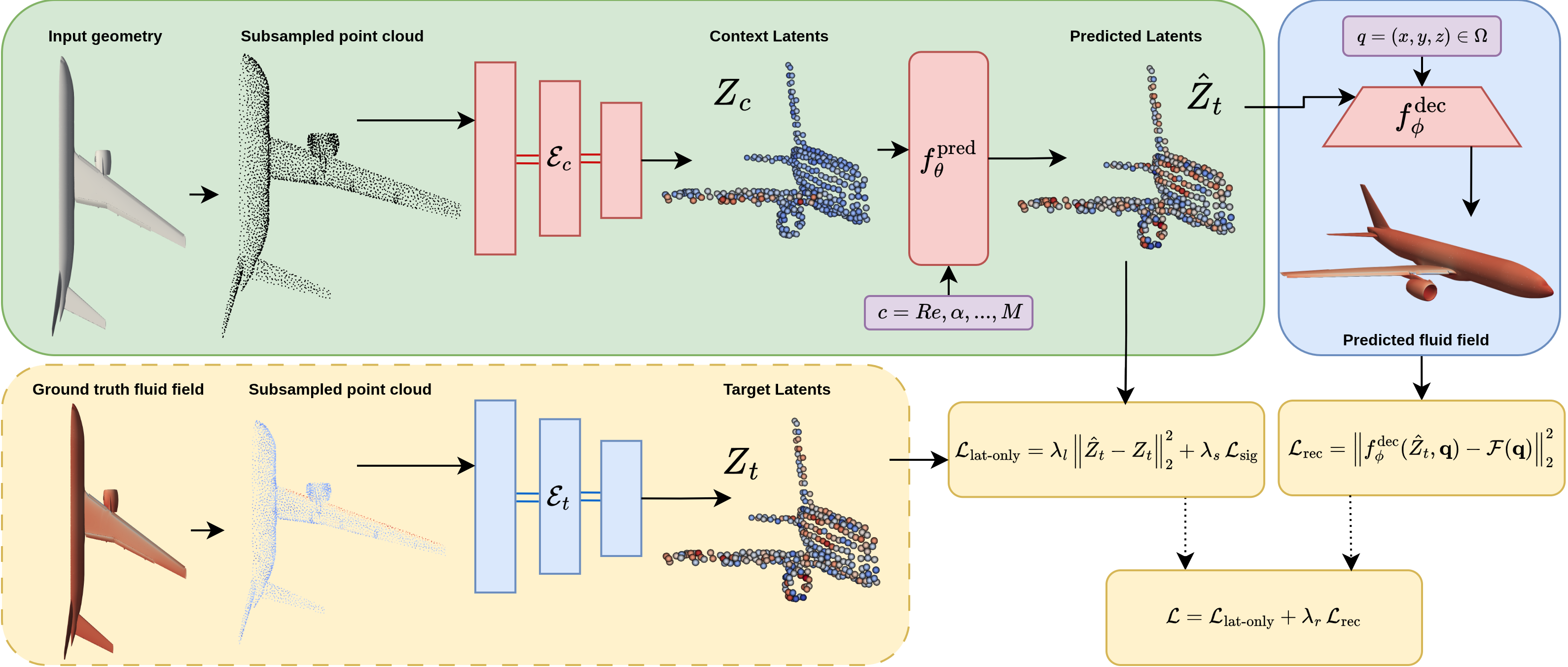
Figure 1: Overview of AeroJEPA; geometry point cloud is encoded into context tokens Zc, target flow field is encoded to target tokens Zt, and the predictor conditions Zc on operating variables to generate predicted target tokens Z^t.
Methodological Framework
AeroJEPA is built upon three distinct modules: context encoder, latent predictor, and an implicit neural representation (INR) decoder. The context encoder maps subsampled point clouds from geometry to fixed-size tokens; the target encoder maps independently subsampled flow fields to tokens, acting as training targets. Both employ centroid clustering, message passing, and point-transformer attention to abstract large unstructured CFD data into tokenized representations. The predictor conditions context tokens on operating variables (e.g., α, Re, Mach) and generates latent targets. The INR decoder reconstructs continuous fields from the predicted latent tokens, allowing query flexibility and resolution independence—a direct advantage over fixed-grid surrogates.
The training objective comprises a latent-matching loss (Llat), field reconstruction loss (Lrec), and a SIGReg regularization (Lsig), which prevents representation collapse by promoting isotropic Gaussian priors over the latent distribution. End-to-end coupled training empirically preserves physical validity of the latents and enhances semantic structuring.
Experimental Evaluation
HiLiftAeroML: Scalability and Latent Structure
AeroJEPA was benchmarked against state-of-the-art baselines (FigConvUNet, GeoTransolver, Transolver) using HiLiftAeroML, which features high-fidelity WMLES boundary-layer fields (Zt015M surface points, Zt150M volume points). AeroJEPA's continuous latent prediction circumvents chunked inference bottlenecks, achieving superior accuracy in velocity and pressure fields while minimizing computational cost.
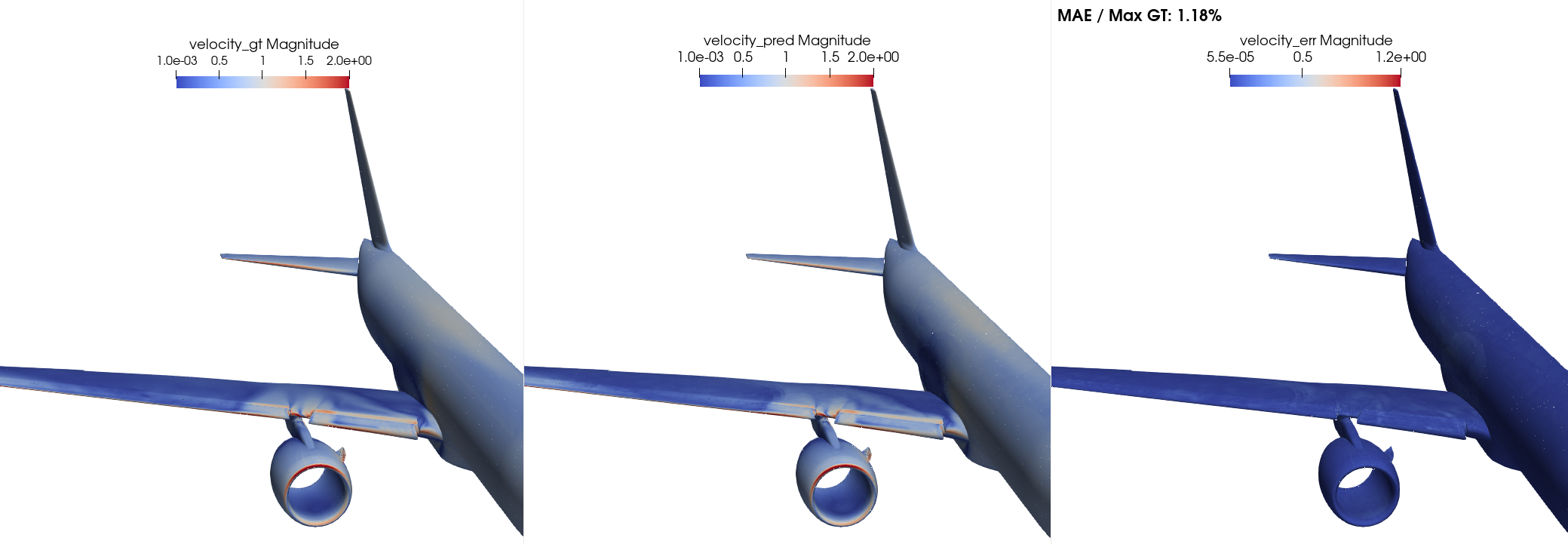
Figure 2: HiLiftAeroML decoded field for LHC013 at Zt2, demonstrating consistent predictions in high-gradient regions and flow separation.
Latent-space analysis reveals significant semantic organization. PCA projections show AeroJEPA context latents encode coherent geometric manifolds, outperforming VAE-based baselines in structure alignment. Ridge regression probes recover flap and slat control-surface deflections with Zt3 between Zt4-Zt5 from the context latent despite no direct supervision. Predicted latents align with aerodynamic coefficients (Zt6, Zt7) with Zt8 of Zt9 and Zc0 respectively.
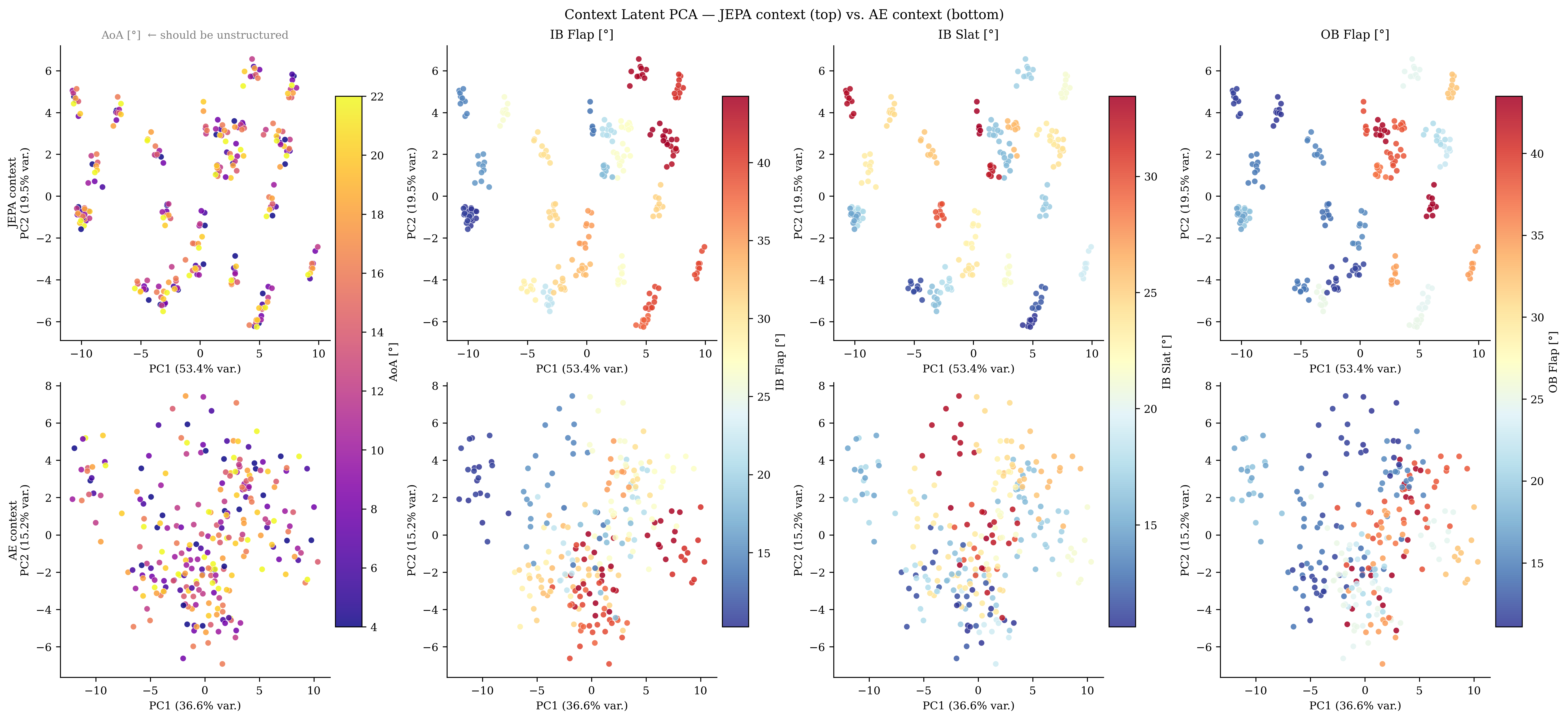
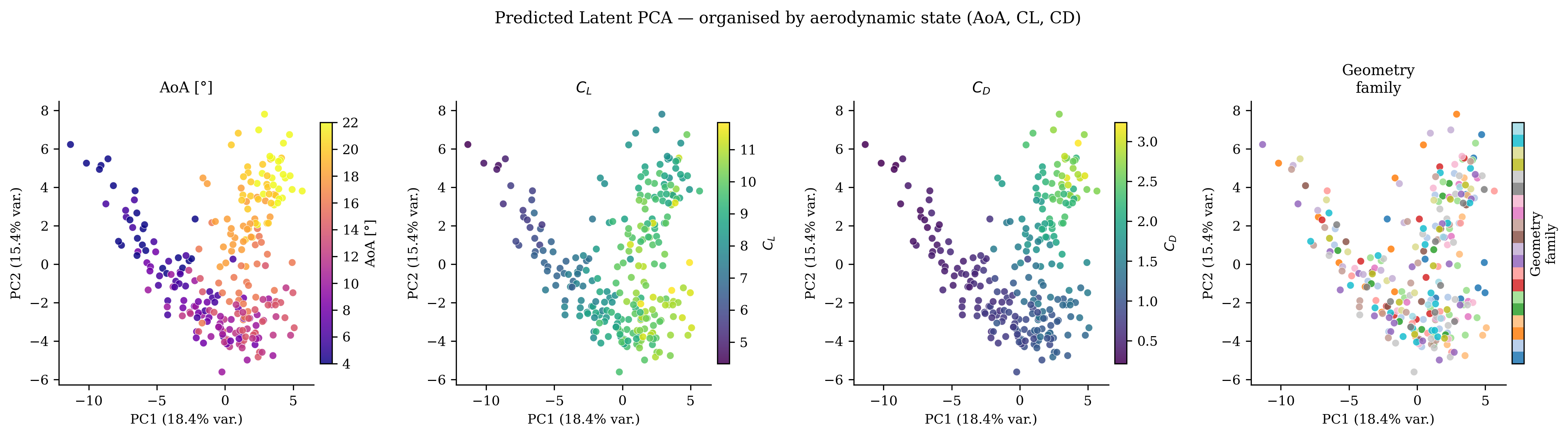
Figure 3: Context latent PCA projection—AeroJEPA organizes geometry manifolds more coherently than VAEs; predicted latent projection aligns smoothly with aerodynamic quantities.
Latent arithmetic exposes disentangled control axes: latent directions corresponding to flap/slat manipulations show minimal cross-coupling, matching physical actuation logic.
SuperWing: Generalization and Latent-Space Design Optimization
SuperWing, a transonic wing dataset (Zc1 wings, Zc2 state solutions), tests generalization and design usability. AeroJEPA's invariance to chunked/one-pass inference regimes yields competitive and often superior surface field prediction against baselines.
Proof-of-concept latent optimization was performed by maximizing Zc3 within physically-consistent constraints directly in the context latent space. The optimized solution lies on the dataset's high-efficiency envelope and can be mapped to recognizable wing designs (high aspect ratio, high sweep, aggressive taper, root-biased twist), demonstrating the latent space's utility as a search space.
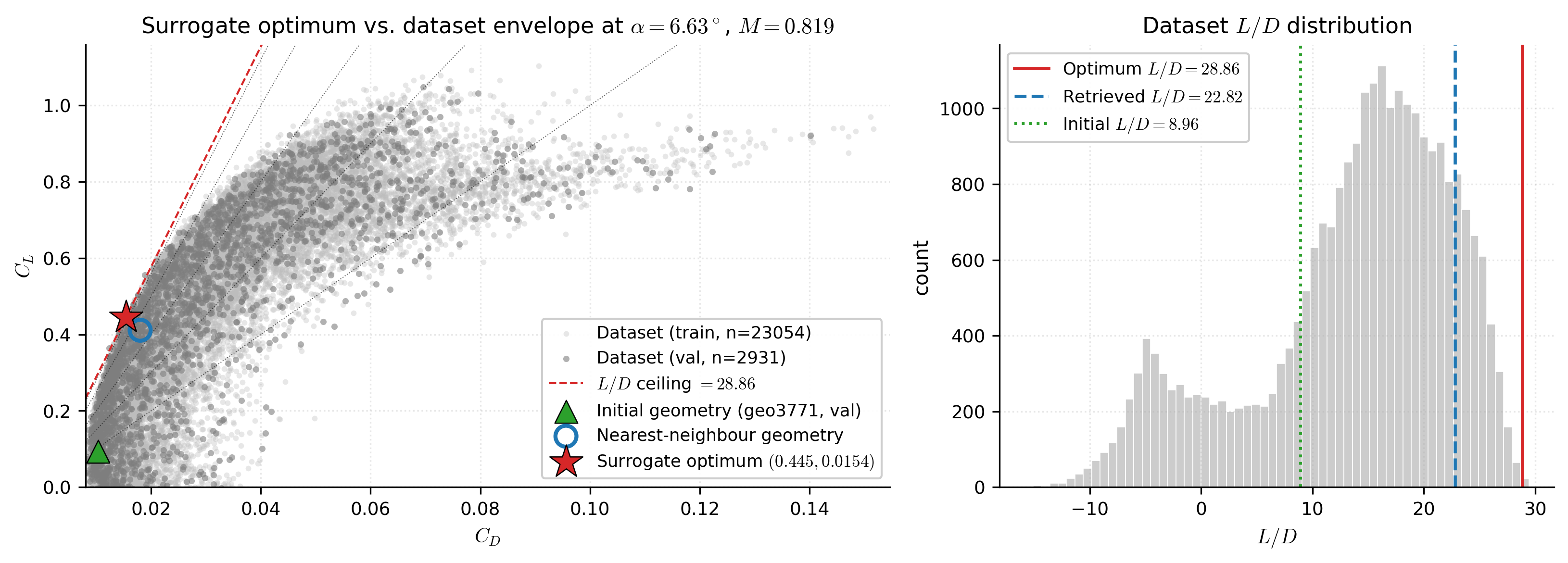
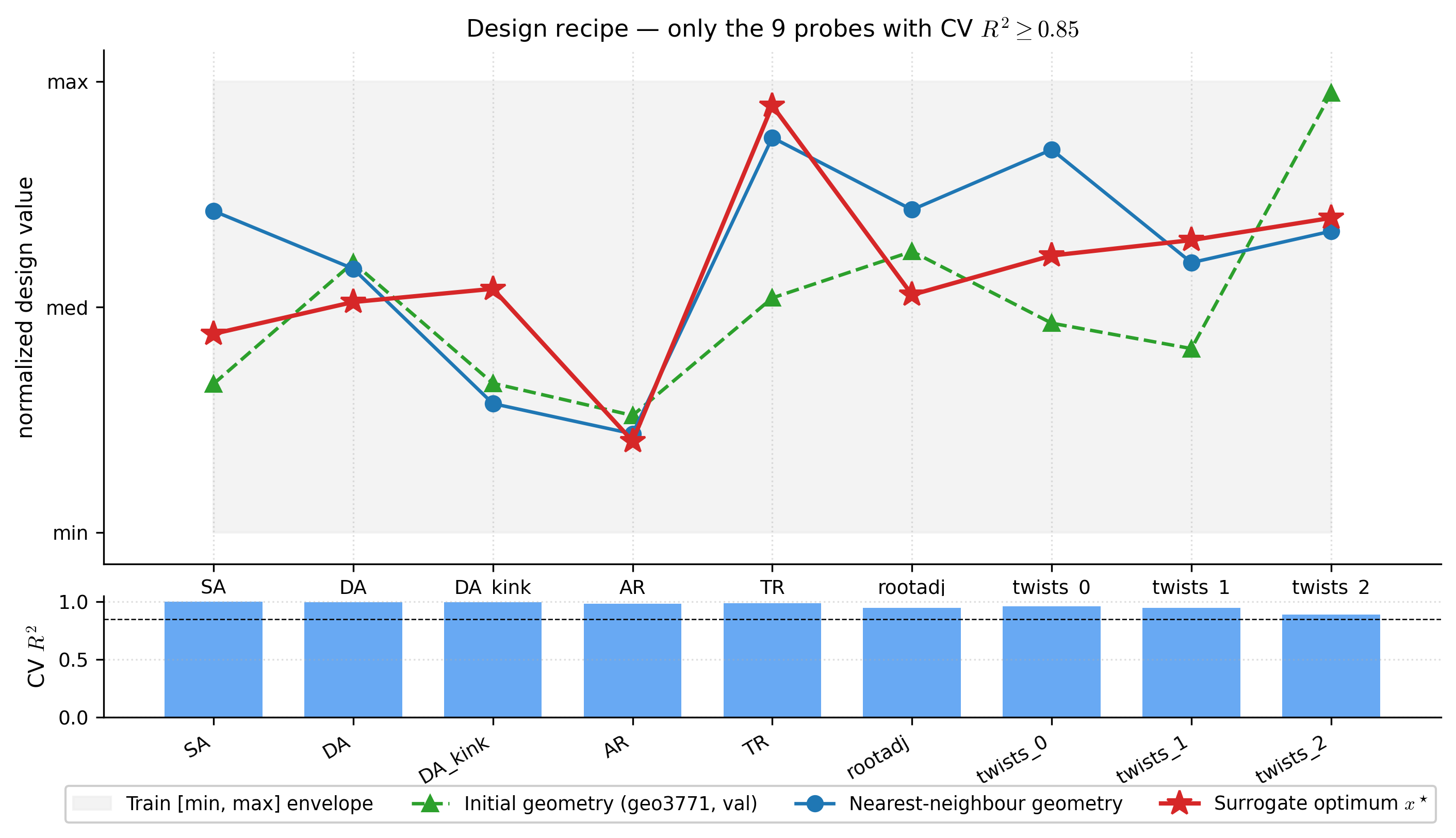
Figure 4: Latent-stack optimization on SuperWing: optimum sits on the high-efficient Zc4 frontier; corresponding design parameters recovered represent a canonical high-efficiency wing.
Decoded fields exhibit excellent agreement with reference solutions, and parity plots confirm fidelity of integrated aerodynamic quantities.
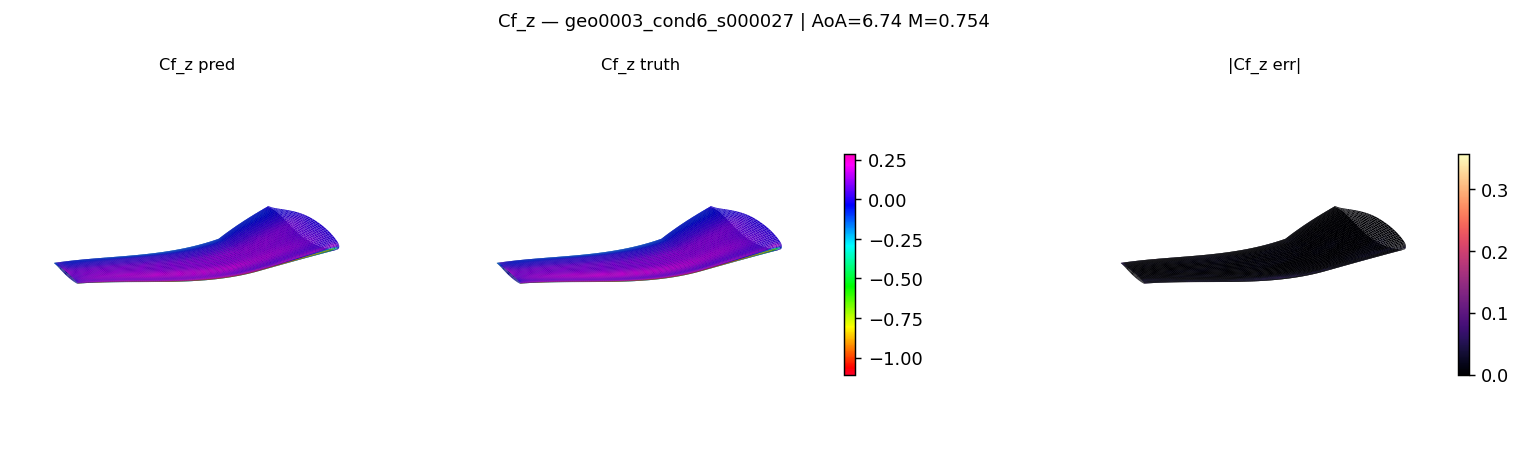
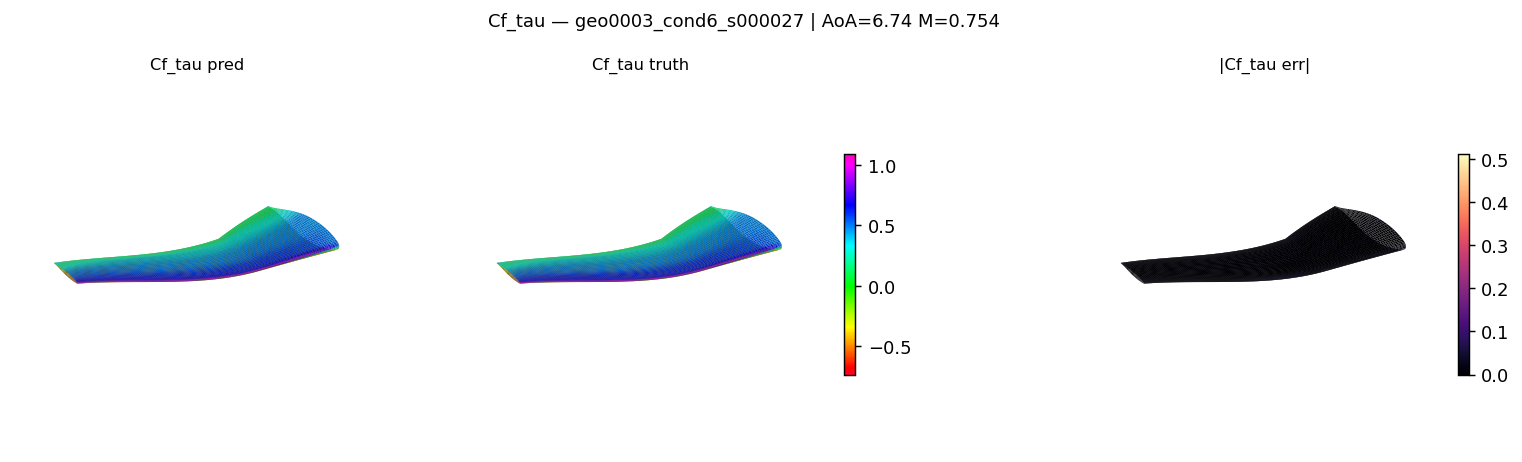
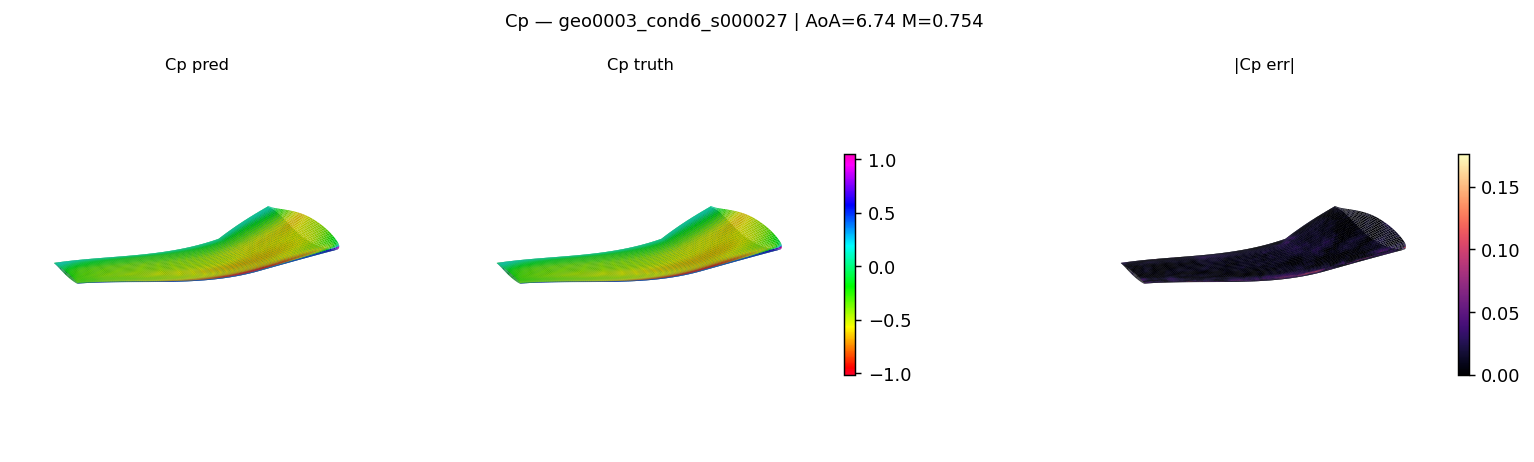
Figure 5: Representative decoded-field comparisons on SuperWing for Zc5, Zc6, and Zc7; predicted fields are consistent with reference solutions.
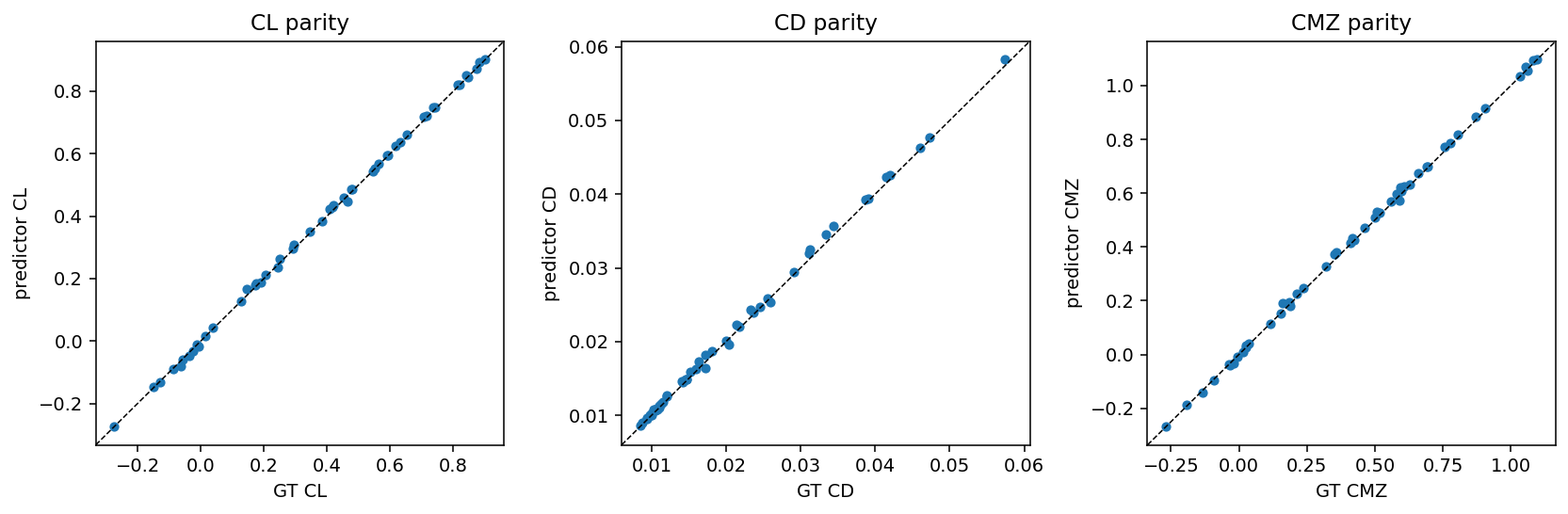
Figure 6: Parity plots for Zc8 and Zc9 from decoded SuperWing fields, demonstrating preservation of integrated aerodynamic response.
Detailed Latent Analyses
Linear-probe evaluations verify that context latents, predicted latents, and target latents all carry semantic information, enabling smooth gradient-based optimization and interpretable latent arithmetic. Concept-vector walks in the HighLift latent space confirm near-unit sensitivity in targeted parameters, with residual couplings that reflect expected flap/slat actuation interaction.
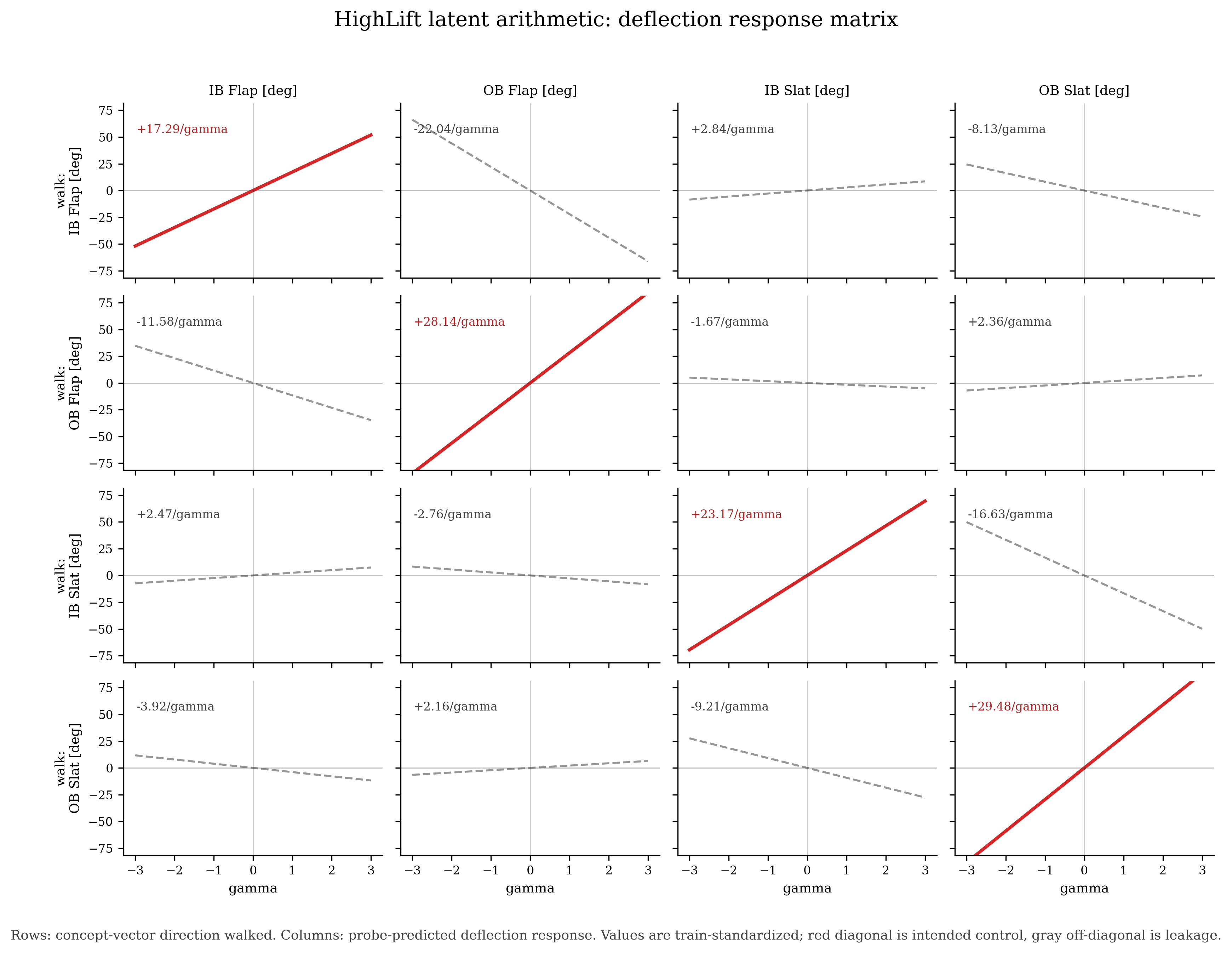
Figure 7: Latent-arithmetic trajectories: walks along concept vectors show isolable design control axes with residual physically-plausible cross-coupling.
Latent-space interpolation between configurations yields physically-plausible decoded fields and coefficient profiles, highlighting smoothness and semantic alignment of the predicted manifold.
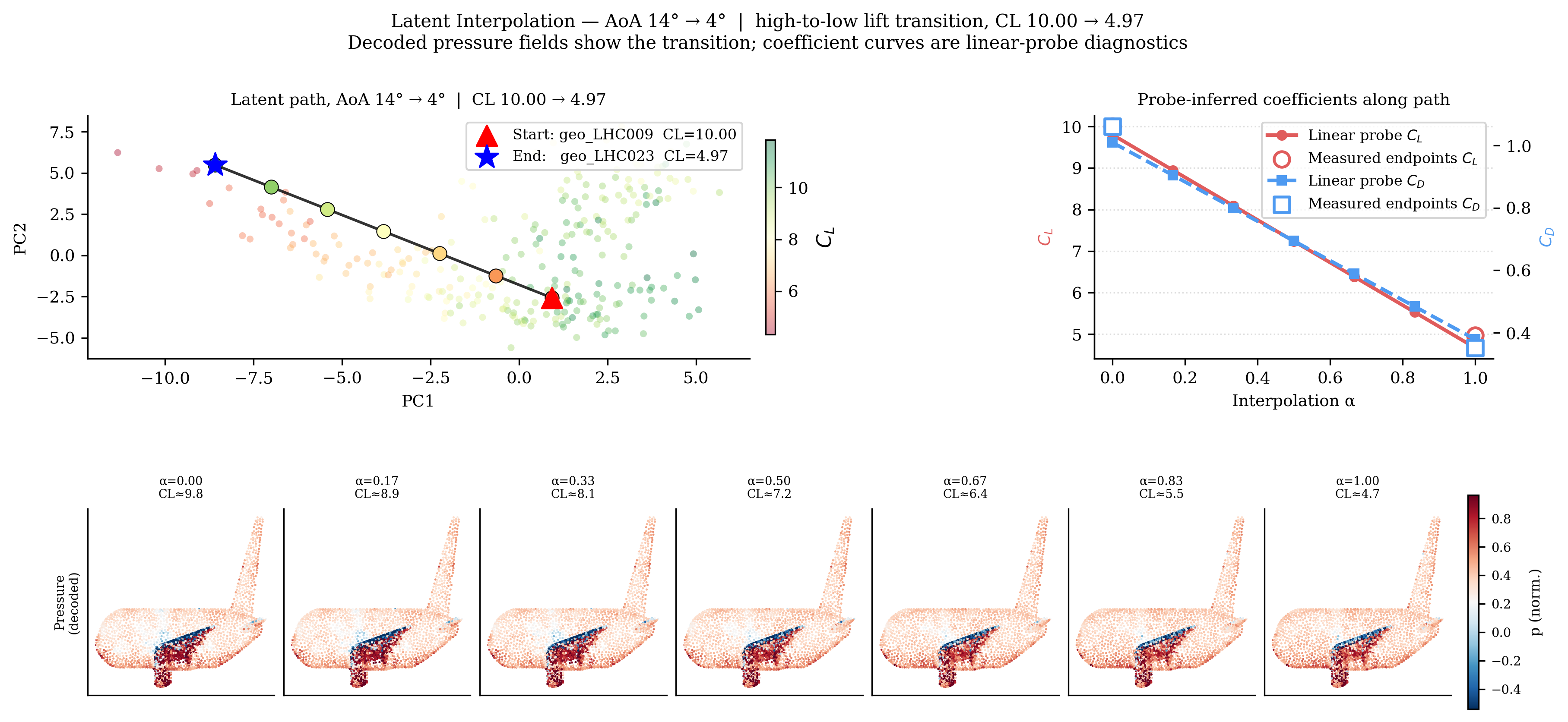
Figure 8: Latent interpolation on HiLiftAeroML yields decoded fields that are physically meaningful, with integrated coefficients tracking ground truth.
Implications and Future Directions
AeroJEPA delivers a scalable surrogate modeling paradigm for 3D aerodynamics, supporting full-field prediction, analysis, and design optimization within a semantically meaningful latent space. The approach addresses scalability by decoupling inference cost from field resolution, and enhances scientific utility by organizing latent variables that access geometry, flow conditions, and downstream performance metrics.
The semantic structure of the latent space—demonstrated via regression, interpolation, concept arithmetic, and constrained optimization—opens pathways for agentic exploration and rapid iteration in design settings without full CFD solves in-the-loop. The theoretical implications involve advancing predictive latent learning beyond image/video domains to scientific modeling, affirming JEPA as a versatile architecture for high-dimensional, physics-informed surrogate modeling.
Next steps include benchmarking across broader aerodynamic regimes, integrating inverse design pipelines, exploring multi-fidelity and unsteady flow extensions, and deploying latent optimization in practical design workflows.
Conclusion
AeroJEPA pioneers the integration of JEPA-style latent prediction and INR decoding for scalable, semantic aerodynamic surrogate modeling. It advances both accuracy and usability in high-resolution CFD surrogate applications, structuring the latent space for interpretability, probing, and optimization. This latent-centric surrogate modeling framework constitutes a major step toward scalable, physically-informed, and design-meaningful machine learning for engineering applications.