Geometry-Aware Neural Optimizer for Shape Optimization and Inversion
Published 6 May 2026 in cs.LG | (2605.04474v1)
Abstract: Geometry is central to PDE-governed systems, motivating shape optimization and inversion. Classical pipelines conduct costly forward simulation with geometry processing, requiring substantial expert effort. Neural surrogates accelerate forward analysis but do not close the loop because gradients from objectives to geometry are often unavailable. Existing differentiable methods either rely on restrictive parameterizations or unstable latent optimization driven by scalar objectives, limiting interpretability and part-wise control. To address these challenges, we propose Geometry-Aware Neural Optimizer (GANO), an end-to-end differentiable framework that unifies geometry representation, field-level prediction, and automated optimization/inversion in a single latent-space loop. GANO encodes shapes with an auto-decoder and stabilizes latent updates via a denoising mechanism, and a geometry-injected surrogate provides a reliable gradient pathway for geometry updates. Moreover, GANO supports part-wise control through null-space projection and uses remeshing-free projection to accelerate geometry processing. We further prove that denoising induces an implicit Jacobian regularization that reduces decoder sensitivity, yielding controlled deformations. Experiments on three benchmarks spanning 2D Helmholtz, 2D airfoil, and 3D vehicles show state-of-the-art accuracy and stable, controllable updates, achieving up to +55.9% lift-to-drag improvement for airfoils and ~7% drag reduction for vehicles.
The paper introduces GANO, a fully differentiable pipeline for shape optimization and inversion that eliminates manual remeshing and accelerates PDE solutions.
The paper leverages a stable SDF auto-decoder and a geometry-injected transformer to enable field-level predictions and efficient latent-space optimization.
The paper demonstrates state-of-the-art performance on 2D and 3D benchmarks, achieving significant aerodynamic improvements while preserving critical design features.
Geometry-Aware Neural Optimization: An Expert Overview of GANO
Introduction and Problem Formulation
Shape optimization and inversion for PDE-governed physical systems are critical for engineering, but the classical optimization pipeline involves expensive simulation, repeated manual geometry updates, and remeshing cycles. Neural surrogates can accelerate forward PDE solutions, but limitations remain: most methods either require restricted parametric design spaces or employ unstable latent-space optimization with little geometric interpretability or sub-component control.
The "Geometry-Aware Neural Optimizer for Shape Optimization and Inversion" (2605.04474) proposes GANO, a fully differentiable, automated pipeline unifying geometry representation, field-level PDE surrogate modeling, and end-to-end shape optimization or inversion. By leveraging a robust auto-decoder SDF representation, geometry-injected transformer-based field surrogate, and advanced optimization strategies (including null-space projection and remeshing-free sampling), GANO achieves state-of-the-art controllability and stability for optimization and inversion tasks on irregular, complex 2D and 3D design spaces.
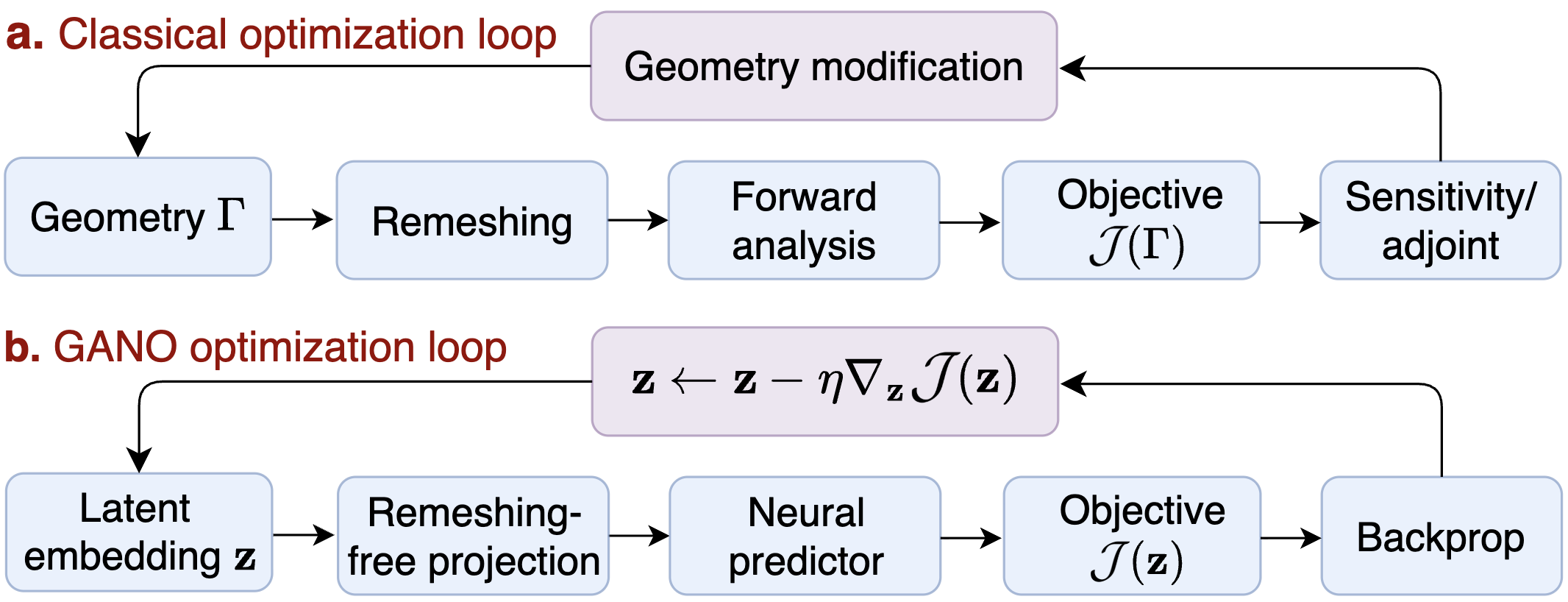
Figure 1: Comparison of the classical geometry optimization workflow (a) versus the GANO loop (b), highlighting elimination of explicit remeshing and human intervention.
Method and Pipeline Design
The GANO pipeline innovates across three tightly coupled components:
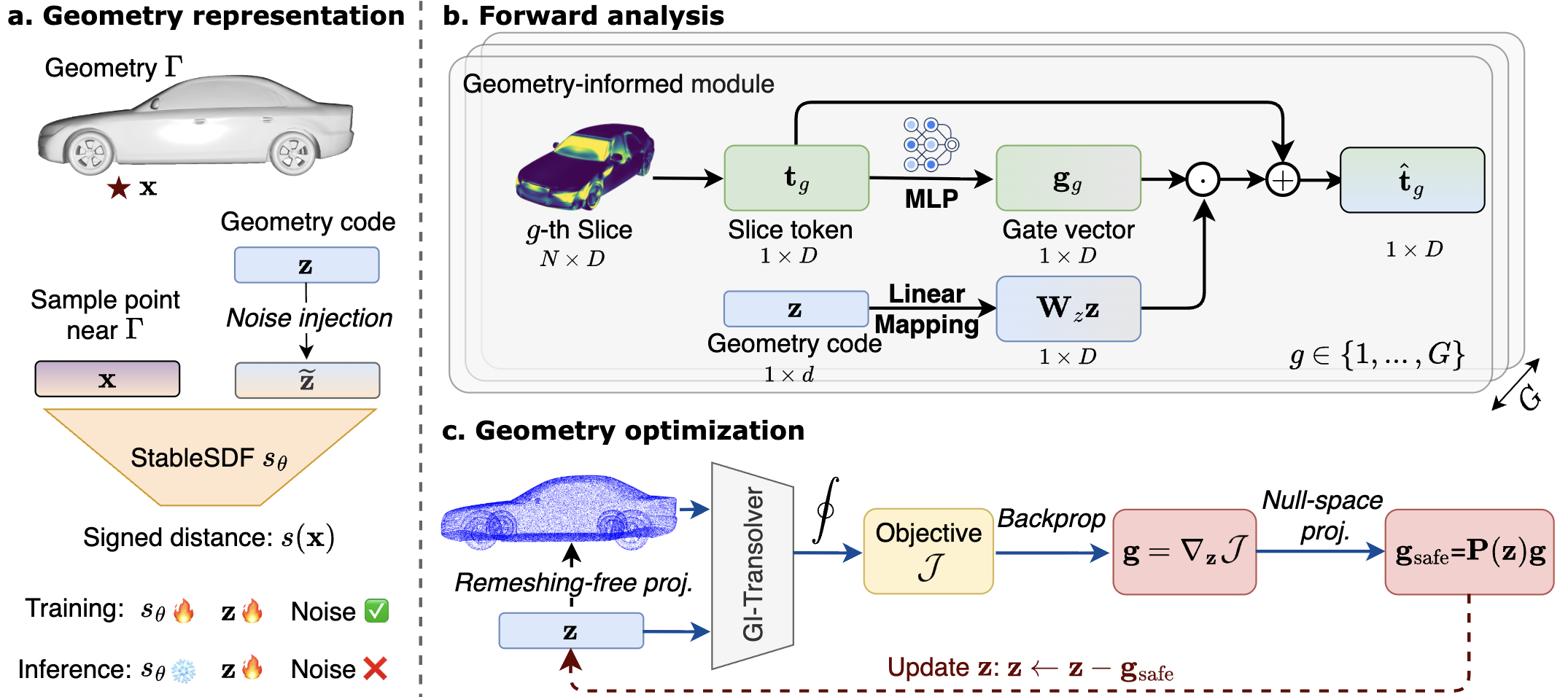
Stable Latent Geometry Representation: GANO employs StableSDF, an SDF-based auto-decoder with denoising regularization. This latent geometry model associates each shape with a learnable codez and a global decoder sθ(x,z), perturbed by Gaussian noise during training to encourage smoothness and stabilize optimization.
Field Predictor with Explicit Geometry Injection: GI-Transolver, a modified transformer architecture, directly injects the geometry latent z into the physics attention slice-token space using a gates mechanism, enabling backpropagation of field-level task objectives to latent design parameters and supporting PDE solution on complex, irregular domains.
Automated, Part-Constrained Latent-Space Optimization: Optimization proceeds directly in the latent z domain, with gradients propagated through the surrogate to geometry. Two innovations substantially improve control:
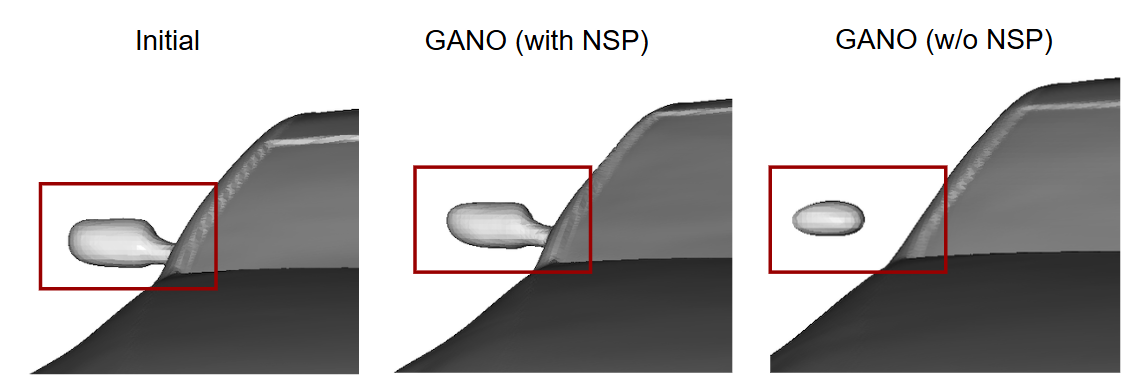
Null-space Projection: For region-specific control (e.g., preserving mirrors during car design), gradient updates are projected to the null-space of the SDF Jacobian at prespecified "protected" points, enforcing local geometric invariance.
Remeshing-Free Projection: During geometry updates, boundary samples are efficiently updated via SDF-based projection, circumventing the need for mesh reconstruction and supporting dense surface queries.
Figure 2: GANO pipeline: (a) latent StableSDF geometry, (b) GI-Transolver with geometry injection for field-level prediction, (c) latent update with null-space projection.
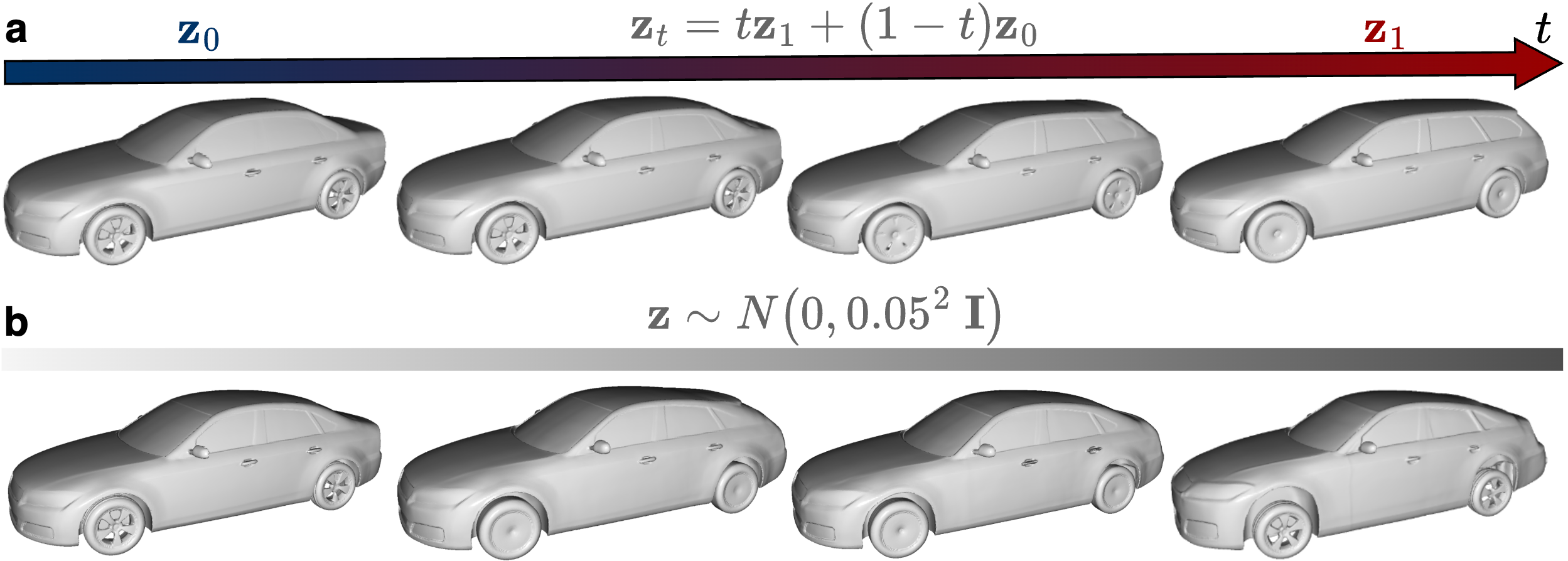
Figure 3: StableSDF latent space: (a) linear latent interpolation yields smooth shape morphs, (b) Gaussian latent sampling preserves global structure.
Theoretical Contributions
The denoising augmentation in StableSDF functions as a latent Jacobian regularizer, provably constraining the sensitivity of the decoded surface to latent code perturbations. Specifically, the ℓ1 loss with Gaussian latent noise yields a regularization:
E[∣f(z+ϵ)−s∣]≤∣f(z)−s∣+σ2/π∥∇zf(z)∥2+O(σ2)
This control ensures each latent-space update induces a proportionally bounded surface displacement in the geometry domain, yielding first-order Lipschitz guarantees on geometric deformation. Additionally, for practical efficiency, remeshing-free projection gradients can be detached with bounded error due to the same sensitivity bound.
Experimental Evaluation
Forward and Inverse PDE Problems
GANO was benchmarked on:
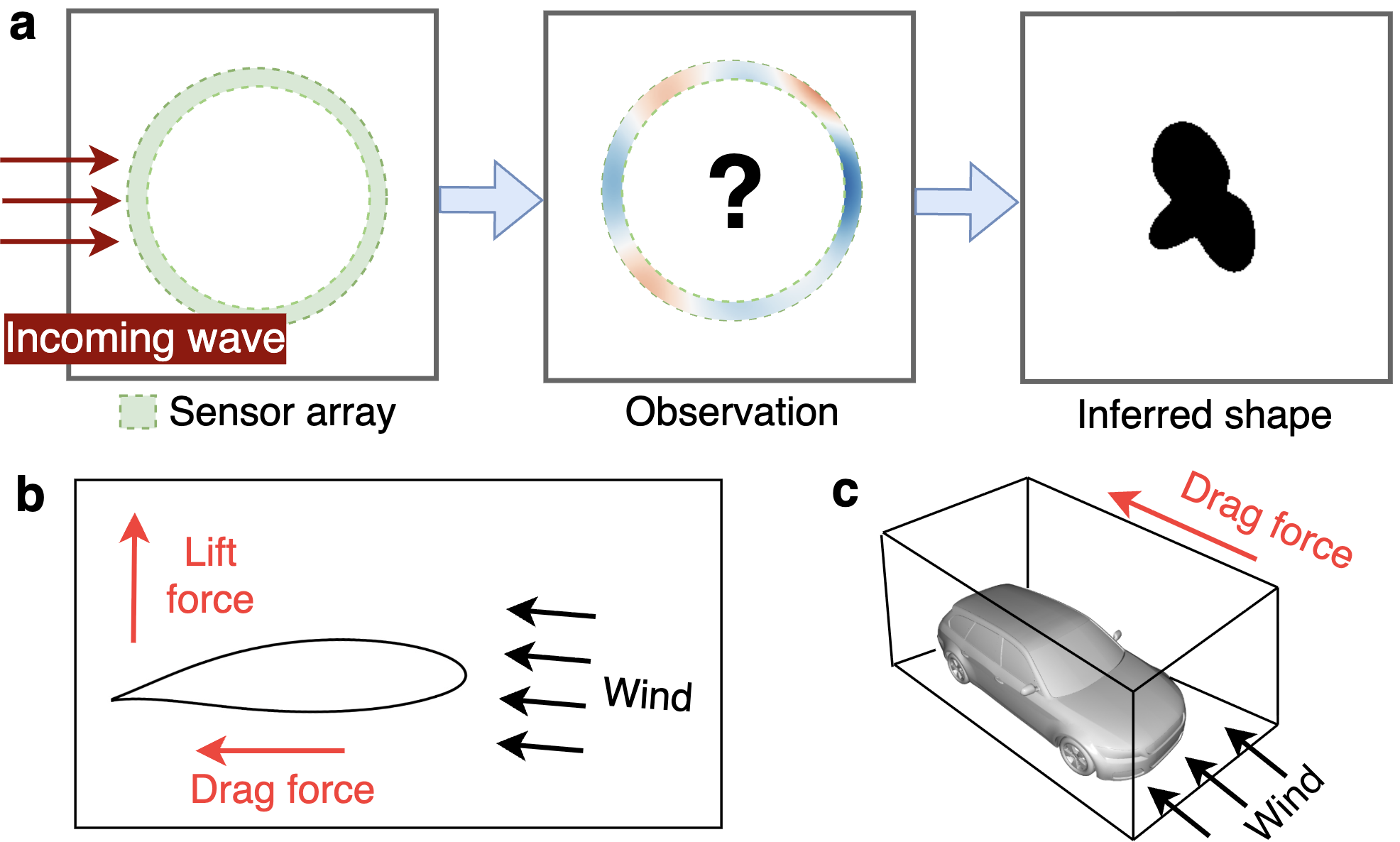
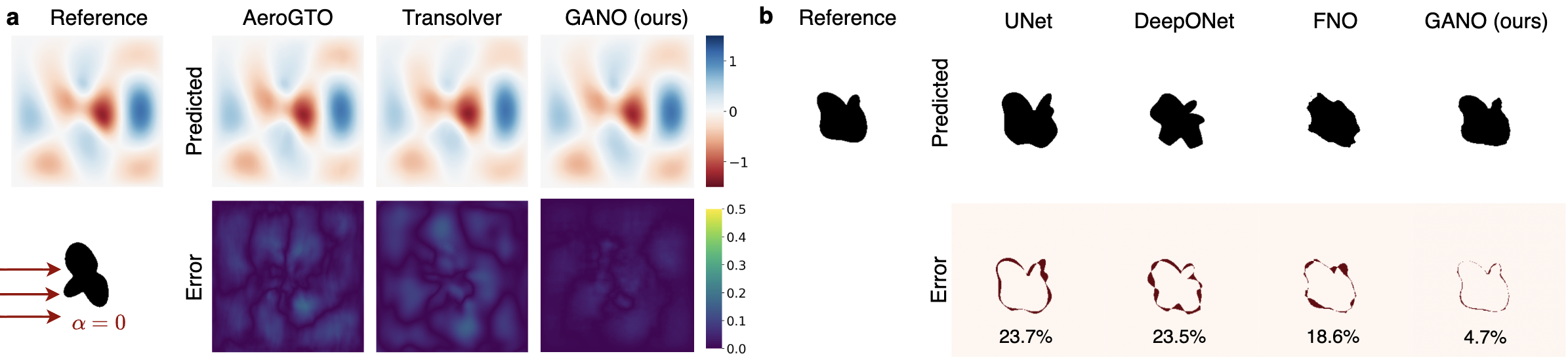
2D Helmholtz equation (shape inversion from boundary measurements)
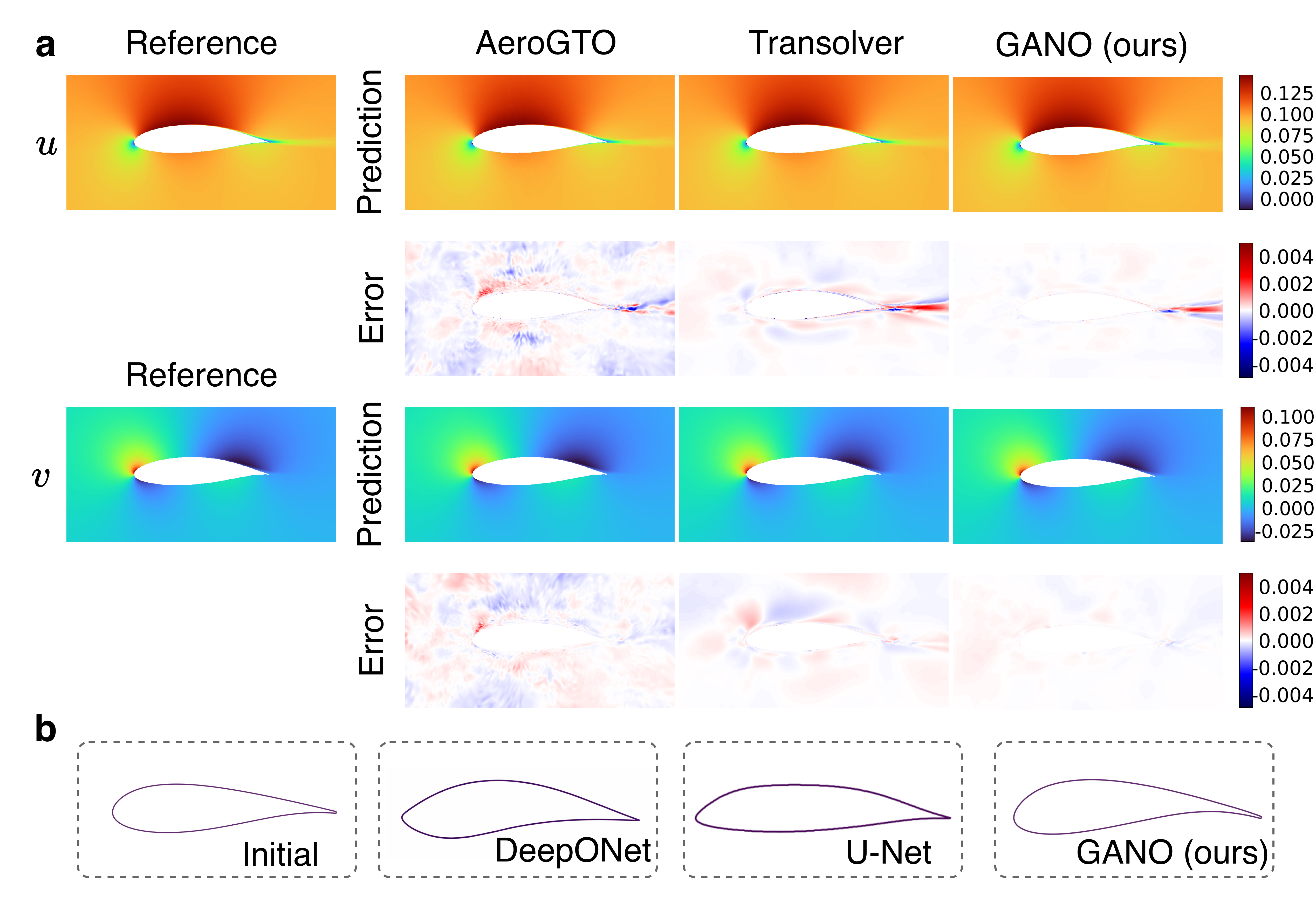
2D airfoil flow (pressure/velocity field prediction, lift-to-drag constrained optimization)
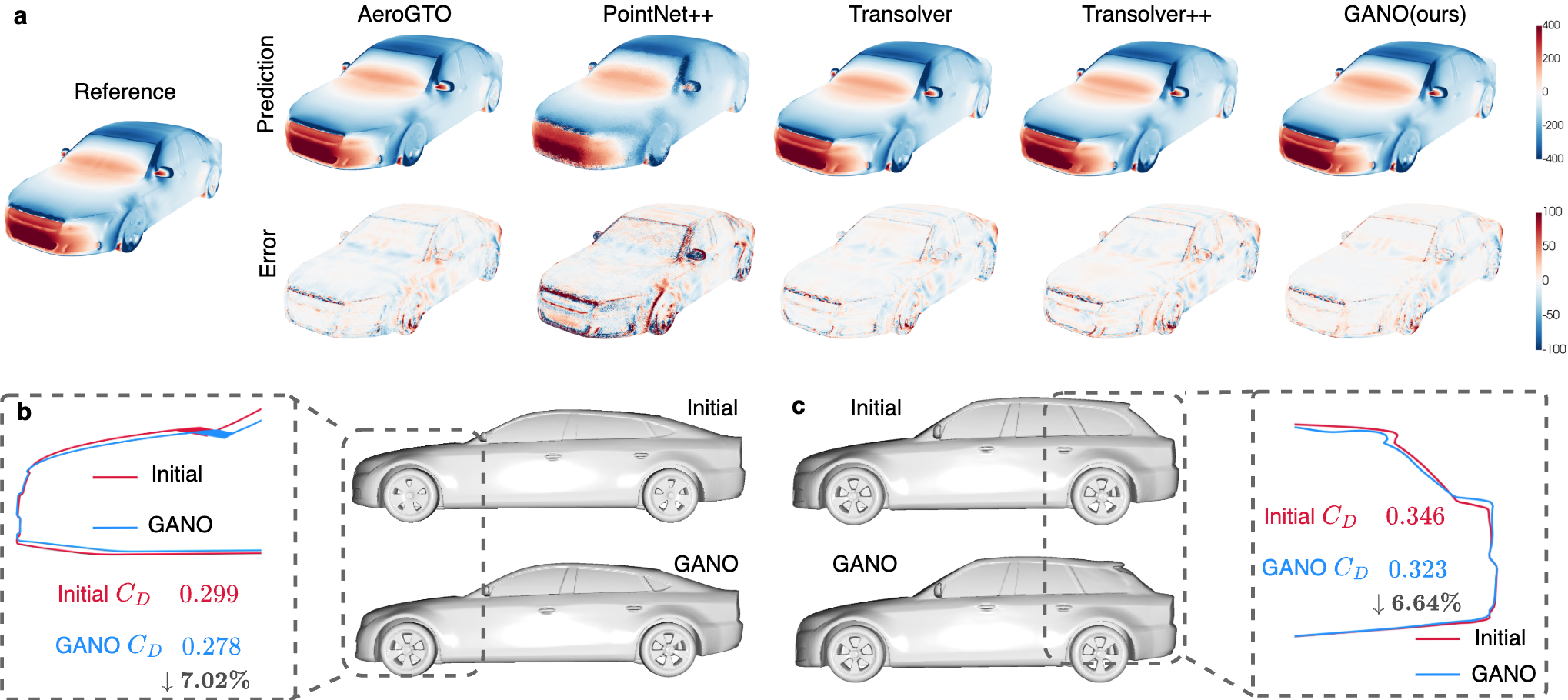
3D vehicle CFD (surface pressure and drag minimization on DrivAerNet++)
GANO achieves lower field prediction errors than all transformer, point-set, and graph-based baselines across tasks, including established architectures like AeroGTO, Transolver++, and DeepONet.
Figure 5: 2D Helmholtz—GANO yields superior field prediction and more accurate inverse shape reconstruction from sensor data.
Shape Optimization
On aerodynamic optimization benchmarks, GANO demonstrates:
For 2D airfoil optimization under drag constraints, a lift-to-drag ratio improvement of 55.9%, outperforming DeepONet and U-Net surrogates.
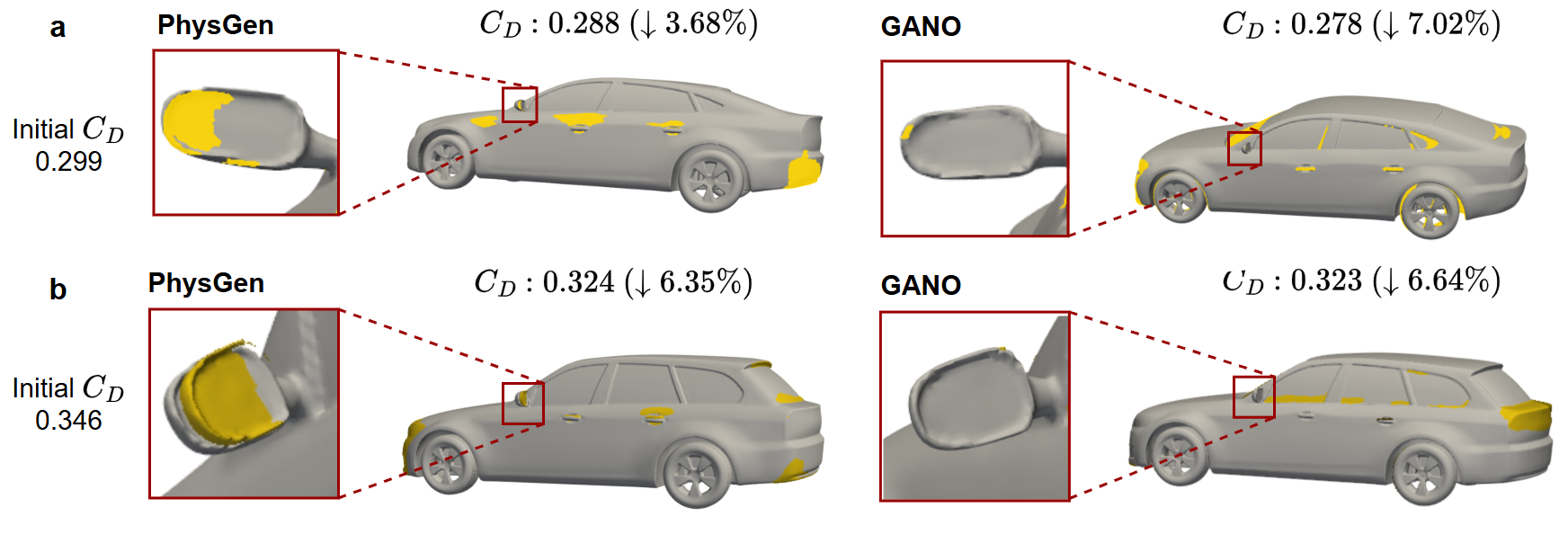
For 3D vehicle drag reduction, up to 7.02% drag decrease on fastback and estateback models, confirmed with high-fidelity OpenFOAM CFD validation. GANO preserves critical geometric features via null-space projection, unlike other latent optimization solutions which collapse sub-components (mirrors, handles).
Figure 6: Airfoil flow field and shape optimization by GANO: smoother, high-performance profiles compared to baselines.
Figure 7: 3D vehicle pressure prediction and shape changes after GANO-based optimization, showing realistic, manufacturable design evolution.
Figure 8: GANO vs PhysGen on vehicle optimization: GANO preserves side mirrors via constrained latent updates, PhysGen collapses unconstrained regions.
Model Analysis
Latent Space Robustness and Control
Diagnostic analysis confirms StableSDF yields:
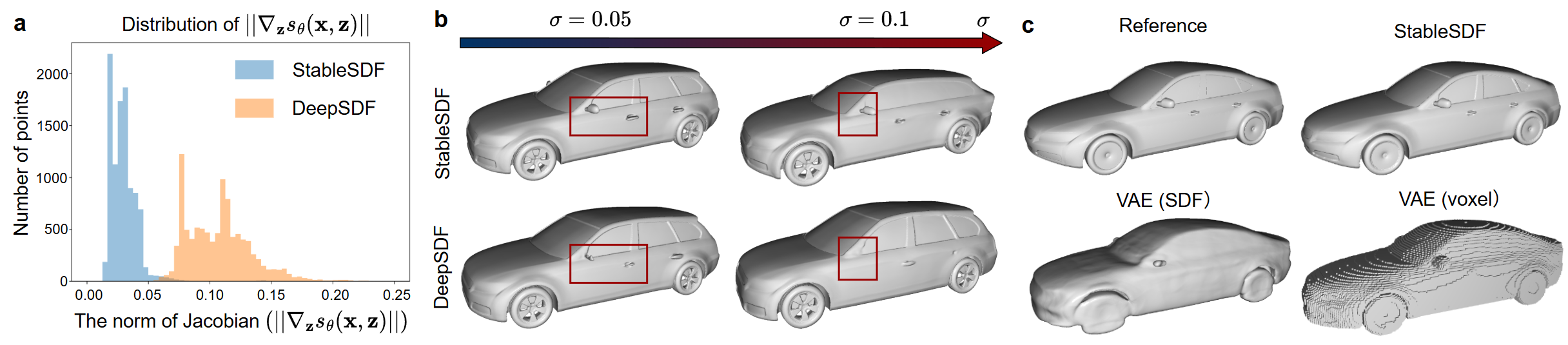
Lower latent Jacobian norms than DeepSDF, empirically validating the theoretical regularization.
Drastically reduced OOD artifacts in geometry after optimization or under latent code perturbation, including preservation of delicate details such as side mirrors, handles, and windows in 3D cars.
Figure 9: StableSDF vs DeepSDF: (a) latent Jacobian norm histograms, (b) shape decoding under latent noise, (c) reconstructions on test vehicles.
Part-Wise Control and Sampling Efficiency
Null-space projection cleanly enforces invariance constraints, as evidenced by mirror-preserving optimization in vehicles (Figure 10).
GANO supports boundary-consistent sampling via fast, low-iteration SDF-based projection, eliminating explicit remeshing while maintaining point-to-surface alignment (Figure 11).
Model performance and inference time remain stable across a wide range of surface point cloud densities.
Figure 10: Null-space projection preserves local geometry during shape optimization.
Implications and Future Developments
GANO’s end-to-end differentiable framework resolves key engineering bottlenecks in geometry optimization and inverse design for PDE-governed systems. By unifying SDF-based latent geometry, geometry-aware surrogate modeling, and programmable constraints (via latent projections), this methodology:
Offers a scalable template for downstream engineering tasks requiring field-level design objectives, not just scalar global targets.
Admits integration with industry workflows through seamless geometry updates, bypassing the need for explicit meshing and specialized CAD editing for each optimization iteration.
Enables programmable, component-level design constraints—a necessity for practical design in automotive, aerospace, and related applications.
Current limitations include focus on steady-state PDEs; extension to time-dependent shape optimization and unsteady flow regimes is a promising research direction, as is incorporation into real-time or online design automation pipelines.
Conclusion
The GANO framework establishes a new paradigm for differentiable, automated geometry optimization and inversion with direct field-level supervision, high geometric fidelity, and explicit sub-part control. Through a combination of latent SDF geometry, transformer-based surrogates, and principled optimization strategies, GANO achieves strong empirical results and theoretical guarantees across challenging real-world design tasks. Future advances may extend its reach to dynamic PDE optimization, integrated manufacturing, and closed-loop engineering design automation.
“Emergent Mind helps me see which AI papers have caught fire online.”
Philip
Creator, AI Explained on YouTube
Sign up for free to explore the frontiers of research
Discover trending papers, chat with arXiv, and track the latest research shaping the future of science and technology.Discover trending papers, chat with arXiv, and more.