- The paper presents MeLISA, a latent-free generative transition kernel that enables one-step forecasting for autoregressive dynamical systems.
- The paper employs a window-consistency MeanFlow objective combined with time increment consistency loss to ensure temporal coherence and physical realism.
- The paper demonstrates superior short-term accuracy and long-term statistical fidelity compared to neural operator baselines on high-resolution turbulence benchmarks.
Scalable One-Step Generative Modeling for Autoregressive Dynamical System Forecasting
Motivation and Background
Efficient surrogate modeling for high-dimensional dynamical systems governed by nonlinear PDEs remains a persistent challenge in scientific computing. Traditional numerical methods such as DNS, RANS, and LES deliver high-fidelity solutions but are often prohibitively expensive for large-scale, real-time, or uncertainty-aware applications. Recent advances in neural operators have accelerated spatiotemporal forecasting but exhibit pronounced trajectory-level error accumulation and drift in turbulent or chaotic regimes, especially over long horizons. Meanwhile, diffusion and flow-matching generative surrogates can capture stochastic transitions but suffer from inference inefficiency due to multi-step denoising, reliance on auxiliary latent encoders, and intricate noise schedules.
This paper introduces a new modeling paradigm—MeanFlow Long-term Invariant Spatiotemporal Consistency Autoregressive Models (MeLISA)—that leverages pixel-space MeanFlow to define a scalable, latent-free, one-step generative transition kernel for autoregressive dynamical system forecasting (2605.05540).
MeLISA: Window-Consistency Generative Surrogates
MeLISA extends the pixel MeanFlow framework to blockwise stochastic prediction directly in pixel space, thus enabling efficient and statistically consistent trajectory generation without latent encoders or iterative diffusion solvers. The methodological innovation centers on two mechanisms:
- Window-Consistency MeanFlow Objective (WinC-MF): A generalization from single-frame to window-conditioned generation. It enforces temporal consistency within partially observed rollout windows, mimicking masked trajectory modeling approaches via selective temporal masking, ensuring the model exploits nontrivial context for generative forecasting.
- Time Increment Consistency Loss (TIC): A finite-lag regularizer that constrains the evolution of temporal increments across multiple lags, directly targeting spatiotemporal covariance and mixing structure. TIC regularizes not just state-level accuracy but also higher-order statistics, addressing limitations of framewise losses in capturing physical invariants and long-range temporal correlations.
This combination yields a stochastic autoregressive surrogate with a single function evaluation per forecast block—removing the bottlenecks of progressive noise schedules and multi-step denoising found in rolling diffusion models (see below).
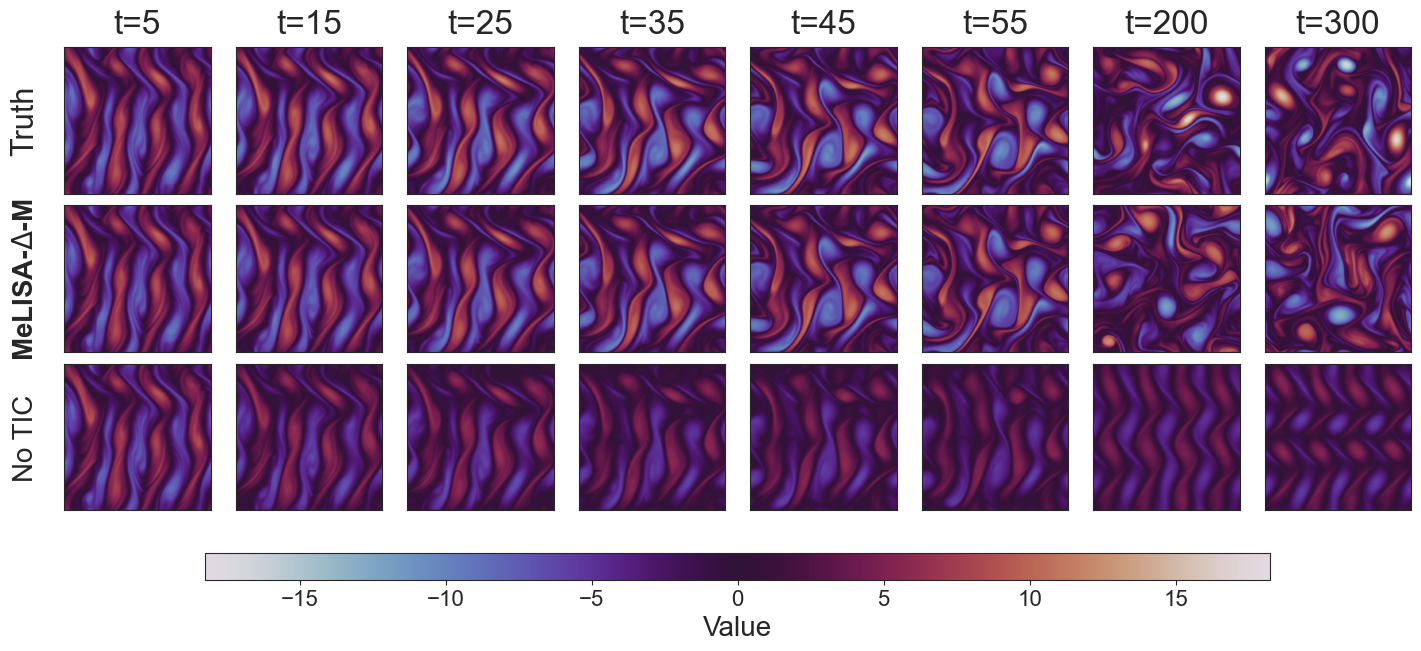
Figure 1: Autoregressive rollout results for MeLISA-Delta-M with two context frames, comparing the full model against a variant trained without TIC under identical optimization. t denotes the frame index in the trajectory; TIC critically improves stability.
Numerical Evaluation and Model Architectures
MeLISA is instantiated with both compact UNet (Υ) and scalable DiT (Δ) backbones, with parameter counts ranging from 3.7M to 150M, and evaluated on two high-resolution turbulence benchmarks: extended 2D Kolmogorov flow (256×256) and channel-flow slice (192×192).
MeLISA matches or outperforms neural-operator baselines (FNO, UNO, Local-FNO) in both short-term predictive accuracy and long-horizon statistical fidelity—measured by RL2, SSIM, PSDD, turbulent kinetic energy difference (TKED), and mixing rate difference (MRD) across all models. Notably, MeLISA-Delta-S achieves the lowest short-term error and SSIM on TCF192, while MeLISA-Upsilon variants deliver superior statistical preservation on Kolmogorov flow.
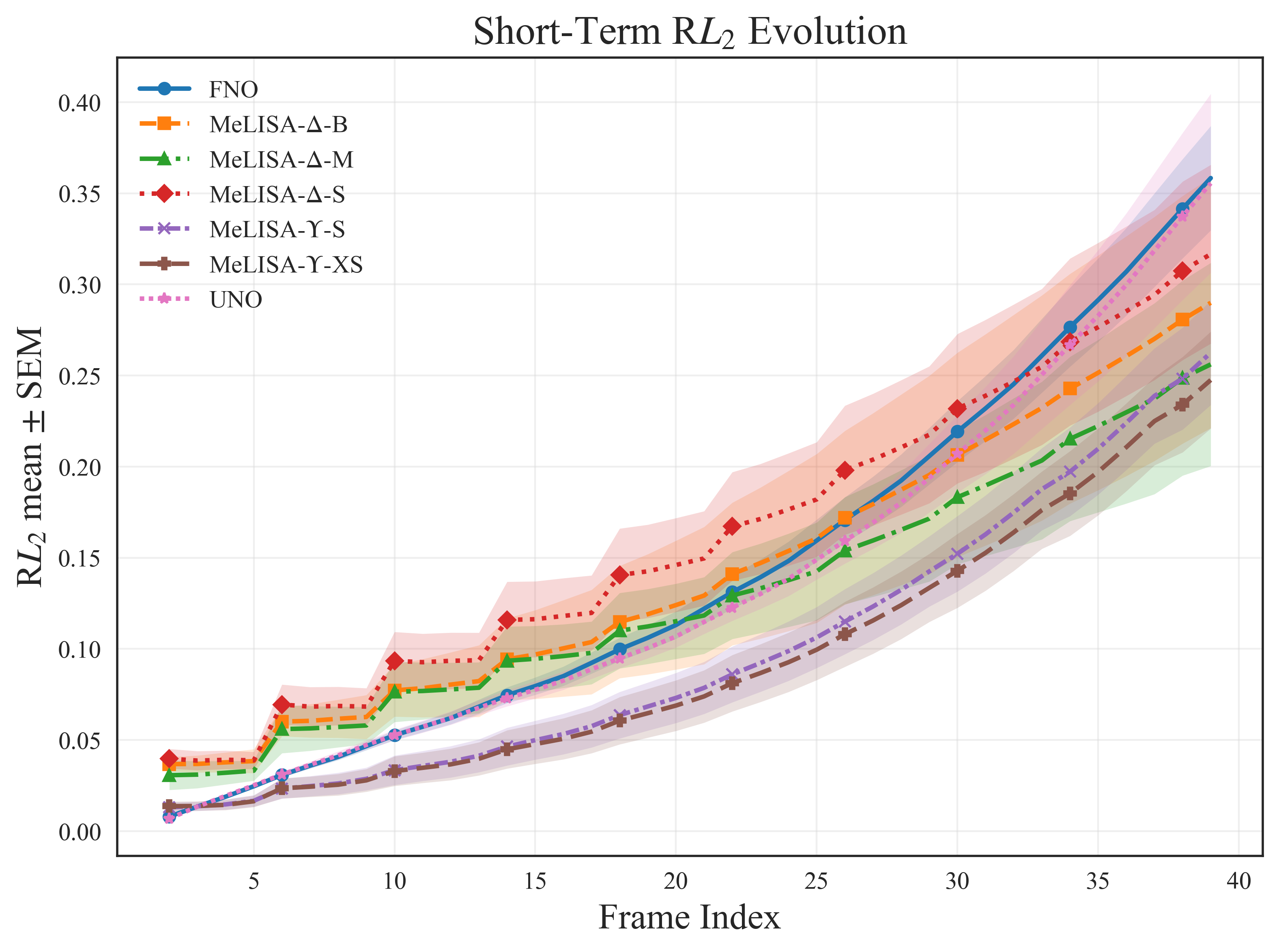
Figure 2: Accumulation of RL2 error over the first 40 rollout frames on KF256, highlighting long-horizon stability of MeLISA models relative to baselines.
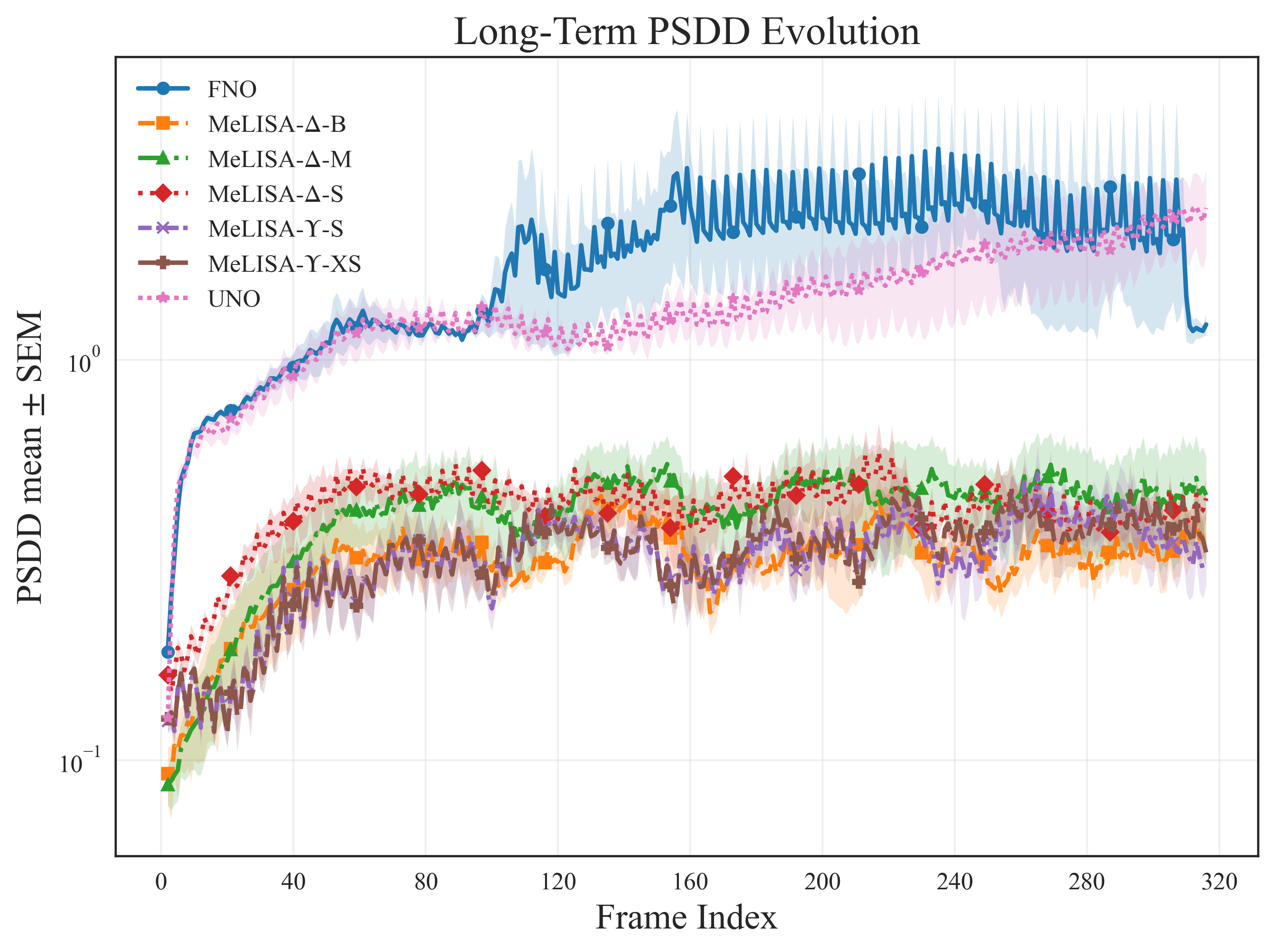
Figure 3: PSDD accumulation over full 320-frame trajectory on KF256; MeLISA maintains spectral fidelity while neural operators lose high-frequency content.
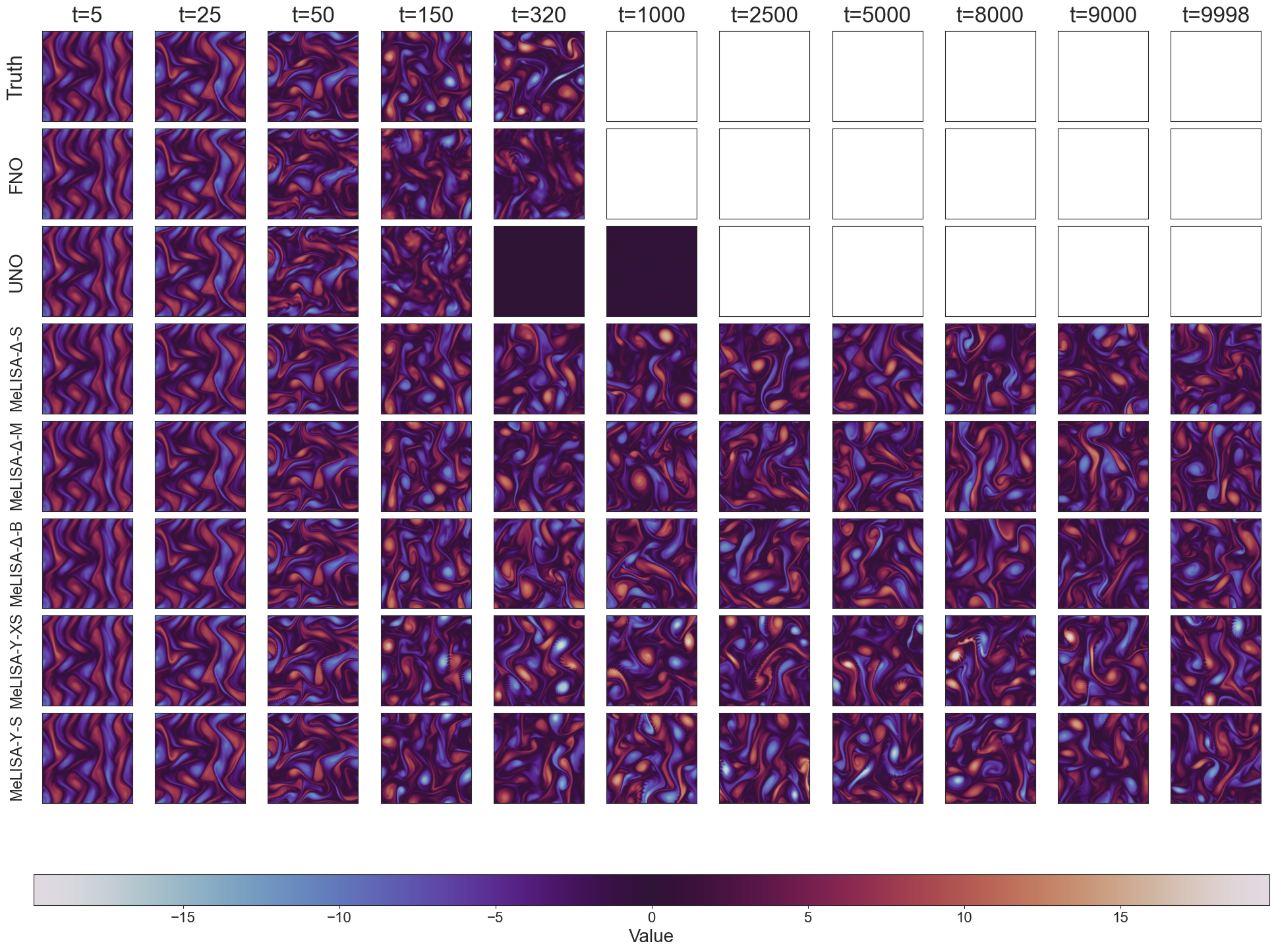
Figure 4: Stress test for maximum rollout length for MeLISA models; MeLISA variants remain stable for up to 9998 consecutive predictions, while baselines fail.
Statistical Consistency and Physical Realism
MeLISA's explicit regularization produces substantially improved stability in error accumulation, spectral statistics, autocorrelation profiles, and ensemble forecasting metrics (CRPS). Baseline neural operators rapidly accumulate state and spectral error and induce temporal ringing artifacts under autoregressive rollout, while MeLISA models maintain smooth and physically realistic autocorrelation decay.
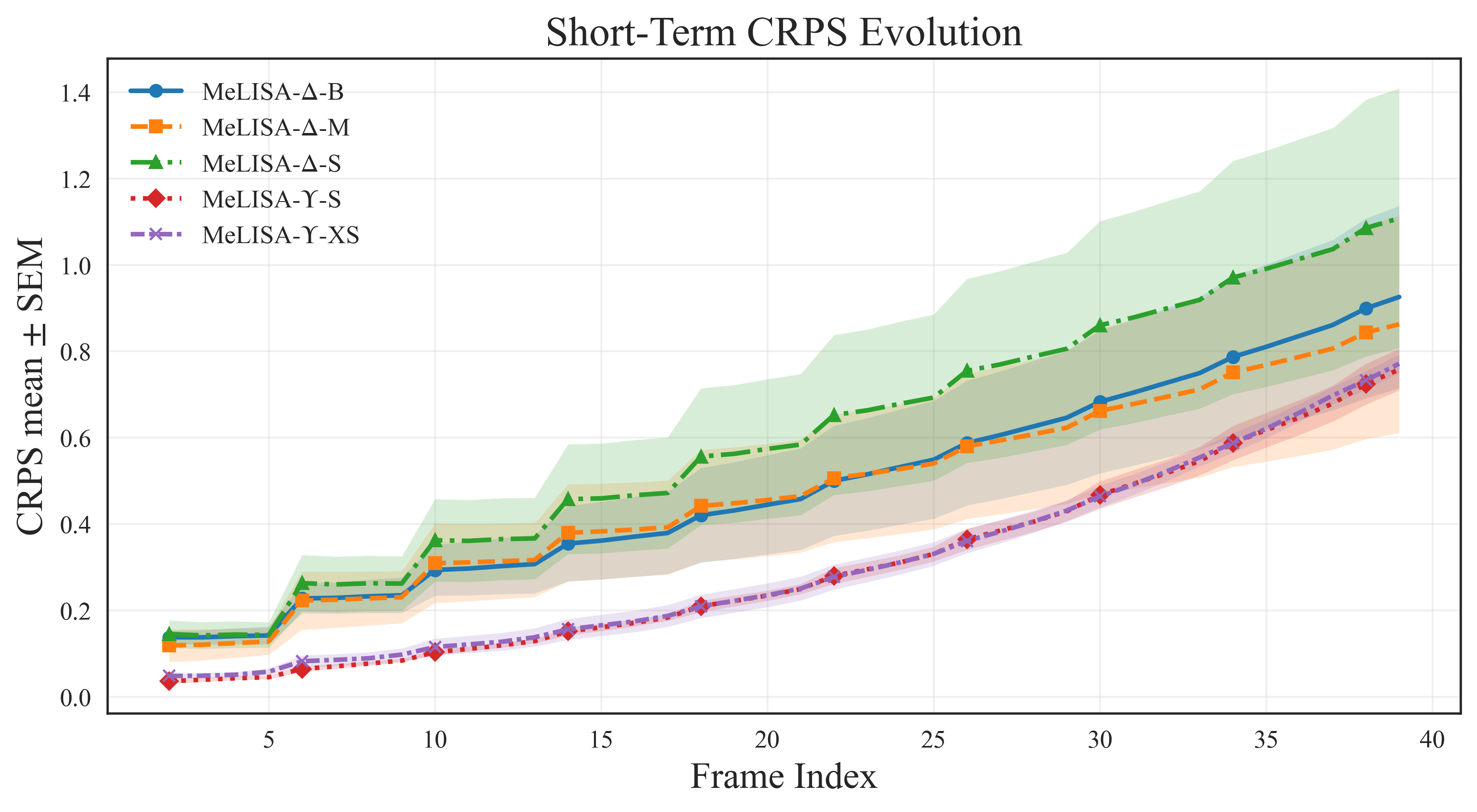
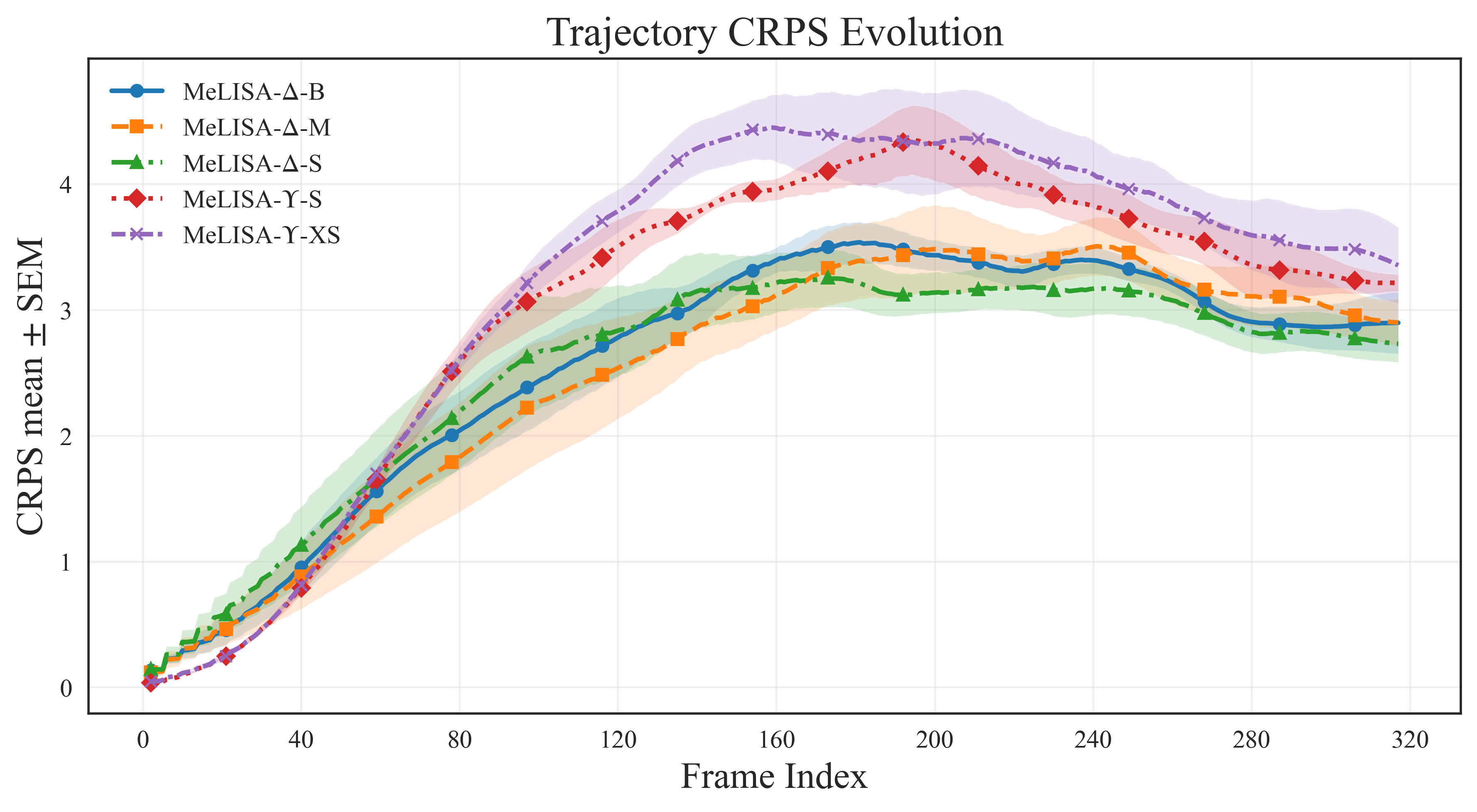
Figure 5: Evolution of CRPS on KF256; MeLISA-Delta variants deliver superior inter-ensemble consistency over long horizons.
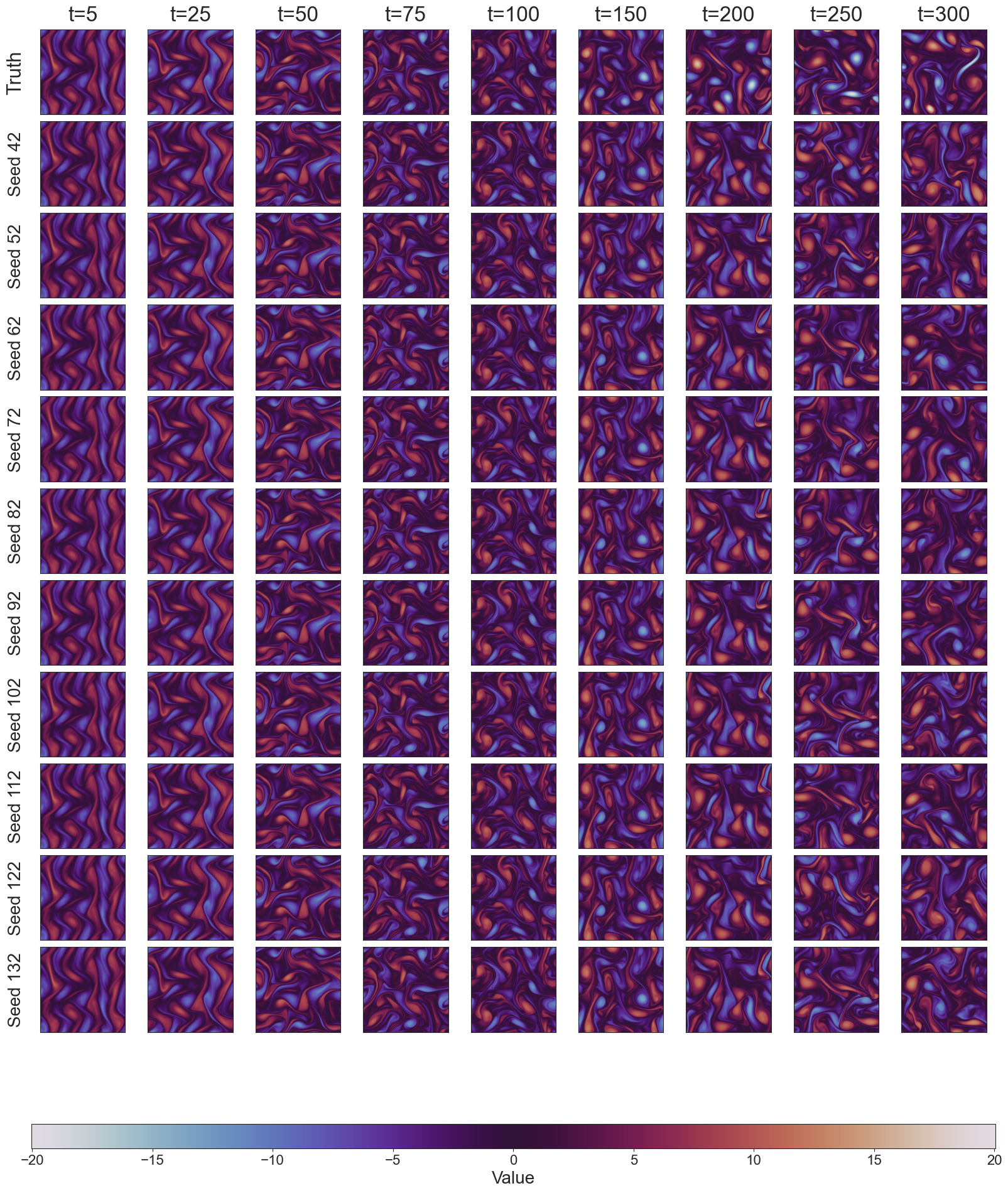
Figure 6: Trajectory ensemble generated by MeLISA-Delta-B for a single initial condition, illustrating diversity and probabilistic character of MeLISA forecasts.
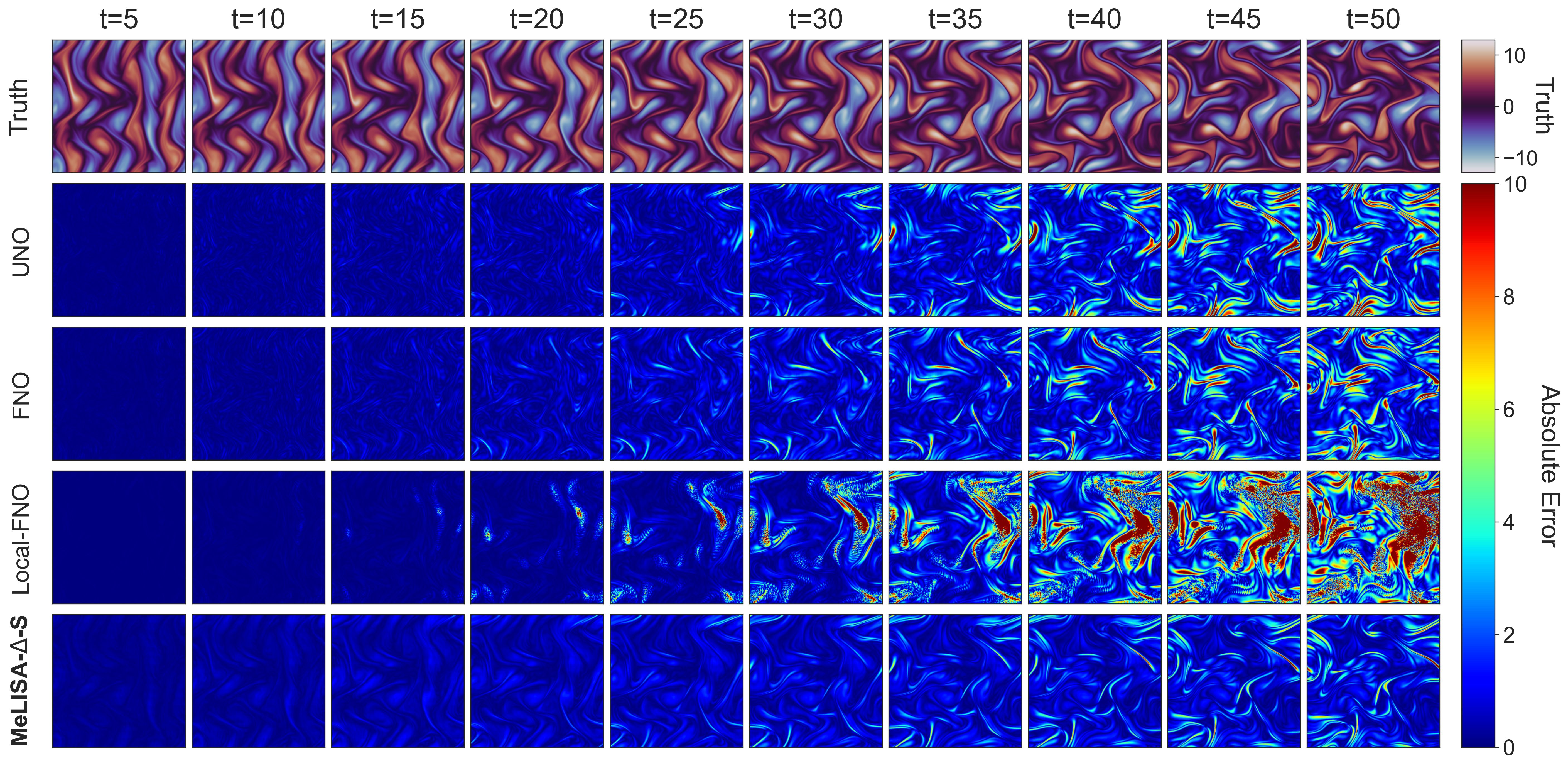
Figure 7: Rollout results on an uncurated test trajectory from KF256; MeLISA-Delta-S delivers substantially improved stability and slower error accumulation.
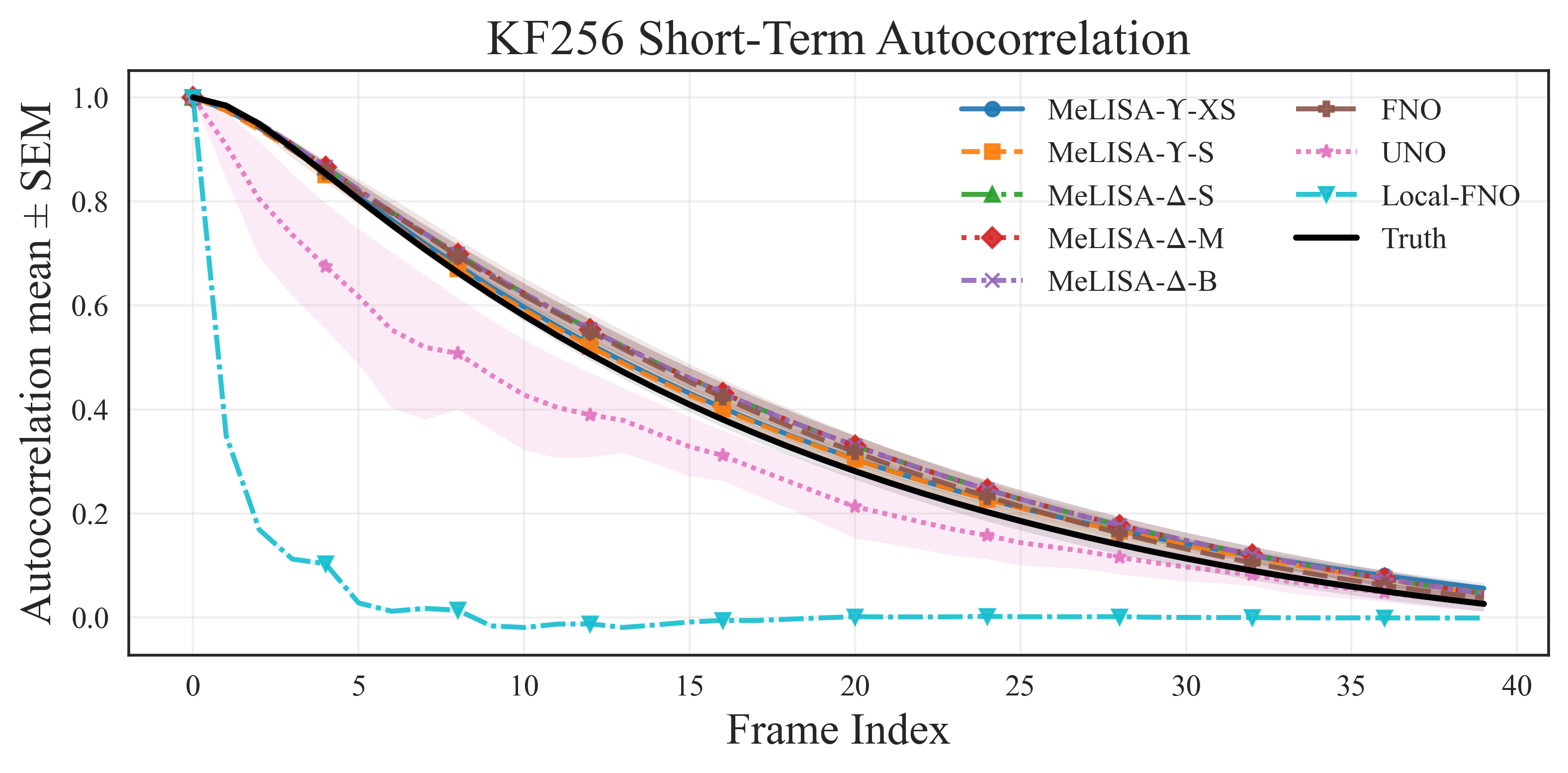
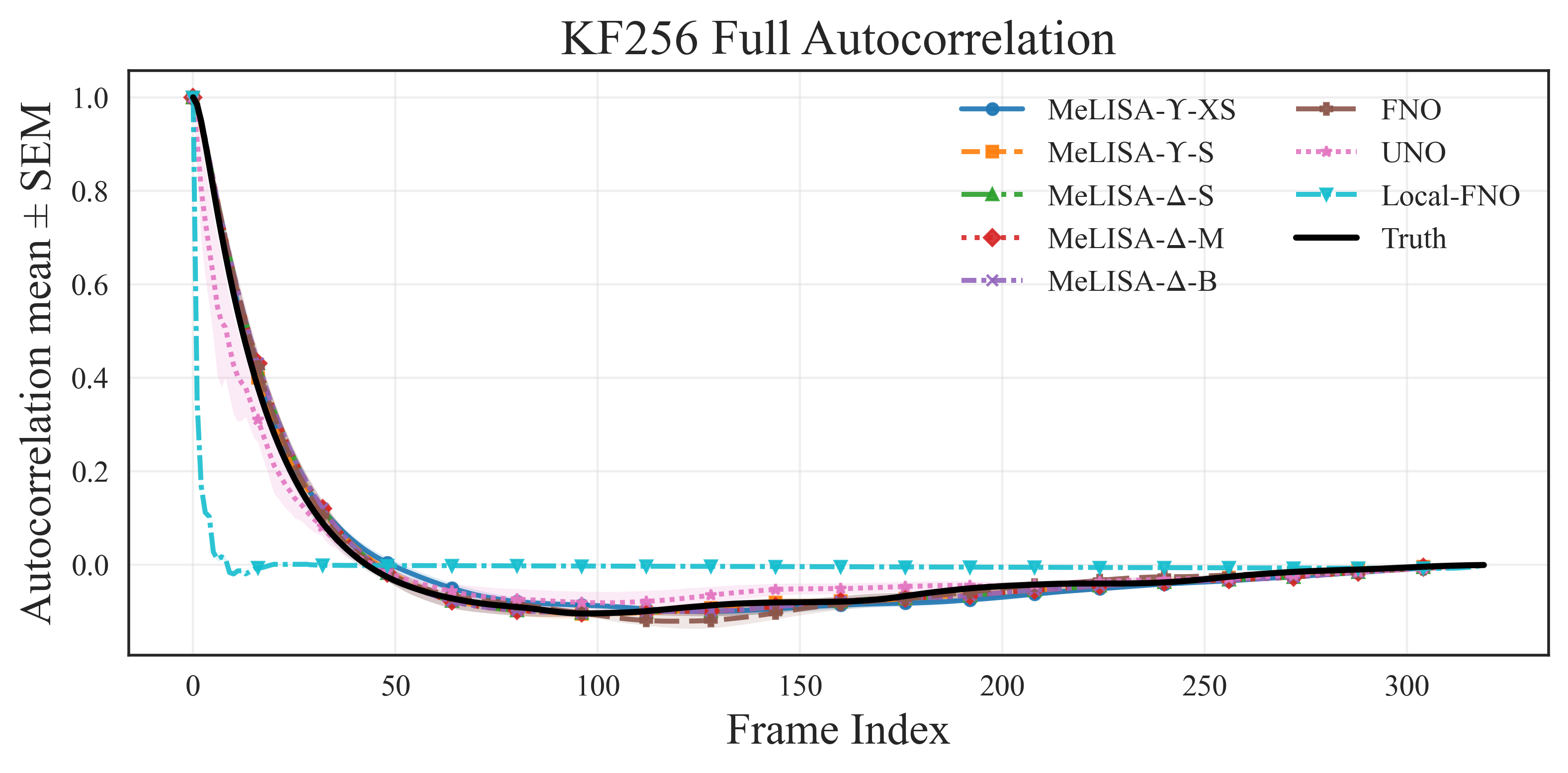
Figure 8: Autocorrelation statistics on KF256; MeLISA tracks ground-truth decay more faithfully than neural operators over both short and long horizons.
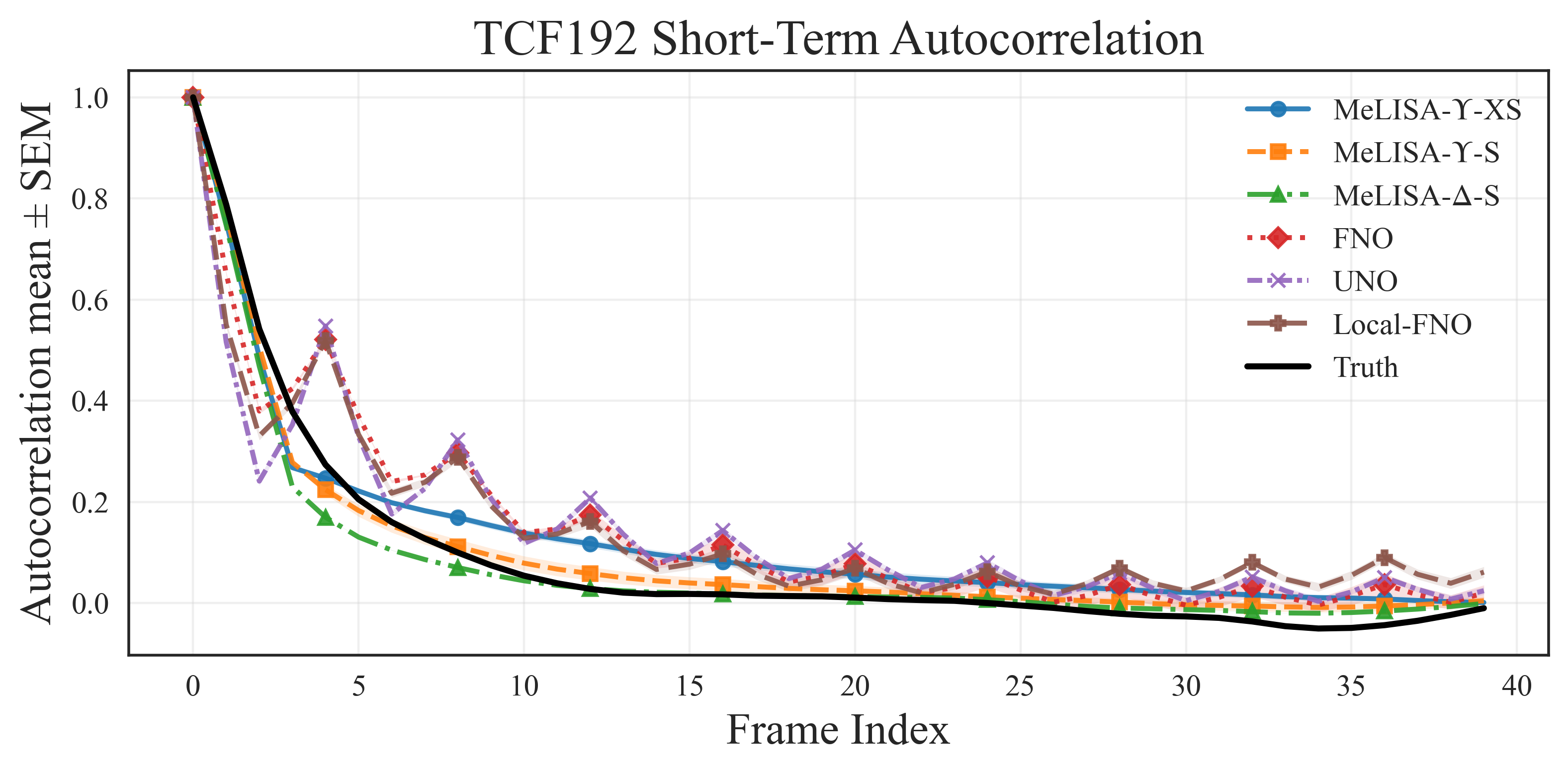
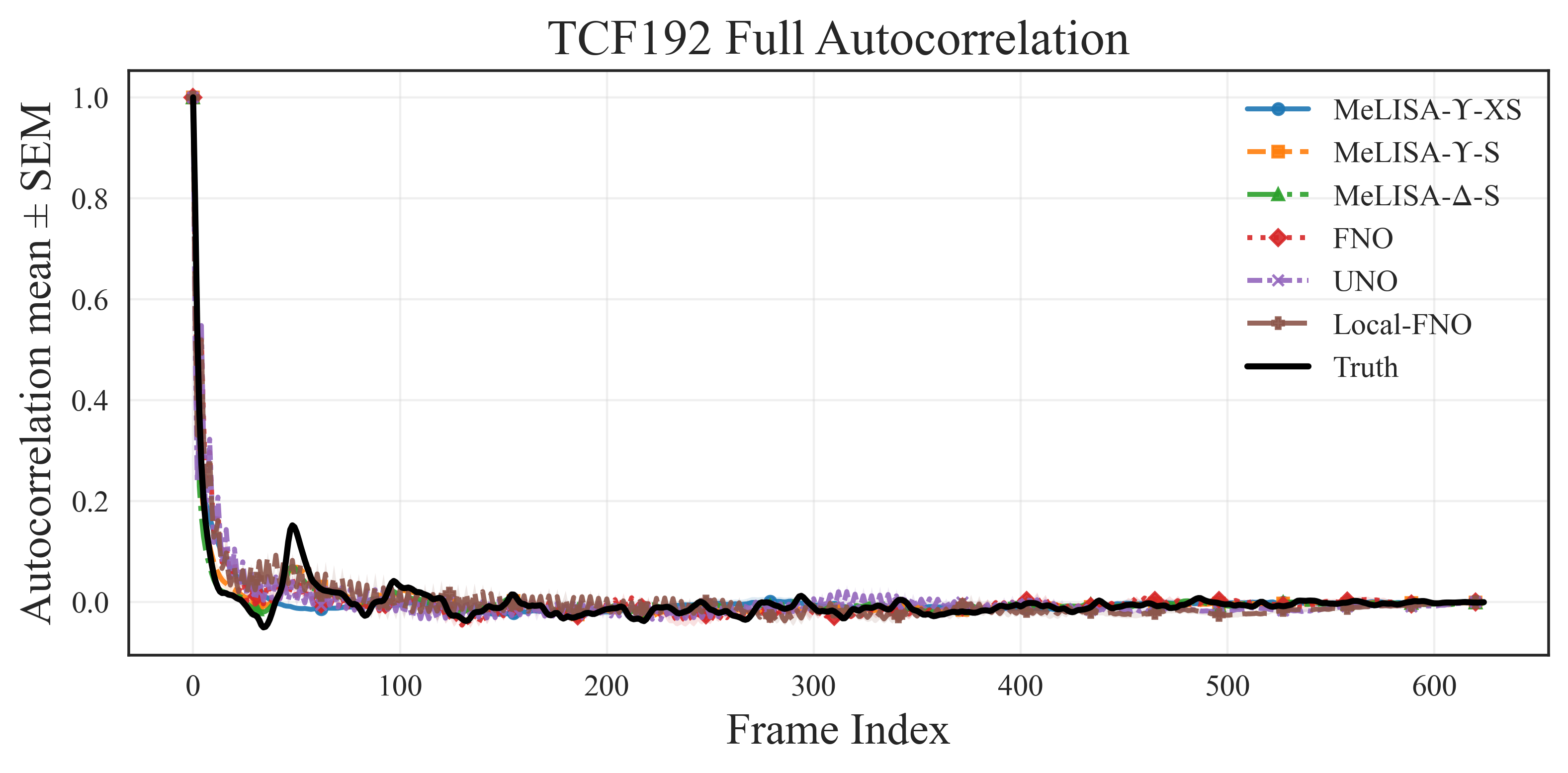
Figure 9: Autocorrelation statistics on TCF192; neural operators exhibit pronounced ringing under windowed autoregressive setting, while MeLISA curves remain smooth.
Theoretical Implications and Ablation
Ablation studies confirm the necessity of both WinC-MF and TIC: removing TIC in MeLISA-Delta-M causes collapse toward channel-flow-like mean field and severe spectral deterioration. The window consistency mechanism retains probabilistic conditioning even with limited guidance frames and scales effectively as model size increases.
Theoretically, MeLISA bridges the probabilistic expressivity of stochastic autoregressive generative modeling (diffusion, flow matching, transition kernels) with the practical efficiency of deterministic surrogates. Conditioning on masked windows enforces self-supervised, context-rich prediction, while TIC regularizes the physical evolution of increments—ensuring surrogate models not only generate plausible states but also preserve invariant measure and mixing structure per ergodic theory.
Practical Implications and Future Directions
MeLISA demonstrates rollout efficiency comparable to (and sometimes exceeding) neural operators, while delivering improved statistical realism for turbulent dynamics. Its latent-free design eliminates reliance on VAEs or specialized backbones, generalizes easily to higher spatial resolution, and supports probabilistic ensemble forecasting. The explicit regularization of temporal structure is crucial for surrogate modeling in turbulent, chaotic, or non-Markovian systems, suggesting wider applicability to scientific ML and probabilistic forecasting.
Potential future directions include scaling MeLISA to three-dimensional and multi-scale settings, extending context length utilization, developing foundation models for continuum dynamics, and exploring uncertainty quantification and ensemble calibration.
Conclusion
MeLISA defines an efficient, scalable, pixel-space, one-step autoregressive generative surrogate for high-dimensional dynamical system forecasting—outperforming neural operators in both short-term and long-horizon metrics, while maintaining fast inference and physical realism. Its architecture and training objective are directly aligned with preserving statistical structure in challenging turbulent regimes, providing a robust foundation for future research in scientific machine learning and uncertainty-aware surrogate modeling.