- The paper introduces GIST, a novel gauge-invariant neural surrogate, alongside an expert-validated LMP2 race-car CFD dataset to enable interactive aerodynamic design.
- The paper leverages stochastic spectral embedding and physically principled attention to ensure mesh-invariance and reduce computational complexity to O(Nr).
- The paper demonstrates industrial applicability by achieving sub-percent errors on drag and downforce predictions, drastically accelerating design iteration cycles.
Neural Surrogate Modeling for Interactive Aerodynamics: GIST and an Expert-Validated Race-Car CFD Benchmark
Introduction
The challenge of efficiently exploring the aerodynamic design space for high-performance vehicles is fundamentally constrained by the prohibitive computational cost of high-fidelity CFD, commonly requiring tens of thousands of core-hours per evaluation. Traditional surrogate modeling approaches have been largely limited by the lack of high-complexity, expert-validated datasets that encapsulate the multi-component, tightly coupled flow phenomena governing motorsport applications. This paper addresses both prerequisites for effective industrial deployment: (1) a high-fidelity, expert-curated LMP2 race car dataset covering multi-regime "map points" relevant to motorsport, and (2) the Gauge-Invariant Spectral Transformer (GIST), a graph-based neural operator ensuring scalability, mesh-invariance, and superior generalization to complex geometries.
High-Fidelity LMP2 Race Car CFD Dataset
A major impediment to surrogate accuracy in automotive aerodynamics is the scarcity of datasets with sufficient geometric and operational diversity. The dataset introduced here is generated from an in-house parametric CAD model of a Le Mans Prototype 2 (LMP2), designed and validated by domain experts at Dallara. This model resolves critical geometric features such as rotating, encapsulated wheelhouses, splitters, and diffuser elements, with a mesh resolution matching industrial CFD standards (average of ∼4.8M points per sample). Each geometric configuration is evaluated over six distinct map points encoding variations in heave, pitch, yaw, roll, and steer, explicitly encompassing both straight-line and cornering conditions—an expansion over typical public benchmarks limited to single-condition regimes.
The simulation process is based on incompressible, steady-state RANS, utilizing the k-ω SST turbulence model customized and validated for industrial correlation. The mesh generation follows best practices for boundary layer and volumetric feature resolution, with convergence checked through both residuals and integral aerodynamic metrics. Surface fields for each configuration include vectorized pressure and mean wall shear stress, enabling both granular diagnostic analysis and computation of integrated aerodynamic performance at the part and full-car level.
Traditional neural operators such as FNO, DeepONet, MeshGraphNet, and recent transformer-based GNOs exhibit critical limitations in the regime of large-scale, highly anisotropic, and topologically detailed CAD meshes. Key pain points include: (a) loss of mesh topology due to point-cloud representations, (b) poor scalability of standard self-attention or full eigendecomposition, and (c) susceptibility to discretization-induced feature variance, impeding mesh-invariant generalization.
GIST addresses these through:
- Gauge-Invariant Spectral Embedding: Meshes are represented as graphs, where the normalized Laplacian's spectrum is approximated using stochastic projections (avoiding explicit O(N3) eigendecomposition), and node embeddings are constructed such that pairwise attention kernels are invariant under gauge transformations (sign flips or rotations in degenerate eigenspaces).
- Linear Computation with Explicit Mesh Invariance: Embedding cost is reduced to O(Nr) for a graph of size N using projection dimension r, with theoretical bounds on the discrepancy between different mesh discretizations of the same manifold, scaling as O(n−m+41)+O(r−21).
- Physically Principled Attention: The model leverages the gauge-invariant kernel K(i,j), enforcing that nodes proximate in the embedding space are also topologically proximate, thus preventing unphysical "shortcuts" between nodes across thin geometric features, a common failure mode in standard transformer or message-passing architectures.
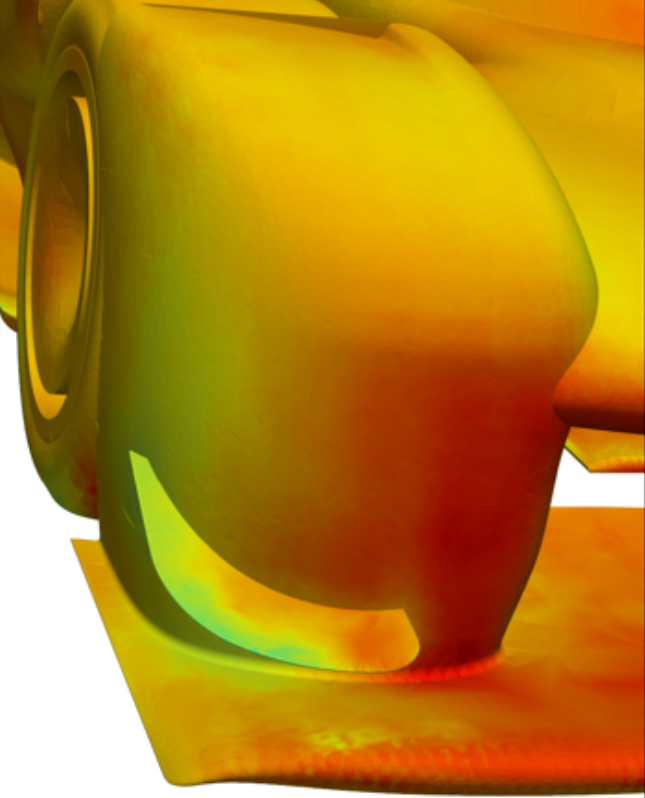
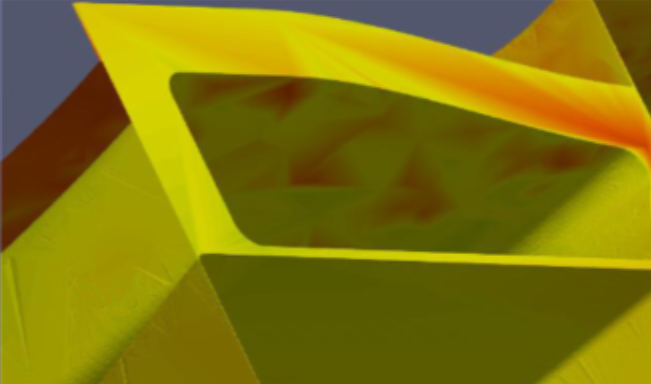
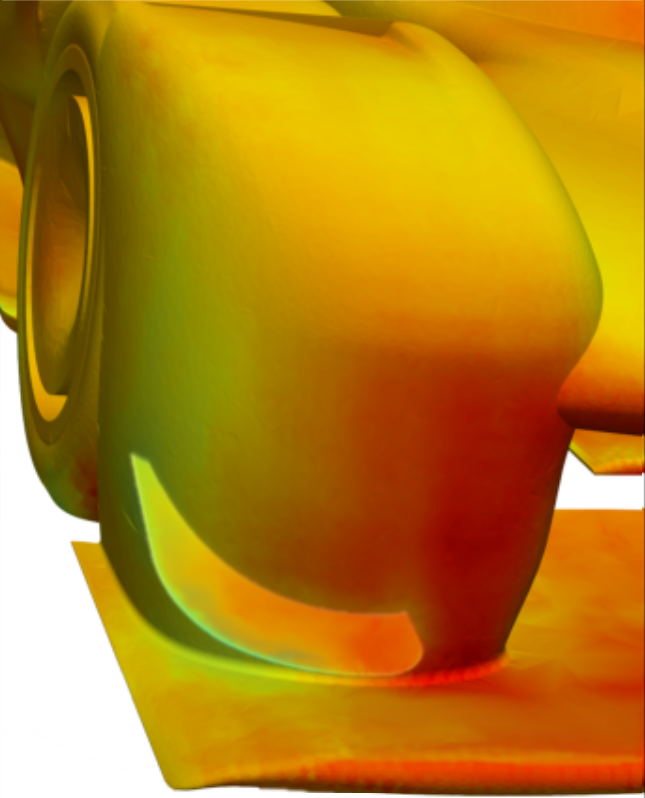
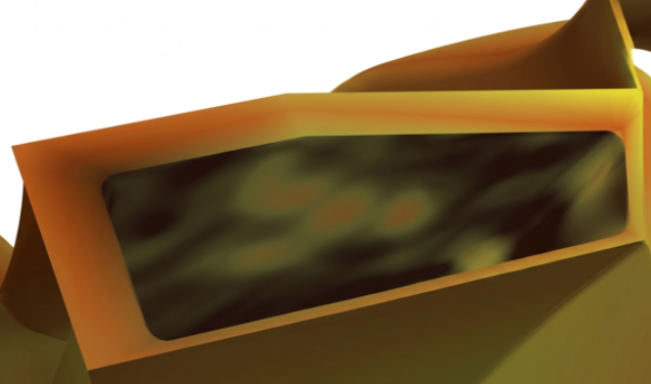
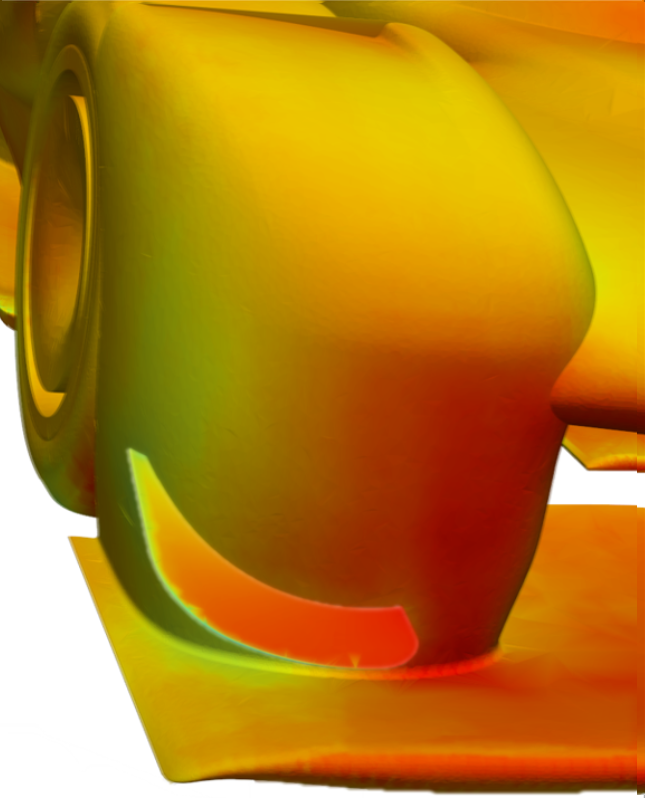
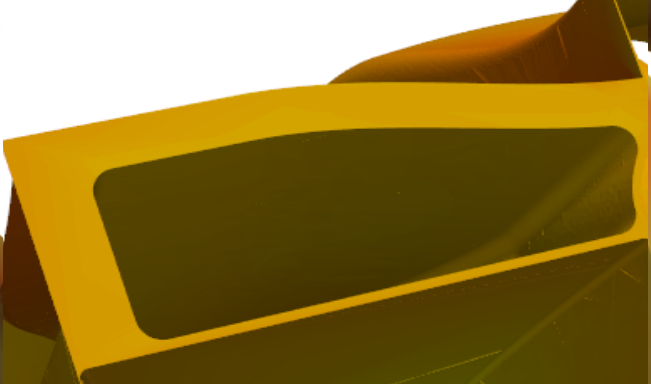
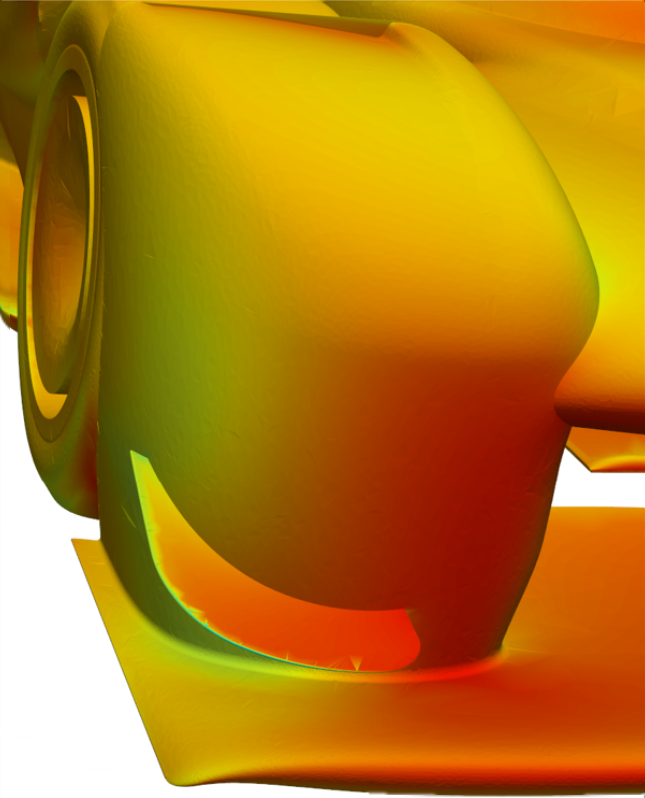
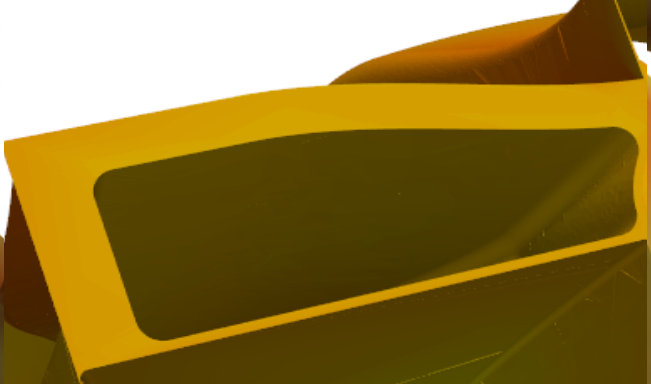
Figure 1: Qualitative pressure field comparison: GIST resolves surface features with higher fidelity and minimal unphysical cross-talk compared to FNO-based and Transolver-based methods.
Evaluation and Numerical Results
Empirical evaluation focuses on two axes: pointwise field reconstruction (pressure and wall shear stress), and accuracy of integrated aerodynamic quantities (downforce and drag coefficients) central to design decisions. GIST delivers state-of-the-art MSE and R2 field metrics, outperforming FNO-based, Transolver, and GAOT baselines. Beyond aggregate scores, GIST's superiority becomes particularly apparent in thin-walled or topologically nontrivial regions where previous attention mechanisms yield systematic errors or nonphysical flow features.
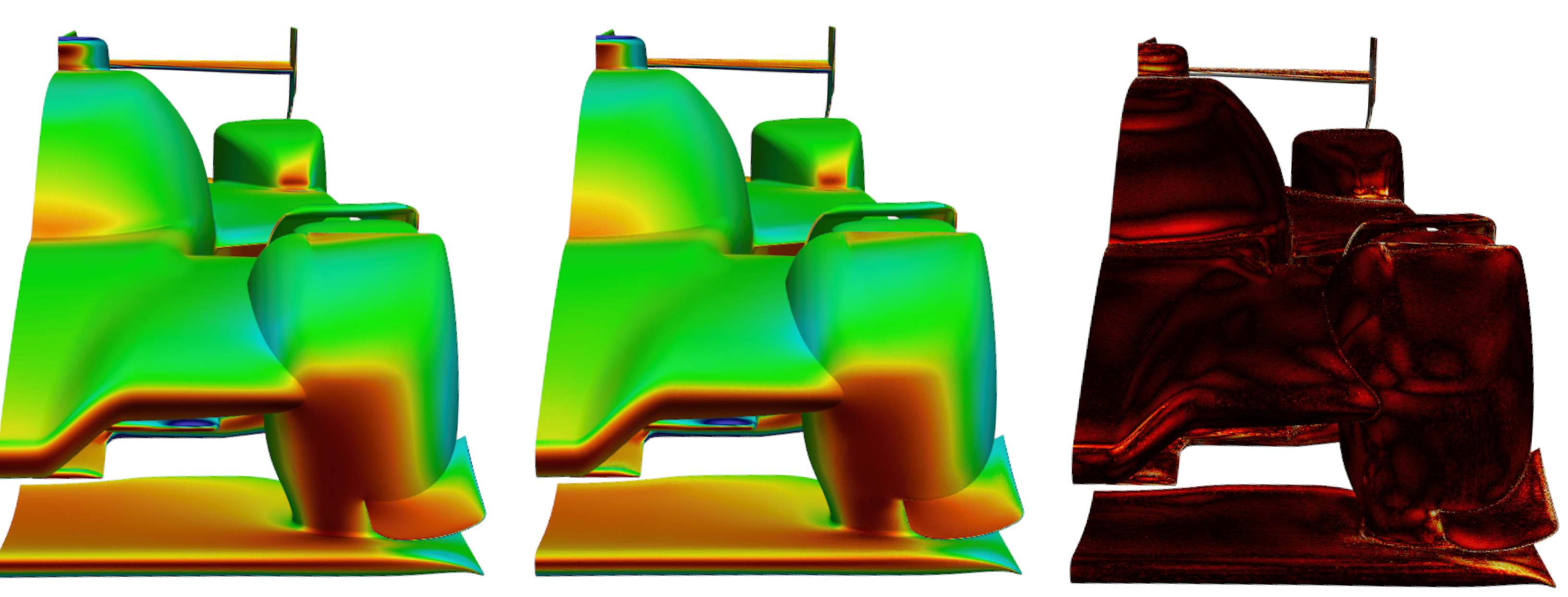
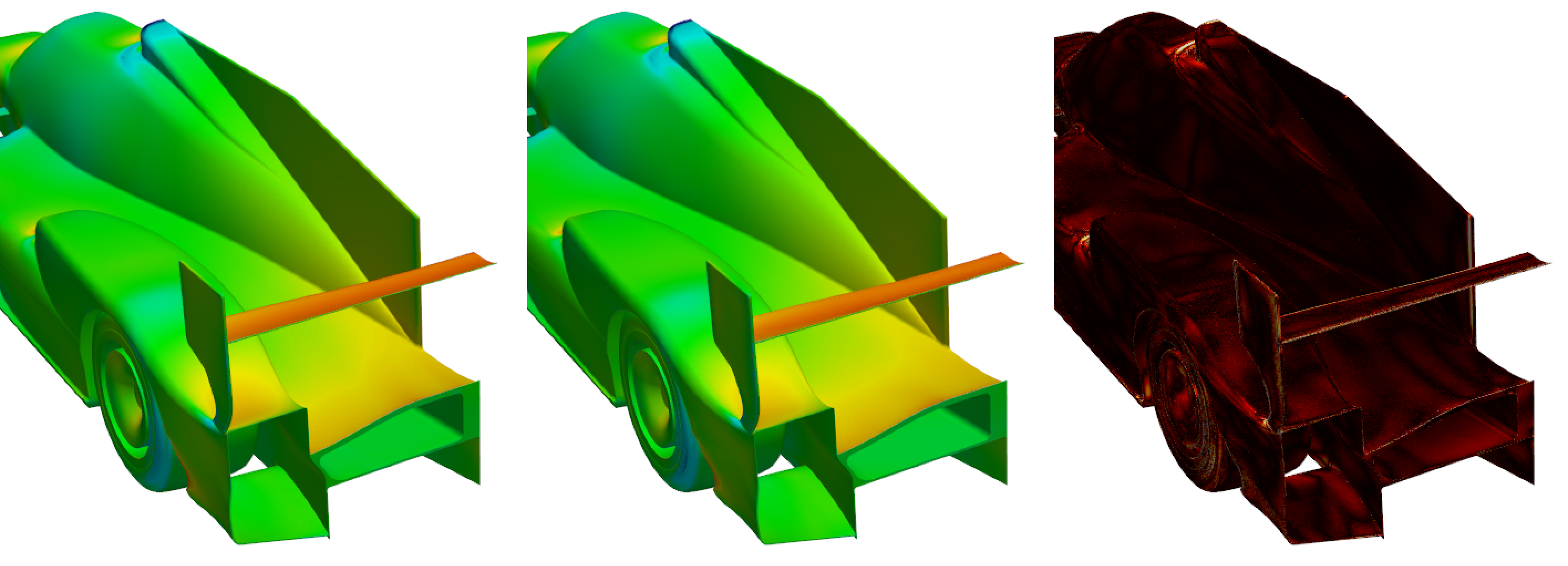
Figure 2: Surface pressure distributions—GIST exhibits strong agreement with CFD ground truth; residual errors (rightmost) are localized and of small magnitude.
At the part-level, the drag prediction from GIST achieves the pre-defined "usability threshold" for all subcomponents and meets the "CFD-replacement threshold" for 18 out of 20 parts, as defined by expert practitioners for productive integration into the industrial workflow.
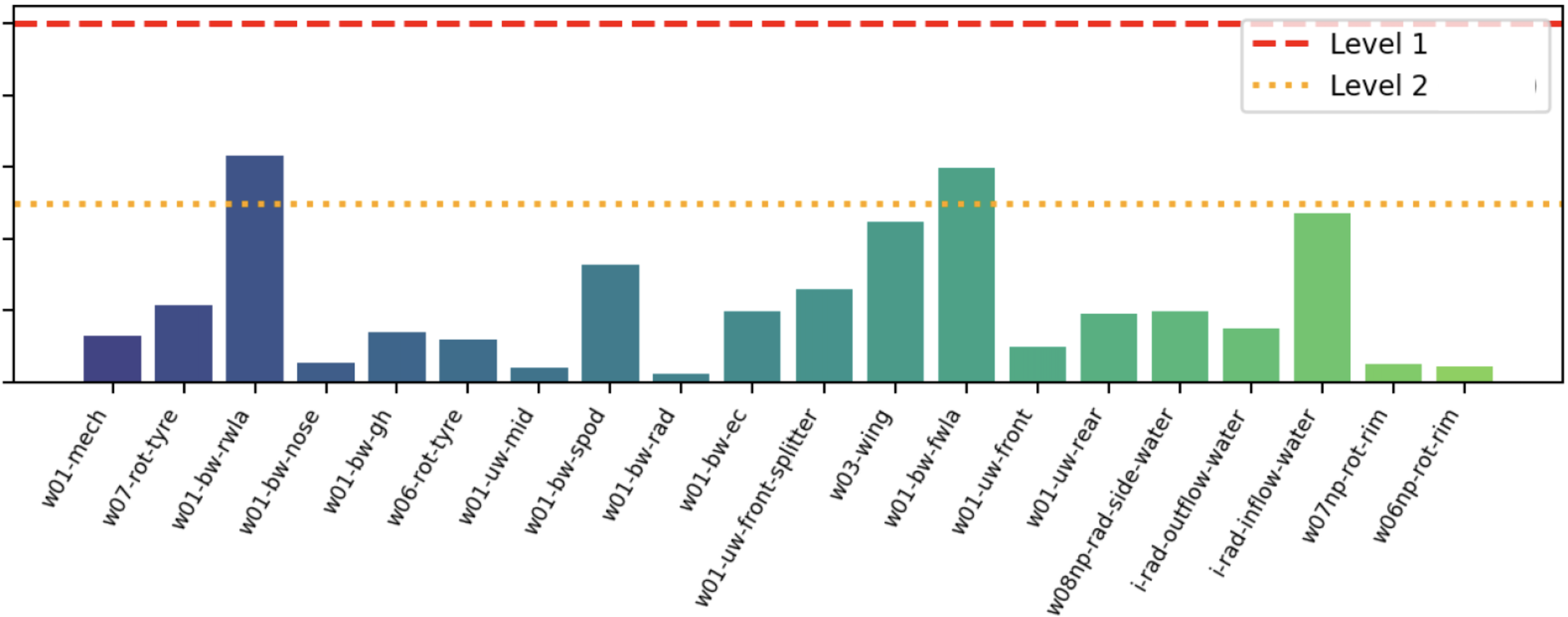
Figure 3: Absolute drag coefficient error per PID; GIST meets stringent industrial error bounds for nearly all subsystems.
For parametric sweeps critical to conceptual design, GIST rapidly generates load curves across the rear diffuser angle of attack, accurately capturing trends such as downforce saturation and the optimal tradeoff envelope for efficiency, as cross-validated against expensive CFD ground truth across the admissible domain.
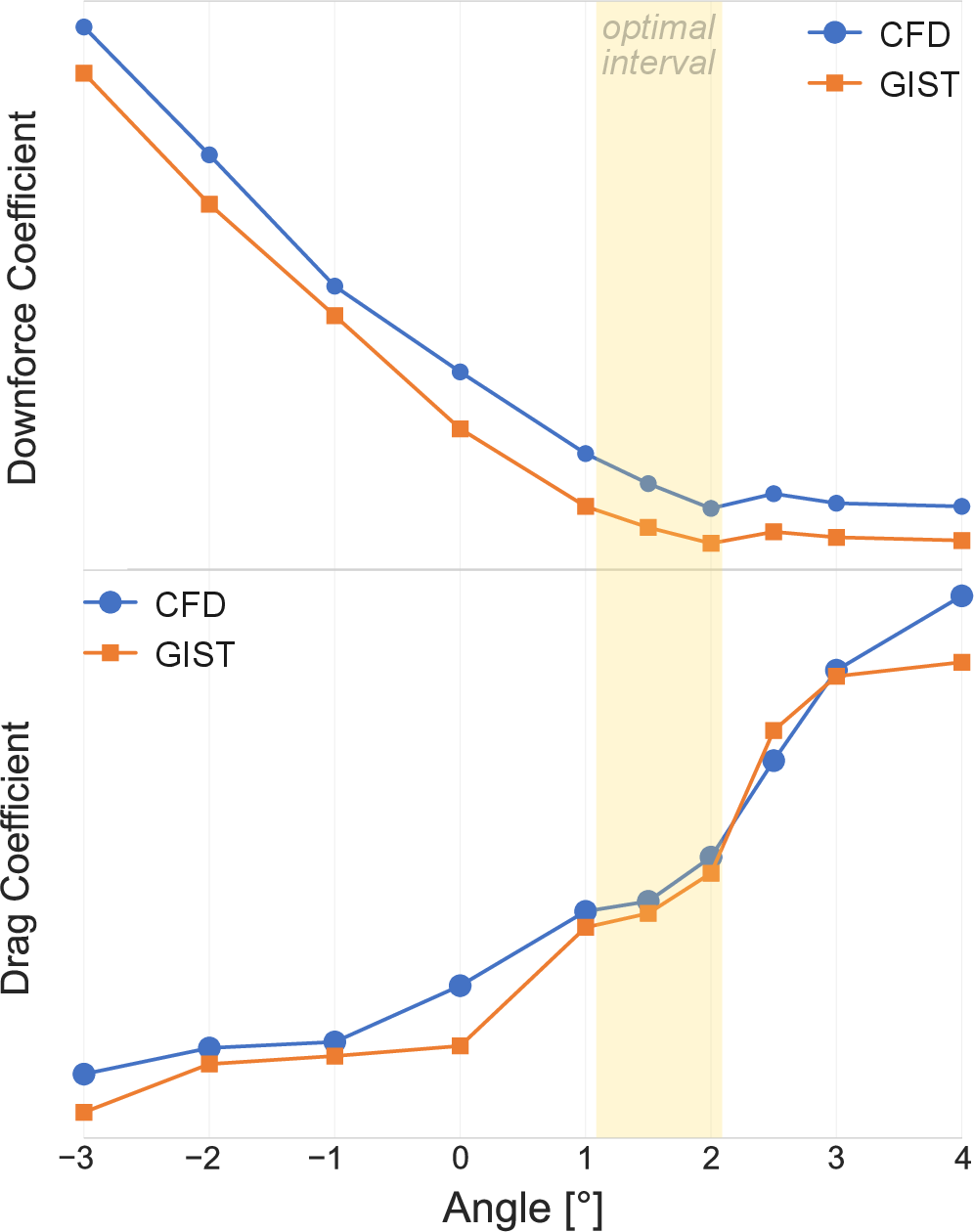
Figure 4: Downforce and drag coefficients vs. rear diffuser angle; GIST tracks both monotonic drag increase and downforce saturation in agreement with CFD.
Practical Implications and Future Directions
On the industrial side, GIST enables interactive aerodynamic design exploration, reducing concept evaluation iteration times from days to seconds while maintaining sub-percent-level error on domain-critical integral metrics. This positions the model for direct integration into product development pipelines as a surrogate for RANS-level simulations, particularly in the rapid concept evaluation and pre-optimization phases.
Theoretically, GIST's mesh-invariant, physically motivated attention keeps it robust to mesh resampling and geometric perturbation. The approach is extensible: extensions to dynamic regimes, probabilistic UQ via conformal methods, and inverse modeling (design optimization via differentiable surrogates) are tractable due to the architecture's differentiability and spectral grounding.
Additional forthcoming directions include integration of internal cooling aerodynamics (porous media flow), development of uncertainty quantification protocols (e.g., MC Dropout, Conformal Prediction), and embedding interpretability tools (e.g., concept-based attention summarization), with potential to close the "sim-to-real" gap through multi-fidelity calibration incorporating wind tunnel or track data.
Conclusion
This work establishes an expert-validated, high-complexity CFD benchmark for race-car aerodynamics and introduces a Gauge-Invariant Spectral Transformer that sets a new performance standard for neural surrogates in this regime. GIST satisfies both the scalability and mesh-invariance demands of industrial application, bridging the gap between academic innovation and practical adoption for rapid design-space exploration, and lays the groundwork for future developments in real-time, physics-aware, and invertible surrogate modeling.