- The paper introduces a novel pre-training framework combining goal-conditioned RL with contrastive objectives to encode temporal goal-reaching in robotic policies.
- It achieves state-of-the-art performance on simulation and real-world benchmarks, with success rates up to 98.4% and robust zero-shot instruction following.
- The method scales efficiently with minimal computational overhead by leveraging innovations like FlashAttention and auxiliary CRL token blocks.
Primitive Reasoning and Tasking System via Contrastive Representations: A Technical Analysis
The paper presents PRTS, a vision-language-action (VLA) foundation model that addresses a core deficiency in current VLA architectures: the lack of explicit goal-reachability awareness in learned representations. Prior VLAs rely primarily on supervised behavior cloning (BC), neglecting the fundamental nature of robotic policy learning as a temporally structured goal-reaching process. PRTS introduces goal-conditioned reinforcement learning (GCRL) into VLA pre-training, employing language instructions as goals and leveraging contrastive reinforcement learning (CRL) to shape backbone representations.
The central insight is that CRL can train paired state-action and goal representations such that their inner product approximates the log-discounted goal occupancy—a quantitative measure of the probability of reaching the language-specified goal from the current state-action. This formulation allows supervision directly from offline trajectories—without reward labels—by exploiting trajectory structure and applying temporal weighting to positive pairs within the contrastive loss. The training framework is architected to incur negligible computational overhead relative to vanilla BC by appending two auxiliary token blocks (<CRL_action> and <CRL_goal>) and integrating a role-aware causal mask into a custom FlashAttention kernel, enabling all objectives to be optimized jointly in a single forward pass.
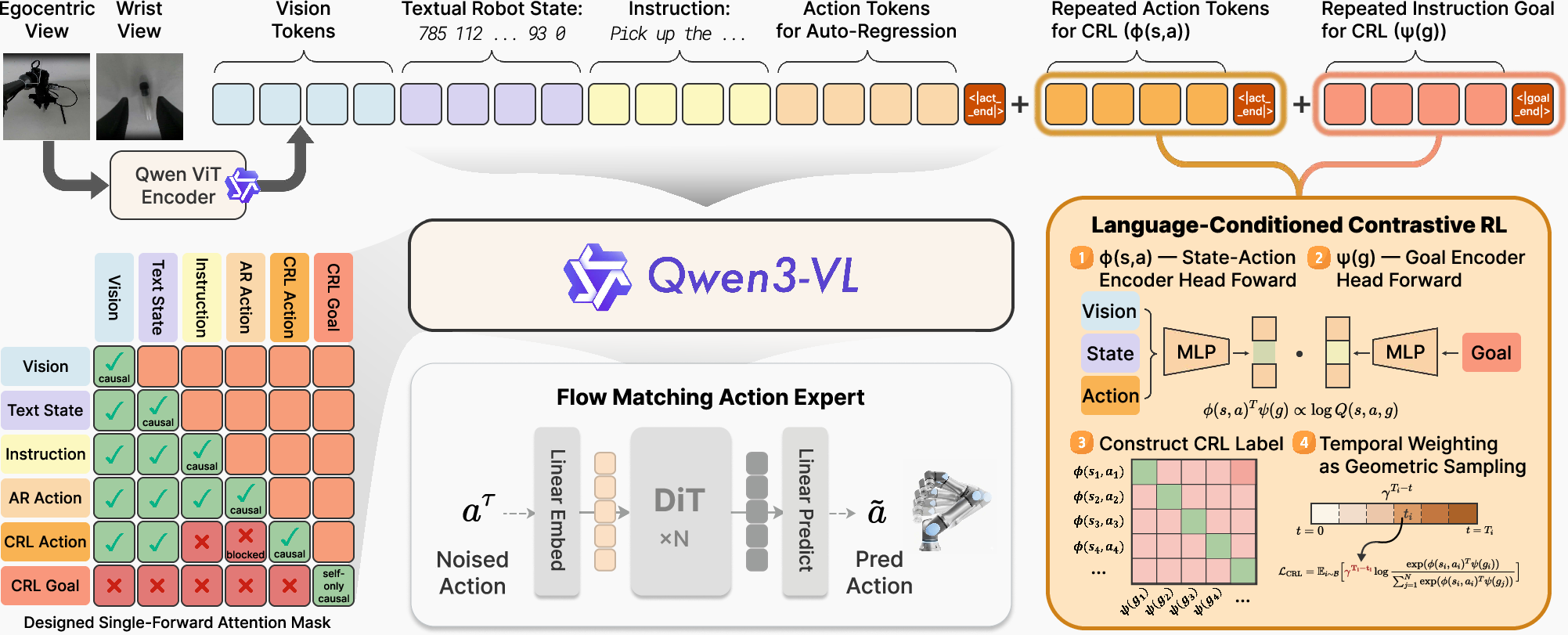
Figure 1: PRTS architecture overview illustrating unified token sequence ingestion, auxiliary CRL blocks, role-aware masking, and single forward-pass contrastive and BC objective integration.
Bidirectional Contrastive Objectives and Temporal Reasoning
PRTS implements two complementary InfoNCE objectives: state-action to language (s,a→l) and language to state-action (l→s,a). The former aligns each state-action pair with its unique task instruction, while the latter encodes temporal task progress by weighting positives according to their temporal proximity to task completion. This temporal weighting (as geometric sampling) ensures that the learned similarity ψ(l)⊤ϕ(s,a) is proportional to the log-discounted occupancy measure, thus faithfully capturing the temporal structure of goal-reaching under deterministic demonstration policies.
The theoretical equivalence to standard CRL is demonstrated, ensuring that dense goal-reachability information is encoded directly in backbone representations. Unlike previous value-augmented VLAs, which rely on hand-engineered or bootstrapped value labels and auxiliary value networks, PRTS integrates value awareness into the joint representation space. The resulting architecture produces discrete-action logits, ϕ(st,at), and ψ(l) for action prediction and dense value extraction, respectively.
Dataset Construction: Cross-Embodiment Action and Visual Reasoning
PRTS is pretrained on a 404M-sample, 167.8B-token corpus that fuses action-labeled trajectories (AgiBotWorld, RoboMind, Open X-Embodiment, and self-collected dual-arm and agile single-arm demonstrations) with visual-reasoning benchmarks (RefCOCO, Pixmo-Point, RoboPoint, RoboRefIt, RefSpatial, RoboAfford, Cosmos-Reason1, EgoPlanIT, RoboVQA, LLaVA-Instruct).
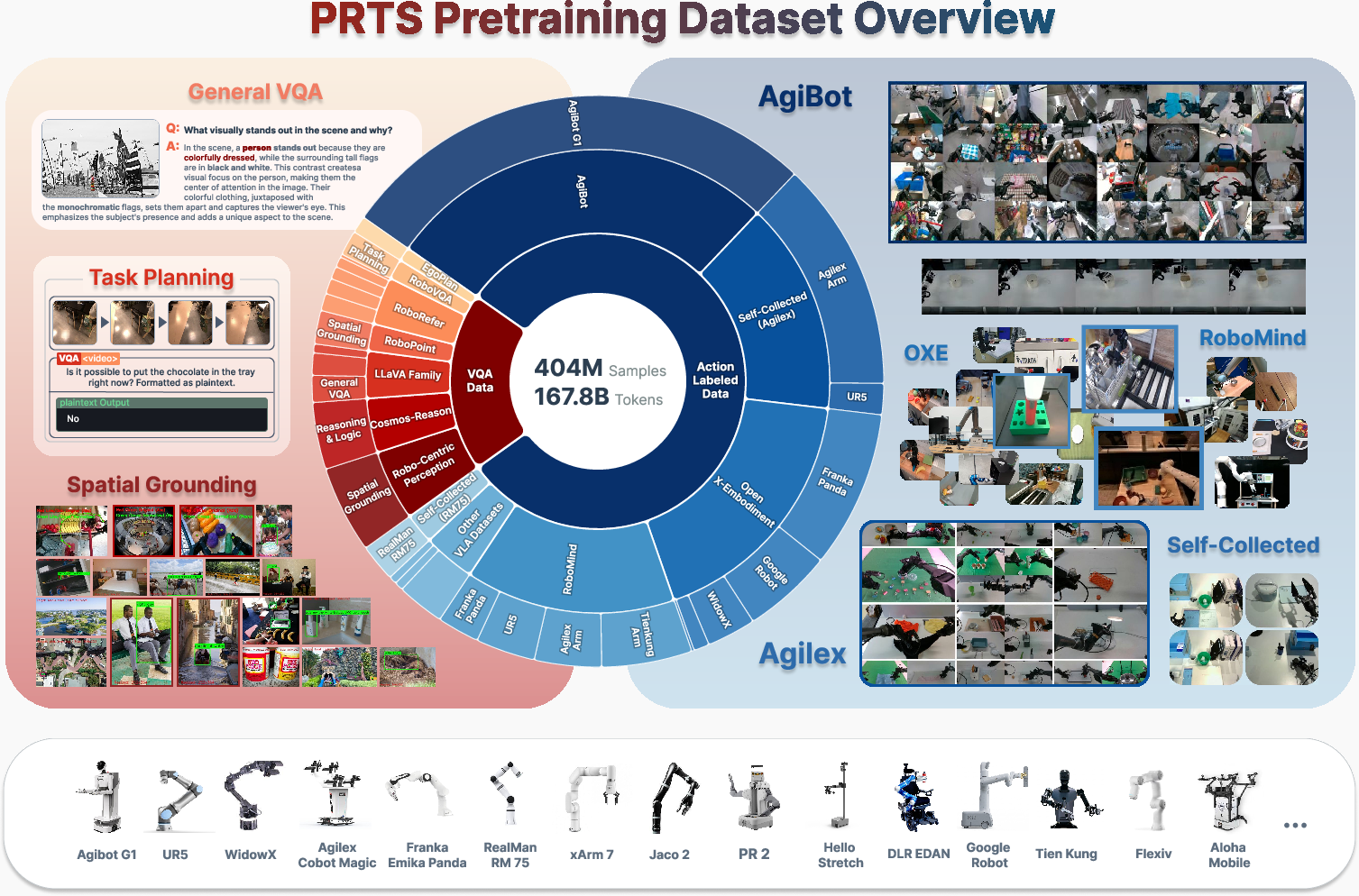
Figure 2: Pre-training dataset composition and structural diversity visualization.
This broad-spectrum dataset ensures transferability across diverse hardware platforms, facilitates spatial grounding, and strengthens both affordance perception and high-level reasoning.
Empirical Evaluation: State-of-the-Art and Robust Generalization
PRTS is evaluated on simulation (LIBERO, LIBERO-Pro, LIBERO-Plus, SimplerEnv/WidowX) and real-world (dual-arm RealMan, single-arm Flexiv) benchmarks. On LIBERO, PRTS achieves 98.4% average success rate with a post-training compute budget significantly lower than prior state-of-the-art VLAs, particularly matching or exceeding performance on long-horizon and spatially challenging tasks. The generalization study on LIBERO-Plus and LIBERO-Pro demonstrates substantial improvements under distribution shifts (object layout, robot state, instruction variation), with robust gains in zero-shot novel instruction following (Task axis: 31.5% vs. baseline 0.8%).
In SimplerEnv and real-world evaluation, PRTS consistently outperforms baseline policies in contact-rich, bimanual, and long-horizon manipulation scenarios as well as in settings featuring intervention recovery and task recombination.
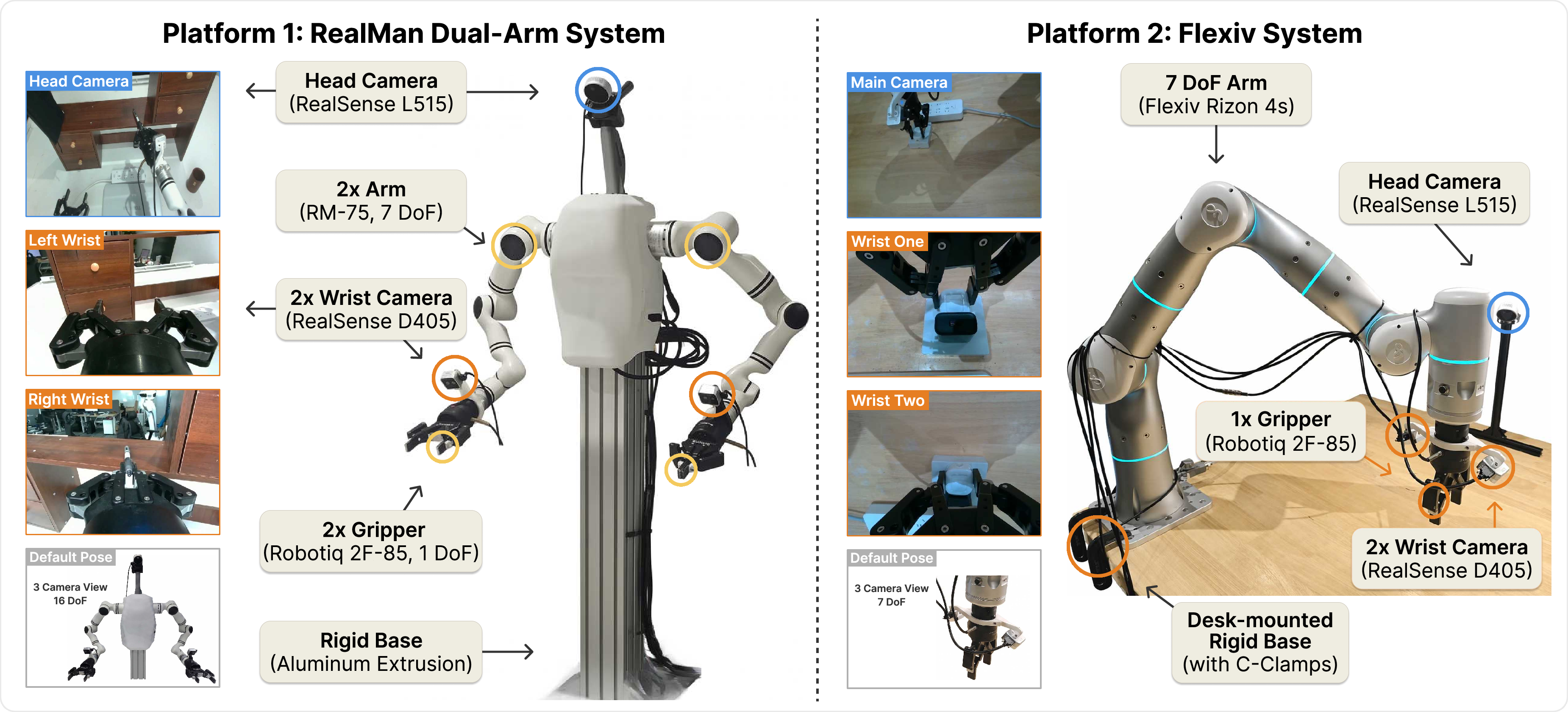
Figure 3: Real-world robot platforms evaluated, showcasing dual-arm and single-arm manipulation setups.
Generalization and Robustness under Controlled Perturbations
Systematic experiments probe lower-level (illumination, spatial, object) and higher-level (task instruction) perturbations in real-world deployment. PRTS maintains 80–100% SR across visual and layout shifts, with a marked advantage on task-instruction recombination (avg. 73.8% SR), confirming task-centric reasoning capability and resistance to memorization-based failures.
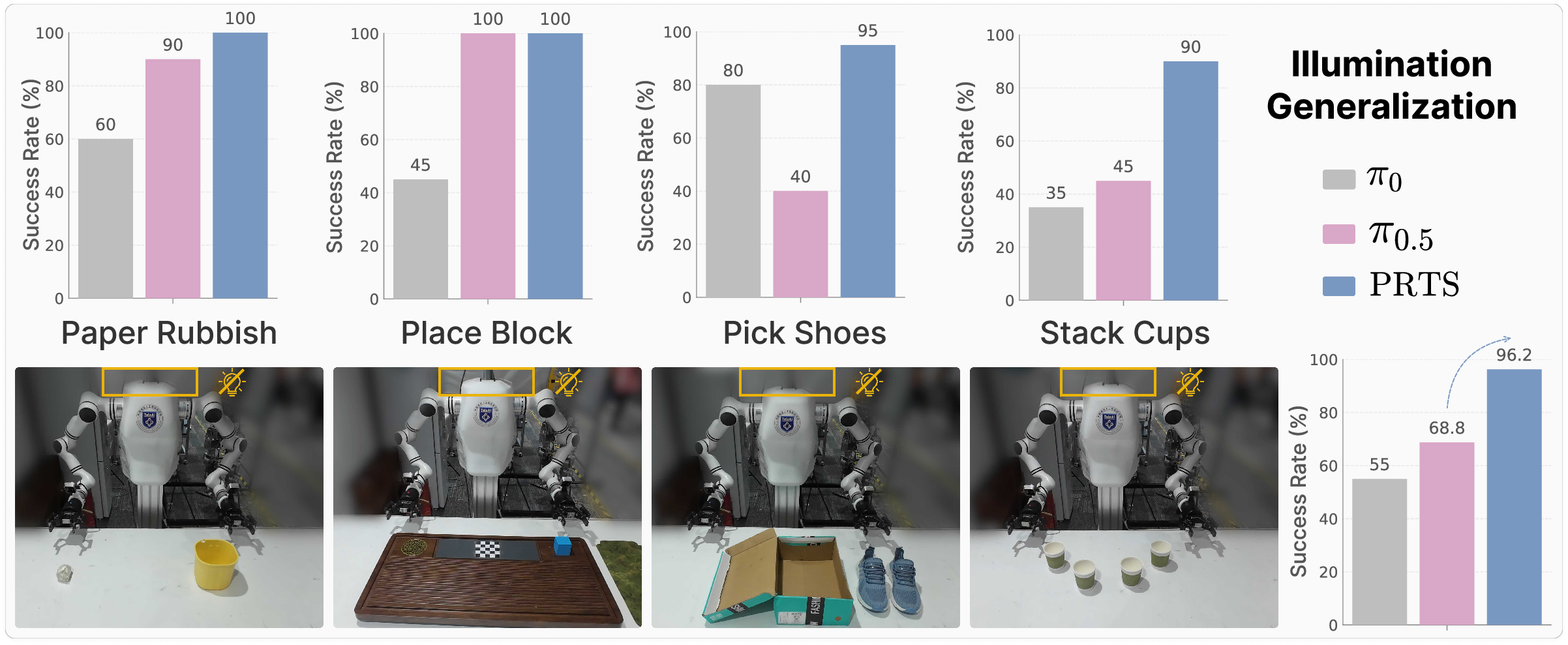
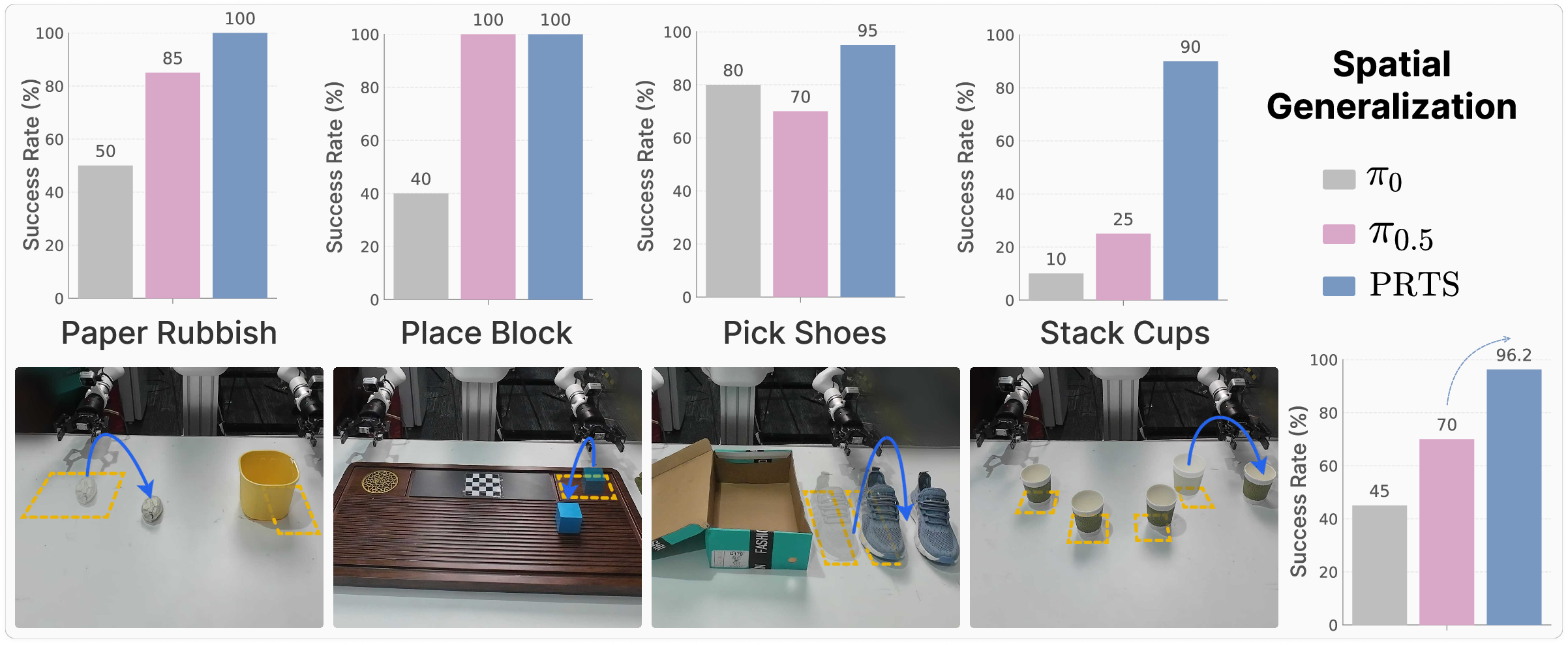
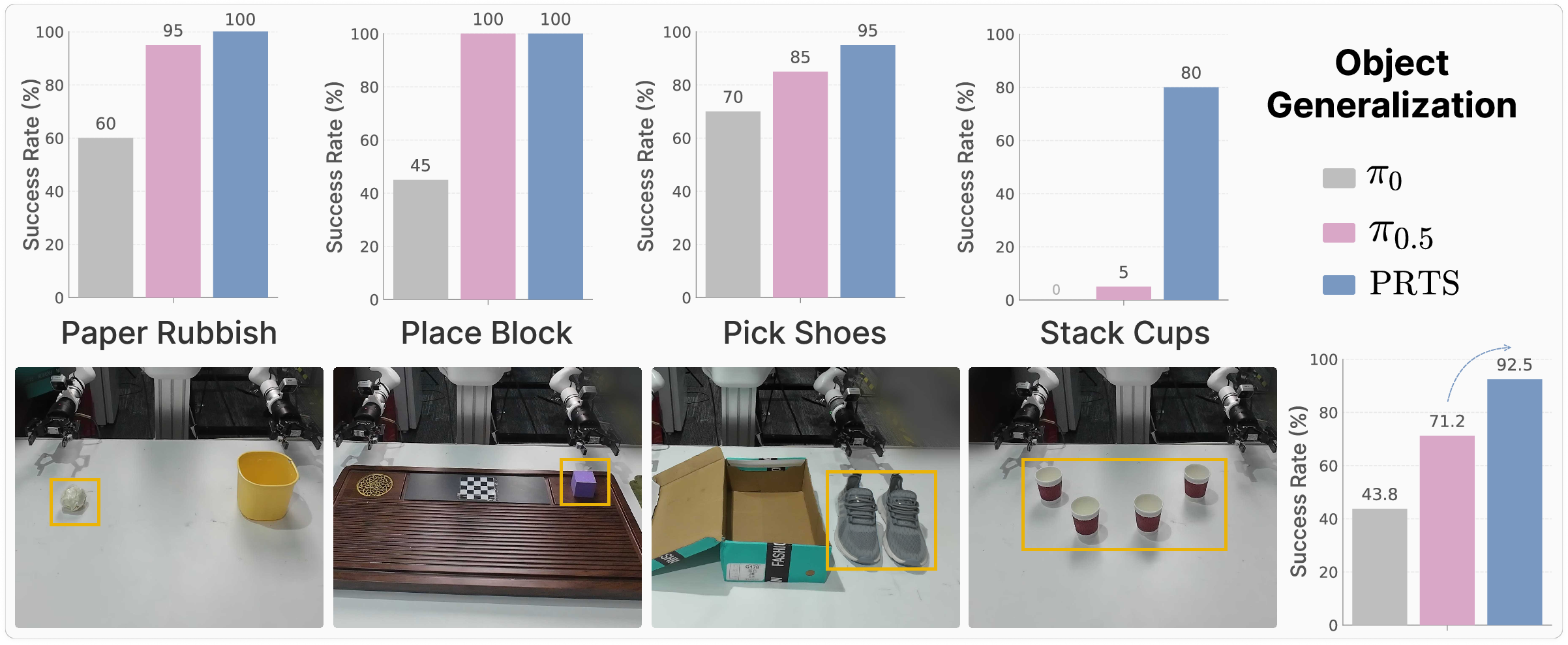
Figure 4: Illustration of visual, spatial, and object-level generalization perturbations employed in controlled studies.
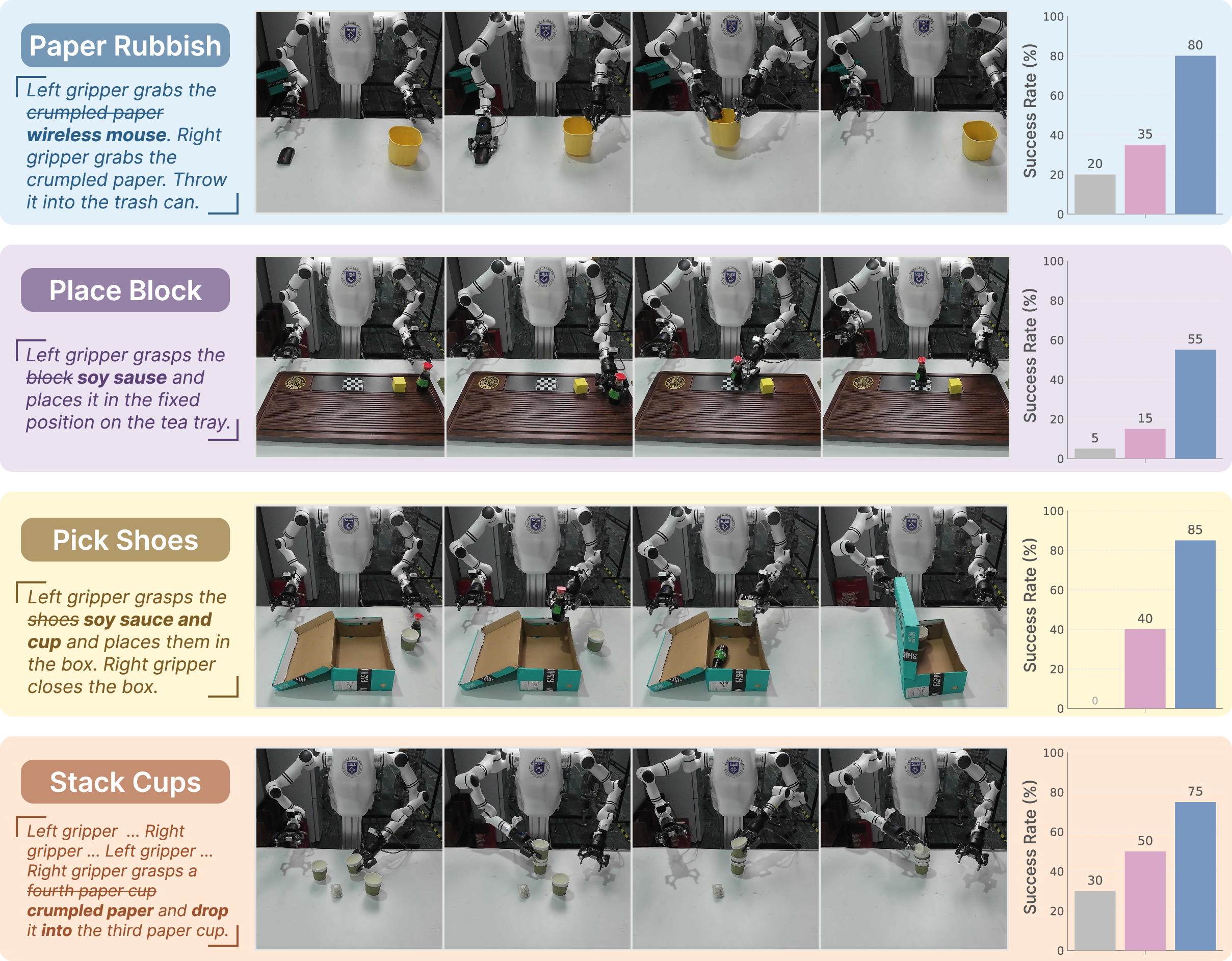
Figure 5: Task-level generalization, testing novel instruction recombination capability and semantic binding.
PRTS further demonstrates robustness and real-time recovery under human interventions; the policy dynamically adjusts to object resets and task reversions, outperforming imitation-only baselines.
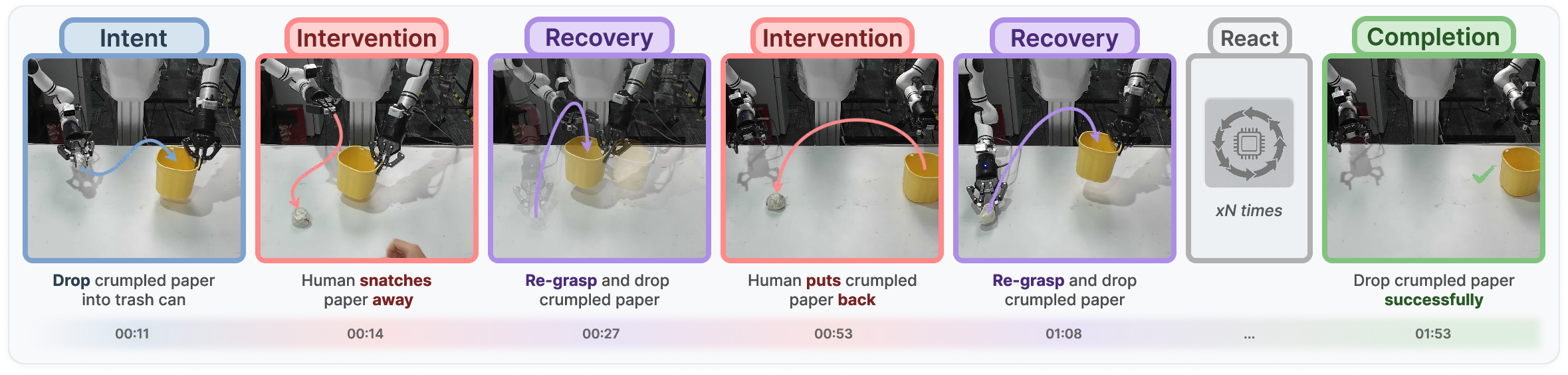
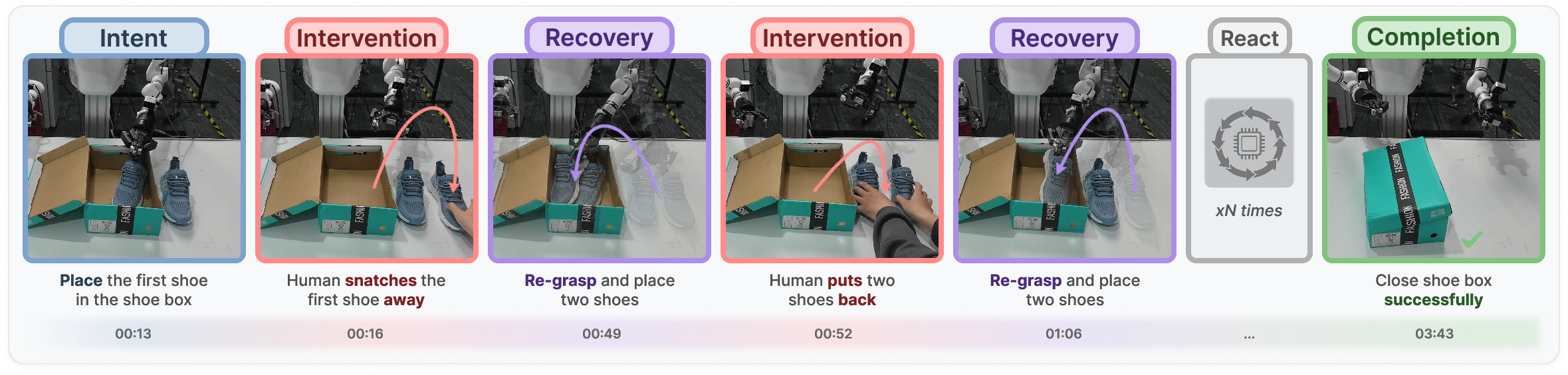
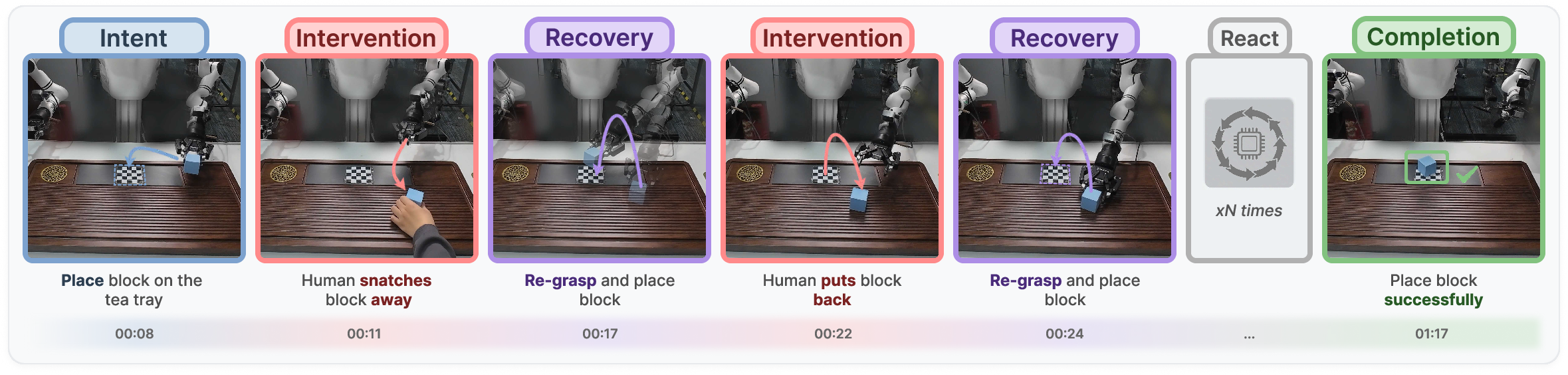
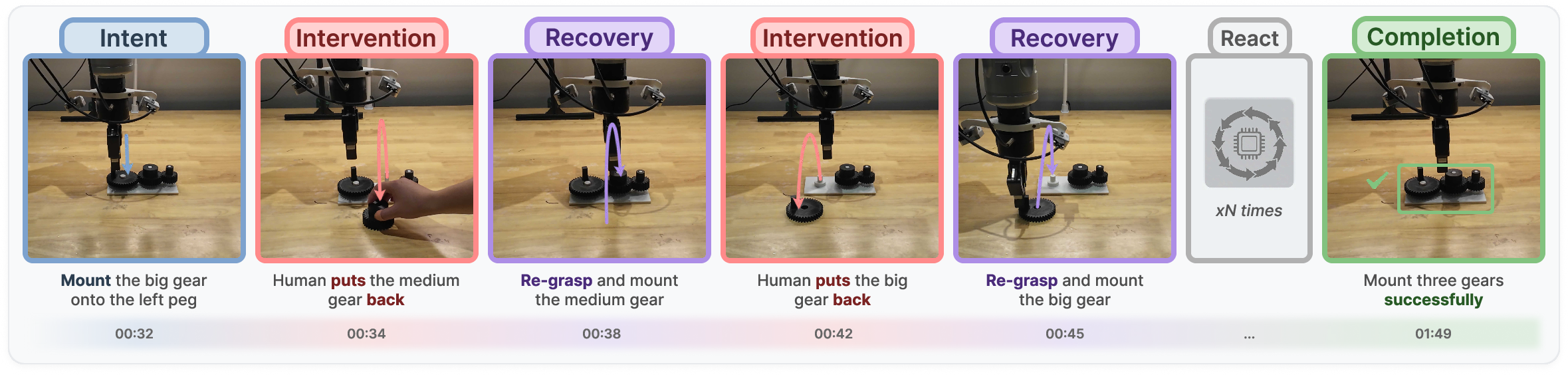
Figure 6: Example recovery rollouts under deliberate human intervention, highlighting goal-conditioned progress estimation and adaptive planning.
Goal-Reachability Awareness and Value Interpretation
Direct value visualization confirms that PRTS's CRL-shaped backbone provides progress-sensitive, instruction-valid discriminative signals, generalizing to out-of-distribution rollouts even in the absence of post-training adaptation.
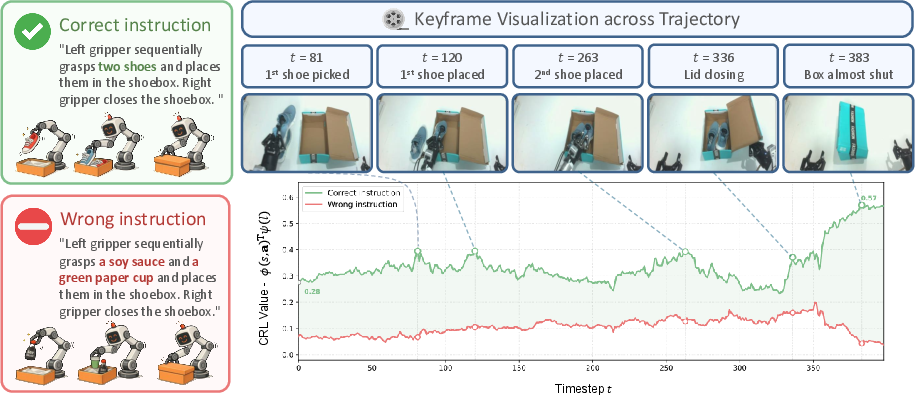
Figure 7: CRL value trajectories—green: correct instruction yields progress-sensitive peaks, red: wrong instruction yields uniformly low values.
Pre-training Efficiency: FlashAttention and Scaling
Practical system-level enhancements—fused CuTe role-aware FlashAttention kernel and global sharded InfoNCE negative pools—allow efficient scaling up to 64 H100 GPUs with near-linear throughput, maintaining per-layer forward-pass efficiency at only modest (1.18×) overhead relative to standard BC-only runs.
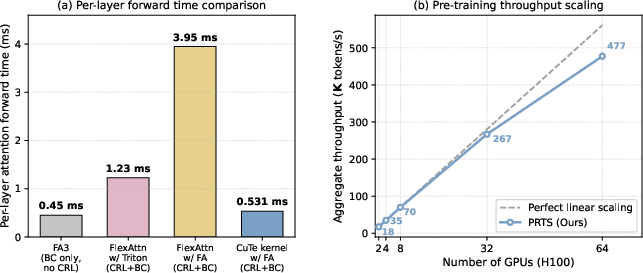
Figure 8: Per-layer attention microbenchmark and aggregate throughput scaling for CuTe/FlashAttention-based CRL implementation.
Implications and Future Directions
PRTS demonstrates that integrating reward-label-free, language-goal-conditioned contrastive RL into VLA pre-training yields temporally consistent, goal-reachability-aware representations. These advances enable superior execution and planning robustness, particularly under long-horizon, instruction-variant, and intervention-heavy deployment situations. Theoretical implications include the potential for scaling value-centric representations in deep autoregressive architectures, robust to distribution shifts and semantic recombination. Practically, this paradigm establishes a foundation for compositional, general-purpose robotic intelligence, moving beyond imitation and memorization toward goal-oriented manipulation and adaptive reasoning.
Conclusion
PRTS unifies semantic understanding, discrete/continuous action prediction, and goal-conditioned value extraction within a scalable VLM-based architecture. It achieves state-of-the-art performance in simulation and real deployment, with strongest gains in zero-shot instruction following, procedural generalization, and robustness to interventions—capabilities unattainable with BC-only or decoupled value-augmented VLAs. These results suggest that reward-label-free contrastive RL pre-training is a critical advance for VLA foundation models, providing an efficient, compositional, and generalizable substrate for goal-directed robotic intelligence (2604.27472).