Point4D: Long-range 4D Motion Reconstruction
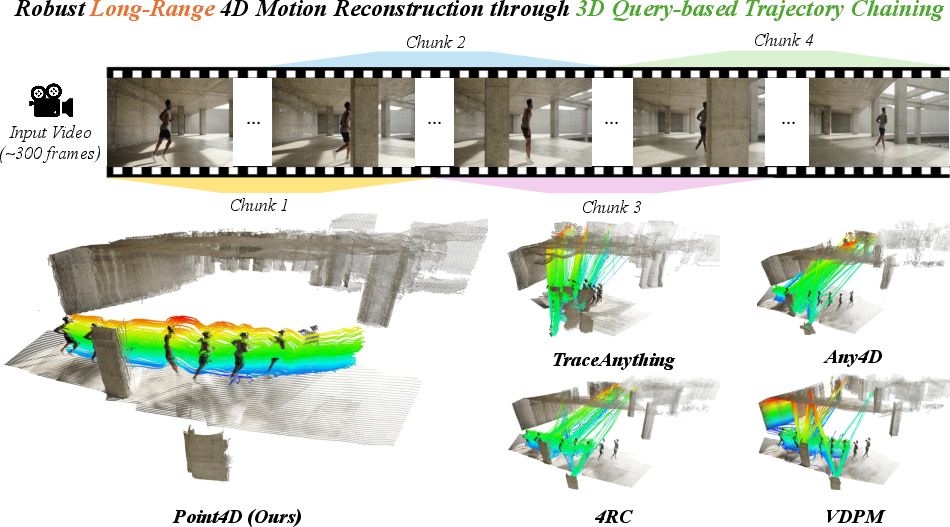
Abstract: We introduce Point4D, a feed-forward model for 4D reconstruction of long-range video sequences. Point4D is able to reliably infer dense per-point 3D trajectories across multi-hundred-frame videos, unlike existing 4D methods that are limited to short input windows of at most a few dozen frames. A key innovation that enables this is our flexible 3D query-based motion decoder that decouples trajectory prediction from image-plane visibility. The predicted 3D endpoints are then directly re-queried in the next chunk without re-projection or matching. Furthermore, we show that extracting and reusing a visual descriptor from an arbitrary frame where the point is visible leads to better performance than relying solely on the source patch. Overall, Point4D achieves state-of-the-art performance across diverse long-video tracking benchmarks spanning over 200 frames and largely outperforms previous feed-forward 4D method. Project page: https://point-4d.github.io
Paper Prompts
Sign up for free to create and run prompts on this paper.
Top Community Prompts
Explain it Like I'm 14
1. What is this paper about?
This paper introduces Point4D, an artificial intelligence system that follows points in a video in three dimensions over time.
A normal video is flat: it has only height and width. Point4D tries to understand:
- where objects are in 3D space,
- how each part of an object moves,
- and where those parts go even when they disappear behind something or leave the camera’s view.
This is called 4D reconstruction:
- 3D means position in space.
- The fourth dimension is time, showing how the 3D scene changes.
For example, imagine a person running down a hallway. They may disappear behind a pillar for a moment. Point4D tries to keep predicting where each part of the person is, even while the person cannot be seen.
2. What questions are the researchers asking?
The researchers mainly want to solve three problems:
- Can a computer track points in 3D for a long video? Earlier systems usually worked only with short clips of a few dozen frames. Point4D aims to work with videos containing hundreds of frames.
- Can it continue tracking points when they are hidden? A point may be covered by another object, move outside the camera view, or disappear between two sections of the video.
- Can the system be fast enough to use on long videos? Processing every frame at once requires too much computer memory. The researchers want to process the video in smaller pieces and connect those pieces reliably.
3. How does Point4D work?
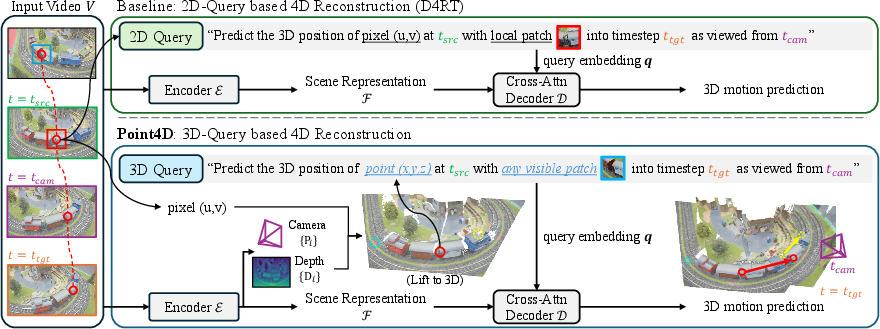
The main idea: ask about 3D points, not 2D pixels
Older systems usually begin with a pixel in an image. A pixel is a location on the flat screen, such as “the person’s shoulder at image position (u, v).”
This causes a problem when the shoulder becomes hidden. If the shoulder is not visible, there may be no pixel to use for continuing the track.
Point4D instead asks about a 3D point, described by coordinates such as (x, y, z). This is more like saying:
“Track the point that is 2 meters in front of the camera, 1 meter to the left, and 3 meters above the ground.”
That 3D point still exists even if it is hidden in the image. It is similar to tracking a friend’s location on a map rather than tracking their exact appearance in a photograph.
Step 1: Understand each video section
The system first uses a neural network called a vision transformer to study a short section of the video. A neural network is a computer program trained to recognize patterns. In this case, it learns about:
- the shapes and surfaces in the scene,
- how far objects are from the camera, called depth,
- and how the camera is positioned and moving.
The video is divided into overlapping sections, called chunks. For example, a long video might be split into sections of 48 frames, with 8 frames shared between neighboring sections.
This is like reading a very long book one chapter at a time, while rereading a few pages at the start of each new chapter to remember where you left off.
Step 2: Create a 3D query
A query is a question given to the model. Point4D’s query includes:
- the point’s 3D coordinates,
- the starting time,
- the time it should be tracked to,
- the camera being used,
- and a small image patch showing what the point looks like.
The image patch acts like a visual clue. Importantly, the patch can come from any frame where the point is visible, not only the starting frame.
For example, if a person’s hand is visible in frame 10 but hidden in frame 30, the system can still use the appearance from frame 10 while predicting the hand’s 3D position in frame 30.
Step 3: Predict where the point moves
The model examines the video features and answers:
“Where is this 3D point at the requested time?”
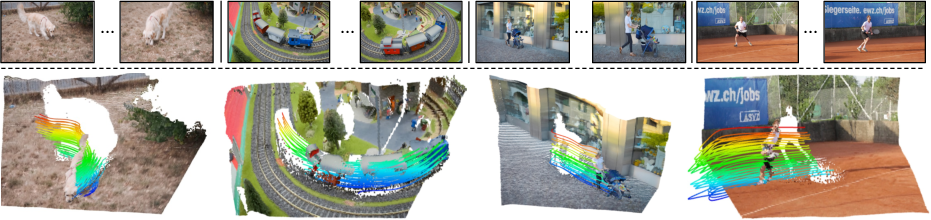
It predicts a new 3D position for the point. The system can do this for many points, allowing it to create dense motion tracks for large parts of the scene.
Step 4: Join the chunks together
After processing one chunk, Point4D takes the predicted 3D position at the end of that chunk and uses it as the starting point for the next chunk.
This is called trajectory chaining. A trajectory is the path followed by a point over time.
Because the next query is already in 3D, the system does not need to find a matching pixel in the next section. This is especially useful when the point is hidden or outside the image.
The researchers also align the coordinate systems of neighboring chunks. This means they make sure that “forward,” “left,” and “right” mean the same thing across the whole video. They use a mathematical transformation called Sim(3), which can rotate, move, and resize one 3D coordinate system to match another.
4. What did the experiments show?
The researchers tested Point4D on several video datasets, including both computer-generated scenes and real-world scenes. They compared it with:
- other fast, feed-forward 4D reconstruction systems,
- and slower systems that repeatedly refine their predictions.
They tested videos containing roughly 150 to 200 frames, which is much longer than the short clips normally used by earlier methods.
Main results
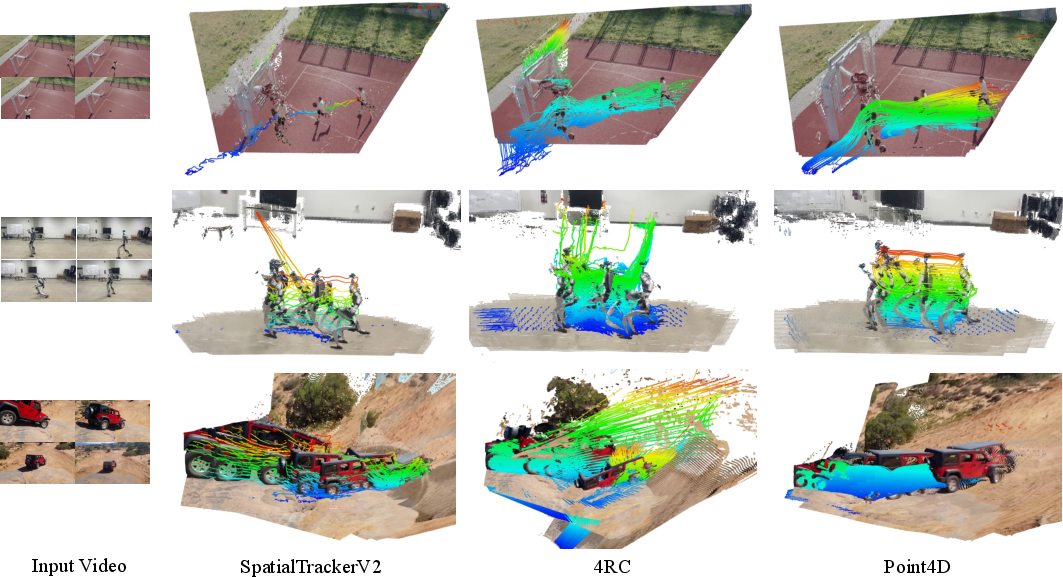
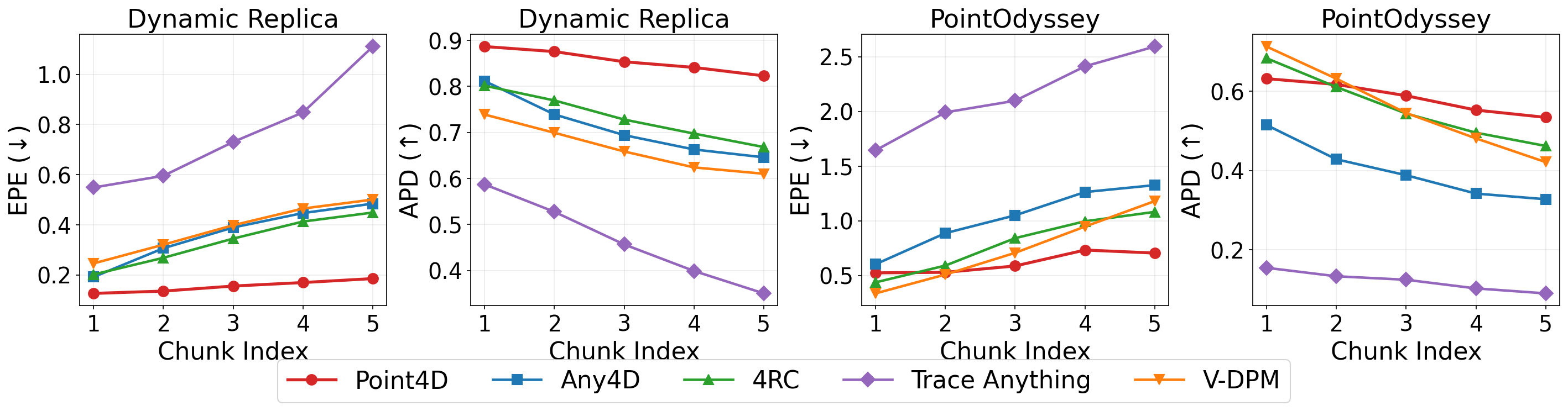
Point4D generally performed better than the other fast 4D methods on long videos.
On the long-video tests, it had:
- smaller position errors,
- more correctly tracked points,
- and higher survival rates.
The survival rate measures how long a point remains correctly tracked before the system loses it.
For example, on one dataset, Point4D achieved a survival rate of 0.514, compared with 0.463 for one of the strongest earlier feed-forward methods. On another dataset, it reached 0.812, compared with 0.654 for that method.
Point4D also performed competitively on short videos. This is important because it suggests that its success on long videos does not come only from being good at short-term prediction. Its biggest advantage is the way it connects predictions across chunks.
Why the 3D queries mattered
The researchers tested different versions of their system:
- one using 2D pixel queries,
- one using 3D queries but only using an image patch from the starting frame,
- and the complete Point4D system, which uses 3D queries and image patches from any visible frame.
The complete version worked best, especially on long videos. This shows that both ideas are useful:
- tracking with a 3D position instead of a 2D pixel;
- using appearance information from a frame where the point can actually be seen.
The results also showed that earlier 2D methods often became less accurate after each chunk. Small mistakes in one chunk could cause bigger mistakes in the next. Point4D’s 3D handoff reduced this problem.
5. Why is this research important?
Point4D is important because it makes it more practical for computers to understand long, changing scenes from ordinary single-camera videos.
Possible future uses include:
- Robotics: helping robots understand where objects and people move.
- Augmented and virtual reality: placing digital objects correctly in a moving real-world scene.
- Video editing and special effects: following objects even when they are briefly hidden.
- Generative AI: helping AI systems build a more complete understanding of moving scenes.
However, the system still has limitations. If a point is hidden for an entire video chunk, the model has very little evidence about where it went. Errors in estimating depth or aligning chunks can also build up over time.
Overall, the paper’s central contribution is simple but powerful: track points in 3D space rather than tying them to visible 2D pixels. This allows Point4D to follow motion over much longer videos and remain more reliable when objects are hidden or move out of view.
Knowledge Gaps
Knowledge gaps, limitations, and open questions
- Performance beyond 200 frames remains unvalidated. The paper demonstrates sequences of up to 200 frames, or 150 frames for PStudio, but does not establish whether autoregressive error remains bounded over thousands of frames or kilometer-scale videos.
- Long-term drift from repeated Sim(3) alignment is not quantified. The method composes pairwise chunk transformations, but the paper does not measure how rotation, translation, and scale errors accumulate as the number of chunks increases.
- The assumption of reliable Sim(3) alignment under dynamic overlap is unresolved. Alignment is estimated from dense depth predictions in overlapping frames, yet the paper does not analyze failure cases involving large camera motion, mostly dynamic content, low overlap, independently moving objects, or insufficient static structure.
- The method has no persistent scene or feature memory across chunks. If a point is occluded or outside the field of view for an entire chunk, its position is inferred without current visual evidence, but the paper does not test how accuracy varies with occlusion duration or investigate memory-based alternatives.
- Reusing a single visual descriptor throughout a long sequence may become unreliable. The paper shows that descriptors extracted from arbitrary visible frames are useful, but does not evaluate appearance changes caused by viewpoint variation, deformation, lighting, motion blur, object interaction, or long temporal gaps.
- The model’s ability to distinguish points with similar appearance is unclear. A local patch descriptor combined with a 3D coordinate may be insufficient for repeated textures, identical objects, transparent surfaces, reflections, or severe boundary ambiguity; these identity-confusion cases are not separately evaluated.
- Uncertainty estimates are not operationalized during chaining. Although the model predicts confidence and visibility scores, the chaining procedure does not appear to use them to reject, branch, reinitialize, or correct unreliable trajectories.
- The treatment of invisible points is conceptually under-specified. The decoder predicts positions for points that are occluded or out of frame, but the paper does not clarify whether these are physically inferred trajectories, learned motion priors, or extrapolations, nor how uncertainty should be represented when multiple trajectories are plausible.
- The approach does not model multimodal future motion. A single deterministic 3D endpoint is predicted even when an occluded point could follow several physically plausible paths; probabilistic or hypothesis-based motion reconstruction remains unexplored.
- Dependence on monocular depth and camera-pose quality is insufficiently isolated. The paper acknowledges this dependency but does not provide controlled experiments using ground-truth depth, ground-truth poses, perturbed poses, or alternative geometry estimators to determine how much error originates from each component.
- Absolute metric-scale behavior is not fully established. Results use median-scale alignment between predictions and ground truth, which can conceal global scale errors and limits conclusions about metric 4D reconstruction for applications requiring physically accurate distances.
- The fixed chunk and overlap configuration is not systematically studied. The choice of 48-frame chunks with 8-frame overlap is used in the main experiments, but the effects of chunk length, overlap ratio, adaptive boundaries, and variable frame rates on accuracy, memory, and runtime are not reported.
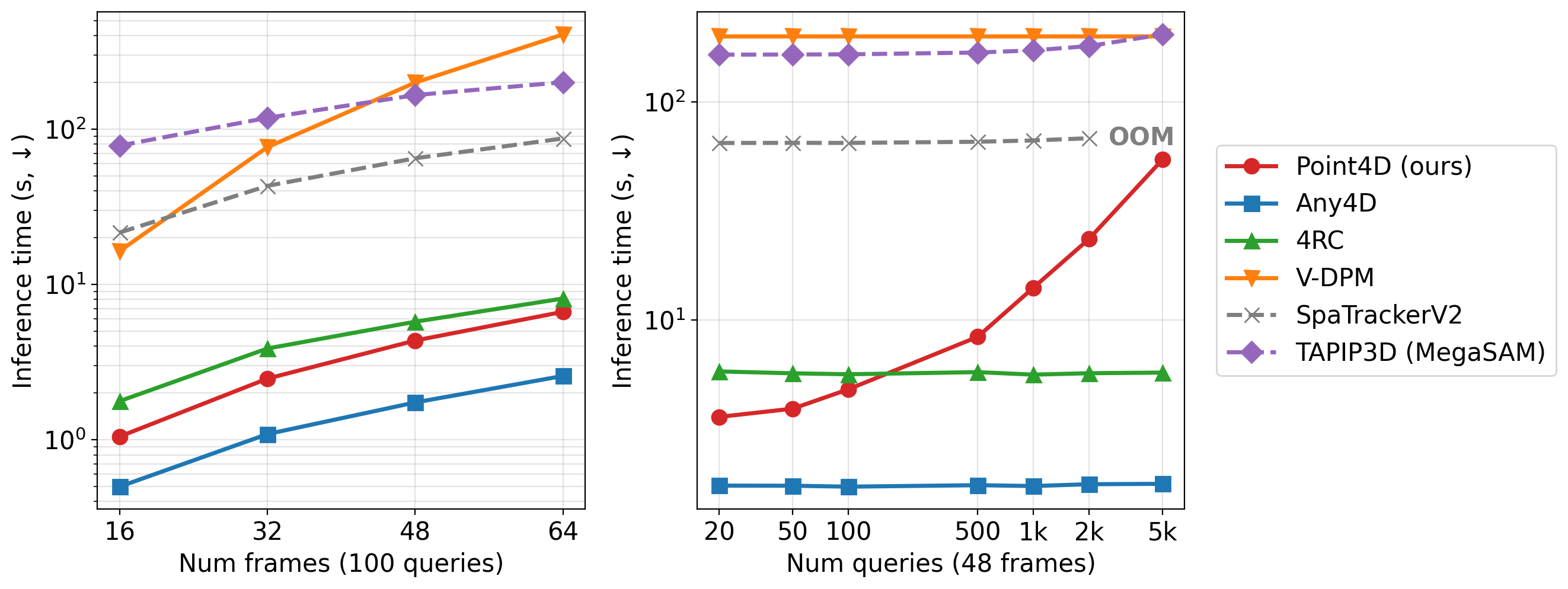
- The method’s computational scaling with dense query counts is unclear. Queries are decoded independently, but the paper does not provide a systematic analysis of memory, throughput, and latency as the number of tracked points grows from sparse queries to full-resolution dense trajectories.
- The scalability of the encoder remains limited. Chunking avoids processing the entire video jointly but requires repeatedly encoding overlapping chunks; the compute cost and energy use for very long videos are not compared with streaming or recurrent alternatives.
- Online and causal operation is not demonstrated. The method appears to encode complete chunks and use information from overlapping future frames, leaving unresolved whether it can operate in real time with bounded latency and without access to future observations.
- Robustness to camera and imaging conditions is underexplored. The evaluation does not systematically cover rolling shutter, variable exposure, compression artifacts, low light, motion blur, abrupt zoom, egomotion, lens distortion, or dropped frames.
- Generalization to unseen domains is not established. Although training uses multiple datasets, the experiments do not clearly separate in-domain and cross-domain performance or evaluate substantial domain shifts such as outdoor night scenes, underwater video, aerial imagery, microscopy, or crowded environments.
- Real-world dense ground-truth coverage is limited. Much of the training and evaluation ecosystem includes synthetic or RGB-D-derived data, while dense, long-range, metrically accurate 4D ground truth for unconstrained real videos remains insufficiently tested.
- Object- and scene-specific failure modes are not analyzed. The paper does not report performance separately for articulated humans, rigid objects, deformable objects, thin structures, vegetation, crowds, reflective surfaces, or independently moving cameras and objects.
- The impact of training static and dynamic points jointly is unresolved. Static points are treated as stationary trajectories, but the paper does not quantify whether this improves geometric stability or causes biases toward static-scene assumptions in highly dynamic environments.
- Training-time and inference-time chaining consistency is unclear. The model is trained on sequences of 16–64 frames but evaluated through autoregressive chaining over substantially longer videos; the paper does not examine exposure bias or compare standard training with explicit multi-chunk or scheduled-chaining training.
- Error correction across chunk boundaries is absent. Once a trajectory becomes inaccurate, the method propagates the erroneous 3D endpoint forward; loop closure, backward refinement, bidirectional inference, or global trajectory optimization are not investigated.
- The choice of a local patch as the sole appearance descriptor is not ablated in depth. The paper compares arbitrary-frame and source-frame patches, but does not compare patch size, multi-frame descriptors, global object context, learned point features, or descriptors updated over time.
- Visibility prediction is not evaluated as a standalone capability. The paper includes a visibility loss but does not report visibility precision, recall, calibration, or its relationship to tracking failures and occlusion duration.
- The superiority of 3D queries over alternative chaining mechanisms is not fully disentangled. Baselines use selection-based reprojection chaining, but stronger correspondence, feature-memory, bidirectional, or optimization-based chaining baselines are not evaluated, making the relative contribution of the query representation versus the chaining implementation uncertain.
- Comparisons with iterative trackers may not be fully compute- or density-matched. Iterative baselines are described as slower and sparser under memory constraints, but the paper does not provide comprehensive matched comparisons across query count, hardware, runtime, memory, and accuracy.
- The evaluation metrics do not capture trajectory plausibility or temporal smoothness. EPE, APD, and survival rate measure pointwise accuracy and failure time but do not assess velocity, acceleration, physical consistency, identity switches, discontinuities at chunk boundaries, or perceptual quality of reconstructed motion.
- Failure criteria based on fixed metric thresholds may obscure gradual degradation. Survival rate marks a point as failed once its error exceeds a threshold, but does not characterize recovery, intermittent failures, uncertainty calibration, or errors relative to object scale and scene depth.
- Dense reconstruction quality is not evaluated independently from point tracking. The paper focuses primarily on queried trajectories and does not establish whether Point4D reconstructs complete dynamic surfaces, preserves topology, or produces coherent geometry for unqueried points.
- The behavior at object entry and exit from the field of view is insufficiently characterized. The central claim concerns visibility-agnostic tracking, yet the paper does not separately quantify re-entry accuracy, the maximum out-of-view duration tolerated, or errors when multiple similar objects enter the scene.
- The method’s applicability to nonrigid and topology-changing motion is unresolved. Occlusion handling is demonstrated conceptually, but interactions such as splitting, merging, self-contact, severe deformation, and object destruction or creation are not examined.
- No principled stopping or reinitialization strategy is provided. The system does not specify when a trajectory should be terminated, reacquired from a new visible observation, or replaced by a new descriptor after confidence degradation.
- The reproducibility and sensitivity of training choices are not fully documented in the provided text. Important details such as loss weights, confidence formulation, sampling distributions, optimizer settings, augmentation policies, and exact preprocessing are delegated to an appendix, making it difficult to assess sensitivity and reproduce the reported results from the main paper alone.**
Practical Applications
Immediate Applications
The paper’s feed-forward inference, dense 3D point queries, and chunk-based processing make the following applications plausible with existing video hardware and software, provided that accuracy requirements are moderate and the system is validated for the target environment.
- Long-duration 3D video tracking for robotics and autonomous systems
- Use case: Track people, tools, vehicles, or environmental landmarks through occlusions and temporary exits from the camera’s field of view.
- Workflow: A robot or mobile platform records monocular video, initializes points on selected objects or scene regions, and uses Point4D-style 3D query chaining to maintain trajectories over hundreds of frames.
- Sector: Robotics, autonomous vehicles, warehouse automation, drones.
- Practical output: A dense set of 3D trajectories that can support obstacle prediction, human–robot interaction, navigation, and workspace monitoring.
- Dependencies: Reliable monocular depth, camera-pose estimation, sufficient visual evidence in each chunk, and calibration for the robot’s coordinate frame. Performance may degrade when a point is fully occluded for an entire chunk.
- 3D motion analysis and annotation for video-production and visual-effects pipelines
- Use case: Convert handheld or monocular footage into approximate 3D trajectories for actors, props, or scene surfaces.
- Potential tool: A plug-in for video-editing, motion-design, or visual-effects software that exports tracked points in formats used by Blender, Maya, Unreal Engine, or Unity.
- Benefits: Faster initialization of camera effects, object replacement, motion graphics, rotoscoping, and scene-layout tasks than manually tracking every frame.
- Dependencies: The paper reports strong benchmark performance but not production-grade metric accuracy for arbitrary footage; artists would still need confidence visualization and manual correction.
- AR/VR and spatial-media authoring
- Use case: Estimate the 3D motion of objects and surfaces in long monocular recordings to place virtual annotations, effects, or persistent spatial labels.
- Potential product: A smartphone or headset application that attaches virtual content to moving or temporarily occluded points across a long video.
- Dependencies: Stable scale and global alignment are important. Point4D aligns chunks using estimated
Sim(3)transformations, so accumulated depth or alignment errors can cause spatial drift. Real-time deployment would also require optimization, although feed-forward inference is more suitable than iterative trackers.
- Sports and movement analytics
- Use case: Track body, equipment, or field points over long recordings, including periods when athletes are partially blocked by other players or structures.
- Sector: Sports technology, biomechanics, coaching, broadcasting.
- Potential workflow: Initialize a grid or selected points in the first frame, reconstruct their 3D trajectories, and compute speed, acceleration, spacing, or tactical movement.
- Dependencies: A monocular camera may not provide sufficiently accurate metric scale or body-joint semantics. The system reconstructs point trajectories, not explicit human pose, so an additional pose or object-understanding module would be needed.
- Video-based measurement for construction, inspection, and surveying
- Use case: Track structural features, machinery components, or workers across long inspection videos.
- Sector: Construction, infrastructure maintenance, industrial inspection.
- Potential output: Approximate 3D displacement maps, movement histories, and candidate regions for manual inspection.
- Dependencies: The method assumes visual texture and adequate observations. Safety-critical measurements should be corroborated with calibrated stereo, LiDAR, inertial sensors, or surveying equipment because monocular depth and chained
Sim(3)alignment can accumulate errors.
- Efficient generation of training data for 4D computer vision
- Use case: Produce dense or semi-dense 3D trajectories from long videos for training downstream trackers, motion-segmentation models, and dynamic-scene reconstruction systems.
- Sector: Academia and industrial machine learning.
- Potential tool: An annotation-assistance system that proposes long-range tracks and exposes low-confidence segments for human review.
- Benefits: Reduces the manual effort involved in labeling trajectories and can provide pseudo-labels for otherwise unlabeled video.
- Dependencies: Automatically generated tracks must be quality-controlled, especially at chunk boundaries and after prolonged occlusion. Dataset bias from the paper’s training mixture may limit performance on unusual environments, cultures, camera types, or motion patterns.
- Benchmarking and diagnostic analysis of long-range tracking
- Use case: Use survival rate, endpoint error, and chunk-wise degradation to evaluate whether a vision system maintains point identity over long sequences.
- Sector: Academia, software engineering, and computer-vision product development.
- Potential workflow: Integrate Point4D-style trajectory chaining into regression tests for video models, comparing performance before and after changes to depth estimation, camera pose, or temporal memory.
- Dependencies: The paper’s reported metrics use median-scale alignment and benchmark datasets; production evaluation should additionally measure absolute scale, latency, calibration, failure detection, and worst-case behavior.
- Forensic, archival, and media analysis
- Use case: Reconstruct approximate 3D motion from long public or archival videos to analyze object movement, scene changes, or event timelines.
- Sector: Digital forensics, journalism, cultural heritage, public-sector analysis.
- Dependencies: Results should be treated as estimates rather than definitive evidence. Compression artifacts, unknown camera intrinsics, editing cuts, and missing frames can invalidate trajectory conclusions. Any legal or policy use would require independent verification and a documented uncertainty model.
- Everyday video organization and editing
- Use case: Automatically identify and follow objects or locations across long smartphone videos, even when they temporarily disappear from view.
- Potential features: Persistent object highlighting, automatic reframing, 3D-aware stabilization, searchable movement timelines, and object-centered video summaries.
- Dependencies: Consumer deployment would require efficient models, privacy-preserving processing, robust handling of scene cuts, and safeguards against incorrect tracking of people.
Long-Term Applications
These applications require additional research, engineering, or validation because they depend on stronger temporal memory, better uncertainty estimation, higher metric accuracy, multimodal sensing, or integration with decision-making systems.
- Persistent 4D world models for autonomous robots
- Use case: Maintain a continuously updated model of a changing environment over minutes or hours, preserving the identity and motion of objects across repeated occlusions.
- Potential system: A robot world model combining Point4D-style 3D query propagation with semantic object identities, map memory, loop closure, and planning.
- Why further development is needed: Point4D carries only a 3D coordinate and visual descriptor between chunks. A point that remains unseen for an entire chunk becomes unreliable, and errors in depth and
Sim(3)alignment can compound over long sequences. - Additional requirements: Long-term feature memory, re-identification, active viewpoint selection, uncertainty-aware reinitialization, and sensor fusion with RGB-D, LiDAR, or inertial measurements.
- Generative video and controllable 4D content creation
- Use case: Use reconstructed trajectories as motion constraints for video generation, object-aware editing, view synthesis, or simulation-to-video systems.
- Potential products: Tools for editing an object’s path, changing camera motion while preserving scene dynamics, or generating new views of long dynamic scenes.
- Why further development is needed: Generative models need temporally consistent, semantically meaningful trajectories, whereas Point4D currently outputs geometric point tracks without guaranteeing object-level identity or complete scene understanding.
- Dependencies: Better dynamic-scene segmentation, semantic correspondence, physically plausible motion modeling, and explicit confidence estimates.
- Immersive telepresence and volumetric communication
- Use case: Reconstruct people and environments from commodity monocular cameras for remote presence, interactive 3D video, or mixed-reality communication.
- Potential workflow: Use long-range 4D tracks to maintain motion consistency while a separate reconstruction system synthesizes geometry and appearance.
- Challenges: Human performance requires high spatial fidelity, low latency, correct handling of self-occlusion, and stable metric scale. The reported benchmarks do not establish these requirements for telepresence.
- Dependencies: Multi-camera or depth-sensor fusion, temporal compression, view-dependent rendering, and perceptual-quality evaluation.
- Clinical movement and rehabilitation monitoring
- Use case: Track limb, joint, or assistive-device motion during long home-based rehabilitation sessions using a single camera.
- Potential workflow: Generate 3D trajectories, derive motion ranges and repetition counts, and provide feedback to clinicians or patients.
- Why further development is needed: Point4D tracks points rather than clinically validated anatomical landmarks and does not establish medical accuracy.
- Dependencies: Pose and anatomy models, patient-specific calibration, privacy protections, clinical trials, uncertainty reporting, and regulatory approval. It should not be used for diagnosis without substantial validation.
- Traffic, pedestrian, and infrastructure analytics
- Use case: Reconstruct long-range 3D trajectories of vehicles, cyclists, and pedestrians from existing monocular surveillance or roadside cameras.
- Sector: Smart cities, transportation planning, road safety, public policy.
- Potential outputs: Near-miss analysis, intersection-flow estimation, infrastructure design data, and evaluation of traffic interventions.
- Challenges: Long-term accuracy, camera calibration, identity privacy, crowded-scene occlusion, and fairness across different body types and mobility aids.
- Dependencies: Multi-camera association, explicit anonymization, governance policies, bias audits, and validated uncertainty bounds before use in enforcement or safety-critical decisions.
- Digital twins for manufacturing and energy systems
- Use case: Build dynamic 4D representations of machines, workers, materials, or maintenance activities from long plant videos.
- Potential tools: Automated process monitoring, anomaly detection, predictive maintenance, and simulation-data generation.
- Why further development is needed: Industrial use requires repeatable metric accuracy and robust operation under lighting changes, reflective surfaces, repetitive textures, and partial visibility.
- Dependencies: Fixed-camera calibration, domain-specific training data, sensor fusion, integration with industrial control systems, and rigorous safety validation.
- Long-range motion-aware mapping and geospatial analysis
- Use case: Combine sequential monocular footage from vehicles, drones, or wearable cameras to create maps that represent both static structure and moving objects.
- Potential applications: Disaster-response mapping, environmental monitoring, archaeological documentation, and large-site inspection.
- Challenges: The current chunk alignment uses pairwise
Sim(3)transformations and may drift over very long sequences or under weak visual overlap. - Dependencies: Loop closure, global bundle adjustment, georeferencing, GPS/IMU fusion, robust handling of scene cuts, and explicit separation of static and dynamic geometry.
- Policy and public-sector evidence systems
- Use case: Support reconstruction of movement patterns in disaster response, emergency management, infrastructure incidents, or public-space planning.
- Potential workflow: Generate candidate 3D trajectories for analysts, retain source-video links, and present confidence scores rather than automatically asserting conclusions.
- Why further development is needed: The paper demonstrates benchmark performance, not evidentiary reliability or accountability in high-stakes settings.
- Dependencies: Chain-of-custody procedures, reproducibility, human review, transparency about model uncertainty, privacy safeguards, and legal standards for admissibility.
- Research platforms for studying dynamic-scene perception
- Use case: Provide an open baseline for investigating long-context vision, occlusion reasoning, scene flow, active perception, and 4D representation learning.
- Potential academic contributions: New datasets with long full-occlusion intervals, uncertainty-aware chaining methods, memory architectures, and comparisons between monocular and multimodal systems.
- Dependencies: More diverse real-world benchmarks, standardized absolute-scale metrics, failure-case taxonomies, and evaluations beyond 150–200 frames.
Overall, Point4D is most immediately useful as a long-video 3D tracking and annotation component. Its broader applications depend on addressing the paper’s stated limitations: persistent occlusion, accumulated depth and alignment error, lack of retained scene memory, unknown real-world scale, and the absence of explicit semantic identity or uncertainty guarantees.
Glossary
- 4D reconstruction: Recovery of a scene’s three-dimensional structure together with its changes over time. “4D reconstruction aims to recover both the 3D structure of a scene and how it changes over time.”
- Autoregressive motion prediction: Sequential prediction in which later outputs depend on previously predicted results. “chaining for 4D reconstruction requires autoregressive motion prediction”
- Binary cross-entropy: A loss function for measuring the difference between binary predictions and target labels. “The auxiliary visibility loss is a binary cross-entropy loss”
- Camera coordinates: A coordinate system whose origin and orientation are defined by a camera. “expressed in the camera coordinates of frame ”
- Camera pose: The position and orientation of a camera in a scene. “A shared ViT encoder produces a scene representation along with per-frame depth and camera poses”
- Canonical view: A designated reference viewpoint used to represent scene geometry or motion. “scene flow from a canonical view”
- Chunking: Dividing a long sequence into smaller, usually overlapping, segments for processing. “we partition the video into overlapping chunks”
- Confidence loss: A training objective that adjusts the penalty according to the model’s confidence in each prediction. “The confidence loss modulates by a per-query confidence score”
- Continuous trajectory field: A representation that models point motion as a continuous function over space and time. “continuous trajectory fields”
- Cross-attention: An attention mechanism in which one set of representations attends to another set. “a lightweight cross-attention decoder takes a 3D query”
- Dense decoder: A neural-network component that predicts an output for many or all spatial positions, such as image pixels. “they all decode motion for every pixel through DPT-style heads or similar dense decoders.”
- Depth map: An image whose values represent the distance from the camera to visible scene points. “Dedicated heads decode camera poses from and depth maps from ”
- End-point error (EPE): The Euclidean distance between a predicted point location and its ground-truth location. “we report end-point error (EPE)”
- Feed-forward model: A model that produces predictions in one forward computation without iterative test-time optimization. “we introduce Point4D, a feed-forward model for 4D reconstruction of long-range video sequences.”
- Field of view: The portion of the scene visible to a camera. “the points to be tracked routinely become occluded or leave the field of view”
- Global coordinate frame: A common reference coordinate system used to express predictions from multiple local coordinate systems. “Ensure 4D trajectories in a global coordinate frame”
- Image-plane visibility: Whether a three-dimensional point projects into the visible two-dimensional image area. “decouples trajectory prediction from image-plane visibility”
- Iterative refinement: Repeatedly updating an initial prediction to improve its accuracy. “require iterative refinement that limits speed.”
- L1 loss: A loss based on the absolute difference between predicted and target values. “The primary loss is an L1 loss on the predicted 3D position”
- Long-range tracking: Following the position of points across a large number of video frames. “Point4D achieves state-of-the-art performance across diverse long-video tracking benchmarks”
- Median-scale alignment: Rescaling predictions relative to ground truth using a scale derived from their median values. “after median-scale alignment of ground truth and predicted trajectories”
- Monocular video: Video recorded from a single camera viewpoint. “recovering per-point 3D trajectories across hundreds of frames from a monocular video”
- Occlusion: A condition in which an object or point is hidden by another object. “allowing direct chaining for long-range motion reconstruction under occlusions.”
- Optical flow: The apparent two-dimensional motion of image patterns between video frames. “point tracking and optical flow methods estimate pixel-level correspondences across frames.”
- Patch token: A learned vector representation corresponding to a small image region, typically used by a vision transformer. “producing patch tokens and camera tokens for each frame”
- Per-point 3D trajectory: The sequence of three-dimensional positions associated with an individual point over time. “infer dense per-point 3D trajectories across multi-hundred-frame videos”
- Pixel projection: The mapping of a three-dimensional point into a two-dimensional image location. “The auxiliary reprojection loss is an L1 loss on the predicted 2D projection”
- Query embedding: A learned vector representation encoding the information needed to answer a model query. “The resulting query embedding cross-attends to ”
- Query-based decoding: Generating a prediction on demand from a specified query rather than producing a complete output for every input location. “D4RT introduces on-demand query-based decoding.”
- Reprojection: Projecting a three-dimensional prediction back onto a camera’s two-dimensional image plane. “requiring reprojection from 3D to 2D for re-querying”
- Scene flow: The three-dimensional motion field describing how scene points move over time. “these approaches allow decoding each pixel's 3D position at any queried timestep, thereby inferring the 4D motion of the scene”
- Self-attention: An attention operation in which elements of a sequence interact with other elements in the same sequence. “with alternating frame-wise and global self-attention layers”
- Signed log-transform: A logarithmic transformation that preserves the sign of a value while compressing its magnitude. “both prediction and target are passed through a signed log-transform”
- Sim(3) transformation: A three-dimensional similarity transformation combining rotation, translation, and uniform scaling. “we align adjacent chunks via a Sim(3) transformation”
- Sinusoidal positional encoding: A positional representation constructed from sine and cosine functions to encode coordinates or sequence positions. “the 3D spatial coordinates are first encoded with sinusoidal positional encoding”
- Sliding-window inference: Processing a long sequence by repeatedly applying a model to moving, overlapping subsequences. “SpatialTrackerV2 and TAPIP3D use their sliding-window inference modes.”
- Sparse query point: An individual point selected for tracking rather than every point or pixel in an image. “these methods only track sparse query points”
- State of the art: The strongest reported performance or methods currently available for a task. “which represent the current state of the art in per-point 3D tracking”
- Survival rate: The average proportion of a video for which tracked points remain within an accepted error threshold. “For long-video, we additionally report Survival rate”
- Temporal token: A learned representation encoding the time associated with a video frame. “recent work augments this representation with a learnable time token”
- Trajectory chaining: Extending a track across multiple sequence segments by passing predictions from one segment to the next. “via trajectory chaining across chunks.”
- Transformer encoder: A neural-network encoder based on attention mechanisms that converts input sequences into contextual representations. “the underlying transformer encoders”
- Unprojection: Converting a two-dimensional image point and its depth into a three-dimensional camera-coordinate point. “”
- Visibility-agnostic descriptor: A visual representation that remains usable regardless of whether the associated point is visible in the current frame. “its visibility-agnostic descriptor decouple a query point from any single frame's image plane”
- Vision transformer (ViT): A transformer architecture that processes images as sequences of image-patch representations. “A shared ViT encoder produces a scene representation”
- Visual descriptor: A feature representation summarizing the appearance of an image region or point. “a visual descriptor extracted from any timestep at which the point is visible”
- Volumetric or 3D point cloud representation: A collection of points representing the geometry of a three-dimensional scene. “lifts video features into a camera-stabilized 3D point cloud”
- Zero-shot visibility: The ability to maintain or predict a point’s trajectory without observing it in the current image. “This enables cross-chunk trajectory chaining as the patch can be sourced from a different chunk entirely”

