Puffin-World: Scaling a Unified Multimodal Model with Native 3D World States
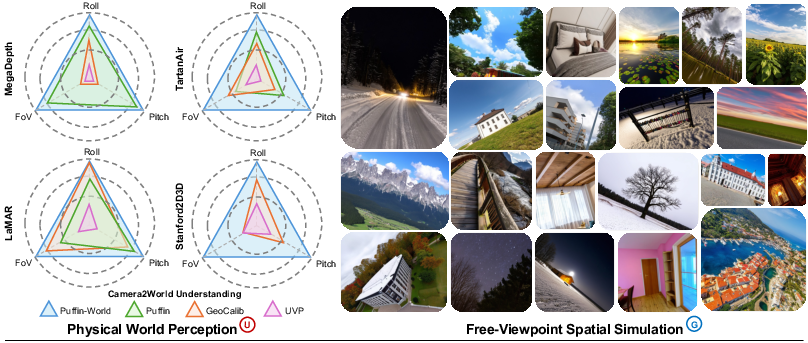
Abstract: We propose Puffin-World, a unified multimodal architecture that integrates physical understanding, spatial simulation, and 3D world generation and reconstruction without relying on external offline modules. To reliably construct and interact with 3D worlds, our framework jointly models three native world states: physics (gravity field and latitude), geometry (depth), and appearance (image), together with a unified Omni-Camera representation that supports diverse tasks and flexible motions. Beyond modeling these states, we introduce a strategy for propagating physical dynamics across future frames. By grounding absolute camera properties in the real world, Puffin-World enables physically consistent and visually stable world generation. We further couple appearance and geometry within a single generative process, jointly synthesizing each future view and reconstructing its underlying geometry. This unified paradigm enables interleaved closed-loop applications requiring synergy across multiple tasks, including mimic and self-calibrated world exploration. To scale Puffin-World to complex scenarios, we construct Puffin-16M, comprising 15 million vision-language-camera triplets and 1 million trajectories featuring various and challenging motions. To foster further research in this area, we released the code, models, and datasets.
Paper Prompts
Sign up for free to create and run prompts on this paper.
Top Community Prompts
Explain it Like I'm 14
1. What is the paper about?
The paper introduces Puffin-World, an artificial intelligence system designed to understand and create 3D versions of the world.
Many AI systems can look at pictures or generate new images, but they often do not truly understand:
- where the camera is,
- how objects are arranged in 3D,
- which way is up,
- how gravity affects the scene, or
- what the world should look like from a new viewpoint.
Puffin-World tries to solve these problems with one system. It combines three kinds of information:
- Physics — facts such as gravity, the horizon, and the camera’s orientation.
- Geometry — the shape and depth of the scene, such as how far objects are.
- Appearance — what the scene looks like in an image.
The authors describe this as creating a model with “native 3D world states.” In simple terms, the AI does not treat the world as just a collection of flat pictures. It tries to build a more complete internal understanding of the 3D world.
2. What questions does the research ask?
The researchers are mainly asking:
- Can one AI model understand both images and the physical camera settings behind them?
- Can it create pictures from viewpoints chosen by a user?
- Can it generate several views of the same place while keeping the scene consistent?
- Can it predict the hidden 3D shape of a scene, including its depth?
- Can it keep the correct sense of gravity and direction during complicated camera movements?
- Can one model perform all these tasks instead of using several separate programs?
For example, imagine showing the AI a picture of a room and asking it to show the room:
- from behind the sofa,
- from above,
- after turning around,
- or while moving through the room.
The goal is for all these new images to belong to the same room and obey the same physical rules.
3. How did the researchers build and test it?
A unified camera description
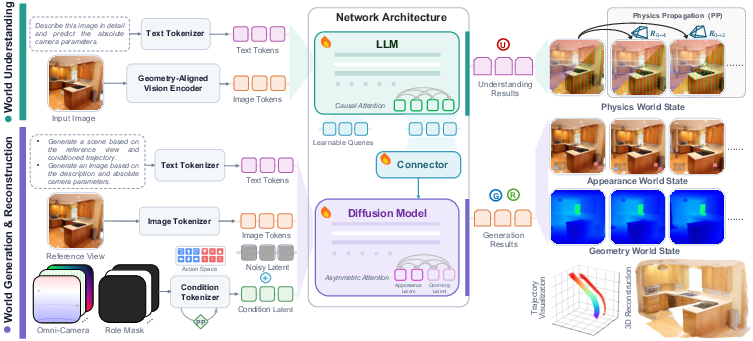
A major part of the system is called the Omni-Camera representation. This is a detailed description of what the camera is doing.
It combines two types of information:
- Absolute information: the camera’s position relative to the real world, such as which way is up and how the view relates to gravity.
- Relative information: how the camera moves from one view to another, such as turning left or moving forward.
A simple analogy is using both a compass and a map:
- The compass tells you your direction in the real world.
- The map tells you how you moved compared with where you started.
Older systems often use only the “map.” This can cause problems because they may know that the camera turned, but not whether it is facing upward, downward, or upside down relative to the real world.
Three types of information
Puffin-World processes three related forms of data:
- Images: the colors and visible details of the scene.
- Depth maps: information about how far each part of the scene is from the camera.
- Physics information: clues about gravity, the horizon, and camera orientation.
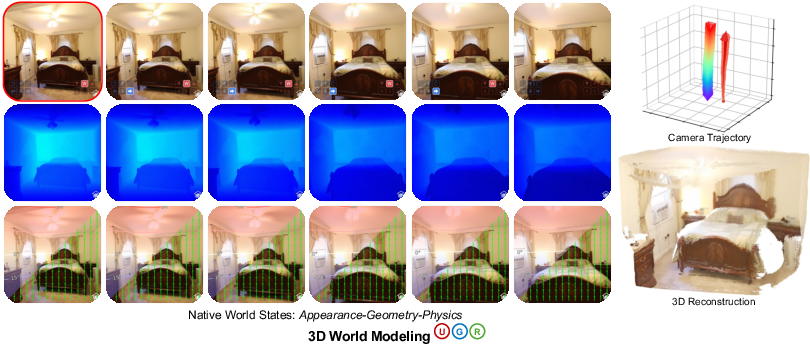
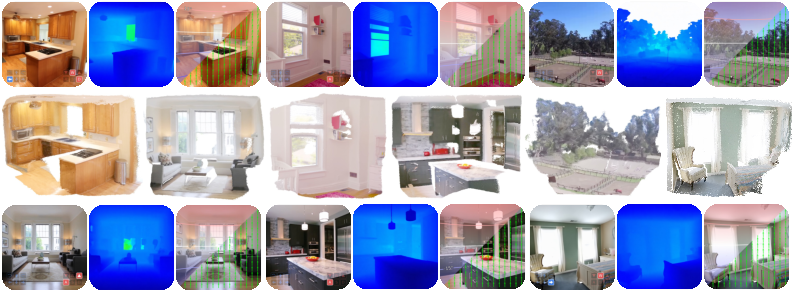
The researchers make the model generate images and depth maps together. This is useful because appearance and shape should agree. For example, a nearby wall should look larger and have a smaller depth distance than a faraway wall.
Understanding camera physics
When given one image, the model predicts information such as:
- the camera’s tilt,
- whether it is rolled sideways,
- its vertical field of view, meaning how much of the scene the camera can see,
- and a description of the scene.
The model produces this information step by step, somewhat like writing an explanation before giving a final answer. This allows it to use clues such as vertical buildings, the horizon, and objects that should normally stand upright.
Generating new views
The model can receive:
- a written description,
- one or more reference images,
- and instructions about where the camera should be.
It then creates new images from the requested viewpoints.
The system uses a diffusion model, a type of image generator that begins with visual noise and gradually changes it into a meaningful picture. The camera information is added during this process so the final image matches the requested viewpoint.
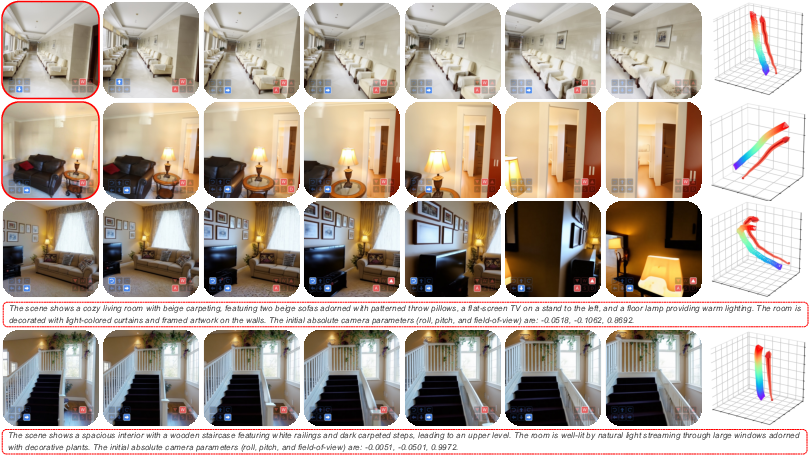
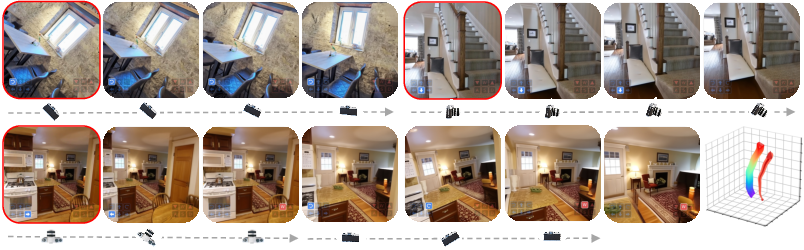
Generating longer journeys
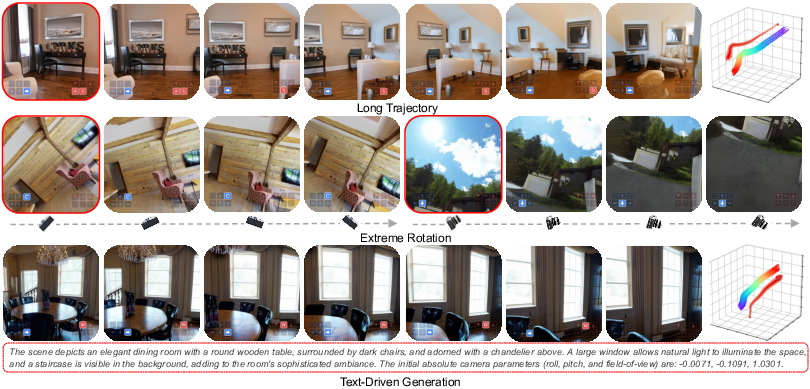
For longer camera movements, Puffin-World works in short sections, or “chunks.” It generates one group of views, then uses the last view as the starting point for the next group.
This is similar to exploring a video game world one section at a time. The researchers also keep the physical gravity information consistent across all sections so that the world does not slowly tilt or change direction.
Training data
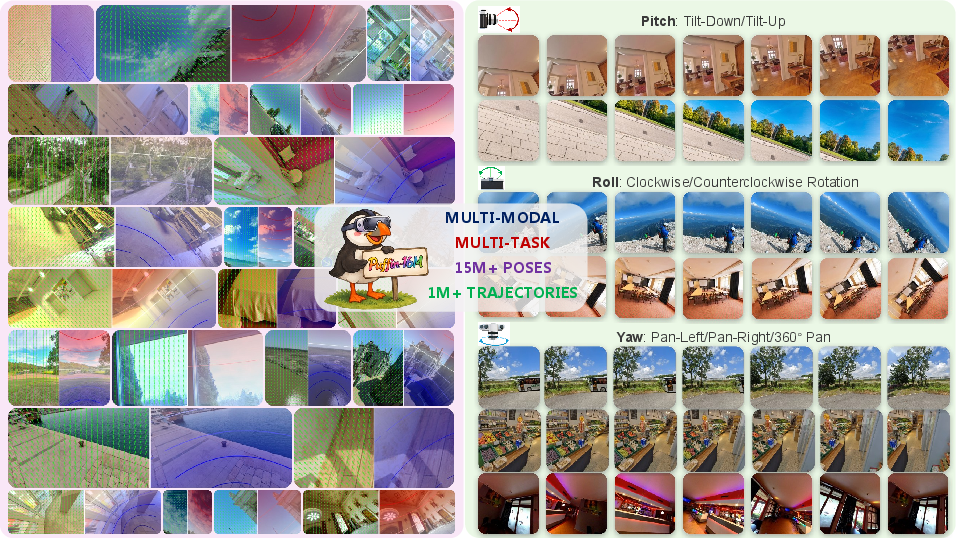
The researchers created a large dataset called Puffin-16M. It contains:
- about 15 million image, text, and camera-information examples,
- about 1 million camera-motion sequences.
The sequences include difficult movements such as:
- looking up and down,
- rotating clockwise and counterclockwise,
- moving around an object,
- and completing a full turn.
The researchers trained the system in four main stages. First, it learned to connect images, language, and camera information. Next, it learned to understand and generate single images. After that, it learned to generate multiple views of a 3D scene. Finally, it learned to generate both images and depth information together.
4. What did the researchers find?
According to the paper, Puffin-World achieved several important results.
Better camera understanding
The model performed very well at estimating a camera’s physical orientation from an image. The paper reports the best results on four public camera-understanding benchmarks, including strong performance in the area-under-the-curve measure at a accuracy level.
In everyday language, this means the model was often able to tell which way the camera was pointing with a small error.
More controllable image generation
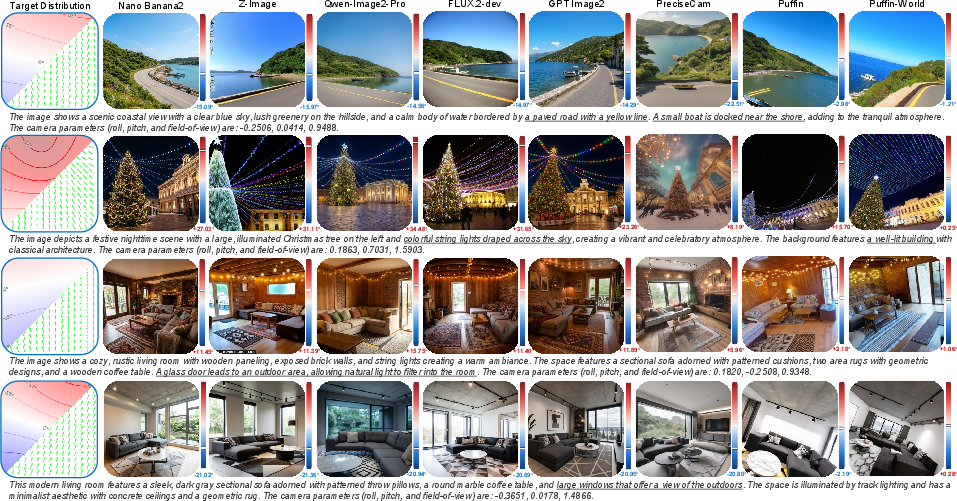
Puffin-World could create images from requested viewpoints while following camera instructions. For example, it could generate a scene while changing the camera’s position, direction, or angle.
The authors report that its generated views followed the requested spatial arrangements more faithfully than several general-purpose image generators.
More stable 3D world generation
The model could generate multiple views of the same scene and keep them more consistent with one another. It also generated depth information at the same time.
This matters because a system might otherwise create a different-looking object every time the camera moves. Puffin-World aims to keep the same objects, shapes, and physical orientation across views.
Better performance during difficult movements
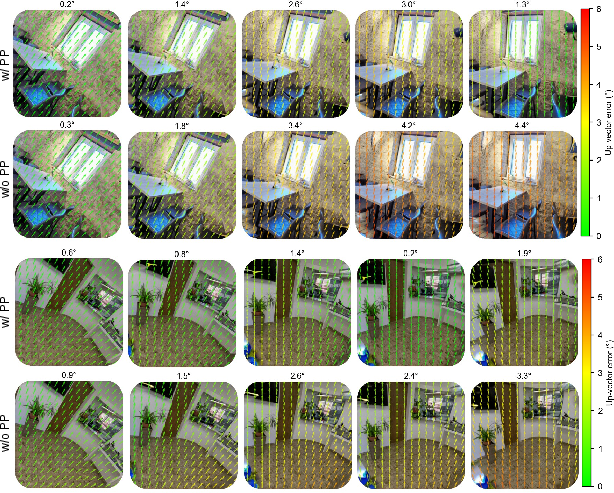
The physics-propagation method helped the model keep track of gravity while the camera moved. This is especially useful for movements that include large rotations or long journeys.
Without this type of physical reference, a generated world might gradually drift—for example, walls could lean more and more, or the horizon could become incorrectly tilted.
Multiple abilities in one model
The paper also demonstrates applications such as:
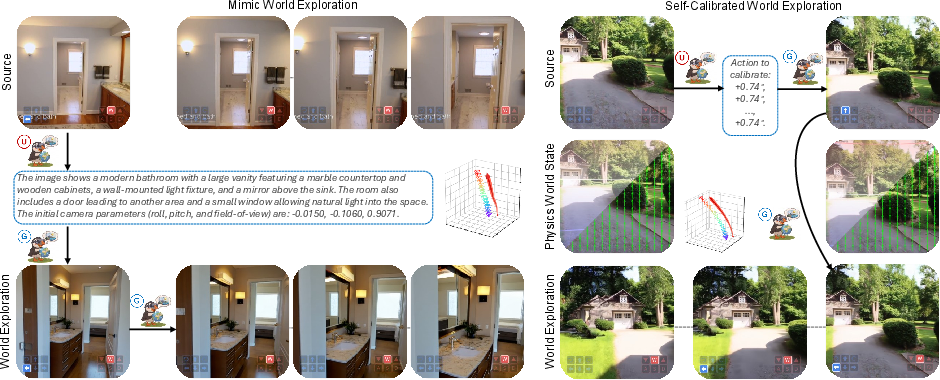
- Mimic exploration: generating a world while copying the camera movement from another sequence.
- Self-calibrated exploration: using the model’s own predictions to detect and correct camera-orientation mistakes.
- 3D scene generation and reconstruction: creating new views while estimating the scene’s depth.
The paper presents these as examples of “multi-task synergy,” meaning that one ability helps another. For instance, understanding the camera can help the model generate more realistic new views.
5. Why is this research important?
Puffin-World could be useful in several areas:
- Robotics: a robot could better understand its surroundings and plan movements.
- Virtual and augmented reality: users could explore realistic 3D environments from different viewpoints.
- Video games and simulations: developers could create interactive worlds more easily.
- Self-driving systems: vehicles could use camera and scene information to understand their surroundings.
- Film and photography: new camera angles could be created from limited visual material.
- Physical AI: machines could learn not only what things look like, but also how they are arranged and how movement affects what is seen.
The most important idea is that understanding an image, understanding its 3D structure, and generating new views should not be treated as completely separate jobs. Puffin-World combines them in one system and gives the model a stable physical reference using gravity and camera information.
However, the paper excerpt does not provide every experiment or numerical result, and the system may still face challenges. Real environments can be messy, objects can move, and a single image may not contain enough information to determine the exact 3D world. Even so, the work is a step toward AI systems that can understand and interact with the world in a more human-like, spatial way.
Knowledge Gaps
Knowledge gaps, limitations, and open questions
The paper leaves the following issues unresolved:
- Quantitative evidence for true physical consistency is limited. The reported results do not establish whether generated views obey physical constraints beyond visual plausibility, such as metric scale, gravity, object permanence, collision behavior, illumination consistency, or valid occlusion ordering.
- The benefit of jointly modeling physics, geometry, and appearance is not fully isolated. Comprehensive ablations are needed to separate the contributions of the Omni-Camera representation, physics propagation, joint depth generation, role masks, asymmetric attention, and the four-stage training schedule.
- The reliability of physics propagation depends on imperfect initial perception. The method propagates the estimated gravity vector from the reference frame, but the paper does not quantify how roll, pitch, field-of-view, or gravity-estimation errors accumulate or affect long-horizon generation.
- The assumed gravity field is too restrictive for some environments. A single gravity direction may be inadequate for curved, non-Euclidean, simulated, underwater, aerial, or dynamically moving-platform settings, and the paper does not investigate how the model handles such cases.
- Absolute camera position is not fully grounded. The framework estimates gravity-relative orientation and some camera properties, but it is unclear whether it can recover globally meaningful translation, metric scale, or camera height without external scene measurements.
- Yaw and translation ambiguities remain underexplored. The absolute representation focuses primarily on gravity, roll, pitch, and latitude; the paper does not clarify how global yaw, translation, and scale are resolved when a scene lacks recognizable landmarks or a canonical coordinate frame.
- The camera model is limited. The formulation appears centered on a pinhole camera and selected distortion parameters, leaving fisheye, panoramic, rolling-shutter, motion-blurred, event-based, stereo, and non-central cameras insufficiently evaluated.
- The treatment of dynamic scenes is unclear. The proposed geometry and trajectory modeling appear to assume a largely static world, but no analysis is provided for moving objects, articulated agents, changing lighting, weather, reflections, or scene deformation.
- Long-horizon stability is not demonstrated rigorously. Chunked autoregressive generation is proposed for arbitrary-length exploration, yet the paper does not report systematic error growth, identity retention, geometric drift, texture repetition, or failure rates as the horizon increases.
- The sliding-window strategy may discard persistent scene memory. Carrying only the last generated view as a reference could cause previously observed regions, objects, and global layout to be forgotten; the paper does not compare this approach with explicit 3D memory or global scene representations.
- Cross-view consistency is evaluated insufficiently. Joint attention is expected to produce consistency without an explicit inter-view loss, but the paper does not provide detailed measurements of multi-view correspondence, loop closure, depth agreement, reprojection error, or 3D reconstruction accuracy.
- Generated depth may not be metrically meaningful. Encoding depth through a bounded Hilbert-curve-inspired RGB mapping may preserve values but does not guarantee accurate metric scale, uncertainty calibration, smoothness, or consistency across views.
- The effect of the depth encoding is not established. Comparisons against direct depth regression, disparity prediction, alternative normalization schemes, and dedicated depth encoders are needed to verify that the proposed representation improves reconstruction rather than merely fitting the pretrained VAE.
- Geometry and appearance may remain asymmetrically coupled. Although geometry tokens attend to appearance while appearance tokens cannot attend to geometry, the paper does not test whether this design limits geometry-to-appearance correction or causes inconsistent predictions between the two modalities.
- Uncertainty estimation is absent. The model produces camera, geometry, and generated-view predictions without reporting confidence, ambiguity, or calibrated uncertainty, despite monocular camera estimation and unseen-view synthesis being intrinsically underdetermined.
- The dataset may contain substantial synthetic and annotation bias. Many examples are rendered from panoramas using virtual cameras, so the training distribution may not reflect real camera optics, capture noise, occlusion patterns, or motion artifacts.
- Panorama-derived views are not fully independent samples. Generating many perspective crops from the same panorama can inflate the nominal dataset size and produce strong train–test correlations unless panorama-level separation is strictly enforced and reported.
- Caption and reasoning annotations may propagate model errors. Captions and chain-of-thought descriptions are generated by external vision-LLMs, but their accuracy, consistency, licensing, and influence on downstream behavior are not systematically validated.
- The dataset’s geographic and semantic coverage is not quantified sufficiently. Although multiple countries and scene types are mentioned, the paper does not provide detailed distributions of environments, cultures, weather, accessibility conditions, object categories, or camera hardware.
- The trajectory dataset may not represent real agent motion. Its challenging motions are constructed or sampled from camera trajectories, but the relationship to physically feasible robot, vehicle, drone, or handheld-camera dynamics is not established.
- Training and evaluation leakage remains a concern. The paper excludes one benchmark source, but it does not fully document source-level deduplication, panorama overlap, contamination from public datasets, or overlap with images used to train the annotation models.
- Performance on truly unseen camera motions is unknown. The training distribution samples specified ranges of roll, pitch, field of view, and trajectory patterns; extrapolation to more extreme, irregular, discontinuous, or adversarial motions is not evaluated.
- The role of camera height labels is unresolved. Five-level camera-height annotations are introduced, but the paper does not show whether they improve perception, generation, or embodied exploration, nor whether categorical labels are adequate for metric height reasoning.
- Generalization beyond panoramic scenes is uncertain. The model’s effectiveness on ordinary monocular photographs, narrow-field cameras, severely cropped images, low-light scenes, and images without visible vertical or horizon cues remains unclear.
- Comparison with specialized systems is incomplete. Unified-task comparisons may not reveal whether Puffin-World matches the best specialized methods for camera calibration, novel-view synthesis, depth estimation, or reconstruction under equal computational and data conditions.
- Computational cost and scalability are insufficiently characterized. The paper does not report training energy, inference latency, memory usage, sampling steps, throughput for long trajectories, or the cost of jointly generating RGB and geometry.
- The claimed absence of external modules is not fully operationally defined. The system relies on pretrained encoders, LLMs, VAEs, diffusion components, and generated annotations; the paper does not clarify which components are considered internal and how performance changes without each pretrained dependency.
- Closed-loop applications are demonstrated mainly qualitatively. Mimic and self-calibrated exploration require task-level metrics such as navigation success, camera-alignment accuracy, loop-closure rate, scene completion, and control safety, which are not sufficiently reported.
- The model is not shown to support real physical interaction. It generates and reconstructs views but does not demonstrate action execution, feedback from sensors, manipulation, collision avoidance, or robust operation on a physical robot.
- Failure modes are not systematically analyzed. The paper does not categorize errors caused by textureless regions, repeated structures, transparent surfaces, mirrors, extreme FoV, severe occlusion, unusual gravity cues, ambiguous horizons, or hallucinated geometry.
- The theoretical relationship between the proposed world states is underspecified. Physics, geometry, and appearance are introduced as a hierarchy, but the paper does not formalize their conditional dependencies, identifiability, or whether additional states—such as semantics, dynamics, lighting, or material properties—are necessary for a complete world model.
- The representation’s invariance properties are unclear. It remains unresolved how Omni-Camera behaves under coordinate-frame changes, scene rotations, image flips, different gravity conventions, variable resolution, and transformations that preserve appearance but alter physical interpretation.
- No explicit mechanism guarantees object-level identity preservation. The model may generate locally consistent views while changing object shape, texture, or identity across frames; object-centric consistency and temporal identity tracking are not evaluated.
- The limits of single-reference reconstruction are unclear. The paper supports one or more reference views, but it does not determine how performance scales with the number, spacing, quality, and redundancy of reference images.
- The impact of prompt semantics on geometry is unresolved. Text conditioning may alter scene structure or introduce semantic hallucinations, yet the paper does not measure whether generated geometry remains faithful to visual evidence when text and images conflict.
- Reproducibility is difficult to assess from the presented description. Important details such as exact data-generation procedures, trajectory sampling distributions, filtering thresholds, evaluation protocols, model sizes, sampling configurations, and benchmark splits are not fully specified in the provided text.
Practical Applications
Immediate Applications
The released code, models, and datasets make several research and prototyping applications feasible now, although production deployment would require validation for accuracy, latency, safety, and domain shift.
- Camera calibration and physical-scene understanding — computer vision, robotics, mapping
- Use Puffin-World to estimate a single image’s gravity-relative roll and pitch, vertical field of view, camera orientation, and scene description.
- Practical workflows include automatic correction of image rotation, horizon detection, monocular camera initialization, and metadata recovery for legacy image or video collections.
- Potential products include a camera-calibration API, an image-quality diagnostic tool, or a preprocessing module for photogrammetry and 3D reconstruction.
- Dependencies: Performance depends on visible horizon or vertical structures, scene diversity, camera-model compatibility, and tolerance to unusual lenses, severe distortion, occlusion, or non-Earth-like environments.
- Automated orientation correction for images and videos — media, surveying, mobile applications
- Apply the predicted gravity field and camera orientation to automatically level photographs, normalize panoramic crops, and correct inconsistent viewpoints in video datasets.
- This could improve downstream panorama stitching, visual search, video stabilization, and dataset preparation.
- Dependencies: The method assumes that gravity and “uprightness” are meaningful visual concepts; it may be unreliable for intentionally tilted scenes, underwater imagery, aerial footage, or scenes without stable geometric cues.
- Camera-controlled image generation — design, simulation, e-commerce, entertainment
- Generate images from text while specifying target camera orientation, field of view, and viewpoint through the Omni-Camera representation.
- Possible tools include virtual product photography, architectural concept visualization, controllable storyboarding, synthetic training-data generation, and viewpoint-specific advertising assets.
- Compared with unconstrained image generation, the workflow can request a scene from a specified elevation, rotation, or viewing direction.
- Dependencies: Generated images still require inspection for object identity, fine geometric accuracy, texture fidelity, and compliance with the requested camera parameters. Commercial use also depends on licensing and content-safety controls.
- Novel-view synthesis from reference images — real estate, tourism, digital content
- Given one or more reference views, generate images from specified target cameras for virtual walkthroughs, property marketing, museum visualization, and interactive scene previews.
- The joint handling of appearance and geometry can provide more consistent viewpoints than independently generating unrelated images.
- Dependencies: Quality depends on sufficient visual evidence in the reference views. Hidden surfaces, reflective materials, transparent objects, and highly detailed environments may be hallucinated rather than reconstructed faithfully.
- Depth-assisted 3D reconstruction — robotics, surveying, AR/VR, graphics
- Use the model’s jointly generated RGB and depth outputs to obtain approximate 3D structure from one or several images.
- A practical workflow is: estimate camera state → generate or reconstruct target views and depth → fuse depth maps into a point cloud or mesh using conventional 3D software.
- This can support rapid scene prototyping, asset creation, virtual set construction, and initialization for downstream SLAM or reconstruction systems.
- Dependencies: The paper’s depth representation is learned and generative, so metric accuracy, scale consistency, and multi-view alignment must be independently evaluated before use in measurement-critical applications.
- Synthetic data generation for spatial-AI training — academia, robotics, autonomous systems
- Generate labeled images, camera configurations, trajectories, and depth maps covering unusual rotations, large translations, and full-surround exploration.
- Researchers can use Puffin-16M and Puffin-Traj-1M to train or benchmark camera understanding, view synthesis, depth estimation, and multimodal spatial reasoning systems.
- This is especially useful where real data collection is expensive or lacks challenging camera motions.
- Dependencies: Synthetic images may contain distributional artifacts or unrealistic object geometry. Models trained primarily on generated data should be tested on independent real-world datasets.
- Dataset annotation and curation — research infrastructure
- Apply the model’s camera-physics predictions and released annotations to enrich image datasets with roll, pitch, field of view, camera height, gravity-relative orientation, and spatial descriptions.
- These annotations can support stratified benchmarking, hard-example mining, camera-aware retrieval, and evaluation of multimodal models.
- Dependencies: Automatically inferred labels should be sampled and manually audited, particularly when used as ground truth for scientific comparisons.
- Camera-aware search and content organization — media archives and enterprise software
- Index images and videos by estimated viewpoint, elevation, orientation, field of view, and scene geometry.
- Users could search for “aerial-looking views,” “eye-level indoor scenes,” or images with a specified orientation range.
- Dependencies: Search quality depends on calibration accuracy and consistent ontology design for scene descriptions and camera metadata.
- Interactive visualization and education — museums, training, and classrooms
- Build demonstrations in which students specify a camera motion or physical viewpoint and observe generated views of an object or environment.
- The model can illustrate perspective, gravity, field of view, depth, and the relationship between camera motion and observed appearance.
- Dependencies: Generated visualizations should be labeled as simulations, not authoritative physical reconstructions, unless their accuracy has been verified.
- Research baselines for unified multimodal modeling — academia
- Use the open implementation as a baseline for studying the integration of language, camera physics, image generation, depth, and multi-view reasoning in one architecture.
- Researchers can compare alternative camera representations, geometry encodings, propagation methods, training schedules, or fusion strategies.
- Dependencies: Reproducibility depends on access to the released checkpoints, computational resources, compatible data preprocessing, and clarification of any missing implementation details.
Long-Term Applications
The following applications are suggested by the paper’s closed-loop and physical-AI capabilities but require additional research, system integration, and safety validation before dependable deployment.
- Closed-loop robotic exploration — robotics and embodied AI
- A robot could use Puffin-World to estimate its camera’s physical orientation, imagine target views under candidate motions, and select actions for exploration.
- A prospective workflow is: capture an observation → estimate gravity and camera state → simulate several camera trajectories → compare predicted views or geometry → execute a selected motion → update the world model.
- Applications include warehouse inspection, indoor mapping, infrastructure assessment, and exploration of previously unseen environments.
- Dependencies: The current model must be validated under real sensor noise, dynamic objects, lighting changes, latency constraints, and robot-specific camera calibration. A generated view is not necessarily a reliable prediction of the physical world and should not directly control safety-critical motion without independent perception.
- Self-calibrating navigation and visual odometry — autonomous vehicles, drones, mobile robots
- Physics propagation could provide a gravity-aligned reference across long camera trajectories, helping reduce orientation drift during navigation or mapping.
- Potential systems could combine Puffin-World with IMUs, wheel odometry, LiDAR, GPS, or SLAM rather than relying on the model alone.
- Dependencies: Long-horizon consistency, metric scale, absolute yaw ambiguity, dynamic environments, and accumulated prediction errors require rigorous testing. External sensors and classical state estimation would likely remain necessary.
- Simulation environments for robot policy training — robotics and reinforcement learning
- The model could generate controllable visual rollouts conditioned on robot-camera trajectories, providing a lightweight environment for pretraining navigation, manipulation, or viewpoint-selection policies.
- Joint RGB-depth outputs could supply observations for vision-based policies and enable domain-randomized training.
- Dependencies: The simulator must preserve action-conditioned causality, object permanence, collision constraints, and temporal consistency. Appearance-only plausibility is insufficient for learning reliable physical behavior.
- AR/VR and 3D telepresence — spatial computing
- Generate consistent novel viewpoints and reconstruct approximate scene geometry for remote walkthroughs, immersive previews, and mixed-reality content.
- Mimic exploration could allow a remote user to follow a shared camera trajectory through a reconstructed or generated environment.
- Dependencies: Applications require low latency, six-degree-of-freedom tracking, stable occlusion handling, accurate scale, temporal persistence, and protection against perceptual artifacts that could cause discomfort or disorientation.
- Digital twins for buildings and infrastructure — construction, facilities, urban planning
- From sparse imagery, the system could help create preliminary geometry-and-appearance models for buildings, roads, facilities, or inspection sites.
- Engineers could request views from planned inspection positions and use generated depth as an initial model for planning.
- Dependencies: Safety, legal, and engineering decisions require metrically verified surveying data. The system should be treated as a hypothesis generator or modeling assistant until its geometric errors are quantified.
- Autonomous inspection and maintenance — energy, transportation, and industrial operations
- Robots or drones could plan viewpoint trajectories around bridges, wind turbines, pipelines, solar installations, or industrial machinery and use generated views to identify potentially unobserved surfaces.
- Physics-grounded camera control may help maintain consistent orientation during complex inspection maneuvers.
- Dependencies: The model must handle outdoor illumination, repetitive textures, reflections, weather, scale variation, and moving equipment. Human review and certified sensing would remain necessary for defect diagnosis.
- Medical and surgical visualization — healthcare
- In the long term, camera-aware novel-view synthesis and geometry reconstruction could assist with endoscopic visualization, surgical training, or interactive anatomical scene review.
- A system might synthesize viewpoints not directly visible to a camera and provide approximate spatial context.
- Dependencies: This is a high-risk application. It requires clinically validated geometry, strict uncertainty reporting, patient-specific calibration, privacy safeguards, and regulatory approval. Generative completion must never be mistaken for directly observed anatomy.
- Spatially consistent game and film production — entertainment and virtual production
- Artists could generate scene concepts, camera-controlled storyboards, multi-view assets, and approximate depth from text or reference imagery.
- Long-horizon camera generation could support previs for continuous shots, virtual cinematography, and interactive set exploration.
- Dependencies: Professional production requires deterministic editing, identity preservation, asset interoperability, temporal coherence, and control over lighting, materials, and animation beyond what is demonstrated in the paper.
- Policy and urban-analysis tools — public planning and emergency response
- Agencies could use camera-aware reconstruction to create rapid visual simulations of streets, public spaces, evacuation routes, or infrastructure changes.
- Candidate viewpoints could help communicate proposed developments or inspect areas where imagery is incomplete.
- Dependencies: Policy use requires unbiased data, provenance tracking, uncertainty estimates, privacy protection, and safeguards against treating hallucinated views as evidence. Geographic coverage and local visual conventions may also affect accuracy.
- Geospatial mapping and disaster assessment — public safety and climate resilience
- After floods, fires, earthquakes, or storms, the model could help synthesize consistent viewpoints from sparse imagery and prioritize future observations for unmanned platforms.
- Dependencies: Disaster scenes differ substantially from ordinary training data, with smoke, debris, damaged structures, and rapidly changing geometry. Any operational deployment requires independent measurements and robust out-of-distribution testing.
- Physical-world foundation models and tool-using agents — general AI research
- Puffin-World’s separation of physics, geometry, and appearance could motivate agents that maintain explicit world states while alternating between perception, language reasoning, action planning, and visual prediction.
- Future products may include a general spatial reasoning API exposing camera calibration, view planning, depth, reconstruction, and simulation as coordinated tools.
- Dependencies: Further work is needed on uncertainty, object-level persistence, dynamic physics, action consequences, real-world intervention, causal reasoning, and evaluation beyond image similarity or camera accuracy.
Glossary
- Absolute camera representation: A camera description anchored to physical-world references such as gravity, the horizon, or uprightness. “the absolute camera representation consisting of the pixel-wise up-vector and latitude angle ”
- Autoregressive modeling: A sequential prediction method in which each output is generated based on previously generated outputs. “The LLM then generates a structured scene and spatial analysis, followed by the numerical camera parameters”
- Camera calibration: The estimation of a camera’s intrinsic and extrinsic parameters from visual data. “Recovering physical camera parameters from images, including camera calibration and pose estimation”
- Camera intrinsics: Internal camera parameters, such as focal length and field of view, that determine image formation. “its intrinsic vertical field-of-view (FoV)”
- Camera pose: The camera’s position and orientation relative to a reference coordinate system. “dense camera-pose or Pl\"ucker-ray embeddings guide camera-controlled video generation”
- Camera-to-world understanding: Inferring a camera’s physical orientation and position in the real world from images. “For physical world perception, it attains state-of-the-art camera-to-world understanding”
- Chain-of-thought reasoning: A structured sequence of intermediate reasoning steps used to derive an answer. “structured chain-of-thought reasoning over spatial relationships, camera parameters, and underlying physical principles”
- Closed-loop interaction: An iterative process in which a system observes outcomes and uses them to determine subsequent actions. “complex, closed-loop applications that jointly involve perception, reasoning, and generation”
- Condition fusion module: A neural component that combines conditioning information, such as camera maps and role masks, with generative-model inputs. “A lightweight condition fusion module maps and the role mask into the input latent space of MMDiT.”
- Continuous latent: A real-valued vector representation used internally by a neural model to encode data. “Puffin encodes a 3-channel Perspective Field into a continuous latent via a VAE”
- Cross-modal alignment: Training models so that representations from different modalities, such as images, text, and camera data, correspond meaningfully. “The first two stages perform cross-modal alignment and supervised fine-tuning (SFT)”
- Cross-view consistency: Agreement between generated or reconstructed content across different viewpoints. “enabling cross-view consistency to emerge without requiring an explicit inter-view consistency loss”
- Diffusion transformer: A transformer-based generative model trained to progressively denoise corrupted data. “the multimodal diffusion transformer (MMDiT)”
- Discrete visual tokens: Quantized units representing visual information for autoregressive modeling. “autoregressive modeling over discrete or continuous visual tokens”
- End-to-end: Describing a system trained jointly as one integrated model rather than through separate processing stages. “jointly model the 3D world in an end-to-end manner”
- Extrinsic parameters: Camera parameters specifying its position and orientation relative to a world coordinate system. “the world-to-camera extrinsic parameters ”
- Flow matching: A generative-training objective that learns a vector field transporting noise distributions toward data distributions. “The MMDiT then denoises a target latent under a flow-matching objective”
- Free-viewpoint synthesis: Generating visual content from a user-specified or otherwise arbitrary viewpoint. “For free-viewpoint spatial simulation, it generates camera-controllable images”
- Gravity field: A spatial representation of the direction of gravitational acceleration. “the physics (gravity field and latitude)”
- Homogeneous coordinates: An augmented coordinate representation used to express projective transformations, including camera projection. “Let be the homogeneous coordinate of pixel .”
- Intrinsic vertical field-of-view: The angular extent of the visible scene in the vertical image direction. “its intrinsic vertical field-of-view (FoV)”
- Joint attention: An attention mechanism that processes multiple related inputs within a shared sequence. “the model processes a set of views within a unified joint-attention sequence”
- Latent space: A learned internal representation in which data are encoded for generation or transformation. “Appearance and geometry share a common latent space”
- Multimodal diffusion model: A diffusion-based generative model that conditions on or produces multiple data modalities. “the multimodal diffusion transformer (MMDiT)”
- Omni-Camera representation: A unified camera encoding that combines absolute physical orientation with relative ray geometry. “we propose the Omni-Camera representation, a simple but effective unified camera representation for versatile applications”
- Perspective Field: A dense representation of pixel-wise physical camera orientation relative to gravity. “For the absolute component, we follow the Perspective Field to represent the physical orientation of each pixel.”
- Physics propagation: The transfer of an inferred absolute physical state across future views using relative motion. “We recover the latter for future frames through physics propagation.”
- Pixel-aligned: Aligned with corresponding image pixels so that each spatial location has matching features or conditions. “this pixel-aligned additive injection supports versatile tasks”
- Plücker embedding: A six-dimensional representation of a 3D line, commonly encoding a ray’s origin and direction for geometric reasoning. “Existing relative camera representations, such as Pl\"ucker embeddings”
- Positional embedding: A learned or fixed representation that provides a model with information about an element’s position in a sequence or spatial arrangement. “apply a one-dimensional rotary positional embedding along this axis”
- Ray map: A per-pixel representation containing the camera origin and the direction of the viewing ray. “the relative camera representation given by the ray map composed of the ray origin and direction”
- Role mask: A spatial indicator specifying the function assigned to each view or token in a multimodal generation process. “A compact four-channel role mask is paired with ”
- Scene geometry: The three-dimensional spatial structure of objects and surfaces in a scene. “the geometry that describes underlying 3D spatial structure”
- Self-calibration: Estimating or correcting camera parameters using the system’s own observations rather than external calibration. “self-calibrated world exploration automatically detects and corrects gravity misalignment”
- Structure-from-motion: A computer-vision technique that estimates camera motion and 3D structure from multiple images. “Although readily obtained from structure-from-motion and effective for cross-view geometry”
- Supervised fine-tuning: Further training of a pretrained model on labeled examples for a particular task or behavior. “supervised fine-tuning (SFT) for single-view understanding and generation”
- Tokenization: The process of converting input data into discrete or structured units that a model can process. “Condition Tokenizer”
- Trajectory anchoring: Maintaining a consistent absolute physical reference while modeling a sequence of camera movements. “Trajectory Anchoring via Physics Propagation.”
- Variational autoencoder (VAE): A neural network that encodes data into a probabilistic latent representation and decodes it back into the original data domain. “RGB images and depth maps encoded by the same VAE”
- View-axis index: An identifier specifying the position of a view within a sequence of views. “we assign each token a view-axis index”
- Vision-language-camera triplet: A dataset item jointly associating visual content, linguistic information, and camera parameters. “15 million vision--language--camera triplets”
- World coordinate system: A global reference frame used to represent positions and orientations in a scene. “the camera center in the world coordinate system is ”
- World model: A model that represents and predicts the states or observations of an environment over time. “Generative world models aim to simulate the world by predicting future observations”

