LeVJEPA: Efficient & Scalable Video Pretraining without the Heuristics
Abstract: Video carries the temporal structure of the physical world, yet learning representations from it has remained computationally expensive: prevailing self-supervised methods either prevent representation collapse through architectural asymmetries, coupling an exponential-moving-average target encoder, a stop-gradient, and a capacity-limited predictor, or circumvent it by reconstructing masked content in pixel space. We introduce LeVJEPA, the first video encoder trained under LeJEPA's collapse-free objective, which dispenses with both. A single encoder is trained with an invariance loss over global and local views of a clip, regularized by SIGReg, which excludes collapse with a provable guarantee. The architecture reduces to an encoder and a projector, and the objective to a single hyperparameter. This formulation admits two properties. First, the cost of pretraining is governed by the number of tokens the encoder observes; uniform random token dropping renders this number small while simultaneously improving downstream accuracy. At matched epochs on identical data, LeVJEPA matches or surpasses V-JEPA 2 across ViT-S/B/L at 5.6 to 20.8x less pretraining compute, and at matched total FLOPs it exceeds the strongest video baseline by 7.6 points on ImageNet-1K while remaining competitive on motion-centric benchmarks. Second, since no asymmetry between branches is required, the encoder can be trained with block-causal attention at no measurable accuracy cost: temporal ordering becomes a property of the encoder itself. Against a compute-matched DINOv2 trained on frames of the same videos, LeVJEPA approaches the image-pretrained encoder on appearance-centric evaluation while nearly doubling its motion-centric accuracy. These results indicate that, once its computational overhead is removed, video becomes a viable and in several respects preferable substrate for general-purpose visual pretraining.
Paper Prompts
Sign up for free to create and run prompts on this paper.
Top Community Prompts
Explain it Like I'm 14
1. What is this paper about?
This paper introduces LeVJEPA, a new way to train artificial intelligence systems to understand videos.
Videos contain more information than single images because they show movement and change over time. However, training AI on videos is usually very expensive because each video has many frames and many visual details.
The main idea of LeVJEPA is to make video learning:
- Cheaper
- Simpler
- Better at understanding motion
- Useful for both videos and still images
- Suitable for systems that process video one frame at a time, such as robots or live cameras
The researchers claim that LeVJEPA can reach similar or better results than previous video-learning systems while using much less computing power.
2. What questions did the researchers ask?
The paper mainly investigates these questions:
- Can an AI learn useful information from videos without complicated extra networks? Earlier methods often used a second “teacher” network, a prediction network, and special training rules. The researchers ask whether these can be removed.
- Can video training be made much cheaper by showing the AI only a small number of video pieces? Instead of processing every small image patch in every frame, LeVJEPA randomly removes most of them during training.
- Does learning from video help the AI understand movement better than learning from images?
- Can the AI understand each frame using only the current frame and earlier frames? This is important for live applications, because a system should not need to look into the future.
- Can useful information about individual objects and image regions appear even when the AI is trained mainly to understand the whole video clip?
3. How does LeVJEPA work?
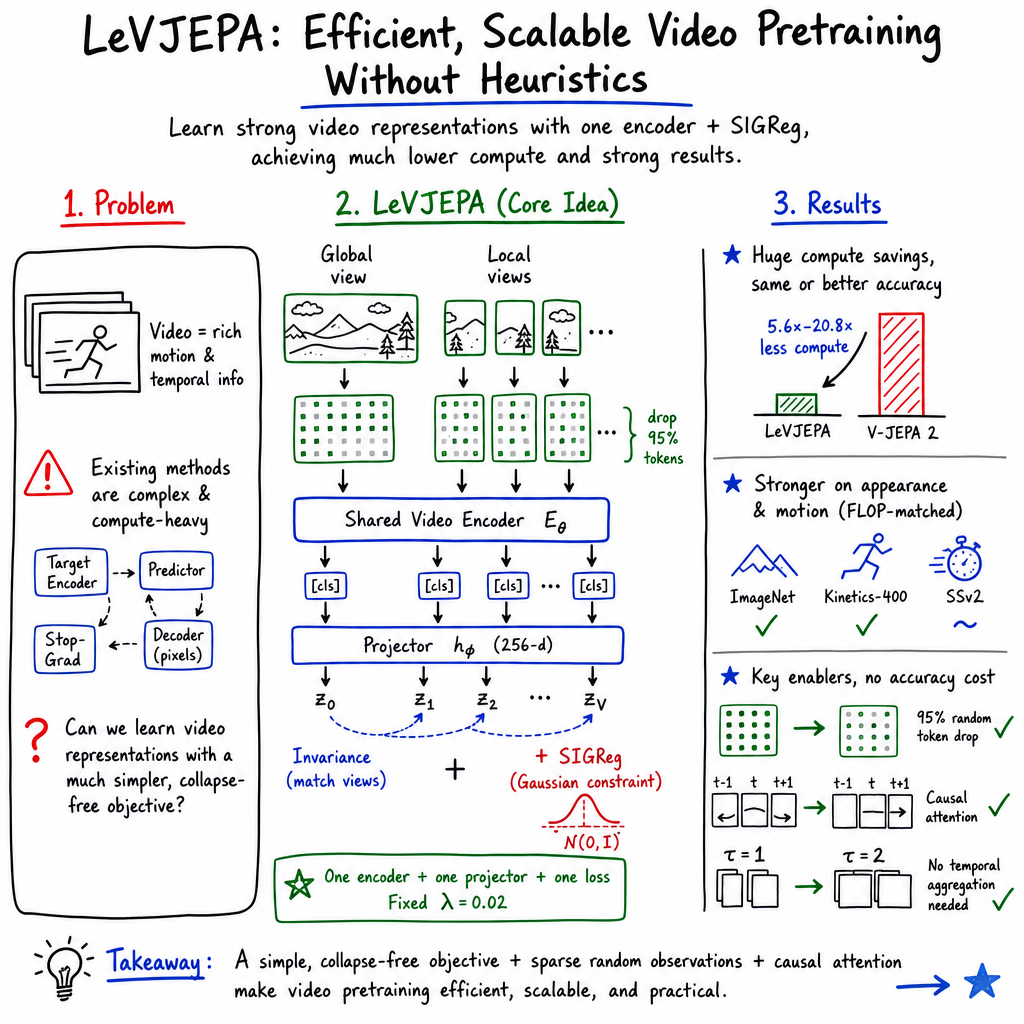
Learning from different views
The system receives a short clip containing 16 video frames. From this clip, the researchers create:
- One large view showing most of the scene
- Several smaller views showing cropped parts of the same scene
This is similar to showing a student both a complete picture and several zoomed-in sections.
The AI uses the same encoder—a network that turns video information into useful numerical descriptions—to process all these views. It is trained to make the descriptions of the different views similar because they came from the same clip.
For example, if one view shows a person riding a bicycle and another view shows only the bicycle, the AI should understand that both views belong to the same video event.
Preventing “collapse”
There is a problem called representation collapse. This happens if the AI gives exactly the same answer for every video. The training loss might appear small, but the AI would have learned nothing useful.
LeVJEPA prevents this using a method called SIGReg. In simple terms, SIGReg checks whether the AI’s answers are spread out in a healthy way rather than all being identical.
An analogy is a classroom quiz:
- If every student gives the exact same answer to every question, something is wrong.
- If answers vary in sensible ways, the students may be learning different information.
SIGReg checks the overall pattern of the AI’s answers and discourages them from becoming identical.
Unlike many earlier methods, LeVJEPA does not need:
- A separate teacher or target network
- A predictor network
- A stop-gradient rule
- A decoder that reconstructs missing pixels
This makes the training system smaller and easier to understand.
Randomly dropping video information
During training, LeVJEPA randomly removes about 95% of the small image patches, also called tokens, from each view. Only the remaining 5% are processed.
A token is simply a small piece of an image, like one tile in a mosaic.
At first, it might seem that throwing away so much information would make the AI worse. Surprisingly, it often makes the AI better. The system must learn to recognize the important content from a scattered sample rather than memorizing every detail.
This also makes training much faster because the computer processes far fewer pieces.
Using past frames only
LeVJEPA uses block-causal attention. This means:
- Patches in the same frame can examine one another.
- A frame can use information from earlier frames.
- A frame cannot use information from future frames.
This is similar to watching a movie one frame at a time. When looking at frame 10, the AI can use frames 1 through 9, but it cannot peek at frame 11.
This allows the system to build a representation of a video continuously. When a new frame arrives, it does not need to recalculate everything from the beginning.
How the researchers tested it
The researchers trained LeVJEPA on collections of unlabeled videos, including videos from the Kinetics datasets. “Unlabeled” means the videos did not need humans to provide detailed descriptions or answers.
They then froze the trained encoder so that its internal knowledge could not change. A small extra classifier was trained on top of it to test what the encoder had learned.
The system was tested on:
- ImageNet-1K, which tests recognizing objects in still images
- Kinetics-400, which tests recognizing actions in videos
- Something-Something-v2, which focuses strongly on understanding motion and interactions
The researchers also compared LeVJEPA with other video methods and with DINOv2, a strong image-pretraining method.
4. What did the researchers find?
LeVJEPA used much less computing power
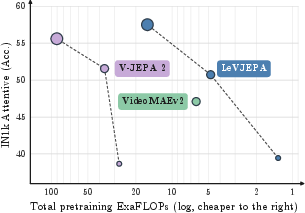
When trained for the same number of rounds on the same data, LeVJEPA performed about as well as, or better than, V-JEPA 2 while using 5.6 to 20.8 times less total computing power, depending on the model size.
For example, for one medium-sized model:
- LeVJEPA used about 4.8 exaFLOPs
- V-JEPA 2 used about 36.4 exaFLOPs
An exaFLOP is an extremely large number of computer calculations. The important point is that LeVJEPA needed far fewer calculations.
When the methods were given the same total computing budget, LeVJEPA scored:
| Test | VideoMAEv2 | V-JEPA 2 | LeVJEPA |
|---|---|---|---|
| ImageNet-1K | 53.4% | 51.6% | 61.0% |
| Something-Something-v2 | 43.6% | 42.5% | 40.4% |
| Kinetics-400 | 37.4% | 40.7% | 44.6% |
These results show that LeVJEPA was especially strong at recognizing objects and actions. It was slightly weaker than the best comparison method on the motion-focused Something-Something-v2 test.
Randomly dropping patches helped
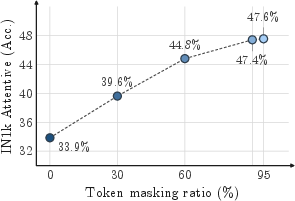
The researchers found that removing more patches often improved ImageNet performance:
- Processing every patch: 33.9%
- Removing 95% of patches: 47.6%
This is important because the same change both:
- Makes training cheaper
- Helps the system learn more useful representations
However, removing too many patches can make short-term motion harder to understand. With longer training, this problem became smaller.
Causal attention did not reduce accuracy
The causal version of the model performed about as well as the version allowed to look at all frames:
- Bidirectional attention: 50.7%
- Block-causal attention: 51.2%
This suggests that the system can learn to respect the order of events without losing accuracy.
Video learning was much better for motion than image learning
At the same computing cost, LeVJEPA was compared with DINOv2 trained on individual frames from the same videos:
| Method | ImageNet-1K | Something-Something-v2 |
|---|---|---|
| DINOv2 | 53.8% | 16.9% |
| LeVJEPA | 50.7% | 30.4% |
DINOv2 was slightly better at recognizing objects in still images. But LeVJEPA scored almost twice as well on the motion-focused test.
This shows the advantage of learning from video: video contains the appearance of images plus information about movement and timing.
Useful object-level information appeared automatically
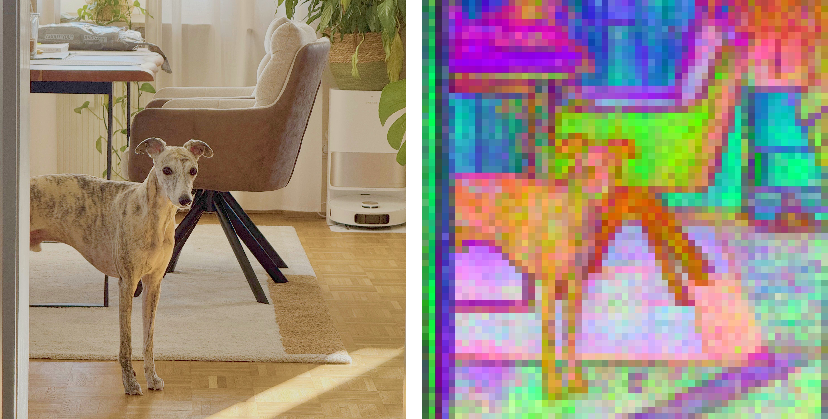
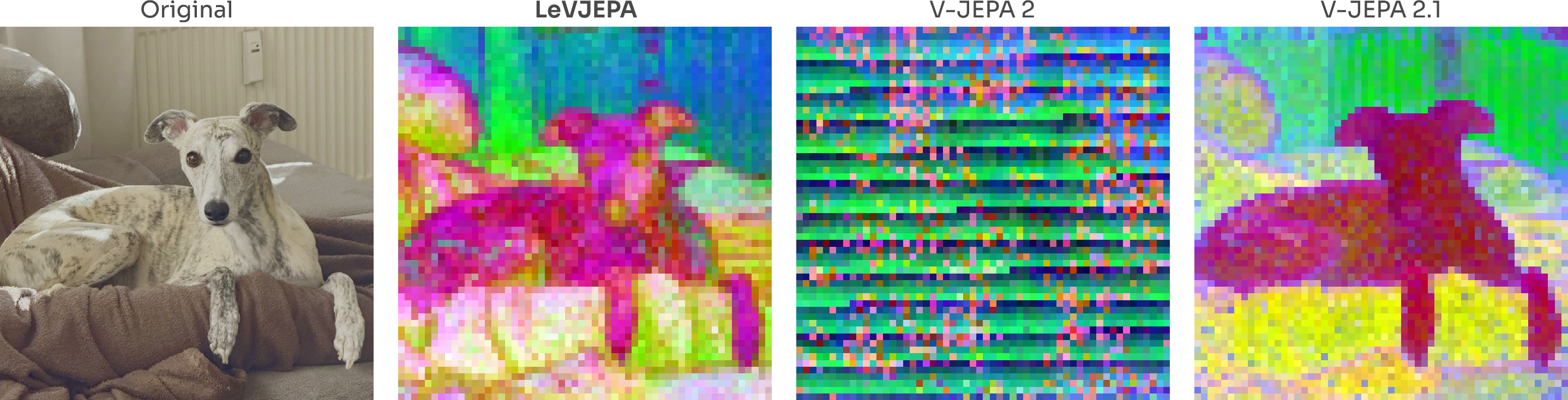
Although LeVJEPA was trained mainly to understand an entire clip, the small image patches also developed meaningful information.
For example, the patch descriptions often grouped together the patches belonging to an animal or object and separated them from the background. This happened without directly teaching the model to identify each patch.
It could run on ordinary hardware
A small version of LeVJEPA was trained for 12 hours on a single consumer graphics card using unlabeled walking videos. Its ImageNet accuracy improved from 8.9% to 25.2%.
This result is not close to the best large models, but it shows that video pretraining may be possible for smaller research groups without enormous computer clusters.
More data improved performance
When the researchers used a larger and more varied video collection, a large LeVJEPA model achieved:
- 69.5% on ImageNet-1K
- 55.0% on Something-Something-v2
This suggests that LeVJEPA continues to benefit from more training data.
5. Why are these findings important?
The paper suggests that video has been considered too expensive for general-purpose AI training partly because earlier training methods were inefficient.
LeVJEPA challenges this idea. Its results suggest that video could become a practical source of training data for many kinds of AI, not only systems that recognize actions.
The method could be useful for:
- Robots, which need to understand what is happening over time
- Security and live-camera systems, which process new frames continuously
- Self-driving vehicles, which must understand movement and possible future events
- Video search and analysis
- AI systems that build models of how the physical world works
The causal design is especially useful because it allows the AI to update its understanding as new frames arrive without repeatedly watching the entire video again.
Simple conclusion
LeVJEPA is a simpler and more efficient way to teach AI about videos. It learns by comparing different views of the same clip, checks that its answers do not all become identical, and processes only a small random selection of visual information.
The main result is that less computation can produce strong video understanding. LeVJEPA performs well on recognizing objects and actions, and it is much better than image-only training at understanding motion.
The research does not solve every problem. The model still has room to improve at difficult motion tasks, and it has not yet been fully tested for jobs such as tracking objects or dividing an image into separate regions. Even so, the paper suggests that video may become a powerful and affordable foundation for future AI systems.
Knowledge Gaps
Knowledge gaps, limitations, and open questions
The paper leaves the following issues unresolved:
- Internet-scale scaling remains unverified: LeVJEPA is only scaled to a ViT-L model and a corpus substantially smaller than those used by recent video foundation models; its performance, stability, and compute efficiency at much larger model, dataset, and training scales are unknown.
- The single fixed SIGReg weight may not generalize: Although is used without tuning, the paper does not establish whether this value remains optimal across model sizes, batch sizes, embedding dimensions, datasets, clip lengths, or distributed-training regimes.
- SIGReg’s behavior in large-scale training is underexplored: The interaction between the number of random projection directions, batch size, quadrature approximation, embedding dimension, and optimization stability is not systematically characterized.
- The claimed collapse guarantee is not empirically stress-tested: The paper does not test whether finite-batch estimation, insufficient random projections, numerical approximation, or optimization failures can produce partially collapsed or poorly conditioned representations despite SIGReg’s theoretical guarantee.
- The source of the token-dropping benefit is unclear: It is not determined whether improved accuracy results primarily from stochastic regularization, increased effective augmentation, reduced computational burden enabling longer training, or a combination of these factors.
- High-sparsity motion learning remains unresolved: Randomly dropping 90–95% of tokens harms Something-Something-v2 performance under shorter schedules, and the paper does not identify a token-selection strategy that preserves temporal correspondences while retaining the observed efficiency.
- The relationship between token dropping and training duration is incomplete: The study does not provide scaling laws that quantify how many additional optimization steps are required to compensate for different dropping ratios across motion- and appearance-centric tasks.
- Other sparse-observation strategies are not compared: Importance sampling, motion-aware sampling, spatially stratified sampling, tube-plus-random mixtures, and adaptive or learned token selection are left unexplored.
- The causal representation claim is evaluated indirectly: Matching ImageNet probing accuracy between causal and bidirectional attention does not establish that the causal representations are better suited to prediction, streaming perception, or temporal reasoning.
- Streaming inference is not experimentally demonstrated: The paper claims that past frames need not be re-encoded, but it does not measure incremental latency, memory growth, throughput, state caching requirements, or accuracy under genuinely online video arrival.
- Temporal leakage and boundary behavior are not examined: The robustness of block-causal representations at clip boundaries, after long sequences, under dropped or irregularly sampled frames, and during abrupt scene changes remains unknown.
- World-model and control utility is untested: No action-conditioned prediction, planning, robotics, anticipation, or control experiments demonstrate that the causal encoder improves downstream world modeling relative to a bidirectional encoder plus a separately trained temporal model.
- Long-range temporal modeling is unresolved: Experiments use 16-frame clips, so it is unclear whether the block-causal encoder captures dependencies over substantially longer horizons or whether its temporal state degrades with sequence length.
- Clip-level supervision may be insufficient for dense tasks: Although patch tokens appear semantically organized in visualizations, segmentation, detection, tracking, optical flow, depth, pose estimation, and temporal correspondence performance are not evaluated.
- The dense-token visual evidence is qualitative: PCA and cosine-similarity examples on a small number of scenes do not establish the consistency, localization accuracy, or class-agnostic quality of the emergent patch representations.
- The role of the projector is not fully understood: The projector is required because of the encoder’s final layer normalization, but the paper does not analyze how projector architecture, dimension, depth, normalization, or removal after pretraining affect the quality and geometry of the retained encoder features.
- Global–local view design is only partially explored: The study varies the number of local views but does not systematically assess crop scale, crop overlap, temporal crop diversity, photometric augmentation strength, or views with different temporal windows.
- Shared temporal windows may limit temporal learning: All global and local views use the same temporal interval, leaving open whether matching views with different temporal windows would improve temporal invariance, anticipation, or long-range motion understanding.
- The evaluation depends heavily on frozen probing: The conclusions may not transfer to full fine-tuning, parameter-efficient adaptation, few-shot learning, retrieval, video-language tasks, or transfer to domains substantially different from Kinetics.
- Probe choices confound representation comparisons: Different benchmarks use attentive probing versus mean-pooled linear probing, and the paper does not provide a uniform set of probe types or end-to-end fine-tuning results to separate encoder quality from adaptation capacity.
- Generalization beyond the selected benchmarks is unknown: The experiments focus mainly on ImageNet-1K, Kinetics-400, and Something-Something-v2; robustness to distribution shift, egocentric video, medical video, surveillance, low-light footage, camera motion, and non-action-centric content is not established.
- The image-pretraining comparison is limited: DINOv2 is trained on frames sampled from the same source videos, but the study does not compare against alternative image and video pretraining objectives under matched data diversity, number of unique frames, optimization steps, augmentation policies, and effective sample exposure.
- Data composition effects are not isolated: The large-scale corpus combines several datasets with different domains and annotation histories, so the contribution of each dataset, data diversity, duplication, and domain mixture to the reported gains is unclear.
- Potential dataset overlap and contamination require further analysis: The paper does not fully quantify overlap between pretraining sources and downstream benchmarks, near-duplicate videos, or reuse of publicly available evaluation content.
- Compute accounting may not capture all costs: Reported FLOP advantages focus primarily on encoder processing; the total cost of data loading, view generation, projector computation, SIGReg evaluation, probing, longer schedules, and checkpoint averaging is not comprehensively compared.
- The consumer-hardware result has limited evidential scope: The single-GPU experiment uses only eight Walking Tours videos and a ViT-Tiny model, so it does not establish practical performance across broader data sources, hardware types, model sizes, or reproducibility conditions.
- Sensitivity to random seeds and statistical uncertainty is insufficiently reported: The paper does not clearly provide multi-seed results, confidence intervals, or significance tests for key comparisons and small accuracy differences such as the causal-versus-bidirectional result.
- The impact of the Polyak-averaged evaluation checkpoint is unclear: Although the moving average is not used in the training objective, the paper does not quantify how much it contributes to downstream performance relative to the instantaneous final checkpoint.
- Training stability under difficult video conditions is unknown: The method is not evaluated with variable frame rates, missing frames, severe compression, camera shake, occlusions, rapid motion, or clips with little temporal redundancy.
- The limits of invariance are not characterized: Matching aggressive spatially and photometrically altered views may remove information that is important for fine-grained recognition, spatial localization, or appearance-sensitive tasks, but the paper does not measure these trade-offs.
- Temporal ordering may not be sufficiently enforced by causality alone: Block-causal attention restricts information flow but does not explicitly require representations to encode order, duration, direction of motion, or causal relations; these properties are not separately measured.
- The theoretical downstream-risk motivation for an isotropic Gaussian is not validated in video: The paper adopts the distributional target from LeJEPA, but it does not test whether isotropic Gaussian embeddings are empirically optimal for video-specific tasks or whether alternative distributions and regularizers would perform better.
- The method’s applicability to multimodal or action-conditioned pretraining is unresolved: It is unknown whether LeVJEPA can incorporate language, actions, proprioception, audio, or other modalities without losing its collapse-free simplicity and computational advantages.
Practical Applications
Immediate Applications
- Lower-cost video foundation-model pretraining — software and AI infrastructure
- Organizations can replace or benchmark against more complex video-pretraining pipelines using an encoder plus projector trained with the invariance loss and SIGReg, without an EMA target encoder, predictor, stop-gradient, or pixel decoder.
- This can reduce pretraining compute by approximately 5.6–20.8× relative to the reported V-JEPA 2 configurations at matched epochs.
- Potential tools/products: open-source video representation-learning libraries, lower-cost domain-specific visual encoders, and cloud-training recipes for organizations without large GPU clusters.
- Dependencies: the reported gains were obtained primarily with ViT-S/B/L models, specific clip/view configurations, and video datasets related to Kinetics. Production users would need to validate performance on their domain and hardware.
- Commodity-hardware visual pretraining — small businesses, laboratories, and edge-AI developers
- A lightweight LeVJEPA model can be pretrained on unlabeled local video using a single consumer GPU. The paper reports a ViT-Tiny trained for 12 hours on a 16 GB RTX 5080, improving ImageNet accuracy from 8.9% to 25.2%.
- This enables small organizations to create specialized representations from surveillance, industrial, agricultural, sports, or egocentric footage without purchasing cloud-scale infrastructure.
- Potential workflow: collect unlabeled video → pretrain a small encoder with aggressive random token dropping → freeze or lightly fine-tune the encoder for classification or retrieval.
- Dependencies: small-data models may not generalize broadly; privacy-preserving storage, consent, and domain-specific evaluation remain necessary.
- Motion-aware video analytics — security, retail, manufacturing, and sports
- The encoder can provide features for action recognition, event classification, activity analysis, and motion-centric retrieval. It substantially outperformed the matched DINOv2 image baseline on Something-Something-v2 and achieved competitive or superior results against video baselines.
- Potential products: worker-activity monitoring, unsafe-action detection, sports-event indexing, gesture recognition, and video search based on actions rather than appearance.
- Dependencies: the experiments used frozen probing rather than complete production systems. Real deployments would require task-specific adaptation, robustness testing, and careful handling of false positives in safety-critical settings.
- General-purpose visual pretraining from video — computer vision platforms
- Video data can serve as a single pretraining source for both appearance-centric and motion-centric tasks. The method approached image-pretrained performance on ImageNet while retaining a large advantage on motion understanding.
- Potential workflow: use one video-pretrained backbone for image classification, video classification, object retrieval, action recognition, and temporal event detection instead of maintaining separate image and video encoders.
- Dependencies: static-image performance remained slightly below DINOv2 in the matched-compute comparison, so image-only models may still be preferable for some appearance-dominated applications.
- Streaming perception with incremental computation — robotics, autonomous systems, and IoT
- Block-causal attention produces frame representations using only the current and preceding frames. New frames can therefore be encoded without re-encoding the entire video history.
- Potential tools: online activity recognition, robot-camera perception, traffic monitoring, wearable-camera analytics, and continuously updated scene-state representations.
- Dependencies: the paper evaluates representation quality primarily through frozen probes, not complete real-time latency, energy, or end-to-end control benchmarks. Deployment would require measuring throughput, memory growth, latency, and behavior under dropped or delayed frames.
- Action and event anticipation — industrial monitoring and human–computer interaction
- Because representations preserve temporal ordering and do not depend on future frames, they can support prediction of imminent actions or events from partial observations.
- Potential applications: predicting machine faults from video, recognizing a worker’s next procedural step, anticipating gestures, and detecting precursors to dangerous incidents.
- Dependencies: anticipation quality was not directly established in the reported experiments. Labeled anticipation data or an additional temporal prediction head may be required.
- Efficient transfer learning and academic benchmarking — research laboratories
- Researchers can use the released code and models as compact baselines for video representation learning, reducing the compute required for ablations and reproducibility studies.
- The method’s single principal hyperparameter, fixed at in the experiments, simplifies controlled comparisons.
- Potential workflow: pretrain once on unlabeled video → freeze the encoder → train lightweight probes for multiple downstream datasets.
- Dependencies: the claimed scaling behavior should be independently verified at larger model, batch, and data scales, where SIGReg’s interaction with optimization may differ.
- Unsupervised visual representation for local or private datasets — healthcare, education, and enterprise analytics
- Institutions can pretrain on unlabeled video without requiring frame-level annotation, potentially reducing labeling costs for specialized domains such as medical procedures, classroom activity, laboratory processes, or warehouse operations.
- Dependencies: the paper does not demonstrate these domains. Healthcare and education deployments additionally require de-identification, access controls, consent, auditability, and domain-specific validation. Video pretraining does not by itself guarantee clinically or operationally reliable predictions.
- More efficient video data pipelines — cloud services and energy-conscious computing
- Since computation scales with the number of retained tokens and uniform random dropping can discard 95% of tokens while improving some downstream results, training systems can reduce GPU time, memory use, and energy consumption.
- Potential products: adaptive video-pretraining services, budget-aware foundation-model training, and energy/carbon reporting tools for multimodal model development.
- Dependencies: aggressive dropping is not uniformly beneficial: short-schedule motion accuracy declined at high dropping ratios. Operators may need different token-retention policies for appearance versus motion tasks.
- Daily-life applications based on efficient temporal features — consumer devices
- Compact models could support on-device gesture recognition, exercise tracking, fall-risk screening, smart-camera event detection, and personal video organization.
- The causal formulation is particularly compatible with continuous camera streams because it avoids repeatedly processing the full history.
- Dependencies: consumer deployment requires quantization, thermal and battery optimization, robust performance across lighting and viewpoints, and strong privacy protections. The paper does not report these engineering evaluations.
Long-Term Applications
- Action-conditioned world models for robotics — robotics and autonomous control
- LeVJEPA’s causal frame representations could serve as the visual state encoder in an action-conditioned world model. A dynamics model could predict future latent states from the current representation, robot actions, and proprioceptive information.
- Potential system: causal LeVJEPA encoder → action-conditioned latent dynamics model → model-predictive controller for manipulation, navigation, or mobile robotics.
- Dependencies: LeVJEPA itself is not action-conditioned and is not shown to support control directly. Additional research is needed on action/state alignment, long-horizon latent prediction, temporal memory, uncertainty estimation, and closed-loop robotic evaluation.
- Real-time autonomous driving and aerial navigation — transportation
- Incremental causal representations could reduce the need to recompute video context when new camera frames arrive, supporting perception and anticipation under strict latency constraints.
- Potential applications: pedestrian and cyclist intent prediction, obstacle-motion estimation, lane-event anticipation, and drone navigation.
- Dependencies: safety-critical deployment requires extensive testing under weather changes, occlusion, distribution shift, adversarial conditions, and sensor failure. The current results do not establish sufficient reliability or real-time performance.
- Dense segmentation, tracking, and object-level video understanding — computer vision
- The paper reports emergent semantic and spatial organization in patch tokens despite supervising only the clip-level
[cls]token. This suggests a possible route to dense prediction without explicit patch-level pretraining losses. - Potential products: weakly supervised segmentation, object tracking, video object discovery, region retrieval, and spatiotemporal correspondence systems.
- Dependencies: dense tasks were explicitly left unevaluated. Further research must determine whether the emergent token structure is stable across objects, scenes, resolutions, and long temporal sequences, and whether it matches models trained with dense supervision.
- The paper reports emergent semantic and spatial organization in patch tokens despite supervising only the clip-level
- Long-horizon streaming memory and persistent scene understanding — robotics, smart infrastructure, and AR
- A causal encoder could provide a continuously updated latent state for persistent environments, allowing systems to reason about object permanence, changing layouts, and recurring activities.
- Potential workflow: encode each incoming frame incrementally → maintain a compressed latent memory → query the memory for scene changes, object states, or user context.
- Dependencies: the current method uses fixed 16-frame clips during training. Long-duration operation may require memory mechanisms, recurrent state, hierarchical temporal representations, and controls against representation drift.
- Video-native general-purpose foundation models — multimodal AI
- If the reported compute efficiency scales to larger datasets and models, video could become a preferred substrate for general visual pretraining because it contains both static appearance and temporal structure.
- Potential tools: video-LLMs, multimodal assistants that understand ongoing activities, visual agents, and unified image/video encoders.
- Dependencies: the paper’s largest controlled experiments use a restricted K710 subsample, while the larger-data experiment remains far below internet scale. Internet-scale deduplication, licensing, safety filtering, multilingual coverage, and scaling-law validation are unresolved.
- Efficient video-language pretraining — multimodal applications
- The compact encoder and emergent patch structure could reduce the visual cost of systems that connect video representations to LLMs for captioning, question answering, instruction following, or video search.
- Potential architecture: pretrained LeVJEPA encoder → temporal or spatial pooling → language-model adapter or cross-attention module.
- Dependencies: the paper does not test language alignment. Additional video-text data, temporal localization, grounding objectives, and evaluation for hallucination and temporal reasoning would be required.
- Policy and public-sector video analytics — transport, emergency response, and infrastructure
- Efficient causal encoders could make large-scale analysis of traffic, public-space activity, infrastructure inspections, or emergency footage more affordable.
- Potential systems: event triage, infrastructure anomaly detection, disaster-response video indexing, and privacy-preserving local analytics.
- Dependencies: public-sector use requires legal authorization, strict purpose limitation, bias and fairness audits, human review, retention controls, and safeguards against mass surveillance. Higher predictive accuracy alone does not establish social acceptability or legality.
- Adaptive token selection for motion preservation — future model development
- The paper identifies a trade-off: uniform 95% token dropping improves appearance-centric accuracy but can reduce short-schedule motion accuracy. Future methods could retain tokens based on temporal correspondence, motion salience, uncertainty, or object trajectories.
- Potential products: motion-aware token routers, variable-rate video encoders, and compute schedulers that allocate more tokens to rapidly changing regions.
- Dependencies: such schemes require additional research while preserving the method’s simplicity and avoiding expensive preprocessing. They must be evaluated for latency, bias toward visually salient motion, and robustness to subtle actions.
- Energy-efficient large-scale video learning — climate-conscious AI infrastructure
- If the compute reductions remain valid at foundation-model scale, video pretraining could lower the energy and financial barriers to training general visual models.
- Potential applications: regional or institution-specific foundation models trained under constrained energy budgets, including models for research, education, and public services.
- Dependencies: total energy savings depend on data loading, storage, repeated training schedules, hardware utilization, and the additional epochs required when using high token-dropping rates. Hardware-level measurements are needed beyond FLOP comparisons.
- Formal, distribution-constrained representation learning beyond video — academia and industrial ML
- SIGReg’s explicit embedding-distribution constraint could be adapted to audio, sensor streams, robotics trajectories, medical signals, or multimodal data where collapse prevention is currently handled through architectural heuristics.
- Potential tools: reusable distribution-regularization modules for self-supervised learning and standardized diagnostics for detecting representation collapse.
- Dependencies: the paper’s guarantee relies on assumptions concerning the embedding distribution and optimization. Whether an isotropic Gaussian is optimal for every modality, task family, or downstream risk remains an empirical and theoretical question.
Glossary
- Autoregressive world model: A model that predicts future states or observations sequentially from previously observed information. “a property required by autoregressive world models and streaming settings”
- Attentive probing: An evaluation method that uses a learned attention mechanism to extract information from frozen representations. “evaluated under frozen probing against video and image pretraining baselines”
- Block-causal attention: An attention pattern that is bidirectional within each frame but only attends to current and preceding frames across time. “the encoder can be trained with block-causal attention at no measurable accuracy cost”
- Causal attention: An attention mechanism that prevents a representation from using future tokens or observations. “Causal attention constrains the representation of each frame to depend exclusively on the current and preceding frames”
- Characteristic function: A Fourier-transform-based representation of a probability distribution used to compare distributions statistically. “The empirical characteristic function underlying Equation~\ref{eq:sigreg} is bounded with bounded gradients”
- Class-balanced subsample: A subset of data constructed so that classes are represented in balanced proportions. “models are pretrained on a class-balanced subsample comprising of K710”
- Collapse-free objective: A training objective designed to prevent all inputs from being mapped to the same representation. “the first video encoder trained under LeJEPA's collapse-free objective”
- Cosine similarity: A measure of similarity between two vectors based on the cosine of the angle between them. “Cosine similarity between a query patch placed on the object and all patch tokens of the image”
- Cramér--Wold theorem: A theorem stating that a multivariate probability distribution is determined by all of its one-dimensional projections. “By the Cram\textit{er--Wold theorem}, the embeddings match if and only if every one-dimensional projection matches ”
- Cross-attention: An attention operation in which queries attend to representations produced by another sequence or source. “a lightweight cross-attention block with a learnable query pools the encoder's output tokens”
- Data augmentation: A transformation applied to training data to improve generalization or enforce invariance. “this token dropping, which determines the computational cost of pretraining, is analyzed”
- Dense prediction: A task that produces an output for many or all spatial locations, such as segmentation or tracking. “their sufficiency for dense prediction tasks such as segmentation and tracking has not yet been evaluated”
- Distributional constraint: A requirement that learned representations follow a specified probability distribution. “collapse is instead excluded by an explicit distributional constraint”
- Downstream probing risk: The worst-case performance risk on later tasks when using learned representations with a probe. “the isotropic Gaussian uniquely minimizes worst-case downstream probing risk”
- Egocentric video: Video recorded from the viewpoint of a person or embodied agent. “Walking Tours consists of a small number of hours-long egocentric walking videos”
- Epps--Pulley statistic: A statistical measure based on characteristic functions for testing whether data follow a specified distribution. “the standard Gaussian is penalized via the Epps--Pulley statistic”
- Exponential-moving-average target encoder: A target network whose parameters are updated as an exponential moving average of another encoder’s parameters. “an exponential-moving-average target encoder, a stop-gradient on the target branch, and a predictor network”
- Factorized three-dimensional rotary embeddings: Positional representations that encode spatial and temporal positions through separate rotary transformations. “Positional information is provided by factorized three-dimensional rotary embeddings”
- Frozen encoder: An encoder whose parameters are kept fixed while another model or classifier is trained on its representations. “Pretrained encoders are evaluated frozen”
- Frozen probing: Evaluating a pretrained representation using a learned task head while leaving the representation-producing encoder unchanged. “evaluate it under frozen probing against video and image pretraining baselines”
- Goodness-of-fit test: A statistical test that measures whether observed data are consistent with a specified probability distribution. “reducing the high-dimensional constraint to univariate goodness-of-fit tests”
- ImageNet-1K: A large-scale image classification benchmark containing 1,000 object categories. “we report linear probing on mean-pooled tokens instead”
- Invariance loss: A loss that encourages different views or augmentations of the same input to have similar representations. “an invariance loss over global and local views of a clip”
- Isotropic Gaussian: A multivariate Gaussian distribution with equal variance in every direction and no directional correlations. “SIGReg constrains the embedding distribution to match an isotropic Gaussian”
- Joint-embedding method: A representation-learning method that maps related inputs into nearby points in an embedding space. “leading video joint-embedding methods train two encoders and a predictor”
- Layer normalization: A neural-network normalization technique that normalizes activations across the features of an individual example. “the final encoder layer applies layer normalization”
- Masked autoencoding: A self-supervised approach that reconstructs hidden parts of an input from the visible parts. “Masked autoencoding reconstructs held-out content in pixel space”
- Masked-image modelling: A training approach in which portions of an image are hidden and the model learns from the missing content. “DINOv2 combines this with masked-image modelling”
- Mean squared error: The average squared difference between predicted and target values. “The objective combines a mean squared error that drives each local [cls] embedding toward the global one”
- Motion-centric evaluation: Evaluation focused on understanding movement and temporal dynamics in video. “while remaining competitive on motion-centric benchmarks”
- Multi-crop scheme: A self-supervised learning strategy that matches representations from multiple small crops with representations from larger crops. “introduces the multi-crop scheme in which several aggressively cropped local views are matched to a small number of global views”
- Non-linear pooling: A learned aggregation operation that combines token representations using a nonlinear mechanism. “Non-linear pooling is appropriate here because the pretraining objective provides no guarantee”
- Normality test: A statistical procedure for determining whether data are compatible with a normal distribution. “penalizes the deviation of each projection from a standard Gaussian via a normality test”
- Patch embedding: A transformation that converts image or video patches into vector tokens for a transformer. “tokenized by a convolutional patch embedding of spatial extent ”
- Patch-token representation: A vector representation corresponding to a spatial patch of an image or video frame. “Patch-token PCA across methods”
- Photometric augmentation: An image transformation that changes appearance-related properties such as brightness, contrast, or color. “local views are additionally cropped and photometrically augmented”
- Predictive feature principle: The principle that representations of temporally adjacent stimuli should predict one another. “Causality aligns the encoder with the predictive feature principle”
- Polyak average: A parameter-averaging technique that maintains a smoothed version of a model’s weights. “a Polyak average of the encoder weights is retained solely as the evaluation checkpoint”
- Predictor network: A network that transforms an encoded representation to predict another representation or target. “no predictor network is instantiated”
- Receptive field: The set of input tokens or observations that can influence a model unit’s representation. “causal masking removes future tokens from the receptive field of every token”
- Representation collapse: A failure mode in which different inputs receive identical or nearly identical representations. “Minimizing Equation~\ref{eq:inv} in isolation therefore admits a trivial solution”
- Rotary embeddings: Positional encodings that represent position by rotating query and key vectors in attention computations. “factorized three-dimensional rotary embeddings”
- Self-supervised learning: Learning from data without manually supplied labels by constructing supervisory signals from the data itself. “Self-supervised learning from video can be both simpler and substantially more compute-efficient”
- SIGReg: A regularization method that matches embedding distributions to an isotropic Gaussian using random one-dimensional projections and statistical tests. “SIGReg enforces it by reducing the high-dimensional constraint”
- Sparse observation: An input representation containing only a small subset of the available tokens or measurements. “the retained tokens constitute a sparse observation of the clip”
- Stop-gradient: An operation that prevents gradients from flowing through a specified computation during backpropagation. “no stop-gradient operation or target network is employed”
- Streaming inference: Processing incoming data sequentially while reusing prior computations rather than recomputing the entire sequence. “a property required by autoregressive world models and streaming settings”
- Structured masking: A masking strategy that removes tokens according to a predefined spatial or temporal pattern. “uniform random token dropping replaces structured masking”
- Temporal aggregation: Combining information from multiple consecutive video frames before processing them with the transformer. “Temporal aggregation () is supported and compared”
- Temporal causality: The constraint that a representation at a given time depends only on present and past information. “Temporal causality is thus obtained at no measurable cost to downstream accuracy”
- Temporal window: The shared interval of video time represented across multiple views or clips. “all sharing the same temporal window”
- Token dropping: Randomly removing input tokens to reduce computation or regularize representation learning. “Within every view, of the patch tokens are dropped uniformly at random”
- Tube masking: A video masking method that removes the same spatial region across all frames. “tube masking, which occludes the same spatial region in every frame”
- Univariate goodness-of-fit test: A statistical test applied to one-dimensional data to assess agreement with a reference distribution. “reducing the high-dimensional constraint to univariate goodness-of-fit tests”
- Vision Transformer (ViT): A transformer architecture that processes images or video as sequences of patch tokens. “The encoder is a Vision Transformer adapted for video”
- Video joint-embedding method: A video representation-learning method that aligns embeddings of different views of the same video. “Joint-embedding methods for video have thus far relied on architectural asymmetries”
- World model: A model that represents and predicts the dynamics of an environment or physical world. “This positions a single pretrained encoder as a foundation for streaming perception and autoregressive world modeling”