SiamJEPA: On the Role of Siamese Student Encoders in JEPA
Abstract: Recently, Joint Embedding Predictive Architectures (JEPAs) have attracted significant attention in the computer vision and machine learning communities as a promising framework for self-supervised representation learning. Unlike masked autoencoders that reconstruct pixels, JEPA models learn representations by predicting latent embeddings of masked regions. Existing JEPA-based methods, such as I-JEPA and V-JEPA, typically employ a single encoder in the student network. In contrast, using Siamese encoders for student network is more naturally aligned with brain-inspired representation learning frameworks, yet their role in JEPA models remains largely unexplored. In this paper, we investigate the effect of Siamese student encoders in JEPA-based representation learning. To this end, we propose SiamJEPA, masked Siamese student encoders equipped with an exponential moving average (EMA) teacher network. SiamJEPA can also be viewed as a JEPA formulation of the brain-inspired representation learning model PhiNet. Through extensive experiments on ImageNet linear probing, we demonstrate that Siamese encoders act as an effective regularizer for the JEPA objective, improving representation separability and accelerating learning during the early stages of training. Furthermore, SiamJEPA consistently outperforms comparable single-encoder JEPA variants under limited training budgets and achieves higher linear probing accuracy than Masked Autoencoders (MAE) which requires longer training. Our findings reveal that Siamese student encoders are not merely an architectural choice but constitute an important inductive bias for predictive representation learning. These results provide new insights into the design of JEPA-based models and suggest that incorporating Siamese student architectures offers a simple yet effective approach for improving self-supervised representation learning.
Paper Prompts
Sign up for free to create and run prompts on this paper using GPT-5.
Top Community Prompts
Explain it Like I'm 14
What is this paper about?
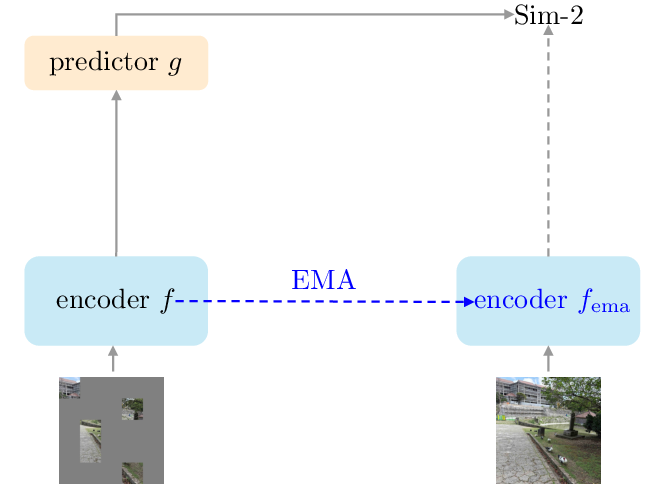
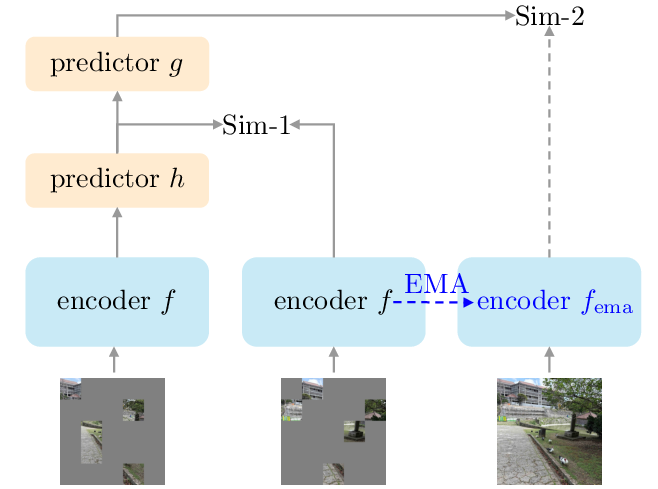
This paper explores a new way for computers to learn from images without needing labels. The idea is called SiamJEPA. It builds on a family of methods named JEPA (Joint Embedding Predictive Architectures), which learn by predicting missing parts of a picture—not the pixels themselves, but the “summary” or meaning of those parts. The special twist in SiamJEPA is using two “student” networks that see different parts of the same image and learn together, guided by a slowly updated “teacher” network.
What questions did the researchers ask?
The paper focuses on a simple question: Do two students (a “Siamese” pair of encoders that share the same design and weights) help JEPA learn better and faster than the usual single-student setup?
Put another way:
- Does having two students who see different masked parts of an image make the learned features clearer and more useful?
- Can this design prevent common learning problems (like all features collapsing to the same answer) and speed up training?
- How does it compare to popular methods that reconstruct pixels (like Masked Autoencoders, or MAE)?
How did they study it?
Think of the training setup like a teamwork exercise:
- Two students look at the same image, but each sees only part of it (because different patches are hidden). These parts don’t overlap to avoid cheating.
- Their job is to predict the “hidden meaning” of the missing parts—not the exact pixels, but a compact, useful representation.
- A teacher network, which is a slow-moving average of the students, provides stable targets. This steady teacher helps prevent the students from collapsing to trivial answers.
Key pieces, in everyday terms:
- Siamese student encoders: Two copies of the same model see different masked views of the image. They share weights, so they learn together.
- Masking: Like covering parts of a puzzle and asking the students to guess what fits there based on what they can see.
- Teacher with EMA (Exponential Moving Average): Imagine a teacher who updates their guidance gradually based on the students’ recent progress, smoothing out noisy changes.
- Predictors: Small networks that help:
- Align the two students’ global view of the image so they agree on the big picture.
- Predict the hidden patch representations from the visible context.
- Losses (how the model is graded):
- A “similarity” loss encourages the two students to agree on the overall meaning (done with a probabilistic distance called KL divergence—think of it as measuring how similar their guesses are).
- A prediction loss checks how well each student can predict the hidden parts’ representations (measured with a kind of averaged error).
They trained on ImageNet (a large image dataset) using a Vision Transformer (ViT-Base) and tested representation quality using “linear probing.” Linear probing means freezing the learned features and training a simple classifier on top—like giving the features a quick quiz to see how informative they are.
What did they find?
Main results:
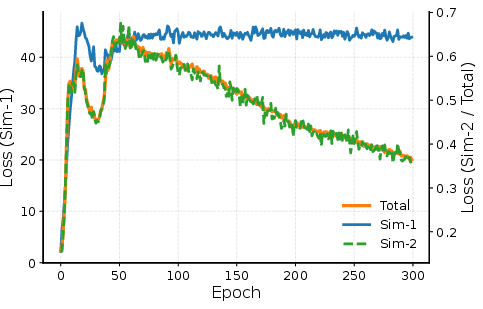
- Two students help: Using Siamese student encoders acts like a helpful rule-of-thumb (a “regularizer”). It makes the learned features more distinct and organized, which improves classification results.
- Faster early learning: Models with two students learn useful features more quickly in the early stages of training.
- Efficient training: SiamJEPA reaches strong accuracy with fewer training epochs compared to reconstruction-based methods like MAE. For example, at 400 epochs SiamJEPA reaches about 70% top-1 accuracy in linear probing on ImageNet, while MAE needs much longer training (often 1600 epochs) to get to similar or better levels.
- Masking matters: “Block masking” (hiding a big chunk at once) generally works better than random masking, especially early in training.
- Tuning helps but isn’t fragile:
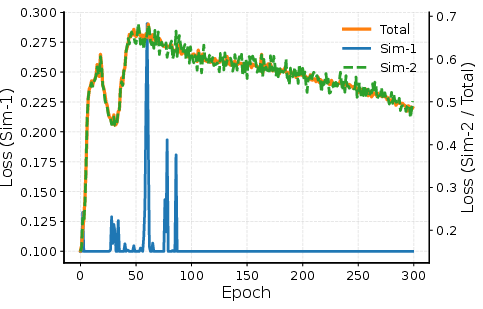
- Increasing the strength of the “agreement” pressure between the two students (the KL regularization) improves both speed and final accuracy—but too much can slow optimization.
- A setting called “free bits” (which ensures the two students don’t become identical) affects results slightly, but the method is not overly sensitive to it.
- Slightly stronger weight decay (a regularization setting) leads to better performance if you train longer.
- Where to read features: Taking the average of patch features (mean pooling), especially from a slightly earlier layer in the network, often gives better results than using the special [CLS] token alone.
Why this matters:
- The Siamese setup isn’t just a styling choice—it provides a useful bias that improves quality and training speed.
- It shows that predicting latent representations (the meaning of patches) can be a more efficient path than reconstructing every pixel, saving compute and time.
Why does this matter?
In simple terms, this work suggests an easier and faster way to teach computers to “understand” images without labels:
- Better features with less training: Useful for people who don’t have huge compute resources.
- Practical design tips: Use two students, block masking, and a modest regularization to align the students’ views.
- Broader impact: The idea may extend beyond images to videos and world-modeling, where predicting what comes next is crucial. It also connects to brain-inspired approaches, hinting at learning strategies that mirror how we humans might integrate different glimpses of the world.
Overall, SiamJEPA shows that having two students learn from different parts of the same picture—and agree on what they are seeing—can lead to faster and better learning than many traditional approaches.
Knowledge Gaps
Knowledge gaps, limitations, and open questions
The following points summarize what remains uncertain or unexplored in the paper and can guide follow-up research:
- Lack of apples-to-apples JEPA baseline: no controlled comparison against a single-encoder JEPA variant under identical codebase, compute budget, masking, predictor depth, EMA schedule, and evaluation protocol (including the “pure JEPA” special case).
- Incomplete efficiency accounting: training “efficiency” is discussed in epochs, but there is no report of total FLOPs, wall-clock time, or energy across methods (MAE vs. SiamJEPA), despite different batch sizes, decoder/predictor depths, and optimization settings.
- Evaluation protocol mismatch: MAE is evaluated with CLS token while SiamJEPA uses mean pooling; comparisons may conflate representation quality with readout choice; a unified evaluation protocol is missing.
- Absence of statistical rigor: results are single-run without confidence intervals; sensitivity to random seeds and run-to-run variance is not reported.
- Limited downstream validation: only ImageNet linear probing is used; no full fine-tuning, detection/segmentation, retrieval, robustness to distribution shift/corruption, or low-shot evaluation to establish general-purpose representation quality.
- Scaling uncertainty: the behavior of SiamJEPA on larger backbones (ViT-L/H), higher-resolution inputs, and larger pretraining datasets (e.g., ImageNet-21K, LAION) remains untested.
- EMA teacher design not ablated: the momentum schedule (0.99→0.999→0.9999), teacher necessity, and alternatives (fixed teacher, no EMA, different schedules) are not studied.
- Mask overlap assumption unvalidated: the claim that disjoint masks are “crucial” to avoid shortcuts is not tested against partial/controlled overlap; the impact of overlap on learning and collapse is unknown.
- Mask geometry underexplored: block vs. random masking is compared, but mask size, aspect ratio, number of blocks, curriculum/schedules, and content-aware masking are not explored.
- Sim-1 objective design space unexplored: KL-based latent consistency is used with stop-gradient on the prior, but alternatives (cosine/MSE alignment, InfoNCE-like contrastive terms, different normalization, temperature) and the effect of removing stop-gradient are not evaluated.
- Predictor architecture ambiguity: only very shallow transformer predictors (depth 1–2) are tested; the effect of deeper, convolutional, MLP, or cross-attention predictors on performance and stability is unknown.
- Latent variable modeling details: the probabilistic prior/posterior design (sampling vs. mean, reparameterization, variance parameterization, training stability) is not fully specified or ablated; it’s unclear whether stochasticity materially helps over deterministic heads.
- Free-bits threshold justification: the choice and scheduling of free-bits (0.01–0.1) are only lightly probed; a principled criterion or broader sweep (including annealing) is missing.
- Interaction with JEPA regularizers: no experiments combine SiamJEPA with SIGReg (LeJEPA) or other decorrelation/whitening/isotropy regularizers to assess complementarity or redundancy.
- Augmentation scope is narrow: beyond masking, standard image augmentations (crop/resize, color jitter, blur) and multi-crop strategies common in joint-embedding SSL are not explored; their impact on invariance and transfer is unknown.
- Layer-wise representation dynamics: intermediate layers sometimes outperform the final layer for linear probing, but there is no systematic analysis across epochs/layers, and no guidance for which layer to probe or why.
- Collapse diagnostics are missing: no direct measurements of collapse/degeneracy (variance, covariance, rank, isotropy, eigenspectra) are reported to substantiate the “regularizer” claim.
- Hyperparameter sensitivity: the paper notes high sensitivity but does not map response surfaces (e.g., batch size, learning rate, weight decay, EMA momentum, mask ratio) or provide robust defaults across settings.
- Asymmetry and architectural variants: effects of using asymmetric student encoders, unequal masking ratios, different positional embeddings, or partial weight sharing are not tested.
- Multi-view generalization: using more than two student views (e.g., multi-crop or tri-view) and the scalability of the KL consistency term in that setting remain unexplored.
- Domain and modality generalization: despite references to video and world-modeling, the method is only evaluated on images; it is unknown how SiamJEPA performs on video, multimodal inputs, or temporal prediction tasks.
- Interpretability and qualitative analysis: there are no visualizations (e.g., attention maps, nearest neighbors) or feature-space analyses (e.g., CKA) to support claims about separability and invariances learned.
- Resource and deployment footprint: memory usage, training/inference throughput, parameter counts (especially for predictor vs. MAE decoder), and real-world deployment cost are not reported.
- Reproducibility gaps: several training details are unspecified or inconsistent (e.g., patch size, normalization, exact NMSE normalization, code release), and the reliance on MAE code rather than official JEPA implementations may limit reproducibility and external validity.
- Failure modes and boundaries: scenarios where SiamJEPA underperforms (e.g., very low compute, very high mask ratios, small datasets) are not characterized, leaving practitioners without guidance on when not to use it.
Practical Applications
Immediate Applications
The findings in this paper enable several concrete, deployable improvements to existing self-supervised vision pipelines, especially where unlabeled data is abundant and compute budgets are constrained.
- Software and AI infrastructure: drop-in replacement for MAE-style pretraining under limited budgets
- Use case: Replace MAE pretraining with SiamJEPA for faster representation learning when training budgets are ≤400 epochs or when faster early progress is required.
- Workflow: ViT-Base backbone; predictor depth
=1; block masking with mask ratio=0.75; disjoint student masks; EMA schedule ramping0.99 → 0.999 → 0.9999; KL regularizationλ_KL ≈ 0.01–0.03; free-bits≈ 0.05–0.1; weight decay≈ 0.1for longer runs; evaluate with mean pooling (e.g., 10th layer). - Tools/products: PyTorch/HF Trainer recipe; MLOps template that logs KL/MSE curves; block-mask generator; metric dashboard to monitor linear probe and KL “free-bits” compliance.
- Assumptions/dependencies: Validated on ImageNet with ViT-Base; hyperparameter sensitivity; requires EMA teacher and careful mask handling; performance parity with the strongest JEPA variants not guaranteed without further tuning.
- Industry (retail/e-commerce, search, and recommendations): faster pretraining for product image understanding
- Use case: Pretrain on unlabeled catalog images to improve retrieval, deduplication, and attribute tagging with fewer epochs than reconstruction-based methods.
- Workflow: Run SiamJEPA pretraining on internal image corpora; freeze encoder; linear probe or shallow fine-tuning for downstream tasks; prefer intermediate-layer mean pooling.
- Assumptions/dependencies: Domain shift from ImageNet; need curated evaluation sets; careful masking still beneficial (block > random on average).
- Manufacturing and quality control: defect detection and anomaly localization
- Use case: Learn general-purpose visual features from unlabeled lines/data to reduce labeled defect requirements.
- Workflow: Pretrain SiamJEPA on unlabeled production frames; fine-tune on small labeled defect datasets; deploy for visual inspection or anomaly scoring.
- Assumptions/dependencies: Data variability and class imbalance; downstream anomaly metrics may require calibration; lighting/process changes affect transferability.
- Robotics and autonomous systems: faster early-stage representation learning for navigation and manipulation
- Use case: Obtain robust, invariant features with improved early-epoch performance for bootstrapping policies or perception modules.
- Workflow: Pretrain on onboard or simulation images; use Siamese encoders with disjoint masks to regularize invariances; freeze encoder in control stacks.
- Assumptions/dependencies: Real-to-sim domain gap; for video/world modeling, extensions exist but need task validation.
- Security and smart cities: pretraining on unlabeled CCTV for analytics
- Use case: Train site-specific representations for re-identification, occupancy analytics, or anomaly detection without labels.
- Workflow: SiamJEPA pretraining on privacy-preserving (blurred/consented) streams; linear probes for downstream tasks.
- Assumptions/dependencies: Privacy policies and consent; stable camera placements; potential bias from location-specific data.
- Finance and document processing: improved vision backbones for KYC/AML and forms understanding
- Use case: Pretrain on unlabeled document images to enhance OCR post-processing, entity detection, and layout understanding.
- Workflow: SiamJEPA on scans, forms, IDs; fine-tune small heads for classification or detection; intermediate-layer pooling favored.
- Assumptions/dependencies: Sensitive data governance; document domains vary widely; masking strategy may require adjustment to text-heavy layouts.
- Healthcare (non-diagnostic R&D): prototyping SSL for medical imaging repositories
- Use case: Pretrain on unlabeled radiology/pathology images to reduce annotation burden in research settings.
- Workflow: SiamJEPA pretraining; downstream evaluation on internal research tasks; compare to MAE baselines for compute savings.
- Assumptions/dependencies: Regulatory constraints for clinical use; strong domain shift vs natural images; robust validation required; ethics and privacy controls.
- Education and academia: teaching and experimentation with predictive SSL
- Use case: Course modules and lab exercises highlighting collapse-avoidance via Siamese students and KL regularization in JEPA.
- Workflow: Provide open-source scripts; ablation notebooks on
λ_KL, free-bits, masking, EMA scheduling; compare mean pooling vs CLS. - Assumptions/dependencies: Availability of compute; reproducibility and seeding; sensitivity to implementation details.
- MLOps and model governance: compute- and energy-aware SSL pretraining
- Use case: Track and reduce training cost/carbon by preferring latent prediction over reconstruction for comparable downstream accuracy under fixed budgets.
- Workflow: Carbon and runtime logging; A/B experiments comparing MAE vs SiamJEPA at equal epochs; policy to adopt SiamJEPA where budgets are capped.
- Assumptions/dependencies: Accurate energy metering; fairness of comparisons (same backbone/batch/epochs).
- Edge and on-device ML: pretrain centrally, enable faster fine-tuning downstream
- Use case: Produce encoders that fine-tune quickly for personalization with small on-device datasets.
- Workflow: Central SiamJEPA pretraining; distill to compact student; on-device adapters (e.g., LoRA) for task-specific updates.
- Assumptions/dependencies: Distillation quality; hardware constraints; privacy-preserving update pipelines.
Long-Term Applications
Several directions are promising but require further research, scaling, or engineering to reach production robustness.
- Video and world modeling (robotics, AV, AR/VR): Siamese JEPA for predictive planning and temporal understanding
- Use case: Extend to V-JEPA-style models leveraging Siamese students to regularize predictive latent dynamics for planning.
- Potential tools/products: World-model backbones for control stacks; temporal mask schedulers; uncertainty-aware predictors.
- Dependencies: Strong benchmarks beyond ImageNet; temporal masking design; stability of KL regularization in long-horizon contexts.
- Federated and on-device continual SSL
- Use case: Privacy-preserving SiamJEPA pretraining/fine-tuning across devices with EMA and local masking strategies.
- Potential tools/products: Federated SiamJEPA SDK; adaptive KL schedules; client-side block masking.
- Dependencies: Communication-efficient EMA updates; robustness to drift; privacy guarantees.
- Multi-modal predictive JEPA with Siamese students (vision+text+audio)
- Use case: Predict cross-modal latent targets (e.g., align audio-visual embeddings) with Siamese regularization.
- Potential tools/products: Foundation backbones for egocentric AR and assistive tech; cross-modal retrieval.
- Dependencies: Architecture design for multi-modal masking; training stability; dataset scale and licensing.
- Healthcare (clinical): semi-supervised representation learning for diagnostic support
- Use case: Pretrain from large unlabeled medical archives to reduce labeled requirements for detection/triage.
- Potential tools/products: Pretrained encoders for radiology/pathology workflows; rapid adaptation kits for hospitals.
- Dependencies: Regulatory validation; rigorous bias and safety assessments; clinical trials; domain-appropriate masking.
- Industrial inspection at scale (energy, utilities, infrastructure)
- Use case: Drone/satellite/robot imagery for corrosion detection, fault localization, right-of-way monitoring.
- Potential tools/products: Pretrained encoders for aerial imagery; anomaly modules; low-label pipelines.
- Dependencies: Domain-specific pretraining corpora; geospatial masking schemes; compliance with operational constraints.
- Policy and standards: guidance for compute-efficient SSL and green AI
- Use case: Promote predictive latent learning as a lower-carbon alternative under budget constraints, with standardized reporting.
- Potential tools/products: Best-practice guidelines; procurement checklists favoring efficient SSL; standardized energy/epoch reporting.
- Dependencies: Community consensus; robust cross-benchmark evidence; transparent energy accounting.
- AutoSSL tooling: automated masking and KL/free-bits scheduling
- Use case: Auto-tune masking strategy,
λ_KL, EMA schedules, and predictor depth to target compute/accuracy trade-offs. - Potential tools/products: AutoSSL controller integrated with training loops; Bayesian/hyperband search for JEPA-specific knobs.
- Dependencies: Reliable online metrics (e.g., KL saturation, early linear-probe proxy); search cost vs savings trade-off.
- Use case: Auto-tune masking strategy,
- Neuroscience-inspired architectures: CLS-aligned fast/slow learners and memory augmentation
- Use case: Further integrate hippocampal-neocortical analogues (fast-slow updates, episodic replay) with SiamJEPA.
- Potential tools/products: Memory-augmented JEPA encoders; episodic controllers for continual learning.
- Dependencies: Algorithmic design; robustness to catastrophic forgetting; empirical validation on continual benchmarks.
- Safety, fairness, and auditability of SSL features
- Use case: Evaluate SiamJEPA embeddings for demographic and context bias; design mitigation strategies (masking, augmentations).
- Potential tools/products: Bias diagnostics for SSL; masking-based debiasing recipes.
- Dependencies: Labeled audit sets; standardized fairness metrics for SSL; organizational oversight.
- Domain-specialized foundation backbones (legal, logistics, agriculture, retail media)
- Use case: Pretrain SiamJEPA on unlabeled, domain-specific corpora to seed downstream tasks with minimal labels.
- Potential tools/products: Sector-specific pretrained checkpoints; task adapters; evaluation suites.
- Dependencies: Data access and licensing; domain-appropriate masking; maintenance and updating strategies.
Notes on Assumptions and Dependencies Across Applications
- Evidence base: Results are on ImageNet linear probing with ViT-Base; not state-of-the-art vs fully tuned JEPA, but show strong training efficiency vs MAE under limited budgets.
- Sensitivity: Performance depends on mask strategy (block masking generally better), KL strength (
λ_KL≈0.01–0.03), EMA schedule, weight decay (≈0.1for longer runs), and evaluation protocol (intermediate-layer mean pooling). - Engineering: Requires careful implementation of disjoint masks, EMA teacher updates, predictor design (shallow transformer), and monitoring of KL “free-bits.”
- Data: Unlabeled data quality and domain match drive downstream performance; privacy, compliance, and ethical data use remain critical.
- Compute: Although more efficient than reconstruction under limited epochs, meaningful pretraining still demands substantial GPU resources; energy tracking recommended for policy and governance use cases.
Glossary
- Ablation study: a controlled analysis where components or hyperparameters are systematically varied to assess their effect on performance. "the ablation study of SiamJEPA"
- AdamW: an optimizer that decouples weight decay from the gradient-based update, improving generalization in deep networks. "AdamW"
- Barlow Twins: a self-supervised learning method that aligns embeddings by reducing cross-correlation off-diagonal terms while preserving variance. "Barlow Twins \citep{zbontar2021barlow}"
- Batch normalization: a technique that normalizes layer inputs to stabilize and accelerate training. "batch normalization"
- Block masking: a masking strategy that hides contiguous regions (blocks) of tokens or patches rather than random individual tokens. "block masking"
- Bootstrap Your Own Latent (BYOL): a non-contrastive self-supervised method using a student-teacher setup with EMA to avoid collapse. "Bootstrap Your Own Latent (BYOL) \citep{grill2020bootstrap}"
- CLS token: a special token in Transformers intended to aggregate global information across an input sequence. "CLS token"
- Complementary Learning Systems (CLS) theory: a neuroscience theory positing fast and slow learning systems (e.g., hippocampus vs. neocortex), inspiring student–teacher designs. "Complementary Learning Systems (CLS) theory \citep{mcclelland1995there}"
- Context autoencoder (CAE): a masked reconstruction method that predicts missing content from context. "context autoencoder \citep{chen2024context}"
- Contrastive learning: a representation learning paradigm that pulls together positive pairs and pushes apart negatives. "contrastive learning"
- DINO: a self-supervised method using self-distillation with no labels and EMA teachers to learn visual features. "DINO \citep{caron2021emerging,oquab2024dinov,simeoni2025dinov3}"
- Exponential moving average (EMA): a parameter update mechanism that maintains a smoothed teacher model from a student’s weights. "exponential moving average (EMA)"
- Free-bit threshold: a lower bound on KL contributions that prevents over-regularization/collapse by allowing a minimum information budget. "free-bit threshold"
- Frobenius norm: the square root of the sum of squared matrix entries; used to measure reconstruction error. "Frobenius norm"
- I-JEPA: an image-based JEPA variant that predicts latent representations of masked image regions. "I-JEPA \citep{assran2023self}"
- Inductive bias: assumptions built into a model or architecture that guide learning toward certain solutions. "inductive bias"
- Isotropic Gaussian distribution: a Gaussian with equal variance in all directions; often a target for embedding regularization. "isotropic Gaussian distribution"
- Joint Embedding Predictive Architecture (JEPA): a framework that predicts target latent embeddings from context without pixel reconstruction. "Joint Embedding Predictive Architectures (JEPAs)"
- Kullback--Leibler (KL) divergence: a measure of how one probability distribution diverges from another, used for probabilistic alignment. "Kullback--Leibler (KL) divergence"
- Latent prediction: learning to forecast hidden representations (embeddings) rather than raw pixels. "latent prediction"
- Linear probing: evaluating representation quality by training a linear classifier on frozen embeddings. "linear probing"
- Mask ratio: the proportion of tokens/patches masked during training. "mask ratio of 0.75"
- Masked Autoencoders (MAE): self-supervised models that reconstruct masked image patches from visible ones. "Masked Autoencoders (MAE) \citep{he2022masked}"
- Masked Siamese Networks (MSN): a masked modeling method aligning student and EMA-teacher embeddings without negatives. "Masked Siamese Networks (MSN) \citep{assran2022masked}"
- Mean pooling: aggregating token features by averaging to form a single representation vector. "Mean Pooling (10th layer)"
- Momentum Contrast (MoCo): a contrastive method using a momentum encoder and a queue to provide negatives efficiently. "Momentum Contrast (MoCo)"
- Momentum encoder: a slowly-updated encoder that stabilizes targets or negatives in self-supervised learning. "momentum encoder"
- Negative samples: embeddings from different images treated as dissimilar pairs in contrastive learning. "negative samples"
- Normalized mean squared error (NMSE): mean squared error scaled/normalized, used as a prediction loss. "normalized mean squared error (NMSE)"
- Patch token representations: per-patch embeddings produced by vision transformers for image tokens. "patch token representations"
- PhiNets: brain-inspired SSL models using Siamese students and EMA targets motivated by hippocampus–neocortex circuitry. "PhiNets"
- Posterior distribution: the distribution inferred with access to richer context (e.g., both views) in a probabilistic predictor. "posterior distribution"
- Prior distribution: the distribution inferred from limited context (e.g., a single view) that is encouraged to match the posterior. "prior distribution"
- Projector head: a network head mapping encoder outputs into a space suited for the learning objective. "projector head"
- Representation collapse: a degenerate solution where model outputs become constant or uninformative. "representation collapse"
- Self-supervised learning (SSL): learning useful representations from unlabeled data using auxiliary objectives. "self-supervised learning (SSL)"
- Siamese student encoders: two weight-sharing encoders processing different views to encourage consistency and regularization. "Siamese student encoders"
- SIGReg (Sketched Isotropic Gaussian Regularization): a regularizer steering embeddings toward an isotropic Gaussian via sketches. "Sketched Isotropic Gaussian Regularization (SIGReg)"
- Sliced Wasserstein distance: a distance between distributions computed via 1D projections, used for embedding regularization. "sliced Wasserstein distance"
- StopGradient operator: a mechanism that blocks gradient flow through part of a computation to stabilize training. "StopGradient operator"
- Temporal predictive hypothesis: the idea that useful representations should predict future or related observations over time. "temporal predictive hypothesis \citep{chen2022predictive}"
- Variance-Invariance-Covariance Regularization (VICReg): a method that enforces variance, invariance, and decorrelation to avoid collapse. "Variance-Invariance-Covariance Regularization (VICReg) \citep{bardes2022vicreg}"
- Vision Transformer (ViT): a transformer architecture operating on patch tokens for vision tasks. "Vision Transformer (ViT) \citep{dosovitskiy2021an}"
- Weight decay: L2-style parameter regularization applied during optimization to improve generalization. "weight decay"
- World-model learning: learning predictive models of environments or data-generating processes for understanding and planning. "world-model learning"
Collections
Sign up for free to add this paper to one or more collections.