Learn What's Left, Not What's Mastered: Saturation Aware Advantage Reweighting for Multi-Reward Policy Optimization
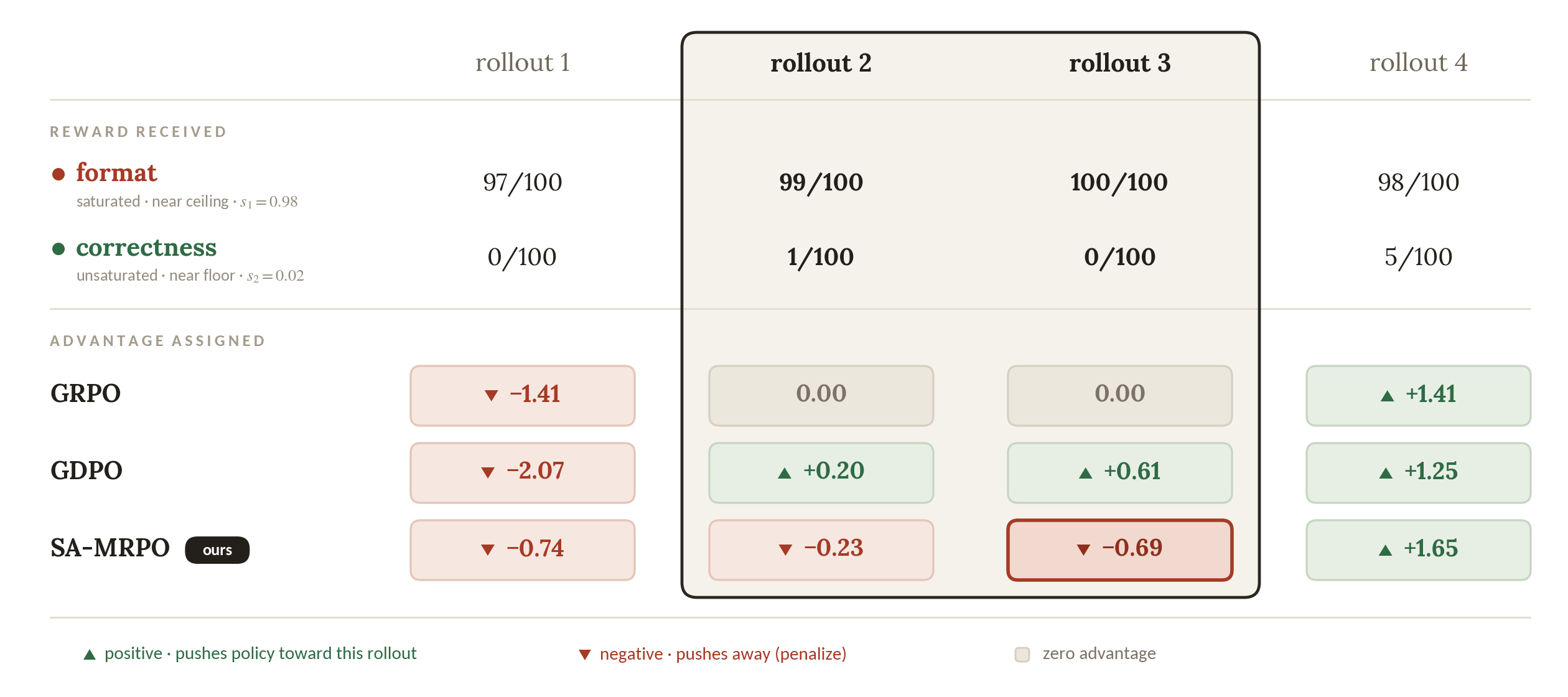
Abstract: Reinforcement learning (RL) with group-relative advantages has become the de facto standard for post-training LLM reasoners. However, when optimizing multiple reward objectives, existing methods typically scalarize the reward vector with a fixed weighted sum before group-wise standardization. We show that this design leads to two fundamental problems: rollouts with distinct reward profiles can receive identical advantages, and all objectives are optimized with fixed relative weights regardless of their current level of saturation. As a result, training continues to allocate gradient budget to already-solved objectives instead of focusing on those with greater remaining headroom. We introduce \textbf{Saturation Aware Advantage Reweighting for Multi-Reward Policy Optimization} (SA-MRPO), which standardizes each reward objective independently and adaptively discounts its contribution according to a batch-level estimate of objective saturation. This dynamically reallocates optimization effort toward under-optimized objectives while empirically maintaining performance on those that are already well satisfied. We further show that saturation-aware reweighting can reverse the sign of an update, rather than merely rescale its magnitude. Across mathematical reasoning with two- and three-objective reward combinations, SA-MRPO improves the harder correctness objective over GDPO in 12 of 15 benchmark comparisons, with gains of up to on AIME24. On adaptive reasoning it improves accuracy on all five benchmarks, by on average and up to on AMC23, and on coding benchmarks it improves pass rate by up to , while in all settings maintaining the easier objectives near their already satisfied levels.
Paper Prompts
Sign up for free to create and run prompts on this paper.
Top Community Prompts
Explain it Like I'm 14
1. What is this paper about?
This paper introduces a new way to train LLMs when they must satisfy several goals at once.
For example, a model solving a math problem might need to:
- Give the correct answer
- Stay under a certain length
- Follow a required format
- Explain its reasoning clearly
The paper argues that existing training methods may spend too much effort on goals the model has already mastered. The authors propose a method called Saturation-Aware Advantage Reweighting for Multi-Reward Policy Optimization, or SA-MRPO.
The main idea is simple:
Train more on what the model still struggles with, and less on what it already does well.
2. What questions are the researchers asking?
The paper focuses on three main questions:
- Do current methods lose useful information when combining several rewards? A model can be good at one goal but bad at another. The researchers ask whether ordinary methods can tell these cases apart.
- Should all goals keep the same importance during training? If a model already follows the correct format almost every time, should format continue to receive the same training attention as mathematical correctness?
- Can changing the emphasis improve difficult goals without damaging easier ones? The authors test whether the new method can improve correctness while still preserving goals such as short answers, proper formatting, and executable code.
3. How does the method work?
Reinforcement learning for LLMs
The researchers use a type of machine learning called reinforcement learning.
A LLM generates several answers to the same question. Each answer receives one or more rewards, which are scores showing how well it performed.
For a math problem, the rewards might look like this:
| Answer | Correct? | Short enough? | Correct format? |
|---|---|---|---|
| A | 1 | 1 | 1 |
| B | 0 | 1 | 1 |
| C | 1 | 0 | 1 |
The training system then compares the answers with one another. An answer that performs better than the others receives a positive learning signal, encouraging the model to produce similar answers in the future. An answer that performs worse receives a negative signal.
This learning signal is called an advantage. It is similar to telling the model:
- “This answer was better than the others—do more like this.”
- “This answer was worse—do less like this.”
The problem with combining rewards too early
Traditional methods often combine all rewards into one score using fixed weights. For example:
This can hide important differences.
Suppose two answers have these scores:
- Answer 1: correctness = 1, format = 0
- Answer 2: correctness = 0, format = 1
With equal weights, both receive the same total score. The training method may treat them as equally good, even though they have completely different strengths and weaknesses.
The authors call this reward-resolution loss: useful details disappear when several scores are squeezed into one number.
SA-MRPO separates the goals
SA-MRPO first evaluates each goal separately. It asks how well each answer performed compared with the other answers for the same question.
It then measures each goal’s saturation.
Saturation means how close a goal is to its maximum possible score. For example:
- If the model follows the required format 98% of the time, format is highly saturated.
- If the model solves only 30% of difficult math problems, correctness is not very saturated.
The method gives each objective a new weight based on how much improvement remains:
Here, controls how strongly the method favors goals that still need improvement.
An everyday analogy is a student studying for several subjects. If the student already gets nearly every spelling question right but struggles with algebra, a smart tutor would spend less time on spelling and more time on algebra. SA-MRPO tries to make the LLM learn in a similar way.
Comparison with existing methods
The paper compares SA-MRPO mainly with:
- GRPO, a common method for training reasoning models using groups of generated answers
- GDPO, which already keeps different reward objectives separate but does not reduce attention to objectives that are nearly mastered
When , SA-MRPO becomes similar to GDPO because no saturation-based adjustment is made. With only one objective, it reduces to the usual GRPO setting.
The underlying training process stays mostly the same. SA-MRPO mainly changes how the learning signal, or advantage, is calculated.
4. What did the researchers find?
The authors tested the method in three areas: mathematics, adaptive reasoning, and code generation.
Mathematical reasoning
The models were trained to optimize combinations of:
- Answer correctness
- Response length
- Required formatting
SA-MRPO performed better than GDPO in 12 out of 15 benchmark comparisons.
For the 7-billion-parameter model with three objectives, the biggest reported improvements included:
- AIME24: accuracy rose from 11.5% to 16.5%, a gain of 5 percentage points
- MATH500: accuracy rose from 64.2% to 67.7%, a gain of 3.5 percentage points
The number of overly long responses changed only slightly. This suggests that the method improved mathematical correctness without completely abandoning the length requirement.
Adaptive reasoning
In another experiment, the model had two goals:
- Get the math answer correct
- Keep the response short
The length reward became “saturated” once the answer was short enough. Making it even shorter no longer produced extra benefit.
SA-MRPO improved accuracy on all five math benchmarks. Its average accuracy was:
- GDPO: 22.8%
- SA-MRPO: 26.6%
That is an average improvement of 3.8 percentage points.
The model did produce somewhat longer answers with SA-MRPO: an average of 459 tokens instead of 333. However, both averages were still below the length limit where the length reward had already reached its maximum. This supports the authors’ explanation that the model used some additional space for better reasoning rather than wasting effort on unnecessary shortening.
Code generation
For coding tasks, the model was trained to:
- Produce code that runs
- Pass as many test cases as possible
Running successfully is an easier goal than passing every test. SA-MRPO was intended to focus more on test-case performance once basic executability was mostly solved.
Compared with GDPO, SA-MRPO achieved higher pass rates on three out of four coding benchmarks:
- APPS: +0.6 percentage points
- CodeContests: +1.4 percentage points
- Codeforces: +2.3 percentage points
On the fourth benchmark, TACO, its pass rate was slightly lower by 0.4 percentage points. Bug rates remained broadly similar between the two methods.
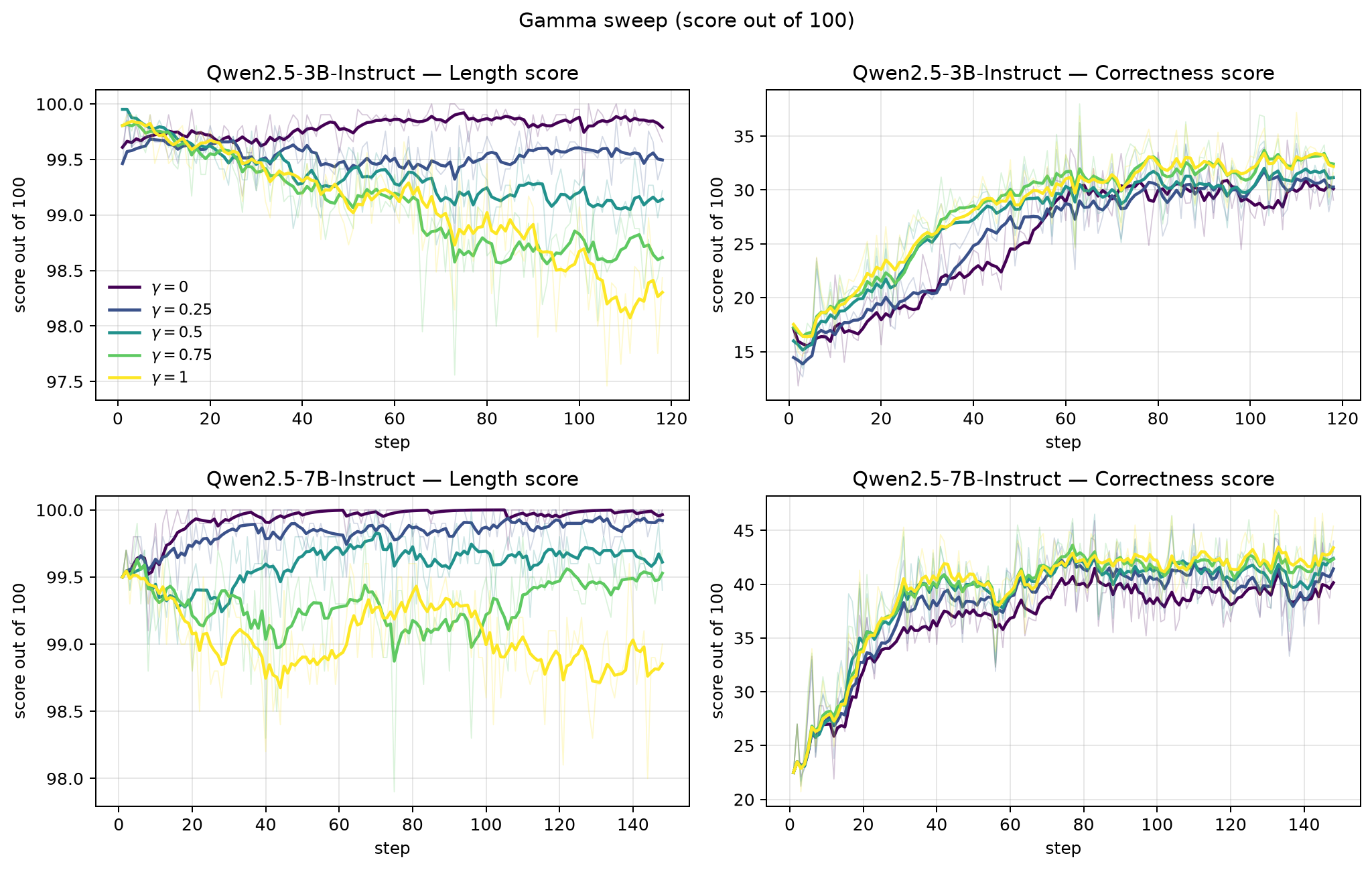
Changing the strength of saturation awareness
The researchers also changed , the setting that controls how strongly saturated objectives are reduced in importance.
They found that:
- Small positive values of usually improved mathematical accuracy compared with
- Larger values shifted more attention toward correctness
- Larger values could also slightly weaken the length objective or lead to longer responses
- A moderate value, especially around in one experiment, gave a good balance
This shows that the method allows researchers to choose how aggressively to focus on difficult objectives.
5. Why are these findings important?
Many real AI systems need to achieve several goals simultaneously. A chatbot may need to be:
- Accurate
- Helpful
- Safe
- Concise
- Properly formatted
These goals do not always improve at the same speed. If the model has already mastered one goal, continuing to train heavily on it may take attention away from harder goals.
SA-MRPO offers a way to make training more flexible. Instead of treating the importance of every goal as fixed forever, it adjusts the training focus as the model develops.
The method can even change the direction of a learning update, not just make the update stronger or weaker. In other words, it may encourage the model to prefer a different answer when one objective has become much more important than another.
6. Limitations and possible risks
The method does not guarantee that already-mastered goals will never get worse.
For example, becoming more accurate at math might require longer explanations. If correctness and shortness conflict, shifting attention toward correctness could slightly harm the length objective.
There is also an important limitation in how saturation is measured. The method estimates how much reward remains compared with the theoretical reward range. But a model may be far from the maximum simply because its size or abilities make that maximum impossible to reach. Therefore, “room left in the score” does not always mean “room the model can realistically improve.”
The method also depends on knowing the lower and upper reward limits for each objective and on choosing a suitable value of .
7. Overall impact
The paper suggests that multi-goal AI training should consider not only which goals matter, but also which goals still need work.
SA-MRPO is a relatively small change to existing reinforcement-learning training methods, but the experiments show promising results. It improved difficult reasoning and coding objectives in many tests while mostly preserving objectives the models had already learned.
If this approach continues to work in larger and more varied experiments, it could help train AI systems that learn more efficiently and balance competing goals more intelligently.
Knowledge Gaps
The paper leaves the following knowledge gaps, limitations, and open questions unresolved:
- No formal convergence or stability analysis is provided for SA-MRPO under dynamically changing saturation weights, batch normalization, clipped updates, and group-relative advantages.
- The relationship between batch-level saturation estimates and true policy-level progress is not established. A batch mean may be highly dependent on prompt composition, rollout sampling, and group size rather than reflecting global objective performance.
- The method assumes known and fixed attainable reward bounds and , but does not explain how these bounds should be obtained for learned, noisy, unbounded, or task-dependent reward functions.
- The impact of inaccurate reward bounds is not evaluated. Misestimated bounds can produce invalid saturation ratios or systematically over- or under-weight objectives.
- Nominal reward headroom is not shown to predict optimizable headroom. The paper acknowledges this mismatch but does not propose a diagnostic, correction, or experiment quantifying how often it occurs.
- The choice of saturation function is insufficiently justified. The power rule is compared only through a limited sweep; alternative mappings, such as adaptive, logarithmic, or uncertainty-aware functions, remain unexplored.
- The saturation exponent is treated as a manually selected global hyperparameter. The paper does not determine how it should be tuned across tasks, training stages, model sizes, or numbers of objectives.
- No adaptive schedule for is investigated, despite the fact that the appropriate reweighting strength may vary as objectives progress or become temporarily unsaturated.
- The effects of batch size, group size, and rollout variance are not systematically studied. These factors may substantially affect per-objective standardization, saturation estimates, and the frequency of zero or unstable advantages.
- Degenerate cases involving zero group standard deviations are not addressed. If all rollouts receive the same reward for an objective, is undefined unless an implementation-specific stabilizer is used.
- The effect of final batch-level advantage normalization is not isolated. Because normalization removes the aggregate scale, it is unclear how much of the observed behavior comes from saturation reweighting versus changes in the batch distribution and sign structure.
- The theoretical claim that SA-MRPO can reverse update directions is not empirically validated at the parameter-update level. The paper illustrates sign changes for rollout advantages but does not measure actual gradient-direction reversals or their frequency during training.
- Objective conflicts are analyzed only locally and theoretically. The experiments do not quantify gradient alignment, conflict frequency, or whether the degradation condition in Equation (13) predicts observed declines in saturated objectives.
- The claim that saturated objectives are maintained is not robustly established. Several results show small degradations in length, format, executability, or bug-related metrics, but there is no statistical analysis or explicit retention guarantee.
- No constrained or Pareto-based baseline is included. The comparison is centered mainly on GDPO, leaving unclear whether SA-MRPO is preferable to methods that explicitly enforce minimum performance constraints or optimize Pareto trade-offs.
- Comparisons with several closely related adaptive multi-reward methods are absent or incomplete. DVAO, GDPO, SAW, Focal Reward, and other dynamic weighting methods are discussed but not evaluated under the same experimental conditions.
- The evaluation does not test more than three objectives. It remains unknown whether saturation-aware weighting scales effectively with many heterogeneous objectives or whether objective interactions become unstable.
- The experiments use a narrow set of mostly binary or rule-based rewards. Generalization to preference-model rewards, learned evaluators, safety objectives, helpfulness, style, and noisy or non-verifiable rewards is unresolved.
- Reward hacking and gaming effects are not investigated. Downweighting an already satisfied objective may encourage the policy to exploit weaknesses in the remaining reward functions or to violate auxiliary constraints that are no longer strongly reinforced.
- The method is not evaluated under dynamically changing or nonstationary reward objectives. It is unclear how quickly saturation weights respond when task distributions, reward definitions, or objective priorities change.
- Cross-prompt heterogeneity is not addressed. An objective may be saturated globally but difficult for particular queries, so batch-wide reweighting could suppress useful learning on minority or difficult subsets.
- The use of a single global saturation value per objective ignores conditional saturation. Future work could estimate saturation by task type, difficulty, domain, or prompt cluster.
- Training reproducibility and statistical significance are insufficiently documented. The paper reports single aggregate results without clearly reporting random-seed variation, confidence intervals, or significance tests.
- The reported gains are not separated from possible differences in effective response length or computational budget. In adaptive reasoning, SA-MRPO produces substantially longer responses, so the accuracy improvements may partly reflect increased inference-time computation rather than better objective allocation alone.
- Inference-time efficiency is not comprehensively evaluated. The method may improve correctness by generating longer outputs, but the trade-off among accuracy, token cost, latency, and energy consumption remains unclear.
- The method’s interaction with KL regularization is unexplored. Although the KL term is omitted from the reward-construction discussion, different KL coefficients could alter objective conflicts, saturation dynamics, and policy drift.
- The effect of unequal prescribed objective weights is not systematically studied. Most evidence concerns particular reward configurations, leaving unclear whether saturation reweighting remains beneficial when priorities are intentionally asymmetric.
- No principled rule is given for combining prescribed importance and saturation. It remains unresolved whether an objective with high external importance should ever be downweighted solely because it is saturated.
- The method’s behavior when an objective is already at its maximum but still has high gradient variance is unclear. Saturation-based suppression may discard useful information or reduce robustness even when the objective helps resolve conflicts.
- The impact of reward sparsity and imbalance is not analyzed. Independently standardized binary rewards may produce unstable advantages when successful rollouts are rare or when objectives have very different frequencies of informative outcomes.
- The reported generalization is limited to a small number of base models and datasets. Broader testing across model families, parameter scales, languages, domains, and training distributions is needed to establish whether the method is generally effective.
- The paper does not examine long-term training behavior. The experiments cover one or three epochs, leaving open whether SA-MRPO prevents premature convergence, causes oscillatory objective performance, or eventually suppresses objectives too aggressively.
- No mechanism is provided for recovering a suppressed objective. If an objective’s performance later deteriorates after being deemed saturated, the paper does not analyze whether batch saturation weighting restores sufficient optimization pressure quickly enough.
Practical Applications
Immediate Applications
- Multi-objective post-training for LLMs (software/AI industry): Integrate SA-MRPO into existing GRPO or GDPO pipelines by replacing only the advantage-construction step. A training workflow can independently normalize rewards such as correctness, safety, formatting, latency, verbosity, and executability, then reduce the weight of objectives that are already near their reward ceiling.
Potential product: a saturation-aware RL trainer or plugin for frameworks such as
verl, with configurable reward bounds, objective weights, and exponent . Dependencies: reliable bounded reward functions, accurate reward ceilings and floors, sufficient rollout diversity, and monitoring for degradation of objectives that receive reduced weight. - Code-generation systems (software engineering): Train coding assistants to prioritize functional correctness and test-case pass rate after basic executability or compilation has been achieved. This could improve coding agents that generate, test, and revise programs, while retaining separate rewards for compilation, runtime validity, style, security, and test coverage. Potential workflow: compile generated code, execute unit tests, compute per-objective rewards, estimate batch saturation, and use SA-MRPO for the next policy update. Evidence from the paper: pass rate improved over GDPO on three of four coding benchmarks, with gains up to 2.3 percentage points. Dependencies: sandboxed execution, representative tests, bounded and trustworthy test-based rewards, and safeguards against gaming incomplete test suites.
- Reasoning-model optimization with length or token-budget constraints (AI products/cloud infrastructure): Apply SA-MRPO when a model must balance answer correctness against response length, latency, or inference cost. Once length compliance is largely satisfied, optimization can focus more strongly on correctness rather than continuing to shorten responses. Potential products: adaptive reasoning models, cost-aware tutoring assistants, and API models with configurable latency or token budgets. Dependencies: length is only a proxy for efficiency; the method should be evaluated for answer quality, latency, and user utility rather than token count alone.
- Structured-output and format compliance (enterprise automation): Jointly optimize semantic quality with JSON validity, schema compliance, XML formatting, citation structure, or tool-call syntax. If formatting is already consistently correct, SA-MRPO can shift training pressure toward substantive accuracy. Potential workflow: use deterministic validators for schema and syntax rewards, independently score content quality, and dynamically reweight the objectives during RL training. Dependencies: validators must reflect real deployment requirements, and format saturation should not be inferred from a narrow or unrepresentative batch.
- Tool-using and agentic LLMs (software/robotics/automation): Combine rewards for successful task completion, valid tool invocation, safety-policy compliance, execution success, and efficiency. Basic tool-call validity may saturate before end-to-end task success, allowing training to focus on planning and outcome quality. Potential product: an agent-training controller that displays objective saturation dashboards and automatically adjusts reward emphasis. Dependencies: verifiable task outcomes, robust safety constraints, non-gameable tool-use rewards, and careful handling of conflicting objectives.
- Research and academic training workflows (academia): Use SA-MRPO as a reproducible baseline for multi-reward RL experiments. Researchers can compare fixed-weight GRPO, GDPO, and SA-MRPO while studying how reward saturation, gradient conflict, model capacity, and affect Pareto tradeoffs. Potential artifact: an open-source implementation with logging for per-objective reward means, saturation ratios, effective weights, advantages, and downstream metrics. Dependencies: the reported gains were obtained mainly on mathematical reasoning and code-generation tasks; broader validation is needed before general conclusions are drawn.
- Evaluation and training diagnostics: Track saturation ratios as an operational signal indicating which objectives still have optimization headroom. Training teams can use these values to identify wasted gradient budget, poorly designed reward functions, or objectives that are too easy relative to the main task. Potential tool: a dashboard showing , effective weights , reward variance, gradient alignment, and objective-specific validation scores. Dependencies: batch means can be noisy or distribution-dependent; dashboards should include confidence intervals and held-out evaluations.
- Policy and governance for AI training: Use saturation-aware reward allocation as a practical design pattern for systems subject to multiple measurable requirements, such as safety, factuality, privacy, latency, and helpfulness. Policymakers and auditors could require reporting of objective definitions, reward bounds, dynamic weights, and evidence that safety objectives are not being neglected. Dependencies: adaptive weighting is not a safety guarantee. Safety and compliance objectives may require hard constraints, rejection filters, or independent audits rather than merely reduced or increased reward weights.
- Daily-life applications through deployed assistants: Improve consumer assistants that must balance helpfulness, factual accuracy, brevity, formatting, and safety. For example, after an assistant reliably follows a response-length preference, training could focus more on factual correctness or task completion. Dependencies: the method affects model training rather than directly adapting an individual user session; personalization requires additional user-specific reward signals and privacy safeguards.
Long-Term Applications
- Constraint-aware and safety-critical language-model alignment (healthcare, finance, legal services): Extend SA-MRPO to systems that optimize correctness, regulatory compliance, uncertainty calibration, privacy, refusal behavior, and usefulness. Saturation-aware allocation could focus learning on the least-developed measurable dimension while preserving already strong constraints. Potential products: domain-specific models with adaptive alignment controllers and auditable objective-allocation logs. Dependencies: safety and legal requirements often need minimum guarantees, not soft optimization. Future systems should combine SA-MRPO with constrained optimization, lexicographic priorities, or worst-case objectives.
- Healthcare decision-support models: Train assistants that jointly optimize diagnostic accuracy, evidence citation, calibrated uncertainty, patient readability, privacy, and refusal of unsafe recommendations. Saturation-aware weighting could shift effort from already reliable formatting or citation compliance toward harder clinical reasoning tasks. Dependencies: requires clinically validated rewards, expert review, distribution-shift testing, prospective evaluation, and strict human oversight. The paper provides no evidence of clinical safety or medical effectiveness.
- Educational tutoring and adaptive learning: Optimize tutoring models for answer correctness, pedagogical explanation quality, age appropriateness, brevity, engagement, and curriculum alignment. Once formatting or basic answer correctness is saturated, the trainer could emphasize explanation quality or misconception correction. Potential workflow: collect verifiable student outcomes and rubric-based evaluations, estimate objective saturation by learner group, and train separate policies for different educational levels. Dependencies: educational rewards are difficult to bound and may be noisy or subjective; improvements in benchmark reasoning do not establish improved learning outcomes.
- Robotics and embodied agents: Apply the method to policies balancing task success, collision avoidance, energy consumption, path length, hardware wear, and human comfort. For example, once collision avoidance is consistently satisfied in a controlled environment, training could emphasize task completion or energy efficiency. Potential product: a robot-training framework using simulator-verifiable rewards and saturation-aware policy updates. Dependencies: real-world rewards are often delayed, sparse, and nonstationary; safety-critical objectives should remain protected by hard constraints. Sim-to-real transfer and sensor noise require extensive validation.
- Autonomous vehicles and drones: Dynamically allocate learning effort among route completion, traffic-rule compliance, collision avoidance, passenger comfort, energy efficiency, and response time. Dependencies: a purely reward-weighted approach is insufficient for safety certification. Formal verification, fail-safe controllers, conservative exploration, and independent safety monitors would be required.
- Energy management and smart-grid control: Train controllers that balance power demand, operating cost, emissions, reliability, storage degradation, and user comfort. As a target such as demand tracking becomes saturated under normal conditions, training could focus on emissions or resilience under unusual demand patterns. Potential product: adaptive control policies for batteries, buildings, microgrids, and data centers. Dependencies: reward bounds must reflect physical and regulatory limits; rare-event performance, changing grid conditions, and stability guarantees require further research.
- Finance and algorithmic decision systems: Explore multi-objective policy optimization for portfolio allocation or resource scheduling using returns, drawdown, liquidity, transaction cost, regulatory compliance, and fairness objectives. Saturation-aware weighting could emphasize risk or compliance dimensions that remain weak. Dependencies: financial rewards are nonstationary and adversarial, and “attainable maxima” are difficult to define. Deployment would require strong risk limits, backtesting under regime changes, interpretability, and regulatory approval.
- Pareto-aware and preference-conditioned extensions: Develop methods that combine saturation-aware reweighting with Pareto-front optimization, user-conditioned preferences, or context-dependent objective priorities. Rather than using only a batch-global saturation ratio, future systems could estimate saturation per task type, user, domain, or environmental condition. Potential tool: a policy that selects objective weights based on both current reward headroom and explicit stakeholder preferences. Dependencies: this requires resolving conflicts between global efficiency and local user preferences, avoiding unstable weight changes, and evaluating performance across the full Pareto frontier.
- Optimizable-headroom estimation: Replace nominal saturation, based on prescribed reward bounds, with an estimate of achievable improvement under the current model, data distribution, and policy class. This could involve learning upper bounds, measuring learning progress, or estimating gradient potential. Why it matters: an objective may have substantial nominal headroom but little improvement available because of model-capacity limits or flawed data. Dependencies: reliable estimation is an open research problem and could introduce additional bias or instability.
- Conflict-aware constrained reweighting: Combine SA-MRPO with gradient-alignment methods, trust regions, rollback mechanisms, or minimum-performance constraints to prevent a saturated objective from degrading sharply. The paper explicitly notes that conflicting objectives can cause such degradation and that SA-MRPO does not guarantee monotonic retention. Potential product: a trainer that discounts saturated objectives only while their held-out performance remains above a specified floor. Dependencies: requires accurate gradient-conflict measurements, reliable validation signals, and additional computational overhead.
- Online and continual-learning systems: Adapt objective weights as environments, tasks, or user requirements change. A model could reallocate training effort when a previously saturated objective regresses or when a new objective becomes important. Dependencies: online reward drift, catastrophic forgetting, delayed feedback, and the risk of unstable adaptation require replay buffers, safety gates, and continual evaluation.
- Large-scale production RL infrastructure: Integrate saturation-aware weighting into distributed rollout systems, inference servers, and automated hyperparameter tuning. The method is attractive operationally because it leaves the standard clipped GRPO update unchanged and adds mainly reward-statistics computation. Dependencies: large-scale deployment still requires tests for batch-size sensitivity, reward variance, heterogeneous task mixtures, communication latency, computational cost, and robustness beyond the paper’s three-epoch experiments.
Glossary
- Advantage estimation: The process of computing an advantage value that measures how favorable a rollout is relative to a baseline or comparison group. “GRPO estimates the advantage of a rollout by comparing its reward with the other rollouts generated for the same query.”
- Advantage normalization: Rescaling advantage values, typically by subtracting their mean and dividing by their standard deviation. “We therefore normalize the aggregate advantages over the current batch”
- Auto-regressive distribution: A probability distribution over a sequence in which each element is generated conditionally on the preceding elements. “the policy defines an auto-regressive distribution over an output sequence”
- Batch-level estimate: A statistic computed across all examples in a training batch rather than from an individual example. “we estimate saturation using the batch-mean reward relative to the objective's attainable range”
- Batch normalization: Standardization of values across a batch to control their scale during optimization. “The resulting advantage is directly used in the standard clipped group relative surrogate objective”
- Clipped surrogate objective: An optimization objective that limits policy-ratio changes to a specified interval to prevent excessively large updates. “GRPO maximizes the clipped surrogate objective”
- Cross-objective terms: Components of an update that describe how optimization for one objective affects another objective. “the cross objective terms describe how updates induced by the remaining objectives affect objective .”
- Dynamic objective allocation: The adaptive distribution of optimization effort among objectives as their relative progress changes. “The saturation rule therefore provides an adaptive allocation mechanism”
- Executability: The property of a generated program being able to compile and run without errors. “Executability captures a basic validity requirement that can become satisfied before full functional correctness.”
- Gradient alignment: The degree to which gradients for different objectives point in similar directions, often measured by their inner product. “limited capacity is only one possible mechanism that can produce negative gradient alignment.”
- Gradient budget: The limited amount of optimization effort or parameter-update capacity available during training. “training continues to allocate gradient budget to already-solved objectives”
- Group Relative Policy Optimization (GRPO): A reinforcement-learning method that estimates rollout advantages by comparing rewards within groups of sampled outputs. “Group Relative Policy Optimization (GRPO) and its variants simplify this process by estimating advantages from groups of rollouts”
- Group reward-decoupled policy optimization (GDPO): A multi-reward policy-optimization method that independently normalizes each reward dimension before combining them. “GDPO distinguishes the two profiles but assigns a larger advantage to rollout $3$”
- Headroom: The remaining attainable improvement between an objective’s current reward and its maximum possible reward. “This dynamically reallocates optimization effort toward under-optimized objectives”
- KL penalty: A regularization term based on Kullback–Leibler divergence that discourages a learned policy from moving too far from a reference policy. “As in standard GRPO, a KL penalty against a fixed reference policy may additionally be included”
- Multi-objective alignment: The process of training a model to satisfy several potentially competing goals simultaneously. “LLM alignment frequently involves multiple objectives”
- Nominal reward headroom: The fraction of a prescribed reward range that remains unrealized, without accounting for model limitations. “Thus, should be interpreted as a measure of remaining nominal reward headroom”
- Objective saturation: The state in which an objective is close to its maximum attainable reward and further optimization yields little additional benefit. “fixed weights ignore objective saturation”
- Pass@1 accuracy: The proportion of problems solved correctly when considering one generated answer or the top-ranked answer. “report the average pass@1 accuracy.”
- Policy gradient: A gradient-based reinforcement-learning update that adjusts policy parameters to increase the probability of advantageous actions or sequences. “the gradient budget to already-solved objectives”
- Policy surrogate: An auxiliary objective used to optimize a policy, often involving probability ratios and estimated advantages. “Let denote an objective specific policy surrogate”
- Policy update direction: The direction in parameter space specified by the gradient used to modify a policy. “We further show that saturation-aware reweighting can reverse the sign of an update”
- Proximal Policy Optimization (PPO): A policy-gradient reinforcement-learning algorithm that constrains updates using a clipped probability ratio or related trust-region mechanism. “avoiding the learned value function required by PPO”
- Reward ceiling: The maximum value that a reward objective can attain. “a larger indicates that the objective is closer to its reward ceiling.”
- Reward decoupling: Treating reward dimensions independently during normalization or advantage computation instead of combining them first. “While reward decoupling preserves information from individual reward dimensions”
- Reward scalarization: Combining multiple reward values into one scalar, usually through a weighted sum. “The standard approach is to combine these objectives through a fixed weighted sum”
- Reward variance: A measure of how much reward values differ from their mean, used in some adaptive weighting methods. “DVAO adapts objective weights according to reward variance”
- Rollout: A sampled sequence of actions or tokens produced by a policy in response to an input. “For each query , a frozen behavior policy generates a group of rollouts”
- Saturation-aware reweighting: Adaptive adjustment of objective weights according to how much of each objective’s attainable reward has already been achieved. “SA-MRPO preserves per-objective normalization while adaptively reweighting each objective according to its current degree of saturation.”
- Saturation exponent: A hyperparameter controlling the strength with which saturated objectives are downweighted. “A single exponent controls the strength of this saturation-aware reweighting.”
- Saturation ratio: A normalized measure of an objective’s current reward relative to its lower and upper reward bounds. “We then define the saturation ratio of objective as”
- Standard deviation: A statistical measure of the dispersion of values around their mean. “the mean and the standard deviation of is represented as”
- Token-level probability ratio: The ratio between the updated policy’s probability and the behavior policy’s probability for a particular generated token. “where the expectation is taken over and ”
- Verifiable reward: A reward that can be automatically determined from objectively checkable properties of a generated output. “Reinforcement learning with verifiable rewards (RLVR) has emerged as a standard approach”
- Weighted sum: A scalar formed by multiplying each objective value by a prescribed weight and adding the results. “existing methods typically scalarize the reward vector with a fixed weighted sum before group-wise standardization.”