Too Correct to Learn: Reinforcement Learning on Saturated Reasoning Data
Abstract: Reinforcement Learning (RL) enhances LLM reasoning, yet a paradox emerges as models scale: strong base models saturate standard benchmarks (e.g., MATH), yielding correct but homogeneous solutions. In such environments, the lack of failure cases causes the advantage signal in group-relative algorithms (e.g., GRPO) to vanish, driving policies into mode collapse. To address this, we propose Constrained Uniform Top-K Sampling (CUTS), a parameter-free decoding strategy enforcing structure-preserving exploration. Unlike standard sampling that follows model biases, CUTS flattens the local optimization landscape by sampling uniformly from constrained high-confidence candidates. We integrate this into Mixed-CUTS, a training framework synergizing exploitative and exploratory rollouts to amplify intra-group advantage variance. Experiments on Qwen3 models demonstrate that our approach prevents policy degeneration and significantly boosts out-of-domain generalization. Notably, Mixed-CUTS improves Pass@1 accuracy on the challenging AIME25 benchmark by up to 15.1% over standard GRPO, validating that maintaining diversity within the semantic manifold is critical for rigorous reasoning.
Paper Prompts
Sign up for free to create and run prompts on this paper using GPT-5.
Top Community Prompts
Explain it Like I'm 14
What is this paper about?
This paper looks at how to teach large AI LLMs to reason better using reinforcement learning (RL). The problem they found is surprising: when the practice problems are too easy (the model already gets most of them right), the model actually stops learning. The authors propose a simple way of making the model “explore” different, still sensible solution paths so it keeps improving, even on easy datasets.
What are the big questions the paper asks?
- Why do RL methods for reasoning models stop improving when the training data is “too easy” or already “solved” by the model?
- How can we keep learning signals alive without making the model produce random, messy answers?
- Can a simple change in how we pick the model’s next words (decoding) make training more diverse and effective?
How did they approach it? (In plain words)
Think of training like coaching a team:
- In group-based RL (they use a method called GRPO), you ask the model to produce several solutions to the same problem, score them, and then push the model toward the better ones. This only works if some solutions are better than others—there needs to be a contrast.
- On “saturated” data (tests that are too easy), the model’s solutions are all correct and very similar. That means the differences in scores disappear, and the training signal fades. The model gets stuck repeating the same style of answer—this is called “mode collapse.”
To fix this, the authors change how the model samples its next words:
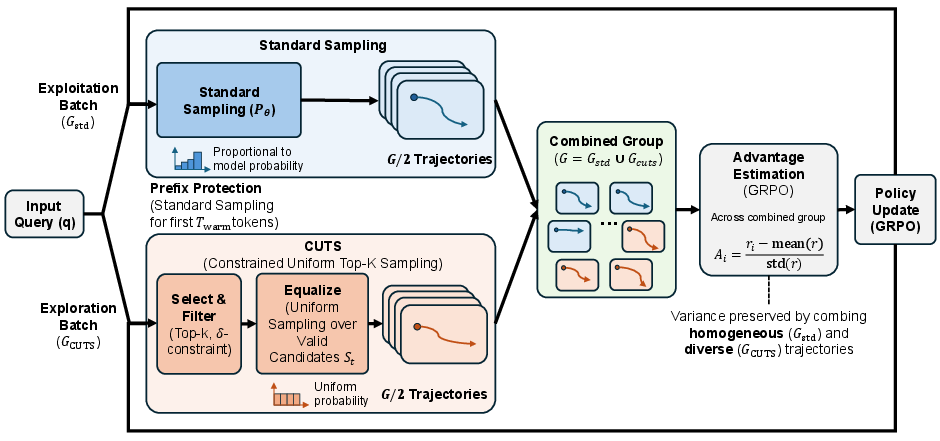
- Constrained Uniform Top‑K Sampling (CUTS):
- At each step, the model looks at the K most likely next tokens (words/symbols).
- It filters out tokens that are too unlikely to keep things sensible.
- Then, instead of always picking the single most likely token, it picks uniformly at random among the remaining top choices.
- Everyday analogy: It’s like always choosing a snack from a top shelf of good options, but instead of always taking your single favorite, you roll a fair die among the best ones. You still eat something good, but you try more variety.
They combine this with normal sampling:
- Mixed‑CUTS:
- For each problem, half the solutions are generated the usual way (exploit what already works).
- The other half use CUTS (explore other good-but-less-used routes).
- Mixing these two keeps results diverse enough that some answers are better than others—bringing back the training signal without making the model go off the rails.
Key ideas explained simply:
- “Saturated data”: practice that’s too easy—no room to learn.
- “Advantage signal”: the score difference that tells the model which solution was better. If all scores are the same, learning stalls.
- “Mode collapse”: the model sticks to one way of solving things and stops exploring.
- CUTS is “parameter‑free”: it doesn’t add new model parts; it just changes how we choose words during generation.
What did they find, and why is it important?
- CUTS + Mixed‑CUTS prevent the model from getting stuck when data is too easy. The model keeps trying different, still sensible solution paths.
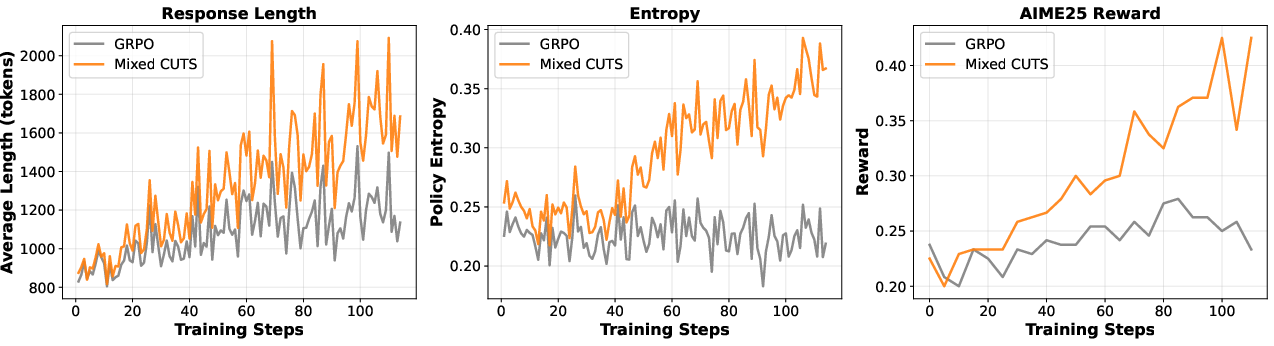
- On hard math tests, this led to big improvements. For example, on AIME’25 (a tough competition math set), their method improved Pass@1 (getting the problem right on the first try) by up to about 15 percentage points compared to a standard RL method (GRPO) using the same base model.
- The method also helped the model reason more consistently across multiple tries and produce longer, more thoughtful solutions when needed.
- Even though they trained only on math, the improvements carried over a bit to other subjects (small but real gains on general knowledge benchmarks). That suggests the model’s overall reasoning got better, not just its math tricks.
Why this matters:
- It shows that when models are “too correct” on training data, you must reintroduce safe diversity so they don’t stop learning.
- A simple decoding change (CUTS) during training can keep learning signals alive without making the model sloppy.
- This can help future models continue improving even as common benchmarks get easier for them over time.
What’s the takeaway?
As AI models get stronger, many training sets become “too easy,” and learning stalls. This paper shows a practical fix: keep exploration inside the model’s high‑confidence choices and mix it with normal generation. That small change keeps training healthy, improves performance on harder problems, and even boosts general reasoning a bit beyond the training domain. It’s a lightweight way to help models keep growing their reasoning skills without needing new model parts or massive new datasets.
Knowledge Gaps
Knowledge gaps, limitations, and open questions
Below is a single, concrete list of what remains missing or uncertain in the paper, formulated to guide actionable follow-up work.
- Lack of formal theory: no convergence, monotonic improvement, or sample-complexity guarantees for GRPO with a mixed behavior policy induced by CUTS; need bounds on off-policy bias accumulation under PPO clipping across long horizons.
- No principled exploration criterion: uniformization over Top‑K with threshold δ is heuristic; a theory linking decoding-level flattening, advantage-variance preservation, and policy improvement is absent.
- Sensitivity to decoding hyperparameters unstudied: no ablations for K, δ, and their schedules; need cross-dataset, cross-model sensitivity analyses and default-setting guidelines.
- Fixed 50/50 mix ratio: no study of the exploitation–exploration split’s effect on advantage variance, stability, and performance; adaptive, per-prompt mixing policies are unexplored.
- Group size dependence: how group size G interacts with CUTS to preserve intra-group variance is not analyzed; determine minimal G to avoid vanishing advantage and its compute trade-offs.
- Behavior in non-saturated regimes: impact of CUTS when baseline success is low and variance is naturally high is untested; risk that uniformization harms learning on challenging datasets.
- Comparison breadth: baselines omit alternative variance/diversity mechanisms (temperature/top‑p schedules, diverse beam search, Gumbel sampling, entropy bonuses configured for reasoning, KL-regularized PPO, RLVR/verification-guided RL, self-consistency-driven training); need controlled head-to-heads.
- Algorithm generality: only GRPO is examined; applicability to PPO with value critics, AWR/IMPALA, off-policy methods, or RLVR variants is not evaluated.
- Reward design scope: only outcome (binary correctness) is used; interactions with process rewards, partial credit, verifier-guided rewards, or self-rewarding RL remain untested.
- Robustness to reward noise: stability of Mixed-CUTS under noisy or biased judges/verifiers is unassessed; quantify resilience to label noise and reward hacking.
- Compute/efficiency trade-offs unquantified: CUTS increases entropy and length; no analysis of training tokens, wall-clock time, and cost-per-point improvement or sample efficiency.
- Inference-time usage unclear: operator is described as inference-time but used during training; need a clear evaluation of CUTS at inference on Pass@1/Pass@k, latency, and calibration.
- Calibration effects: uniformizing local distributions may distort token-level calibration; no measurement of calibration error or likelihood quality post-training.
- Length/verbosity bias: longer chains under CUTS are observed, but whether gains stem from better reasoning or verbosity is not disentangled; analyze minimality, stop criteria, and reasoning-step correctness.
- Failure-case analysis missing: GPQA Pass@16 regressions and other dips lack explanation; need error taxonomies to identify when CUTS hurts and why.
- Model diversity: evaluation limited to Qwen3-1.7B/4B non-thinking; need tests on other families (Llama, Mistral, DeepSeek, Phi), larger scales (7B–34B+), and thinking-mode policies to assess generality.
- Domain breadth: training only on MATH; cross-domain gains are small and narrow; evaluate on code (HumanEval/MBPP), planning/agents (ALFWorld/BabyAI), scientific QA, and multimodal reasoning to validate transfer.
- Saturation detection: no metric or trigger to detect per-prompt/dataset saturation; design adaptive controllers that enable CUTS only when variance collapses.
- Safety and alignment: uniformized sampling could increase generation of unsafe or off-distribution content; effects on refusal calibration and harmful output rates are not studied.
- Interaction with test-time scaling: complementarity with self-consistency, majority voting, budget forcing (e.g., s1), and in-context exploration recipes (e3) is unmeasured.
- KL/constraint monitoring: policy drift from reference under Mixed-CUTS is not tracked; define safe KL ranges and measure drift to prevent catastrophic forgetting.
- Statistical reliability: results lack confidence intervals and multi-seed variance; quantify run-to-run variability and training stability.
- Advantage-variance instrumentation: while the method targets intra-group variance, direct measurements of per-prompt advantage variance over training are not reported.
- Exploration set construction: alternative constraints beyond probability thresholding (e.g., verifier-filtered candidate sets, structural/grammar constraints, prefix diversity) are not compared.
- Curriculum interactions: whether CUTS reduces reliance on hard-example mining or interacts beneficially with curriculum learning is uninvestigated.
- Reproducibility: code, configurations, and full training details (e.g., hyperparameter sweeps, seeds) are not provided in the main text; open artifacts would enable independent verification.
Practical Applications
Immediate Applications
The paper introduces CUTS (Constrained Uniform Top-K Sampling) and Mixed-CUTS (a hybrid exploratory–exploitative rollout scheme for GRPO-style RL) that can be used today to stabilize learning on saturated datasets and to diversify high-confidence reasoning paths at inference time. The following applications can be deployed with modest engineering effort:
- Production inference “diverse reasoning” mode for assistants
- Sector: software, education, enterprise knowledge management
- What: Add a decoding option that samples uniformly within Top-K tokens above a probability threshold (CUTS) to generate multiple high-confidence but diverse chains of thought; combine with majority vote/self-consistency.
- Tools/products/workflows:
- “Uniform Top-K” sampling flag in inference servers (vLLM/TGI/Triton).
- UI toggle: “Try another approach” to surface alternative correct explanations.
- Self-consistency pipelines that mix standard sampling with CUTS for higher pass@k and more robust consensus.
- Assumptions/dependencies: Access to token logits and Top-K filtering; compute budget for multiple rollouts; safe CoT handling policies.
- RL fine-tuning on saturated datasets without new data
- Sector: AI/ML industry, open-source labs, academia
- What: Integrate Mixed-CUTS into GRPO/RLHF/RLVR pipelines to maintain intra-group reward variance when base models already solve most training items (e.g., MATH), preventing mode collapse and sustaining learning.
- Tools/products/workflows:
- “Mixed-CUTS trainer” plugin that splits per-prompt rollouts into standard and CUTS subgroups.
- MLOps monitors for advantage variance and reward std to detect saturation-induced collapse.
- Assumptions/dependencies: Existing GRPO/ppo-style pipeline; reward signals (exactness, unit tests, rule-based verifiers); proper K and δ tuning; trust-region clipping to bound off-policy bias.
- Education-focused solution diversity
- Sector: education
- What: Math tutors and STEM learning tools generate multiple valid methods (algebraic, geometric, numerical) by forcing exploration within high-confidence tokens; improves pedagogy and metacognition.
- Tools/products/workflows: “Show another method” teaching aid; step-by-step solution comparator.
- Assumptions/dependencies: Quality base model with multiple plausible local continuations; alignment to prevent hallucinated steps.
- Code assistant diversification within safe bounds
- Sector: software engineering
- What: CUTS at inference generates alternative snippets/implementations that remain near the model’s high-confidence distribution; improves pass@k and majority vote when combined with unit-test selection.
- Tools/products/workflows: Test-time generation with CUTS + unit-test filter; “Alternative implementation” quick actions in IDEs.
- Assumptions/dependencies: Fast unit-test harness; Top-K includes semantically valid tokens; safety checks for dangerous APIs.
- Better evaluation and benchmarking under saturation
- Sector: academia, model evaluation organizations
- What: Use Mixed-CUTS during evaluation harnesses to test generalization and detect stagnation on overfitted benchmarks; track intra-group variance as a health signal.
- Tools/products/workflows: Evaluation scripts that report advantage variance, pass@k with/without CUTS; dataset “saturation meters.”
- Assumptions/dependencies: Access to logits during eval; compute for multiple rollouts.
- Enterprise Q&A and RAG answer cross-checking
- Sector: enterprise software, legal, compliance
- What: Generate multiple high-confidence reasoning paths to validate answers against retrieved evidence, reducing myopic, single-path errors.
- Tools/products/workflows: RAG pipelines with CUTS sampling + entailment/consistency checks; consensus-based response selection.
- Assumptions/dependencies: Reliable verifiers (e.g., entailment models), governance rules for multi-sample inference costs.
- Workflow-level knobs for exploration vs. exploitation
- Sector: platform/infra
- What: Expose K and δ as configuration in API/SDKs to tune exploration without degrading coherence; log and audit CUTS usage.
- Tools/products/workflows: API parameters for top_k_uniform and min_prob; dashboards tracking entropy and variance.
- Assumptions/dependencies: Careful defaults to avoid incoherent tail tokens; monitoring for unexpected failure modes.
Long-Term Applications
Realizing these applications may require further research, domain verifiers, scaling, or safety frameworks:
- Agentic planning with structure-preserving exploration
- Sector: robotics, logistics, operations, energy management
- What: Use CUTS-like exploration for action/plan tokenization to diversify candidate plans while staying within plausible local choices; select via simulators or process verifiers.
- Tools/products/workflows: Planning agents with CUTS planning mode + verifier (simulator, rule checker); majority-vote or search-based selection.
- Assumptions/dependencies: Robust task-specific verifiers/simulators; safety constraints; tokenization that reflects action semantics.
- Clinical decision support and diagnostic brainstorming
- Sector: healthcare
- What: Generate high-confidence differential diagnoses and workups that explore diverse, plausible paths; clinicians review consensus and discrepancies.
- Tools/products/workflows: Clinical assistant with CUTS-based multi-hypothesis generation + medical guideline checker.
- Assumptions/dependencies: Strong medical verifiers, regulatory approval, strict human-in-the-loop control, domain-tuned models to avoid unsafe exploration.
- Financial and policy scenario exploration
- Sector: finance, public policy, macroeconomic planning
- What: Diversified, high-confidence scenario analyses to reduce bias from a single dominant narrative; combine with risk and compliance verifiers.
- Tools/products/workflows: Policy/portfolio planners with CUTS sampling + risk engines; consensus or robust-optimization selectors.
- Assumptions/dependencies: High-quality risk/verifier models; governance over exploration bounds and reporting.
- Continuous self-improvement and auto-curricula
- Sector: AI platforms, academia
- What: Use Mixed-CUTS to surface edge-case failures and novel strategies on “easy” datasets, auto-curate harder data for curriculum progression.
- Tools/products/workflows: Self-training loops that harvest divergent CUTS paths into new training items; difficulty-aware schedulers.
- Assumptions/dependencies: Data filtering pipelines, deduplication and quality assurance; compute for iterative RL.
- Code generation RL at scale with robust generalization
- Sector: software, DevOps
- What: Apply Mixed-CUTS to RL for code LLMs where common tasks are saturated; maintain advantage signals for harder/out-of-domain coding challenges.
- Tools/products/workflows: RLVR/GRPO for code with CUTS rollouts + unit/property tests and static analyzers as reward verifiers.
- Assumptions/dependencies: Extensive automated test suites; guardrails for security and licensing.
- Safety alignment frameworks with exploration controls
- Sector: AI governance, compliance
- What: Standardize “exploration budgets” and local-uniformity controls to balance performance and safety; audit logs for exploration paths.
- Tools/products/workflows: Policy artifacts defining K/δ ranges in regulated settings; compliance checks on multi-sample outputs.
- Assumptions/dependencies: Sector-specific safety thresholds; monitoring infrastructure; accepted auditing standards.
- Theoretical guarantees and broader model families
- Sector: academia, foundation model developers
- What: Extend formal analysis of decoding-time uniformization with RL objectives; generalize to other RL variants (e.g., PPO with critics), modalities, and larger scales.
- Tools/products/workflows: Open-source libraries exposing CUTS/Mixed-CUTS with proofs and defaults; benchmarking suites across domains (code, planning, multimodal).
- Assumptions/dependencies: Research into convergence and off-policy effects; community benchmarks beyond math.
- Retrieval and knowledge workflows that avoid echo chambers
- Sector: enterprise search, legal research, scientific discovery
- What: Use CUTS to generate diverse yet plausible interpretations of retrieved evidence; reduce over-reliance on the most frequent phrasing or source.
- Tools/products/workflows: RAG with exploration-aware decoding; evidence triangulation and contradiction detection pipelines.
- Assumptions/dependencies: Strong evidence scorers; source diversity; policies for presenting disagreements to users.
These applications hinge on a few common assumptions: base models must be competent enough that Top-K neighborhoods contain coherent tokens; verifiers or reward signals must exist to select among diverse candidates; and operational constraints (compute, safety, and governance) must be respected. When these conditions hold, CUTS and Mixed-CUTS provide a low-friction way to regain learning signal on saturated tasks and to deliver more reliable, generalizable reasoning in real systems.
Glossary
- advantage signal: The relative improvement signal (reward minus baseline) that weights policy updates in RL. "the advantage signal in group-relative algorithms (e.g., GRPO) to vanish, driving policies into mode collapse."
- AIME25: A challenging competition math benchmark (American Invitational Mathematics Examination 2025 subset) used to evaluate reasoning. "Mixed-CUTS improves Pass@1 accuracy on the challenging AIME25 benchmark by up to 15.1\% over standard GRPO,"
- autoregressive decoding: A generation process where each token is sampled conditioned on the prior context. "Standard autoregressive decoding samples from ."
- behavior policy: The policy that generates the data used for learning, which can differ from the target policy being optimized. "Although Mixed-CUTS induces a mixed behavior policy , we retain the standard clipped objective with $\pi_{\theta_{\text{old}$,"
- clipped surrogate objective: A PPO-style objective that clips the policy ratio to stabilize learning updates within bounds. "The policy is then updated by maximizing a clipped surrogate objective that ensures stability within a trust region:"
- Constrained Uniform Top-K Sampling (CUTS): A decoding method that samples uniformly among a constrained set of high-confidence tokens to encourage structured exploration. "we propose Constrained Uniform Top-K Sampling (CUTS), a parameter-free decoding strategy enforcing structure-preserving exploration."
- critic: The value-estimating component in actor–critic RL used to compute baselines/advantages. "GRPO eliminates the critic to reduce memory overhead,"
- entropy regularization: An RL regularizer that encourages exploration by penalizing low-entropy (overconfident) policies. "Standard entropy regularization fails here by indiscriminately penalizing confidence, disrupting coherent reasoning rather than restoring learning signals"
- Exploitation Batch: The subset of rollouts generated by standard sampling to follow the current policy’s bias. "Exploitation Batch ($\mathcal{G_{\text{std}$):} Trajectories generated via standard sampling, which anchor the baseline to the policy's current bias."
- Exploration Batch: The subset of rollouts generated by CUTS to inject diversity and uncover alternative solutions. "Exploration Batch ($\mathcal{G_{\text{CUTS}$):} Trajectories generated via CUTS, which inject diversity by uncovering plausible but under-explored paths."
- Group Relative Policy Optimization (GRPO): An RL algorithm that standardizes rewards within a group to compute advantages without a separate value network. "algorithms like Group Relative Policy Optimization (GRPO) \citep{shao2024deepseekmath} transform models from pattern matchers into rigorous reasoners"
- importance ratio: The ratio between current and reference policy probabilities used in PPO-style updates. "the PPO clipping on the importance ratio $\pi_\theta/\pi_{\theta_{\text{old}$ further limits the per-step policy update,"
- intra-group variance: The variance of rewards among samples in the same group, crucial for learning signal in group-relative methods. "intra-group reward variance collapses toward zero."
- law of total variance: A statistical identity that decomposes total variance into within-group and between-group components. "By the law of total variance applied to the combined group,"
- majority-vote consistency: The stability of answers when aggregating multiple samples via voting (e.g., maj@k). "substantially stronger majority-vote consistency."
- Mixed-CUTS: A training framework that mixes standard and CUTS-generated rollouts to preserve variance and prevent collapse. "We integrate this operator into Mixed-CUTS, a framework leveraging a dual-stream rollout strategy to amplify GRPO's intra-group variance."
- mode collapse: A degeneration where the model concentrates on a few dominant outputs, losing diversity. "driving policies into mode collapse."
- off-policy bias: The bias arising when optimizing a policy using data generated by a different behavior policy. "the resulting off-policy bias is tightly bounded by three compounding restrictions."
- Pass@1: A metric measuring the probability of getting a correct answer with a single sampled attempt. "We report Pass@1 and Pass@16 (\%) across five benchmarks, including "Thinking Mode" baselines for reference."
- Proximal Policy Optimization (PPO): An on-policy RL algorithm using clipped objectives for stable policy updates. "Unlike PPO \citep{schulman2017proximal} that requires a parametric value network,"
- proposal distribution: An alternative distribution from which samples are drawn during decoding instead of the model’s raw distribution. "constructs a locally flattened proposal distribution "
- reference policy: The previous or fixed policy used for sampling and computing importance ratios in policy optimization. "the reference policy $\pi_{\theta_{\text{old}$ samples outputs "
- rollout: A sampled trajectory (from prompt to response) used to evaluate and update the policy. "The framework combines exploitative rollouts () and exploratory rollouts () to preserve advantage variance under saturated training conditions."
- saturated reasoning data: Datasets on which strong base models already achieve very high accuracy, reducing useful training signal. "This growing prevalence of saturated reasoning data fundamentally alters the learning dynamics of RL for LLMs."
- Top-K candidate set: The set of the K most probable tokens considered during decoding. "within a constrained Top- candidate set,"
- trust region: A constraint region that limits how much the policy can change in a single update to maintain stability. "ensures stability within a trust region:"
- uniform prior: A distribution assigning equal probability to all items in a set. "we define the proposal distribution as a uniform prior:"
- vanishing-advantage problem: A failure mode where standardized advantages approach zero, stalling optimization. "The Vanishing-Advantage Problem."
- width-first exploration: An exploration strategy that spreads probability across multiple plausible options rather than following the single most likely path. "This equalization enforces local ``width-first'' exploration,"
Collections
Sign up for free to add this paper to one or more collections.

