DeepLoop: Depth Scaling for Looped Transformers
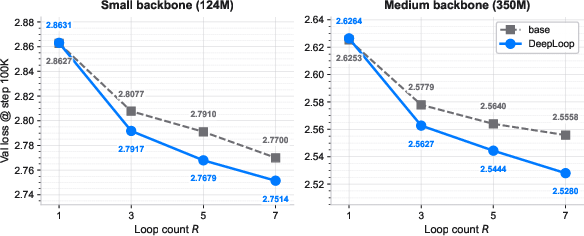
Abstract: Looped Transformers scale sequential computation by applying a compact stack of physical blocks for multiple rounds, increasing unrolled depth without increasing stored parameters. This reuse changes the residual-scaling problem: in an untied Transformer, each residual branch receives and applies its own parameter update, whereas in a looped Transformer one shared update aggregates gradients from repeated visits and is read back by those same visits in the next linearized forward pass. We formalize this tied-depth effect through a first-order perturbation bound controlled by a visit-alignment coefficient $κ_R$. The bound recovers the DeepNorm exponent when visits decorrelate, but in the conservative aligned regime it requires the exponent to increase from $1/4$ to $1/2$ as loop count grows at fixed physical depth. The resulting method, \textbf{DeepLoop}, keeps the Post-LN DeepNorm architecture and sets $α=(2N){1/2}$ and $β=(8N){-1/2}$ for unrolled depth $N$. On GPT-style looped LLMs at GPT-2 small and GPT-2 medium scale, DeepLoop is neutral when no physical block is revisited and improves validation loss and downstream accuracy once recurrent depth is activated. These results show that stable recurrent depth requires residual scaling rules that account for parameter visits, not only nominal layer count.
Paper Prompts
Sign up for free to create and run prompts on this paper using GPT-5.
Top Community Prompts
Explain it Like I'm 14
What this paper is about (big picture)
This paper is about making a special kind of Transformer (a popular AI model) work better when it reuses the same layers multiple times. Instead of stacking lots of different layers (which costs lots of memory), a “looped Transformer” runs a small set of layers again and again like looping a playlist. The authors show that, when you do this, you must change how you scale the “skip” connections and the layer weights so training stays stable. They propose a simple rule called DeepLoop to do exactly that.
What questions the paper asks
In simple terms, the paper asks:
- If we reuse the same layers many times (looping), how should we set the model’s internal “volume knobs” so training doesn’t blow up or fade out?
- Why do the usual rules (made for non-reused layers) stop working when we start looping?
- Can a new scaling rule make looped Transformers train reliably and perform better?
How they approached the problem (in everyday language)
Think of a Transformer layer like a tool on an assembly line:
- The skip connection is a “fast lane” that lets information pass through unchanged.
- The layer’s computations are like a “workstation” that makes changes to the information.
- Training adjusts the tool a little bit each time (like fine-tuning a machine).
In a standard Transformer (no looping), each layer is a different tool. In a looped Transformer, you reuse the same tool several times in a row. That reuse causes two things to happen:
- The training update to the tool is the sum of many passes (you “write” multiple times).
- The same updated tool is then used in all those passes (you “read” multiple times).
If those passes are very similar to each other, these “write” and “read” effects can stack up and make the model unstable unless you set the volume knobs carefully.
Key ideas they formalize:
- They measure how similar the repeated passes are with a visit-alignment number, called . If passes are very different, is small; if they’re very similar, grows with the number of loops .
- They analyze how small training changes add up (“first-order” analysis) and show the total effect scales like
- is how many residual sublayers you run in total,
- is the skip-connection scale (a knob on the “fast lane”),
- is how big you initialize certain layer weights (a knob on the workstation’s starting strength).
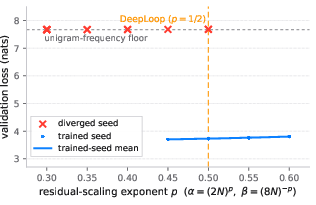
DeepNorm (a prior rule for non-looped Transformers) chooses and with an exponent . The authors show that, when layers are reused and aligned, you need a stronger setting, with exponent , to keep things stable.
Their proposal, DeepLoop, keeps the same architecture style but changes the scaling to:
- Skip scale:
- Init gain: Here, is the total “unrolled depth” (how many times you effectively apply blocks when you count loops).
What they found (results in plain terms)
- Training stability: With looping turned on (reusing blocks multiple times), the standard DeepNorm setting () can be too weak in the worst case because repeated, similar passes amplify training changes. DeepLoop’s stronger setting () keeps training steady.
- Language modeling tests (GPT-2 style, “small” and “medium” sizes):
- When there’s no looping (), DeepLoop behaves about the same as the baseline.
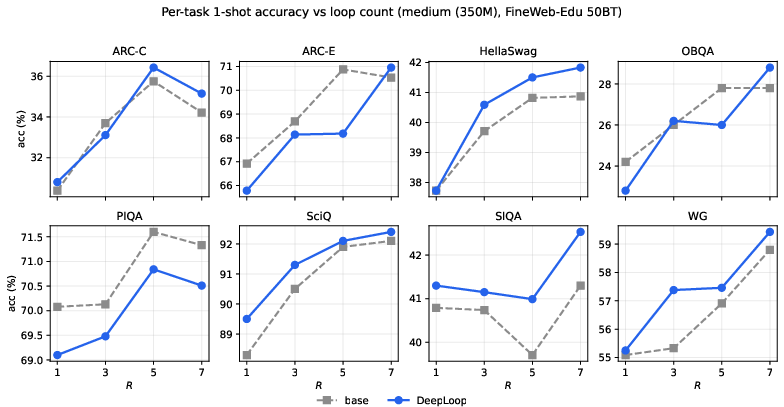
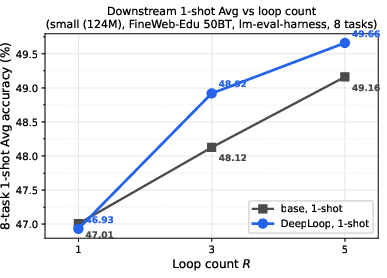
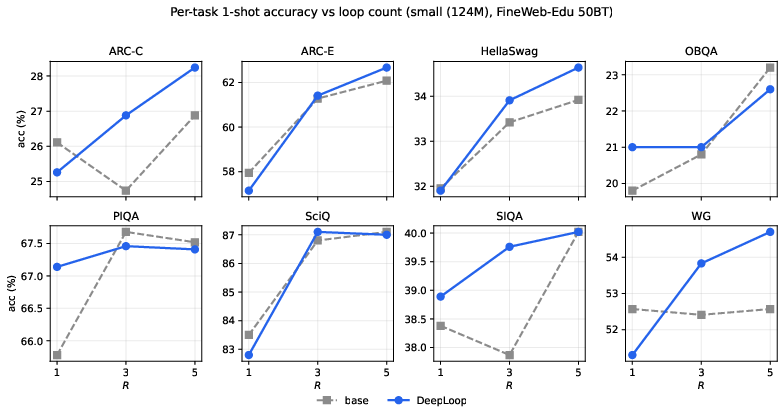
- When looping is on (), DeepLoop consistently improves validation loss (a measure of how well the model predicts text) and also improves accuracy on downstream benchmarks (a set of 8 common NLP tasks).
- Reasoning tests (hierarchical recurrent reasoner on ARC-AGI puzzles):
- Applying the same rule to a more complex, multi-loop reasoning model improved puzzle-solving accuracy across different voting budgets (how many attempts the model gets before submitting its answer), with a notable gain at the main reported setting.
Why that matters:
- These gains happen specifically when the model revisits the same blocks—exactly the setting looped Transformers target—without increasing the number of stored parameters.
Why this is important
- More depth without more memory: Looping lets you spend more compute at test time to get better results without making the model bigger. That’s handy for improving performance on tough tasks.
- Simple, practical fix: DeepLoop is just a change in two scaling formulas—no extra modules, gates, or special tricks—so it’s easy to use.
- Correct scaling depends on reuse, not just layer count: The paper shows you must consider how many times a block is reused, not only how many layers you “unroll.” If the same block is visited many times and those visits are similar, you need stronger scaling () to keep things stable.
Quick takeaways
- Problem: Reusing the same Transformer blocks many times can make training updates pile up too much.
- Idea: Measure how similar those repeated passes are, and scale the skip path and weight initialization more strongly when reuse is high.
- Rule: DeepLoop sets and for total unrolled depth .
- Outcome: With looping active, this improves stability and performance on language and reasoning tasks, while staying neutral when there’s no looping.
Knowledge Gaps
Knowledge gaps, limitations, and open questions
Below is a concise list of what remains missing, uncertain, or unexplored in the paper, formulated to guide concrete follow-up research:
- Lack of empirical measurement of the visit-alignment coefficient κ_R:
- No layer- or round-wise estimation of κ_R during training to verify whether visits are decorrelated (γ≈0) or aligned (γ≈1).
- No analysis of how κ_R evolves over training, across datasets, tasks, models, or loop counts R.
- No adaptive scaling based on measured alignment:
- DeepLoop fixes p=1/2 as a conservative choice; there is no mechanism to adapt α and β online per layer or per block based on empirical κ_R or per-visit gradient/sensitivity statistics.
- The paper does not explore intermediate exponents 1/4<p<1/2 when κ_R indicates partial alignment (0<γ<1).
- Fixed constants (c,d) from DeepNorm are unvalidated for looped settings:
- The choice to retain DeepNorm constants (2,8) is not justified by theory or empirical tuning for different architectures (e.g., number of sublayers >2, multi-branch blocks, MoE).
- No sensitivity analysis to these constants or guidelines for retuning when block composition changes.
- First-order perturbation approximation not validated in practice:
- The analysis relies on first-order bounds and absorbs optimizer and learning-rate effects into O(·); there is no evidence that higher-order terms remain negligible under typical training step sizes and optimizers.
- No diagnostics showing that the effective update-to-residual ratio β/α remains in the linear regime during training.
- Optimizer and training-strategy dependence is underexplored:
- The theoretical bounds abstract away optimizer specifics; the experiments use a single (or limited) optimizer setting without testing Adam vs. AdamW vs. AdaFactor vs. SGD, or different preconditioning/clipping strategies.
- No study of how momentum, adaptive learning rates, weight decay, or gradient clipping interact with tied-depth aggregation and the proposed scaling.
- RMSNorm assumption not stress-tested:
- Theory emphasizes RMSNorm; robustness to LayerNorm, ScaleNorm, or other normalizations is not analyzed or validated empirically.
- No ablations isolating the role of input-side norm (e.g., embedding RMSNorm) versus residual scaling.
- Limited architectural coverage:
- Experiments focus on decoder-only GPT-style models; it is unknown whether the scaling holds for encoder-only, encoder–decoder, vision Transformers, or multimodal models.
- No evaluation on architectures with more than two residual sublayers per block, different attention variants (e.g., MQA/MHA-MoE), or gating (e.g., ReZero, GLU).
- Incomplete comparison to alternative parameterizations:
- Baselines exclude strong residual/initialization strategies (e.g., DeepNet/DeepNorm with tuned exponents, T-Fixup, µParam/µTransfer, λ-parameterization, ReZero).
- No comparison to Universal Transformer/ALBERT/Subformer with their recommended normalizations/initializations under looped depth.
- Single-seed experiments for language modeling:
- Most GPT-2 experiments report single-seed results; no variance estimates or statistical tests to support claims of consistent improvements.
- The paper itself notes that multi-seed runs are needed, but none are reported for the LM experiments.
- Scale limits and generalization:
- Experiments are at GPT-2 small/medium and 50B tokens on FineWeb-Edu; it is unknown whether gains persist at larger scales (≥1B–10B+ parameters, ≥200B tokens) or with different data mixtures.
- No long-context or different positional embedding variants (e.g., ALiBi, YaRN) to test stability under longer effective depths.
- Train–test compute decoupling is untested:
- The central motivation is test-time compute (increasing R at inference), but models are trained and evaluated at matched R; generalization to R_test>R_train is not studied.
- No exploration of performance/cost trade-offs when varying R at inference for fixed trained parameters.
- K–R co-scaling regimes are not explored:
- Theory focuses on fixed K with increasing R; behavior when both K and R grow, or when K grows while R stays moderate, is not analyzed or tested.
- No guidance on selecting K vs. R for a given compute/parameter budget.
- No empirical validation of the predicted exponent boundary:
- Appendix reports a p-sweep only at R=3; there is no systematic sweep across R to observe the transition from p≈1/4 to p≈1/2 as alignment increases.
- No per-layer or per-module p selection to test the hierarchical prediction that inner loops need p≥1/2 while outer loops may suffice with p≥1/4.
- Hierarchical Reasoning Model (HRM) coverage is narrow:
- Only ARC-AGI-1 is reported; generality to other reasoning datasets, different cycle counts C and C_L, and varying gradient truncation windows is unknown.
- No evaluation of full BPTT vs. one-step gradient truncation to assess how the bound and scaling rule change when gradients flow through more outer cycles.
- Lack of direct κ_R-aware training diagnostics:
- No measurement of inter-visit gradient alignment, e.g., cosine similarity between per-visit gradients/sensitivities or empirical R-scaling of update magnitudes.
- No visualization of how the tied-update norm scales with R for different blocks or training stages.
- Interaction with regularization and training stabilizers is unexamined:
- Effects of weight decay, dropout, stochastic depth, label smoothing, or gradient noise scale on tied-depth stability and the effective β/α are unreported.
- No study of how gradient clipping thresholds alter κ_R or the stability margin.
- Potential conservatism for decorrelated regimes:
- DeepLoop’s p=1/2 may be overly conservative when visits decorrelate (γ≈0), possibly reducing effective capacity or slowing optimization; no ablation quantifies this trade-off.
- No hybrid strategy that relaxes p when κ_R is small (e.g., during early training or in specific layers).
- Practical guidance for choosing α, β per module/layer is absent:
- While the theory allows per-module scaling, the paper applies a single p to all components; there is no recipe for heterogeneous scaling in mixed-rate or multi-module systems beyond the HRM commentary.
- No investigation into per-layer α and β schedules (e.g., depth- or round-dependent scaling).
- Robustness across data and tasks:
- Results are limited to FineWeb-Edu and a specific eight-task harness; behavior on code, math, multilingual data, and structured reasoning tasks (beyond ARC) remains unknown.
- No study of calibration, robustness to distribution shift, or downstream metrics beyond accuracy (e.g., perplexity-to-accuracy transfer curves).
- Implementation details that could affect reproducibility:
- Exact set of matrices receiving β (S_j) follows DeepNorm but is not exhaustively enumerated; minor deviations can materially change effective β/α.
- Interaction with implementation choices (e.g., fused RMSNorm, mixed precision, FlashAttention kernels) is not evaluated for numerical stability with p=1/2.
- Theoretical constants and sharper bounds:
- Bounds hide constants C′, C″, C_U, C_G; without estimates, it is hard to predict when DeepLoop is necessary or sufficient across architectures.
- No attempt to bound κ_R under statistical assumptions (e.g., random feature models) to justify typical-case γ values.
- Negative side effects and training dynamics:
- No analysis of convergence speed, gradient noise scale, or training stability curves (only final-validation metrics reported).
- Potential interactions with learning-rate schedules or warmup lengths are not examined.
- Extensions to partial sharing and more complex loop schedules:
- The analysis assumes fully tied residual sublayers across rounds; mixed tying patterns (e.g., periodic tying, block-cycling, or partial sharing within sublayers) are not addressed.
- No treatment of asynchronous or adaptive loop schedules where visit counts differ across tokens or positions.
Practical Applications
Immediate Applications
Below are concrete ways the paper’s findings can be used today, grouped by sector and accompanied by likely tools/workflows and feasibility notes.
- Stable training of looped (weight-tied) Transformers in mainstream LLM stacks (software, AI platforms)
- What: Replace DeepNorm’s p=1/4 scales with DeepLoop’s α=(2N){1/2}, β=(8N){-1/2} when reusing blocks R>1 to prevent training instability or degradation as unrolled depth increases.
- Tools/products/workflows:
- Add a “LoopedTransformer” module to PyTorch/JAX/HuggingFace Transformers that ties block weights and sets α, β from N=K·R.
- Config presets for GPT-style decoders that switch scaling based on R.
- Simple helper API: given K, R, return α, β; apply per DeepNorm’s per-matrix initialization semantics.
- Assumptions/dependencies:
- Post-LN with RMSNorm and DeepNorm-style per-matrix initialization (β used only at init).
- Model must actually tie weights across rounds (R>1) for benefits; neutral at R=1.
- Constants shown for decoder-only, two-sublayer blocks; adjust carefully for other architectures.
- Test-time compute “deliberate mode” without increasing parameter count (consumer apps, enterprise software)
- What: Train with DeepLoop and expose R as a runtime knob to trade latency for quality (more loops = better accuracy), especially for reasoning-heavy prompts.
- Tools/products/workflows:
- Chatbots/coding assistants with a slider/toggle (“fast” vs. “deliberate”).
- Server-side policies to increase R on hard queries (measured by uncertainty, perplexity, or refusal risk).
- Assumptions/dependencies:
- Models should be trained with DeepLoop scales to remain stable at higher R; retrofitting R on a model trained with p=1/4 can underperform or be unstable.
- Latency/throughput budgets must account for extra passes.
- Parameter-efficient on-device NLP with adjustable compute (mobile/IoT, edge AI)
- What: Use few physical blocks (small memory) and loop more at inference to improve accuracy when resources allow.
- Tools/products/workflows:
- On-device summarization, translation, and intent classification with dynamic R based on battery/thermal budget.
- Distilled looped models for phones and embedded systems that can “think longer” offline when needed.
- Assumptions/dependencies:
- Proper α/β scaling at training; RMSNorm-based Post-LN.
- Edge runtimes must support repeated compute over the same weights (weight-cache friendly).
- Improved planning/reasoning modules in robotics with fixed memory (robotics, control)
- What: Use looped Transformers to increase decision-time computation without extra parameters, stabilized via DeepLoop.
- Tools/products/workflows:
- Model-predictive control/planning modules that allocate more loops in occlusions/complex scenes.
- Task-adaptive R policies (e.g., more loops near collisions).
- Assumptions/dependencies:
- Real-time constraints; R must be capped to meet deadlines.
- Stability relies on Post-LN + RMSNorm + correct per-matrix β.
- Hierarchical Reasoning Model (HRM) training with per-module stability (research/education)
- What: Apply p=1/2 to the looped inner module (the one revisited C_L times) and (optionally) p≥1/4 to the once-per-cycle outer module under one-step gradient truncation, improving ARC-style reasoning.
- Tools/products/workflows:
- HRM implementations that compute gradient-visible depth N_g and set α=(2N_g){1/2}, β=(8N_g){-1/2} for each module.
- Curriculum schedules that increase inner loops C_L over training while maintaining stability.
- Assumptions/dependencies:
- One-step gradient truncation used during training; N_g must reflect gradient-visible visits.
- Gains validated on ARC-AGI; broader generalization needs further testing.
- MLOps defaults and guardrails for tied-depth models (enterprise ML)
- What: Bake DeepLoop as a default when weight sharing across depth is enabled; monitor misconfiguration (e.g., p=1/4 used with R≫1).
- Tools/products/workflows:
- AutoML checklists that set p=1/2 for tied-depth and p=1/4 for untied depth by default.
- Training dashboards flagging abnormal gradient norms when α/β are inconsistent with R.
- Assumptions/dependencies:
- Accurate counting of unrolled depth N and gradient-visible depth N_g.
- Existing optimizers (Adam, etc.) are compatible.
- Benchmarking and evaluation with compute-versus-performance curves (academia, industry)
- What: Report accuracy across loop counts (R=1,3,5,7,…) for trained looped models to quantify test-time compute scaling.
- Tools/products/workflows:
- Extend lm-evaluation-harness or internal eval suites to sweep R and plot accuracy/latency curves.
- Assumptions/dependencies:
- Models trained with DeepLoop scaling so performance increases predictably with R.
- Standardized reporting of inference compute (token×loops).
- Compression and distillation workflows using weight tying plus loops (software, academia)
- What: Tie layers to cut parameters, then recover quality with higher R at training/inference; stabilize with DeepLoop.
- Tools/products/workflows:
- Knowledge distillation targets that allow higher R for the student during training on hard examples.
- Assumptions/dependencies:
- Distillation losses and schedules may need adjustment for looped dynamics.
- Risk and decision engines with elastic compute budgets (finance, ops analytics)
- What: Keep models small for memory-bound deployments but spend extra compute (higher R) on flagged high-stakes scenarios to refine outputs.
- Tools/products/workflows:
- Risk scorers that escalate to larger R when volatility indices spike.
- Assumptions/dependencies:
- Governance around variable-latency decisions; audit trails should log R used per instance.
- Privacy-preserving, offline assistants with better on-demand performance (daily life, healthcare)
- What: On-device note summarization or care-plan drafting can “think longer” without uploading data, improving quality as needed.
- Tools/products/workflows:
- Local EHR note helpers with a user-selectable “accuracy boost” mode that raises R.
- Assumptions/dependencies:
- Health data constraints; device compute availability and energy limits; careful latency UX.
Long-Term Applications
These opportunities likely require additional research, scaling, or ecosystem development beyond the paper’s immediate scope.
- Large-scale looped LLMs with adaptive halting and compute allocation (software, AI research)
- What: Combine DeepLoop with adaptive computation time (ACT) or entropy-based halting to allocate loops per token/sentence dynamically.
- Tools/products/workflows:
- Controllers that choose R online based on uncertainty or self-consistency signals.
- Assumptions/dependencies:
- Robust halting policies; training regimes that expose models to variable R; careful calibration to avoid drift.
- Cross-modal looped Transformers (vision, speech, multimodal) (healthcare, autonomous systems, media)
- What: Extend DeepLoop scaling to weight-tied ViTs or speech encoders to gain depth benefits under memory constraints.
- Tools/products/workflows:
- Multimodal stacks that reuse encoder blocks across rounds for high-res images or long audio.
- Assumptions/dependencies:
- Re-derivation of constants for different block structures (e.g., encoder-only, different sublayer counts); empirical validation.
- Hardware and system co-design for looped compute (semiconductors, systems)
- What: Architect accelerators and runtimes that cache small sets of weights and iterate efficiently (high on-chip reuse, low DRAM bandwidth).
- Tools/products/workflows:
- Weight-stationary kernels optimized for repeated passes; scheduler support for variable R across batches.
- Assumptions/dependencies:
- Compiler/runtime support; model-hardware codesign; memory hierarchy tuned for reuse.
- Estimating and exploiting visit-alignment κ_R to go beyond conservative p=1/2 (research tooling)
- What: Build diagnostics to measure κ_R during training and set p adaptively (p ∈ [1/4, 1/2]) for better optimization-accuracy trade-offs.
- Tools/products/workflows:
- “Kappa meters” that track per-visit gradient/sensitivity correlations; adaptive scaling schedules.
- Assumptions/dependencies:
- Efficient, low-variance estimators for κ_R; theoretical/empirical validation that adaptive p is safe.
- Dynamic training curricula for R and module-wise exponents (AutoML)
- What: Jointly schedule loop counts and per-module exponents (inner vs. outer modules in HRMs) to optimize stability and convergence.
- Tools/products/workflows:
- Controllers that increase C_L (inner loops) over epochs while adjusting α/β.
- Assumptions/dependencies:
- Reliable signals for stability boundaries; interaction with learning-rate/optimizer dynamics.
- Safety and reliability frameworks for “thinking longer” (policy, safety)
- What: Governance for variable compute per query, including fairness and transparency around loop counts and their effect on outcomes.
- Tools/products/workflows:
- Reporting standards that include R; guardrails preventing unbounded compute escalation; bias checks across different R.
- Assumptions/dependencies:
- Consensus on compute disclosures; regulatory alignment in sensitive domains.
- Self-consistency and deliberate reasoning with looped depth (education, productivity, coding tools)
- What: Combine looped passes with self-consistency voting to improve reasoning and reduce hallucinations without more parameters.
- Tools/products/workflows:
- Multi-sample, multi-loop decoders that allocate more loops to generate and verify candidate chains-of-thought.
- Assumptions/dependencies:
- Training exposure to CoT; careful cost control (loops × samples).
- Neuromorphic/embedded real-time control with looped models (robotics, IoT)
- What: Fixed-weight controllers that iterate internal dynamics multiple times per control step for improved performance on hard states.
- Tools/products/workflows:
- Event-driven runtimes that trigger additional loops under uncertainty.
- Assumptions/dependencies:
- Tight worst-case timing guarantees; empirical stability in closed-loop settings.
- Model compression at scale via tied-depth distillation (enterprise AI)
- What: Replace deep untied stacks with tied stacks and recover capacity with higher R; migrate foundation models to memory-limited platforms.
- Tools/products/workflows:
- Distillation toolchains that optimize for parameter count while allowing compute scaling; inference SLAs incorporating R.
- Assumptions/dependencies:
- Task-dependent transfer; careful teacher-student design; cost-aware scheduling.
- Public-sector guidelines for energy-efficient AI via compute/parameter decoupling (policy)
- What: Encourage deployments that minimize parameter footprints (memory, bandwidth) and use adjustable compute when needed.
- Tools/products/workflows:
- Procurement checklists referencing looped/tied-depth models with stability-aware scaling; energy reporting that separates params vs. compute.
- Assumptions/dependencies:
- Standard metrics; lifecycle analyses comparing energy/latency trade-offs across R.
Notes on feasibility across all applications:
- The proposed scaling is immediately compatible with Post-LN + RMSNorm architectures following DeepNorm’s per-matrix initialization practice; transferring to Pre-LN or different norms requires new analysis.
- Benefits manifest when R>1 and weights are shared across visits; little to no gain is expected at R=1.
- Results are demonstrated at GPT-2 small/medium scale and HRM on ARC-AGI; larger models and other domains should validate empirically.
- Optimizer, learning-rate, and normalization choices can interact with α/β; retain monitoring for gradient explosion/vanishing when adopting new regimes.
Glossary
- AdamATan2: An optimizer variant used for training the hierarchical reasoner. "the optimizer (AdamATan2)"
- ALBERT: A Transformer variant that ties parameters across layers to reduce parameter count. "ALBERT \citep{lan2019albert} similarly ties Transformer parameters across layers."
- ARC-AGI-1: A benchmark based on the Abstraction and Reasoning Corpus for evaluating general reasoning. "evaluate on ARC-AGI-1 \citep{chollet2019measure}."
- bf16 (bfloat16): A 16-bit floating-point format commonly used to speed up inference/training with minimal precision loss. "bf16 inference."
- DeepLoop: A loop-aware residual scaling method for looped Transformers that sets α and β as functions of unrolled depth. "The resulting method, DeepLoop, keeps the Post-LN DeepNorm architecture and sets and for unrolled depth ."
- DeepNorm: A residual scaling scheme that stabilizes very deep Post-LN Transformers via skip-scale α and initialization gain β. "DeepNorm, in particular, makes very deep Post-LN Transformers trainable by choosing a skip scale and a residual-branch initialization gain ..."
- Decoder-only Transformer: A Transformer that uses only decoder blocks, typical for autoregressive language modeling. "For an encoder-only or decoder-only Transformer with blocks and residual sublayer applications, DeepNorm sets"
- Decorrelated regime: The case where visit-wise contributions are effectively uncorrelated across rounds. "recovering DeepNorm in the decorrelated regime"
- Encoder-only Transformer: A Transformer using only encoder blocks, typical for bidirectional modeling. "For an encoder-only or decoder-only Transformer with blocks and residual sublayer applications, DeepNorm sets"
- First-order perturbation bound: A stability bound that controls the effect of small parameter updates on the model output to first order. "We formalize this tied-depth effect through a first-order perturbation bound controlled by a visit-alignment coefficient ."
- Gradient-visible visit count: The number of residual-sublayer visits that contribute gradients under truncated backpropagation. "Define the gradient-visible visit count $M_{\mathrm{g} := 2\,(K_H + C_L K_L),$"
- Hierarchical Reasoning Model (HRM): A two-level recurrent reasoning architecture with high- and low-level modules, often trained with gradient truncation. "The Hierarchical Reasoning Model \citep{wang2025hrm} instantiates both: a high-level module and a low-level module are unrolled jointly, and gradients are computed through only the last outer cycle."
- Linearized forward pass: The forward computation considered under a first-order (linear) approximation around current parameters. "and is read back by those same visits in the next linearized forward pass."
- Loop count R: The number of rounds each physical block is revisited in a looped Transformer. "When a physical sublayer is visited times, its optimizer update aggregates the visit-wise gradients from all rounds."
- Loop-aware scaling rule: A residual scaling choice that accounts for repeated parameter visits in looped depth. "but use the loop-aware scaling rule"
- Looped Transformer: A Transformer that reuses a fixed set of blocks over multiple rounds to increase effective depth without increasing parameters. "Looped Transformers scale sequential computation by applying a compact stack of physical blocks for multiple rounds, increasing unrolled depth without increasing stored parameters."
- Multi-Head Attention (MHA): The standard attention mechanism with multiple heads used in Transformers. "GPT-MHA-RoPE model"
- One-step gradient approximation: Training with gradients computed only through the last outer cycle, truncating earlier cycles. "Hierarchical recurrent reasoners are typically trained with a one-step gradient approximation: the forward pass uses all outer cycles, but the backward pass is computed against the last cycle only, with and from earlier cycles detached from the autograd graph."
- Optimizer preconditioning: Modifications applied by an optimizer (e.g., adaptive scaling) that change the effective update direction/scale. "Constants depending on width, normalization gain, attention heads, learning rate, or optimizer preconditioning are absorbed into the notation."
- Physical block: A parameter-tied Transformer block that is revisited across rounds in a looped architecture. "A looped Transformer reuses the same physical blocks for rounds."
- Post-LN: The normalization placement that applies layer normalization after adding the residual branch. "Post-LN can preserve a more expressive residual stream"
- Pre-LN: The normalization placement that applies layer normalization before the sublayer computation. "Pre-LN improves optimization stability in deep Transformers"
- Residual branch: The transformation added to the skip connection within a residual block. "the residual branch enters the normalized direction through a factor of "
- Residual parameterization: The specific scaling and initialization choices for residual connections that affect training stability. "Residual parameterization is decisive for deep Transformer optimization"
- Residual scale α: The multiplicative factor on the skip connection in Post-LN DeepNorm/DeepLoop parameterizations. "choosing a skip scale "
- Residual sublayer: A subcomponent (e.g., attention or MLP) wrapped by a residual connection within a Transformer block. "Each physical block contains two residual sublayers: attention and MLP."
- RMSNorm: Root-mean-square normalization, a normalization variant that fixes the RMS of activations. "RMSNorm restores unit RMS at every sublayer"
- RoPE (Rotary Positional Embeddings): A positional encoding method that rotates query/key vectors by position-dependent phases. "GPT-MHA-RoPE model"
- Scaling exponent p: The exponent controlling how α and β scale with depth in DeepNorm/DeepLoop. "DeepLoop uses the exponent rather than "
- Submultiplicativity: A matrix norm property used to bound the product of operators in the stability analysis. "and applying submultiplicativity gives the looped version of the DeepNorm bound,"
- Test-time compute: Additional computation spent at inference by revisiting blocks more times without changing parameters. "test-time-compute models that spend additional sequential computation without a proportional increase in parameters"
- Tied depth: Depth where multiple unrolled layers share the same parameters across visits. "We identify the tied-depth aggregation mechanism that is absent from untied residual-scaling analyses: a shared update is accumulated across repeated visits and then read through those same visits;"
- Tied embeddings: Sharing parameters between input and output token embeddings in LLMs. "tied embeddings, when used, are outside the residual-sublayer count"
- Unrolled depth: The effective number of layer applications after expanding loops across rounds. "yielding unrolled depth while storing only blocks"
- Universal Transformer: A model that reuses the same transition across depth, representing a fully recurrent approach. "The Universal Transformer \citep{dehghani2018universal} corresponds to the fully recurrent extreme in which the same transition is reused across depth;"
- Untied depth: Depth where each layer has distinct parameters (no sharing across layers). "The difficulty is that standard residual-scaling analyses are written for untied depth."
- Visit alignment: The degree to which visit-wise gradients/sensitivities across rounds point in similar directions. "The size of this effect depends on visit alignment."
- Visit-alignment coefficient κ_R: A factor measuring alignment across repeated visits that scales the stability bound. "We introduce a visit-alignment coefficient "
- Visit-wise gradients and sensitivities: The per-visit contributions to the update and output sensitivity used in the perturbation analysis. "If visit-wise gradients and sensitivities are nearly orthogonal across rounds, a looped model behaves like untied depth up to constants."
- Voting budget K: The number of solution samples used for majority-vote evaluation in ARC. "voting budgets ."
- Weight sharing: Reusing the same parameters across different unrolled positions or rounds. "Weight sharing violates precisely this assumption."
- WinoGrande: A commonsense reasoning benchmark used in downstream evaluation. "with WinoGrande in particular jumping by points 0-shot ($59.04$ vs.\ $57.30$)."
Collections
Sign up for free to add this paper to one or more collections.