- The paper introduces a recursive multi-agent orchestration framework that integrates deep multi-hop reasoning with broad entity coverage using evidence-driven expansion.
- The methodology employs dynamic objective-mode pairing and within-instance experience transfer to adaptively refine search strategies and reduce redundant queries.
- Experimental results show significant performance improvements on benchmarks like BrowseComp-Plus and WideSearch, highlighting its robustness in complex search tasks.
WebSwarm: Recursive Multi-Agent Orchestration for Deep-and-Wide Web Search
Introduction
WebSwarm proposes a novel recursive multi-agent orchestration framework for web-based information seeking, enabling agents to achieve both deep multi-hop reasoning and broad coverage over entities and attributes. The framework overcomes deficiencies observed in both single-agent ReAct-style approaches and prior multi-agent systems, particularly regarding recursive delegation, local adaptation, and grounding task decomposition in web evidence structures. The core mechanism dynamically instantiates search nodes with objective--mode pairs, recursively constructs and revises the solution tree, and marries evidence-driven expansion with both web-probing and within-instance experience transfer. WebSwarm achieves state-of-the-art performance on challenging benchmarks including BrowseComp-Plus, WideSearch, DeepWideSearch, and GISA.
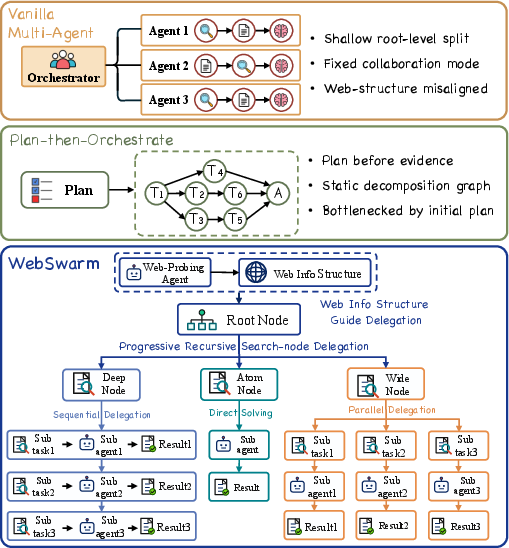
Figure 1: Various multi-agent orchestration paradigms are contrasted, showcasing WebSwarm's recursive delegation mechanism and evidence-driven expansion.
Motivation and Limitations of Previous Approaches
Single-agent LLM-driven agents, such as ReAct, cannot simultaneously handle increasing task depth and breadth due to context window and trajectory limitations. Prior multi-agent frameworks (e.g., parallel tasking, aggregation, hierarchical planners) address coverage or robustness but remain structurally shallow, inflexible in local collaboration orchestration, and misaligned in decomposition—rarely matching the true evidence topology of the web.
Key limitations are:
- Shallow recursive delegation: Existing systems usually only decompose the root and lack multi-level, dynamic expansion as new evidence accumulates.
- Static collaboration patterns: Local search needs are heterogeneous; fixed parallelization or serial handoffs cannot serve both deep reasoning and wide aggregation effectively.
- Weak evidence-grounding: Decomposition is largely query-semantic-driven and misses alignment with actual web evidence distribution, leading to redundant or inefficient search.
WebSwarm Architecture
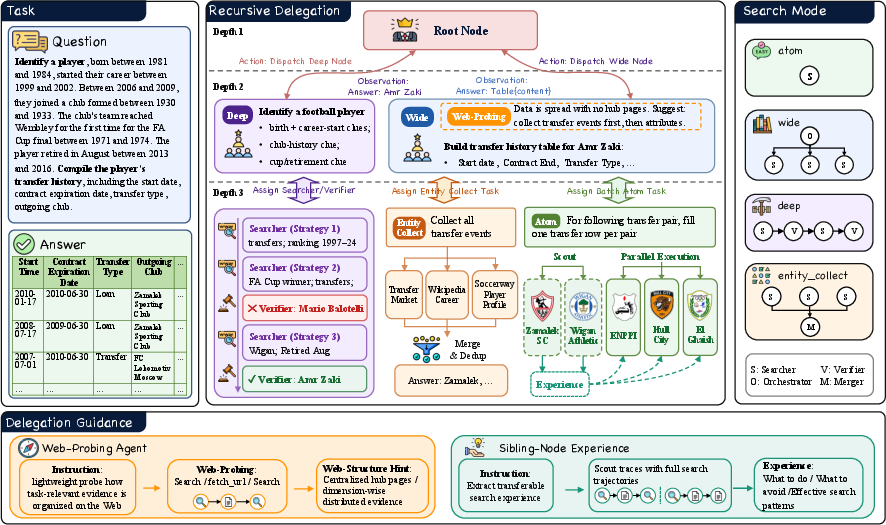
Figure 2: High-level overview of WebSwarm applied to a DeepWideSearch benchmark instance, illustrating recursive node delegation and mode assignment.
The WebSwarm framework orchestrates agents in a recursive delegation tree where each node consists of a local objective and a search mode. These search modes are: atom (fact lookup), deep (iterative search and verification), wide (parallel aggregation), and entity_collect (multi-path recall for entity set construction). Each node, depending on mode and local evidence staleness, may either solve its objective or further delegate specialized child nodes.
On delegation, evidence and search-mode cues are transmitted. Critically, subsequent expansions leverage two complementary signals:
- Web-probing: An agent queries the web to determine if required information is hub-centralized or distributed, thus informing the expansion axis for parallelization and aggregation.
- Experience transfer: Sibling nodes in fan-out expansions receive reproducible tactical process knowledge extracted from initial scout trajectories, improving robustness and convergence among homogeneous tasks.
The inference process employs progressive top-down delegation and bottom-up aggregation of results and signals. Mode assignment can be dynamically revised as returned evidence (from child nodes) fails, covers, or alters the local objective.
Experimental Results
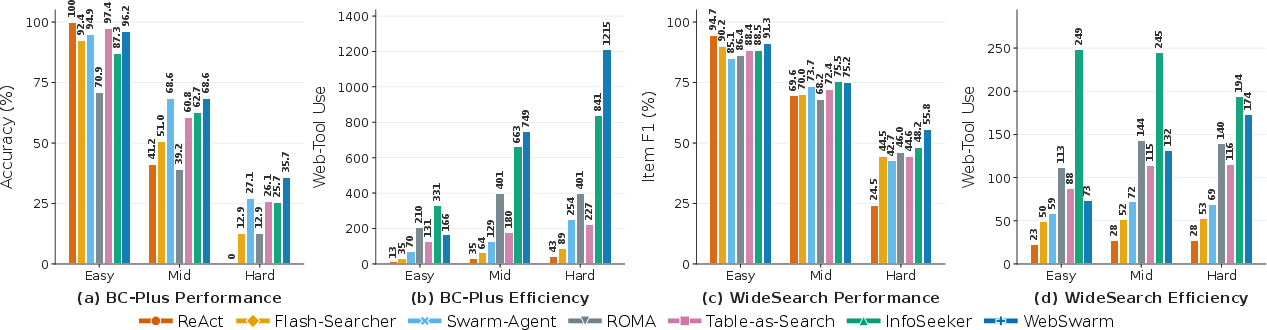
Figure 3: Task performance and web tool consumption (GLM-4.5) on BrowseComp-Plus and WideSearch-EN, stratified by task difficulty.
WebSwarm outperforms all tested baselines, including both ReAct agents and advanced multi-agent models (Swarm-Agent, Flash-Searcher, Table-as-Search, InfoSeeker, ROMA), across BrowseComp-Plus, WideSearch, DeepWideSearch, and GISA. Gains are prominent when search complexity increases (greater depth, width, or their combination).
- BrowseComp-Plus (deep search): Accuracy increases by +17.5 over single-agent ReAct, +3.5 over best multi-agent baseline.
- WideSearch-EN (wide search): Row-F1 / Item-F1 gains of +10.91 / +9.76 over ReAct; consistently outperforms aggregation-based and table-completion models.
- DeepWideSearch-EN: Substantial improvements in both coverage and cell-wise correctness, underscoring efficacy in settings where breadth and multi-hop evidence must be integrated.
- Hard example analysis: WebSwarm's adaptive resource allocation and recursion specifically unlock significant performance margins on high-difficulty/long-tail samples.
Ablation studies demonstrate that recursive delegation is essential, single-mode forced variants are suboptimal, and both web-probing and within-instance experience transfer are synergistically beneficial. Notably, web-probing markedly reduces redundant LLM and web-tool queries without undermining performance; experience transfer ensures homogeneous fanout nodes avoid repeated dead-ends and leverage discovered effective process paths.
Technical Analysis
The recursive multi-agent orchestration in WebSwarm constitutes a system in which task decomposition, evidence-driven search, and result aggregation become tightly coupled processes. Nodes dynamically select search strategy (atomic, deep iterative, wide parallel, or entity set aggregation) conditioned on both task-specific constraints and runtime signals. Information topology is reliably inferred via lightweight, zero-shot probing of the actual web (centralized, partial-hub, or distributed structures), mitigating the decomposition-evidence misalignment that impairs prior multi-agent methods.
Within-instance process-level experience transfer avoids sample-specific memorization while capturing query patterns, source ranking, and effective failure-avoidance heuristics observable in sibling search traces. This directly boosts the success rate, consistency, and quality of broad coverage fanout.
Practical and Theoretical Implications
Practically, WebSwarm substantially expands the capability envelope for autonomous LLM agents on open, long-horizon research and structured discovery queries, including scenarios with complex recursively-defined targets and partially observable entity boundaries. The data and ablation show performance/efficiency trade-offs can be dynamically tuned according to task stratification and resource constraints.
Theoretically, WebSwarm formalizes a general recursive multi-agent framework in which local search protocol assignment, discovery of decomposable evidence axes, and within-tree lateral experience pooling are all components of a single, unified agentic architecture. This demonstrates that limited context LLMs, when orchestrated with adaptive topologies and local modes, can robustly simulate much larger effective working memory and parallel reasoning bandwidth.
Extensions may include:
- Joint multi-agent policy training aligned with recursive delegation trees, to further optimize search-mode assignment and evidence aggregation (currently, delegation decisions rely on the LLM backbone).
- Incorporation of explicit multimodality (images, video, UI scraping), as the present system is text-centric.
- Online resource-constrained or latency-constrained delegation policies, enhancing the system's utility in real-time or cost-sensitive deployments.
Conclusion
WebSwarm demonstrates a principled, scalable recursion-based orchestration for multi-agent web research, achieving superior coverage and reasoning depth over a spectrum of modern benchmarks and difficulty strata. The recursive objective--mode-pair node structure, evidence-driven web-probing and within-instance experience reuse collectively enable robust, adaptive, and highly compositional task solvers. These findings strongly motivate future work on learned multi-agent orchestration, fine-grained local protocol induction, and cross-task skill sharing in the context of long-horizon agentic search systems.