- The paper introduces a novel multi-path latent reasoning approach that operates entirely in latent space to enhance long-horizon vision-language-action performance.
- It employs reward-guided training and diversity regularization to select and aggregate action hypotheses without incurring extra inference latency.
- MPCoT demonstrates significant gains on LIBERO and CALVIN benchmarks, showcasing improved error mitigation and compositional manipulation capabilities.
MPCoT: Reward-Guided Multi-Path Latent Reasoning for Test-Time Scalable Vision-Language-Action
Introduction
This essay provides an in-depth technical analysis of "MPCoT: Reward-Guided Multi-Path Latent Reasoning for Test-Time Scalable Vision-Language-Action" (2606.06245). The work addresses a central challenge in the current generation of Vision-Language-Action (VLA) policies: test-time brittleness and compounding errors during long-horizon, high-uncertainty manipulation tasks. Existing VLA models either rely on single-shot action decoding (limiting deliberation), or, when attempting explicit Chain-of-Thought (CoT) mechanisms, introduce token-generation latency and burdensome interfaces to continuous action spaces. The paper proposes MPCoT as a method to achieve multi-step, multi-path internal deliberation in continuous latent space, enabling improved inference-time reasoning and better long-horizon performance, yet with no modification to the action interface and zero reasoning-token overhead.
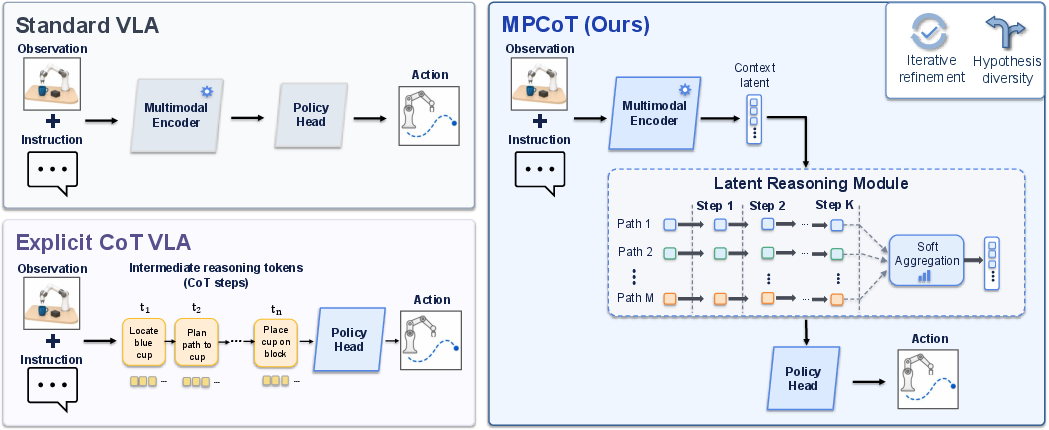
Figure 1: Conceptual comparison between standard VLA, explicit CoT VLA, and MPCoT. MPCoT keeps deliberation in continuous latent space, enabling multi-step/multi-path reasoning without changing the action interface or generating reasoning tokens.
MPCoT is motivated by limitations of both explicit CoT in VLA (which incurs token and runtime overheads, and poorly aligns with continuous actions) and purely implicit, one-pass policies (which lack adaptable inference compute and are prone to error accumulation). Prior work in recurrent-depth latent refinement, continuous/latent CoT, and soft trajectory aggregation have shown the utility of hidden-state deliberation in LMs and VLA models. However, these approaches do not combine explicit, test-time scalable depth/width compute allocation with reward-aligned branch selection.
The work distinguishes itself in several ways:
- Latent Deliberation: Iterative refinement and competition occur entirely in latent space before action decoding without generating any auxiliary reasoning tokens.
- Test-Time Scalability: The architecture exposes explicit inference-time controls over the number of refinement steps (K) and parallel hypotheses (M).
- Reward-Guided Path Scoring: A training-only reward-based objective teaches the latent branch scorer to mimic downstream execution quality, using action consistency, world-model progress, and success signals—no reward is used at inference.
Method: Multi-Path Latent Reasoning with Reward-Guided Path Selection
Architecture
At each control step, MPCoT generates M latent hypotheses by adding learned embeddings and minor perturbations to the shared context vector (the fused output of the visual and language encoders). Each hypothesis is then refined independently for K recurrent, weight-tied steps using a lightweight residual MLP conditioned on the initial context. After refinement, a learned scorer predicts logits over the M hypotheses, yielding soft selection probabilities via a τ-controlled softmax.
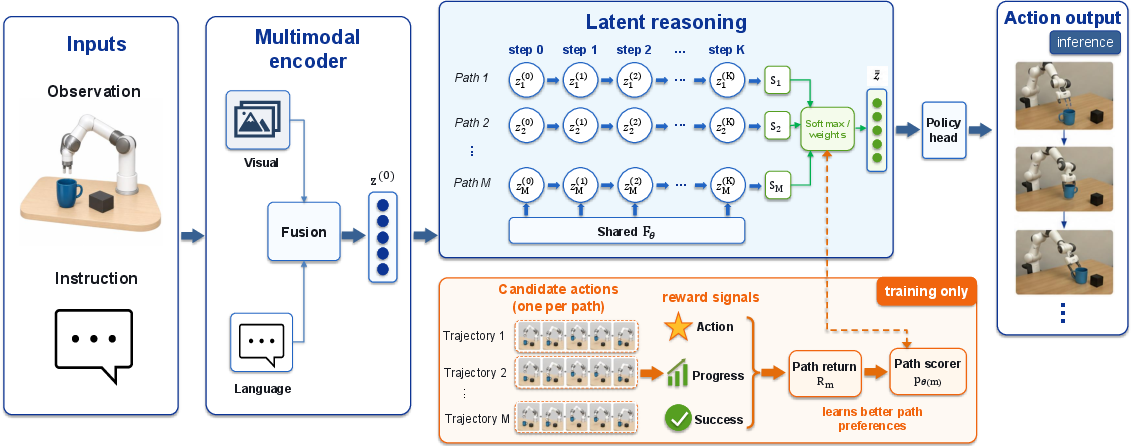
Figure 2: MPCoT architecture with training-time path supervision. Multiple latent branches are refined for K shared steps, scored, and softly aggregated before action decoding. During training only, candidate action branches receive action, world-model/VLM progress, and success feedback to supervise the scorer; this reward branch is removed at inference.
The final latent zˉt is computed as a soft aggregation of the M refined hypotheses, weighted by the scorer output. This latent is passed to the unchanged action head, which generates an 8-step action chunk, preserving compatibility with standard VLA interfaces.
Reward-Guided Training
The training objective is a composite of behavior cloning, reward-guided path preference (which aligns the scorer with the path yielding best actual post-action reward), and diversity regularization (to prevent hypothesis collapse):
- Action Consistency: Penalizes deviation of branch actions from the demonstration.
- World-Model Progress: Measures task-driven distance in world state (predicted by a separate, fixed, training-only world model/VLM).
- Success Feedback: Sparse binary reward based on success labels.
Critically, at inference/deployment, the path scorer uses only the learned weights from this reward-guided supervision without explicit reward computation, external evaluators, or rollouts.
Test-Time Controls
MPCoT supports explicit compute allocation via (K,M):
- Depth (M0): Number of recurrent latent refinements per branch.
- Width (M1): Number of concurrent hypotheses maintained and competed.
Both are variably configurable at inference, enabling efficiency-accuracy trade-offs.
Experimental Results
The empirical evaluation uses standardized VLA benchmarks: LIBERO (multi-suite, multi-task) for compatibility, and CALVIN ABCM2D (compositional multi-step manipulation) for real long-horizon, error-propagation stress tests.
LIBERO
- Single-policy, all-suite: MPCoT achieves 98.9% average success rate (+2.1% over OpenVLA-OFT baseline), and 98.9% on long-horizon tasks (+3.6%).
- Per-suite: 99.0% average, 97.8% long-horizon.
Given LIBERO's near-ceiling baselines, these gains primarily validate architectural compatibility and efficient latent reasoning.
CALVIN ABCM3D
On the challenging CALVIN generalization split:
- 1-step to 5-step SR: MPCoT outperforms all prior systems at every horizon, with maximum improvements at longer horizons (5-step SR: 89.4% vs 72.9% for OpenVLA-OFT; +16.5 points).
- Average successful sequence length: 4.92 for MPCoT vs 4.28 for OpenVLA-OFT.
This demonstrates MPCoT’s mitigation of error accumulation and supports the claim that latent, multi-path refinement especially benefits sequential, compositional control under uncertainty.
Ablation Studies
- Depth vs Width: Increasing M4 (with M5) monotonically improves long-horizon SR, confirming repeated latent correction improves a single hypothesis. Adding width (M6) gives further boost, as soft aggregation of specialized but diverse hypotheses yields complementary corrections.
- Aggregation and Diversity: Soft, confidence-weighted aggregation combined with diversity regularization outperforms hard or uniform selection, leading to lower hypothesis similarity and more stable, non-duplicated final actions.
- Test-Time Scaling and Latency: MPCoT achieves similar or better performance than explicit textual CoT while incurring much lower inference latency (e.g., 38ms for M7 vs 110–160ms for textual CoT), due to operating in and reasoning over continuous latent states rather than decoded tokens.
Reward-Guided Path Scoring
Path Consistency diagnostic shows the reward-guided scorer learns to select execution-aligned branches, significantly increasing alignment from 68.5% (no reward) to 84.3% (full reward-guided supervision). Each reward signal (action, progress, success) contributes complementarily, with the composite scheme yielding the greatest gains in horizon metrics.
Implications and Future Directions
MPCoT provides a modular, architecture-agnostic mechanism for internal compute allocation in VLA models, disentangling advances in inference-time reasoning quality from backbone size or action interface changes. The explicit separation between training-side reward guidance and inference-side reward-free execution prevents overfitting to evaluators and preserves deployment efficiency. Soft, differentiable aggregation and scalable parallelism position MPCoT as a bridge towards more general, test-time resource-controllable robotic agents.
Future lines of investigation include:
- Adaptive Budgeting: Real-time allocation of M8, M9 based on runtime uncertainty or resource constraints.
- Physical Deployment: Real-robot evaluations to probe MPCoT robustness under sensing noise, actuation delays, and other hardware non-stationarities.
- Latent Representations: Synergies with future continuous reasoning architectures, e.g., latent spatio-temporal reasoning, cross-modal compression, or task-centric hypothesis initialization.
Conclusion
MPCoT advances latent-space reasoning in VLA by combining reward-supervised multi-path deliberation, configurable inference-time compute, and full preservation of the standard action interface. Its design enables both strong performance on long-horizon, compositional manipulation tasks and efficient, token-free deployment, positioning it as a leading approach for scalable, adaptive, and robust Vision-Language-Action policies.

