Stateful Visual Encoders for Vision-Language Models
Abstract: Vision-LLMs (VLMs) are increasingly used in multi-image, multi-turn agentic settings where decisions depend on visual changes. However, in existing open-weight VLMs, visual comparisons happen only inside the LLM, while the visual encoder itself remains stateless: each image is encoded independently, without access to the prior visual context. As a result, small but task-critical changes may be attenuated before the LLM has a chance to compare them, especially when those changes do not affect the high-level semantics of the scene. We introduce a Stateful Visual Encoder, which conditions each visual representation on prior visual features. Under supervised finetuning, VLMs equipped with stateful encoders achieve consistent improvements on controlled tasks involving cross-image spatial aggregation, multi-object visual differencing, and visual trajectory behavior cloning. These improvements are consistent across input resolutions, LLM sizes, and VLM backbones. Finally, we validate our model on real-world tasks, including longitudinal radiology, fine-grained image comparison, and remote sensing, where stateful encoders consistently improve generalist VLM baselines and can match or surpass specialized models in selected domains. Project page: https://statefulvisualencoders.github.io/
Paper Prompts
Sign up for free to create and run prompts on this paper using GPT-5.
Top Community Prompts
Explain it Like I'm 14
A Simple Guide to “Stateful Visual Encoders for Vision-LLMs”
What is this paper about?
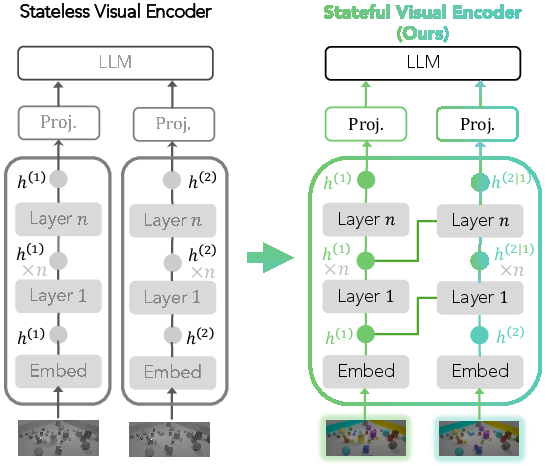
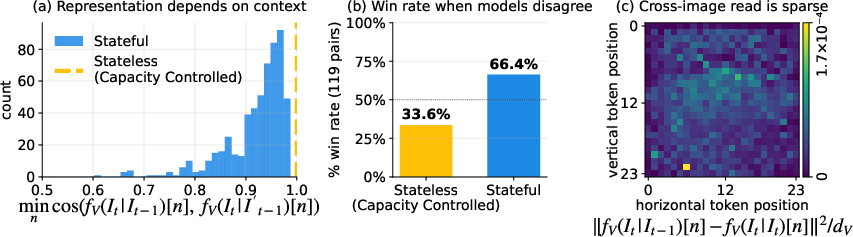
This paper is about helping AI systems do a better job when they need to look at more than one picture and notice what changed. Today’s popular “vision-LLMs” (AIs that look at images and talk about them) usually treat each image separately and only compare them later using their language part. The authors show a way to give the visual part a memory of past images so it can spot small but important differences early, before details get lost.
What questions did the researchers ask?
They focused on three easy-to-understand questions:
- Can we add a simple “memory” to the visual part of an AI so it remembers previous images while looking at the current one?
- Does this help the AI notice tiny changes across pictures (like before/after pairs or a sequence over time)?
- Will this idea work across different tasks, image sizes, and AI model families, and does it help in real-world problems (like medical scans or satellite images)?
How did they try to solve it? (Methods in plain language)
Think of a vision-LLM as having “eyes” (the visual encoder) and a “brain” (the LLM). In most models, the eyes look at each image alone, and the brain tries to compare the results later. That can miss subtle changes.
The authors add a “stateful visual encoder,” which means:
- The eyes get a short-term memory: when they look at image 2, they can “peek” at what they saw in image 1; when they look at image 3, they can also use image 2, and so on.
- This look-back is one-way (left-to-right), like watching a slideshow where you only know the past, not the future—just like real life.
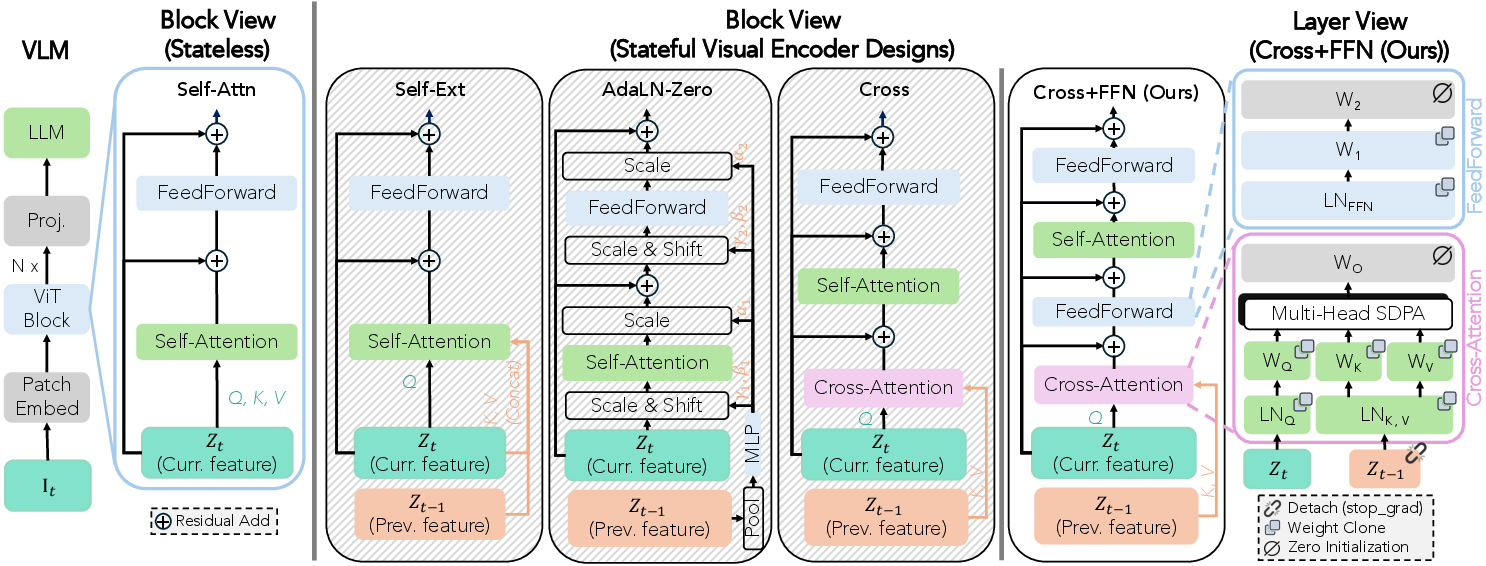
They tested a few ways to add this memory. The best version works like this:
- At each step, the current image can look up details from the previous image (like glancing back at the last slide to see what moved).
- Then, a small extra “thinking step” cleans up and shapes those retrieved details before passing them on.
- They trained this gently so the new memory feature doesn’t mess up what the model already knows (they start the new parts very carefully and copy helpful settings from nearby layers to keep things stable).
In short: the visual encoder becomes “stateful,” meaning it builds on what it just saw, not just what it’s seeing now.
What did they test, and what did they find?
They designed three kinds of tests to check if this memory helps:
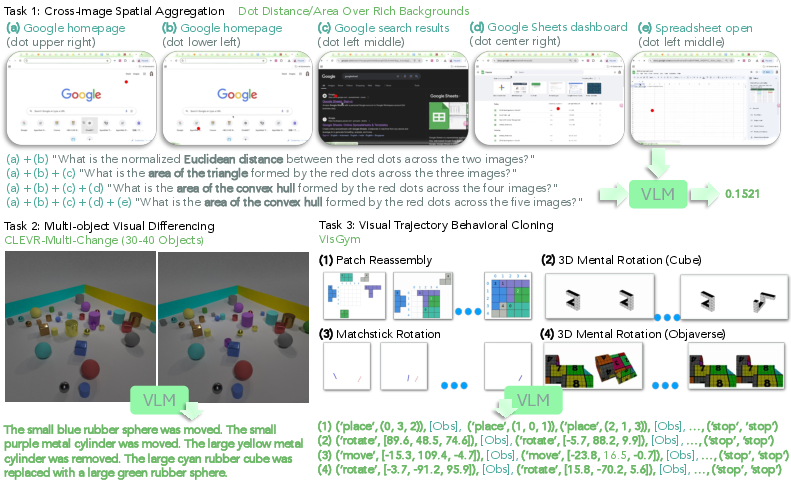
- Cross-image geometry: On busy computer-screen images with small red dots appearing across frames, the model had to measure things like distances and areas formed by dots across multiple images. With memory, the model made fewer mistakes, especially in precise tasks like distance.
- Spot-the-difference with many objects: On scenes with 30–40 objects and subtle changes (move, add, remove, replace), the memory model wrote better descriptions of what changed and identified changes more accurately.
- Step-by-step puzzles: On interactive tasks (like reassembling tiles or mental rotation), the memory model predicted the next action better because it kept track of the visual state over time.
They also ran “ablation” checks (turning parts on/off) to learn what really mattered. Key takeaways:
- The look-back step plus the small “thinking” step was the strongest combo.
- Careful starting settings (like zeroing certain outputs at the beginning and copying some weights from nearby layers) made training stable and avoided breaking the pretrained model.
- Simply adding more parameters without real look-back didn’t match the gains—the memory itself was crucial.
Beyond controlled tests, they tried real-world tasks:
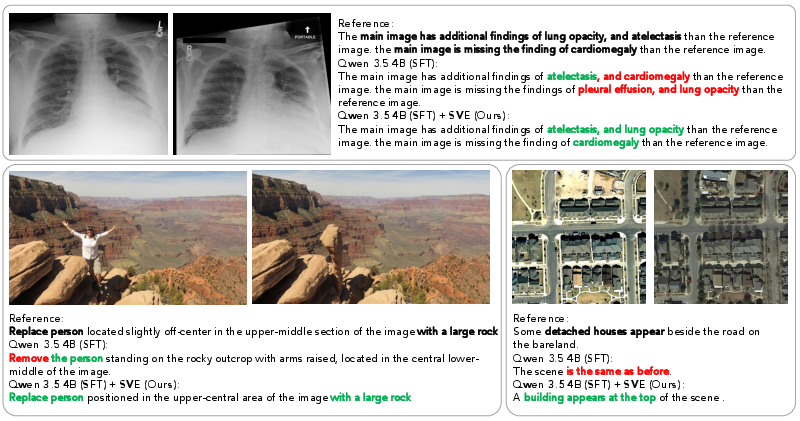
- Medical: Comparing pairs of chest X-rays over time, the memory model described clinical changes more accurately and improved checklist-style medical scores.
- Image editing comparisons: Given a before-and-after photo, it was better at describing the edit that happened (a strong AI judge often preferred its answers).
- Remote sensing: It improved at finding changes in satellite images.
Importantly, these gains held up:
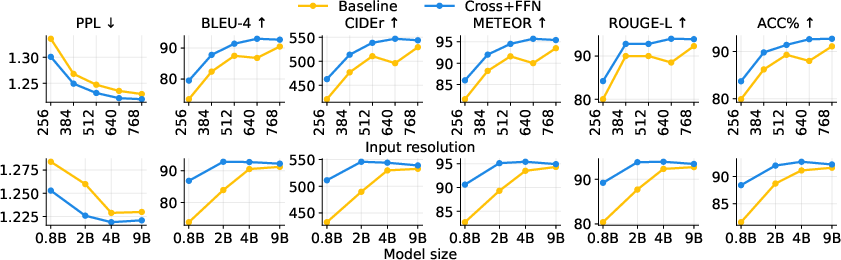
- Across image sizes (from small to large resolutions),
- Across model sizes (small to mid-size),
- Across different AI families (like Qwen, GLM, InternVL, Gemma).
Why is this important?
- Catching small changes early: If tiny details get lost in the visual pipeline, the language part can’t recover them later. Giving the eyes memory keeps those details alive.
- Practical value: This helps in healthcare (tracking a patient’s progress), security or environment monitoring (spotting changes from satellites), and creative tools (verifying or describing edits).
- Plug-and-play improvement: You don’t need to rebuild the whole model. You can add this stateful module to many existing models and fine-tune it.
- Efficiency: Smaller models with memory can sometimes rival bigger models without it—helpful when computing power is limited.
Bottom line
The paper shows a simple but powerful idea: let the visual encoder remember what it just saw. This makes AI better at comparing images over time, noticing small changes, and making more grounded decisions—across many tasks, model types, and real-world settings.
Knowledge Gaps
Knowledge gaps, limitations, and open questions
Below is a consolidated list of what remains missing, uncertain, or unexplored, framed to guide follow-up research.
- Long-horizon state: The SVE conditions only on the immediately previous image (). It is unknown how performance scales with longer visual histories, memory length, forgetting strategies, or retrieval from sparse, non-consecutive past states.
- Order sensitivity vs. symmetry: The causal left-to-right design enforces temporal directionality that may be suboptimal for order-invariant tasks (e.g., before/after comparisons where swapping images should not change the outcome). How to reconcile causal conditioning with order-invariant objectives remains open.
- Multi-image conditioning design: The paper does not examine conditioning on multiple prior images simultaneously (e.g., keys/values from a sliding window, top-k memory retrieval, hierarchical memory, or learned external memory) or dynamic selection of which past frames to attend.
- Scaling laws for SVE benefit: Improvements diminish as resolution/model size increases (approaches task ceiling), but no quantitative scaling law is provided to predict when SVE yields material gains vs. diminishing returns.
- Computational overhead: The added Cross+FFN increases FLOPs and latency, but there are no wall-clock, memory, or throughput benchmarks on single and multi-image inference. The compute–accuracy trade-off versus late-fusion or memory-bank baselines is not quantified.
- Energy/efficiency optimizations: No exploration of lightweight stateful variants (e.g., low-rank cross-attn, token/pruning schemes, sparse routing, conditional gating) that reduce overhead while retaining gains.
- Placement and depth of state modules: The paper inserts Cross+FFN pre-self-attention at each block but does not ablate which layers (early/mid/late), how many layers, or multi-scale locations are most cost-effective.
- Positional encoding choices: While positional embeddings are found important, the study does not compare absolute vs. relative vs. learned 2D bias for cross-image attention, nor robustness to misalignment, viewpoint changes, or differing crops.
- Image misalignment and registration: Real-world pairs (radiology, remote sensing) often have non-rigid or viewpoint misalignment. Robustness of SVE to unregistered inputs, differing scales, rotations, or projection changes is not analyzed.
- Robustness to noise and shift: Sensitivity to sensor noise, compression, occlusions, lighting changes, adversarial edits, and domain shift (e.g., new hospitals/satellites, seasonal changes) remains untested.
- Objective functions: Training uses SFT. The benefits (or risks) of self-supervised or contrastive change-aware pretraining (e.g., positive/negative change pairs, invariances) are not explored.
- Gradient flow design: Stop-gradient on (K,V) improves stability in some tasks, but there is no study of alternatives (e.g., momentum/EMA teacher, partial gradients, consistency losses) or when enabling gradients might help.
- First-image handling: The fallback to using as (K,V) for the first image works empirically, but other strategies (learned null state, explicit “no context” token, task-aware priors) are not compared.
- Connector/tokenization interplay: Whether better cross-image conditioning can allow fewer visual tokens to be passed to the LLM (reducing cost) or different connector designs to capitalize on stateful features is not investigated.
- Interaction with LLM memory: The division of labor between stateful visual encoding and LLM-level memory/attention (e.g., KV cache, compression, retrieval) is not characterized; direct comparisons controlling for compute are missing.
- Comparison to video encoders: While SVE targets image-based multi-image use, there is no compute-matched head-to-head with strong video backbones or video-aware VLMs to clarify when SVE is preferable.
- Domain generalization: Real-world validation spans radiology, image edits, and remote sensing, but broader domains (e.g., robotics, industrial inspection, microscopy, document versioning) and cross-domain generalization are untested.
- Closed-loop agents: The impact of SVE on interactive agents (planning, tool use, exploration) in long multi-turn sessions and how stateful vision interacts with textual state/memory are not evaluated.
- Single-image tasks: Potential negative transfer to single-image perception/VQA is not measured; whether SVE harms, helps, or can be gated off for single-image inputs remains open.
- Error analysis and minimum detectable change: There is no systematic analysis of which change types benefit most, failure modes, or thresholds for the smallest reliably detectable changes as a function of resolution and noise.
- Class-conditional change grounding: The method improves caption/accuracy metrics, but explicit localization (pixel/segment-level change maps), calibration of change confidence, and grounding faithfulness are not assessed.
- Evaluation methodology: Heavy reliance on captioning metrics for change tasks can be misaligned with detection/grounding quality; standardized change-detection metrics (e.g., IoU/precision-recall over change masks or object-level deltas) are largely absent.
- Judge-based evaluation: For image edits, reliance on a proprietary LLM judge (Claude) introduces potential bias and opacity; sensitivity to the judge choice and agreement with human raters are not reported.
- Radiology safety and clinical validity: While RATE-style findings are reported, there is no clinician-in-the-loop assessment, calibration analysis, or exploration of safety/hallucination risks and error costs in clinical settings.
- Data governance: The paper does not detail privacy handling, de-identification, licensing, or fairness/bias audits for medical and satellite data across demographics, institutions, or geographies.
- Catastrophic forgetting and stability: Effects of SVE finetuning on original pretrained capabilities (e.g., general VQA, captioning) and stability across long training runs, different optimizers, or low-rank adapters (LoRA/QLoRA) are not reported.
- Hyperparameter sensitivity: The sensitivity of SVE gains to learning rates, layer-wise lr schedules, weight decay, and zero-init magnitudes is only partially explored; robust defaults are not established.
- Interpretability: Preliminary feature analyses show sparsity/context sensitivity, but systematic interpretability linking cross-attn updates to semantic changes (and detecting spurious correlations) is missing.
- Security and privacy persistence: In multi-turn, multi-image sessions, how long and what kind of visual information persists in the encoder state (and the risk of leaking sensitive data across tasks/users) is not addressed.
- Open-source reproducibility: While a project page is provided, exact training data splits, seeds, and full code/config for all backbones and tasks are not detailed in the main text; replicability across labs is uncertain.
- Ablation completeness: Alternative stateful forms (e.g., cross-attn at multiple scales, dilated/region attention, deformable attention, hybrid correlation volumes) and their compute–accuracy frontier are not explored.
- Theoretical understanding: There is no formal analysis of when stateful conditioning is provably helpful or harmful, or a principled framework relating SVE to information bottlenecks and token selection for change detection.
- Ethical implications of comparative vision: The paper does not discuss risks of misuse (e.g., surveillance/change tracking in sensitive contexts) or guidelines for responsible deployment of stateful comparative perception.
Practical Applications
Immediate Applications
Below are concrete ways to deploy the paper’s Stateful Visual Encoder (SVE) today, leveraging its demonstrated gains in multi-image comparison, edit verification, and change detection. Each item notes relevant sectors, potential tools/products/workflows, and key assumptions/dependencies.
- Longitudinal radiology change assistant
- Sector: Healthcare
- What it does: Compare prior and current studies (e.g., chest X‑rays) to highlight added/resolved findings, draft structured change summaries, and support triage/QA.
- Tools/products/workflows: PACS/RIS plug‑in that calls an SVE‑augmented VLM; “change checklist” output aligned to frameworks like RATE; report drafting assistant that prepopulates change sections for radiologist review.
- Assumptions/dependencies: Requires DICOM integration, robust domain adaptation, clinical validation, and regulatory clearance; performance depends on reliable pairing/registration of prior and current images and adequate training on local protocols.
- Remote-sensing change detection copilot
- Sectors: Energy, Environment, Public Sector, Insurance
- What it does: Before–after satellite/aerial comparison for urban expansion, deforestation, disaster damage, or asset monitoring (e.g., solar farms, pipelines).
- Tools/products/workflows: ArcGIS/QGIS plugin; API that ingests geo‑aligned image pairs and returns change masks and natural‑language summaries; analyst-in-the-loop dashboards.
- Assumptions/dependencies: Requires geo‑registration and normalization for seasonal/lighting differences; access to high‑quality imagery; human oversight to manage false positives/negatives.
- Image edit verification and creative tooling
- Sectors: Software, Media/Entertainment, Advertising
- What it does: Verify whether an edited image matches an instruction; generate precise “what changed” summaries for creative QA and content governance.
- Tools/products/workflows: Photoshop/Figma plug‑ins providing “Explain the change” and “Verify against prompt”; reward models for image‑editing agents; post‑edit compliance checks.
- Assumptions/dependencies: Domain finetuning on relevant edit types; clear policies for acceptable differences; availability of paired source/edited images.
- Semantics-aware UI regression testing and RPA
- Sectors: Software/QA, DevOps
- What it does: Compare sequential screenshots to detect subtle UI regressions and verify multi‑step workflows beyond pixel diffs.
- Tools/products/workflows: Playwright/Cypress add‑ons using SVE to produce human‑readable “what changed” reports; CI gates based on semantic diffs; RPA agents that track state across screens.
- Assumptions/dependencies: Stable screenshot capture and test harnesses; thresholds for acceptable UI drift; handling of dynamic content and localization variants.
- Manufacturing visual quality control
- Sector: Manufacturing
- What it does: Detect small, task‑critical changes across consecutive frames on assembly lines (scratches, misalignments, missing components).
- Tools/products/workflows: Inline camera pipelines using SVE to compare against last‑known‑good or golden references; operator dashboards with structured defect descriptions.
- Assumptions/dependencies: Controlled lighting and camera placement; domain finetuning; real‑time performance constraints; calibrated tolerances for defect severity.
- Microscopy and time‑lapse analysis
- Sectors: Academia, Biotech/Pharma
- What it does: Track subtle longitudinal changes (e.g., cell confluence, colony growth, fluorescence dynamics) in before–after frames.
- Tools/products/workflows: ImageJ/Fiji plug‑ins outputting per‑region change summaries; Jupyter‑first APIs for batch experiments; structured CSV outputs for downstream stats.
- Assumptions/dependencies: Proper registration and calibration; domain‑specific finetuning (modality, staining); handling non‑rigid changes.
- Digital asset management and platform moderation
- Sectors: Media Platforms, E‑commerce
- What it does: Detect unauthorized modifications (logo removal, watermarks, background swaps), verify product photo updates, and audit A/B creatives.
- Tools/products/workflows: Ingest pipelines that compare incoming assets with approved versions; moderation tool that flags high‑risk edits; audit trails with natural‑language rationales.
- Assumptions/dependencies: Reference repositories; policy‑driven thresholds; adversarially robust preprocessing for common manipulations.
- Consumer photo comparison and organization
- Sector: Daily life/Consumer Apps
- What it does: Summarize differences between similar photos (e.g., renovation progress, fitness before–after, multiple takes), aid best‑shot selection.
- Tools/products/workflows: Mobile app feature “Spot the difference” with on‑device SVE; change highlights overlaid on images; privacy‑first inference.
- Assumptions/dependencies: On‑device or efficient edge inference; user consent and privacy policies; robust handling of lighting/pose variations.
- Education tools for spatial/visual reasoning
- Sector: Education
- What it does: Author and grade “spot the difference,” cross‑image geometry, and change‑description assignments.
- Tools/products/workflows: LMS plug‑ins that auto‑generate problem sets; classroom assistants that provide stepwise feedback and localized difference heatmaps.
- Assumptions/dependencies: Age‑appropriate content, explainability; alignment to curricula; guardrails for bias/fairness.
- Research and prototyping kits for multi‑image VLMs
- Sector: Academia/AI R&D
- What it does: Lower the barrier for multi‑image work via lightweight SVE adapters and stable finetuning recipes (weight cloning, zero‑init outputs, stop‑grad on past features).
- Tools/products/workflows: Open‑source PyTorch modules for Qwen/GLM/Gemma/InternVL; eval suites mirroring CLEVR‑Multi‑Change and VisGym tasks; reproducible training configs.
- Assumptions/dependencies: Access to backbone licenses and GPUs; careful hyperparameter control; standardized data formatting for multi‑image prompts.
Long-Term Applications
These opportunities require further research, scaling, domain validation, or regulatory approvals, but are directly enabled by the paper’s methods and results.
- Integrated clinical decision support across modalities and time
- Sector: Healthcare
- What it could do: Cross‑study comparisons for CT/MRI/pathology; disease progression tracking; EHR‑integrated, structured change summaries for multidisciplinary conferences.
- Tools/products/workflows: Longitudinal imaging timeline explorers; auto‑drafted radiology addenda with links to prior studies; population‑level dashboards for quality metrics.
- Assumptions/dependencies: Large‑scale prospective validation, regulatory clearance, robust multi‑site generalization; interoperability with EHR/PACS; rigorous explainability and safety audits.
- Autonomous robotics and drone inspection with sparse observations
- Sectors: Robotics, Infrastructure/Energy
- What it could do: Use SVE‑style causal conditioning to track state across low‑FPS image sequences for manipulation, navigation, and infrastructure inspections.
- Tools/products/workflows: On‑edge SVE modules fused with control policies; inspection drones that produce change‑aware maintenance tickets.
- Assumptions/dependencies: Tight latency budgets, hardware acceleration; coupling with control stacks; robust training on real‑world sequences and failure modes.
- Automated disaster‑response and policy monitoring
- Sectors: Public Sector, NGOs, Insurance
- What it could do: City‑scale before/after assessment for floods, earthquakes, wildfires; auto‑generated impact reports for policy action and claims triage.
- Tools/products/workflows: Streaming change‑alert services; integration with emergency ops centers; human‑in‑the‑loop verification.
- Assumptions/dependencies: Consistent time‑series imagery, governance around false alarms, equitable coverage, and resilient infrastructure.
- Infrastructure and structural health monitoring
- Sectors: Transportation, Energy/Utilities
- What it could do: Long‑term monitoring of bridges, roads, power lines; trend detection across periodic inspections; prioritization of maintenance.
- Tools/products/workflows: SVE‑powered analytics in asset‑management software; scheduled inspection workflows with structured, explainable change logs.
- Assumptions/dependencies: Sensor/camera integration, stable viewpoints, domain adaptation; safety certification; low false‑negative targets.
- Retail/supply‑chain shelf auditing and planogram compliance
- Sector: Retail/CPG
- What it could do: Detect stockouts, misplaced items, or pricing label changes across time.
- Tools/products/workflows: Store‑camera ingestion → SVE comparison → ERP alerts; compliance scoring dashboards.
- Assumptions/dependencies: Privacy policies, variable store lighting and layout; scalable edge compute; continuous learning for new SKUs.
- Forensic and legal image analysis
- Sectors: Legal, Journalism, Compliance
- What it could do: Compare suspect images against trusted references to generate courtroom‑grade difference reports.
- Tools/products/workflows: Chain‑of‑custody pipelines with SVE summaries and confidence scores; standards‑aligned audit outputs.
- Assumptions/dependencies: Strong provenance metadata (e.g., C2PA), adversarial robustness, consensus testing standards.
- Financial and document analytics
- Sector: Finance/Enterprise
- What it could do: Detect subtle visual changes in reports, filings, charts, or stamped documents across versions for risk/compliance.
- Tools/products/workflows: Document‑image diff services integrated with DMS; alerting for material visual changes (plots, tables, seals).
- Assumptions/dependencies: OCR/vision synergy for charts/tables; domain finetuning; strict access controls.
- Long‑horizon multi‑image agents with memory
- Sectors: Software, Robotics, General AI
- What it could do: Agents that rely on causal, stateful visual encoding over tens to hundreds of images for planning and tool use.
- Tools/products/workflows: Memory‑banked SVE variants with learned retrieval; agent frameworks that surface visual state deltas as intermediate steps.
- Assumptions/dependencies: Scalable memory and KV‑cache strategies, datasets for long‑horizon supervision, mitigation of catastrophic interference.
- Unifying image‑sequence and video encoders
- Sector: AI/ML infrastructure
- What it could do: Bridge image‑based SVEs and video encoders to handle mixed sparse/streaming visual inputs with causal conditioning.
- Tools/products/workflows: Hybrid backbones and connectors that adapt SVE to video tasks; standardized APIs for multi‑image/video interleaving.
- Assumptions/dependencies: Training compute and data; architectural extensions for long contexts; benchmarks spanning both regimes.
- Standards and governance for responsible change detection
- Sectors: Policy, Standards Bodies, Industry Consortia
- What it could do: Establish calibration, fairness, and reliability metrics for change‑detection systems; disclosure requirements for automated decisions.
- Tools/products/workflows: Open benchmarks and reporting templates; certification processes for sector‑specific deployments.
- Assumptions/dependencies: Multi‑stakeholder collaboration; transparent datasets; alignment with sectoral regulations (health, critical infrastructure, privacy).
Cross-cutting assumptions and dependencies
- Multi-image availability and quality: SVE benefits rely on having correct before–after sequences and reasonable spatial alignment.
- Domain adaptation: Although SVE is backbone‑agnostic and lightweight to finetune, high‑stakes domains require domain‑specific training and validation.
- Compute and latency: Cross‑attention adds overhead; edge deployments may need quantization or distillation.
- Safety and governance: Especially in healthcare, public sector, and forensics, deployments require explainability, auditing, and regulatory compliance.
- Integration: Real value emerges when SVE outputs are wired into existing workflows (PACS, GIS, CI/CD, ERP), with human‑in‑the‑loop review where appropriate.
Glossary
- AdaLN-Zero: A conditioning method that pools features from a previous image to modulate current-layer computations via adaptive normalization, typically with carefully initialized parameters. "AdaLN-Zero pools features from the previous image to modulate the self-attention and feed-forward layers through adaptive normalization"
- adaptive normalization: A technique that conditions normalization parameters on an external signal (here, prior-image features) to modulate network activations. "AdaLN-Zero pools features from the previous image to modulate the self-attention and feed-forward layers through adaptive normalization"
- behavioral cloning: Supervised imitation learning where a model learns to predict actions from demonstration trajectories. "visual trajectory behavioral cloning"
- BLEU-4: A reference-based n-gram precision metric for evaluating generated text quality, using up to 4-grams. "For CLEVR, PPL, B4, C, M, S, R-L, and Acc denote perplexity, BLEU-4, CIDEr, METEOR, SPICE, ROUGE-L, and change accuracy."
- BYOL: A self-supervised learning method that uses online/target networks and stop-gradient to bootstrap representations without negative pairs. "reminiscent of BYOL and SimSiam"
- causal cross-image conditioning: Conditioning current visual features only on past images (not future ones), matching sequential/online settings. "a SVE introduces causal cross-image conditioning into the existing image encoder"
- change-detection: The task of identifying and describing differences across two or more images of the same scene. "Specialized change-detection models compare images inside the visual encoder"
- CIDEr: A consensus-based image captioning metric that weights n-grams by TF-IDF and measures similarity to references. "including CIDEr from $529.5$ to $543.9$"
- CLEVR-Multi-Change: A synthetic dataset/engine for visual reasoning where multiple subtle object changes occur between scenes. "Using the CLEVR-Multi-Change engine~\citep{johnson2017clevr,qiu2021describing}, we create scene pairs"
- Cross+FFN: A proposed stateful block that inserts cross-attention followed by a feed-forward network to retrieve and transform prior-image features. "Cross+FFN performs best across all spatial aggregation tasks, with the largest gain occurring in Dot-Distance"
- cross-attention: An attention mechanism where queries attend to keys/values from a different source (e.g., prior-image tokens). "Cross inserts a full token-level cross-attention layer before each pretrained self-attention layer"
- cross-image interaction: Any architectural mechanism that allows features from one image to influence the encoding of another image. "we add cross-image interaction (i.e., \cref{fig:teaser}) directly into the visual encoder"
- FFN: The position-wise feed-forward network in transformer blocks, typically two linear layers with a nonlinearity. "augmenting this interaction with an FFN"
- Gated DeltaNet: A specialized gating module (here, part of a visual backbone) that modulates feature updates. "Gated DeltaNet \citep{yang2025gated}"
- Gemma-3: A family of vision-LLMs/backbones evaluated as baselines for generality experiments. "including Qwen3.5, Qwen3-VL, GLM-4.6V-Flash, InternVL3.5, and Gemma-3 (\cref{subsec:generality})."
- I3D: An inflated 3D convolutional video encoder that extends 2D CNNs into the temporal dimension. "Representative video encoders include I3D~\citep{carreira2017quo}, MViT~\citep{fan2021multiscale}, Video Swin~\citep{liu2022video}, TimeSformer~\citep{bertasius2021space}, and ViViT~\citep{arnab2021vivit}"
- InternVL3.5: A vision-LLM family used as a backbone/baseline in generality comparisons. "including Qwen3.5, Qwen3-VL, GLM-4.6V-Flash, InternVL3.5, and Gemma-3"
- KV-cache mechanisms: Techniques that store and reuse attention key/value tensors to extend context efficiently in long sequences. "Long-video and streaming VLMs add memory banks, token compression, or KV-cache mechanisms after visual encoding"
- late fusion: A design where images are encoded independently and fused only at a later stage (e.g., inside the LLM). "Most multi-image VLMs adopt late fusion:"
- LayerScale: A per-layer learnable scaling mechanism often used to stabilize deep transformer training. "LayerScale \citep{touvron2021going}"
- Local-global Attn.: An attention pattern combining local (windowed) and global attention for efficiency and long-range context. "Local-global Attn. \citep{beltagy2020longformer}"
- masked modeling: A self-supervised learning objective that reconstructs masked portions of the input (e.g., video frames or patches). "video-text supervision, masked modeling, and long-context spatiotemporal tokenization."
- Medical-Diff-VQA: A dataset of paired medical images (e.g., X-rays) with annotations describing clinically meaningful changes. "We use the Medical-Diff-VQA dataset~\citep{PhysioNet-medical-diff-vqa-1.0.1}"
- METEOR: A captioning metric based on unigram precision/recall with stemming and synonym matching. "For CLEVR, PPL, B4, C, M, S, R-L, and Acc denote perplexity, BLEU-4, CIDEr, METEOR, SPICE, ROUGE-L, and change accuracy."
- MLLMs: Multimodal LLMs that process both language and visual (or other) inputs. "with recent video foundation models and MLLMs such as VideoMAE~\citep{tong2022videomae}, InternVideo2~\citep{wang2024internvideo2}, and VideoPrism~\citep{zhao2024videoprism}"
- MViT: Multiscale Vision Transformer, a spatiotemporal transformer for video representation learning. "Representative video encoders include I3D~\citep{carreira2017quo}, MViT~\citep{fan2021multiscale}, Video Swin~\citep{liu2022video}, TimeSformer~\citep{bertasius2021space}, and ViViT~\citep{arnab2021vivit}"
- RATE framework: A structured evaluation framework for clinically meaningful radiology findings and changes. "We further introduce a structured evaluation based on the RATE framework~\citep{agrawal2025pillar}"
- ROUGE-L: A recall-oriented metric for generated text based on the longest common subsequence with references. "For CLEVR, PPL, B4, C, M, S, R-L, and Acc denote perplexity, BLEU-4, CIDEr, METEOR, SPICE, ROUGE-L, and change accuracy."
- Self-Ext.: A stateful variant that extends the current self-attention’s key-value set with tokens from a prior image. "Self-Ext extends the pretrained self-attention key-value set with features from the previous image."
- SigLIP: A CLIP-style image-text pretraining method using a sigmoid-based contrastive loss. "Image-text aligned visual encoders such as CLIP~\citep{radford2021learning} and SigLIP~\citep{zhai2023sigmoid} can struggle"
- SimSiam: A self-supervised learning method that, like BYOL, avoids negative pairs and uses stop-gradient to prevent collapse. "reminiscent of BYOL and SimSiam~\citep{grill2020bootstrap,chen2021exploring}"
- SPICE: A captioning metric that parses scene graphs and compares semantic content against references. "For CLEVR, PPL, B4, C, M, S, R-L, and Acc denote perplexity, BLEU-4, CIDEr, METEOR, SPICE, ROUGE-L, and change accuracy."
- Stateful Visual Encoder (SVE): The proposed visual encoder that conditions current-image features on prior-image features before sending tokens to the LLM. "We introduce a Stateful Visual Encoder , which conditions each visual representation on prior visual features."
- stop-gradient: An operation that treats a tensor as a constant during backpropagation to stabilize learning. "we apply stop-gradient to the predecessor branch in all cross-attention variants"
- SwiGLU: A variant of gated linear units using the swish activation, commonly used in transformer FFNs. "SwiGLU \citep{shazeer2020glu} FFN"
- TimeSformer: A transformer-based video model with factorized space-time attention. "Representative video encoders include I3D~\citep{carreira2017quo}, MViT~\citep{fan2021multiscale}, Video Swin~\citep{liu2022video}, TimeSformer~\citep{bertasius2021space}, and ViViT~\citep{arnab2021vivit}"
- VideoMAE: A video foundation model trained with masked autoencoding objectives. "with recent video foundation models and MLLMs such as VideoMAE~\citep{tong2022videomae}"
- ViT: Vision Transformer; here, the base image-encoder block from which weights are cloned for initialization. "cloned initialization from the same ViT block"
- Vision-LLMs (VLMs): Models that combine visual and language encoders to understand and generate language grounded in images. "Vision-LLMs (VLMs) are increasingly used in interactive and comparative visual tasks"
- vision-language connector: The module that projects visual features into the LLM’s embedding space. "a vision-language connector "
- VisGym: A suite of interactive vision tasks used for behavioral cloning and state tracking. "We use four VisGym tasks: Patch Reassembly, 3D Mental Rotation (Cube), Matchstick Rotation, and 3D Mental Rotation (Objaverse)"
- zero-initialization: Initializing certain output layers to zero to preserve pretrained behavior when adding new modules. "Removing zero-initialization causes the largest degradation."
Collections
Sign up for free to add this paper to one or more collections.