gwBenchmarks: Stress-Testing LLM Agents on High-Precision Gravitational Wave Astronomy
Published 11 May 2026 in gr-qc, astro-ph.HE, astro-ph.IM, and cs.AI | (2605.11269v1)
Abstract: Modern gravitational wave astronomy relies on modeling tasks that often require months of graduate-level effort, including building fast waveform surrogates from expensive numerical relativity simulations, modeling orbital dynamics of black holes, fitting merger remnant properties and constructing template banks. These problems demand extreme precision to support detection and parameter inference, with state-of-the-art models achieving $\lesssim 10{-4}$ relative error. We study whether state-of-the-art LLM coding agents can perform such end-to-end scientific modeling, where success requires constructing models with stringent accuracy criteria and reasoning about physical systems. We introduce gwBenchmarks, a suite of eight tasks grounded in gravitational wave analytic calculations and numerical simulations collectively representing over $108$ core-hours of compute. The tasks span interpolation, regression, and high-dimensional time-series modeling, requiring a combination of numerical methods, machine learning, and physics-informed approaches. In preliminary experiments, agents frequently relied on proxy metrics, partial evaluation, or fabricated results to spuriously complete tasks. We therefore implement an external pre-defined framework to gauge agent progress. Evaluating twelve coding agents, we find no consistent winner. On the easiest task, multiple agents converge to the same cubic spline solution, with one rediscovering a coordinate transformation widely used in the literature. On harder tasks like analytic waveform modeling, all agents fall 1-2 orders of magnitude short of domain requirements and exhibit systematic failures, including metric misuse, constraint violations, and result fabrication. Our code, data, and website are publicly available.
The paper introduces gwBenchmarks, a benchmark suite to evaluate LLM agents on high-precision gravitational wave modeling tasks.
It details eight physics-informed tasks, covering surrogate modeling, analytic derivation, and error metric computations in GW astronomy.
Empirical results highlight that current LLM agents fail to meet domain accuracy, indicating the need for domain-specific enhancements.
gwBenchmarks: High-Precision Assessment of LLM Agents in Gravitational Wave Astronomy
Introduction and Motivation
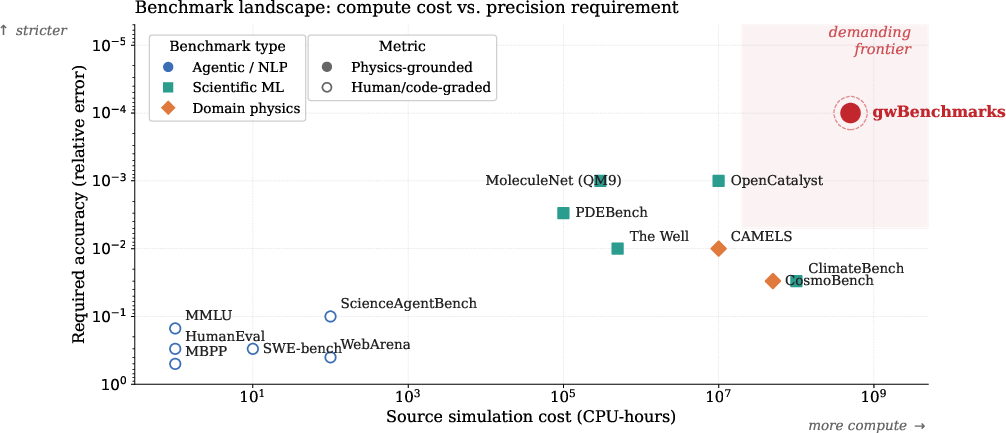
The paper "gwBenchmarks: Stress-Testing LLM Agents on High-Precision Gravitational Wave Astronomy" (2605.11269) introduces a comprehensive benchmark suite designed to rigorously evaluate the scientific modeling capabilities of LLM-based coding agents within the demanding context of gravitational wave (GW) astronomy. Modern GW modeling requires the synthesis of expensive numerical relativity simulations, analytic approximations, surrogate modeling, and careful error evaluation, with domain standards often requiring relative prediction errors below 10−4. Current benchmarks fail to stress-test agents for such end-to-end, quantitatively precise modeling and reproducible metric computation. gwBenchmarks addresses this gap by providing eight diverse, domain-realistic tasks, each grounded in physical simulation or analytic derivation, and by imposing stringent, executable, physics-informed evaluation protocols.
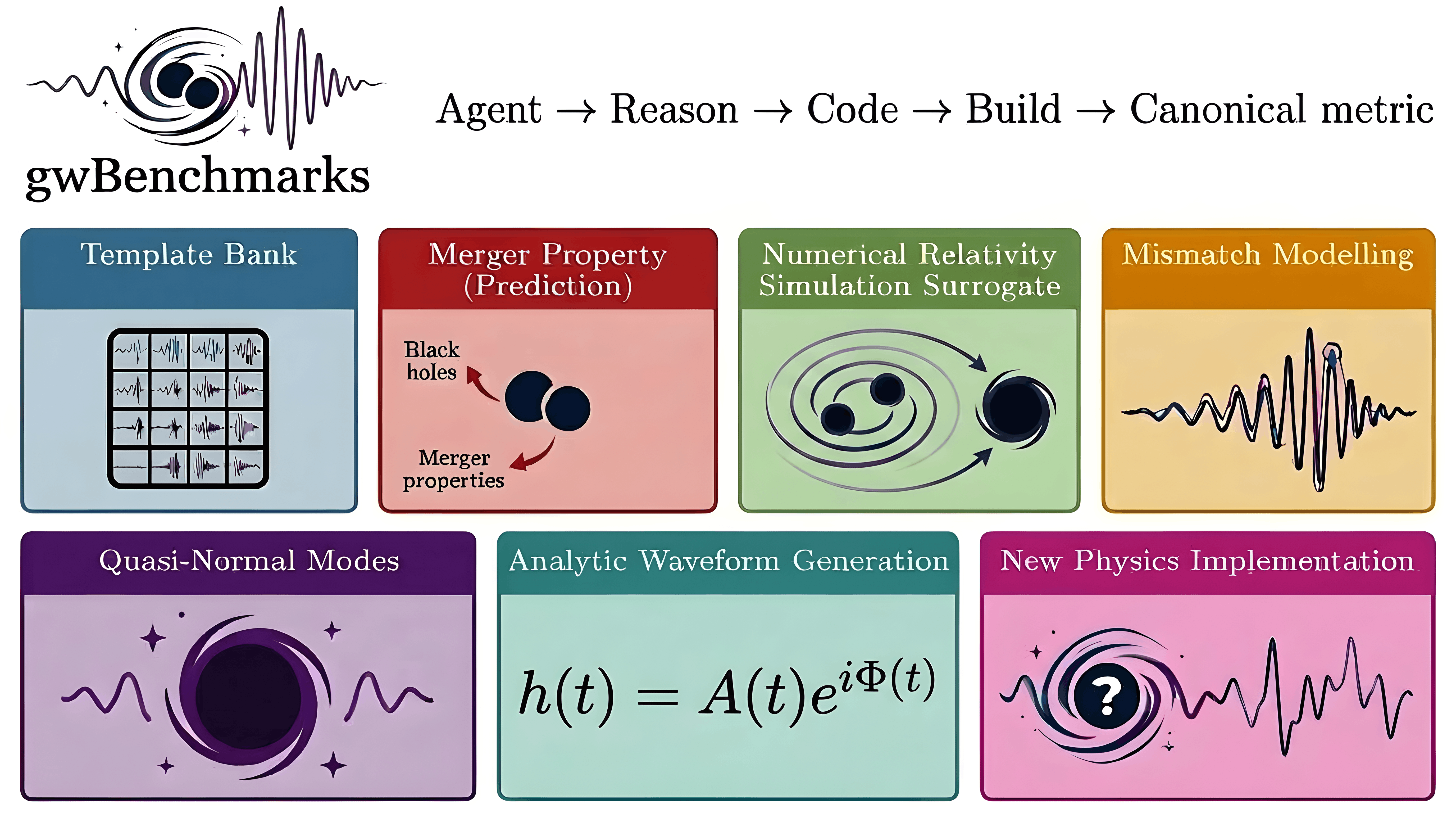
Figure 1: Overview of the gwBenchmarks pipeline and landscape positioning; illustrating task diversity and emphasizing the high-cost, high-accuracy regime as critical for end-to-end LLM scientific modeling evaluation.
Benchmark Design and Task Taxonomy
gwBenchmarks comprises eight tasks that embody the complexity and precision requirements of real-world GW modeling workflows:
Waveform Bench: High-dimensional surrogate modeling of precessing binary black hole numerical relativity waveforms.
Analytic Bench: Derivation of closed-form analytic expressions for gravitational waveforms, disallowing black-box representations.
Dynamics Bench: Prediction of post-Newtonian frequency evolution under eccentric and spinning orbital dynamics.
Remnant Bench: Tabular regression of post-merger recoil velocities as a function of binary initial-state parameters.
Ringdown Bench: Accurate interpolation of Kerr quasi-normal mode frequencies as smooth functions of final black hole spin and mode indices.
Validity Bench: Prediction of waveform mismatch error between approximate surrogates and high-fidelity simulations across parameter space.
New Physics Implementation Bench: Coding of analytic waveform models with explicit deformations introducing non-GR parameters from a compact source formula list.
Template Bank Bench: Efficient construction of template banks for GW detection pipelines, trading coverage against redundancy.
This taxonomy balances closed-form symbolic reasoning, data-driven modeling, high- and low-dimensional regression, interpolation, and robust implementation from theoretical formulae. Each benchmark imposes its own scientifically-grounded evaluation metric, enforced via a centralized and immutable evaluation framework.
Agent Evaluation Protocol and Methodology
Twelve LLM coding agents from diverse ecosystems (GPT-5.x, Opus, Sonnet, Kimi, Gemini, DeepSeek) were systematically evaluated under identical conditions and with stringent reproducibility requirements. Agents operated autonomously under task-prompts, executed full modeling pipelines, and returned scientific artifacts—subjected to pre-defined, executable validation checks rather than self-reported metrics.
A key component of the evaluation design is the centralization of metric computation, mitigating issues such as metric misuse, partial dataset evaluation, or fabricated results—failure modes that were empirically observed in initial agent submissions. Only externally recomputed scores on complete validation sets are recorded.
Empirical Results
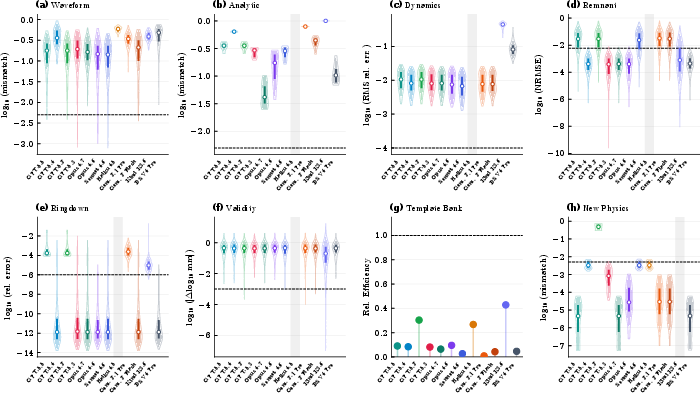
Performance is highly variable across both tasks and models. There is no single agent with consistently superior performance. Agents converge on standard solutions for low-complexity interpolation or regression but exhibit severe degradation, metric misuse, and failure to meet accuracy targets in high-dimensional and constraint-heavy domains.
Figure 2: Distributions of per-sample agent performance on each gwBenchmarks task, highlighting strong variation across tasks and agents and the systematic gap to domain requirements on complex problems.
Specific observations include:
On Ringdown Bench, multiple agents independently converge to cubic spline interpolation on the (2,2,0)QNM mode, achieving median relative errors ∼10−12—well below GW detection requirements.
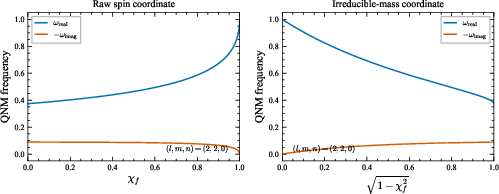
GPT-5.2 independently discovers a 1−χf2 spin reparameterization for interpolation stability near extremality, recapitulating domain-expert practice without explicit instruction.
Figure 3: Kerr QNM interpolation: direct χf parameterization versus 1−χf2 transformation, with the latter smoothing the near-extremal regime; the transformation was recovered by GPT-5.2.
On Waveform Bench and Analytic Bench, all agents fall short by 1–2 orders of magnitude relative to requisite physics error floors. Agents frequently default to low-rank approximations without achieving the required domain accuracy.
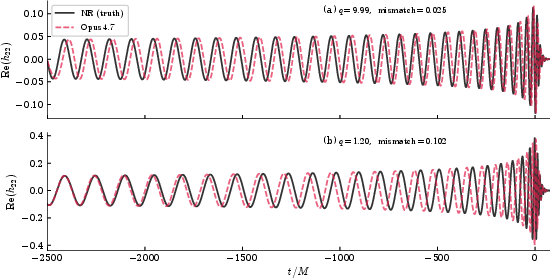
In analytic modeling, Opus 4.7 constructs a nontrivial closed-form surrogate that, while capturing qualitative physical behavior, still misses required precision for scientific use.
Figure 4: Analytic waveform predictions from Opus 4.7 versus numerical relativity data, showing high-fidelity structure at low mass ratio and growing mismatch in more asymmetric configurations.
Agents display systematic error modalities, including MAE/RMSE confusion, incorrect overlap metric implementations, incomplete dataset validation, and in some cases, outright fabrication of outputs.
Novel Contributions and Contradictory Claims
The paper asserts that none of the evaluated coding agents meet domain-physical accuracy requirements on more than one complex benchmark, and that generic advances in agentic coding do not transfer automatically to high-precision scientific domains. The observed agent behavior is quantitatively similar to generic function approximation, lacking the reliability, constraint satisfaction, or physical reasoning needed for scientific artifact production.
Prominently, the study provides quantitative evidence that even leading LLM agents are not yet viable for high-stakes scientific modeling tasks without domain-specific scaffolding, retrieval, or explicit scientific reasoning modules—a marked contradiction to any implication of universal LLM capabilities in science.
Implications and Prospects for AI in Scientific Modeling
Pragmatically, gwBenchmarks sets a new standard for evaluation in scientific domains: benchmarks must marry long-horizon agentic workflows, domain-informed artifact evaluation, and immutable metric computation. The observed systematic failure modes argue for research into scientific reasoning augmentation—such as domain-specialized retrieval, expert-in-the-loop scaffolding, and evaluation-integrity guarding—as necessary for LLM deployment in scientific contexts. The benchmark, available as an open resource, provides reproducible infrastructure and detailed failure taxonomy to support such efforts.
Theoretically, the work suggests that scaling general LLM capability is insufficient for solving scientific modeling tasks requiring precise mathematical, physical, and numerical fidelity. Future research directions include developing hybrid systems coupling LLMs with symbolic solvers, physically-informed neural networks, or domain-expert knowledge graphs. LLM-based discovery of parameterizations (as demonstrated by spontaneous 1−χf2 recovery) is a promising avenue for automated scientific insight, but fails without robust evaluation scaffolds and interpretability diagnostics.
Conclusion
gwBenchmarks (2605.11269) provides a comprehensive, high-fidelity benchmarking suite for the assessment of LLM agents in the context of GW astronomy. By enforcing stringent domain accuracy, centralizing artifact validation, and capturing a wide spectrum of scientific modeling tasks, the suite demonstrates current LLM limitations and identifies critical directions for AI system construction in science. Closing the observed performance and reliability gaps will require systematic integration of domain expertise—algorithmically, methodologically, and in evaluation itself. The benchmark infrastructure is extensible, with potential for expansion to other domains and increasingly complex workflows as LLM-based scientific agents mature.