- The paper introduces an agentic AI framework that models automotive workflows as coupled offline/online decision processes.
- It processes multimodal engineering data to build a structured memory and employs a stability-inspired workflow-energy heuristic for action selection.
- The framework integrates suspension design, RL tuning, aerodynamic optimization, and MBSE to enhance traceability and decision-making efficiency.
Agentic Engineering Intelligence Framework for Automotive Engineering Workflows
The paper introduces the Agentic Engineering Intelligence (AEI) framework for modeling iterative, constraint-driven automotive engineering workflows as coupled offline/online sequential decision processes. AEI abstracts engineering workflows using workflow state, observation, candidate interventions, workflow memory, feasibility constraints, transition dynamics, and utility. The offline phase processes multimodal engineering data—design artifacts, simulation logs, workflow traces, and human feedback—into structured memory including retrieval stores, knowledge graphs, and workflow records. The online phase uses this engineering memory to estimate workflow state, retrieve prior experiences, reason over constraints, select actions, and evaluate them using a stability-inspired workflow-energy heuristic incorporating performance gap, constraint violation, and workflow cost.
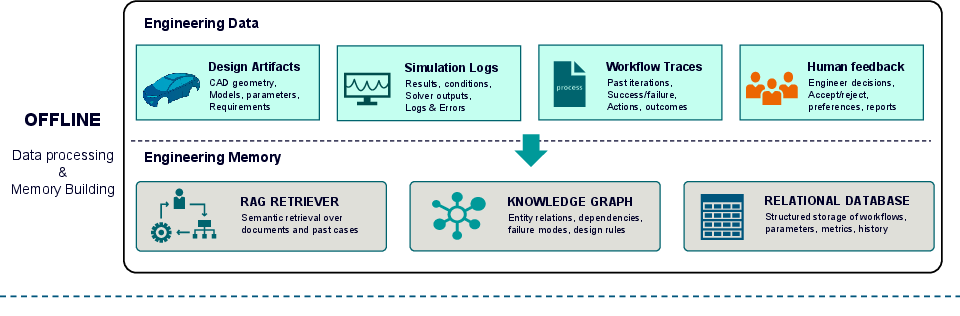
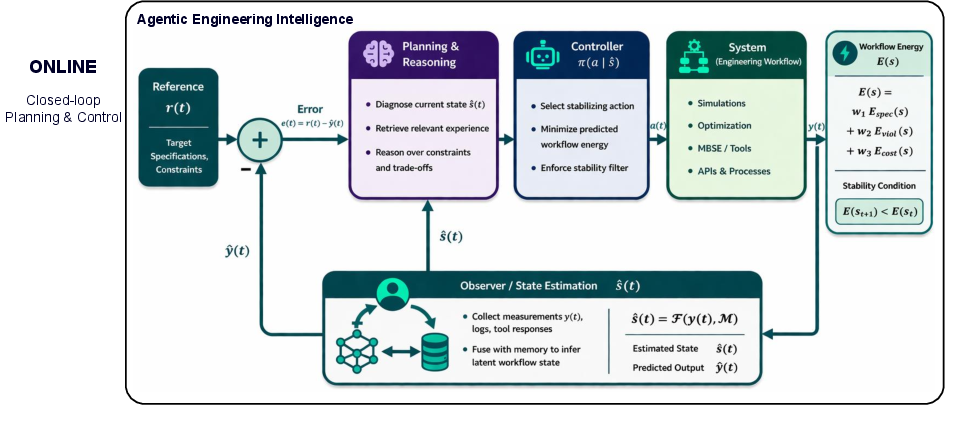
Figure 1: AEI’s coupled phases: offline memory construction and online agentic planning/control across heterogeneous automotive workflows.
An explicit compact formulation is provided: interventions at∗ are selected by ranking candidate actions using predicted workflow energy Et(a), where lower values support process stability and feasible outcomes. This operational heuristic allows recommendation-centered agentic reasoning without assuming full autonomy. The AEI control-theoretic interpretation treats engineering objectives as reference signals, agents as workflow controllers, and toolchains as feedback plants, thereby generalizing across simulation, optimization, diagnosis, and MBSE workflows.
Multimodal Engineering Memory Construction
AEI addresses institutional engineering knowledge reuse through an offline pipeline that builds a memory store D from heterogeneous artifacts such as slide decks, technical reports, and presentation recordings. Three mutually complementary parsing paths are included: (1) structured extraction from slides and reports (text, tables, metadata), (2) vision-language modeling for context-aware figure interpretation—incorporating aligned textual and oral commentary, and (3) ASR for presentation recordings, time-aligned to slide content. The outputs are indexed in a hybrid retrieval system combining semantic (vector) and exact-match (keyword) search, enabling hybrid queries that support nuanced engineering context and precise technical retrieval.
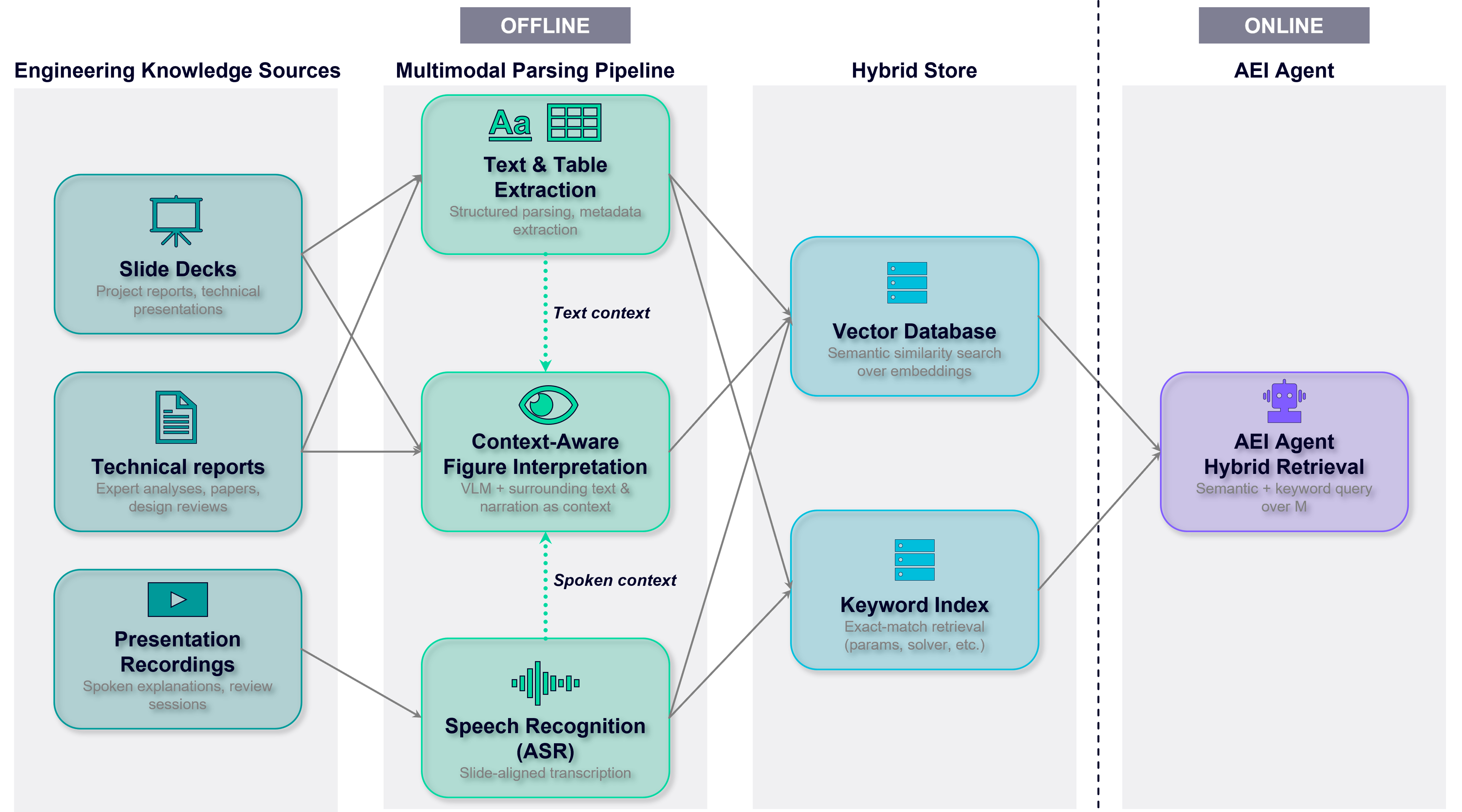
Figure 2: Multimodal engineering pipeline links text, figures, and spoken narration for offline memory store creation and hybrid retrieval.
This approach overcomes limitations of typical RAG pipelines, which fail for engineering figures lacking sufficient context and for oral commentary not present in written artifacts. By integrating multimodal memory, agentic reasoning during online workflows is supported, allowing retrieval of prior cases, diagnoses, and rationale, and informing subsequent interventions with richer institutional knowledge.
Suspension Design Workflow
AEI redefines suspension system design as an agentic workflow: translating Kinematics & Compliance (K&C) targets into feasible hardpoint configurations involves managing nonlinear constraints (packaging, roll-center, scrub radius, tie-rod inclination) and performance objectives. The agent observes workflow state (geometry, constraints, optimization outcomes, historical traces), retrieves analogous prior cases and sensitivities, and ranks candidate actions—modifying hardpoints, relaxing constraints, adjusting optimization initialization, or escalating for review.
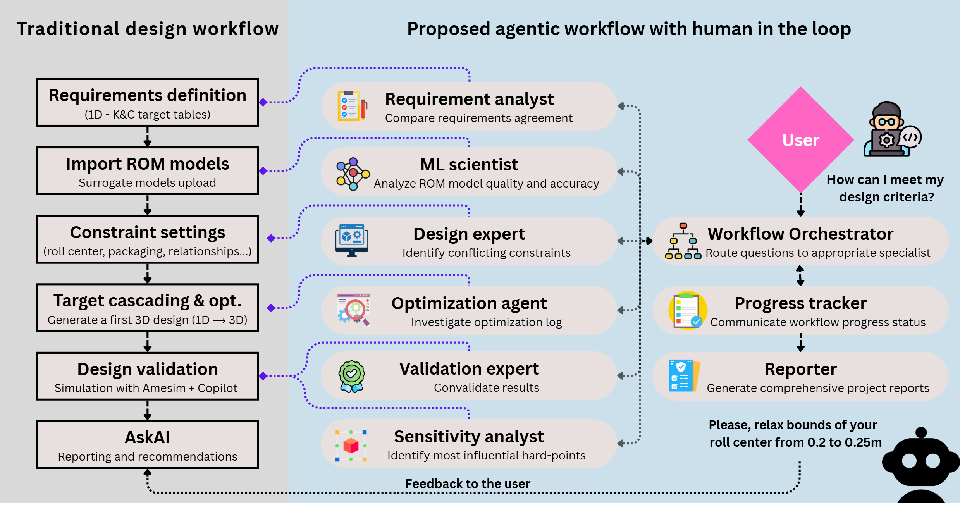
Figure 3: Agentic suspension design loop: optimization outcome monitoring, constraint analysis, memory access, targeted intervention with human oversight.
Instead of optimization failures as terminal conditions, AEI treats intermediate states (including infeasible runs) as informative, facilitating diagnosis and recovery, and preserving traceable reasoning for both experienced and less experienced engineers.
RL Hyperparameter Tuning Workflow
AEI enables workflow-level traceability and intervention for reinforcement learning controller design, where complex hyperparameter tuning (learning rate, entropy, reward weights, horizon) is demanded. The agent processes workflow state (policy config, rewards, stability, historical tuning attempts) and accesses both human-authored diagnostic heuristics and empirically accumulated run history. Candidate interventions are issued (parameter adjustments, direction changes, evaluation requests, escalation).
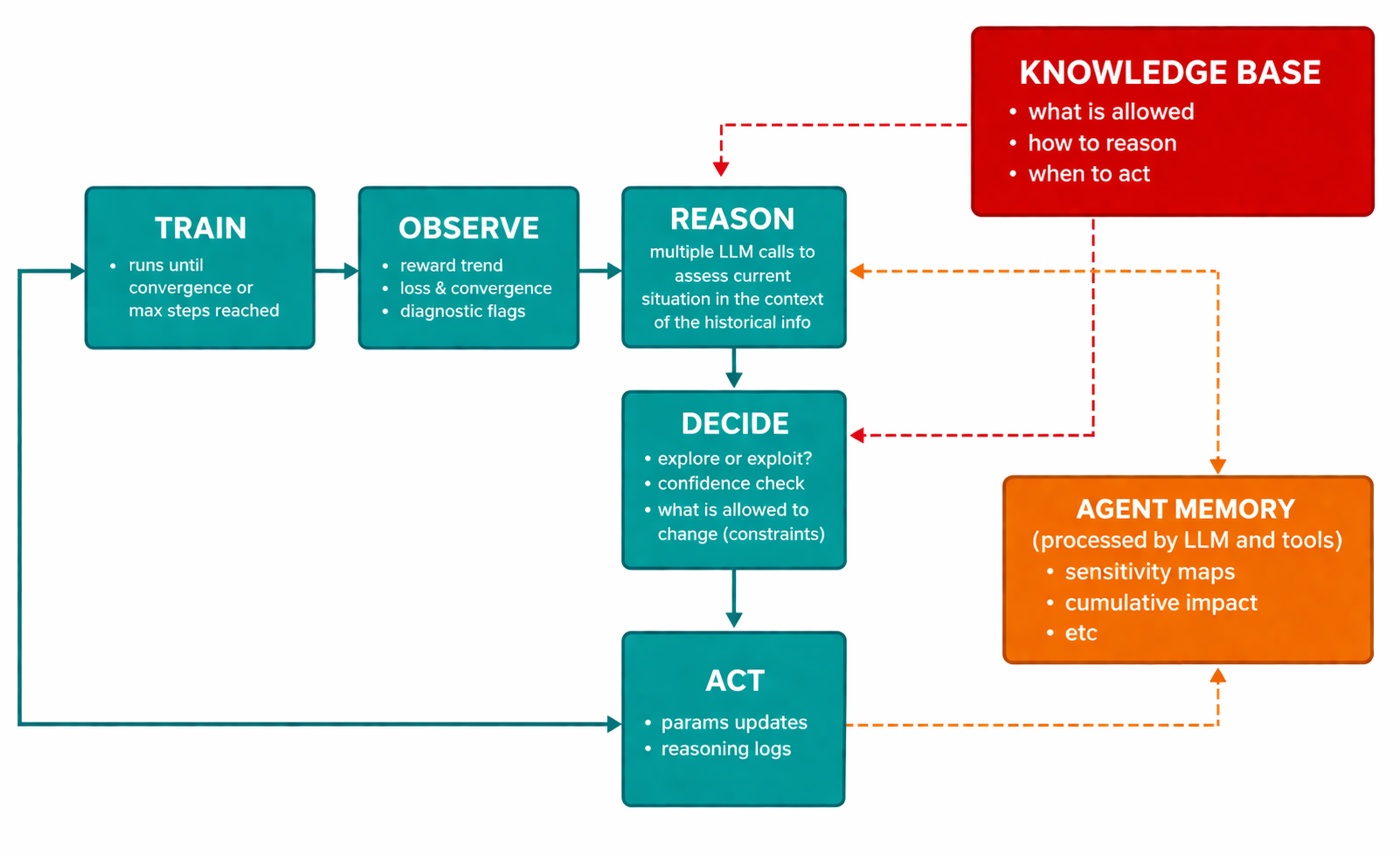
Figure 4: RL hyperparameter tuning: agent combines expert heuristics and empirical run logs for targeted decision support.
This method emphasizes explicit reasoning logs for analysis and reuse, rendering tuning workflows scalable and reproducible at the process level—contrasting with conventional, often opaque, search loops.
Surrogate-Assisted Aerodynamic Design Workflow
Aerodynamic optimization, constrained by expensive CFD evaluations, benefits from AEI’s integration of surrogate modeling within workflow-level control. The agent observes current vehicle parameterizations, metric targets, surrogate model predictions, constraint statuses, and prior design history. Candidates for design modifications are proposed and rapidly evaluated via surrogates, with agentic ranking to determine actions—accept, refine, launch local optimization, or escalate to high-fidelity CFD.
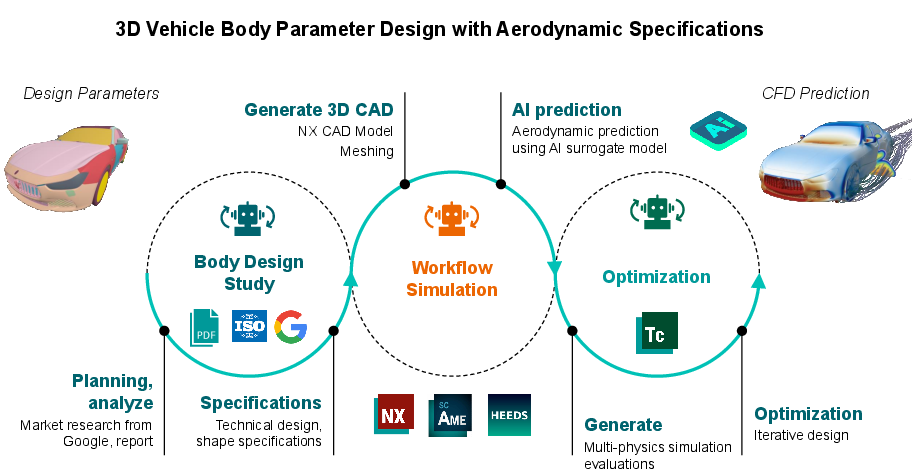
Figure 5: Aerodynamic workflow: agent leverages surrogates for rapid geometry assessment and constraint reasoning prior to CFD analysis.
AEI structures the surrogate not only as a predictor but as part of the closed-loop workflow, which coordinates prediction, constraint handling, and fidelity escalation in a traceable intervention process.
AEI’s relevance to MBSE is demonstrated via integration with the Simcenter engineering toolchain, where explicit models, requirements, dependencies, and analyses are organized. The agent operates over structured workflows: sensing workflow state (requirements, analyses, inconsistencies), reasoning about interventions (control retuning, heat-exchanger capacity reallocation, requirement decomposition), and acting under engineer supervision (simulation launch, parameter modification, traceability reporting).
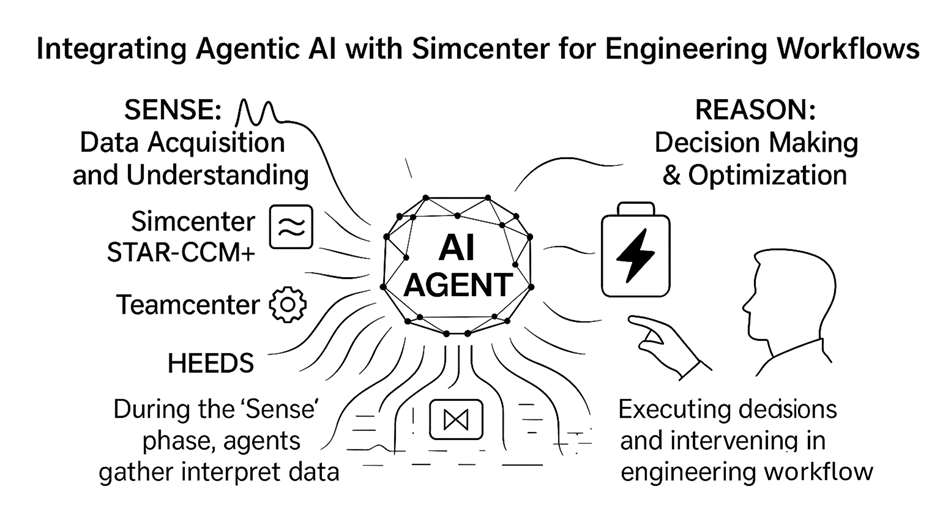
Figure 6: MBSE integration: agent senses workflow state, reasons over interventions, and acts—supporting traceable engineer-supervised execution.
This sense–reason–act paradigm converts workflow-level conflicts (e.g., battery protection vs. cabin cooldown requirements) into explainable, evidence-grounded recommendations, enhancing information flow, cross-tool reasoning, and traceability.
Implications and Future Directions
AEI positions engineering AI as process-level intelligence leveraging historical memory, constraint reasoning, toolchain feedback, and human oversight. The practical implications include increased traceability, institutional knowledge reutilization, reduced diagnostic overhead, and accelerated workflow execution across automotive engineering domains—suspension, RL control, aerodynamics, and MBSE.
Theoretically, AEI’s formalization and stability-inspired energy heuristic provide a foundation for sequential decision-based engineering process optimization, distinct from artifact-level approaches. The proposed agentic abstraction generalizes to other engineering domains characterized by partial observability, multi-objective optimization, and iterative toolchain integration.
Future developments may include empirical benchmarking, uncertainty-aware recommendation/optimization, active learning for memory construction, and rigorous evaluation of agentic workflows in industrial settings. Deeper coupling with foundation models and domain-specific LLMs, combined with interpretable attribution and robust memory augmentation, could further enhance workflow adaptability and reasoning capabilities.
Conclusion
The Automotive Engineering-Centric Agentic AI Workflow Framework defines a unified, sequential decision process for engineering workflows, combining multimodal memory construction and closed-loop online agentic reasoning. By leveraging constraint handling, workflow traceability, and human-in-the-loop supervision, AEI addresses process-level optimization in practical automotive scenarios. Expanded validation and tool integration will determine its effectiveness as a foundation for engineering AI in industrial applications.
(2604.07784)

