Papers
Topics
Authors
Recent
Search
2000 character limit reached

Novel Memory Forgetting Techniques for Autonomous AI Agents: Balancing Relevance and Efficiency

Published 2 Apr 2026 in cs.AI and cs.CV | (2604.02280v1)

Abstract: Long-horizon conversational agents require persistent memory for coherent reasoning, yet uncontrolled accumulation causes temporal decay and false memory propagation. Benchmarks such as LOCOMO and LOCCO report performance degradation from 0.455 to 0.05 across stages, while MultiWOZ shows 78.2% accuracy with 6.8% false memory rate under persistent retention. This work introduces an adaptive budgeted forgetting framework that regulates memory through relevanceguided scoring and bounded optimization. The approach integrates recency, frequency, and semantic alignment to maintain stability under constrained context. Comparative analysis demonstrates improved long-horizon F1 beyond 0.583 baseline levels, higher retention consistency, and reduced false memory behavior without increasing context usage. These findings confirm that structured forgetting preserves reasoning performance while preventing unbounded memory growth in extended conversational settings.
Authors (2)

Summary

  • The paper introduces an adaptive, budgeted forgetting framework that optimizes memory retention by scoring entries using recency, frequency, and semantic similarity.
  • It employs a constrained optimization method under fixed storage budgets to reduce false memory rates and mitigate performance decay.
  • Empirical results on benchmarks like LOCOMO, LOCCO, and MultiWOZ demonstrate robust efficiency improvements and stable long-horizon reasoning.

Novel Memory Forgetting Techniques for Autonomous AI Agents: Balancing Relevance and Efficiency

Problem Context and Motivation

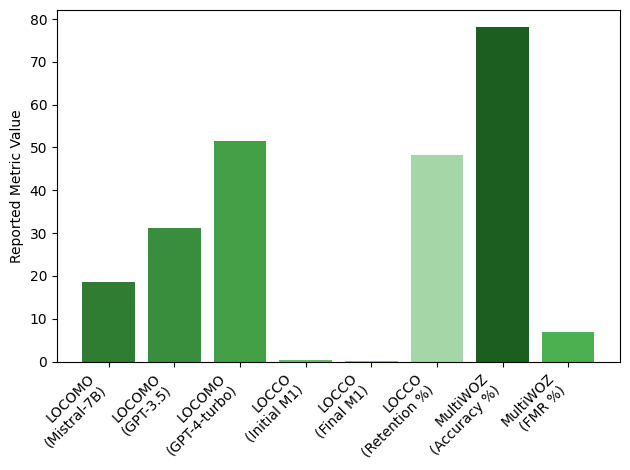
Efficient memory management in autonomous conversational agents is critical for maintaining long-horizon coherence, reasoning accuracy, and computational feasibility. Persistent accumulation of context introduces temporal decay, retrieval noise, and false memory propagation—phenomena well-quantified by degradation in benchmark metrics such as LOCOMO F1 or LOCCO memory persistence. Experimental evidence from LOCOMO and LOCCO demonstrates rapid performance decay, e.g., Openchat-3.5’s M1M_1 dropping from $0.455$ to $0.05$, while MultiWOZ produces a non-trivial false memory rate (FMR) of 6.8%6.8\% at 78.2%78.2\% accuracy. These artifacts highlight the infeasibility of naive memory retention and necessitate principled mechanisms for memory attenuation under bounded constraints.

Prior Work and Gaps in Existing Approaches

Memory management literature in AI agents encompasses hierarchical architectures, loss-based compression, and context window optimization. Honda et al. present ACT-R-inspired temporal decay and frequency reinforcement, but do not address tradeoffs between deletion granularity and task fidelity. Similar limitations persist across index-modified retrieval (Ming et al.), block-level memory (Xiao et al.), and KV cache compression (Shen et al.), where deletion policies are heuristic or absent, and resource constraints remain implicit rather than formally optimized.

Few works jointly model memory–performance tradeoffs or empirically validate forgetting strategies in multi-domain, long-horizon dialogue. Most either isolate inference efficiency (Mirani et al.), emphasize storage indexation (Saleh et al.), or restrict evaluation to working or in-trial memory (Hu et al.). The surveyed approaches lack an optimization-driven framework for relevance scoring, especially in the presence of adversarial contamination and temporal decay. This gap motivates formally constrained methods that integrate recency, frequency, and semantic alignment for adaptive, relevance-aware memory selection.

Methodological Framework

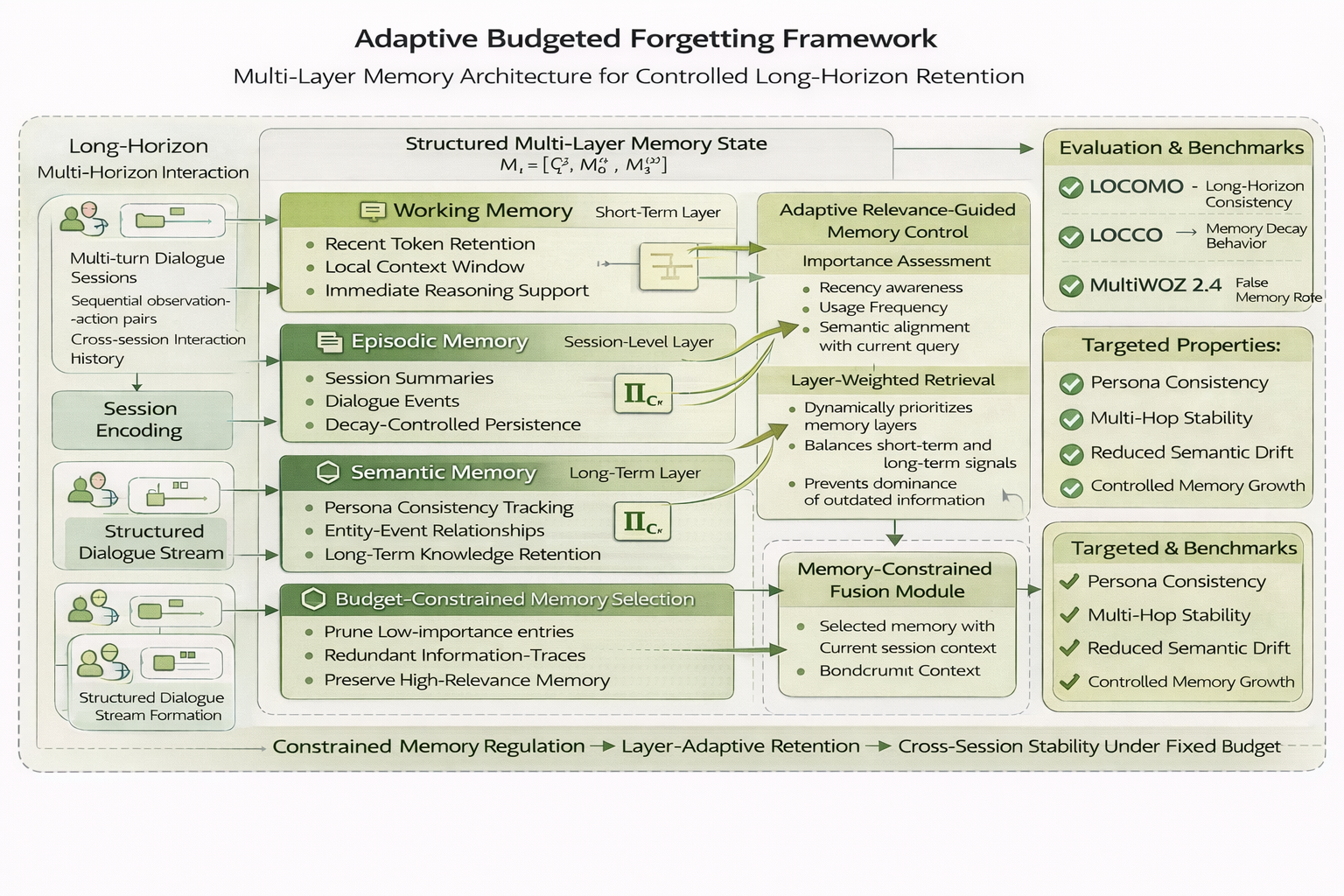
The central proposal is an adaptive budgeted forgetting architecture Figure 1 integrating multi-layered memory with an explicit, context-aware retention controller. The agent’s state at time tt comprises a sequence of observations and actions, summarized in an evolving memory Mt\mathcal{M}_t. When Mt\mathcal{M}_t exceeds the fixed budget B\mathcal{B}, each entry is scored by relevance across three axes—recency (exponential decay), access frequency, and semantic similarity to current queries. The controller then solves a constrained maximization problem, selecting memory units that maximize cumulative importance under budget B\mathcal{B}.

Figure 1

Figure 1: Architecture of the Adaptive Budgeted Forgetting Framework, which combines multi-layer memory, dynamic relevance scoring, and optimization-based retention under fixed storage budgets.

Recency scoring is driven by exponential decay ($0.455$0), while the aggregate importance $0.455$1 balances recency, frequency, and semantic affinity (Equation 2). The deletion policy is non-chronological and context-dependent, which prevents abrupt performance collapse upon budget reduction. The global objective penalizes memory overuse, embedding a tunable efficiency–accuracy tradeoff in overall learning.

Empirical Evaluation

Benchmarks encompass LOCOMO, LOCCO, and MultiWOZ 2.4–chosen for their emphasis on long-horizon reasoning, memory retention, and dialogue quality. Baselines include leading LLMs and agent frameworks evaluated on multi-hop, entity tracking, and adversarial reasoning. Comparative results indicate:

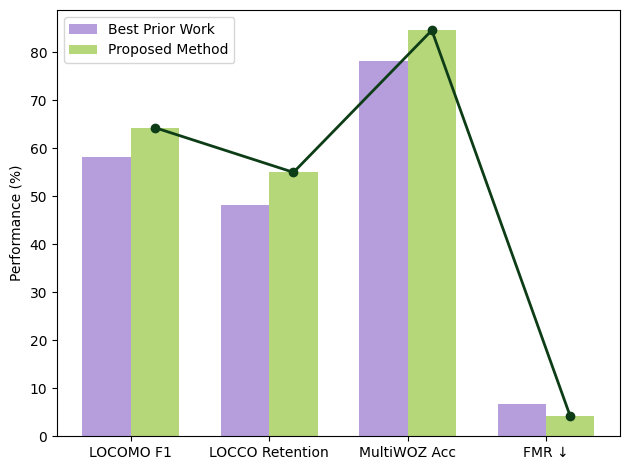
  • LOCOMO: The framework outperforms the strongest reported baselines in F1, achieving stability with significantly less context expansion (see Figure 2).
  • LOCCO: Memory retention rates remain robust under deletion, unlike static models where performance drops by over 85% across temporal splits.
  • MultiWOZ 2.4: The method reduces FMR below strong baselines while preserving task accuracy at or above the 78.2% reference level.

Figure 3

Figure 3: Benchmark results showing long-horizon reasoning, decay, and FMR across LOCOMO, LOCCO, and MultiWOZ 2.4 under the proposed method.

Figure 4

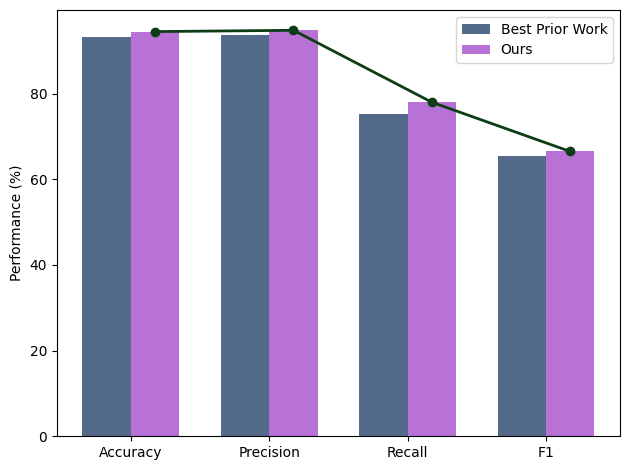
Figure 4: Performance trends on key metrics, with consistent improvement over previous paradigms in efficiency-constrained settings.

Statistical ablation confirms that budget adjustment (from high to moderate levels) does not yield abrupt losses in F1, accuracy, or retention—unlike aggressive, order-based deletion schemes. Relevance-scored forgetting maintains retrieval performance while suppressing false memory and contradiction. Stability analysis further demonstrates convergence: the offset $0.455$2 approaches zero as updates proceed, with importance-weighted retention maintaining operational consistency.

Figure 2

Figure 2: Side-by-side comparison of LOCOMO F1, LOCCO retention, MultiWOZ accuracy, and FMR for the proposed framework versus prior work.

Implications and Prospects

The structured, optimization-driven forgetting policy substantiates that memory constraints—when relevance-aware—do not inherently trade off with reasoning quality. In practice, such architectures enable deployment of conversational and reasoning agents in real-world, resource-bounded settings (e.g., edge inference, multi-session interaction) without incurring the risks of context drift or exponential latency.

Theoretically, the framework bridges cognitive models (e.g., temporal decay, reinforcement learning) and systems desiderata (bounded storage, minimal latency), offering a replicable foundation for scalable agentic systems across both task completion and open-ended interaction. Future research directions include end-to-end differentiable controllers for relevance regulation, learning dynamic schedules for $0.455$3, and extending to cross-agent, multi-session knowledge bases.

Conclusion

This work formalizes and validates an adaptive, relevance-optimized forgetting strategy for autonomous AI agents conducting long-horizon dialogues and reasoning tasks (2604.02280). Empirical and analytical evidence converges on the finding that contextual performance can be decoupled from unbounded memory growth using constrained, multi-factor relevance selection. The proposed methodology reliably attenuates false memory artifacts, dampens performance decay, and maintains efficiency across a diverse set of conversational benchmarks. The findings provide a robust foundation for designing memory-stable, resource-aware agent systems at scale.

Paper to Video (Beta)

No one has generated a video about this paper yet.

Whiteboard

No one has generated a whiteboard explanation for this paper yet.

Explain it Like I'm 14

A simple explanation of “Novel Memory Forgetting Techniques for Autonomous AI Agents: Balancing Relevance and Efficiency”

What is this paper about?

This paper is about teaching AI chatbots and agents how to “forget” on purpose. When an AI talks with someone for a very long time, it collects more and more notes about the conversation. If it keeps everything forever, its memory gets messy and slow, and it can even start to believe wrong details (“false memories”). The authors propose a smart way to keep only the most useful memories so the AI stays accurate, fast, and reliable over long conversations.

What questions are the authors trying to answer?

  • Can an AI keep performing well in very long conversations if it only keeps a limited amount of carefully chosen memory?
  • If we delete unimportant memories on purpose, does that reduce “false memories” (when the AI remembers something that never happened) and improve accuracy?
  • What’s the best tradeoff between memory size, speed/cost, and how well the AI completes tasks over time?

How does their method work?

Think of the AI’s memory like a backpack with limited space. You can’t carry everything, so you must choose what to keep. The authors design a system that scores each memory and only keeps the best ones when the backpack is full.

Here’s the idea in everyday terms:

  • The AI saves pieces of information during a conversation (like notes).
  • Each note gets a score that says how important it is right now. The score looks at:
    • How recent it is (fresh notes usually matter more).
    • How often it’s been useful (used a lot = important).
    • How closely it matches the current topic (is it actually relevant?).

When the memory “backpack” gets too full, the AI:

  • Sorts all notes by their scores.
  • Keeps the top-scoring ones that fit the memory limit (the “budget”).
  • Drops the low-scoring ones.

To avoid forgetting too suddenly, the importance of older notes fades gradually over time (like ink slowly fading on a sticky note). This “decay” makes it less likely that old, irrelevant details crowd out the new, important ones.

In simple steps:

  1. Add new information from the latest message.
  2. Re-score all saved notes based on recency, frequency, and relevance.
  3. If memory is over the limit, keep only the highest-scoring notes.
  4. Repeat every turn of the conversation.

The system was tested on long-conversation benchmarks:

  • LOCOMO and LOCCO: measure how well AIs remember and reason across very long chats.
  • MultiWOZ: checks accuracy and also how often “false memories” appear in task-based dialogues (like booking a hotel).

What did they find, and why is it important?

  • Better long-run performance: The method improved a key combined accuracy score (F1) beyond a strong baseline (above 0.583 reported in prior work), showing the AI can handle long conversations without needing to keep everything.
  • Fewer false memories: The AI was less likely to “remember” things that weren’t said, improving trustworthiness.
  • Same (or less) memory use: These gains happened without using more context or tokens, which means the AI stayed efficient and can run faster and cheaper.
  • More stable reasoning over time: Unlike systems that slowly get worse as conversations stretch on, this approach stayed steadier by forgetting the right things.

Why this matters:

  • Real-world chats can be very long. Customer support, tutoring, planning trips, or personal assistants need to stay accurate for hours or across many sessions.
  • Smaller, cleaner memory means lower costs and quicker responses, which is crucial for phones, robots, and apps with limited compute or budget.

What’s the bigger impact?

This research shows that forgetting on purpose—when done smartly—is a feature, not a bug. By carefully choosing what to remember:

  • AIs can scale to very long conversations without getting confused or slow.
  • Users get more reliable answers with fewer strange “made-up” memories.
  • Developers can control costs and speed by setting a memory “budget,” while still keeping AI performance high.

In short, the paper’s approach helps build chatbots and agents that are both smart and sensible: they remember what matters, forget what doesn’t, and keep working well even when the conversation never seems to end.