Speed by Simplicity: A Single-Stream Architecture for Fast Audio-Video Generative Foundation Model
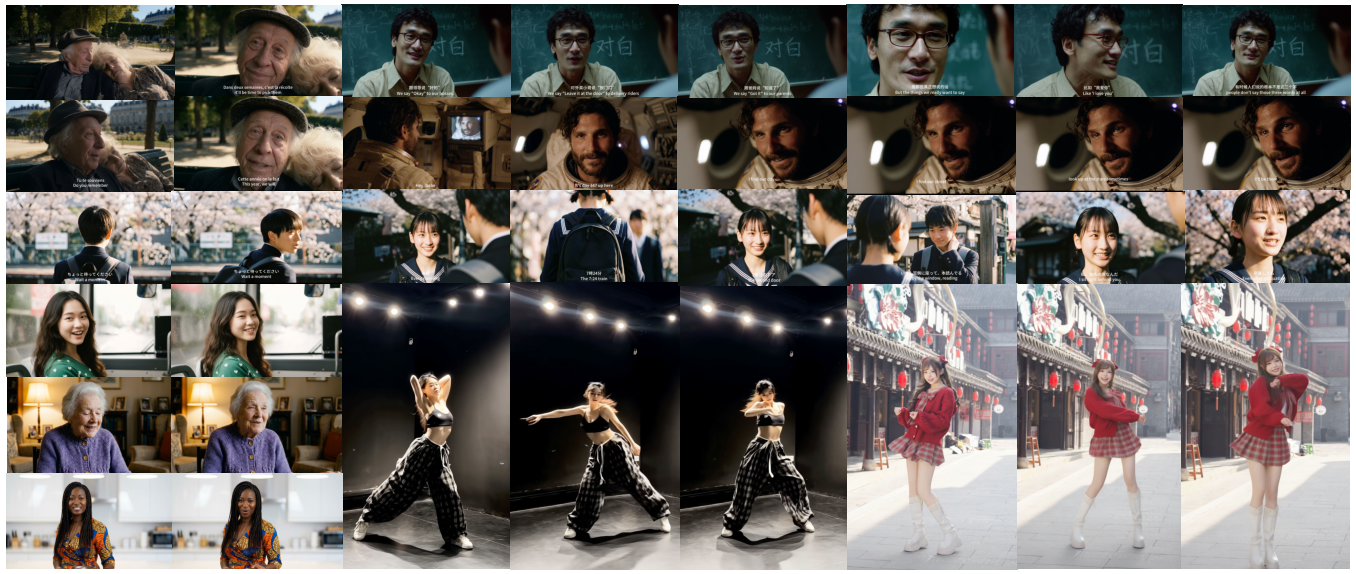
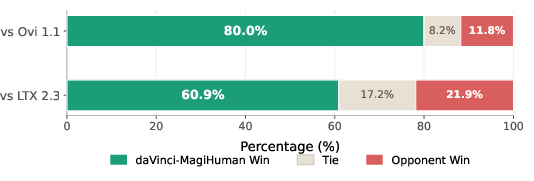
Abstract: We present daVinci-MagiHuman, an open-source audio-video generative foundation model for human-centric generation. daVinci-MagiHuman jointly generates synchronized video and audio using a single-stream Transformer that processes text, video, and audio within a unified token sequence via self-attention only. This single-stream design avoids the complexity of multi-stream or cross-attention architectures while remaining easy to optimize with standard training and inference infrastructure. The model is particularly strong in human-centric scenarios, producing expressive facial performance, natural speech-expression coordination, realistic body motion, and precise audio-video synchronization. It supports multilingual spoken generation across Chinese (Mandarin and Cantonese), English, Japanese, Korean, German, and French. For efficient inference, we combine the single-stream backbone with model distillation, latent-space super-resolution, and a Turbo VAE decoder, enabling generation of a 5-second 256p video in 2 seconds on a single H100 GPU. In automatic evaluation, daVinci-MagiHuman achieves the highest visual quality and text alignment among leading open models, along with the lowest word error rate (14.60%) for speech intelligibility. In pairwise human evaluation, it achieves win rates of 80.0% against Ovi 1.1 and 60.9% against LTX 2.3 over 2000 comparisons. We open-source the complete model stack, including the base model, the distilled model, the super-resolution model, and the inference codebase.
First 10 authors:
Paper Prompts
Sign up for free to create and run prompts on this paper using GPT-5.
Top Community Prompts
Explain it Like I'm 14
What is this paper about?
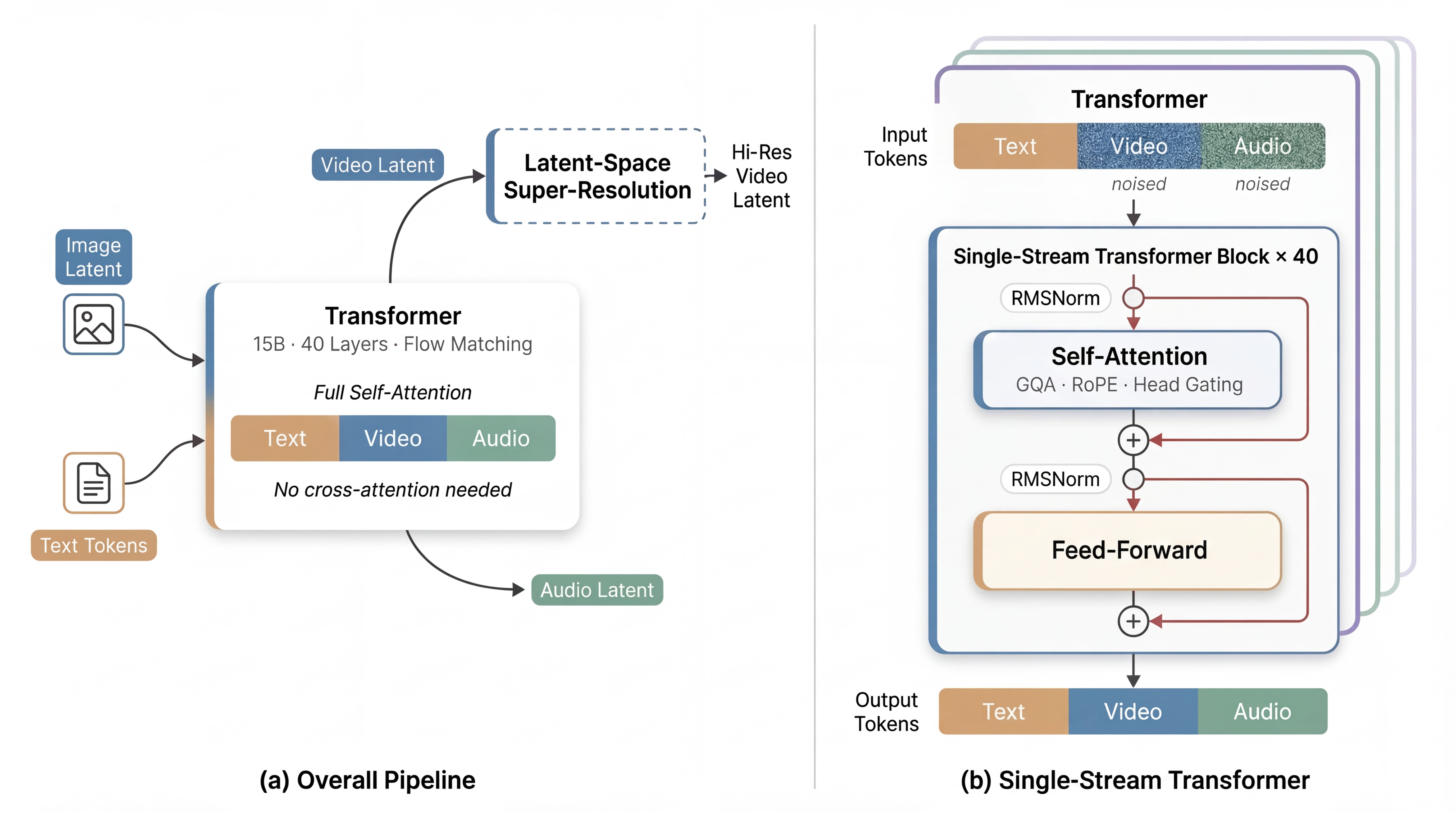
This paper introduces daVinci‑MagiHuman, an open‑source AI that can create short videos of people speaking and moving, with matching sound and lips, from text prompts. It makes both the video and the audio at the same time, works in several languages, and runs fast on modern GPUs. The big idea is to keep the model simple: instead of building separate parts for text, video, and audio, they use one “single stream” that handles everything together.
What questions were the researchers trying to answer?
- Can a simple, single system generate both video and sound together, and keep them perfectly in sync?
- Can this work well for people-focused videos (faces, expressions, lip movements, body motion) across different languages?
- Can it be fast enough for practical use, not just lab demos?
- Is a simpler design as good as, or better than, more complicated designs with many separate parts?
How does the model work? (In everyday language)
Think of the model like a single, well-organized production line where text, video, and audio pieces flow together, instead of splitting into different rooms and then being re‑combined.
Here are the main ideas, explained simply:
- Single‑stream Transformer: A Transformer is a kind of neural network that pays “attention” to different parts of the input to understand what matters. “Tokens” are small chunks of information (like words for text, or tiny pieces of video and sound). In this model, all tokens—text, video, and audio—go through the same shared backbone. This avoids complicated cross‑connections and makes the system easier to train and speed up.
- Sandwich layout: The first few layers and the last few layers specialize a bit for the type of input/output (text, video, audio), while the many middle layers are shared. It’s like having subject-specific teachers at the start and end, with common classes in the middle to help everything work together.
- Denoising without a step counter: The model uses a diffusion process, which is like starting with a noisy, blurry draft and cleaning it up step by step. Instead of telling the model what “step number” it’s on, it learns to guess how much noise is left by looking at the current inputs—like cleaning a picture without checking a countdown clock.
- Per‑head gating in attention: Attention has multiple “heads,” like many tiny spotlights focusing on different details. Each head gets a small “volume knob” (a gate) to stabilize learning and improve control, without making the model complicated.
- Unified conditioning: Extra information (like a reference image or the text prompt) is fed in the same token format as everything else. No special side modules are needed.
To make it run fast:
- Latent‑space super‑resolution: The model first creates a smaller, rough version of the video in a compressed “latent” space (think: a zipped sketch). Then it sharpens this compressed version to higher resolution with just a few extra steps. This saves time compared to making a full‑resolution video from scratch.
- Turbo VAE decoder: A VAE is a compressor/decompressor for video. They use a faster “Turbo” decoder to quickly turn compressed latents back into frames.
- Compiler optimization: They use a specialized compiler that fuses operations to make the GPU run the model about 1.2× faster.
- Distillation: A bigger “teacher” model trains a smaller “student” to do almost as well with fewer cleanup steps. This cuts the number of diffusion steps down to 8 while keeping quality high.
What did they find, and why is it important?
Here are the key results:
- Quality and clarity: On automatic tests, the model had the best visual quality and best match to the text prompt among the compared open models. For speech clarity, it had the lowest error rate (14.6%), meaning the spoken words are easier to understand.
- Human preference: In blind side‑by‑side tests with people, the new model was preferred 80% of the time over one open model (Ovi‑1.1) and about 61% of the time over another (LTX‑2.3).
- Speed: On a single H100 GPU, it can make a 5‑second low‑resolution video (256p) in about 2 seconds, and a 5‑second full‑HD video (1080p) in about 38 seconds. That’s fast enough for interactive uses.
- Multilingual support: It can generate spoken videos in Chinese (Mandarin and Cantonese), English, Japanese, Korean, German, and French, with good lip‑sync and facial expression matching.
- Open source: They released the base model, the faster distilled model, the super‑resolution model, and the code, so others can use and improve it.
Why it matters: This shows that a simpler, single‑stream design can produce high‑quality, well‑synced audio and video while running quickly—making it easier for the community to build on and deploy.
What could this mean for the future?
- Easier research and development: A simpler design is easier to understand, maintain, and improve. Because it’s open source, students, researchers, and developers can build new features on top of it.
- Better tools for creators: Fast, high‑quality, human‑focused video generation could help with dubbing, virtual presenters, educational videos, customer support avatars, and more, across multiple languages.
- Foundation for real‑time and interactive apps: The speed and simplicity suggest a path toward real‑time or near‑real‑time tools.
Overall, daVinci‑MagiHuman demonstrates that you don’t need a complicated, multi‑part system to get excellent audio‑video generation. A clean, single stream—plus smart speed‑ups—can deliver strong quality, good language coverage, and fast results.
Knowledge Gaps
The following are concrete knowledge gaps, limitations, and open questions left unresolved by the paper:
- Training data transparency: sources, sizes, modality/language distributions, data quality filters, licenses, and consent for identity/voice usage are not disclosed, preventing reproducibility and bias assessment.
- Tokenization/latent details are unspecified: latent grid sizes, spatial-temporal downsampling factors, frame rates, audio sample rates, token counts per modality, and text tokenization—needed to reason about compute/memory and replication.
- Positional/temporal encoding scheme is not described (e.g., absolute vs. relative, rotary), leaving unclear how long-range temporal dependencies and cross-rate alignment (audio vs. video) are handled.
- Architectural ablations are missing: no controlled studies isolating the impact of single-stream vs. multi-stream, “sandwich” modality-specific layers, per-head gating, timestep-free denoising, or unified conditioning.
- Theoretical/empirical trade-offs of single-stream design remain underexplored: when does single-stream underperform (e.g., physics, multi-person scenes) relative to specialized cross-attention pathways?
- Scalability limits are not characterized: quadratic attention over combined audio+video+text tokens likely bottlenecks long durations and higher resolutions; no analysis of memory/latency scaling or use of block-sparse/chunked attention.
- Long-form generation is unevaluated: quality, identity persistence, narrative coherence, and A/V sync beyond 5 seconds (e.g., 30–120s videos) remain unknown.
- A/V synchronization lacks objective metrics: no SyncNet/LSE-C/LSE-D or AV offset measurements across lengths and languages; reliance on WER and human preference is insufficient for sync claims.
- Effect of latent-space super-resolution on sync and identity is unquantified: does updating only video latents introduce A/V drift or identity shifts? Ablate SR noise level, step count, and attention locality with identity (e.g., ArcFace) and sync metrics.
- Distillation trade-offs are not reported: quality gap vs. teacher, robustness, and failure modes with 8-step sampling; curves over steps vs. quality/latency are needed to guide deployment.
- Physical consistency underperforms a competitor but lacks failure analysis: identify scenarios (occlusions, object interactions, contact dynamics) and propose targeted remedies (e.g., physics-aware priors).
- Multilingual coverage is coarse: no per-language WER/MOS, accent robustness, code-switching, low-resource languages, or phoneme coverage analysis; mispronunciation and prosody errors are unreported.
- Audio quality assessment is limited: WER measures intelligibility only; no MOS/NISQA, speaker similarity, prosody naturalness, artifacts, or background noise metrics.
- Speech controllability is not addressed: mechanisms and evaluations for speaker identity, timbre, prosody, emotion, speaking rate, and style cloning/conditioning are absent.
- Non-speech audio is unexplored: capabilities for environmental sounds, Foley, and music generation/conditioning and their alignment with video are untested.
- Multi-speaker scenarios are unevaluated: diarization, overlapping speech, speaker switching, and correct lip-voice assignment in multi-person scenes remain open.
- Task breadth is unclear: no demonstrations/benchmarks for dubbing to given audio, lip-sync-to-audio, video continuation, editing/inpainting, or keypoint/pose-conditioned generation despite the “unified conditioning” claim.
- Inference on commodity hardware is not characterized: VRAM footprint, throughput, and latency on GPUs like A100/4090/L40S; feasibility for real-time or edge devices beyond Turbo VAE is unknown.
- Decoder replacement implications are unmeasured: Turbo VAE retraining details and reconstruction fidelity (e.g., PSNR/LPIPS/FVD vs. original VAE) and downstream perceptual impacts are missing.
- Training protocol is opaque: optimizer, batch sizes, learning rate schedules, diffusion noise schedule, sigma parameterization, EMA, EMA decay, augmentation—needed for reproducibility and transfer.
- Data and compute efficiency are unreported: training compute budget, energy/carbon footprint, and scaling behavior vs. model/data size for the 15B backbone.
- Safety, bias, and fairness assessments are absent: demographic performance disparities (visual and speech), stereotype/toxicity in speech, inappropriate content generation, and mitigation strategies (filters, refusal policies).
- Privacy and misuse risks are unaddressed: identity/voice cloning safeguards, provenance/watermarking, content authenticity signals, and data right-to-erasure pathways.
- Human evaluation methodology lacks rigor detail: prompt set disclosure, rater instructions, inter-rater reliability, confidence intervals, statistical significance tests, and domain stratification (languages, scenarios).
- Benchmark breadth is limited: comparisons only to two open baselines; no evaluation against broader public suites (e.g., VBench-Vid, AVSync benchmarks) or closed models for context.
- Failure mode documentation is sparse: no systematic taxonomy or qualitative analysis of errors (e.g., lip jitter, eye artifacts, hand artifacts, motion drift, flicker).
- Temporal stability metrics are missing: flicker/strobing measures, FVD over longer horizons, and consistency under camera motion or scene changes are not reported.
- Alignment learning without cross-attention is unexamined: analyses of cross-modal attention patterns, learned temporal alignment behaviors, and robustness when training data has A/V misalignment.
- Extensibility to additional modalities is untested: depth, optical flow, segmentation, keypoints, 3D cues, or control signals (e.g., motion trajectories) in the single-stream paradigm.
- Licensing/scope-of-use specifics are unclear: model license terms, any usage restrictions for commercial/derivative works, and clarity on training data licensing to guide compliant downstream use.
Practical Applications
Below is an overview of practical applications enabled by the paper’s contributions—chiefly a single-stream Transformer for unified text–video–audio generation, fast inference via distillation and latent-space super-resolution, and an open-source, hardware-friendly stack. Applications are grouped by deployment horizon and linked to sectors, with indicative workflows and key assumptions or dependencies.
Immediate Applications
These use cases can be built now using the released models, super-resolution, and inference codebase; they leverage current performance (e.g., 5 s at 256p in ~2 s on an H100, multilingual support, strong lip-synchronization and human-centric quality).
Media, Entertainment, and Marketing
- Multilingual digital presenters for explainer videos, news briefs, promos, and product demos
- Sectors: media, advertising, e-commerce
- Workflow: script (text) + reference portrait/image → base generation (audio+video) → optional latent SR to 540p/1080p → Turbo VAE decode → publish
- Dependencies/Assumptions: strongest quality on human-centric scenes; GPU availability (latency targets reported on H100); permissions for likeness; language coverage is strongest for CN/EN/JP/KR/DE/FR with varying out-of-domain performance
- Automated dialogue replacement (ADR) and lip-synced dubbing for localization
- Sectors: film/TV, streaming, gaming
- Workflow: input transcript or translated script + actor/reference image → co-speech facial performance with precise A/V sync → editorial adjustments in NLE
- Dependencies/Assumptions: performance depends on speech intelligibility (WER varies by domain), cultural/linguistic nuance requires human QA; rights management for talent likeness and voices
- Virtual influencers and social content at scale
- Sectors: creator economy, brand marketing
- Workflow: prompts/themes + brand style guide → batch generation (distilled model for speed) → selection → SR for winners → deployment
- Dependencies/Assumptions: brand risk controls, disclosure and platform policies for synthetic media
Education and Training
- Synthetic instructors and multilingual course materials with precise lip-sync
- Sectors: education technology, corporate L&D
- Workflow: lesson script + reference teacher avatar → multi-language AV generation → LMS integration (SCORM/xAPI)
- Dependencies/Assumptions: GPU inference budget; institutional policies on synthetic avatars; accessibility requirements (captions, translations)
- Pronunciation and conversation practice with expressive, lip-synced feedback
- Sectors: language learning
- Workflow: lesson prompts + learner inputs → generated examples and corrective demonstrations in target language(s)
- Dependencies/Assumptions: pedagogy validation; speech intelligibility varies with content; integrate with ASR for feedback loops
Customer Support and Commerce
- Multilingual customer-service avatars for FAQs and onboarding
- Sectors: retail, fintech, telecom, SaaS
- Workflow: knowledge-base snippets → scripted AV responses → web-embedded avatar widget
- Dependencies/Assumptions: latency constraints for interactive UX (256p generation is faster-than-real-time on H100); governance around hallucinations and disclosure
- Personalized product explainers at scale (dynamic creatives)
- Sectors: e-commerce, marketplaces
- Workflow: product metadata + buyer segment features → auto-generated, lip-synced promos → A/B testing
- Dependencies/Assumptions: content moderation; performance uplift requires experimentation
Accessibility and Healthcare (Non-Clinical)
- Lip-readable instructional content for hearing-impaired users
- Sectors: public services, education, nonprofits
- Workflow: clear, slow-paced scripts → AV generation prioritizing articulation and close-up framing
- Dependencies/Assumptions: does not replace sign language; requires accessibility review; on-device deployment not yet supported at comparable quality/speed
- Guided facial or speech exercise videos for therapy homework
- Sectors: speech therapy, rehabilitation (non-diagnostic use)
- Workflow: clinician-provided protocols → consistent, expressive exercise demonstrations in multiple languages
- Dependencies/Assumptions: not a medical device; requires clinician oversight; regulatory boundaries apply
Software and Developer Tools
- Rapid prototyping of multi-modal generators using a single-stream backbone
- Sectors: AI platforms, MLOps
- Workflow: fork open-source repo → domain fine-tuning (e.g., corporate comms style) → deploy as internal API; leverage MagiCompiler for speedups
- Dependencies/Assumptions: training data availability and licenses; compute for fine-tuning; adherence to Wan2.2 VAE/Turbo VAE licenses
- Faster AV generation workflows in creative suites
- Sectors: creative software (plugins)
- Workflow: integrate base+SR pipeline into NLE/DAW (e.g., Premiere, Resolve) or OBS for scripted segments
- Dependencies/Assumptions: plugin engineering; GPU support in client machines or service backends
Research and Academia
- Benchmarking and ablations for unified multimodal generation
- Sectors: academia, corporate research
- Workflow: replicate single-stream Transformer with per-head gating and timestep-free denoising → investigate ablations vs. multi-stream baselines → evaluate on VerseBench/TalkVid
- Dependencies/Assumptions: compute for training/ablation; dataset curation and rights
- Data augmentation for AVSR/lip-reading and AV alignment tasks
- Sectors: speech, computer vision
- Workflow: generate controlled AV pairs (languages, phoneme distributions, emotions) → train or stress-test AVSR models
- Dependencies/Assumptions: synthetic-to-real domain gap; labeling/metadata consistency
Policy and Governance
- Red-teaming and evaluation of synthetic media detection and provenance
- Sectors: platforms, regulators, standards bodies
- Workflow: use open model to generate varied, high-quality AV samples → test watermarking/detectors → iterate policy thresholds
- Dependencies/Assumptions: require watermarking/provenance tooling; ethical guidelines for test distributions
Finance and Enterprise Communications
- Rapid creation of compliance training and internal announcements in multiple languages
- Sectors: finance, insurance, energy/utilities, manufacturing
- Workflow: policy scripts → multilingual digital announcers → distribution via intranet/LMS
- Dependencies/Assumptions: legal review; audit trails for content provenance; secure on-prem deployment options
Long-Term Applications
These rely on further research, scaling, improved streaming/edge performance, or broader ecosystem development (e.g., watermarking standards, regulatory frameworks).
Real-Time and Interactive Systems
- Live speech-to-speech and video-to-video translation with synchronized lip movements
- Sectors: communications, conferencing, broadcasting
- Path to product: streaming inference (token-by-token), coupled ASR+NMT+AV generation, speaker identity preservation
- Dependencies/Assumptions: sub-200 ms end-to-end latency; robust voice cloning safeguards; strong watermarking/provenance
- Conversational digital humans for customer service and tutoring
- Sectors: contact centers, EdTech
- Path to product: integrate LLM policy/knowledge layers + real-time AV generation + turn-taking; multimodal safety filters
- Dependencies/Assumptions: scalable serving; content safety and brand guardrails; consistent persona/voice identity controls
Personalized and Pervasive Digital Humans
- Individualized “digital twins” for creators, executives, and educators
- Sectors: media, enterprise, education
- Path to product: consented identity capture + fine-tuning (style, voice, expressions) + secure deployment; contracts/IP frameworks
- Dependencies/Assumptions: clear licensing of likeness/voice; platform policies; robust watermarking and misuse prevention
- On-device or edge inference for private, low-bandwidth telepresence
- Sectors: mobile, IoT, enterprise comms
- Path to product: further distillation/quantization; mobile-friendly VAEs; hardware accelerators
- Dependencies/Assumptions: acceptable quality at mobile power/thermal budgets; privacy-by-design
Content Production and Localization at Studio Scale
- End-to-end synthetic actor pipelines (background extras, ADR, multilingual releases)
- Sectors: film/TV, streaming, gaming
- Path to product: asset management for identities; director tools for emotion/gesture control; contract and union-compliant workflows
- Dependencies/Assumptions: legal frameworks for synthetic actors; creative controls for emotion/gesture; negotiated compensation models
Healthcare (Clinical-Grade)
- Regulated therapeutic avatars and adherence coaching with culturally adapted delivery
- Sectors: digital therapeutics, telemedicine
- Path to product: clinical validation for efficacy; integration with EHR/telehealth; explainability and safety reviews
- Dependencies/Assumptions: regulatory approval (FDA/CE, etc.); bias and equity audits; data privacy (HIPAA/GDPR)
Robotics and Embodied AI
- Large-scale synthetic AV data for training perception and multimodal alignment in human-robot interaction
- Sectors: robotics, autonomous systems
- Path to product: programmatic generation of co-speech gestures and expressions; curriculum datasets for AV alignment
- Dependencies/Assumptions: bridging sim-to-real gaps; domain adaptation; standardized benchmarks
Multimodal Foundation Extensions
- Single-stream architectures for broader tasks (e.g., AVSR, AVQA, agentic video understanding/generation)
- Sectors: AI research, enterprise AI
- Path to product: adapt unified tokenization and per-head gating to recognition and agentic planning tasks; unify with LLMs for tools use
- Dependencies/Assumptions: training data breadth; stable optimization at larger scales; safety and grounding mechanisms
Policy, Standards, and Safety Infrastructure
- Sector-wide watermarking and provenance standards validated on open, high-quality AV generators
- Sectors: standards bodies, platforms, regulators
- Path to product: interoperable watermarking APIs; risk-tier frameworks for deployment contexts; red-team datasets
- Dependencies/Assumptions: cross-industry coordination; robust adversarial testing; enforceability and user transparency
- Risk assessment sandboxes and certification for enterprise use of synthetic AV
- Sectors: finance, healthcare, public sector
- Path to product: scenario libraries (fraud, impersonation, misinformation); auditing protocols; compliance reporting
- Dependencies/Assumptions: governance processes; identity and consent verification tooling; incident response playbooks
Cross-Cutting Assumptions and Dependencies (impacting feasibility across applications)
- Compute: reported latencies require high-end GPUs (e.g., H100); edge/mobile deployment needs further distillation/acceleration.
- Data and Rights: consent for likeness/voice; licensing for training/fine-tuning data; compliance with platform and regional policies.
- Domain Scope: model excels in human-centric scenarios; performance may degrade on complex non-human scenes or esoteric domains.
- Language Coverage: strongest for Chinese (Mandarin/Cantonese), English, Japanese, Korean, German, French; other languages may require fine-tuning.
- Toolchain: relies on Wan2.2 VAE and a Turbo VAE decoder; ensure compatible licenses and infrastructure (e.g., MagiCompiler) for promised speedups.
- Safety & Governance: watermarking/provenance, detection, and disclosure are critical for ethical deployment; sector-specific regulations (e.g., healthcare, finance) may require additional validation and controls.
Glossary
- AdaLN conditioning: Adaptive LayerNorm-based conditioning used to inject control signals (e.g., timesteps) into diffusion/Transformer blocks. "explicit timestep embeddings or AdaLN conditioning"
- CFG: Classifier-Free Guidance; a guidance technique in diffusion models that trades off fidelity and condition adherence without an external classifier. "generate with only 8 denoising steps without CFG, while maintaining strong generation quality."
- CJK languages: Abbreviation for Chinese, Japanese, and Korean languages, often treated distinctly in ASR/NLP evaluation. "For CJK languages, we compute WER at the character level to avoid inconsistencies from word segmentation."
- cross-attention: An attention mechanism that lets one sequence (e.g., video) attend to another (e.g., text) for fusion or conditioning. "without separate cross-attention or fusion modules."
- DiT architectures: Diffusion Transformer architectures that combine diffusion modeling with Transformer backbones. "Unlike original DiT architectures~\citep{peebles2023scalable} that inject diffusion timestep information through explicit timestep embeddings or AdaLN conditioning,"
- Distillation: Training a compact or fast student model to mimic a stronger teacher model’s behavior for efficient inference. "Distillation. To reduce cost in inference, we apply DMD-2~\cite{yin2024improved} to distill the base generator."
- DMD-2: A specific Distribution Matching Distillation method for accelerating generation while preserving quality. "we apply DMD-2~\cite{yin2024improved} to distill the base generator."
- Dual-stream architectures: Designs with separate modality pathways (e.g., text and video) that are later fused, increasing complexity. "commonly adopt dual-stream architectures, where tokens from text and video are processed by partially separate branches and fused through cross-attention or other dedicated modules."
- Full-Graph Compilation: Compilation that optimizes the entire model graph to fuse ops and reduce communication for faster inference. "Full-Graph Compilation. We further integrate \href{https://github.com/SandAI-org/MagiCompiler}{MagiCompiler}, our full-graph PyTorch compiler, into the inference stack."
- GLM-ASR: An automatic speech recognition system (from the GLM family) used here for transcription in evaluation. "All generated audio is transcribed by GLM-ASR~\citep{zai2025glmasr}."
- Latent-space super-resolution: Upscaling and refining outputs in the model’s latent space rather than pixel space to reduce cost and preserve consistency. "latent-space super-resolution"
- Local attention: An attention variant restricting receptive fields to local neighborhoods to control computation at high resolutions. "the super-resolution model additionally enables local attention in many layers to control high-resolution attention cost."
- Modality-specific projections: Separate projection layers tailored for each modality (text, video, audio) at certain stages of a shared model. "The first and last 4 layers use modality-specific projections and RMSNorm parameters,"
- Per-Head Gating: Adding a learned scalar gate to each attention head to improve stability and representational control. "Per-Head Gating."
- RMSNorm: Root Mean Square Layer Normalization; a normalization technique using RMS statistics instead of mean-subtracted normalization. "modality-specific projections and RMSNorm parameters,"
- Sandwich Architecture Layout: A layer layout with modality-specific blocks at the beginning and end and shared layers in the middle for fusion. "Sandwich Architecture Layout."
- Self-attention: An attention mechanism where a sequence attends to itself to model dependencies without recurrence or convolution. "via self-attention only."
- Single-stream Transformer: A unified Transformer that processes all modalities in one shared token stream instead of separate branches. "using a single-stream Transformer that processes text, video, and audio within a unified token sequence via self-attention only."
- Super-resolution checkpoint: A dedicated model checkpoint specialized for the super-resolution stage that refines upsampled latents. "using a dedicated super-resolution checkpoint."
- Timestep embeddings: Learnable vectors encoding the diffusion timestep, typically injected to condition the denoiser. "explicit timestep embeddings"
- Timestep-Free Denoising: Denoising without an explicit timestep embedding pathway, inferring state directly from noisy inputs. "Timestep-Free Denoising."
- Trilinear interpolation: Three-dimensional linear interpolation (e.g., over x-y-time) used to upsample video latents. "we upsample the video latent with trilinear interpolation, inject additional noise, and refine it"
- Turbo VAE decoder: A lightweight, retrained video VAE decoder variant designed for fast, low-overhead decoding. "all decode times are measured with the Turbo VAE decoder."
- VAE: Variational Autoencoder; a latent-variable model used here to encode and decode compressed video/audio representations. "We use Wan2.2 VAE~\citep{wanteam2025wan2.2} for encoding"
- VerseBench: A benchmark used to evaluate generative video quality across multiple dimensions. "For video quality, we evaluate on VerseBench~\cite{wang2025universe}"
- VideoScore2: An evaluation framework that scores generative videos on aspects like visual quality and alignment. "and adopt VideoScore2~\cite{he2025videoscore2} to measure visual quality, text alignment, and physical consistency."
- WER: Word Error Rate; a standard ASR metric measuring transcription errors as a percentage. "using word error rate (WER), where lower is better."
- Unified Conditioning Without Extra Modules: Handling all conditioning signals (text, image, audio-video denoising) within the same token/latent space without dedicated branches. "Unified Conditioning Without Extra Modules."
Collections
Sign up for free to add this paper to one or more collections.