- The paper demonstrates that multiwavelength observations reveal a dynamically young galaxy group merger at z=0.35, highlighted by tailed radio galaxies and irregular X-ray morphology.
- The paper employs detailed radio jet bending analysis to constrain IGM flows, deriving a lower velocity limit of approximately 540 km/s for the brightest group galaxy.
- The paper integrates photometric and spectroscopic data to confirm the group's unrelaxed state, reinforcing the use of tailed radio sources as reliable indicators of merger activity.
Multiwavelength Signatures of Early Galaxy Group Mergers: The Case of Two Tailed Radio Galaxies at z=0.35
Introduction and Overview
The study "A multiwavelength study of an early galaxy group merger in COSMOS revealed by two tailed radio galaxies at z = 0.35" (2512.19792) presents an extensive analysis of a massive, X-ray luminous galaxy group at z=0.349 in the COSMOS field, whose dynamical youth and merging state are established through multiwavelength data. The presence of two tailed radio galaxies, including a wide-angle tail (WAT) hosted by the brightest group galaxy (BGG), forms the empirical basis for probing the interplay between galaxy kinematics, intragroup medium (IGM) dynamics, and hierarchical structure growth.
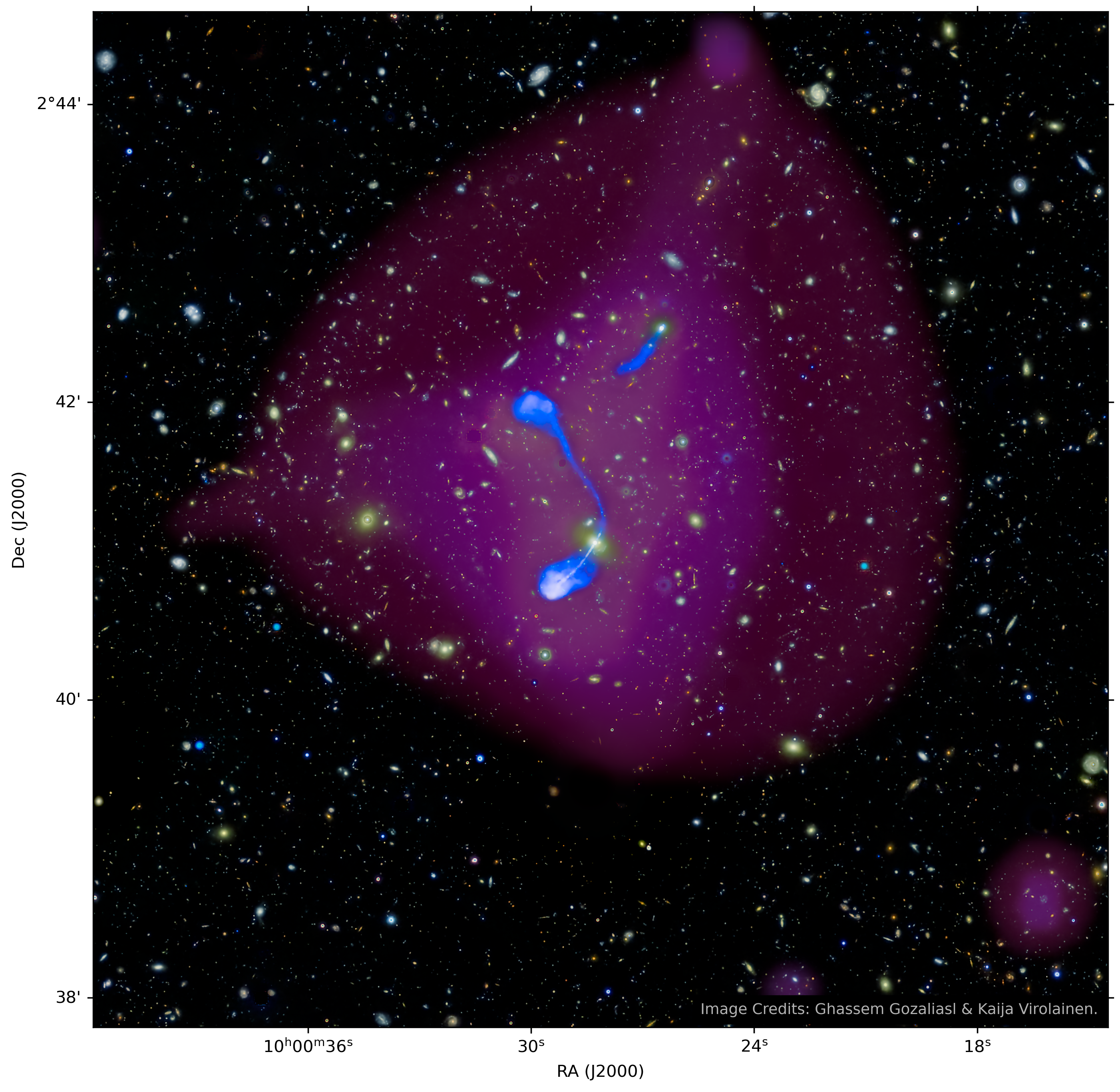
Figure 1: Multiwavelength composite of the galaxy group, showing optical, X-ray, and radio emission. The magenta overlay maps the diffuse intragroup X-ray plasma, blue contours show 3 GHz VLA radio emission associated with the WAT and tailed radio galaxies, and the Subaru RGB background traces member galaxies.
Group Environment and Dynamical State
Multiwavelength observations—spanning deep Subaru and HST imaging, Chandra/XMM X-ray data, and high-resolution VLA 3 GHz radio mapping—reveal a group that is highly unrelaxed, with strong, spatially irregular X-ray emission (LX≈7.5× median, M200≈3.2× median, TX≈1.3× median for field groups at similar redshift). The diffuse IGM exhibits a high temperature (TX=2.4±0.6 keV) and an electron density of ne=(8.2±0.3)×10−4 cm−3, consistent with dynamically young and possibly merging group environments.
Voronoi tessellation applied to the COSMOS2020 photometric-redshift galaxy catalog yields a galaxy overdensity that is irregular in spatial morphology, showing substructures and non-virial characteristics.
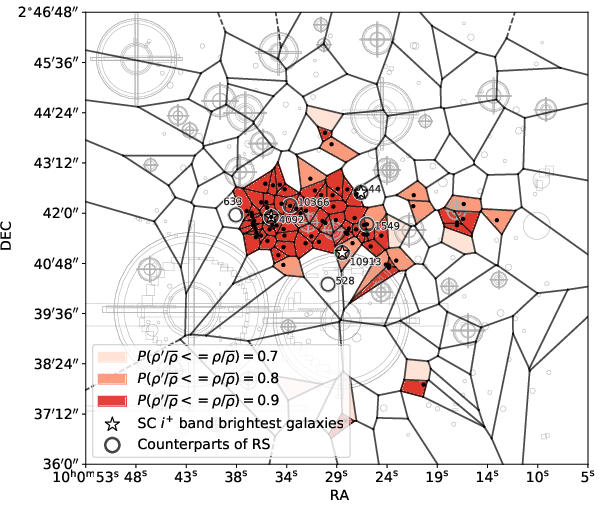
Figure 3: Voronoi tessellation of projected group galaxies highlighting significant overdensities and substructure. Black dots indicate galaxies at high local density, open gray circles denote the hosts of the seven radio sources, and the brightest group members are marked with white stars.
These findings, coupled with the peculiar offsets of the BGG and second-brightest group member from the overdensity centroid, support the interpretation that the system is an early-stage group-group merger, rather than a relaxed, virialized group.
Radio AGN, Host Galaxies, and IGM Interactions
The two dominant radio sources—WAT 10913 and tailed galaxy 44—exemplify classical indicators of IGM dynamism and group merger activity. Using VLA 3 GHz imaging:
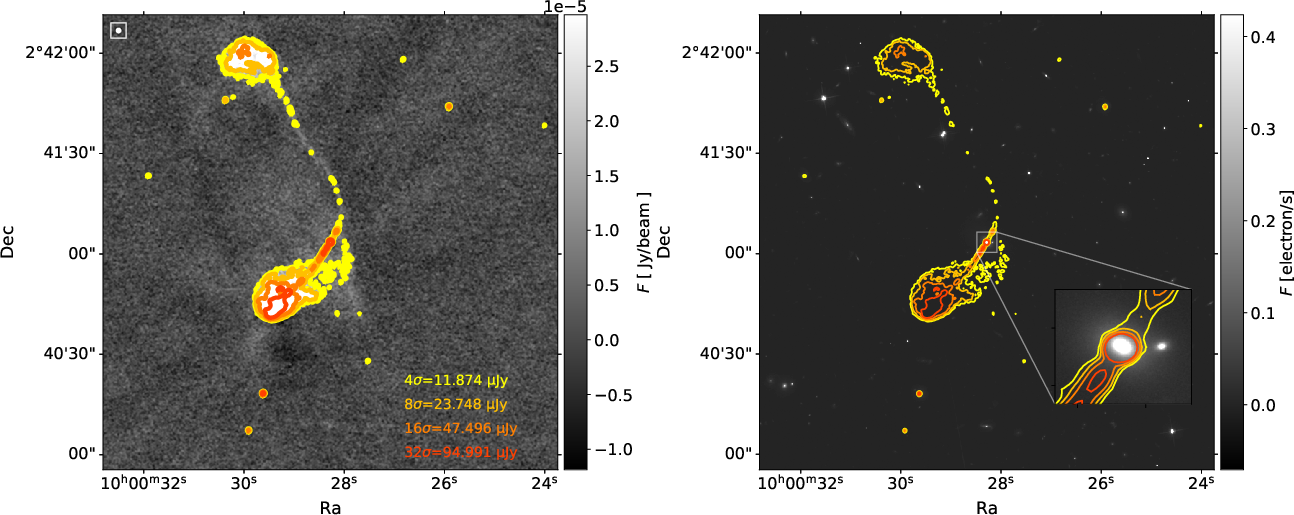
Figure 2: 3 GHz radio continuum image of WAT 10913 (left) and overlay of radio contours on HST ACS optical imaging (right), displaying clear C-shaped jet morphology indicative of a WAT.
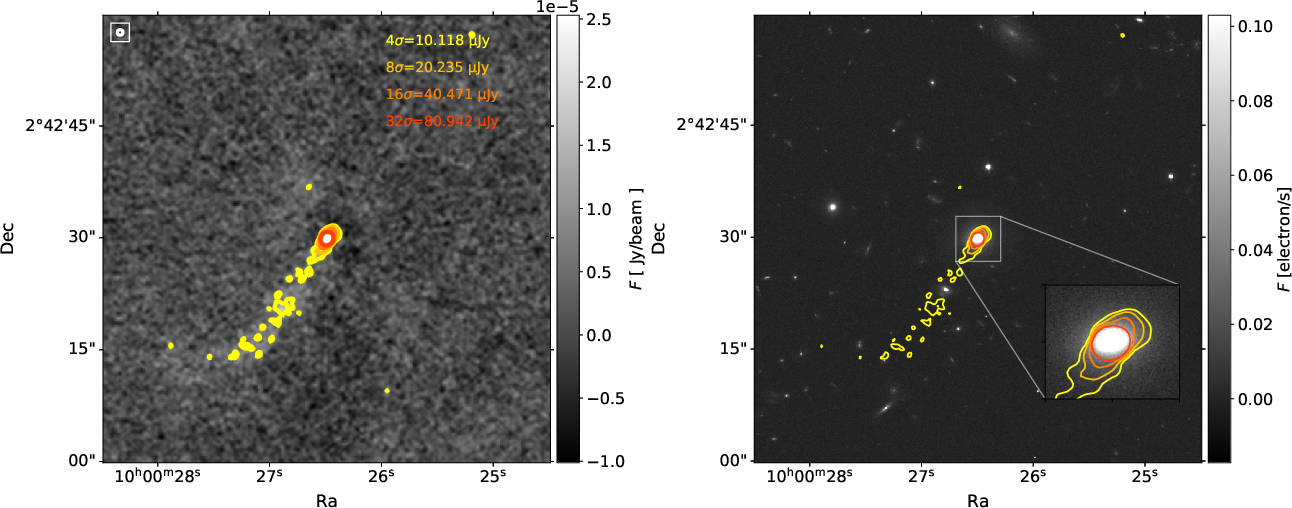
Figure 6: Same as previous, for tailed radio galaxy 44, which exhibits a head-tail or narrow-angle tail (NAT) morphology with a dominant single jet.
Both hosts are massive elliptical galaxies with extended stellar halos, as confirmed by surface-brightness profile modeling. The WAT BGG exhibits an FR II radio morphology, whereas source 44 is likely an unresolved HT (head-tail/NAT) system.
Surface brightness profile analysis, using both isophote fits and GALFIT modeling, shows these galaxies have S\'ersic indices characteristic of giant ellipticals with pronounced outer light excesses (n∼4.7–$4.8$, Re∼14 kpc and $5.5$ kpc, respectively). The extended halos are consistent with central group galaxies in dynamically young environments.
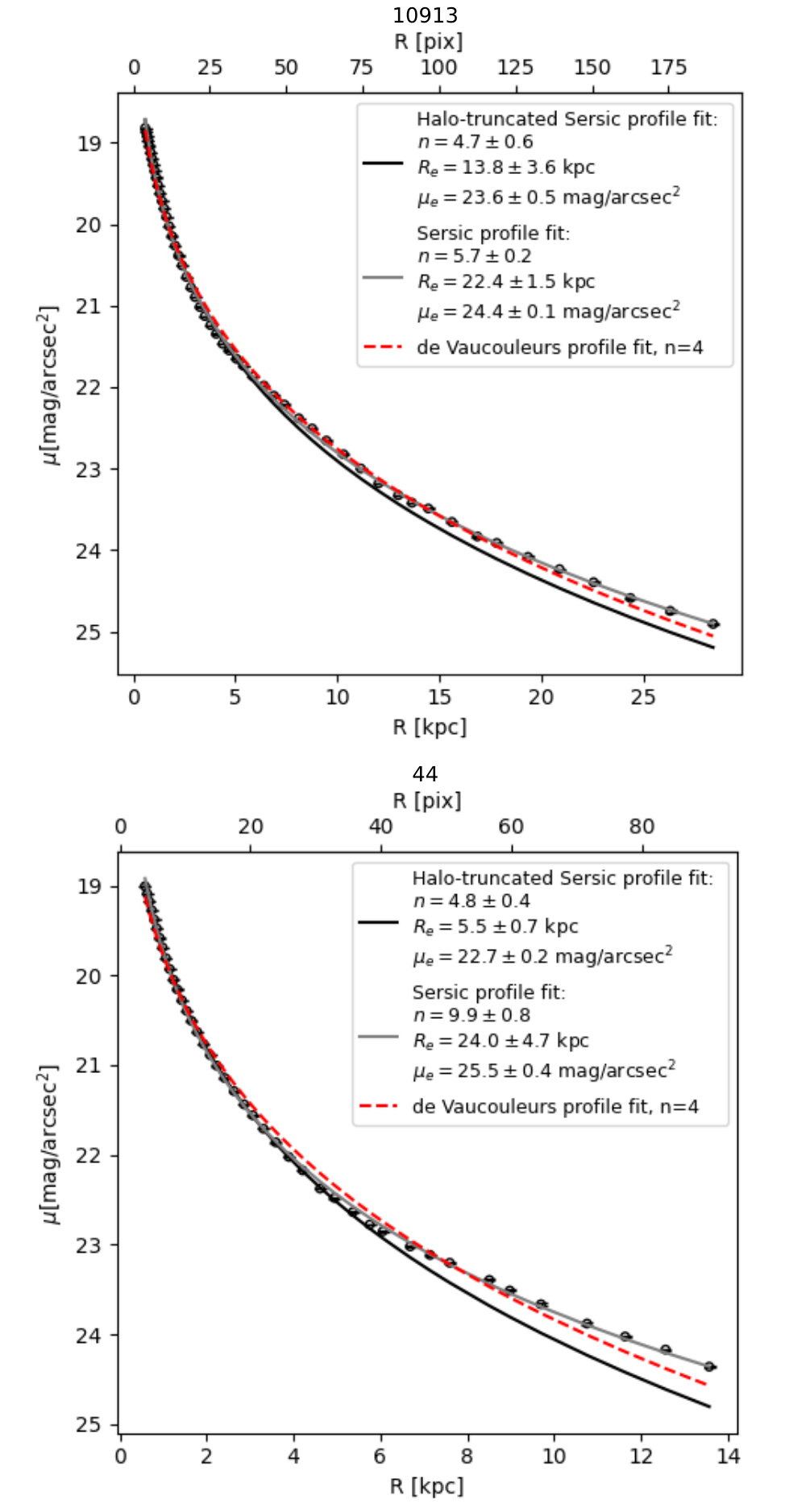
Figure 8: Elliptical isophotal surface-brightness profiles for WAT 10913 (top) and galaxy 44 (bottom). Both show deviation from a pure de Vaucouleurs profile at large radii, indicative of extended stellar halos and possible accretion signatures.
Dynamical Constraints from Radio Jet Bending
The observed jet bending in WAT 10913 constrains the velocity of the BGG relative to the IGM. Hydrodynamical modeling following the Begelman et al. (1979) approach, using measured curvature and estimates of jet speed and density, yields a lower limit on the relative velocity:
- vBGG/IGM≳540 km s−1
In contrast, the line-of-sight peculiar velocity of the BGG is much smaller (∼97–$160$ km s−1), implying that the bulk of the relative motion is contributed by the IGM, not the galaxy. This is a direct, quantitative signature of IGM turbulence or bulk outflow, as expected in the early phases of a group-group merger.
For radio galaxy 44, the morphology and high LOS velocity (∼443 km s−1) suggest a classic NAT/HT scenario—a sign of either high peculiar velocity relative to the group or substantial IGM flow, both characteristic of dynamically disturbed clusters.
Stellar Populations and Group Membership
Analysis of the color-magnitude and color-stellar mass diagrams for 76 probable group member galaxies indicates a clear red sequence dominated by massive ellipticals, consistent with expectations for cluster environments. The BGG and radio galaxy hosts are the most massive and luminous members (log10(M∗/M⊙)=11.88±0.03 and 11.49±0.06 respectively). The red galaxy fraction is enhanced compared to the general field, showing accelerated evolution in the denser group environment.
Implications for Group Assembly and Tailed Radio Galaxies as Tracers
This study demonstrates that multiwavelength analysis—including jet morphology, group-wide X-ray properties, and galaxy population metrics—is essential for diagnosing the dynamical state of galaxy groups. The presence of a WAT hosted by the BGG, high IGM temperature and density, irregular X-ray and optical morphologies, and large bulk flows in the IGM collectively provide strong evidence for an early-stage group merger.
The analysis reinforces the use of tailed radio galaxies, especially WATs, as powerful tracers of dynamically young and assembling group and cluster environments. Interpretation of jet bending within the context of group kinematics establishes a direct link between radio AGN activity and large-scale gravitational interactions. The evidence supports a scenario in which the mechanical interaction between merging groups, turbulent bulk flows in the IGM, and rapid galaxy/ICM infall drive the bent radio morphologies.
Conclusions and Prospects
This work shows that the dynamical youth and merging status of galaxy groups at z∼0.35 can be robustly assessed through an overview of X-ray, radio, and optical/NIR observations. The detection of heightened IGM temperature/density and the diagnosis of bulk IGM flows from radio jet bending present a compelling, multi-probe framework for understanding group assembly.
Further progress can be made with deeper, higher-resolution radio imaging to resolve the full morphology of NAT sources and to probe the evolution of jet-ICM interactions. Integral-field spectroscopy and next-generation X-ray studies will allow detailed mapping of the velocity field of the IGM and star formation histories of member galaxies. Systematic surveys exploiting radio AGN as dynamical probes will enhance the census of group/cluster assembly in the context of cosmological structure formation.
Conclusion
The multiwavelength analysis of the COSMOS group at z=0.349 reveals a massive, dynamically unrelaxed system in the process of hierarchical assembly, anchored by the presence of two tailed radio galaxies and corroborated by irregular X-ray and optical morphologies. The study provides strong quantitative evidence for bulk IGM flows and establishes WATs as reliable tracers for early-stage group mergers. This work underscores the need for integrated, multiwavelength diagnostics in the study of cosmic structure evolution and highlights future opportunities for leveraging tailed radio galaxies as probes of group and cluster dynamics (2512.19792).