- The paper presents a comprehensive multi-frequency analysis showing complex spectral ageing and non-monotonic brightness profiles in the head-tail galaxies T1 and T2.
- It employs spatially resolved spectral index mapping and radiative age diagnostics to reveal age gradients, with T1 exhibiting a high 3D velocity and T2 indicating non-standard injection histories.
- Environmental diagnostics using deep Chandra X-ray mapping highlight ICM interactions and hydrodynamical instabilities as drivers of the observed morphological transformations.
Spectral Ageing and Morphological Complexity of Tailed Radio Galaxies in Abell 2142
Introduction
The study "Ageing and dynamics of the tailed radio galaxies in Abell 2142" (2409.03453) addresses the spectral and dynamical evolution of two head-tail (HT) radio galaxies, T1 and T2, embedded in the ICM of the galaxy cluster Abell 2142 (A2142). Utilizing a comprehensive dataset from LOFAR, uGMRT, VLA, MeerKAT (30 MHz–6.5 GHz), and deep Chandra X-ray observations, the paper provides an in-depth multi-frequency analysis of both the non-thermal and thermal environments influencing these galaxies.
Abell 2142 and the Cluster Environment
A2142 is a massive, z=0.0894 system hosting approximately 900 member galaxies and characterized by an intermediate state between relaxed and merging clusters, with substantial substructure and ongoing infall processes. Multi-wavelength imaging reveals a hybrid radio halo structure consisting of three components (H1, H2, H3), colocated with intricate thermal structures visible in X-rays, including prominent cold fronts associated with subcluster mergers.
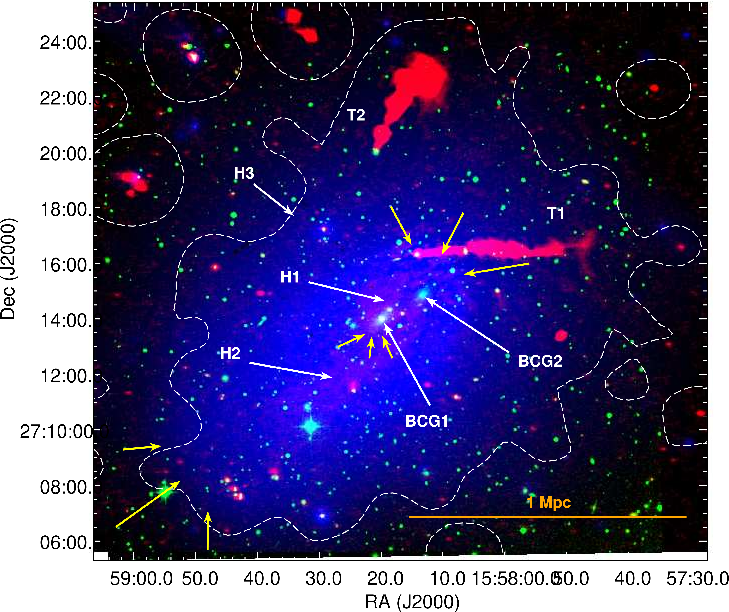
Figure 1: Multi-band imaging of A2142, showing LOFAR 143 MHz radio contours (red), DSS-2 optical (green), and XMM-Newton 0.7–1.2 keV X-ray emission (blue). Labels identify T1, T2, the brightest cluster galaxies, and radio halo components.
Radio Morphology and Substructure
Both T1 and T2 demonstrate pronounced morphological complexity departing from canonical NAT/WAT shapes. T1 extends up to 700 kpc, showing high collimation (T1-A), strong surface brightness discontinuities, “wiggles” (T1-B), broadening and fainter downstream regions (T1-C), and finally a faint arc-like structure (T1-D) indicative of very aged emission. T2 is more anomalous, with a light-bulb-shaped head (T2-A), an abrupt narrowing (choke, T2-B), and a highly diffuse, filamentary plume (T2-C) detected only at low frequencies, which likely traces the oldest electron populations.
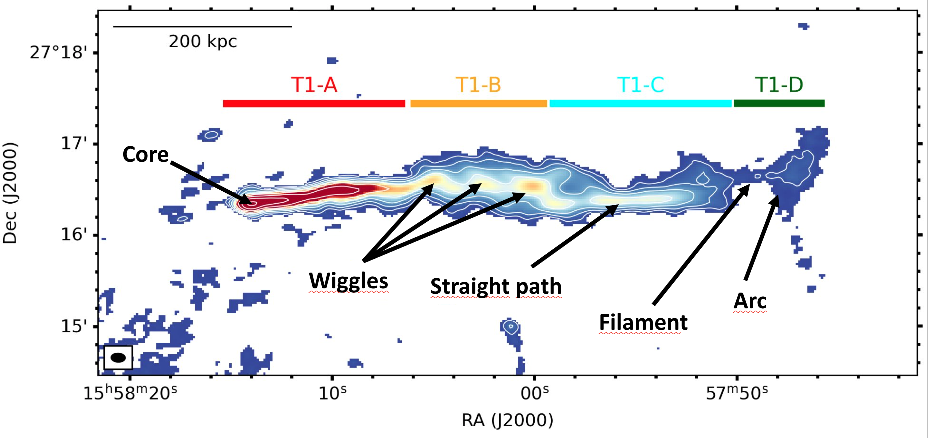
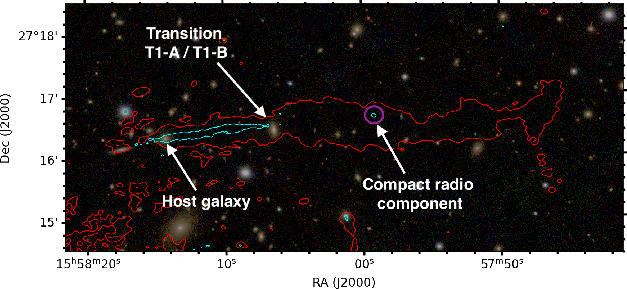
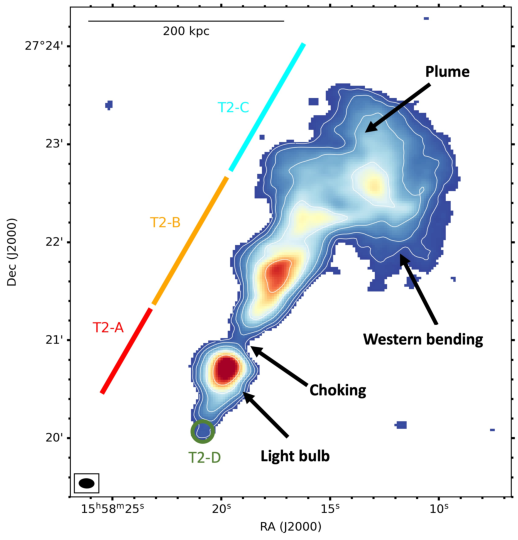
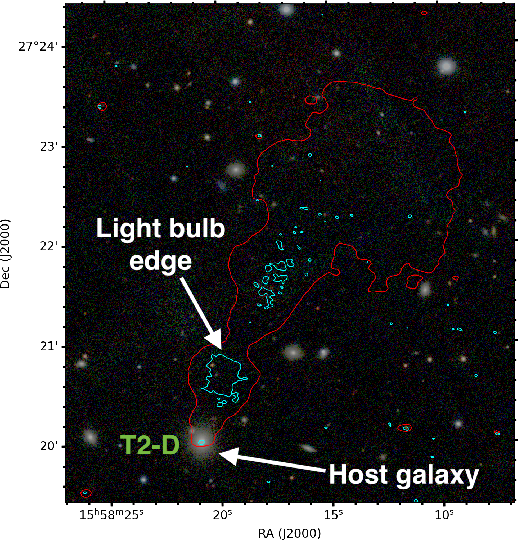
Figure 2: 143 MHz radio images and contours overlaying optical images, defining the substructures and irregularities within T1 and T2.
Surface Brightness and Spectral Profiles
Detailed surface brightness profiles at multiple frequencies (down to 50 MHz) reveal non-monotonic, oscillating features in both galaxies. For T1, the profile shows rapid initial decline, local enhancements (“wiggles"), and an eventual plateau in the arc. In T2, three comparable peaks mark T2-A, T2-B, and the extended plume, inconsistent with standard monotonic ageing predictions; the radio core is weak and does not coincide with the main emission peaks.
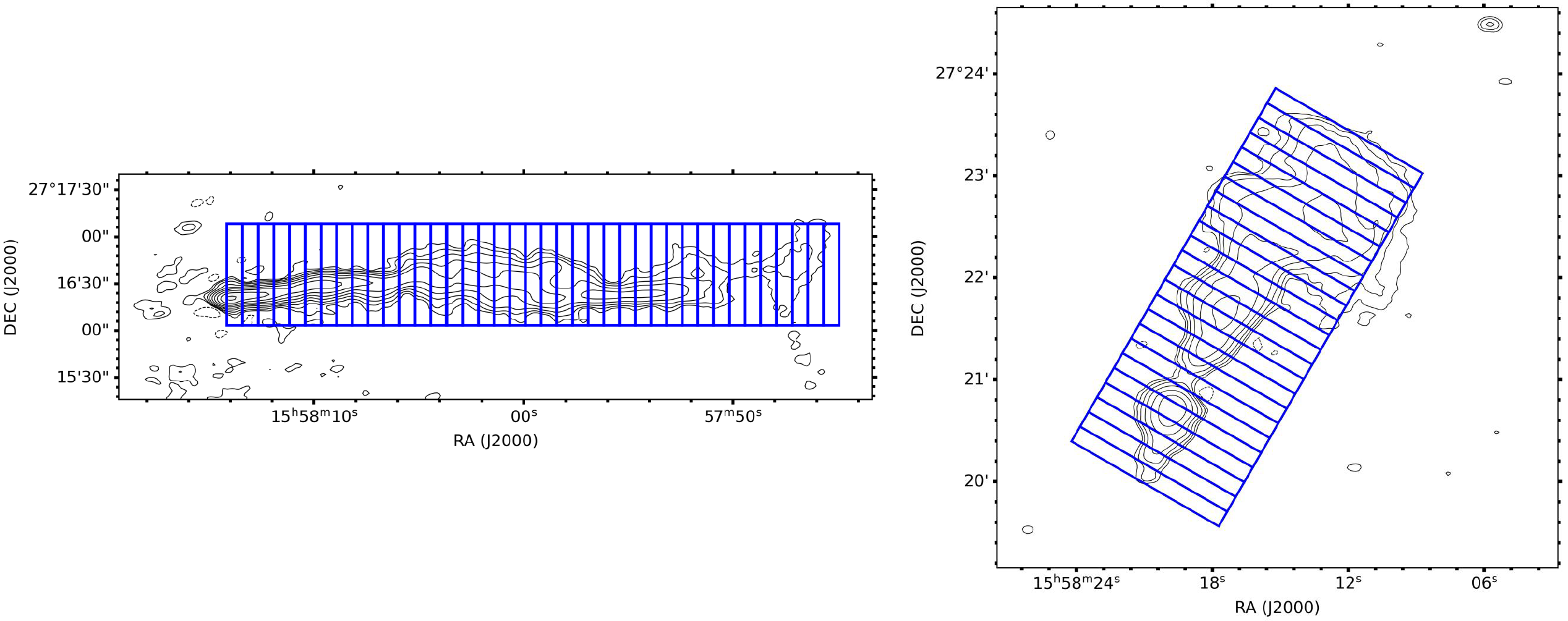
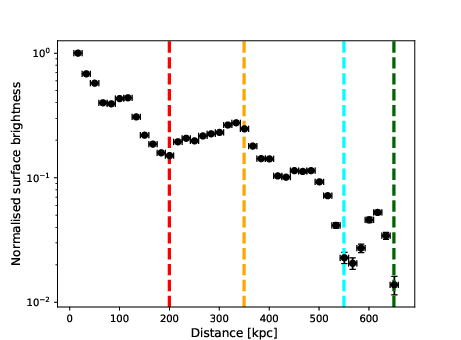
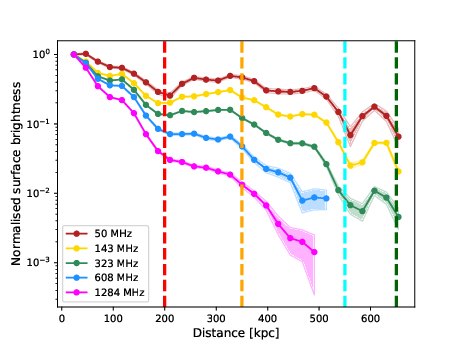
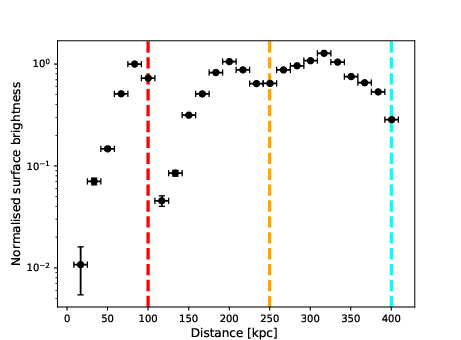
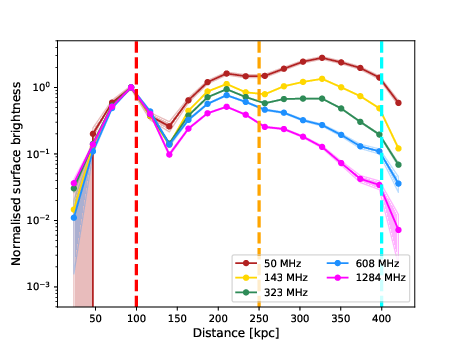
Figure 3: Surface brightness profiles of T1 and T2 at multiple frequencies, highlighting sub-regional boundaries and anomalous features.
Spectral Analysis and Ageing Diagnostics
The integrated spectra of T1 (α=0.87±0.01) follow a single power law from 50 MHz up to 2 GHz, dominated by the T1-A region; however, spatially resolved analyses indicate spectral breaks and progressively steeper spectra in T1-B, T1-C, and especially T1-D. T2 shows no single power-law fit, and all subregions display pronounced spectral curvature and ultra-steep indices in the plume.
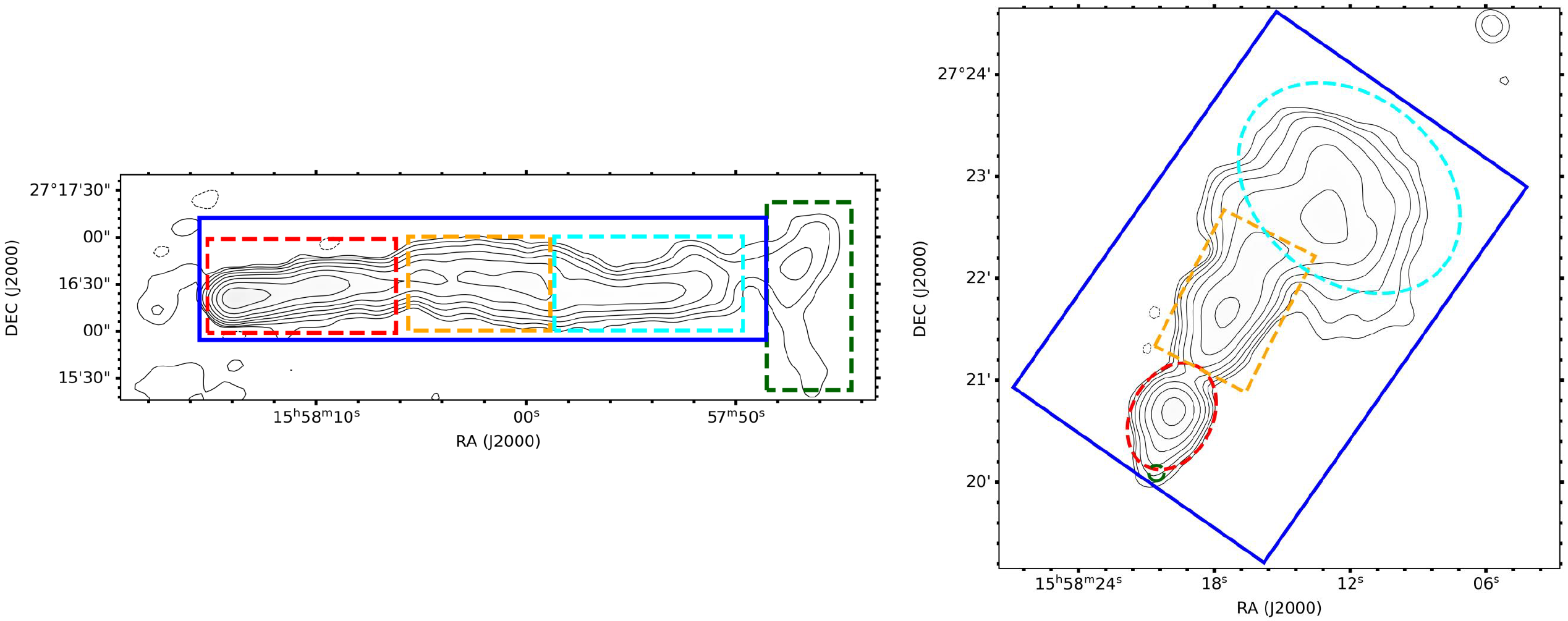
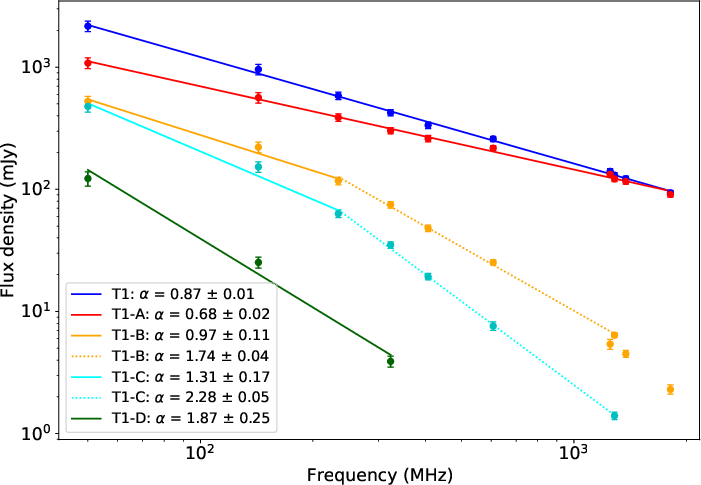
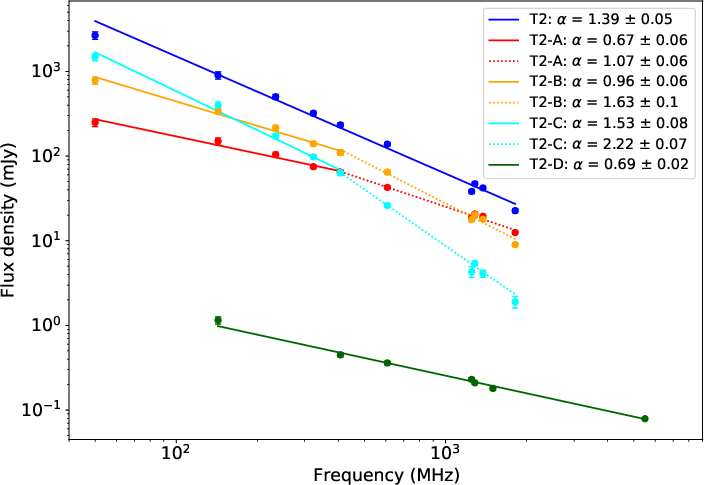
Figure 4: Integrated spectra for T1 (left) and T2 (right), with color-coded contributions from different subregions.
Pixel-by-pixel mapping of spectral indices and spectral index profiles strongly support ongoing spectral ageing, with a steady steepening along tail lengths, reaching α>2 at high frequencies in the outermost regions (both in T1 and T2). Ultra-steep spectra in T1-D and T2-C suggest synchrotron ages exceeding several hundred Myr.
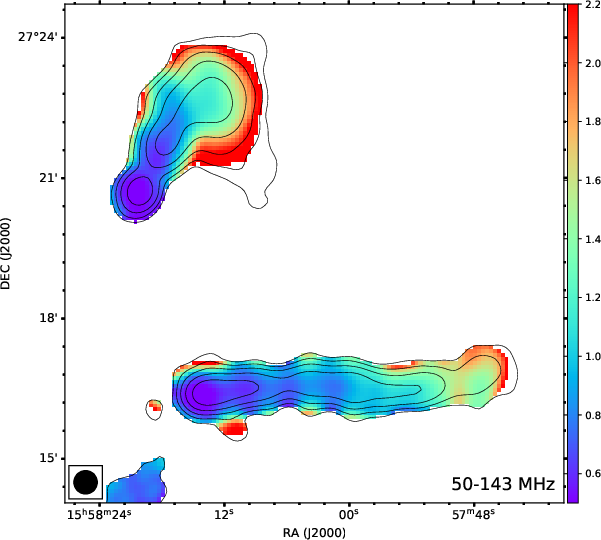
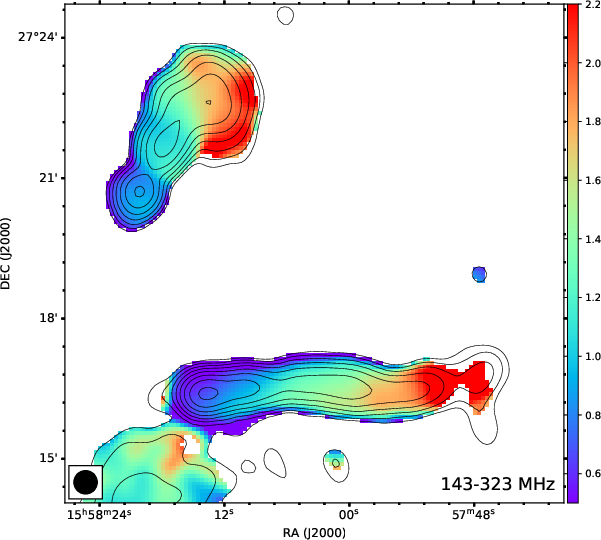
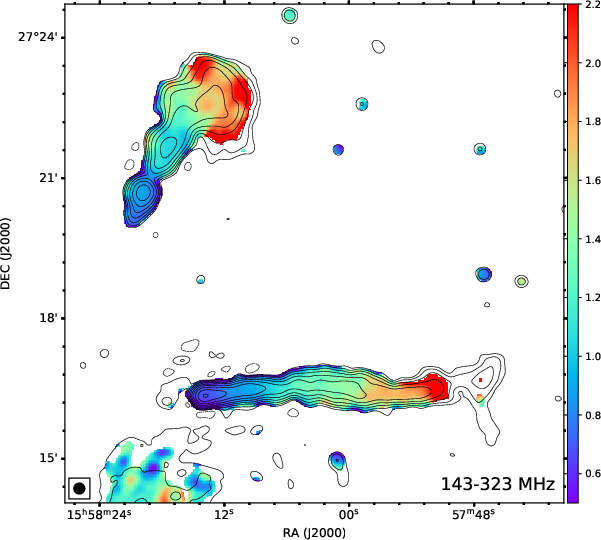
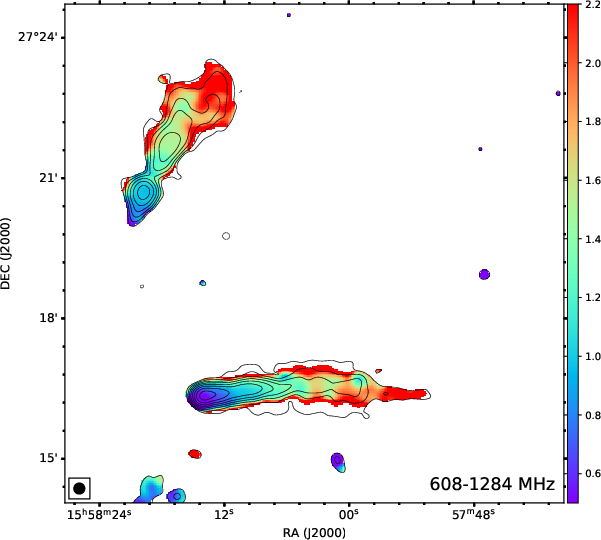
Figure 5: Spectral index maps between various frequency pairs, demonstrating spatial gradients and regions of ultra-steep spectrum corresponding to oldest plasma.
Spectral ageing models (KP, JP, TJP) are tested via radio color-color diagrams. For T1, low-frequency color-color data can be reconciled with simple JP/TJP models at αinj=0.51, but higher-frequency behavior in T1-B, T1-C, and T1-D deviates—indicating the involvement of mixing, unresolved re-acceleration, or calibration systematics rather than pure radiative losses. For T2, none of the standard models account for the complex spectral tracks, and the data suggest non-monotonic injection histories.
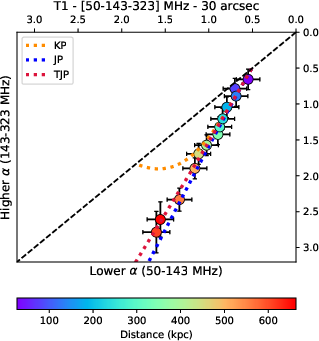
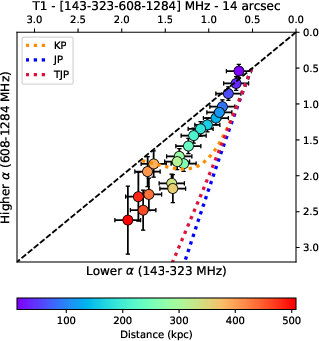
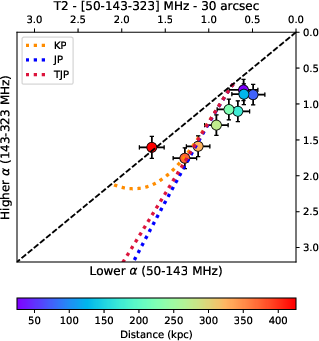
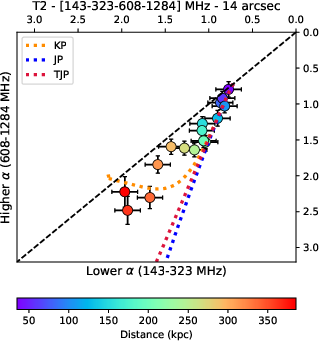
Figure 6: Color-color diagrams comparing measured spectral indices with predictions from KP, JP, and TJP ageing models.
Environmental Diagnostics from X-Ray Observations
Chandra spectral mapping and surface brightness analysis reveal significant variations in the local ICM pressure and temperature at the locations of tail discontinuities (e.g., T1-A/T1-B transition). At least in T1, these coincide with locations of heightened surface brightness and morphological transitions. However, the analysis does not support strong shock signatures; moderate pressure discontinuities and possible compression features are identified, but these cannot fully account for observed radio morphology and spectral features.
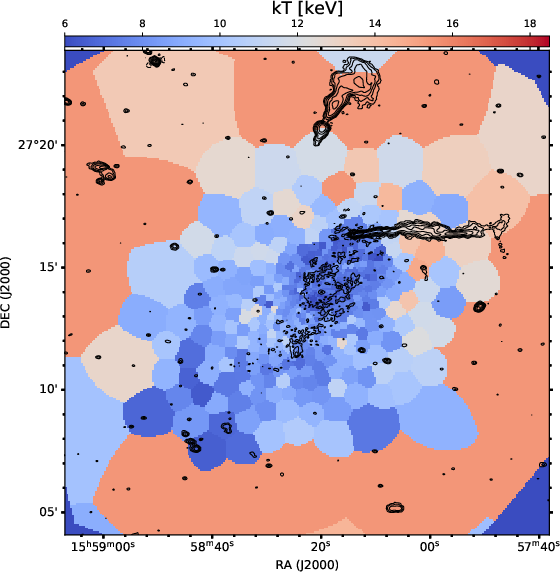
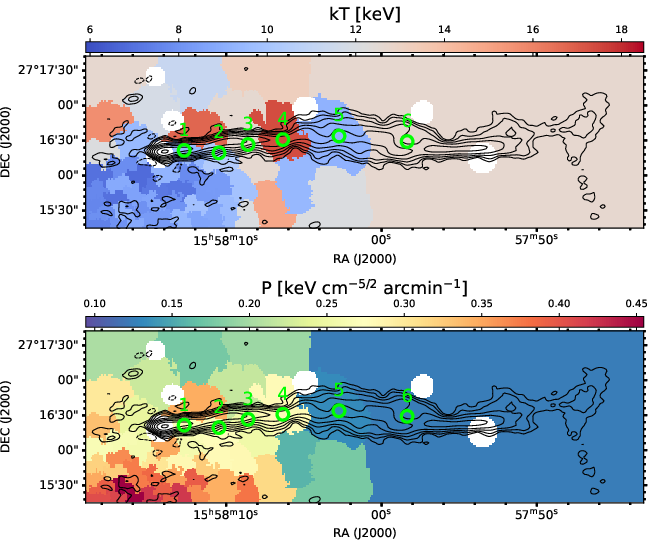
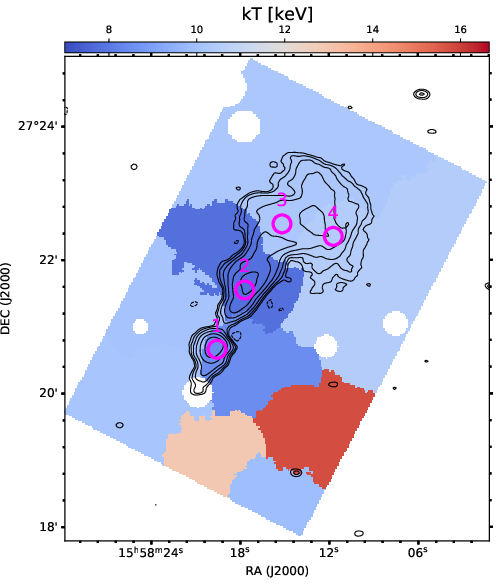
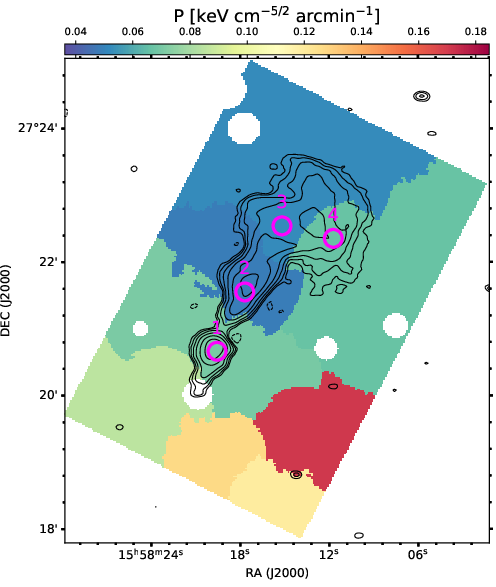
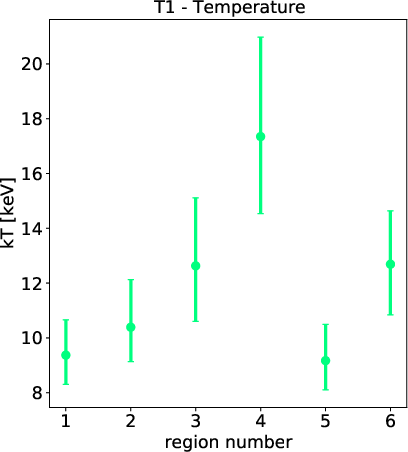
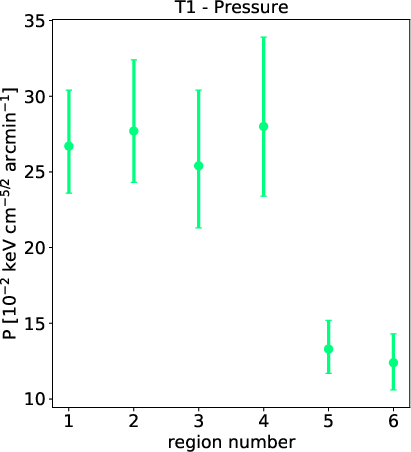
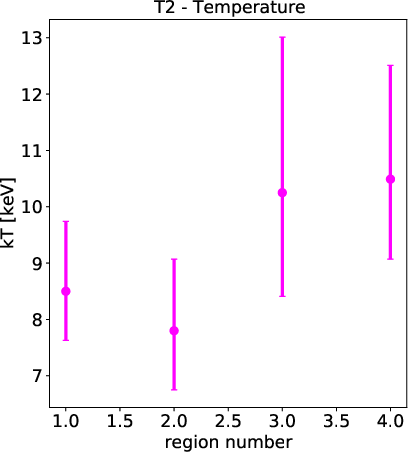
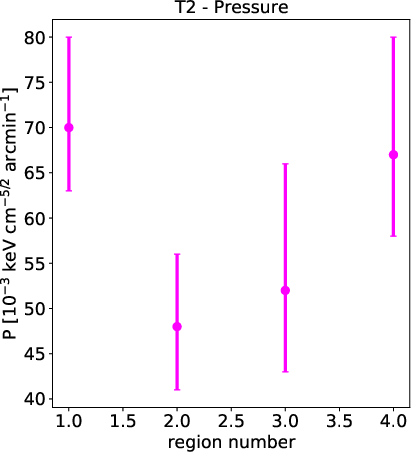
Figure 7: X-ray thermodynamic maps showing projected temperature and pressure variations through the T1 and T2 environs.
Dynamical Inference and Radiative Age Mapping
Radiative ages inferred from multi-frequency fits increase from t∼50 Myr near the heads to t∼350 Myr in the oldest downstream regions, with the age gradient permitting a 3D velocity reconstruction for T1: v3D≳2670 km/s, a value exceeding the cluster velocity dispersion. The derived projection angle (∼52∘) constrains the likely tail orientation.
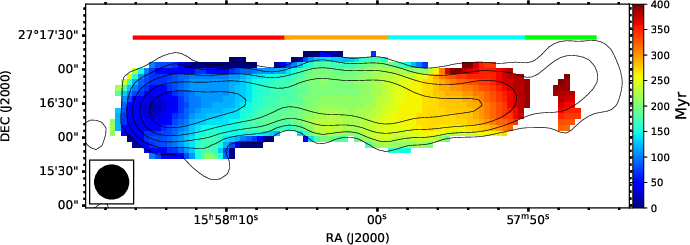
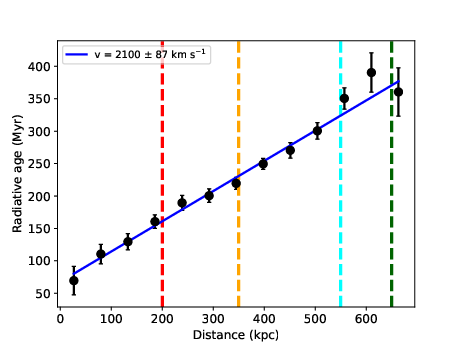
Figure 8: Radiative age map and profile for T1, quantifying spatial age gradients and substantiating a high-velocity orbital solution.
Interpretation: Ageing, Instabilities, and AGN History
For T1, the absence of downtime in the spectral index profile rules out ongoing re-acceleration in the main tail, supporting a scenario where Kelvin-Helmholtz instabilities, likely triggered at the T1-A/B boundary, give rise to observed wiggles and mixing, with further diffusion and plasma ageing downstream (T1-D). At the T2 core, radio and X-ray properties (weak radio core, thermal X-ray emission) suggest a remnant AGN, with the double-peaked radio profile and spectral curvature best explained by at least two AGN outbursts—creating sequentially T2-B and T2-A—during infall, and possible ram-pressure triggering. The diffuse, ultra-steep spectrum plume in T2-C is an archetype of extreme cosmic-ray electron ageing and mixing with the ICM over time.
Implications and Future Prospects
This work underscores the necessity of high-fidelity, multi-frequency spectral mapping in cluster radio galaxy studies, demonstrating that even morphologically “classical” HT galaxies can display pronounced deviations from monotonic spectral ageing due to hydrodynamical effects and complex AGN duty cycles. The inability of standard single-injection models to fit the entirety of spectral data, especially in T2, points to an essential role for non-stationary AGN histories and local ICM dynamical processes (e.g., mergers, cold fronts, bulk flows).
Next-generation observations with LOFAR international baselines and deep polarimetry (MeerKAT) are anticipated to resolve finer-scale jet instabilities, magnetic field evolution, and intermittency signatures, opening new avenues for connecting microscopic plasma physics with the macroscopic evolution of cluster AGN.
Conclusion
The spectral and dynamical properties of T1 and T2 in A2142, as revealed by broad-band radio and deep X-ray data, exemplify the intricate interplay between radio galaxy jets and the evolving ICM. The results strongly indicate the prevalence of spectral ambiguities and morphological transitions that are not captured by conventional synchrotron ageing models. Accurate modeling of these sources will require detailed plasma-ICM simulation frameworks incorporating multi-episode jet activity, MHD-driven instabilities, and a direct coupling between environmental dynamics and AGN physics. This study provides a benchmark dataset and analysis framework for further theoretical and observational advancement in cluster radio galaxy research.