- The paper demonstrates that bent-tailed radio galaxies effectively trace galaxy clusters and large-scale structure up to z ~ 2.
- The paper employs multiwavelength observations to decode cluster merger dynamics and assess tail morphology as a diagnostic tool.
- The paper shows that polarization and differential Faraday rotation in corkscrew sources enable precise measurements of intracluster magnetic field coherence.
Bent-Tailed Radio Galaxies as Environmental Probes: Morphology and Magnetic Field Diagnostics
Introduction
Bent-tailed (BT) radio galaxies occupy a distinct morphological category within the radio-loud AGN population, exhibiting highly distorted, non-linear radio structures. These galaxies predominantly reside in dense environments such as galaxy clusters and groups, where their jet morphologies are shaped by various physical mechanisms, including ram pressure from galaxy motion through the intracluster medium (ICM), buoyancy in cluster atmospheres, jet precession, and gravitational interactions with neighboring galaxies. The spatial distribution and morphology of BTs thus encode critical information about the local environmental conditions on scales ranging from local density enhancements to cluster-scale weather phenomena.
BTs as Tracers of Large-Scale Structure
The correlation between BT radio sources and galaxy overdensities is robust up to at least z∼1, with increasing evidence supporting the persistence of this relationship out to z∼2. Two principal strategies have been employed for using BTs as cosmological signposts: (1) the identification of BTs in wide-area radio surveys (e.g., FIRST), followed by targeted search for associated overdensities, and (2) direct cross-correlation in legacy deep fields such as the Chandra Deep Field South (CDFS), where extensive multiwavelength and spectroscopic resources enable the joint study of BT morphologies and underlying galactic density fields.
In the CDFS at z∼0.13, BTs are found to be closely associated with the arc-like large-scale structures revealed by both spectroscopic and photometric redshift groupings. Specifically, BTs labeled ID 08 and 55 spatially coincide with substantial overdensities, reinforcing the efficacy of BTs as tracers of cosmic structure (Figure 1).
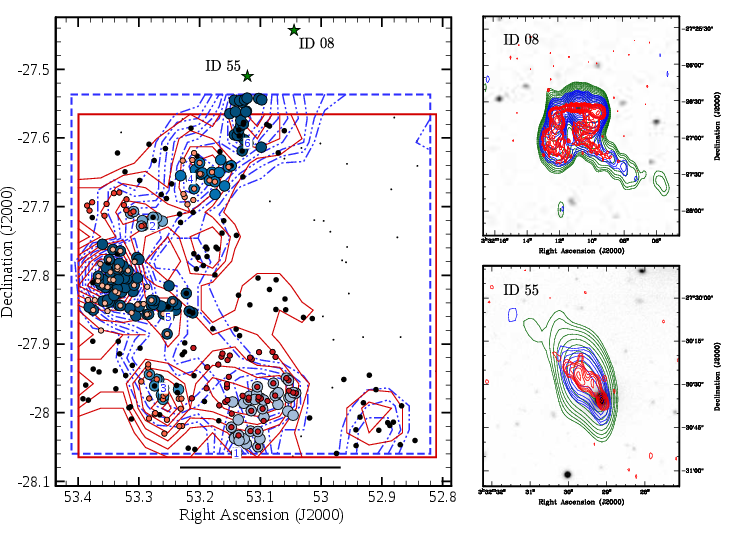
Figure 1: BTs, identified by green stars, delineate the continuation of a redshift-selected large-scale structure in the CDFS, supporting their utility as tracers of overdense environments.
These results underscore the complementarity of wide-area and deep-field approaches and motivate further large-scale comparison between BT distributions and galaxy clustering statistics across cosmic time.
BT Morphology as a Diagnostic of Cluster Dynamics
Beyond signposting, the detailed morphology of individual BT galaxies provides direct constraints on environmental conditions within clusters. Parameters such as tail curvature and asymmetry encode the local history of dynamical events, including accretion shocks, merger-induced flows, and ICM turbulence. Case analysis of PKS J0430-6132 in the cluster A3266 demonstrates this diagnostic power: through joint radio and optical spectroscopic data, it is possible to differentiate between degenerate cluster merger scenarios. The detailed radio structure supports a merger model with a secondary core passage and associated sloshing, elucidating the recent dynamical evolution of the host system (Figure 2).
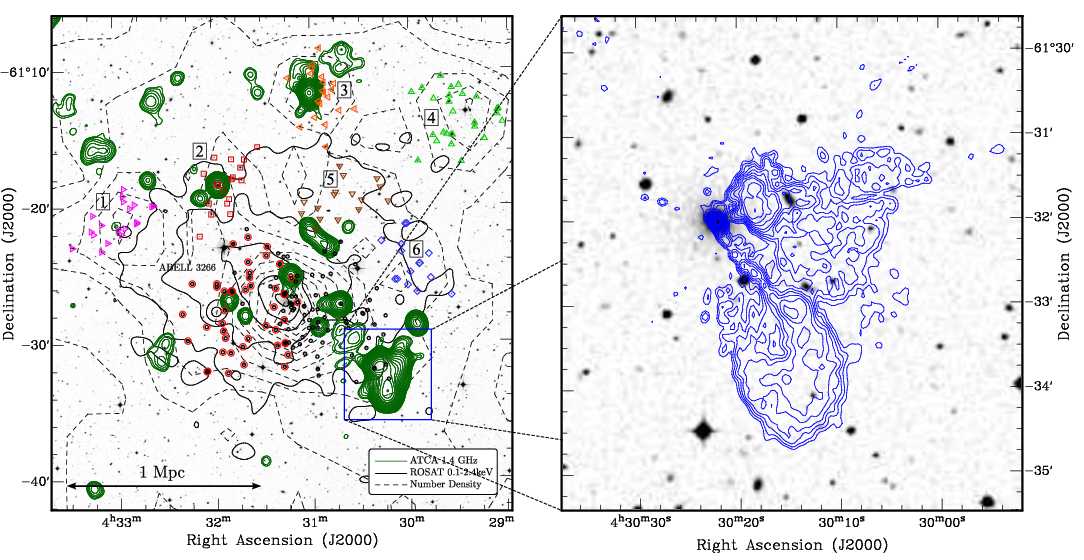
Figure 2: Multiwavelength analysis of A3266 reveals substructure and kinematics through BT morphology, with PKS J0430-6132 providing evidence for a double core passage event.
Such studies advance the use of BTs as anemometers of historical cluster weather and as arbiters in complex cluster dynamical histories.
BTs as Probes of Intracluster Magnetic Fields
BTs, particularly those with well-resolved, polarized tails, serve as effective Faraday screens for the study of cluster-scale magnetic fields. Traditional analyses use extended tail structures to measure the coherence length of magnetic fields in the plane of the sky, leveraging the ensemble of rotation measures (RMs) collected along extended lines of sight through the ICM. However, these approaches confound cluster magnetic fields with other line-of-sight contributions, limiting attribution precision.
A breakthrough is offered by the identification of so-called "corkscrew" BTs, such as ESO 137-G 007 in the Norma cluster. The helical geometry of these jets produces sightlines for polarized emission that traverse differential path lengths within the cluster, separated by Δd∼20 kpc. Measuring the difference in RM between the near and far sides of the helical jet isolates the incremental contribution of the cluster field over this well-defined spatial scale (Figure 3).
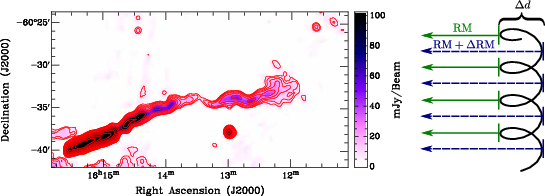
Figure 3: The helical (corkscrew) morphology of ESO 137-G 007 enables differential Faraday rotation studies, yielding direct measurement of intracluster magnetic field coherence on the scale Δd.
Though rare in current samples, future large-area, high-sensitivity polarimetric surveys (e.g., SKA1) are projected to detect thousands of such sources, rendering statistical studies of cluster-field turbulence feasible on tens-of-kpc scales.
Implications and Prospects
The projected yield of BTs from upcoming and next-generation radio surveys (e.g., ASKAP/EMU, SKA) is substantial, with estimates reaching ∼106 BT sources. Of these, a significant fraction will possess sufficient polarization to allow for RM studies: $50,000$–$100,000$ BTs for rotation measure analysis and $5,000$–$10,000$ corkscrew BTs for detailed intra-cluster field diagnostics. The anticipated data volume implies a step change in the ability to use BTs both as large-scale structure tracers and as environmental probes, including unique opportunities to place the first robust constraints on turbulence and magnetic field coherence in the ICM on spatial scales and line-of-sight path-lengths inaccessible to other observational techniques.
These developments will impact both cosmological and cluster astrophysics, improving the completeness of cluster catalogs at high redshift, refining our understanding of cluster assembly, and elucidating the microphysics of the ICM.
Conclusion
Bent-tailed radio galaxies are confirmed to be uniquely powerful probes of both large-scale structure and the local physical conditions within clusters and groups. Their morphology and polarized emission enable studies of cluster density, merger history, velocity fields, and, with the identification of "corkscrew" sources, detailed line-of-sight magnetic field coherence on small spatial scales. With forthcoming deep, wide radio continuum and polarimetric surveys, BT-based environmental diagnostics will become routine, offering new routes to characterize the cosmic web and the baryonic processes governing cluster formation and evolution (1412.8596).