- The paper demonstrates that minor merger-induced turbulence re-accelerates fossil AGN plasma, producing uniform, steep-spectrum radio filaments.
- It employs deep uGMRT and MeerKAT data with high-resolution imaging and spectral mapping to characterize diffuse and tailed radio structures.
- The study correlates radio emissions with X-ray ICM fluctuations, challenging traditional AGN-tail models and expanding mini-halo paradigms.
Filamentary and Tailed Radio Galaxies in the A3528 Cluster Complex: Insights from uGMRT and MeerKAT Observations
Context and Scientific Motivation
The A3528 cluster complex in the core of the Shapley Supercluster at z∼0.05 serves as a paradigm for studying the interplay between the ICM, cluster dynamical state, and non-thermal radio plasma. The system comprises three main clusters—A3528 (split into A3528N and A3528S), A3532, and (with sparser coverage) A3530—all displaying signatures of mild dynamical activity, minor merger signatures, and a noticeable population of radio-loud galaxies. The central question addressed by Di Gennaro et al. ["Cosmic dance in the Shapley Concentration Core II. The uGMRT-MeerKAT view of filaments in the brightest cluster galaxies and tailed radio galaxies in the A3528 cluster complex" (2408.14142)] is how minor mergers affect the evolution of cluster radio galaxies and the efficiency of relativistic electron re-acceleration in the ICM traced by deep, multi-band radio continuum observations.
Observational Data and Methodology
The study leverages the complementary capabilities of the upgraded Giant Metrewave Radio Telescope (uGMRT) at Bands 3, 4, and 5 (250–1460 MHz) and MeerKAT L-band (900–1670 MHz), providing contiguous frequency and angular scale coverage, with root-mean-square noise levels down to ∼10–50 μJybeam−1. These radio data are correlated with X-ray imaging from SRG/eROSITA, yielding a coherent multiwavelength perspective on both thermal and non-thermal ICM components.
Comprehensive imaging at multiple resolutions is performed, including high-resolution (∼2.9×2.2 arcsec) imaging for morphology and low-resolution, uv-cut images to emphasize diffuse and filamentary structures. Source peeling, robust wide-band calibration, and direction-dependent corrections (notably SPAM and CARACal pipelines) mitigate ionospheric and instrumental artifacts. Quantitative analysis includes:
- Integrated and resolved spectral index (α) mapping between 250 MHz and 1.3 GHz
- Power-law and Jaffe-Perola (JP) aging models for spectral profiles
- β-model residual mapping for cluster X-ray morphology
- Surface brightness and equipartition analyses for diffuse features.
Key Observational Results
Detection of New Diffuse and Filamentary Emission
The deep, resolved radio imaging reveals a set of new large-scale, steep-spectrum (α∼−2 to −2.5) filamentary structures associated with the BCGs in A3528S and A3532, as well as archetypal tailed radio galaxies (WATs, NATs, HTs) not previously identified at these frequencies and sensitivities.
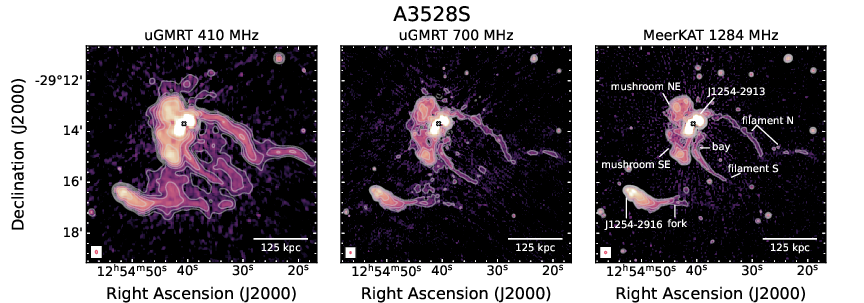
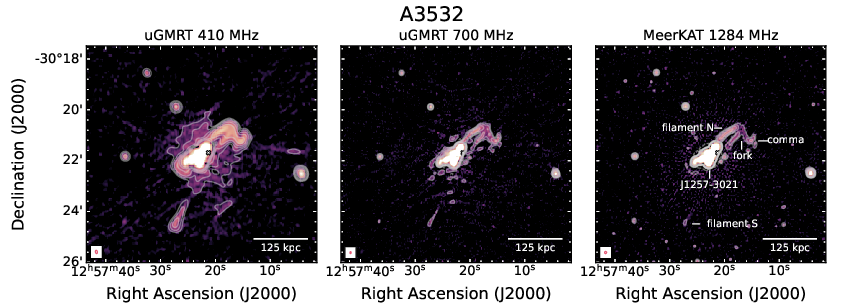
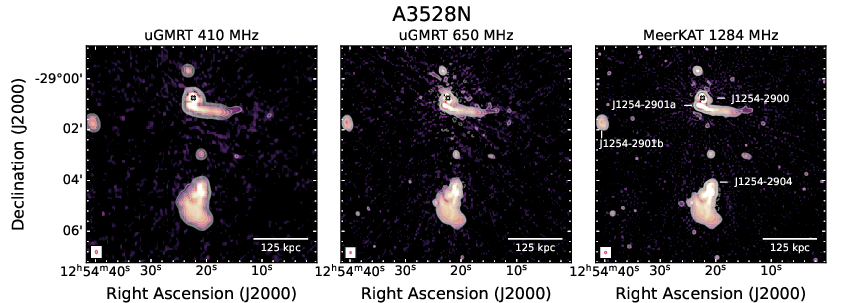
Figure 1: Full-resolution images of the central regions in A3528N (top), A3528S (middle), and A3532 (bottom), showing the uGMRT Band 3/4 and MeerKAT L-band emission with highlighted filamentary features and BCG/tailed galaxy labeling.
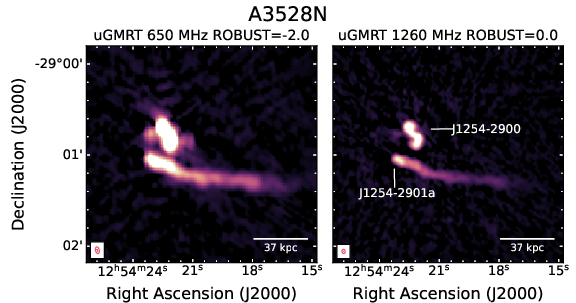
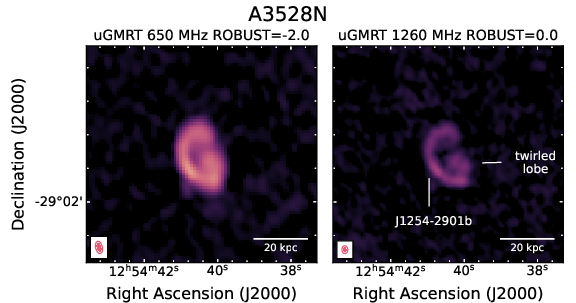
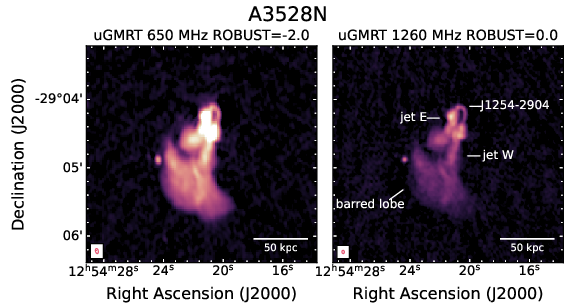
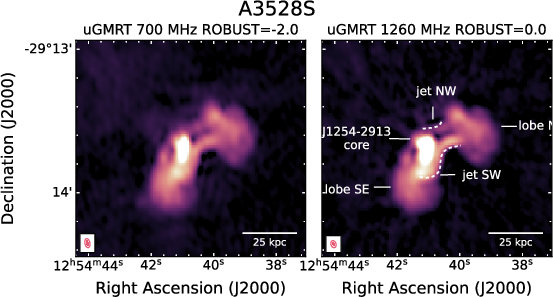
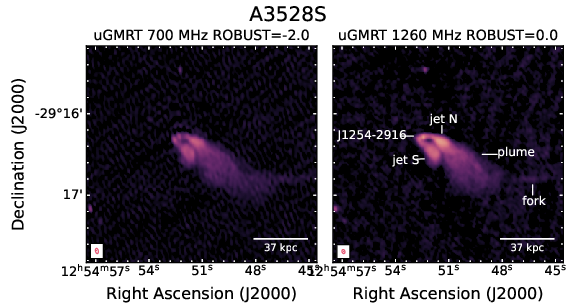
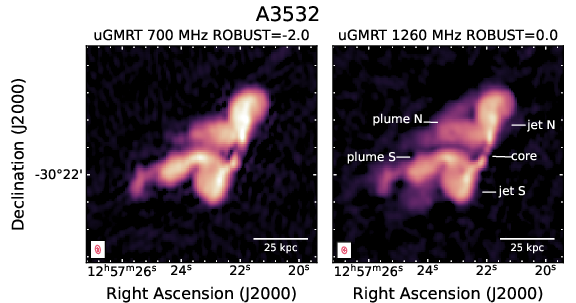
Figure 2: High-resolution imaging of key cluster radio sources (e.g., J1254-2913 WAT in A3528S, J1257-3021 in A3532) showing jet/lobe morphology and connections to diffuse emission.
Spectral Properties and Aging
The filamentary structures feature remarkably steep, homogeneous spectral indices (α∼−2 to −2.5), inconsistent with classical passive ageing of AGN plasma. Tailed galaxies in A3528N follow expected JP steepening along the tails; in contrast, filamentary features in A3528S and A3532 deviate from this behavior, as their spectra remain constant over hundreds of kpc.
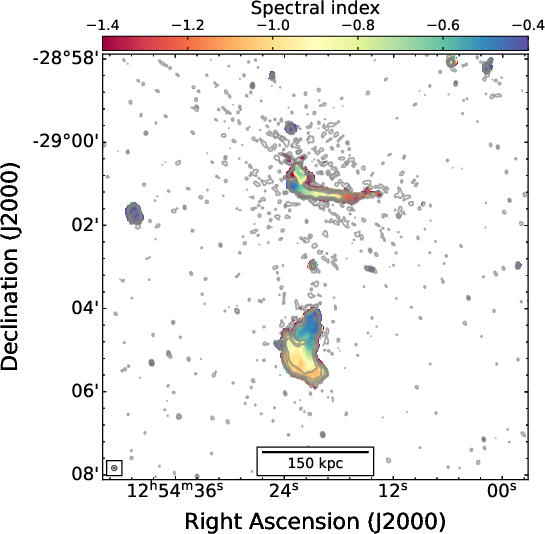
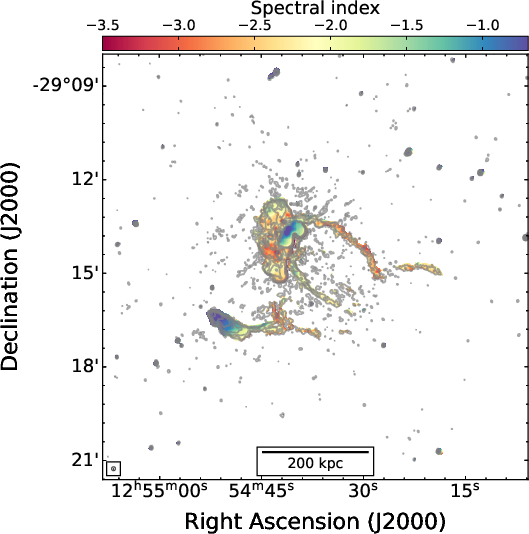
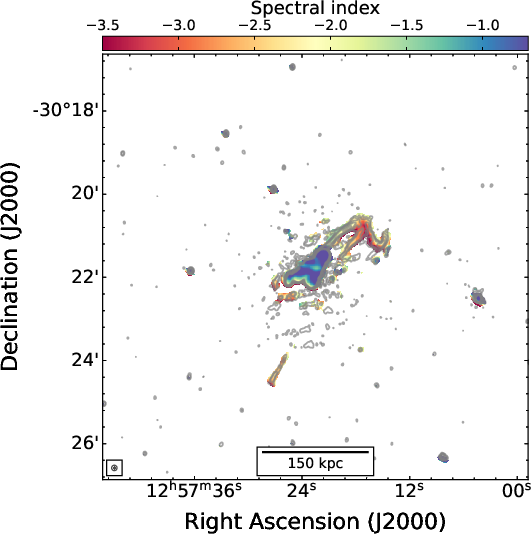
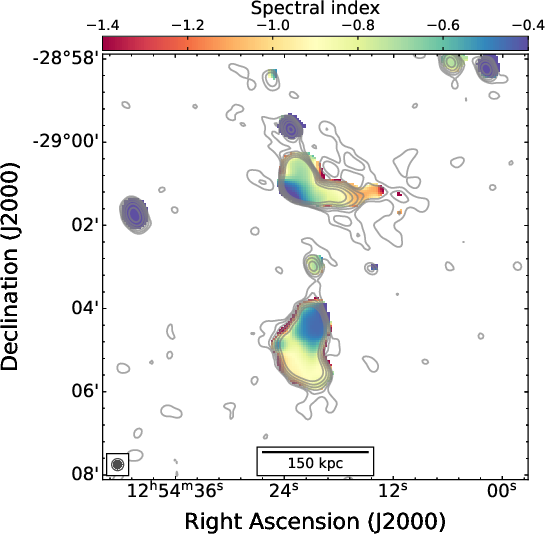
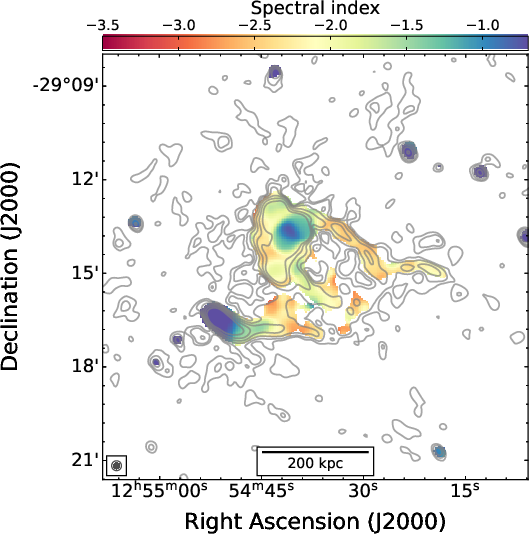
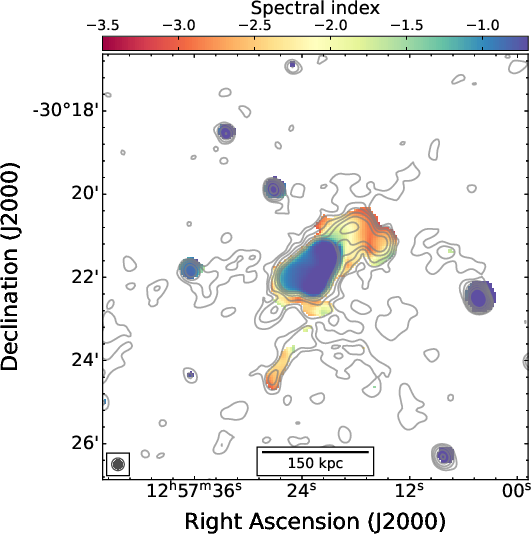
Figure 4: Spectral index maps (α) for A3528N, A3528S, and A3532, overlaid with radio contours. Steep, uniform spectra in filaments are evident in A3528S and A3532.
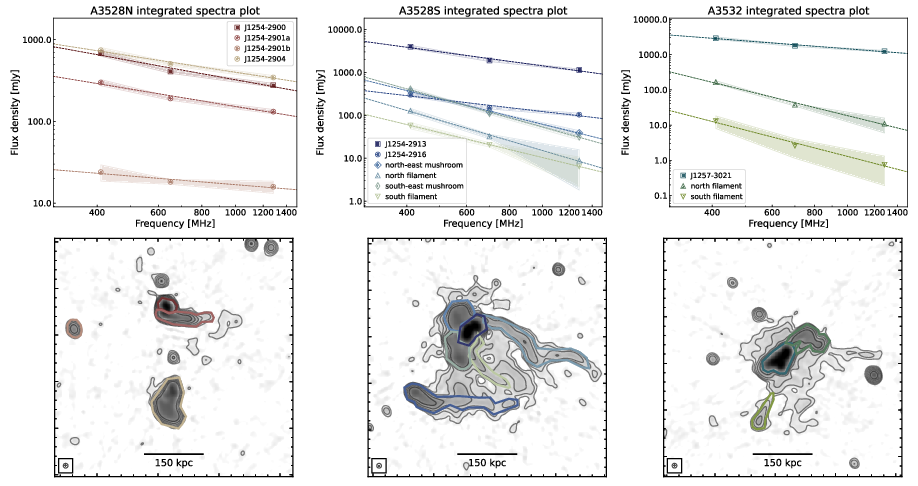
Figure 6: Integrated spectra for principal sources and regions, with fit power-law indices distinguishing classical AGN-tailed emission from anomalous filament spectra.
Correlation with ICM Structure and Dynamics
X-ray residuals and gradient magnitude filtering demonstrate a correspondence between radio filaments and sites of enhanced ICM fluctuations, particularly in A3528S, though the radio features do not consistently trace obvious cold fronts or shocks. Morphological parameters (concentration c, centroid shift w, substructure power ratio P3/P0) classify the clusters as only mildly disturbed, reinforcing the role of minor mergers in generating turbulence and sloshing, both candidates for re-acceleration mechanisms.
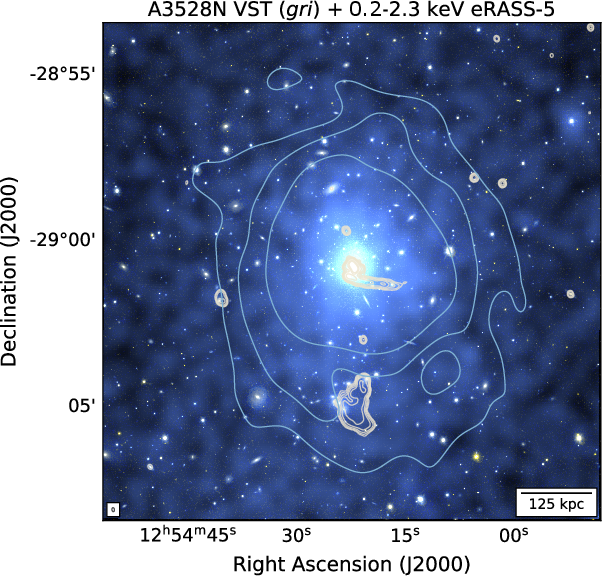
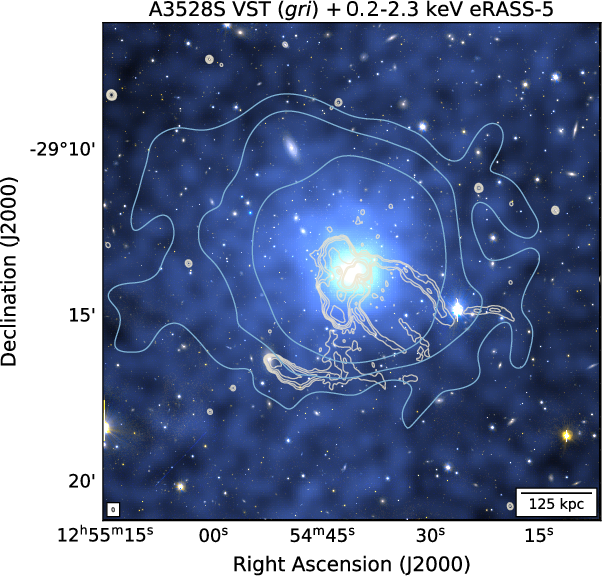
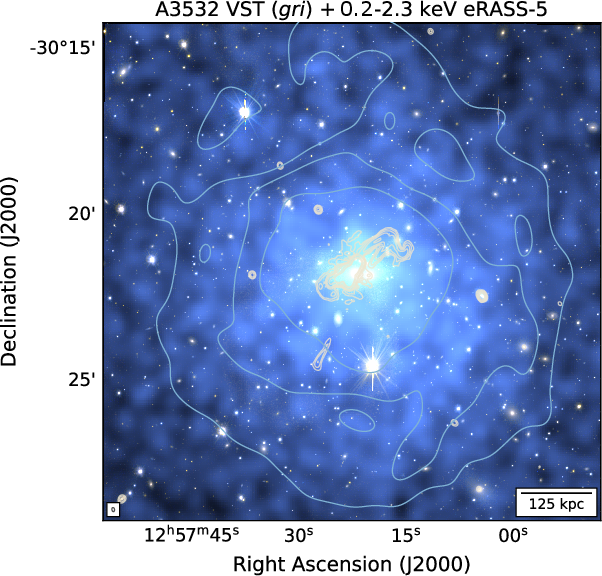
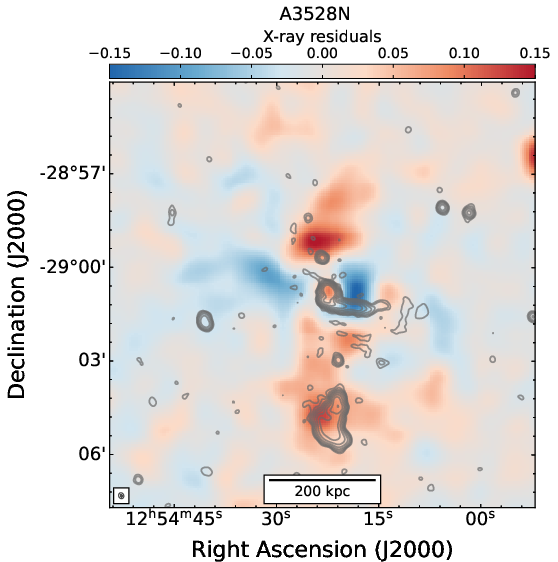
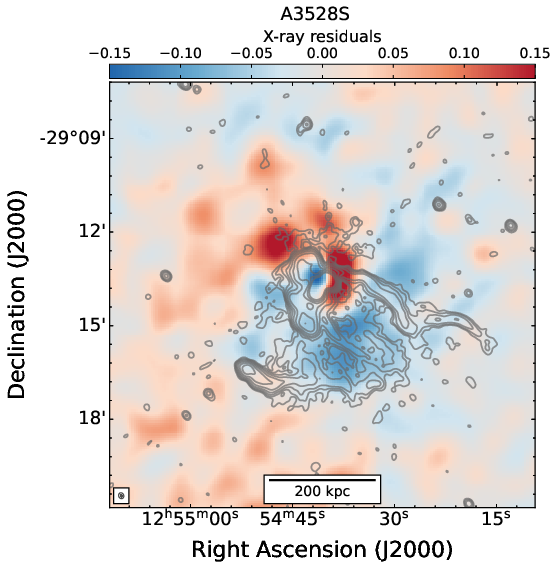
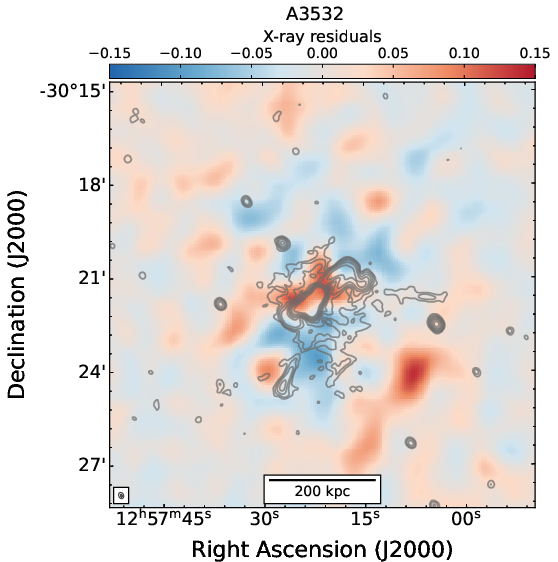
Figure 5: Combined optical (VST), X-ray (eROSITA, with residuals), and radio overlays revealing juxtaposition of non-thermal structures and ICM disturbances.
Mini-Halo Candidate
Additional low surface brightness diffuse emission, spatially displaced between the radio galaxies and cluster X-ray center in A3528S, is detected at 410 and 700 MHz, disappearing at higher frequency. Its morphology, scale (∼200 kpc), and total power place it in the regime of radio mini-halos, though the emission is notably offset from the BCG and thermal peak.
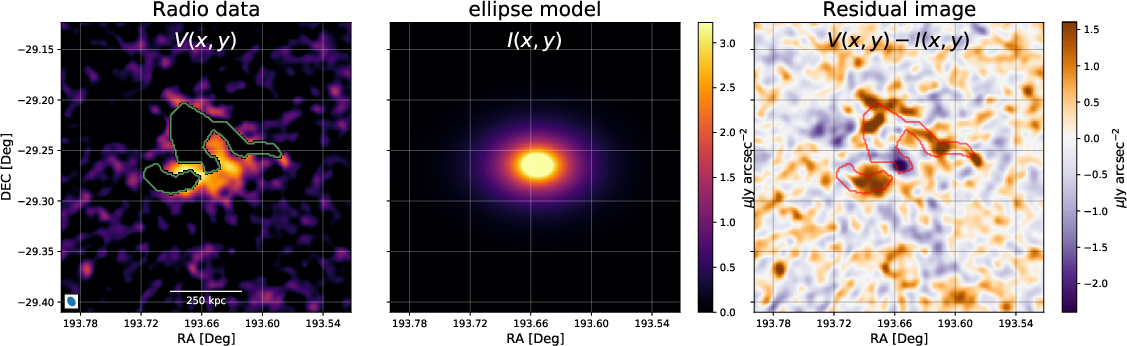
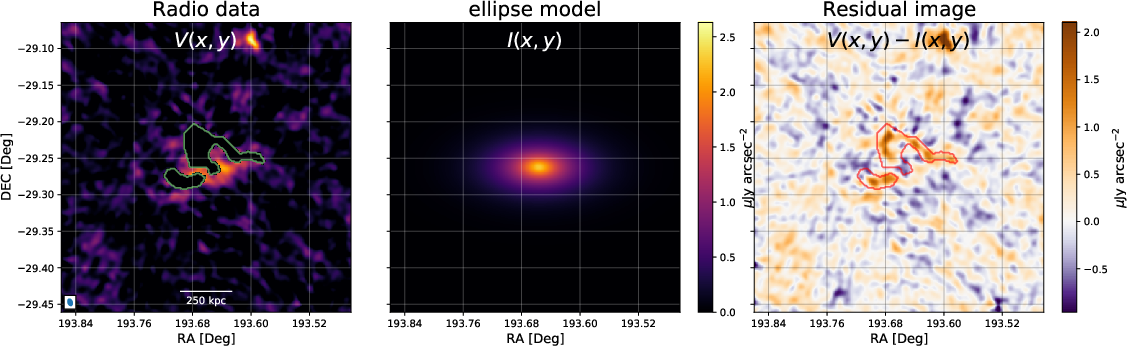
Figure 3: Model-fit and residual maps for the candidate radio mini-halo in A3528S, showing elliptical surface-brightness decrement after subtraction of compact sources.
Physical Interpretation
Re-acceleration in Mildly Disturbed Clusters
Despite less energy than produced in major mergers, the minor merger–induced bulk motions (sloshing, turbulence) are shown to efficiently re-energize relativistic electron populations, especially in the fossil plasma reservoirs left by prior AGN activity. The strong, uniform, and extremely steep spectra observed in the filamentary features are not compatible with standard spectral aging models (e.g., Jaffe-Perola or continuous injection) for AGN tails. Models involving mild, ongoing re-acceleration—such as those invoked for GReETs or turbulent stochastic acceleration in mini-halos—are strongly favored. The presence of large, regular filaments, and their equipartition B fields O(1 μG), suggest an interplay of ICM turbulence, gentle re-acceleration, and possibly AGN re-triggering.
Displacement and Diversity of Diffuse Emission
The spatial separation of the mini-halo candidate from the BCG and cool core, along with the absence of strong X-ray discontinuities, challenges the canonical scenario (which ties mini-halos closely to central sloshing or AGN outburst events). This broadens the phenomenology of diffuse cluster radio sources and highlights the prevalence of fossil plasma and re-acceleration in non-merging environments.
Implications and Future Directions
This work robustly establishes that minor mergers in cluster cores can induce the development of long, uniform, steep-spectrum filaments and extended diffuse radio emission in the absence of major dynamical disruption. Practically, fossil plasma from AGN activity is confirmed as a necessary seed population for re-acceleration processes illuminating the non-thermal ICM. These findings challenge simple binary merger-driven paradigms for cluster radio emission and motivate further systematic searches for steep-spectrum filaments and mini-halo analogs in less disturbed systems, particularly using future SKA and next-generation X-ray facilities for higher surface brightness sensitivity and resolved turbulence diagnostics.
Key avenues for future exploration include:
- Deep, resolved polarimetry to assess magnetic field topology and detect the degree of filament ordering and Faraday complexity.
- High-resolution X-ray calorimetry for detailed turbulence and cold front tracing.
- 3D spectral tomography and modeling to constrain the timescales and physical drivers of the re-acceleration in filaments.
- Multi-epoch monitoring for tracing AGN duty cycles and correlation with diffuse emission on cosmological timescales.
Conclusion
The combination of multi-band radio and X-ray imaging of the A3528 cluster complex reveals a wealth of previously unrecognized, extended, steep-spectrum filaments and diffuse emission features tied to BCGs and tailed radio galaxies. These structures are strongly indicative of gentle, distributed particle re-acceleration driven by minor merger–induced turbulence, acting on fossil AGN plasma over ∼100–400 kpc. The properties of these features deviate from standard AGN-tail models and mini-halo paradigms, indicating a broader phenomenological range for cluster non-thermal emission and requiring refinement of transient and continuous re-acceleration frameworks in the ICM. These results have substantial implications for our understanding of the lifecycle of relativistic plasma, the impact of subdominant merger events on cluster evolution, and the role of non-thermal components in the baryon cycle of massive structures.