- The paper demonstrates that WAT radio galaxies inhabit significantly denser and centrally concentrated galaxy clusters than FR I/II sources.
- The analysis uses robust catalogs and neighbor metrics within 500 kpc to 2 Mpc to quantify local galaxy density and cluster richness.
- The study confirms that a majority of WATs exceed the expected uniform concentration parameter, reinforcing their status as brightest cluster galaxies.
Large-Scale Environments of Wide-Angle Tailed Radio Galaxies in the Local Universe
Introduction
The environment of extragalactic radio galaxies is fundamental to understanding the interplay between AGN evolution, jet dynamics, and galaxy cluster physics. Wide-angle tailed radio galaxies (WATs) are of particular importance due to their characteristic bent jets and association with the brightest cluster galaxies (BCGs). This study presents a comprehensive statistical analysis of the megaparsec-scale environments of WATs with redshift z≲0.15, benchmarking these environments against those of Fanaroff-Riley type I and II (FR I/II) sources using uniformly selected and complete samples (2304.09192).
Sample Selection and Methodology
Three homogeneous catalogs, all based on the radio-loud sample of Best et al. (2012) and leveraging the FIRST survey, underlie this analysis:
- The WAT sample: 47 two-sided jet sources with prominent warmspots and plumed emission, zsrc≤0.15.
- The FR I sample: Extends to zsrc≤0.15, includes sources with radio structure spanning >30 kpc.
- The FR II sample: 105 edge-brightened sources within the same redshift interval.
A robust definition of "cosmological neighbors" (optically confirmed galaxies within 2 Mpc and Δz<0.005 of each central source) provides the basis for environmental richness, group/cluster size, and concentration analyses.
Cosmological Neighbors and Richness Metrics
The number of cosmological neighbors within 500 kpc (Ncn500) and 2 Mpc (Ncn2000) provides direct measures of the local galaxy density around each radio galaxy. Comparison with the Tempel group catalog demonstrates that this approach yields higher fidelity richness estimates at low redshift.
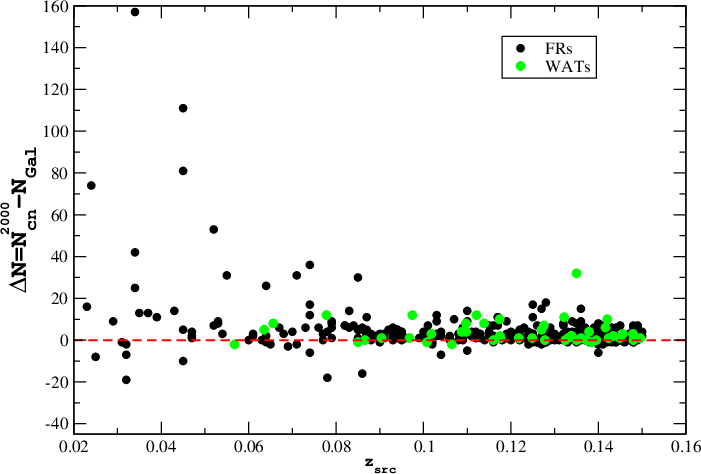
Figure 1: The difference ΔN between the number of cosmological neighbors within 2 Mpc (Ncn2000) and the Tempel et al. (2012) Ngal richness as a function of source redshift.
Statistical Dissection of Environment Properties
The distribution of median cosmological neighbor counts distinctly favors WATs over FRs across all but one redshift bin, with only 0.4% and 2% probabilities that the WAT medians fall below those of FRs for Ncn500 and Ncn2000, respectively. This systematic excess supports the assertion that WATs are preferentially located in highly populated environments.
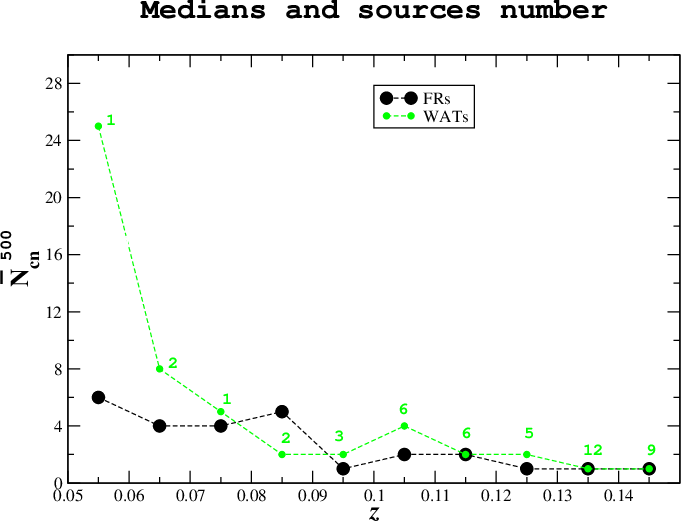
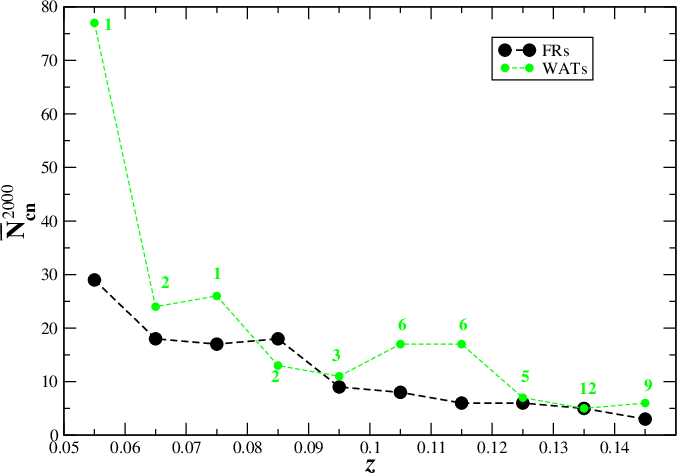
Figure 2: Median number of cosmological neighbors for WATs (green) and FRs (black) within 500 kpc (upper) and 2 Mpc (lower) as a function of redshift bin.
The spatial scales characterizing WAT group/cluster membership remain essentially constant at ∼1 Mpc, with no sources exceeding 1.2 Mpc in average projected neighbor distance. The standard deviation in neighbor redshifts, σz, remains well within the cluster/group dispersion threshold (<0.003).
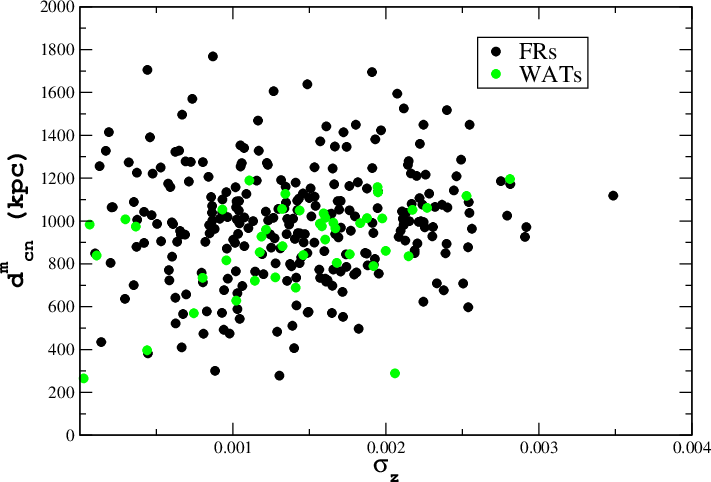
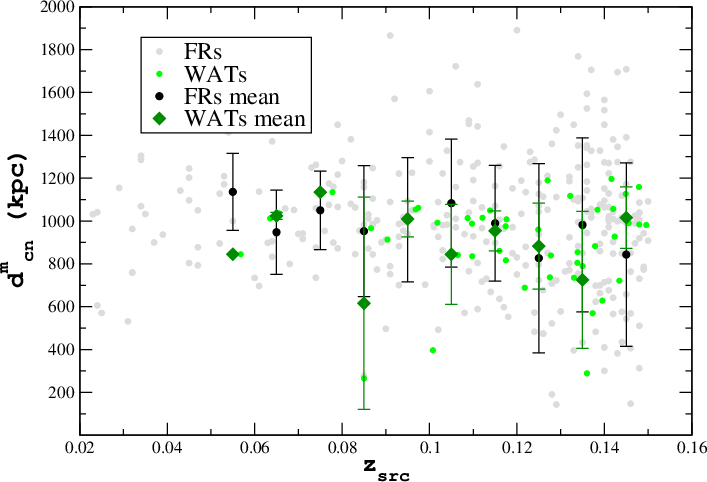
Figure 3: Average projected distance dcn of cosmological neighbors in WAT and FR fields.
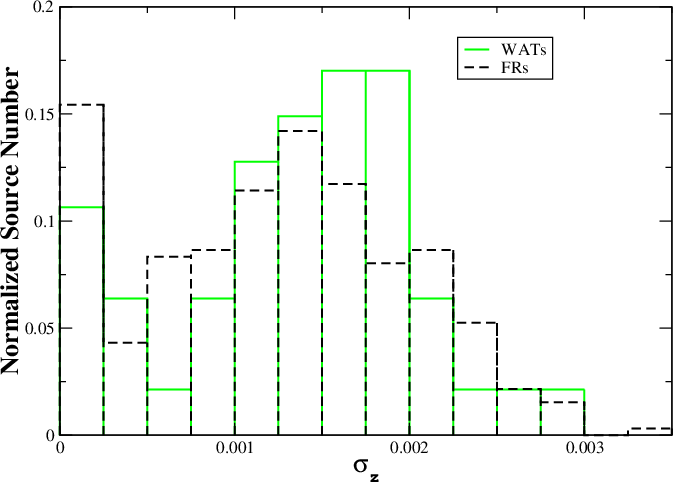
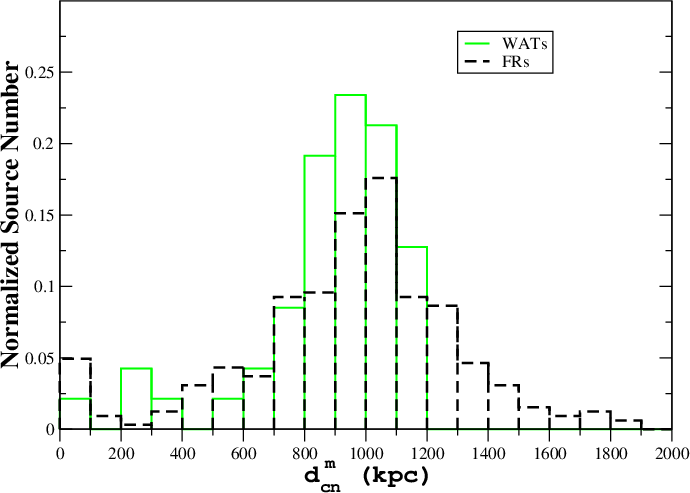
Figure 4: Distribution of the standard deviation σz of neighbor galaxies around radio galaxies.
Concentration Parameter and Positional Trends
The concentration parameter ζcn (ratio of neighbors within 500 kpc to those within 1 Mpc) is a critical diagnostic for distinguishing central from peripheral cluster occupancy. For a uniform neighbor distribution, ζcn=0.25 is expected; however, 41 out of 47 WATs exhibit ζcn>0.25, aligning with the paradigm that WATs are BCGs.
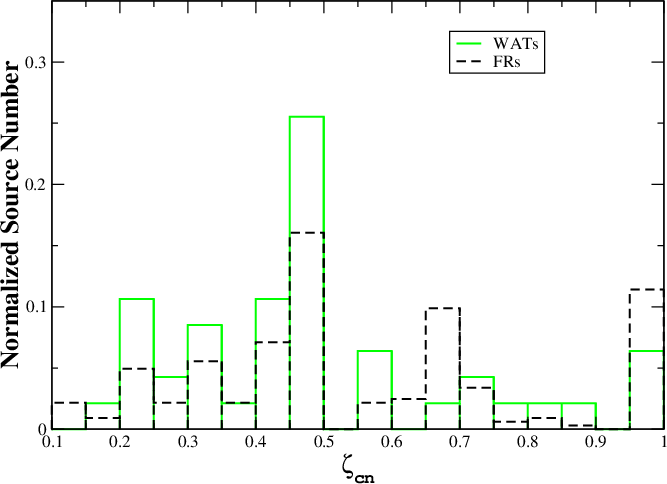
Figure 5: Distribution of the concentration parameter ζcn for WATs (green) and FRs (black); most WATs exceed the 0.25 uniformity threshold.
Implications and Future Perspectives
The findings reinforce the scenario that WATs inhabit denser galaxy clusters than FR I/II galaxies at comparable redshifts and are centrally located within these environments. The near-constant group/cluster radii underscore uniform environmental conditions for jet bending and dynamical perturbation. The absence of correlation between environmental parameters (projected distance, ζcn) and both radio power and [OIII] emission line luminosity indicates that environmental density, rather than nuclear or host luminosity, is the dominant factor mediating the WAT morphology and centrality.
This work suggests several avenues for extension. In particular, X-ray follow-up (e.g., with eROSITA) is necessary to link observed galaxy concentrations and the ICM, probing the dynamical state of these rich clusters and securing the stellar/gas mass connection. Low-frequency radio mapping can further elucidate extended emission and relic activity. These approaches will refine the understanding of how environment shapes radio galaxy morphology and AGN feedback.
Conclusion
This comprehensive analysis demonstrates that WATs, compared to FR Is and FR IIs, overwhelmingly inhabit the richest, most centrally concentrated environments in the local Universe. The evidence for their preferential location as BCGs in ∼1 Mpc clusters supports morphology-environment coupling driven by large-scale cluster dynamics. Future integration of X-ray and low-frequency radio data will be pivotal for disentangling the role of both galaxy and gas density in shaping AGN activity and jet propagation.