- The paper reveals unprecedented details of the Corkscrew Galaxy’s helical, filamentary tail structures spanning ~570 kpc using high-resolution ASKAP imaging.
- It documents a transition from collimated to disrupted jet emissions with steepening spectral indices, confirming electron aging and shock interactions.
- The study links AGN radio plasma dynamics with cluster merger events, providing empirical support for MHD simulations of jet-ICM feedback mechanisms.
ASKAP Imaging and the Discovery of Intricate Radio Filamentary Structures in the Corkscrew Galaxy
Introduction
Koribalski et al. present a high-resolution analysis of the head-tail "Corkscrew Galaxy" (1610–60.5, ESO 137-G007) in the massive, X-ray-bright Abell 3627 cluster, utilizing ASKAP wide-field, multi-frequency (944 MHz and 1.4 GHz) radio continuum imaging (2405.04374). The dataset yields unprecedented characterization of the helical, filamentary structures within and beyond the ∼570 kpc radio tail. The morphological and spectral features of the Corkscrew tail, its interactions with the intracluster medium (ICM), and connections to cluster-scale merger-driven dynamics are rigorously detailed, drawing on both empirical findings and comparisons to 3D MHD simulations.
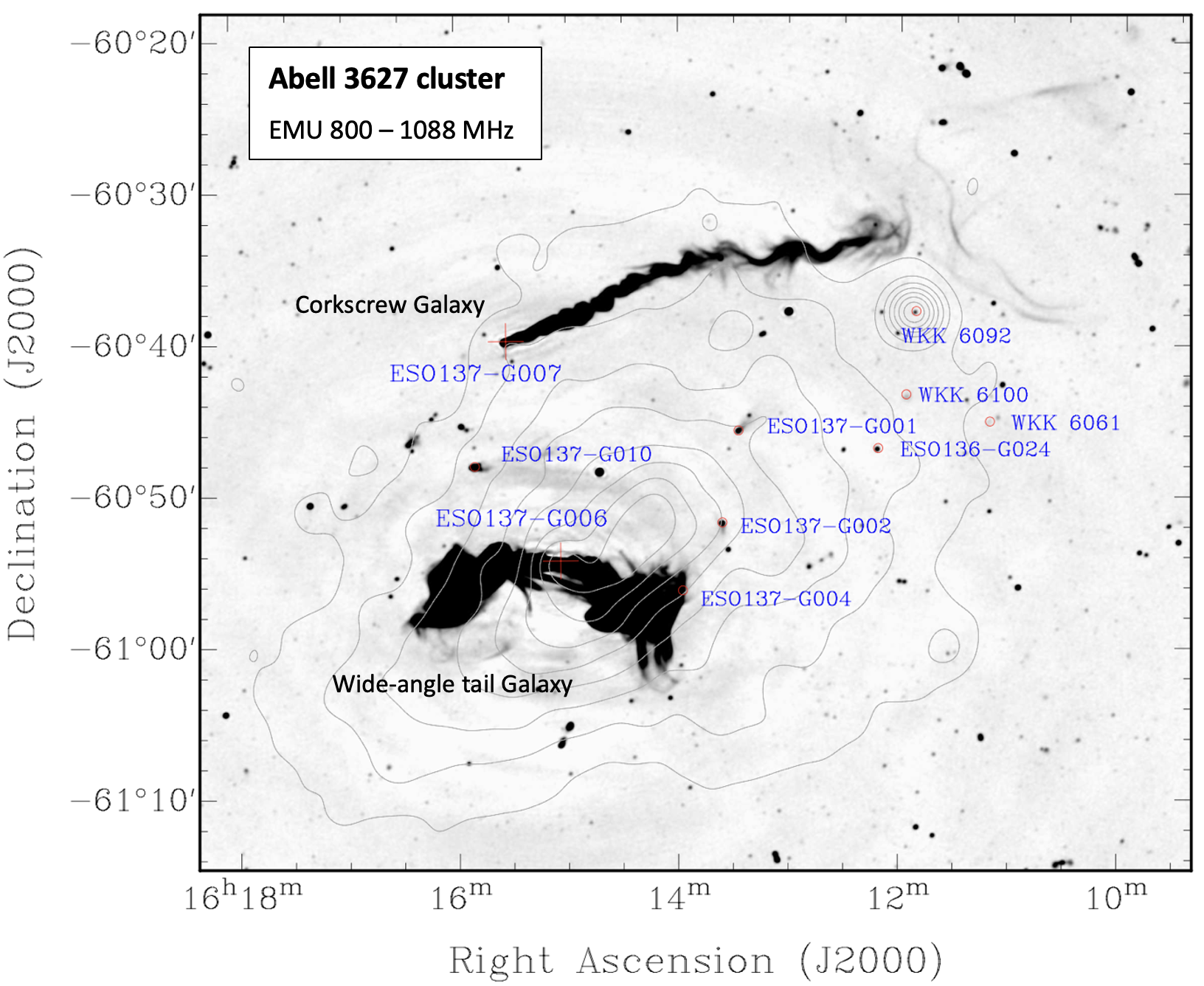
Figure 1: Wide-field ASKAP 944 MHz radio continuum image of Abell 3627 overlaid with ROSAT X-ray contours, illustrating the positions of the Corkscrew Galaxy (1610–60.5) and the WAT 1610–60.8 within the cluster potential.
Morphology and Tail Structure
The Corkscrew Galaxy's radio tail, extending ∼28 arcmin (∼570 kpc) and terminating in a set of arc-shaped filaments that broaden its effective projected length to nearly 920 kpc, exhibits a well-collimated, oscillating (helical) inner jet and a fainter, filamentary, high-amplitude oscillatory outer structure. The multi-configuration ASKAP imaging resolves both the collimated young section and the disrupted older section, revealing fine-scale features such as wisps, arcs, and forward-facing filaments.
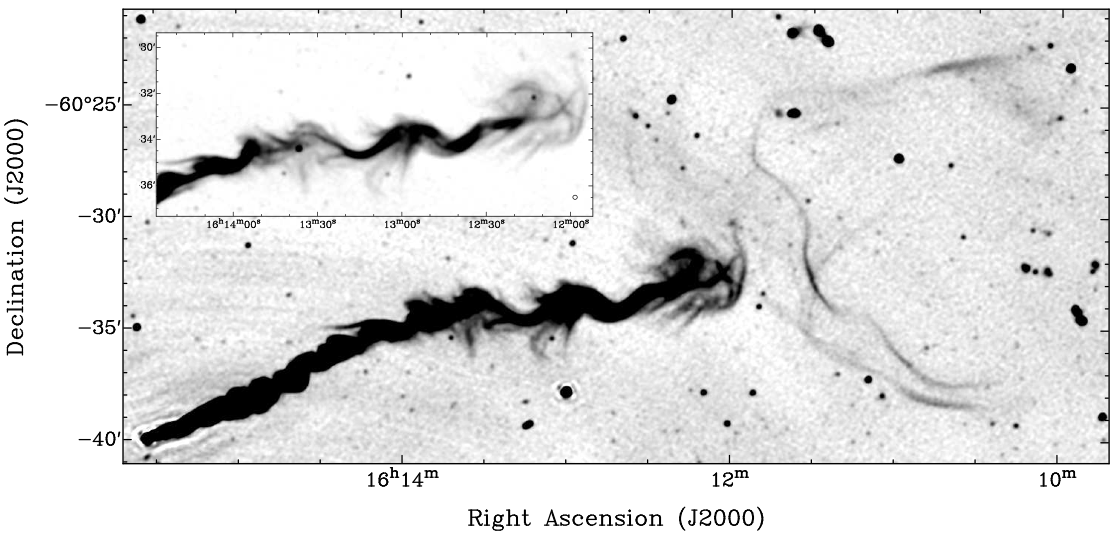
Figure 2: High-fidelity ASKAP 944 MHz map of the Corkscrew Galaxy, highlighting the filamentary, corkscrew morphology and the complexity of the older tail sections.
The inner tail transitions at ∼14 arcmin (∼285 kpc) from collimated emission to a disrupted, more oscillatory regime. At the tail end, the radio emission becomes X-shaped, with fine-scale, narrow filaments observed at multiple orientations, including set(s) of arcs nearly perpendicular to the tail.
Within the classic context of head-tail morphology, these features indicate both dynamical interaction with the ICM (ram pressure, shear) and complex magnetic field topologies, as predicted by MHD simulations. The partial bubble of arc-shaped filaments at the tail end constitutes an empirical analog of a "proto-lobe" structure.
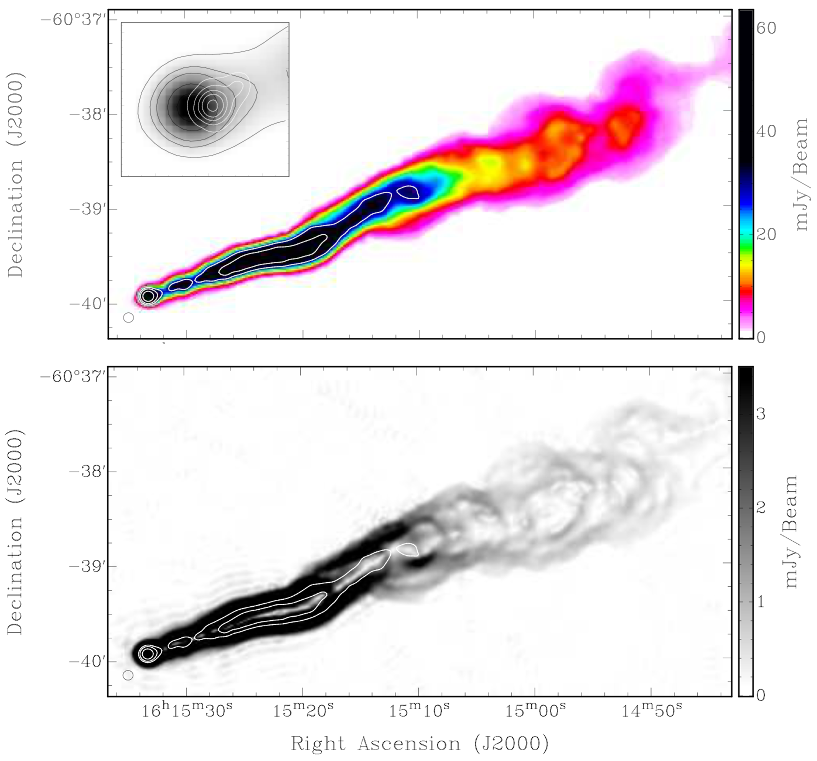
Figure 3: High-resolution ASKAP image of the Corkscrew's bright inner region, showing jet collimation and revealing an eastern offset consistent with the presence of a counter-jet.
Spectral Indices and Electron Aging
Spectral index mapping between 944–1368 MHz (ASKAP EMU and WALLABY) and, independently, 835–1051 MHz (ASKAP EMU in-band) reveals an unambiguous steepening along the tail: from α≈−0.56 at the host galaxy to α≈−4 at the X-shaped tail terminus. The arc filaments beyond the visible tail are measured to have α∼−2.2±0.1, characteristic of aged electron populations. This confirms the scenario of synchrotron and radiative losses acting over large (500–900 kpc) scales, with the spectral steepening mapping directly to electron lifetimes and past jet activity.
Arc-Filamentary Bubble and Shock–ICM Interactions
The discovery of a disconnected set of thin, arc-shaped radio filaments—located west and mostly orthogonal to the collimated tail end—has broad implications. The morphology, spectral index, and placement with respect to cluster X-ray structure are consistent with the passage of the Corkscrew through a cluster shock or cold front, as observed in MHD simulations by Nolting et al. This scenario predicts "proto-lobe" bubble formation via face-on interaction, stripping the outer cocoon and amplifying oscillation amplitudes in the relic plasma.
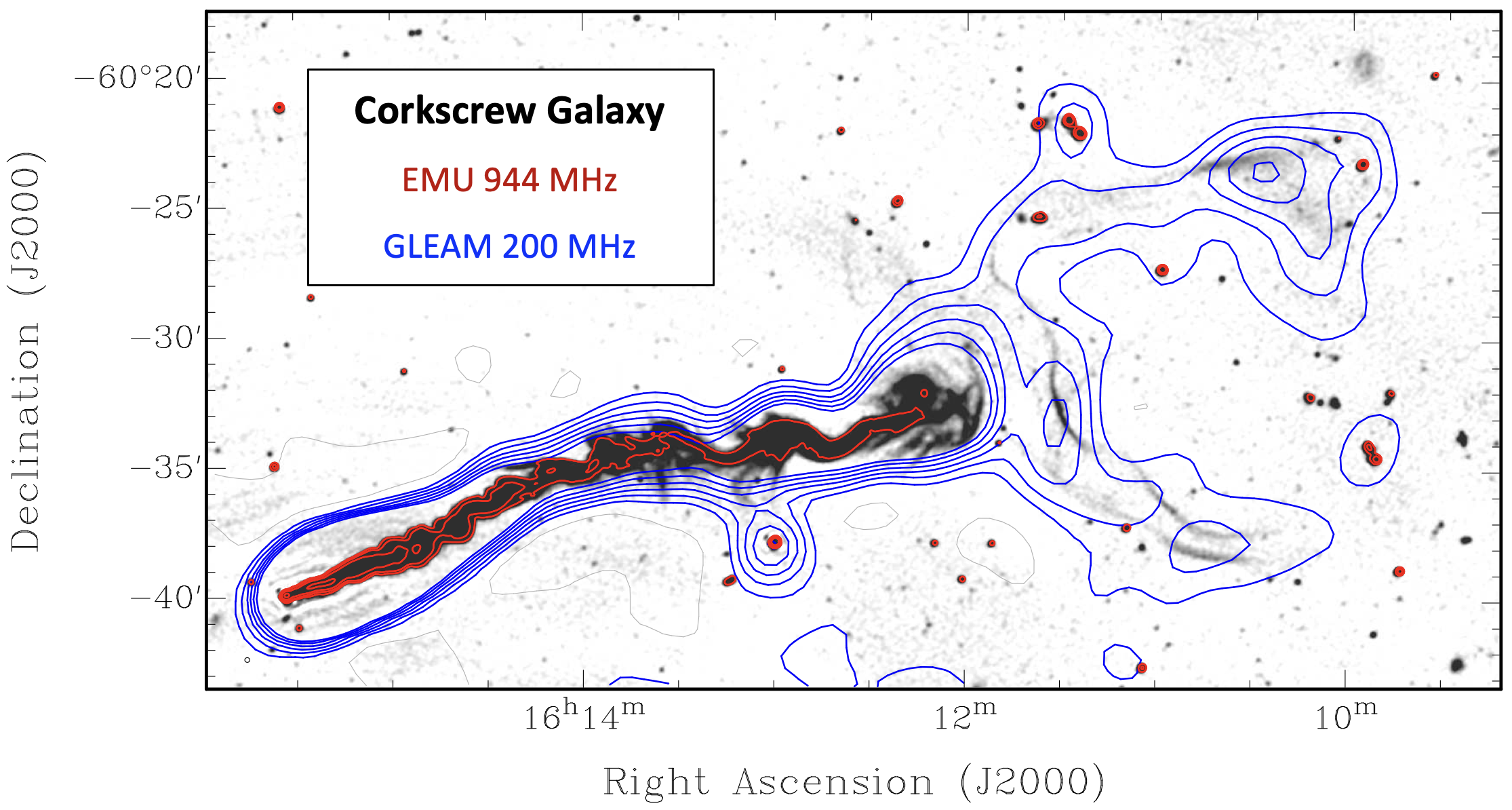
Figure 4: ASKAP 944 MHz map of the Corkscrew overlaid with GLEAM 170–231 MHz contours, highlighting the extent and spectral steepness of the western arc-filaments.
The existence of these structures, empirically confirmed herein, directly links AGN radio plasma and large-scale cluster dynamical processes such as mergers and shocks. These fossil plasma bubbles, with steep spectra and bubble-like arcs, form a pathway to the creation of large-scale diffuse cluster radio relics after further re-acceleration.
Environmental Context: Cluster Dynamics and Additional Tail Galaxies
The analysis of the full cluster field, especially via the overlay of ROSAT X-ray emission, situates the Corkscrew Galaxy at the cluster periphery. This location supports a scenario of supersonic orbital motion through a dynamically active ICM. The WAT 1610-60.8, near the cluster core, exhibits its own rich synchrotron thread network, supporting the broader role of radio AGN as ICM and merger-event tracers.
The discovery of four spiral galaxies with short (∼20–30 kpc) radio tails confirms ongoing ram-pressure stripping ("jellyfish" phenomena) and furthers the characterization of the ICM's influence on cluster-member evolution.
Implications for Galaxy–ICM Feedback and MHD Jet Simulations
The observed features in the Corkscrew system—oscillating, helical tails; partial bubbles; arc-filaments; steepening spectral gradients—directly constrain models of jet/ICM interaction, magnetic field evolution, and shock acceleration physics. The findings present observational support for numerical predictions of vortex ring, proto-lobe, and cocoon-removal phenomena arising from cluster shocks, as detailed in contemporary MHD work.
On the broader scale, the documented filamentary diversity, combined with the environment's X-ray and radio morphology, provides key benchmarks for future SKA/FAST-class studies of AGN feedback, cluster magnetization, and cosmic-ray transport. The ASKAP discoveries in Abell 3627 highlight the necessity of high-sensitivity, wide-bandwidth, and multi-resolution radio imaging in exploring these regimes.
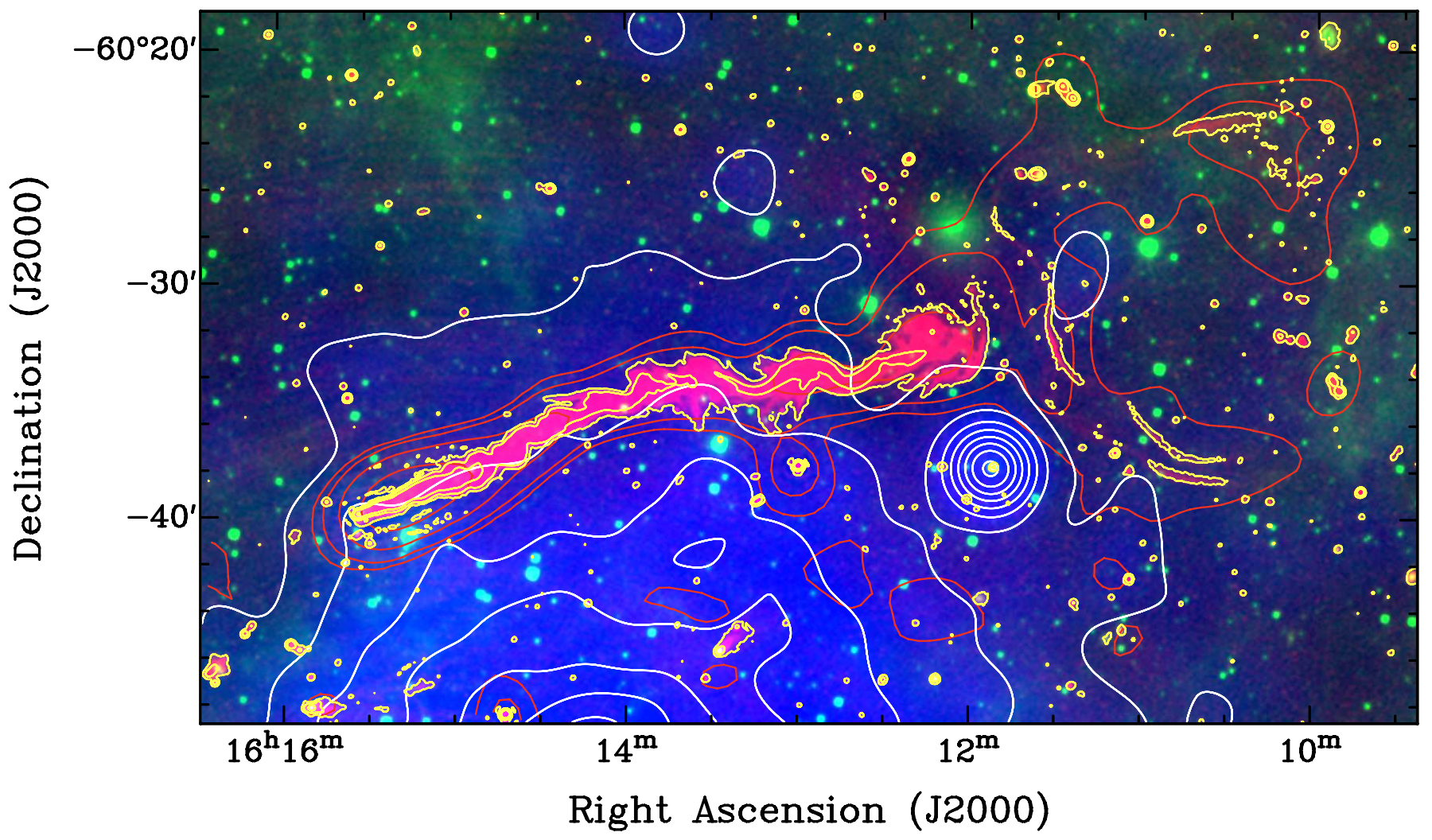
Figure 5: Multi-wavelength composite of the Corkscrew region in Abell 3627, integrating ROSAT X-ray, ASKAP 943 MHz radio, WISE 12 μm, and GLEAM 200 MHz imaging.
Conclusion
This study demonstrates the essential role of next-generation radio interferometry in resolving the morphological and spectral evolution of AGN tails subject to extreme ICM interaction. The ASKAP data confirm the existence of long-lived, filamentary, helical structures and identify a candidate "proto-lobe"—supporting MHD-based jet–shock interaction scenarios. The empirical results clarify the AGN–ICM interplay, underscore the impact of cluster-scale shocks on fossil radio plasma, and offer a template for future synergistic X-ray/radio investigations of active and fossil cluster radio structures.