Probing AGN duty cycle and cluster-driven morphology in a giant episodic radio galaxy
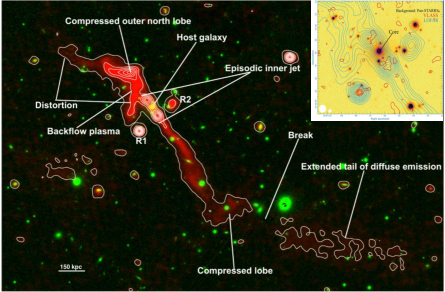
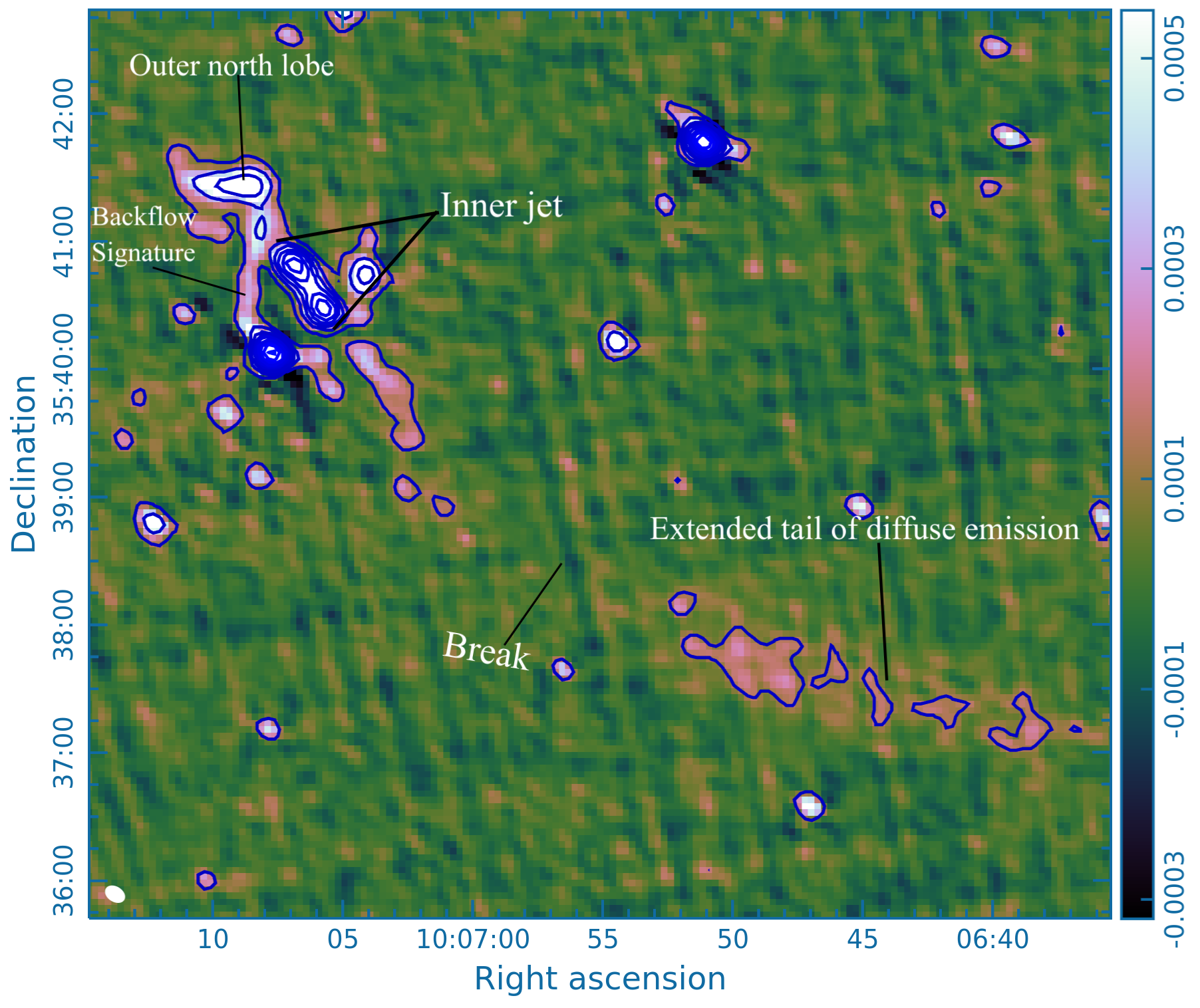
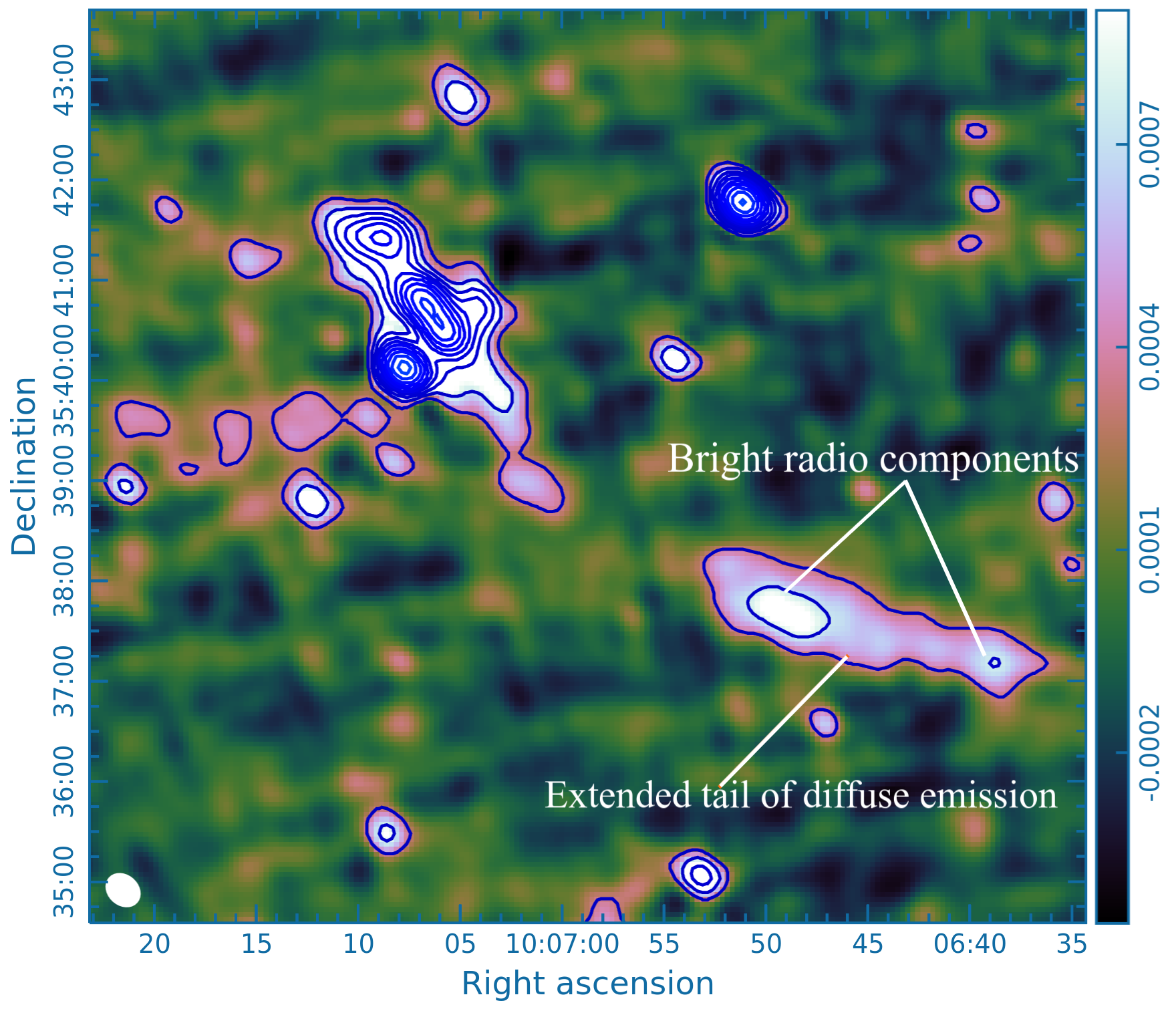
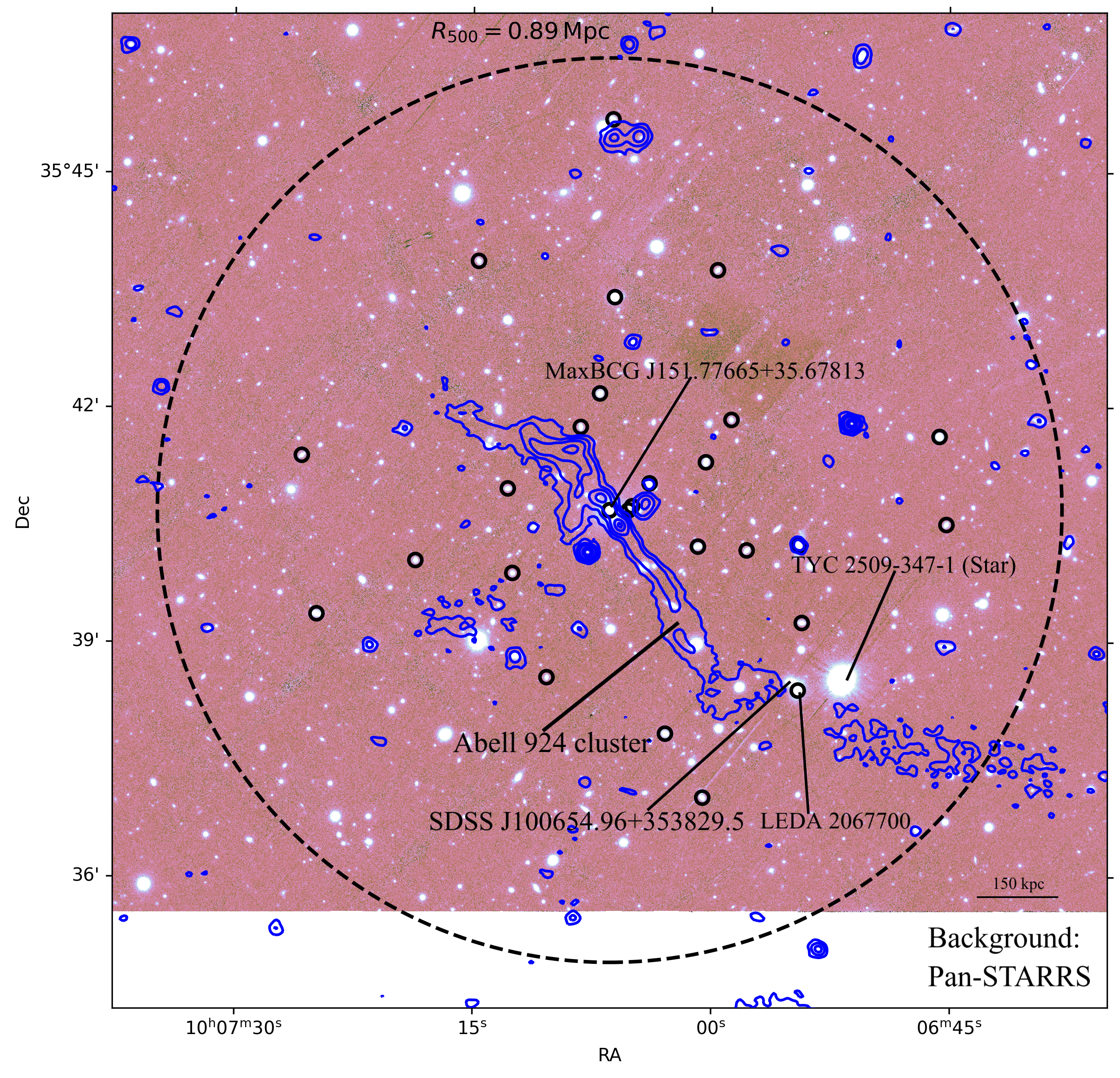
Abstract: The evolution of radio jet morphology and its energetics is significantly influenced by the environment in which the host galaxy resides. As giant radio galaxies (GRGs) often extend to the scale of entire galaxy clusters ($\sim$Mpc) and beyond, they are a suitable class of objects for studying jet--intracluster medium interactions. This paper presents a multiwavelength study of a GRG, J1007+3540, using the LOFAR Two-metre Sky Survey second data release (LoTSS DR2) at 144 MHz and the upgraded Giant Metrewave Radio Telescope (uGMRT) at 400 MHz. The source has a projected linear extension of 1.45 Mpc and is hosted by MaxBCG J151.77665+35.67813, within the WHL 100706.4+354041 cluster. At both frequencies, the source exhibits clear signatures of recurrent jet activity, a one-sided, extended, tail-like diffuse structure with a morphological break in the tail. The estimated radiative ages of the inner lobes and outer north lobe are $\sim$140 Myr and $\sim$240 Myr, respectively. In addition to the radio analysis, we performed optical--to--infrared spectral energy distribution modelling. The host galaxy is an evolved elliptical system with a stellar mass of $\log_{10}(M_\star/M_\odot) = 11.0$ and an old stellar population age of $\sim$12 Gyr. The high infrared-derived star formation rate ($\sim106~M_\odot$~yr${-1}$) of the source implies significant dust-obscured star formation, potentially linked to merger-driven gas inflows. J1007+3540 presents a rare combination of a restarted jet, a detached tail-like structure, and unusual spectral flattening beyond the tail break, which is very rare to report together in a GRG. This rare and remarkable system offers a unique laboratory for probing the interplay between active galactic nucleus activity, star formation, and environmental effects in cluster-surrounded GRGs.
Paper Prompts
Sign up for free to create and run prompts on this paper using GPT-5.
Top Community Prompts
Explain it Like I'm 14
What is this paper about?
This paper studies a huge galaxy with a supermassive black hole at its center that shoots out giant jets of radio-emitting particles. The galaxy, called J1007+3540, is so large that its radio “wings” stretch about 1.45 million light‑years across—bigger than most galaxy clusters. The authors use radio and infrared/optical data to figure out how the black hole’s jets turn on and off (its “duty cycle”), how the surrounding cluster gas bends and reshapes the jets, and how this all ties in with star formation in the host galaxy.
What questions did the researchers ask?
In simple terms, they wanted to know:
- Has this black hole turned its jets on more than once?
- How old are the different parts of the radio structure (the inner and outer “lobes” and a long tail)?
- How does the hot gas between galaxies in the cluster (the intracluster medium, or ICM) affect the shape of the jets?
- What is the host galaxy like—how massive is it, how old are its stars, and is it forming new stars now?
- How do all these pieces (jets, hot cluster gas, and star formation) fit together?
How did they study it?
Think of this like using different types of cameras and colors of light to see different layers of the same scene.
Radio telescopes and images
- They used two powerful radio surveys:
- LOFAR (at 144 MHz), which is great at seeing very faint, spread‑out radio glow.
- uGMRT (at 400 MHz), which adds another “color” of radio light, helping measure how the glow changes with frequency.
- By making both sharp (high‑resolution) and smooth (low‑resolution) images, they saw both bright, compact features and faint, extended tails.
Reading the “color” of radio light (spectral index)
- The “spectral index” tells how bright the radio glow is at different frequencies. A steeper index usually means older, more “tired” particles; a flatter index can mean younger or re‑energized particles.
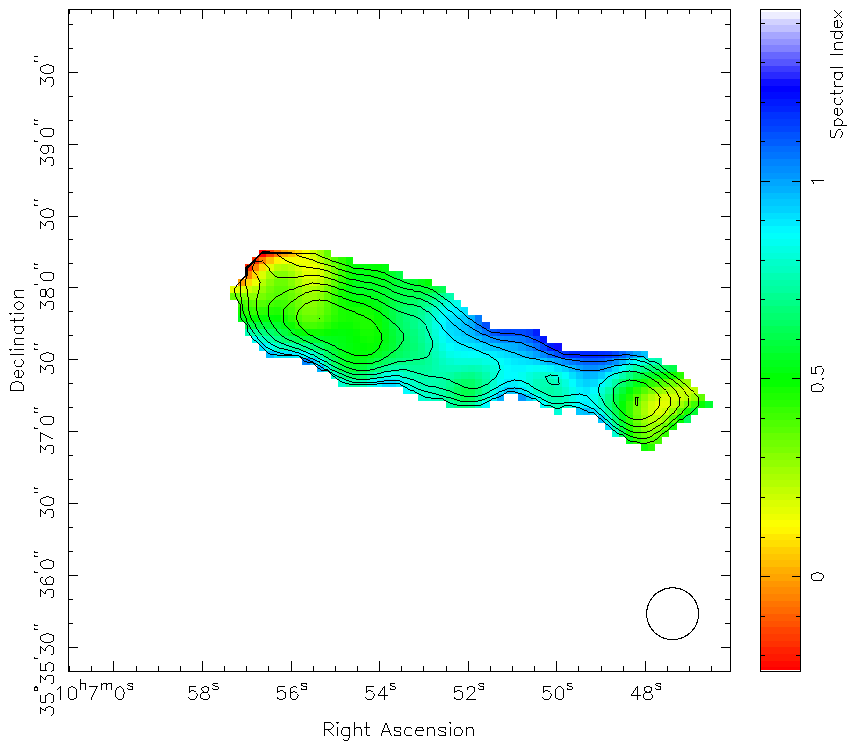
- Comparing 144 MHz and 400 MHz, they mapped where the radio glow is steep (older) or flat (younger or re‑accelerated).
Estimating ages (radiative aging)
- Radio‑emitting particles lose energy over time, like a glowstick that slowly fades. By measuring how the spectrum bends (the “break frequency”), they estimated how long ago the particles were last strongly energized.
- They used standard models to turn these measurements into approximate ages for different parts of the radio structure.
Looking at the host galaxy’s starlight and dust (SED fitting)
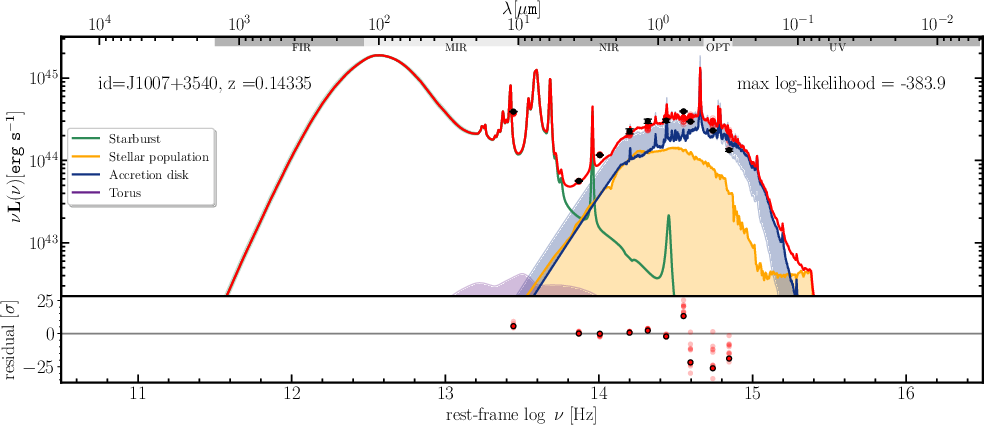
- They collected optical and infrared light (from surveys like Pan‑STARRS, 2MASS, and WISE) and used a tool called AGNfitter.
- This separates the light from old stars, dust warmed by young stars, and the black hole’s own glow (including light re‑emitted by a dusty “torus” around it).
- That revealed the galaxy’s mass, how fast new stars are forming, and how much dust is hiding star formation from optical view.
What did they find?
Here are the main results, explained simply:
- A restarted jet system:
- The galaxy shows signs of jets that turned on, switched off, and then turned on again. You can see younger “inner lobes” closer to the center and older “outer lobes” farther out.
- Estimated ages:
- Inner lobes: about 140 million years old.
- Outer north lobe: about 240 million years old.
- This on‑and‑off behavior is the black hole’s “duty cycle.”
- A striking, one‑sided tail with a “break”:
- There’s a long, diffuse tail on one side that suddenly changes (a “break”), then continues.
- Just before the break, a “compressed” lobe is so steep and faint at 400 MHz that it wasn’t detected there—suggesting very old particles.
- Surprisingly, beyond the break the spectrum becomes flatter again, which is unusual. That likely means the particles got re‑energized—possibly by motions, turbulence, or gentle shocks in the cluster’s hot gas.
- The cluster environment is reshaping the radio galaxy:
- The galaxy sits near the center of a known cluster (WHL J100706.4+354041).
- The hot, thin cluster gas (the ICM) acts like a headwind or “thick soup” that bends and distorts the jets, creating asymmetries, backflows, and the long, one‑sided tail.
- Magnetic fields and particle aging:
- The radio lobes contain magnetic fields a few millionths of a gauss (microgauss), typical for such systems.
- Older regions show steeper spectra and lower break frequencies (consistent with particles losing energy over time).
- The host galaxy is massive and dusty—but still forming stars:
- It’s a big, old elliptical galaxy with a stellar mass of about 1011 Suns and an average star age around 12 billion years.
- The infrared data show a high, dust‑hidden star formation rate (about 106 Suns per year), much higher than what optical light alone suggests. That likely means dust is hiding most newborn stars from optical view.
- The central black hole is bright but heavily obscured, indicating it’s currently in a radiatively efficient mode (actively feeding) even if much of its light is hidden by dust.
- A rare combination:
- Seeing a restarted jet, a detached/long tail with a clear morphological break, and unusual “spectral flattening” beyond that break—all together in one giant radio galaxy—is very rare. This makes J1007+3540 a valuable case to study.
Why is this important?
- Understanding black hole “duty cycles”:
- Knowing how often and how strongly jets turn on and off helps us learn how black holes feed and how they influence their surroundings over hundreds of millions of years.
- Jet–cluster gas interactions:
- Jets push on, heat, and stir the hot cluster gas, which helps prevent the gas from cooling too fast and forming too many stars. This “feedback” is a key piece of how galaxies and clusters evolve.
- Re‑energizing old plasma:
- The unusual spectral flattening beyond the tail’s break hints that old, faded radio plasma can be gently “revived” by the cluster environment. That connects to mysterious cluster radio features seen elsewhere (like “relics” and “phoenixes”).
- Hidden star formation in giant ellipticals:
- Finding strong, dust‑obscured star formation in an old, massive galaxy suggests that mergers or fresh gas inflows can briefly boost star birth—even in systems usually thought to be quiet.
Big picture and what’s next
J1007+3540 acts like a cosmic laboratory where three things meet: a powerful black hole, a hot cluster atmosphere, and an actively star‑forming (but dusty) host galaxy. Studying objects like this helps scientists:
- Track how black holes switch their jets on and off over time.
- See how cluster “weather” (winds, shocks, turbulence) bends jets and can even re‑energize old radio plasma.
- Understand when and how star formation can flare up in massive, otherwise old galaxies.
Future observations—especially more radio frequencies and X‑ray images of the hot cluster gas—will help confirm how and where particles are re‑accelerated, measure ages more precisely, and reveal the full energy budget of this remarkable system.
Knowledge Gaps
Knowledge gaps, limitations, and open questions
Below is a single, concrete list of what remains missing, uncertain, or unexplored in the paper, framed to guide future investigations.
- Physical association of the extended, one-sided tail with J1007+3540 is not confirmed; polarization and spectral continuity tests (e.g., RM synthesis, high-S/N multi-frequency mapping) are needed to rule out a separate cluster relic/phoenixed source.
- Cause of the “morphological break” and the unusual spectral flattening beyond the break is unresolved; targeted tests for adiabatic compression (X-ray shocks), gentle reacceleration (GReET-like turbulence), or mixing/stratification are missing.
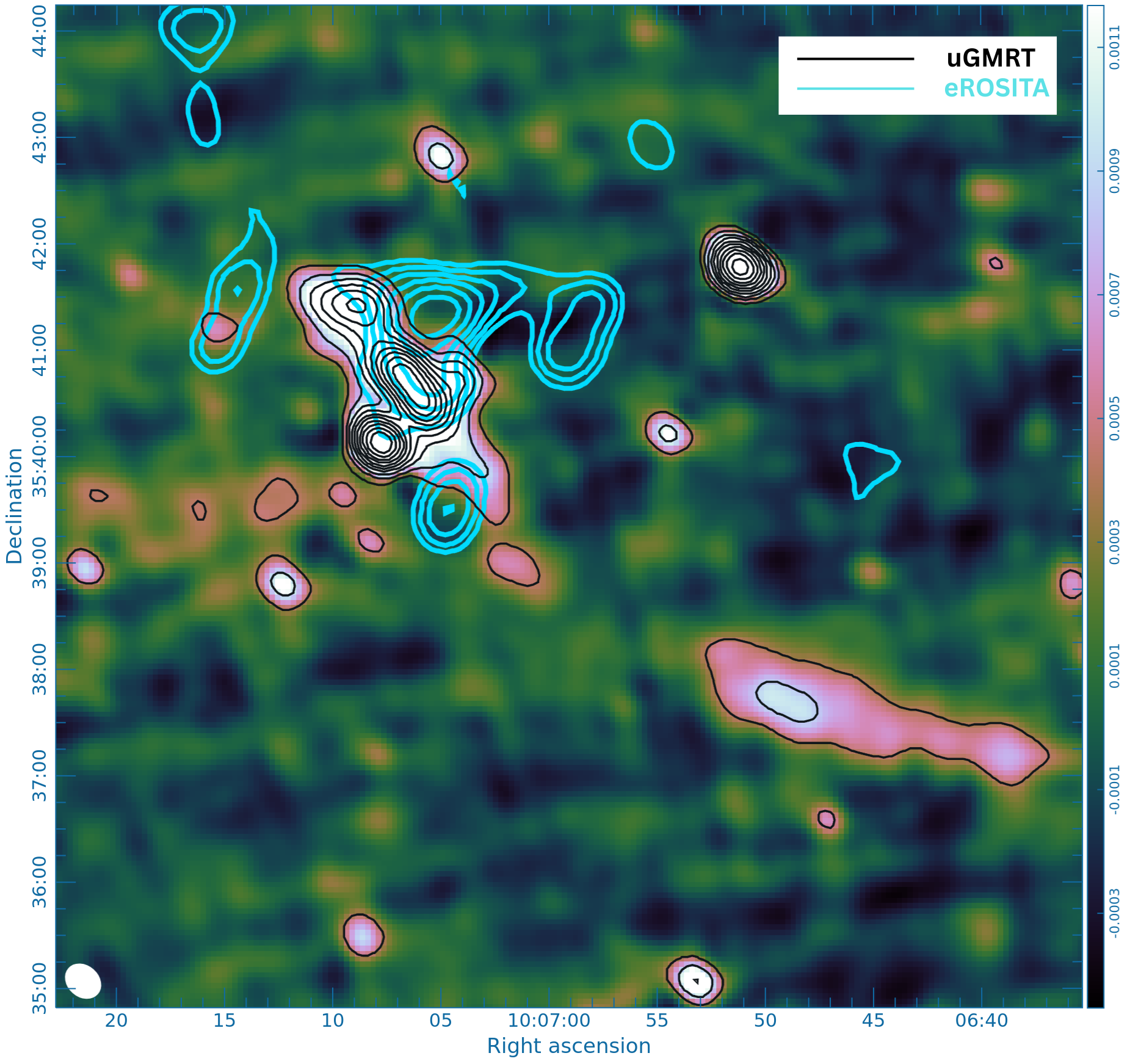
- No X-ray observations (Chandra/XMM) of the WHL J100706.4+354041 ICM to quantify density, temperature, pressure, shocks/turbulence, and cavities; this prevents robust jet–ICM interaction diagnostics and lobe/ICM pressure balance estimates.
- The duty-cycle chronology is poorly constrained: with only two radio frequencies, injection indices are assumed, and radiative ages (inner ≈140 Myr, outer ≈240–260 Myr) lack uncertainties and may be biased by inhomogeneous fields and mixing; full JP/KP/Tribble fits across >4 bands are needed.
- Equipartition magnetic fields are adopted with K=0 (pure e± plasma) and cylindrical volumes; the absence of inverse-Compton X-ray constraints and proton content estimates yields potentially biased B-field and energy densities.
- uv-coverage mismatch between LOFAR (dense short baselines) and uGMRT introduces systematic errors in spectral index maps; matched uv coverage, mosaicking, or combination with single-dish data are needed to recover all diffuse flux and minimize artificial spectral flattening.
- The compressed lobe prior to the break is undetected at 400 MHz; deeper low-frequency imaging (LOFAR LBA, uGMRT Band 2) and higher dynamic range at intermediate bands (uGMRT Band 4/VLA L–S) are required to constrain its spectrum (currently α ≲ 3.6) and physical state.
- No polarization or Faraday rotation analysis; magnetic-field geometry, depolarization, and RM gradients across lobes/tail (key for interaction with the ICM and shock/turbulence diagnostics) remain unknown.
- The inner “restarted” classification is not rigorously validated: absence of inner hotspots/shocks, cocoon conditions, and advance speeds; VLBI core-jet imaging, hotspot spectral diagnostics, and jet-sidedness analysis are needed to confirm episodic activity.
- Jet orientation and host’s 3D motion relative to the ICM are unconstrained; optical spectroscopy (velocity dispersion, systemic velocity) and ICM bulk-flow (X-ray thermodynamics) are required to test ram-pressure bending vs. reorientation scenarios.
- The potential link between high IR-derived SFR (~106 M⊙ yr⁻¹) and merger-driven gas inflow is speculative; no molecular gas (CO), atomic gas (H I), or merger signatures (deep optical imaging, kinematics) are presented to confirm fuelling mechanisms.
- AGN mode classification (radiatively efficient) is inferred without UV coverage or optical emission-line diagnostics; Eddington ratio and BH mass (from σ⋆ or reverberation) are not estimated, leaving accretion state and feedback mode uncertain.
- WISE W4 (22 μm) photometry and far-IR constraints are absent; SFRIR and dust properties rely on limited MIR/NIR bands, increasing uncertainty in dust-obscured star formation estimates.
- Cluster mass and dynamical state rely on richness scaling rather than X-ray or velocity dispersion measurements; the true mass, substructure, and merger state of the cluster remain unquantified.
- No search for diffuse cluster radio emission (halo/relic) beyond the RG extent; wide-field low-frequency imaging and polarization are needed to establish whether environmental shocks coincide with the tail break/flattening.
- Pressure and energy budgets of lobes/backflow/tail are not compared to ICM conditions; without X-ray constraints, the confinement, over/under-pressuring, and energetics of different components are speculative.
- Radiative age estimates lack error propagation (flux-scale, geometry, B-field); formal uncertainties and model degeneracies (advection, adiabatic losses, intermittent reacceleration) are not quantified.
- Nature of nearby radio features R1/R2 is unconfirmed (R2 has no redshift); deeper spectroscopy and multi-frequency radio imaging are required to exclude contamination or interaction with the GRG’s emission.
- The GRG classification hinges on including the diffuse tail beyond a break; a rigorous connectivity test (spectral/kinematic continuity, polarization, shock signatures) is needed to confirm size and true physical extension.
- No hydrodynamic/MHD simulations are compared to the observed morphology; tailored jet–ICM simulations (varying jet power, ICM gradients, bulk flows) could test whether the observed distortions and break/flattening are reproducible.
- Advance speeds and ages of inner vs. outer components are not estimated with orientation corrections; sidedness ratios, hotspot compactness, and multi-epoch core flux measurements could refine speed and angle to the line-of-sight.
- Lack of high-frequency radio data (>1 GHz) limits constraints on spectral curvature, break frequencies, and fresh particle injection; a broad-band radio SED (≤60 MHz to ≥3 GHz) is needed for robust ageing and reacceleration diagnostics.
- No attempt to detect IC/CMB X-ray emission from lobes to directly measure B-fields and electron populations; such measurements could validate or revise equipartition-based energetics.
- Interpretation of tail spectral flattening lacks tests for adiabatic compression (e.g., Mach number estimates from X-ray shock edges) versus Fermi II reacceleration (curvature and high-frequency flattening).
- The 2σ VLASS core detection is marginal; deeper high-frequency imaging is needed to secure core flux, spectral index, and variability, which bear on current accretion state and jet power.
- Jet position angle vs. host major-axis PA is noted but not interpreted; alignment/misalignment statistics and their implications for AGN fuelling (e.g., minor mergers, misaligned inflows) remain unexplored.
- No environmental comparison to similar cluster-surrounded DDRGs/GRGs; placing J1007+3540 in a controlled sample would clarify how rare the combined features (restarted jets, detached tail, flattening) are and which conditions drive them.
Practical Applications
Immediate Applications
The following applications are directly deployable using the data, methods, and results presented in the paper.
- Survey pipeline to identify cluster-associated giant radio galaxies (Academia, Software)
- Use the paper’s selection workflow (LoTSS DR2 filtering by LAS ≥ 4′ plus cross-matching to WHL, DESI LS DR9, and Abell cluster catalogs) to assemble high-value target lists of GRGs interacting with the intracluster medium (ICM).
- Potential tools/workflows: scripted Astroquery/Astropy cross-matching, reproducible Jupyter notebooks, batch source vetting.
- Assumptions/Dependencies: survey sensitivity and angular resolution comparable to LoTSS DR2; catalog completeness and redshift accuracy; manual vetting availability.
- Imaging recipe for faint, diffuse cluster-tail emission (Academia, Software)
- Operationalize the imaging settings demonstrated here (uv-tapering, Briggs robust=0, multi-term MFS with nterms=2, self-calibration) to consistently recover low-surface-brightness structures in cluster environments.
- Potential tools/workflows: CASA tclean scripts; CAPTURE pipeline; standard self-cal calibration sequences; uGMRT/LOFAR best practices.
- Assumptions/Dependencies: sufficient short-baseline uv coverage; low RFI; adequate on-source time.
- Low-frequency spectral index and radiative-age mapping for target triage (Academia)
- Apply the BRATS-based pipeline and two-frequency mapping strategy to derive spectral indices and indicative radiative ages that prioritize sources for deeper multiwavelength follow-up.
- Potential tools/workflows: BRATS specindex, common-beam convolution, pixel-aligned mosaics.
- Assumptions/Dependencies: uv-coverage mismatch between arrays can bias spectral indices; adoption of assumed injection index and equipartition fields introduces model-dependent uncertainties.
- RFI-mitigation practices and data quality control (Telecom/Industry, Academia)
- Transfer uGMRT RFI filter usage, tfcrop-based flagging, and QA routines to other low-frequency arrays and, by analogy, to industrial RF systems where interference excision is needed.
- Potential tools/workflows: station-level filters, automated flagging heuristics, observatory QA dashboards.
- Assumptions/Dependencies: site-specific RFI characteristics; access to firmware/software-level filtering.
- SED fitting for dust-obscured star formation in BCGs (Academia)
- Use the AGNfitter MCMC decomposition to quantify obscured star formation rates and AGN modes in brightest cluster galaxies, enabling targeted IR/submm follow-ups.
- Potential tools/workflows: AGNfitter containers; standardized photometry ingestion from WISE, 2MASS, Pan-STARRS1.
- Assumptions/Dependencies: reliable photometry and redshifts; IR coverage; degeneracy handling in SED models.
- Training data for ML detection of restarted jet systems (Academia, Software)
- Leverage J1007+3540 as a labeled exemplar of restarted jets with detached tails and spectral flattening to seed convolutional or graph neural networks for LoFAR/SKA survey mining.
- Potential tools/workflows: curated image cutouts, masks, and metadata; augmentation strategies; baseline CNN architectures for radio morphology.
- Assumptions/Dependencies: need for more labeled examples; class imbalance; reproducible feature extraction.
- Observatory planning and follow-up prioritization (Academia, Policy)
- Use derived ages, magnetic fields, and morphology to build compelling proposals for X-ray (Chandra/XMM), higher-frequency radio, and polarization observations to constrain AGN feedback and ICM conditions.
- Potential tools/workflows: proposal-ready target briefs; expected signal calculators; cross-facility coordination templates.
- Assumptions/Dependencies: allocation cycles; detectability forecasts; multiwavelength scheduling.
- Open education and outreach resources (Education, Daily life)
- Utilize the visual overlays (radio contours on optical), cluster-member plots, and SED decompositions to explain AGN feedback, duty cycles, and cosmic magnetism in classrooms and planetaria.
- Potential tools/workflows: educator slide decks; annotated images; short explainer videos.
- Assumptions/Dependencies: permissive data licenses; accessible narratives for non-specialists.
- Reproducible, containerized analysis workflows (Software, Academia)
- Package the end-to-end workflow (selection, imaging, spectral mapping, SED fitting) into containerized pipelines for lab groups and cross-observatory teams.
- Potential tools/workflows: Docker/Singularity containers; Nextflow/Snakemake pipelines; data provenance tracking.
- Assumptions/Dependencies: compute access; data rights; stable tool versions.
Long-Term Applications
These applications require further research, scaling to larger samples, instrument development, or methodological advances.
- SKA-era, at-scale discovery and characterization of episodic radio galaxies (Software, HPC, Academia)
- Build fully automated pipelines (“Restarted RG Finder”) to detect and classify restarted jets, detached tails, and spectral breaks at SKA/LoFAR depths, including uv-aware spectral index corrections.
- Potential tools/products: ML classifiers trained on LoTSS/uGMRT exemplars; active learning with expert-in-the-loop; scalable GPU inference.
- Assumptions/Dependencies: availability of large labeled datasets; robust domain-adaptation across telescopes; SKA data rates and computing.
- Calibrating feedback–ICM and richness–mass scaling relations (Academia, Policy)
- Use large samples of cluster-surrounded GRGs with age/energetic estimates to improve scaling relations that feed cosmological inference and cluster thermodynamics models.
- Potential tools/workflows: joint radio–X-ray–SZ meta-analyses; hierarchical Bayesian modeling; simulation–observation comparison frameworks.
- Assumptions/Dependencies: X-ray and SZ data coverage; careful control of selection effects; projection and dynamical-state uncertainties.
- Interferometric calibration transfer to massive MIMO and 6G (Industry/Telecom)
- Translate self-calibration, beam-weighting (uv-taper analogs), and sparse-array imaging concepts to improve localization, beamforming, and interference rejection in next-gen wireless networks.
- Potential tools/products: calibration algorithms embedded in baseband software; adaptive weighting strategies; diagnostic metrics.
- Assumptions/Dependencies: adaptation to real-time constraints; proprietary hardware constraints; regulatory acceptance.
- Spectrum management and radio-quiet policy guidance (Policy, Telecom)
- Inform national/international spectrum policy by quantifying the impact of RFI on low-frequency astronomy and defining protection zones, time-sharing schemes, and mitigation standards.
- Potential tools/products: RFI impact assessments; best-practice guidelines; observatory–regulator data-sharing protocols.
- Assumptions/Dependencies: multi-stakeholder coordination; compliance frameworks; continuous monitoring.
- Polarization and cosmic magnetism constraints for astroparticle models (Academia)
- Extend studies with polarization and broadband spectra to constrain lobe magnetic fields and particle aging, informing models of cosmic magnetism and ultra-high-energy particle transport.
- Potential workflows: joint radio–gamma-ray constraints; Faraday tomography; advanced spectral aging models beyond JP/KP.
- Assumptions/Dependencies: broadband, high-SNR polarimetry; accurate Faraday screens; improved aging formalisms.
- Multi-physics “digital twins” of cluster radio plasma (Academia, Software)
- Integrate radio, optical/IR, and X-ray constraints into co-simulations that track jet duty cycles, ICM turbulence, and lobe evolution to produce predictive digital twins of cluster systems.
- Potential tools/products: interoperable data models; simulation–inference loops; parameter-estimation dashboards.
- Assumptions/Dependencies: standardized data formats; compute resources; validated subgrid physics for feedback.
- Observatory decision-support systems (Software, Policy)
- Build rarity/novelty scoring systems that use morphology, spectral ages, and environment metrics to guide queue scheduling and optimize cross-facility follow-ups.
- Potential tools/products: TAC-facing scoring APIs; pilot scheduling policies; user feedback loops.
- Assumptions/Dependencies: governance adoption; fairness and bias checks; alignment with science priorities.
- Citizen-science programs for radio-tail discovery (Education, Academia)
- Create public platforms where volunteers label breaks, tails, and hotspots in low-frequency images to scale training data for ML and enable discovery of rare systems.
- Potential tools/workflows: Zooniverse-style portals; gamified tutorials; expert verification pipelines.
- Assumptions/Dependencies: sustained community engagement; curation teams; data release policies.
Cross-cutting assumptions and dependencies
- Model assumptions: equipartition fields may differ from true lobe fields by factors of 2–3; two-frequency age estimates rely on assumed injection indices and JP/KP aging models; projection effects and uv-coverage mismatches can bias spectral indices.
- Data requirements: robust low-frequency sensitivity and short-baseline coverage (LOFAR/SKA-Low, uGMRT); multiwavelength photometry (WISE, 2MASS, Pan-STARRS1) and spectroscopy for precise redshifts; X-ray/SZ data to constrain ICM properties.
- Operational constraints: RFI environment and mitigation efficacy; telescope time availability; compute and storage for large surveys.
- Generalizability: pipelines may need re-tuning across arrays and epochs; ML models require diverse, well-labeled training sets and careful validation to avoid selection biases.
Glossary
- Active galactic nucleus (AGN): A compact, luminous region at a galaxy’s center powered by accretion onto a supermassive black hole, often launching powerful jets. "Active galactic nuclei (AGN), in radio-loud mode, squirt out bipolar jets ranging from parsec (pc) scale to Mpc scale in size."
- Advance speed: The propagation velocity of a hotspot or jet head through the ambient medium. "\citet{Sc00b} estimated the advance speeds of the inner hotspots in the range between $0.19c$ and $0.57c$"
- AGN feedback: Energy and momentum injection from an AGN (e.g., jets, winds) that heats or displaces surrounding gas, affecting galaxy and cluster evolution. "RGs are known to influence the thermal and dynamical state of ICM through AGN feedback, particularly in the form of mechanical (or kinetic) feedback."
- Backflow: Plasma that flows back from the jet termination region (hotspot) into the lobe, often appearing as a trailing, distorted structure. "the distorted backflow alone has an even steeper spectral index of 2.3."
- Bandpass calibration: The correction of frequency-dependent gain variations across a receiver’s band during radio data reduction. "Following these quality checks, initial calibration steps, including flux density and bandpass calibration, were performed."
- Big Blue Bump (BBB): The optical–UV thermal emission component from an AGN accretion disk. "the AGN accretion disk or ``big blue bump'' \citep[BBB;] []{Te21}"
- Briggs weighting: A radio imaging scheme that balances resolution and sensitivity via a robustness parameter. "It employs gridder = `widefield', Briggs weighting, with a robustness parameter set to 0 (robust = 0), and two Taylor series expansion terms (nterms = 2, representing tt0 and tt1)."
- Brightest cluster galaxy (BCG): The most luminous galaxy in a cluster, typically near the cluster’s center. "The source J1007+3540 is found to be hosted by the brightest cluster galaxy (BCG), MaxBCG J151.77665+35.67813"
- Broadband Radio Astronomy ToolS (BRATS): Software for spectral analysis and modeling of radio sources. "We used the Broadband Radio Astronomy ToolS \citep[BRATS;] []{harwood_2013MNRAS} to create the spectral index map."
- Break frequency (): The frequency above which a synchrotron spectrum steepens due to radiative losses. "the corresponding break frequencies ($\nu_{\mathrm{br}$) (as per the assumptions in \citet{Br19}) for J1007+3540, are listed"
- CMB (cosmic microwave background): Relic radiation from the early Universe permeating all space, important for IC energy losses. "inverse Compton (IC) scattering to the cosmic microwave background (CMB)."
- CMB energy density redshift scaling: The increase of CMB energy density with redshift as , enhancing IC losses at high z. "because of the dependence of the CMB energy density."
- CMB-equivalent magnetic field strength: The effective magnetic field representing CMB energy density, used to compare synchrotron and IC losses. "CMB-equivalent magnetic field strength (3.2 G at )."
- Cocoon: The low-density, lobe-filled region carved by earlier jet activity, into which restarted jets propagate. "the low-density environment inside the cocoon is generally insufficient to produce strong shocks necessary for the formation of hotspots and radio lobes"
- Comoving distance: Cosmological distance measure that factors out expansion, keeping coordinate positions fixed with cosmic time. "where is the comoving distance to J1007+3540"
- Critical density: The density required for a flat Universe at a given redshift. " represents the critical density of the Universe at redshift "
- Double-double radio galaxy (DDRG): A radio galaxy showing two distinct pairs of lobes from separate episodes of jet activity. "One of the most intriguing characteristics of restarted RGs, particularly double-double RGs (DDRGs), is the presence of inner radio lobes"
- Dusty torus: A donut-shaped region of dust around an AGN that reprocesses UV/optical into infrared emission. "the emission from the dusty torus surrounding the AGN"
- Equipartition magnetic field (): The magnetic field strength derived assuming energy balance between particles and fields. "The magnetic field () calculations were done in accordance with the revised equipartition arguments provided by \citet[] [see equation 3]{Be05}."
- FR II: Fanaroff–Riley class II; powerful, edge-brightened radio galaxies with prominent hotspots. "the magnetic field strengths in the lobes of active FR II radio sources are typically lower by a factor of 2--3 compared to equipartition estimates"
- Gently re-energized tails (GReET): Cluster radio sources where fossil plasma is mildly re-accelerated, producing diffuse tails. "gently re-energized tails \citep[GReET;] []{Ga17}"
- Hotspot: A bright, compact region at the jet termination where strong shocks accelerate particles. "the formation of new lobes and hotspots once the jet flow is re-established"
- Intracluster medium (ICM): The hot, diffuse plasma pervading galaxy clusters that interacts with radio jets and lobes. "the pressure of the hot and dense intracluster medium (ICM) can lead to confinement of these lobes"
- Inverse Compton (IC) scattering: Up-scattering of low-energy photons (e.g., CMB) by relativistic electrons, causing energy losses. "inverse Compton (IC) scattering to the cosmic microwave background (CMB)."
- Jaffe–Perola (JP) model: A synchrotron aging model assuming continuous isotropization of electron pitch angles. "it is not possible to directly measure the injection index by fitting the Jaffe--Perola (JP) \citep{Ja73} ... models."
- Jet kinetic power: The mechanical power carried by the AGN jet, inferred from radio structures and luminosities. "the outer north lobe exhibiting the highest jet kinetic power"
- Kardashev–Perola (KP) model: A synchrotron aging model with fixed electron pitch angles during radiative losses. "Jaffe--Perola (JP) \citep{Ja73} and Kardashev--Perola (KP) \citep{Ka62, Pa70} models."
- LOFAR: A low-frequency radio interferometer operating mainly between 10–240 MHz. "LOw-Frequency ARray \citep[LOFAR;] []{va13}"
- LoTSS DR2: The second data release of the LOFAR Two-metre Sky Survey at 144 MHz. "LOFAR Two-metre Sky Survey second data release (LoTSS DR2) at 144 MHz"
- Luminosity distance (): Distance measure used to convert observed flux to intrinsic luminosity in cosmology. "where is the luminosity distance to the source"
- Markov Chain Monte Carlo (MCMC): A statistical sampling method to estimate posterior distributions of model parameters. "The fitting was carried out using a Markov Chain Monte Carlo (MCMC) approach"
- : The total mass within radius of a cluster, where the mean density is 500 times the critical density. "The total mass enclosed within a radius of R, denoted as , is noted as "
- NVSS: A 1.4 GHz VLA sky survey covering most of the sky, useful for detecting extended radio emission. "the National Radio Astronomy Observatory (NRAO) VLA Sky Survey (NVSS) at 1400 MHz"
- Radiative age (): The time since particle acceleration inferred from spectral steepening due to synchrotron/IC losses. "Due to the availability of only two frequencies (144 and 400 MHz), we estimated the radiative age ()"
- Restarted jet: A new episode of AGN jet activity occurring after a period of quiescence, often within older lobes. "J1007+3540 presents a rare combination of a restarted jet, a detached tail-like structure, and unusual spectral flattening beyond the tail break"
- RFI (radio frequency interference): Unwanted radio signals from human-made or natural sources that contaminate observations. "radio frequency interference (RFI)."
- : Cluster radius within which the mean density is 500 times the critical density. "Here, R is defined as the largest radius within which the overdensity () exceeds 500"
- Richness–mass scaling relation: An empirical correlation linking a cluster’s galaxy richness to its total mass. "using the information of cluster richness R in richness--mass scaling correlation"
- Self-calibration: Iterative calibration technique using the target’s own data to improve phase and amplitude solutions. "Finally, tasks gaincal and applycal in casa were used for amplitude and phase self-calibration."
- Spectral energy distribution (SED): The flux of a source as a function of wavelength/frequency across bands, used to infer physical components. "we performed a multi-component spectral energy distribution (SED) fitting"
- Spectral flattening: A local or global reduction in spectral index (less steep spectrum), often indicating re-acceleration or mixing. "unusual spectral flattening beyond the tail break"
- Spectral index (): The exponent in the power-law relation describing radio spectra. "The emission exhibits a power--law energy distribution with a steep spectral index (1.3)"
- Synchrotron radiation: Emission from relativistic electrons spiraling in magnetic fields, dominant in radio lobes and jets. "primarily through synchrotron radiation and inverse Compton (IC) scattering"
- Taylor series terms (nterms, tt0, tt1): Parameters in multi-term imaging that model frequency dependence of sky brightness. "two Taylor series expansion terms (nterms = 2, representing tt0 and tt1)."
- uGMRT: The upgraded Giant Metrewave Radio Telescope, operating at meter wavelengths. "using LOFAR Two-metre Sky Survey second data release (LoTSS DR2) at 144 MHz and the upgraded Giant Metrewave Radio Telescope (uGMRT) at 400 MHz."
- uv taper: A weighting in the Fourier (uv) plane to emphasize short baselines, improving sensitivity to extended emission. "we applied a uv taper of 10 k"
- VLASS: A 3 GHz VLA sky survey providing high-resolution radio imaging. "the VLA Sky Survey (VLASS) at 3 GHz"
- WHL cluster: A galaxy cluster identified in the Wen–Han–Liu catalogue. "the WHL J100706.4+354041 cluster"
- X-ray cavities (or bubbles): Depressions in X-ray emission created by radio lobes displacing the hot ICM. "inflate cavities (or bubbles) in the X-ray emitting gas"
Collections
Sign up for free to add this paper to one or more collections.