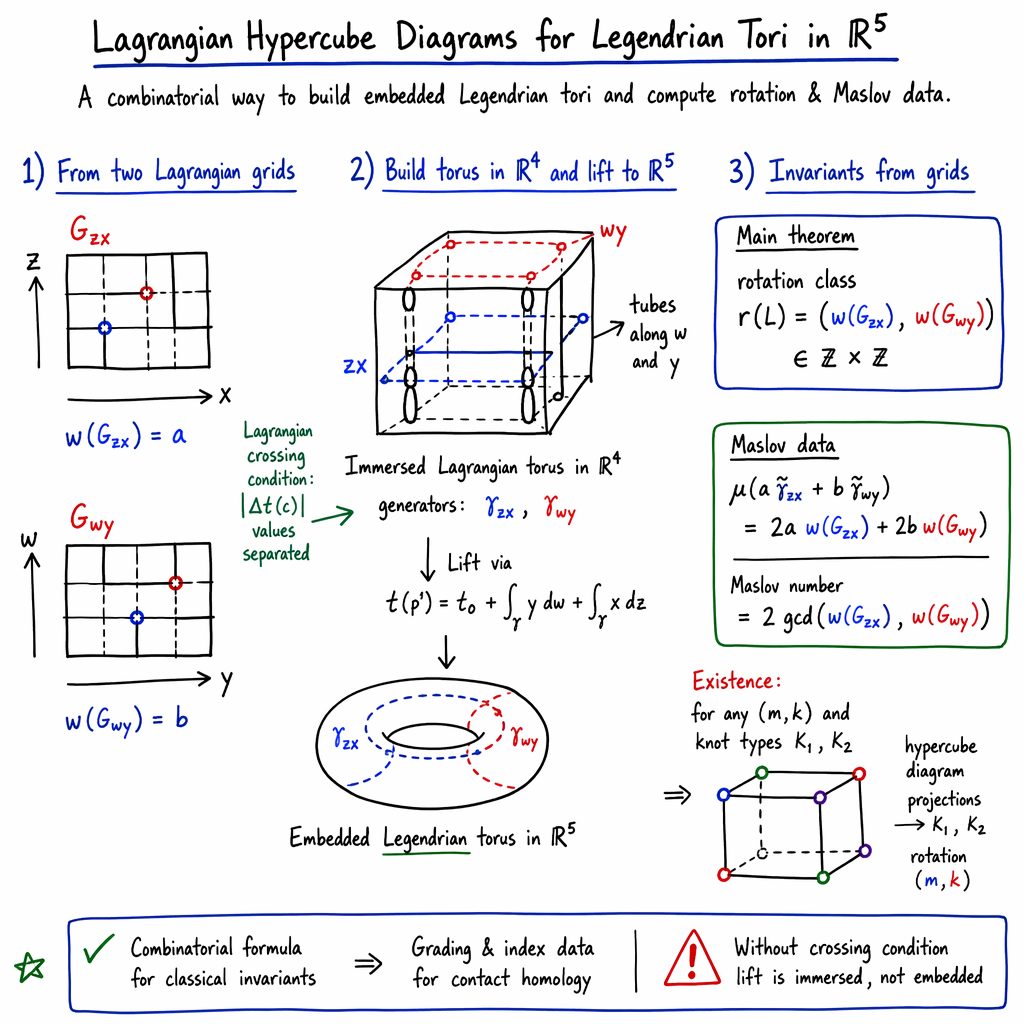
- The paper presents a combinatorial method that reduces the rotation class of Legendrian tori in R^5 to an explicit pair of integers.
- It derives concrete formulas for the rotation class, Maslov index, and Maslov number using projections from Lagrangian grid and hypercube diagrams.
- The framework enables the construction of Legendrian tori with any prescribed rotation class, paving the way for algorithmic advances in contact topology and related invariants.
Combinatorial Computation of Rotation Class for Knotted Legendrian Tori in R5
Introduction and Motivation
This paper introduces a combinatorial framework for explicitly constructing and computing the rotation class of embedded Legendrian tori in R5 equipped with its standard contact structure. Unlike R3, the study of knotted Legendrian submanifolds in higher dimensions (R2n+1, n≥2) has lacked effective diagrammatic representations or computational tools for classical invariants. Notably, the Thurston-Bennequin invariant is trivial in the genus-1 case in R5, making the rotation class the key topological invariant of interest. The approach centers on a new combinatorial gadget, the Lagrangian hypercube diagram, which generalizes and unifies the structure of grid and cube diagrams known from lower-dimensional knot theory.
Theoretical Framework: Rotation Class in Higher Dimensions
For a Legendrian torus L⊆(R5,ξ), the rotation class generalizes the classical rotation number from dimension 3, capturing the homotopy class of a bundle isomorphism from TL⊗C to the contact plane bundle, modulo the unitary group action. The central insight established in the paper is the reduction of the rotation class for embedded tori in R5 to an explicit pair of integers: [T2,U(2)]≅π1(U(2))×π1(U(2))≅Z2, with the correspondence determined by two canonical generators of the torus' first homology.
Lagrangian Grid Diagrams and Their Invariants
The construction starts from immersed grid diagrams, generalized to Lagrangian grid diagrams by imposing area and crossing conditions ensuring that grid diagrams actually lift to piecewise-linear Legendrian knots under the standard contact form on R50. The key computational result is that the rotation number associated to such a lift can be extracted directly as a signed quarter-count of corner types in the grid diagram:
R51
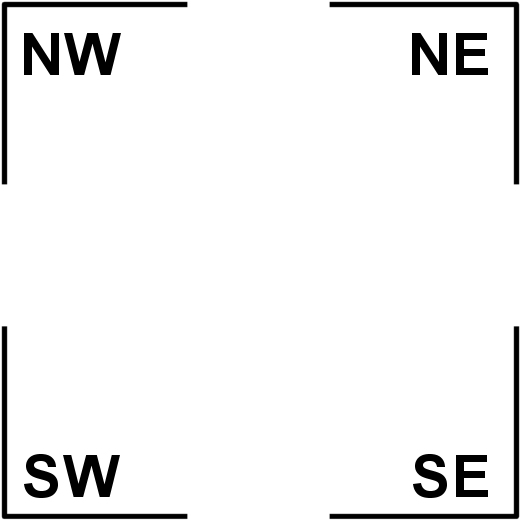
Figure 1: Types of corners in a grid diagram.
This formula provides an elementary method for associating an integer winding number to each grid diagram, with the smoothing process ensuring the piecewise-linear object can be made Legendrian isotopic to a smooth embedding.
Lagrangian Hypercube Diagrams: Definition and Structure
Lagrangian hypercube diagrams are constructed within a R52-dimensional hypercube, with one axis for each pair of coordinates (R53), and are defined via a system of markings and projections mirroring the classical notion of grid diagrams. Each such structure gives projections to a pair of Lagrangian grid diagrams R54, one for each factor of the torus. The markings in the hypercube encode both the combinatorial data needed to realize immersed Lagrangian tori and the explicit combinatorics required to guarantee embeddedness after lifting to R55.
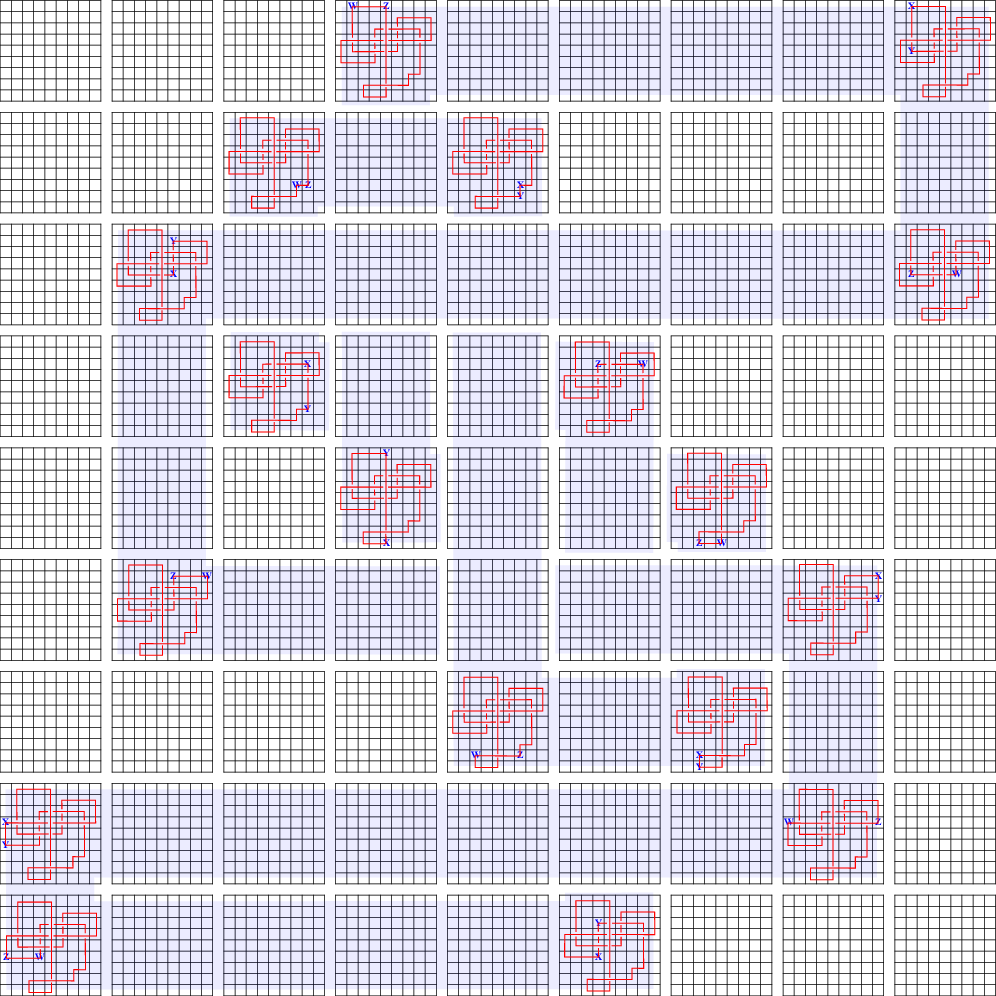
Figure 2: Schematic for displaying a Lagrangian hypercube diagram showing relationships between the various projections used in the construction.
Main Results: Computational Formulae
The pivotal theorem demonstrates that for a Legendrian torus constructed from a Lagrangian hypercube diagram, the rotation class is given explicitly by the pair of winding numbers associated to the two Lagrangian grid diagram projections:
R56
with the winding numbers computed over the respective grid diagrams.
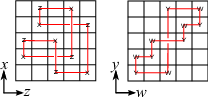
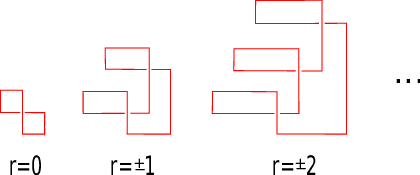
Figure 3: Unknots with rotation numbers 1 and 0, comprising the building blocks for tori with prescribed rotation classes.
Furthermore, the paper provides direct combinatorial formulae for:
- The Maslov index for any loop R57:
R58
- The Maslov number (minimal positive Maslov index value for a nontrivial loop):
R59
This completely reduces the computation of these fundamental Legendrian invariants to integer calculations on the associated grid diagrams.
Universality: Realization of All Pairs R30
A central claim of the paper is that every element of R31 can be realized as the rotation class of an embedded Legendrian torus in R32 arising from the construction. Explicit procedures are given to:
Algorithmic and Theoretical Implications
By leveraging the explicit and combinatorial nature of the construction, this framework points the way toward algorithmic computation of contact homology and related invariants for Legendrian tori in higher-dimensional contact manifolds. The realization and computation of the rotation class and Maslov index as functions of grid diagram data is essential for grading and moduli space calculations in Legendrian contact homology.
In physics, particularly within the context of the SYZ conjecture and special Lagrangian geometry relevant to string theory, these combinatorial methods may provide local models for analyzing singular special Lagrangian cones, whose links are minimal Legendrian tori.
Examples and Visualization
A series of explicit schematic diagrams, including unknots and nontrivial knots (e.g., the trefoil and R35 torus knot), demonstrates the versatility of the construction. The figures highlight how even complex Legendrian tori with prescribed rotation class can be built from the explicit combinatorial data in hypercube diagrams.
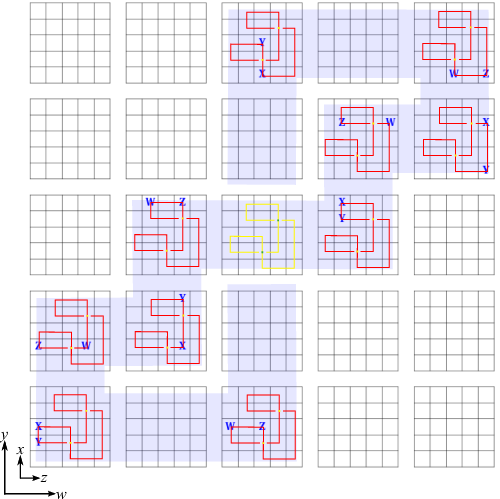
Figure 5: Lagrangian hypercube diagram with unknotted R36 and R37 and rotation class R38.
Figure 6: Hypercube diagram with R39 a R2n+10 torus knot and R2n+11 a trefoil, rotation class R2n+12.
Conclusion
This work establishes a combinatorial and algorithmic method for constructing and computing the rotation class and Maslov index of Legendrian tori in R2n+13, grounded in Lagrangian hypercube diagrams. It demonstrates that every pair of integers is realized as the rotation class, and lays the foundation for further developments in combinatorial contact topology and computational methods for Legendrian invariants, with ramifications for both pure mathematical theory and mathematical physics.