- The paper rigorously compares attractor and Hesse flows, clarifying their duality via Legendre transformation in wall-crossing structures.
- It details how special Kähler geometry and affine structures enable inductive computation of Donaldson-Thomas invariants through attractor trees.
- The study bridges mirror symmetry with integrable systems, offering new computational insights into BPS state counting and moduli space singularities.
Attractor Flow Versus Hesse Flow in Wall-Crossing Structures
Wall-Crossing Structures, Integrable Systems, and Affine Geometry
The paper presents a rigorous comparison between attractor flow and Hesse flow within the context of the Kontsevich-Soibelman wall-crossing formalism, with particular attention to the Z-affine structures on the base of complex integrable systems. Wall-crossing structures (WCS) encode the discontinuous behavior of Donaldson-Thomas invariants (DT invariants), which arise in the enumeration of BPS states across walls in moduli space. The role of the base B of a complex integrable system is central: it admits a family of Z-affine structures derived from special coordinates, each related by S1-rotations and governed by Monge-Ampère geometry.
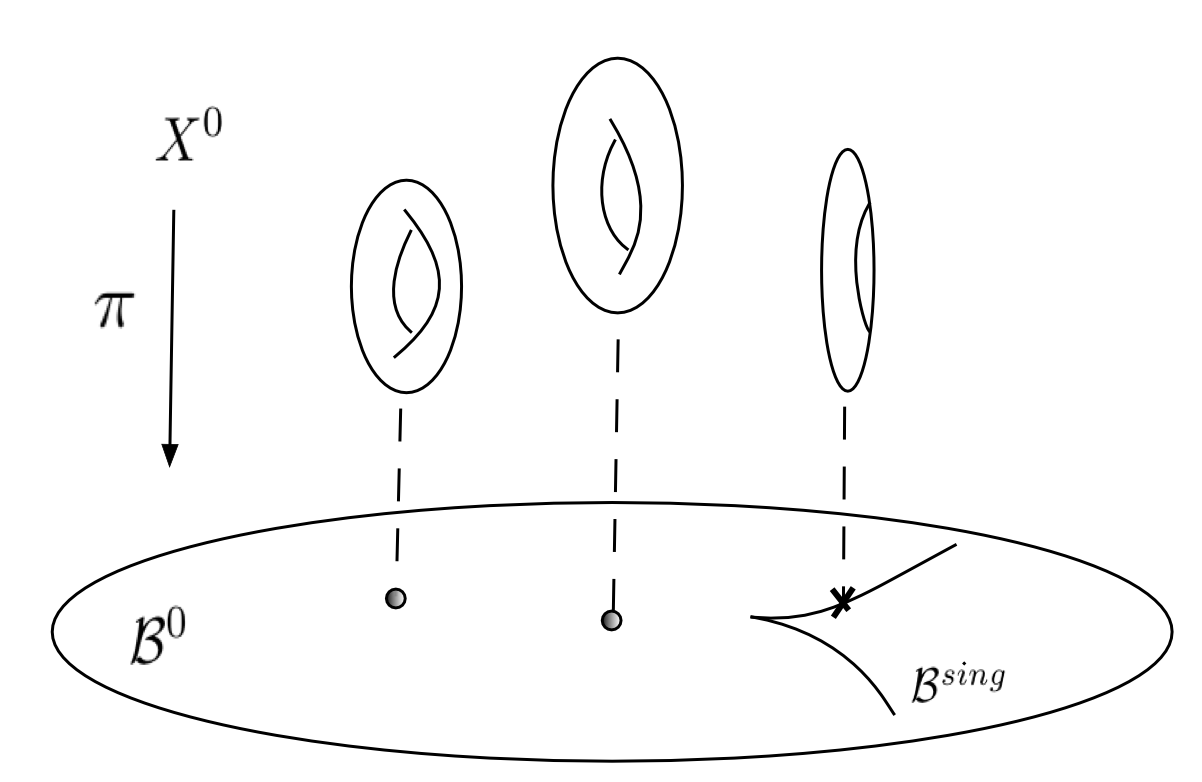
Figure 1: Schematic of a complex integrable system as a Lagrangian torus fibration over its base B.
Special Geometry, Central Charge, and Affine Coordinates
Special Kähler geometry underpins the structure on B, where the Kähler metric is realized via the Hessian of a Hesse potential. The integrable system, viewed as a Lagrangian torus fibration with charge lattice Γ, admits action-angle coordinates and central charges Z(γ). Special coordinates ai, aD,i are defined via a holomorphic prepotential B0, and yield adapted real and dual B1-affine coordinates B2. The rotation by an angle B3 produces an B4-family of affine structures, relating real and imaginary parts of central charges through these coordinates.
Singularities in the affine structure, modeled by focus-focus or Ooguri-Vafa type degenerations, yield non-trivial monodromy and constrain DT invariants. The Ooguri-Vafa space provides an explicit instance, with central charges exhibiting logarithmic monodromy consistent with BPS state counting:
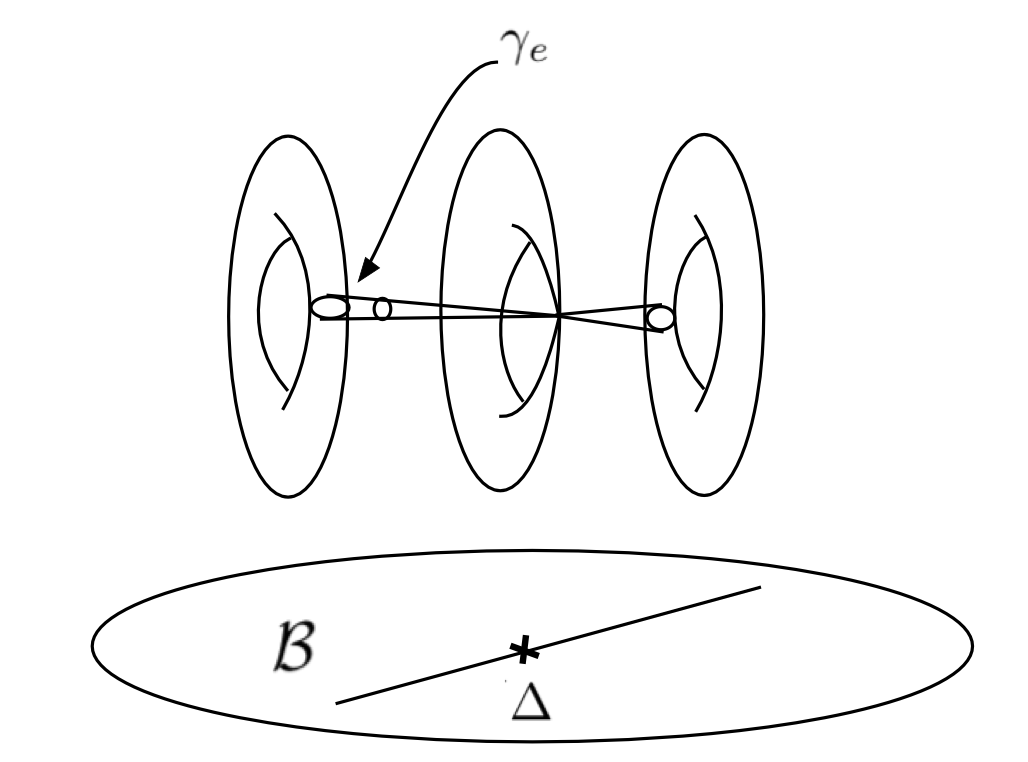
Figure 2: The Ooguri-Vafa space as an explicit local model of a singularity of the affine structure.
Attractor Flow, Split Attractor Trees, and Wall-Crossing
The attractor flow is defined as the gradient flow of the real part of the central charge B5, with respect to the special Kähler metric. The flow lines are straight (affine) away from the discriminant locus, converging to attractor points where vanishing cycles shrink to zero. Splitting occurs when the flow hits first-kind walls B6, resulting in a split attractor tree structure whose combinatorics are used for inductive computation of DT invariants via application of the Kontsevich-Soibelman Wall-Crossing Formula (KSWCF):
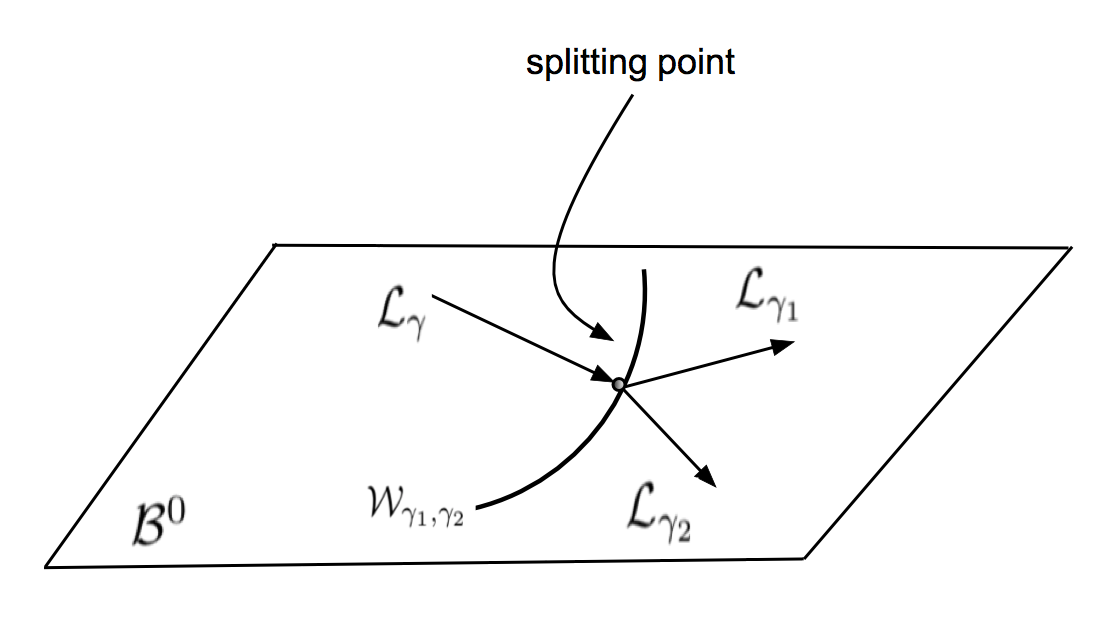
Figure 3: Illustration of split attractor flow and splitting point, visualizing wall-crossing and the tree structure of flows.
This mechanism is directly tied to WCS: the root of the attractor tree corresponds to the desired invariant, while leaves are assigned "initial data" at the discriminant locus, typically only non-trivial for primitive vanishing cycles. These ideas underpin the recursive computation of BPS state counts.
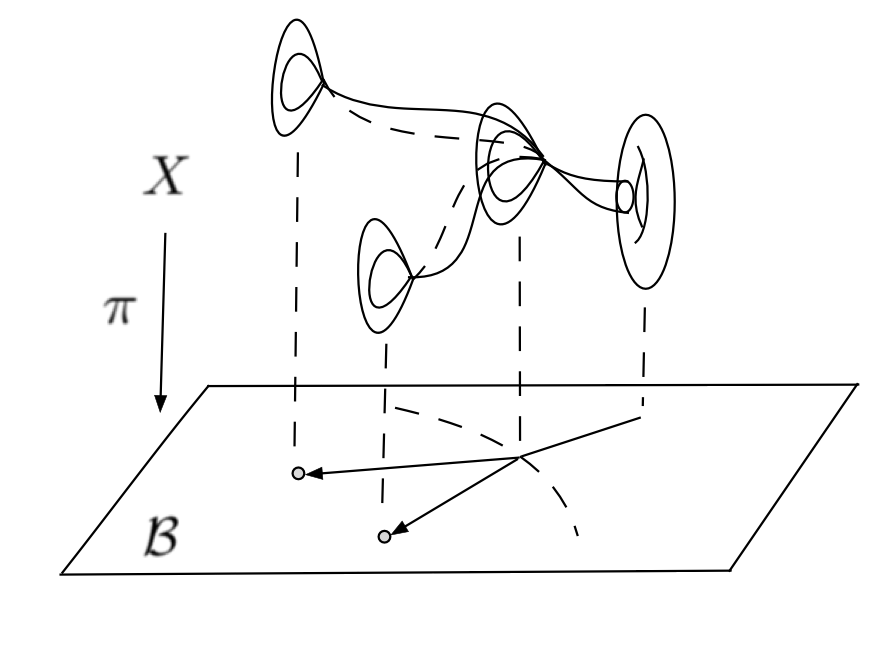
Figure 4: Holomorphic disks and attractor flows, emphasizing the interplay between mirror symmetry, tropical curves, and WCS.
Hesse Flow, Legendre Duality, and Affine Structures
In parallel, the paper recasts Hesse flow as the gradient flow of the Hesse potential (the Legendre transform of the Kähler potential) in B7-affine coordinates. The duality arises due to the Monge-Ampère property: both the original and the Legendre-dual potentials yield Ricci-flat metrics on the affine base. By explicit computation in adapted coordinates, it is shown that the attractor flow equation B8 in one affine structure is equivalent, after B9-rotation, to the dual attractor flow Z0 in the dual affine structure.
The Hesse flow and its dual are thus interrelated: the former is obtained by taking the real part of the rotated central charge, while the latter corresponds to the imaginary part. Both flows can be interpreted as geodesics with respect to the appropriate affine metric, providing a unifying formalism for wall-crossing phenomena, special geometry, and mirror symmetry.
Implications and Future Directions
The formal duality between attractor flows and Hesse flows, demonstrated via Legendre transforms, suggests a deep relation between wall-crossing, tropical geometry, and mirror symmetry. The identification and rotation of Z1-affine structures correspond to physical dualities between symplectic and complex geometry, as realized in SYZ mirror symmetry. The precision of the calculations exposes the possibility to algorithmically induct DT invariants, paving the way for systematic study of BPS state counting, moduli space singularities, and their applications in both mathematical and physical contexts.
The theoretical framework holds promise for further investigation of mirror symmetry via tropicalization and the combinatorics of attractor trees, as well as for enhancing computational approaches to invariants in algebraic geometry and string theory.
Conclusion
This paper provides a mathematically explicit bridge between attractor flow, Hesse flow, and wall-crossing structures by leveraging Monge-Ampère geometry and Legendre duality in special Kähler settings. The results clarify the equivalence and duality of flows in different affine structures, advance the formalism for inductive computation of DT invariants, and reinforce the geometric and combinatorial foundations underpinning wall-crossing and mirror symmetry (2607.05433).