- The paper presents an explicit SYZ mirror construction for Gr(2,4) by dualizing a Lagrangian torus fibration, recovering matching analytic and Lie-theoretic superpotentials.
- It employs explicit cluster coordinates and wall-crossing formulas to compute holomorphic disk counts and establish an integral affine structure on the base.
- The construction bridges Floer theory and Lie-theoretic approaches, providing a blueprint for extending mirror symmetry methods to higher Grassmannians and flag varieties.
Family Floer SYZ Mirror Algorithm for the Grassmannian Gr(2,4)
Introduction and Background
This work provides a concrete and explicit SYZ (Strominger-Yau-Zaslow) mirror construction for the Grassmannian Gr(2,4), focusing on an explicit fibration-level realization of mirror symmetry within the non-archimedean analytic category. The approach bridges the gap between Lie-theoretic (Landau-Ginzburg) mirror models and the geometric SYZ philosophy by explicitly constructing both the mirror fibration and the superpotential, sidestepping abstract Floer-theoretic machinery in favor of constructive geometric arguments.
The construction centers on dualizing a Lagrangian torus fibration on the A-side (symplectic geometry of Gr(2,4)∖Dac, Dac being the anti-canonical divisor) to produce a non-archimedean analytic mirror fibration on the B-side (analytified Langlands dual Grassmannian, realized as Gr(2,4)Λan∖Dac), and demonstrates that the corresponding bases, singular loci, and integral affine structures match exactly. Furthermore, the Landau-Ginzburg superpotential constructed via disk-counting agrees precisely with the Marsh-Rietsch superpotential previously obtained by Lie-theoretic approaches.
Lagrangian Fibrations on the Grassmannian
A Lagrangian torus fibration is constructed over the open part X=Gr(2,4)∖Dac via a Hamiltonian T3-action, where the moment map image is the interior of the (2,4)-hypercube, Δ2,4∘—an octahedron in R4. The fibers are classified as smooth or singular depending on their intersections with specific divisors, and their explicit description leverages cluster chart coordinates and Plücker coordinates.
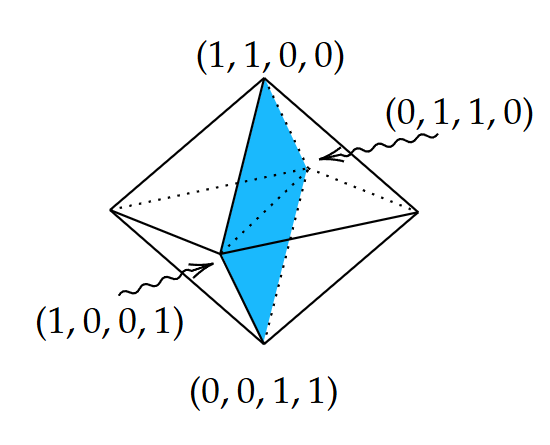
Figure 1: The octahedral hypersimplex Gr(2,4)0, which forms the moment map image for the Lagrangian fibration on Gr(2,4)1.
Singular loci are precisely described: the subset Gr(2,4)2 within the base Gr(2,4)3 is identified with points where Gr(2,4)4 and Gr(2,4)5. Wall loci Gr(2,4)6 and Gr(2,4)7 correspond to codimension-1 strata where Maslov index zero disks appear.
The construction employs two explicit cluster charts Gr(2,4)8, corresponding to Gr(2,4)9 and Gr(2,4)∖Dac0 respectively. The overlap of these charts underpins the non-trivial wall-crossing structure and necessitates explicit gluing in the analytic mirror.
Topological and Holomorphic Disks: Monodromy and Affine Structures
All local systems Gr(2,4)∖Dac1 and Gr(2,4)∖Dac2 are calculated, their monodromies computed explicitly via intersection data with divisors, and an integral basis of disk classes Gr(2,4)∖Dac3 (on Gr(2,4)∖Dac4) and Gr(2,4)∖Dac5 (on Gr(2,4)∖Dac6) is identified.
Integration of the symplectic form over these disk classes yields explicit action coordinates, globally defined on Gr(2,4)∖Dac7. These coordinates are instrumental in constructing a concrete integral affine atlas, whose transition function is piecewise linear—incorporating quantum corrections from wall-crossing phenomena.
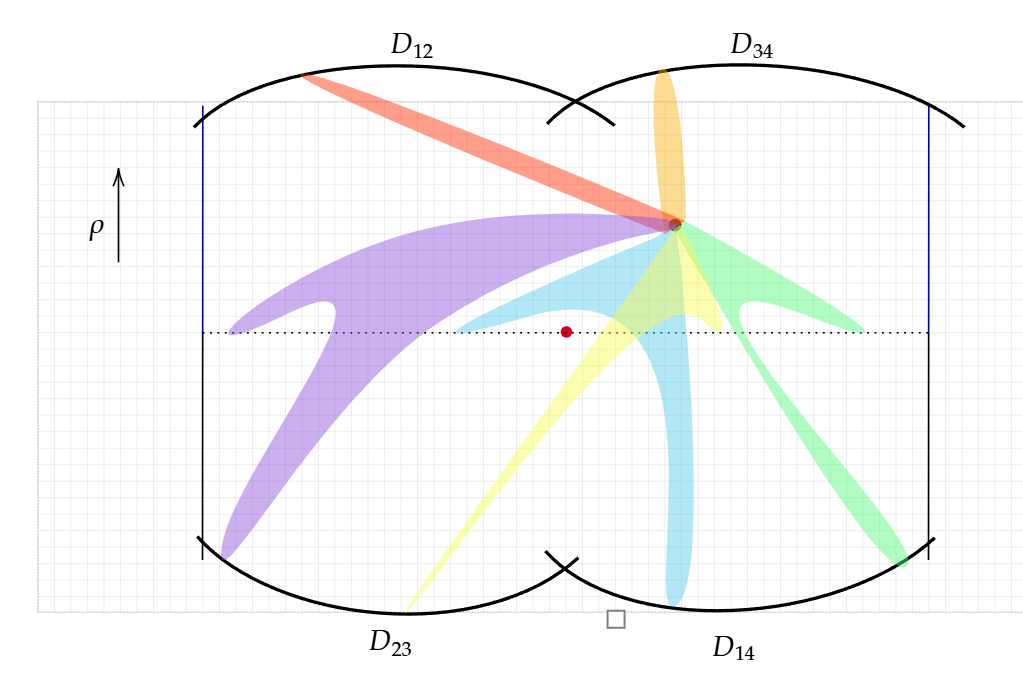
Figure 2: The six holomorphic disks bounded by a regular Lagrangian fiber in the chart Gr(2,4)∖Dac8 over Gr(2,4)∖Dac9.
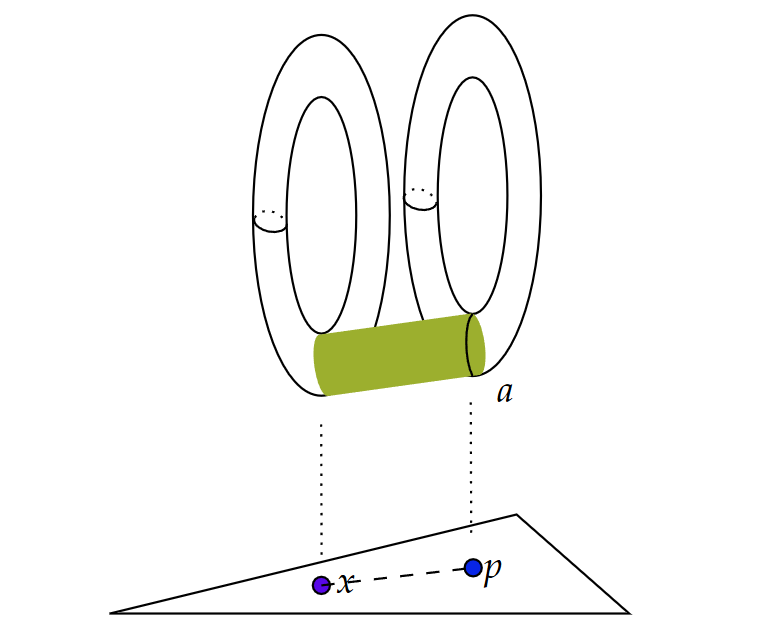
Figure 3: The geometric interpretation of the action coordinates using cylinder areas between adjacent Lagrangian torus fibers.
Analytic Mirror Construction via Family Floer Theory
Working over the Novikov field Dac0, affinoid charts are constructed via the Berkovich analytification. The mirror space Dac1 is explicitly realized as the gluing of two charts Dac2, with the transition map precisely determined by wall-crossing formulae reflecting quantum corrections from Maslov index zero disks.
The data on each chart is presented as follows:
- Coordinates Dac3 (resp.\ Dac4) parametrize the dual torus fibration.
- The Landau-Ginzburg superpotential is explicitly constructed using holomorphic disk enumeration:
Dac5
with a corresponding expression on Dac6.
Crucially, the analytic gluing map Dac7 is determined by equating the superpotential across the wall to enforce the corrected mirror geometry, ensuring that the global analytic function Dac8 is well-defined.
Embedding into the Langlands Dual and Superpotential Identification
A global analytic embedding Dac9 is constructed, with explicit formulas matching cluster coordinates and Plücker coordinates. The fiberwise torus action on the mirror aligns the bases of the A-side and B-side fibrations, and the gluing is shown to be injective and compatible with the analytic structures.
The global superpotential Gr(2,4)Λan∖Dac0 on the analytic mirror is shown to coincide explicitly with the Marsh-Rietsch superpotential:
Gr(2,4)Λan∖Dac1
demonstrating that holomorphic disk enumeration via the SYZ construction recovers precisely the Lie-theoretic LG model.
Theoretical and Practical Implications
This explicit construction substantiates the conjectural SYZ framework for Grassmannians at the level of explicit topological and analytic data, showing that the dual of the Lagrangian fibration recovers the Langlands dual Grassmannian (with anti-canonical divisor removed) not just as an abstract variety, but as an analytic space with matching fibration, affine structure, and superpotential.
Practically, this provides:
- An effective algorithm for constructing mirrors to other similarly structured varieties (e.g., higher Grassmannians, flag varieties) using explicit affine charts and wall-crossing data.
- A bridge between enumerative techniques (disk-counting) and cluster/Lie-theoretic mirrors, with every phase of the construction laid bare for computation.
- An analytic apparatus for understanding mirrors over Novikov fields, which could facilitate the study of non-archimedean, tropical, and Berkovich geometry in the context of mirror symmetry.
On the theoretical side, it demonstrates that the wall-crossing corrections (quantum corrections in gluing) are sufficient to resolve singularities and precisely recover the expected mirror geometry and superpotential even in the presence of walls generated by Maslov-zero disks. The method would likely generalize, perhaps modulo additional complexity, to higher Gr(2,4)Λan∖Dac2 and to more complicated flag varieties.
Further, the approach makes the analytic topology—so often mysterious in mirror symmetry—entirely explicit in this case, giving a concrete foothold for future non-Archimedean studies, and suggests new avenues for explicit computations of Fukaya categories, disk potentials, and wall-crossing automorphisms in a rigorously controlled non-Archimedean analytic setting.
Conclusion
This paper demonstrates a fully constructive, explicit, non-archimedean analytic realization of SYZ mirror symmetry for Gr(2,4)Λan∖Dac3 by dualizing a Lagrangian fibration, carefully encoding holomorphic disk enumeration, wall-crossing, and integral affine base structures, and identifying the analytic mirror with the Landau-Ginzburg model of Marsh and Rietsch. The method establishes concrete evidence for the geometric SYZ principle in the context of Grassmannians and provides a clear blueprint for future generalizations and computational analyses in both symplectic and algebraic mirror symmetry frameworks.