- The paper constructs an explicit A-side Legendrian moduli framework to realize the monodromy action of the annular braid group on the derived category for toric Calabi-Yau surfaces.
- It employs combinatorial and geometric correspondences to link configurations of embedded graphs to Seidel–Thomas twists and line bundle autoequivalences.
- The method circumvents challenges in direct SKMS studies and establishes equivalences with known HMS results, offering computational tools and new insights for toric mirror symmetry.
Monodromy Action of Mirror Stops for Toric Calabi-Yau Surfaces
Overview and Motivation
This work addresses a central problem in homological mirror symmetry (HMS): the explicit construction and combinatorial description of the monodromy action of the fundamental group of the stringy Kähler moduli space (SKMS) on derived categories, focusing on toric Calabi-Yau surfaces. The paper develops a robust A-side model based on Legendrian moduli spaces to probe categorical monodromy phenomena conjectured by mirror symmetry for toric stacks and their resolutions, with detailed results for An−1 singularities. The approach circumvents deficiencies in the direct study of SKMS by leveraging the geometry and topology of moduli spaces of stops (Legendrians isotopic to the FLTZ Legendrian) in the boundary-at-infinity of cotangent bundles.
Theoretical Framework
Mirror symmetry predicts an (often nontrivial) monodromy action of π1(SKMS) on the derived category of coherent sheaves Db(X) by exact autoequivalences. Toric settings offer explicit models for the SKMS, often given as moduli of nondegenerate Laurent polynomials or as parameter spaces for certain Landau-Ginzburg mirrors. However, constructing the corresponding categorical actions is generally open due to the elaborate and intricate topology of these spaces and the analytical subtleties of defining wrapped or partially wrapped Fukaya categories in families.
The authors propose to replace the elusive SKMS by the moduli space of Legendrian stops isotopic to the FLTZ stop, which controls the shape of a partially wrapped Fukaya category W(X,Λ) for X a cotangent bundle. For toric Calabi-Yau surfaces—specifically, for the An−1 singularity—they construct an explicit and combinatorially tractable model for this moduli, relating its topology to configuration spaces (and thus to braid groups), and then use symplecto-geometric correspondences to realize an action by autoequivalences on the derived category.
Construction of the Legendrian Moduli
The central innovation is the moduli of embedded graphs in a thickened cylinder, subject to area constraints on faces, and lifted (via explicit integrality conditions) to Legendrian graphs in the contact boundary at infinity. Paths in this moduli correspond to isotopies of stops. Combinatorial and geometric analysis shows that the relevant component of the moduli is homotopy equivalent to a configuration space: this provides a direct link to the (annular) braid group Bn,1 (see (Figure 1)).
(Figure 1)
Figure 1: A model for the space of stops as a configuration space of n points in an annulus, implying a monodromy action of the annular braid group Bn,1.
The explicit combinatorial generators—standard and annular twists—are then related to well-understood autoequivalences: Seidel–Thomas twists and line bundle twists.
Monodromy Action via Geometric Correspondences
Given a smooth path in the Legendrian moduli, the authors construct a corresponding symplectic isotopy of stops, producing an exact Lagrangian correspondence between the partially wrapped Fukaya categories associated to the endpoints. The formalism is robust under Hamiltonian isotopy, well-defined up to natural equivalence, and compatible with composition up to isotopy (see (Figure 2)). This realizes an action (or, more precisely, a projective action, due to higher categorical ambiguities) of the fundamental group of the Legendrian moduli space on the triangulated category An−10.
(Figure 2)
Figure 2: Depiction of a Lagrangian correspondence arising from a path in the Legendrian moduli space, generating an autoequivalence functor on the partially wrapped Fukaya category.
For the An−11 singularity, this produces a faithful action of the annular braid group An−12 on An−13 by explicit symplecto-geometric functors, which can be matched via homological mirror symmetry with algebraic autoequivalences: Seidel-Thomas spherical twists (braid group action) and tensoring by An−14 (annular generator).
Numerical and Categorical Implications
The key results demonstrate:
- Identification and realization of the full annular braid group action on the derived category, extending previous results for subgroups (ordinary braid groups) and offering an explicit geometric realization for the additional annular generator corresponding to tensor product with An−15.
- Compatibility of the construction with known window equivalences and spherical twist functors, providing an alternative route to established HMS theorems for toric varieties and their stacky (Deligne-Mumford) enhancements.
Moreover, strong numerical results are provided:
- The authors show that their moduli of Legendrians is homotopy equivalent (in dimension two) to the unordered configuration space An−16, so An−17 is the classical braid group An−18, and for annular geometry, to the annular braid group An−19.
- Explicit correspondences and mapping cones are constructed locally in the Fukaya category, allowing direct computations of spherical twists and mapping out their categorical effect, matching known representation-theoretic expectations for braid group actions.
Structural and Combinatorial Applications
The approach unifies and generalizes several disparate lines in the study of toric HMS and its symmetries:
- The moduli of embedded graphs and their Legendrian lifts encode both the combinatorics of toric GIT (variation of GIT and wall-crossing) and the symplectic geometry of stops, providing a direct dictionary between variation of toric data and derived autoequivalences ((Figure 3), (Figure 4), and (Figure 5)).
- The method naturally explains and categorifies mutations of exceptional collections (Bondal–Thomsen collections) and their deformation under monodromy, offering a combinatorial rule for their evolution tied directly to the Legendrian moves.
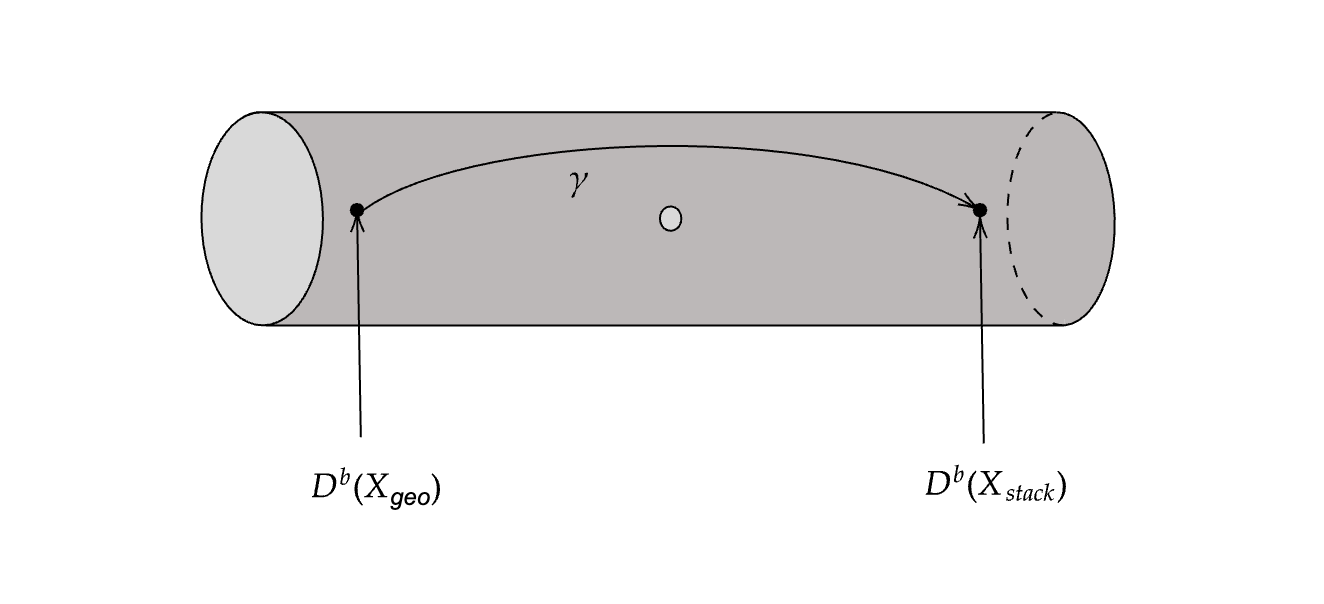
Figure 3: A depiction of π10 for the π11 singularity, with a path representing a window equivalence between derived categories at two GIT quotients.
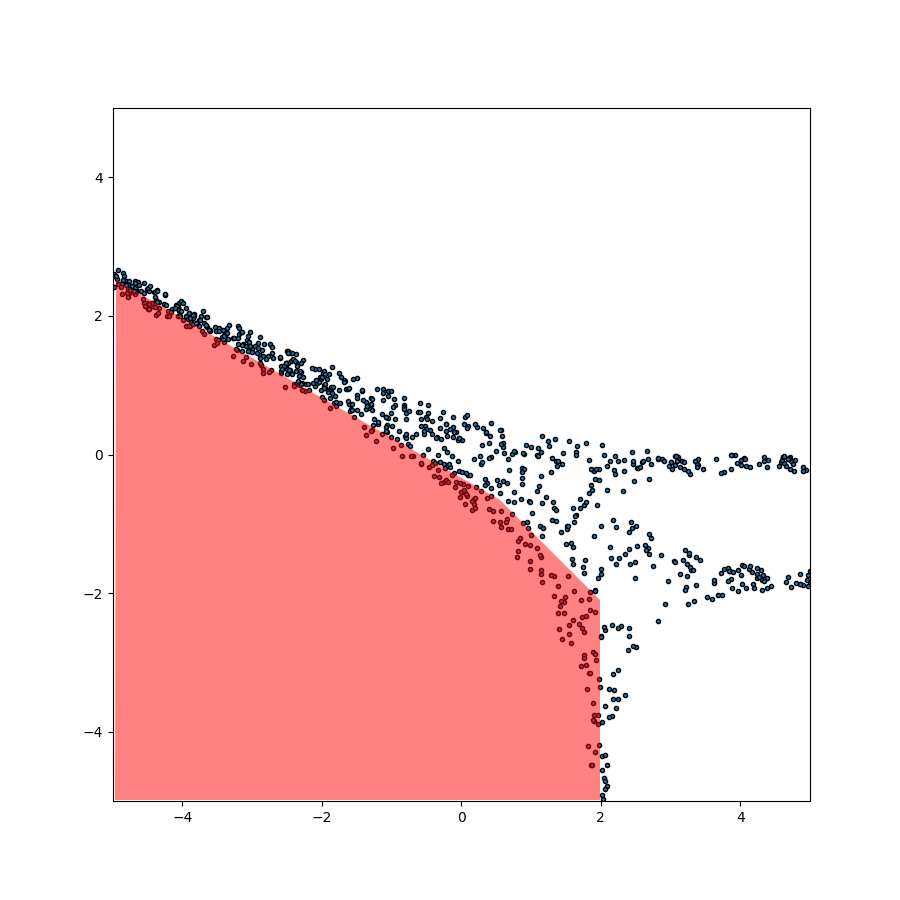
Figure 4: Tropicalization of a fiber of the open Gromov–Witten potential, with the red region approximating the moment polytope for π12.
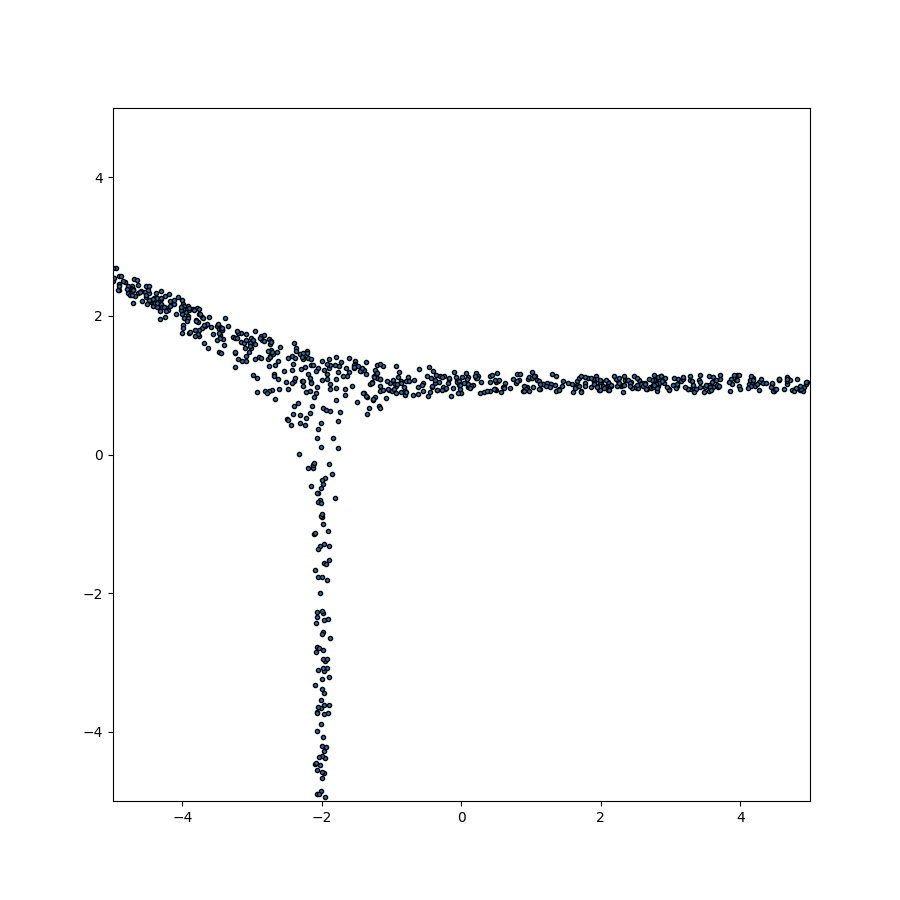
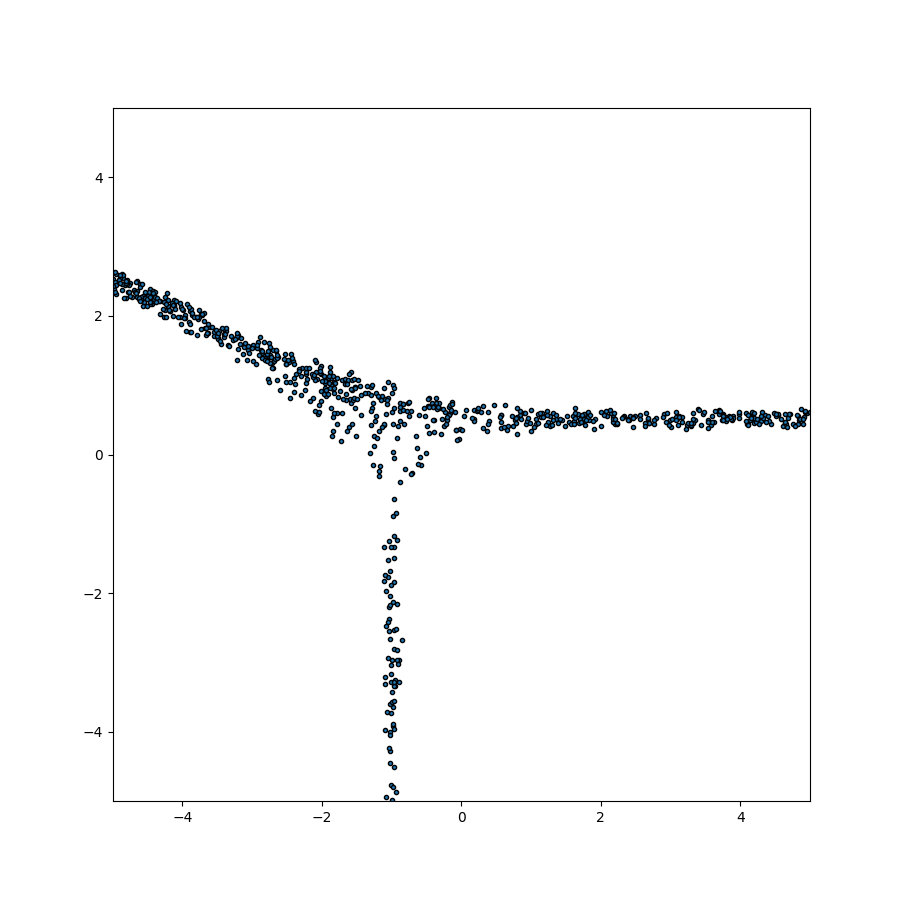
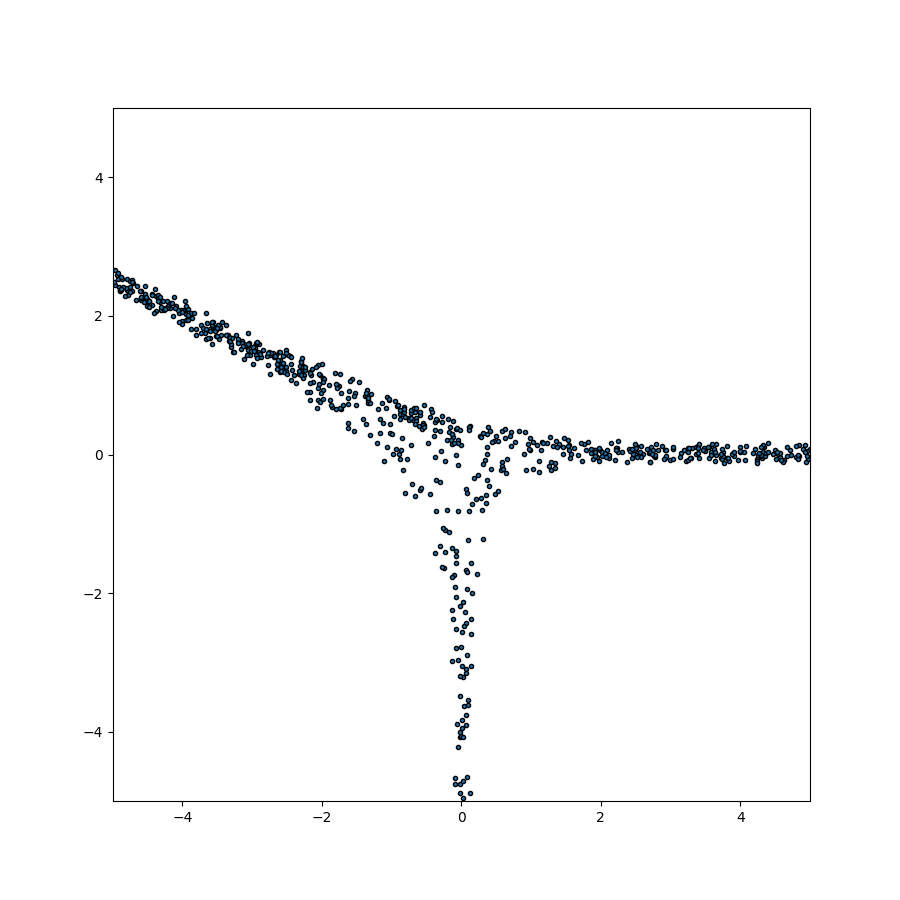
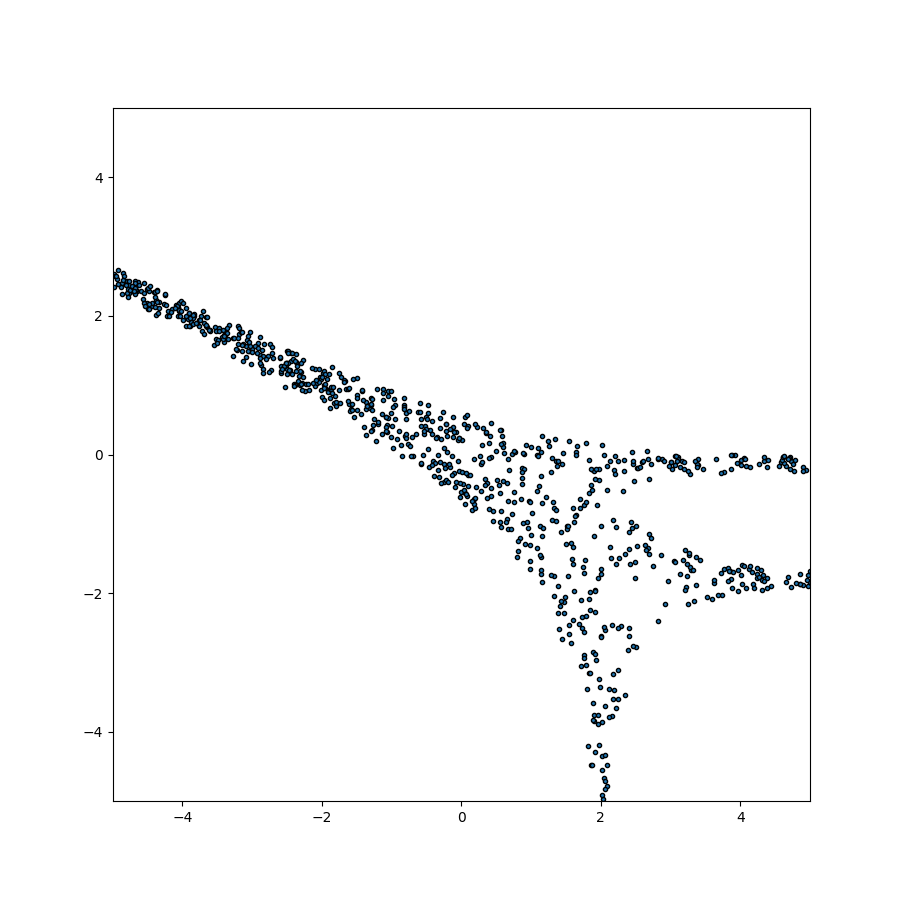
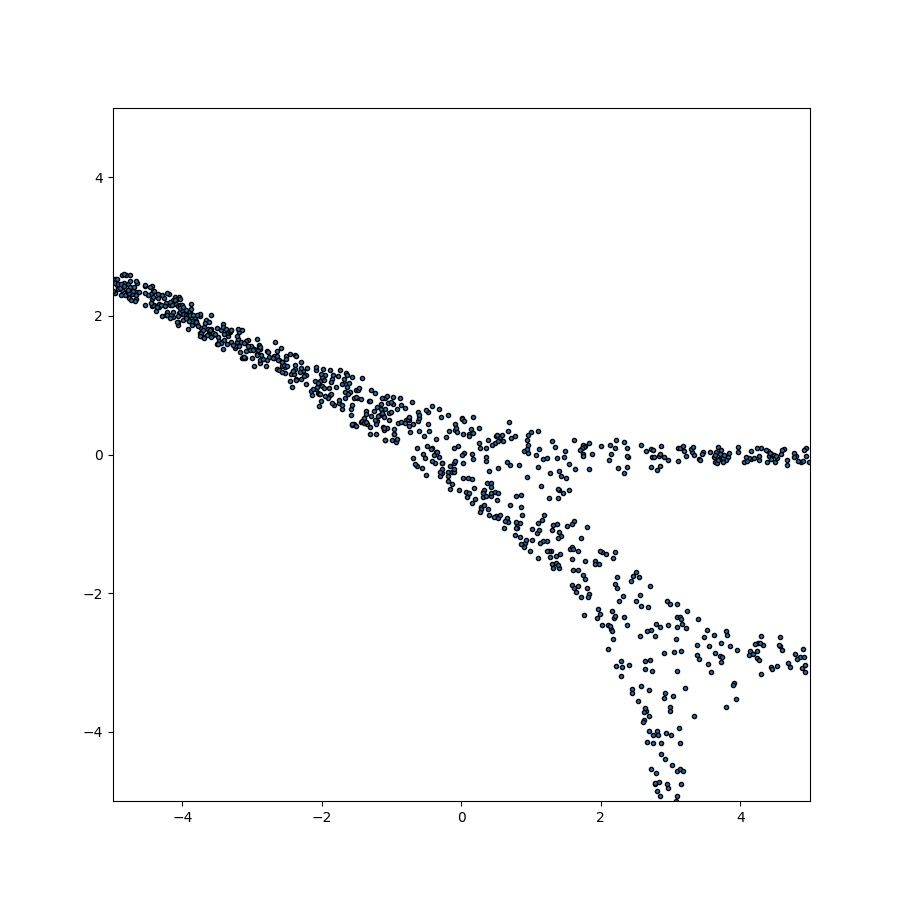
Figure 5: Variation of the tropicalization, where real parameter space for π13 tracks the VGIT parameter space, corresponding to GIT wall-crossing on the π14-side.
Additionally, the Legendrian moduli formalism makes precise predictions about relations between derived categories of different toric (and stacky) quotients corresponding to partial resolutions and ties their autoequivalence groups to partitioned (colored) braid groups.
Extension to Stacks and General Toric Varieties
A technical appendix generalizes the Floer-theoretic approach to HMS for semiprojective toric Deligne-Mumford stacks over arbitrary fields. It constructs the equivalence between π15 of the stack and the partially wrapped Fukaya category stopped at the FLTZ skeleton, utilizing explicit Morse theory models for tropical Lagrangian sections, even in the stacky setting.
This opens a direct path for further generalization: although the combinatorics and geometric models become more complex in higher dimensions or for stacks with more intricate inertia, the Legendrian-stop moduli formalism remains applicable.
Implications and Future Developments
The formalism outlined provides a transparent topological and combinatorial model for monodromy and autoequivalence symmetries in toric mirror symmetry, connecting deep symplectic and algebraic phenomena via accessible geometric models. Practically, it allows one to calculate autoequivalences and their categorical effects in concrete terms, with potential applications to:
- Stability condition spaces and their relation to stop moduli,
- Perverse schober constructions (categorified local systems over discriminant loci),
- Quantum and enumerative calculations, where monodromy plays a role in wall-crossing and degeneration formulas,
- Generalizations to higher dimensions and singularities beyond the toric context.
Open conjectures raised—such as the proposed equivalence between the configuration space and the moduli of Legendrian stops—point towards deeper relations between combinatorial moduli spaces and derived categorical symmetries, likely extending to much broader classes of mirrors and beyond toric settings.
Conclusion
By constructing and analyzing moduli spaces of Legendrian stops, this work provides a powerful and explicit framework for understanding and realizing the monodromy action on derived categories in toric mirror symmetry. The explicit link to configuration spaces and braid groups, together with compatibility with established HMS results, position this model as a foundational tool for future investigations of symmetries and autoequivalences in both symplectic and algebraic geometry.