- The paper demonstrates that Ehrhart polynomial invariants determine whether contact topological structures are rigid or flexible based on toric diagram properties.
- It employs combinatorial methods, including pseudo-bipyramids and rooted 3-cacti, to classify and enumerate toric diagrams with identical contact invariants.
- The study highlights rigid cases such as small cross-polytopes and primitive prequantizations, linking the divisibility of the first Chern class to unique manifold determination.
Introduction and Mathematical Context
This paper presents a comprehensive study of the interplay between contact topological invariants and discrete-geometric properties of toric diagrams associated with Gorenstein toric contact manifolds. Gorenstein toric contact manifolds—good toric contact manifolds with vanishing first Chern class—are uniquely determined by their associated integral simplicial polytopes called toric diagrams. The core combinatorial data is encoded via the Ehrhart polynomial of these polytopes, which, in turn, governs the contact Betti numbers of the manifold, i.e., the dimensions of cylindrical contact homology in each degree, yielding a bridge between symplectic/contact topology and Ehrhart theory.
The central question addressed is the extent to which these contact invariants—or, equivalently, the Ehrhart polynomial—rigidly determine the underlying Gorenstein toric contact manifold, i.e., whether two distinct toric diagrams can yield the same contact invariants (flexibility) or whether the invariants uniquely specify the manifold (rigidity). The study is further motivated by the context of prequantizations of monotone toric symplectic manifolds and iterated S2-bundles (Bott manifolds), as their structure yields rich combinatorial frameworks for the investigation.
A Gorenstein toric contact manifold (N2n+1,ξ) is characterized by the existence of a good toric symplectic cone with zero first Chern class. There is a bijective correspondence between such manifolds and integral simplicial polytopes with unimodular facets (toric diagrams), up to an action by GL(n,Z) and translation.
The Ehrhart polynomial LD(t) of a toric diagram D,
LD(t)=#(tD∩Zn),t∈Z>0,
is a degree n polynomial whose coefficients, written in the h∗-basis
LD(t)=k=0∑nhk∗(D)(nt+n−k),
are complete contact invariants, as established in prior work [AMM]. Specifically, the increments of successive h∗-coefficients yield the contact Betti numbers, which, for toric manifolds, vanish outside even degrees.
Flexibility Phenomena: Families with Non-Rigid Invariants
Prequantizations of Monotone Bott Manifolds
The work demonstrates that flexibility—the failure of rigidity—is prevalent. In the family of prequantizations of monotone Bott manifolds (iterated (N2n+1,ξ)0-bundles with monotone toric symplectic forms), all manifolds share the same (N2n+1,ξ)1-polynomial as the cross-polytope, i.e.,
(N2n+1,ξ)2
This gives rise to exponential flexibility: in dimension (N2n+1,ξ)3, there exist exponentially many unimodular equivalence classes of toric diagrams (enumerated by rooted (N2n+1,ξ)4-cacti) with identical contact invariants (see enumeration, Table 1 in the paper).
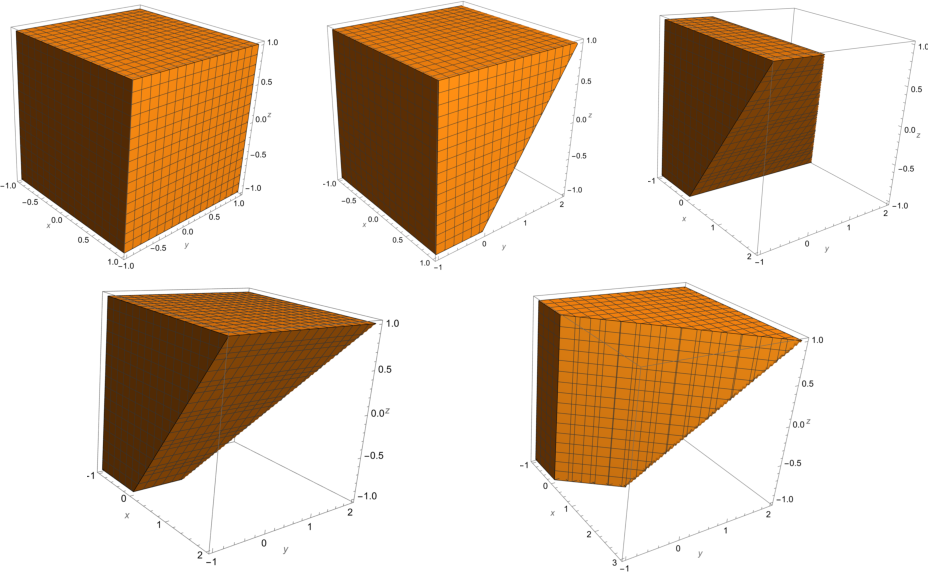
Figure 2: Moment polytopes for the five monotone Bott 6-manifolds, visualizing the combinatorial diversity underlying Ehrhart-equivalent diagrams.
Characterizing these families, the paper develops an inductive combinatorial framework utilizing pseudo-bipyramid constructions over lower-dimensional diagrams, tightly connected to the rooted (N2n+1,ξ)5-cactus bijection. The results establish that for (N2n+1,ξ)6, monotone Bott manifold prequantizations are far from unique within the class of manifolds sharing their contact invariants.
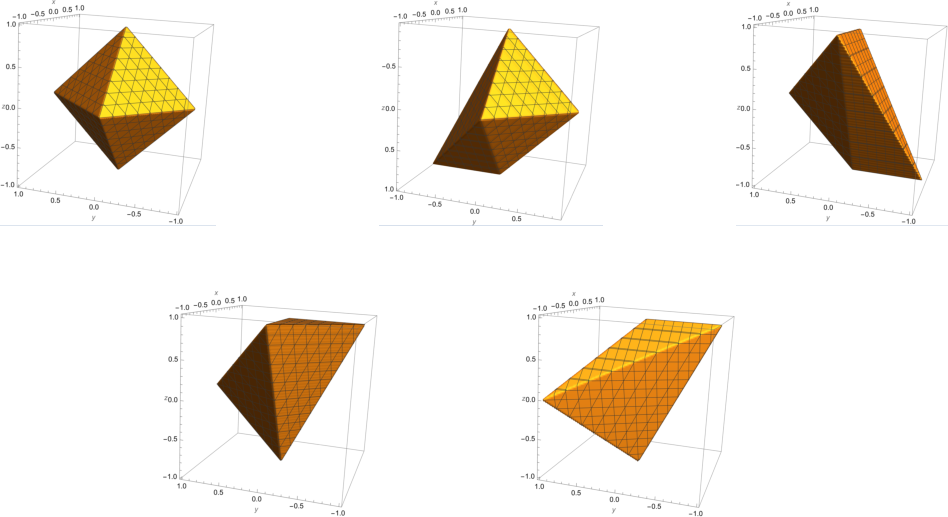
Figure 4: Toric diagrams for the prequantizations of all five monotone Bott 6-manifolds, illustrating the combinatorial variety leading to flexibility in contact invariants.
Explicit Structure and Enumeration
Through careful combinatorial analysis, the authors classify toric diagrams Ehrhart-equivalent to the cross-polytope by mapping the pseudo-bipyramid construction to rooted (N2n+1,ξ)7-cacti. The enumeration of these equivalence classes demonstrates rapid growth with dimension, and the explicit graphs provide a mechanism for calculation and tabulation to high dimensions, offering a concrete combinatorial model for contact flexibility.
Rigidity Results: Unique Determination from Invariants
The paper identifies significant rigid cases, where the contact Betti numbers (or equivalently, the (N2n+1,ξ)8-polynomial) uniquely determine the toric diagram up to unimodular equivalence.
Small Cross-Polytopes
A central rigidity theorem is established for the so-called small cross-polytope (N2n+1,ξ)9, arising as the toric diagram of the prequantization of GL(n,Z)0 with symplectic form proportional to half its first Chern class. The GL(n,Z)1-polynomial is
GL(n,Z)2
for GL(n,Z)3 and zero otherwise. Unlike the standard cross-polytope, GL(n,Z)4 is shown to be Ehrhart-determined: any toric diagram with these invariants is unimodularly equivalent to GL(n,Z)5.
(Figure 2)
Figure 5: Small cross-polytope in dimension 3, representing the unique rigid case in the family of cross-polytope-like diagrams.
The proof interweaves combinatorial and geometric arguments using face-structure, barycentric relations, and symmetries. Notably, this combinatorics underlies the unique determination of the corresponding toric contact structure, contrasting with the flexible cross-polytope case.
Primitive Prequantizations over Projective Bundles
Another family of rigid cases corresponds to primitive prequantizations of monotone GL(n,Z)6-bundles over GL(n,Z)7, where the first Chern class is even. Here, the associated GL(n,Z)8-polynomial becomes
GL(n,Z)9
It is shown via explicit affine dependencies and combinatorial polytope classification that each distinct value of the Chern class parameter corresponds to a unique unimodular equivalence class of toric diagrams, and thus to a unique toric contact manifold with those invariants.
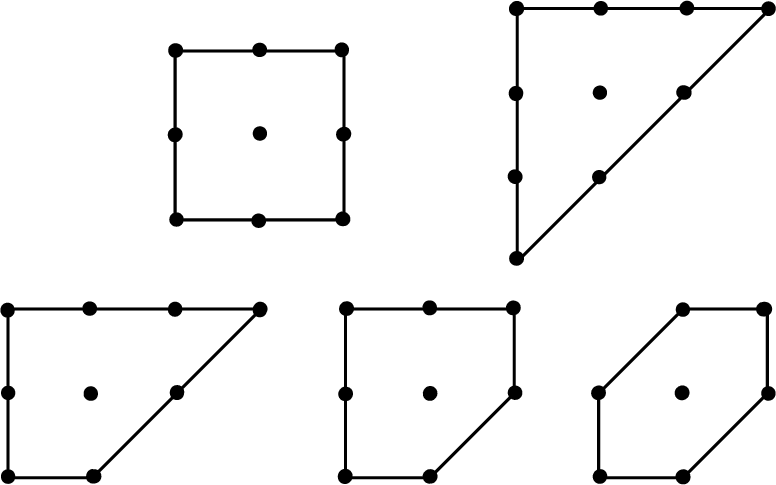
Figure 6: Moment polytopes for various monotone toric symplectic 4-manifolds, including primitive cases displaying rigidity.
Ehrhart Theory, Prequantization, and Polytope Combinatorics
An important technical contribution is the generalization of the prequantization construction and its impact on Ehrhart theory. By investigating polytopes for which division by a positive integer yields an integral polytope, the authors characterize how the LD(t)0-polynomial transforms under prequantization, applying these results to Gorenstein index shifting and the combinatorics of bipyramids and pseudo-bipyramids.
This combinatorial machinery underpins the explicit classification of diagrams occurring in both rigid and flexible regimes and elucidates the algebraic and discrete-geometric structures governing rigidity phenomena.
Implications and Future Directions
The paper’s results establish a nuanced dichotomy in the landscape of Gorenstein toric contact manifolds: flexibility is generically ubiquitous except in the presence of particularly structured combinatorial symmetries, such as in small cross-polytopes and primitive prequantizations with divisible LD(t)1. The enumeration results suggest that rigid contact invariants are rare and special in high dimension, while flexibility is typical.
The rigid examples constructed all stem from prequantizations where the minimal Chern number exceeds one—highlighting a deep interaction between the algebraic divisibility of LD(t)2 and the combinatorics of lattice polytopes. This leads naturally to the open question of whether rigid Gorenstein toric contact manifolds can arise when the minimal Chern number is one.
For symplectic topologists and combinatorial geometers, the results direct attention both to the further classification of Ehrhart-equivalent polytopes in more general settings and to the possible extension of rigidity phenomena beyond the toric or Gorenstein setting. Connections to mirror symmetry, stringy invariants, and symplectic fillings are anticipated, particularly given the combinatorial encoding of topological data via polytopes. The paper also invites further examination of the distribution of Ehrhart roots and their topological implications, as conjectured relationships between the real parts of such roots and manifold properties become more rigorously understood.
Conclusion
This work presents a rigorous and comprehensive analysis of the relationship between discrete-geometric polytope invariants and contact topology in the toric Gorenstein setting. It establishes clear criteria for flexibility and rigidity, providing both explicit construction methods and classification results. The connection between the combinatorics of rooted LD(t)3-cacti and contact topology unveils deep symmetries and enumeration patterns, fundamentally linking contact invariants, polytope Ehrhart theory, and symplectic constructions. Through its blend of polyhedral and topological methods, the paper marks a significant advance in the understanding of contact rigidity phenomena in higher dimensions.

