- The paper provides an algorithmic criterion using signed multiplicities from Newton polygons to detect essential tori in link complements of mixed singularities.
- It establishes explicit conditions that obstruct hyperbolicity by linking combinatorial data with geometric topology.
- The approach bridges analytic data from mixed polynomials and topological invariants, offering practical tools for classifying link exteriors.
Essential Tori in the Complements of Links of Mixed Singularities
Introduction and Context
This paper investigates a direct correspondence between the analytic structure of certain real mixed polynomials in two variables and the topology of links arising as the intersection of their vanishing set with small 3-spheres. Specifically, it establishes explicit, algebraically computable conditions for the presence of essential tori in the link complement, leveraging Newton polygon invariants associated with convenient, non-degenerate, and Γ-nice mixed polynomials. These algebraically defined criteria provide direct obstructions to hyperbolicity of the associated link complements.
Classically, in the context of complex surface singularities, links are iterated cables of torus links, and always non-hyperbolic. However, weakly isolated real singularities admit links of arbitrary topological type, including hyperbolic ones. This work focuses on the rich landscape of links associated to real mixed polynomials, where detecting non-hyperbolicity and essential tori is non-trivial and not reducible to the complex case. The results establish a bridge from the combinatorics of Newton polyhedra to the geometric topology of link complements.
Analytic–Topological Correspondence: Statement of Main Results
Let f be a convenient, non-degenerate, Γ-nice mixed polynomial f:C2→C. The Newton boundary Γ(f) decomposes into N compact 1-faces, each corresponding to a component Li of the link. These Li are organized inside a sequence of nested solid tori V1⊂V2⊂⋯⊂VN−1 which produce separating tori ∂Vi.
The main algorithmic result is the following effective criterion, stated in terms of the signed multiplicities of distinguished face functions f0 and f1:
f3
then f4 is an essential torus in the link exterior and the link is not hyperbolic.
More generally, the paper provides recursive criteria based on differences of signed multiplicities around various vertices in the Newton boundary, which handle more complicated cases, including links with multiple nonempty sublinks and varying winding patterns.
Numerical evaluation of these linking numbers is accomplished via the algebraic data of Newton polygons and face polynomials; see Section~\ref{sec:results} for the explicit formulas and combinatorial recipes.
Topological and Geometric Structure
A torus f5 is essential if it is incompressible and not boundary-parallel in the link exterior. The existence of such tori is equivalent to the link being a satellite or, more generally, non-hyperbolic. The paper rigorously characterizes when the canonical decomposition tori f6 arising from the Newton boundary construction are essential, via winding and wrapping numbers computable from the mixed polynomial structure.
The structure of the link complement and the essentiality of f7 is completely determined by winding numbers f8 and f9 of the components Γ0 in their respective tori. These are, in turn, calculated as signed multiplicity differences evaluated at Γ1 of 1-variable mixed polynomials derived from the Newton boundary vertices:
Γ2
Γ3
The precise essentiality conditions for all nested tori are expressed in Theorem~\ref{th:char_essentialtori}, distinguishing all boundary cases and accommodating arbitrary numbers of sublinks.
Computability and Connections to Newton Data
A key technical innovation of the paper is the explicit link between computations involving winding numbers (topological intersection data) and combinatorial data extracted from the Newton polyhedron. Signed multiplicities are determined by analyzing mixed univariate polynomials associated to the edges and vertices of the Newton polygon. Homogeneity and bi-degree considerations, together with Oka’s intersection theory for mixed polynomials, allow for direct calculation of multiplicities with sign, even in the presence of non-trivial neutral roots, as detailed in Lemma~\ref{multhomog}.
In semiholomorphic cases (i.e., the monomial supports restrict to single complex variables or their conjugates), the signed multiplicity is simply the degree in that variable, simplifying calculations for many geometrically relevant examples.
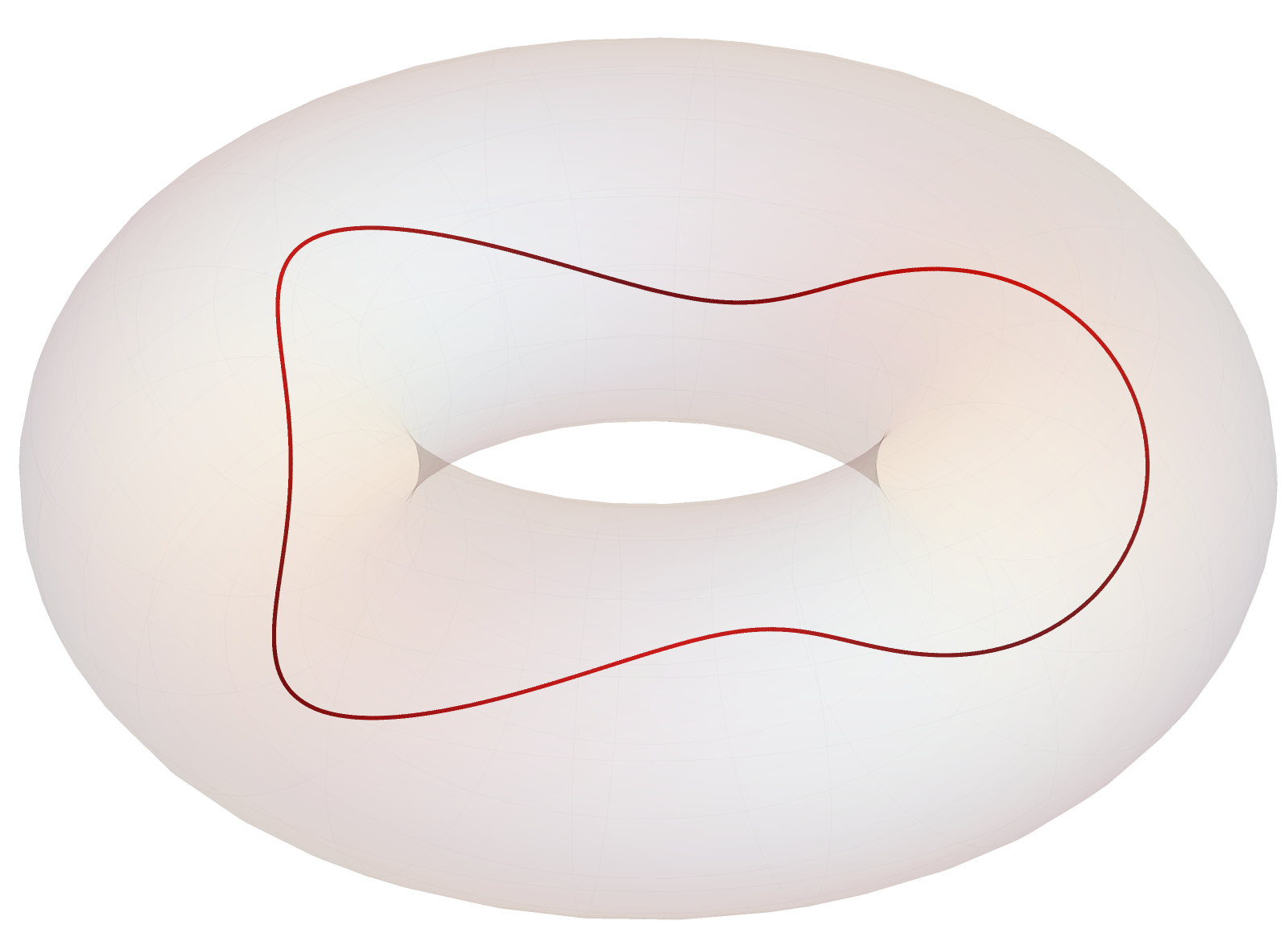
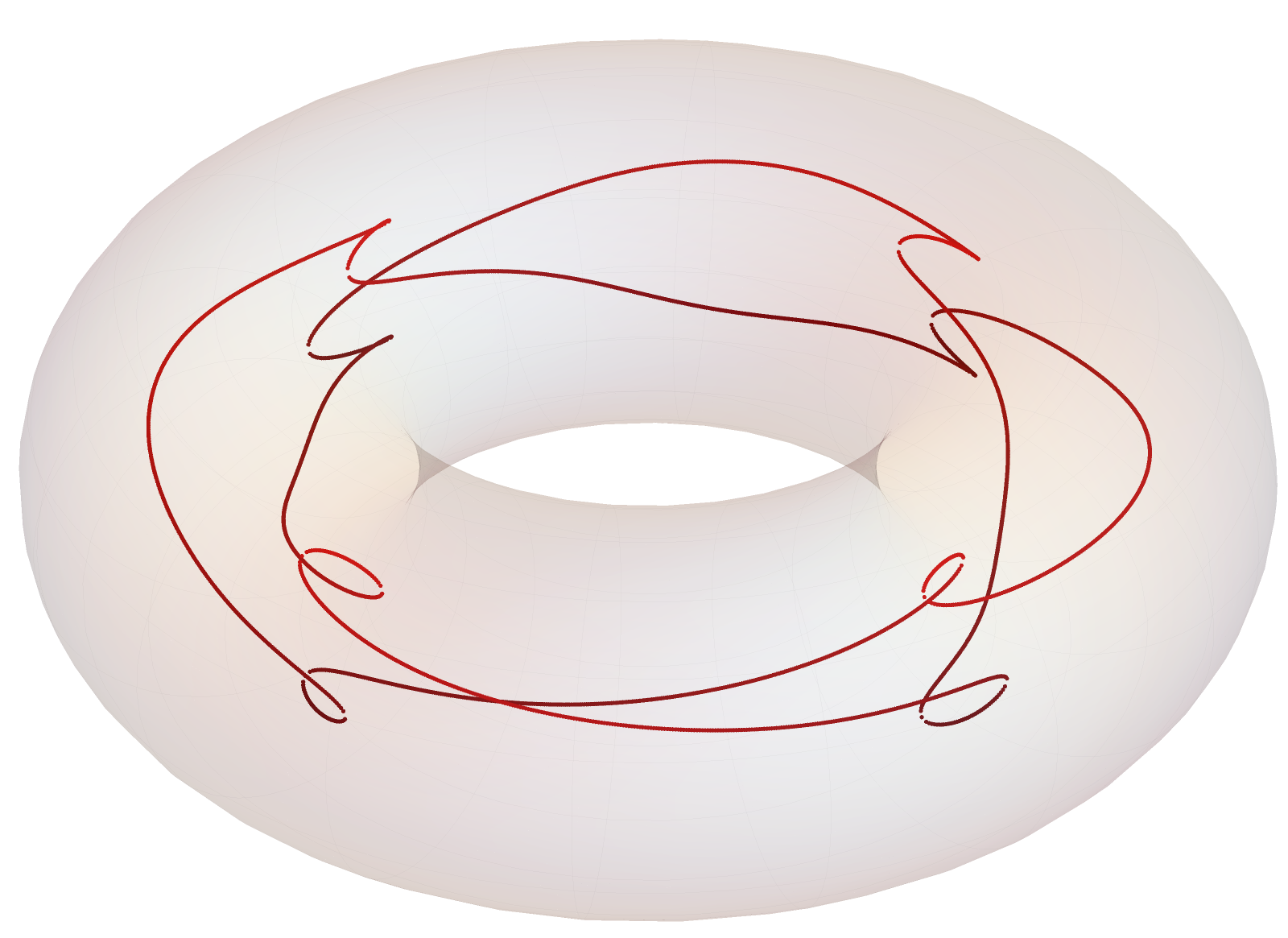
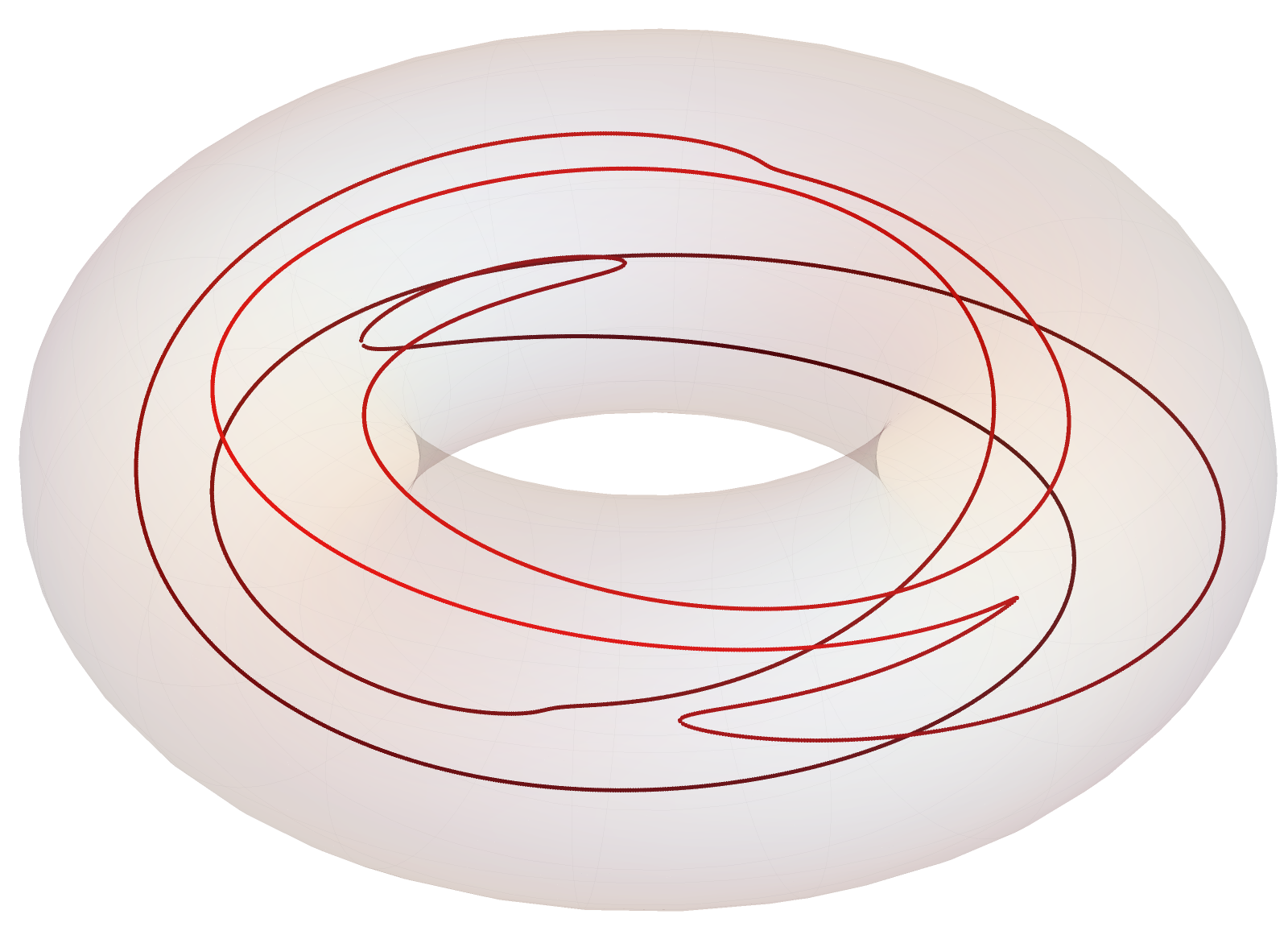
Figure 1: Decomposition of a link arising from a mixed polynomial into its sublinks Γ4 inside nested solid tori.
Illustrative Examples
The paper contains a sequence of worked examples that demonstrate the sharpness and necessity of the various combinatorial criteria. These include situations where the faster criterion is not sufficient, but the refined general criterion guarantees the existence of an essential torus. Specifically, Example~\ref{ex:ex2} displays a case where only the more general difference conditions detect the topological feature. The approach also recovers known properties for links associated to pure complex polynomials as a degenerate case.
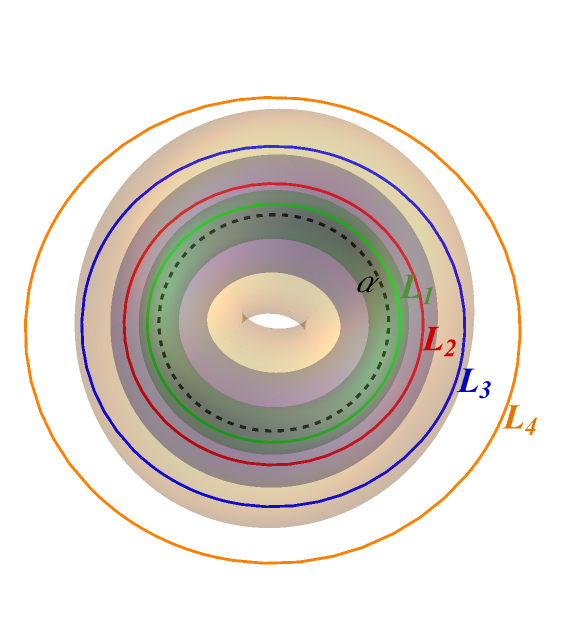
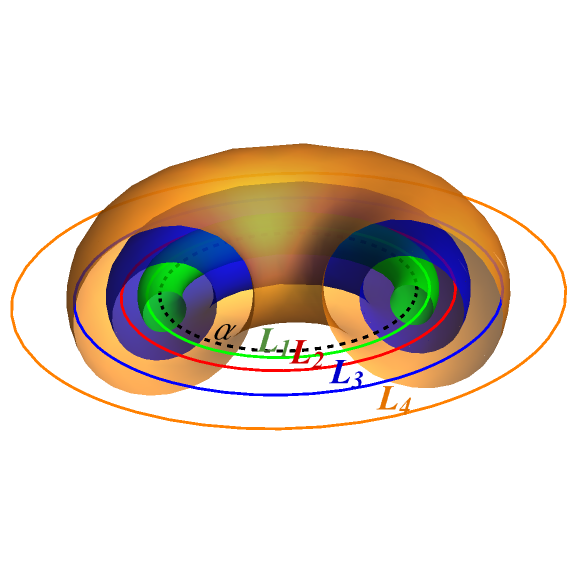
Figure 2: Nested solid tori Γ5 with sublinks Γ6, demonstrating the explicit topological decomposition underlying the Newton polygon calculation.
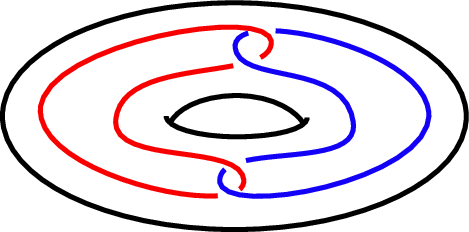
Figure 3: Whitehead link in a solid torus, exhibiting the non-additivity of wrapping number in arbitrary cases.
Practical and Theoretical Implications
On the practical side, the results provide explicit, algorithmic obstructions to hyperbolicity that can be verified for links of real singularities defined by general mixed polynomials without requiring an explicit topological classification. Thus, these criteria are applicable to algorithmic studies and databases of singularity links, as well as in the systematic investigation of which 3-manifolds occur as link complements of real polynomial singularities.
Theoretically, these theorems establish a concrete realization of the principle that fine analytic/algebraic data (here: Newton polyhedra and supporting face polynomials) controls and detects subtle features of 3-manifold topology. The presence of essential tori detected via this method implies strong restrictions on the geometric decomposition of the link exterior—participants in the JSJ decomposition—highlighting the deep interaction between singularity theory, low-dimensional topology, and real algebraic geometry.
Outlook and Future Directions
Potential future developments include:
- Generalizing the Newton polygon approach to non-isolated and higher-dimensional singularities, potentially connecting with further aspects of the singularity link statistics for real polynomials.
- Systematic enumeration of possible link types and satellite structures realized by families of mixed singularities.
- Extension of the criteria to other types of essential embedded surfaces (e.g., essential spheres, annuli) and their detection via analytic invariants.
- Exploration of the implications for the study of link invariants (e.g., Alexander polynomials, signature, Floer-theoretic invariants) within the class of links determined by mixed polynomials.
- Integration into computational tools for singularity and knot data classification.
Conclusion
This work provides a direct and algebraically transparent method for detecting essential tori and hence non-hyperbolic structure in the exteriors of links of weakly isolated mixed singularities, in terms of Newton polygon and mixed polynomial data. By solving for winding numbers as signed multiplicities at Newton vertices, the authors offer canonical, computable, and theoretically robust obstructions to hyperbolicity, which avoid the necessity for explicit topological type computations. This approach not only enhances practical capabilities in the topological study of mixed singularities but also deepens the theoretical understanding of the interaction between analytic and topological structures in real algebraic geometry.
[See (2604.25517)] for full details and proofs.