Invariants of Legendrian knots in thickened convex surfaces
Published 23 Apr 2026 in math.SG and math.GT | (2604.22053v1)
Abstract: We define a differential graded algebra associated to Legendrian knots in thickened convex surfaces $Σ\times \mathbb{R}$. The algebra is defined in the same spirit as the Chekanov-Eliashberg DGA for Legendrians in $\mathbb{R}3$, but makes use of the data of the dividing set $Γ$ of $Σ$. The algebra is generated by countably many Reeb chords of the Legendrian $Λ$, and its differential counts certain immersed polygons in the projection $π:Σ\times \mathbb{R}\to Σ\times {0}$ with boundary on $π(Λ)\cup Γ$. We show that the differential squares to zero and that the stable tame isomorphism type of the DGA is invariant under Legendrian isotopy. Finally, we compute several examples and use the invariant to distinguish Legendrian knots in thickened convex surfaces that cannot be distinguished by the classical invariants.
The paper introduces a differential graded algebra (DGA) that extends Chekanov-Eliashberg invariants to thickened convex surfaces.
It employs combinatorial polygon counts and adapted Maslov-type gradings to encode Reeb chord data and contact topology features.
It distinguishes Legendrian knots with identical classical invariants, enabling algorithmic computation in complex contact manifolds.
Invariants of Legendrian Knots in Thickened Convex Surfaces
Introduction and Motivation
The paper "Invariants of Legendrian knots in thickened convex surfaces" (2604.22053) formulates a differential graded algebra (DGA) for Legendrian knots Λ embedded in the contact 3-manifold (Σ×R,ξΓ), where Σ is a closed orientable surface equipped with a convex structure. The construction extends the combinatorial Chekanov-Eliashberg DGA in (R3,ξstd) and adapts the algebraic formalism to settings where the topology of the base surface and its dividing set Γ play an essential role.
The context is that convex surface theory, particularly Giroux’s theory, enables decomposition of (Σ,Γ) into regions Σ±, separated by the dividing set Γ, which then governs the interaction of Legendrian knot projections with the ambient contact structure. This geometry appears in natural generalizations of contact topology, with practical relevance for the study of higher-genus surfaces, open books, and links in more general contact 3-manifolds.
The main algebraic object associated to a Legendrian knot Λ⊂Σ×R is a countably generated, semi-free DGA A, whose stable tame isomorphism class is a Legendrian isotopy invariant. The generators of (Σ×R,ξΓ)0 are in bijection with Reeb chords of (Σ×R,ξΓ)1, distinguished as double points in the projection(Σ×R,ξΓ)2 to (Σ×R,ξΓ)3 (away from (Σ×R,ξΓ)4) and as (possibly self-intersecting) arcs contained in or intersecting the dividing set (Σ×R,ξΓ)5.
The differential is defined combinatorially: for generators corresponding to double points in (Σ×R,ξΓ)6, the differential counts rigid, immersed polygons in (Σ×R,ξΓ)7 with prescribed boundary corners at the generators under consideration. For generators associated to chords along (Σ×R,ξΓ)8, the differential combines algebraic splitting and counts of immersed polygons with sides on both (Σ×R,ξΓ)9 and Σ0.
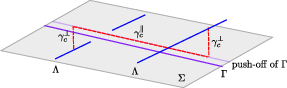
(Figure 1)
Figure 1: Height of a Reeb chord along Σ1 as a function of projection data and contact form, illustrating the geometric input to the DGA differential.
The grading is a Maslov-type index defined relative to capping surfaces constructed via a Seifert resolution procedure on capping paths in Σ2, naturally reflecting the genus and nontrivial topology of Σ3. These gradings are integer-valued when Σ4, and coincide with standard gradings in the classical setting.
Well-Definedness and Invariance of the DGA
The main technical theorems established in the work are:
Σ5: The differential squares to zero, proved via combinatorial "broken-heart" arguments reminiscent of those used in the standard Chekanov-Eliashberg setting, associating moduli spaces of polygons to boundary strata in one-dimensional families.
Legendrian Isotopy Invariance: The stable tame isomorphism type of the DGA is invariant under Legendrian isotopy, employing an appropriate generalization of the Reidemeister moves (including moves involving the dividing set Σ6 and its relation with Σ7) for diagrams on convex surfaces.
These foundations confirm the invariant encodes strictly more data than the classical invariants such as Thurston-Bennequin or rotation number.
Computational Examples and Separation of Legendrians
The paper includes explicit computations for Legendrian unknots and Chekanov's 5Σ8 knots in thickened convex surfaces of genus Σ9. Notably, the algebra can distinguish pairs of null-homologous, but not null-homotopic, Legendrian knots with identical classical invariants (e.g., (R3,ξstd)0 and (R3,ξstd)1), establishing the strong separation power of the invariant.
(Figure 2)
Figure 2: Two Legendrian knots (R3,ξstd)2 and (R3,ξstd)3 in a genus-2 surface with the same classical invariants, which are distinguished by their DGAs.
These computations rely on the ability to combinatorially enumerate holomorphic polygons or, equivalently, immersed regions in the Lagrangian projection, and to analyze the resulting differentials and augmentations.
Relation to Symplectic Field Theory and Existing Contact Homology Frameworks
The construction is a quotient-type or bilinearized variant of the symplectic field theory (SFT) DGA, as outlined by Eliashberg-Givental-Hofer [egh2000SFT], adapted specifically for hypertight (R3,ξstd)4 by discarding contributions from contractible Reeb orbits (which are absent by hypertightness). When the projection of (R3,ξstd)5 is disjoint from (R3,ξstd)6, the construction specializes to known invariants on exact symplectic manifolds [ekholm2007PxR]. For projections intersecting (R3,ξstd)7, the development generalizes bordered and sutured approaches [sivek2011bordered], accommodating immersed Lagrangian fillings and infinite generators along (R3,ξstd)8.
Figures and Their Roles
Figure 3: Height function for a Reeb chord along (R3,ξstd)9, critical for combinatorial area and grading calculations.
Throughout the narrative, figures such as Figure 3 provide geometric and calculational intuition for the analytic constraints entering polygon counts, as heights and areas directly bound possible contributions to differentials.
Theoretical and Practical Implications
Theoretical Implications: This paper provides a robust combinatorial model for Legendrian invariants in a highly general class of contact manifolds, integrating the divisor data of convex surface theory with the SFT perspective. The formalism supports potential extensions to arbitrary open books and higher-dimensional cases where dividing sets and convexity play central roles.
Practical Implications: The combinatorial nature of the invariant opens the way for algorithmic computation of Legendrian invariants in settings beyond Γ0, facilitating classification problems, tabulation of knots in general 3-manifolds, and machine-assisted discovery of exotic Legendrian phenomena in high-genus ambient spaces.
Future Directions
A promising route is to extend this construction to Legendrian links in general open books or sutured manifolds, possibly merging with the functorial LCH approaches for Lagrangian cobordisms [pan2021functorial], or to generalize to higher-dimensional contactizations where convex hypersurfaces and dividing sets naturally arise. Further, deepening connections with the "bordered" framework and categorified knot invariants may yield rich new structural results in symplectic and contact topology.
Conclusion
This work develops a combinatorial DGA for Legendrian knots in thickened convex surfaces, extending the Chekanov-Eliashberg mechanism to settings dictated by convexity and dividing sets. The resulting invariant is computable, isotopy-invariant, distinguishes knots indistinguishable by classical invariants, and offers an overview of SFT and combinatorial contact topology for general base surfaces. Its implications span both theoretical insight and practical computation, with substantial potential for further developments in Legendrian and symplectic knot theory.
(Figure 1)
Figure 1: Height of a Reeb chord along Γ1 measuring the Γ2-coordinate difference used in area and differential calculations.