Cognition Spaces: Natural, Artificial & Hybrid
Script
Is a single cell capable of thinking? Does a swarm of robots possess a mind? These questions often fail because our definitions of cognition are strictly tied to human brains. This paper introduces a new cartography for the mind, mapping cognition across natural, artificial, and hybrid systems.
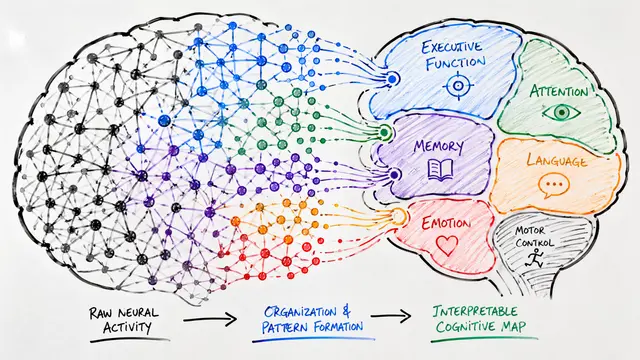
To solve the definition problem, the researchers propose moving away from biology-centric views. They introduce 'Cognition Spaces'—multidimensional maps where any system, from a slime mold to a Large Language Model, can be plotted based on its functional capacity rather than its physical material.
The authors categorize complexity into three specific spaces. First is the Basal space, where neuron-free organisms store memory in their physical structure. Second is the Neural space for brains and robots, and third is the Hybrid space, where human and machine cognition merge.
However, the drivers of these systems differ radically. While basal systems use their physical bodies to compute and survive, artificial systems exhibit an 'Agency Gap'—they process sophisticated information but lack the fundamental biological drive for self-preservation.
Mapping these spaces reveals vast 'voids'—regions of potential cognition that biology cannot reach on its own. The paper suggests that human-AI hybrids act as new evolutionary units capable of crossing these voids, allowing information to evolve at speeds that outpace biological constraints.
By treating cognition as a mappable space rather than a biological privilege, we can better understand the strange, hybrid minds of our future. For more insights on this research, visit EmergentMind.com.