AI Must Embrace Specialization via Superhuman Adaptable Intelligence
This presentation challenges the dominant paradigm of artificial general intelligence by exposing the anthropocentric fallacy at its core. It argues that human intelligence is not truly general but narrowly specialized for survival-critical tasks, and proposes Superhuman Adaptable Intelligence (SAI) as a superior North Star for AI research. SAI reframes progress around the speed of adaptation and skill acquisition across utility-driven tasks, rather than imitating human versatility or chasing universal competence.Script
The entire AI field has been chasing the wrong goal. We measure progress by how well machines mimic human versatility, but this paper reveals a fundamental flaw: humans aren't actually general learners at all.
The authors expose how evolutionary pressures sculpted human cognition for a tiny slice of possible problems. Our brains excel at social reasoning and language but struggle with tasks outside our ancestral niche. Defining artificial general intelligence by human standards is like judging fish by their ability to climb trees.
So if human-centric definitions fail, what should guide AI research?
This work introduces Superhuman Adaptable Intelligence, or SAI, which measures progress by how quickly systems acquire new skills rather than how well they imitate humans. The shift is profound: instead of asking whether AI can replicate our narrow evolutionary toolkit, SAI asks how fast it can master tasks we care about—including domains where humans systematically fail.
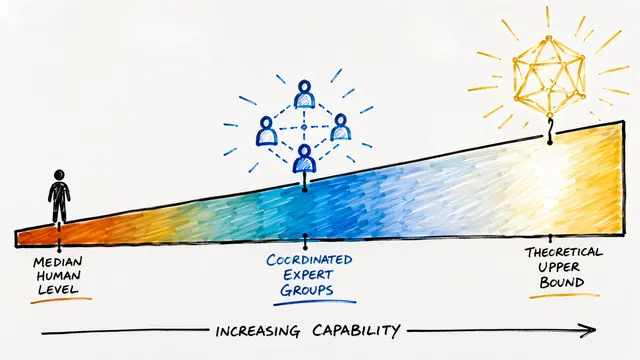
The theoretical case is ironclad. No Free Lunch theorems prove that maximizing performance requires strong domain-specific priors—jack-of-all-trades algorithms lose to focused specialists every time. Biology and economics reinforce this: selective pressure drives organisms and firms toward narrow optimization. In AI, breakthroughs like AlphaFold and modular expert systems validate specialization as the path to superhuman capability.
SAI offers a concrete research agenda. Prioritize self-supervised learning and world models that compress experience into adaptable representations. Design ecosystems of specialist modules rather than chasing universal monoliths. And critically, stop converging on a single autoregressive paradigm—architectural diversity is essential for exploring the full landscape of intelligence.
The North Star for AI shouldn't be a reflection of ourselves, but a measure of how quickly machines transcend our limits. Visit EmergentMind.com to explore more cutting-edge research and create your own AI presentation videos.