Graph-Transformer EEG Emotion Recognition
Script
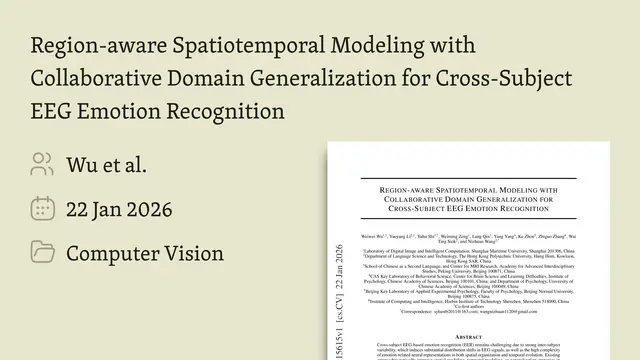
Imagine trying to navigate a complex city using a map that ignores neighborhoods and only shows a flat grid of streetlights. This is essentially how many deep learning models treat the brain—ignoring the rich, hierarchical structure of biological neural networks. The research in this paper, 'Learning from Brain Topography,' introduces a method that finally aligns AI architecture with the brain's actual 3D design to better recognize human emotions.
Current approaches face a fundamental mismatch: they treat the brain's electrodes as a flat 2D grid or independent tokens. However, the authors argue that the brain operates through functional segregation—processing data locally—and functional integration—communicating globally. Existing models miss these critical non-Euclidean 3D connections, limiting their ability to decode complex emotional states.
To bridge this gap, the researchers developed the Neuro-HGLN framework, which processes input through two simultaneous pathways. On the left, a Global Stream utilizes spatial priors to capture holistic, whole-brain dynamics. On the right, a Local Stream partitions the brain into anatomical regions, applying parallel processing to ensure fine-grained regional details aren't lost.
The model's sophistication lies in how it handles these streams. The authors employ a 'Dimension-as-Token' strategy within an iTransformer to model complex correlations between brain regions. Crucially, they introduce geometric constraints and diversity regularization into the loss function, forcing the AI to respect physical anatomy and preventing the learned graph structures from overfitting to noise.
This biologically grounded approach paid off in the experiments. The model achieved state-of-the-art results across four major benchmarks, including the difficult MPED dataset which requires distinguishing between 7 distinct emotions. Beyond raw accuracy, visualizations showed that the model successfully isolated distinct regions like the Prefrontal cortex, proving it was actually learning from the brain's topography.
By acknowledging that the brain is a hierarchy of local neighborhoods and global networks, this work moves us closer to AI that truly understands human emotion. For more on the intersection of neuroscience and deep learning, head over to EmergentMind.com.