Cognition as Remapping and Navigation
An overview of the paper "Remapping and navigation of an embedding space via error minimization," which proposes a unified framework for intelligence in biological and artificial systems.Script
How does a single cell know how to build a body without a brain? And how is that process similar to a generative AI refining an image from static noise? The authors of this paper argue that these seemingly different systems share a single, fundamental organizational principle.
To answer these questions, the researchers confront a major limitation in behavioral science: the focus on animals with brains. They propose a substrate-independent framework called Diverse Intelligence, which seeks to explain problem-solving in everything from simple gene networks to complex artificial agents.
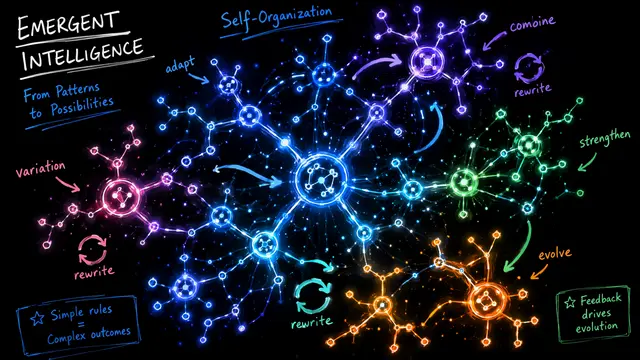
At the core of this framework is the Dual Invariant Principle, which splits cognition into two inseparable processes. First, an agent actively constructs and reshapes an internal map of its world, known as remapping. Second, it navigates this space by constantly minimizing the error between its current state and its goal.
In the biological world, this navigation happens in spaces we cannot see with the naked eye. For instance, planaria flatworms navigate transcriptional space by altering gene expression to survive novel stress, while salamanders navigate anatomical space to regenerate lost limbs by correcting deviations in their physical shape.
This principle of iterative error correction extends directly to modern artificial intelligence. The paper highlights how diffusion models generate images by navigating from high-entropy noise to structured data, mirroring the way biological systems navigate developmental pathways to form complex bodies.
The key takeaway is that intelligence, whether in a petri dish or a server farm, is defined by the ability to map a problem space and navigate it through continuous correction. To explore more about this unified theory of cognition, visit EmergentMind.com.